


READY TO SELL Fire pits ONLINE?
Get a store built for you in 5 days, plus training and support to help you start, run, and grow your Alternative business.

Learn how to sell fire pits online in the UK: choose a focused range, verify product safety, price delivery and build listings that answer buyer questions.

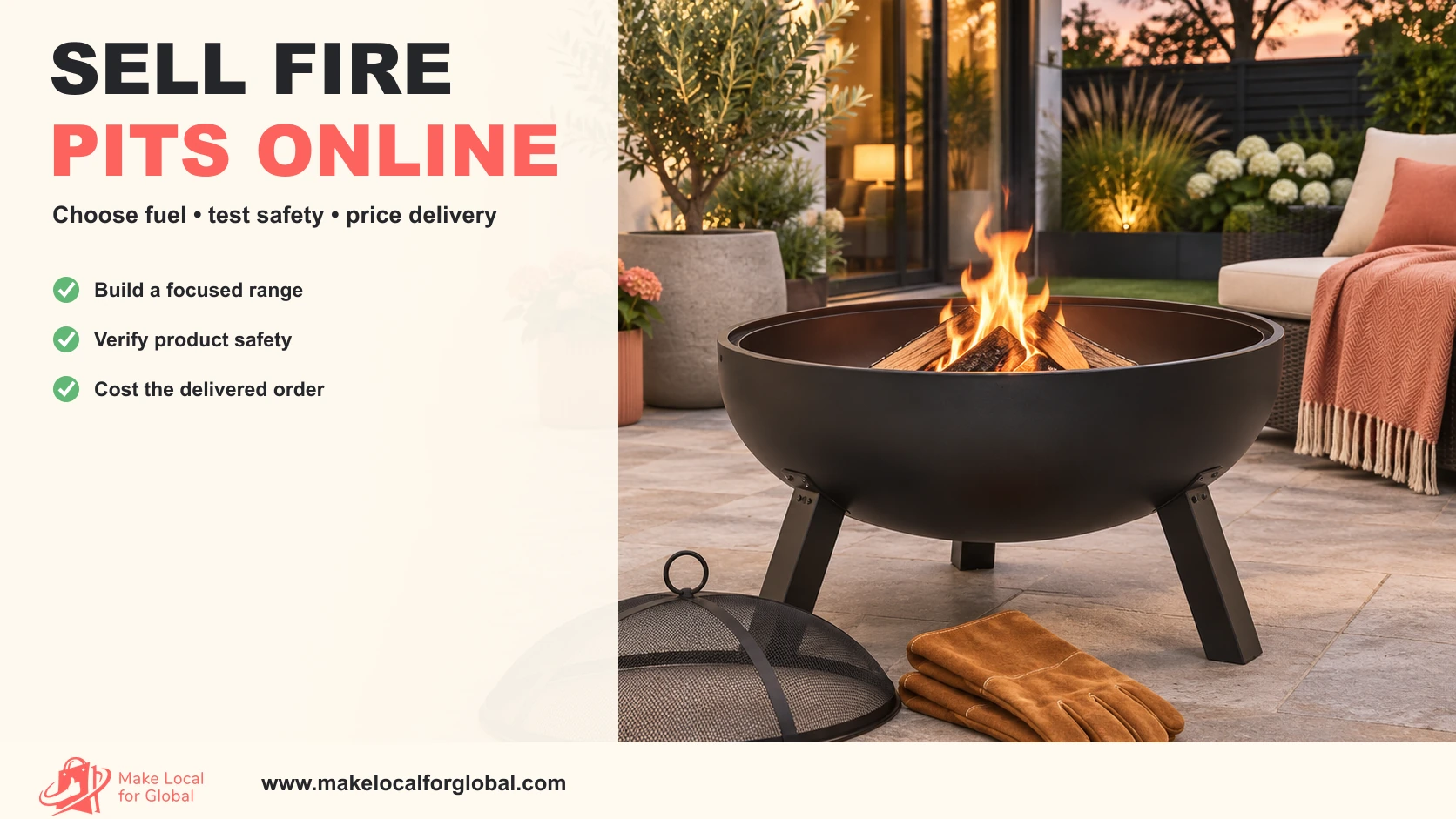
Fire pits can make a garden feel like a place to gather after the barbecue has finished or the evening has cooled. For a new online seller, they also bring practical questions that do not appear on a simple decorative product: fuel, smoke, stability, heat, surface protection, weathering, packaging and bulky delivery. Those details shape the buying decision as much as the photograph of a glowing bowl.
This guide shows how to plan a focused fire pit range, assess suppliers, check the products and the claims you make, calculate a realistic delivered price and create listings that answer a buyer’s questions. It is written for a UK seller starting small. It does not replace the instructions for a particular model or advice from the relevant local authority, fire service or product-safety professional.
The most useful first principle is to choose a customer and use before choosing a catalogue. A compact patio bowl, an outdoor cooking unit and a gas fire table solve different problems. A clear range lets buyers understand which one is for them and lets you test demand without tying up too much cash.
“People who like gardens” is too broad to guide a first range. Write down one buyer, one setting and one reason to buy. For example, a renter with a small paved patio may want a compact, easy-to-store fire bowl. A homeowner who hosts friends may be looking for a larger centrepiece with a spark screen. A keen outdoor cook may value a compatible grill and clear cooking instructions more than a dramatic flame.
Use interviews, search questions, marketplace reviews and your own customer enquiries to understand the job the product must do. Look for recurring concerns, not just compliments. Reviews that mention an unstable base, confusing assembly, a bowl smaller than expected, rust after rain, a missing screen or expensive delivery reveal what your product page and supplier checks must address.
Create a simple buyer sheet with these fields:
Then choose a narrow starting position. A small collection for compact patios is easier to explain than a shop with unrelated bowls, gas tables, chimineas, camping stoves and grills. A clear proposition can still include several models, but each should have a reason to be there.
Use keyword tools and marketplace searches to collect the language people use, such as “fire pit for small garden”, “fire pit with grill”, “portable fire pit” or “fire pit cover”. These phrases are research clues, not proof that a product will sell profitably. Compare them with stock availability, shipping dimensions, return terms, competition and the cost of reaching a buyer.
Read recent reviews of competing products. Sort complaints into product, fulfilment and expectation problems. Product problems include poor welds or a warped bowl. Fulfilment problems include dented boxes or delayed bulky deliveries. Expectation problems include missing accessories or images that make a small model look large. You can differentiate by resolving a repeated concern with a more specific specification, better packaging or clearer photography.
Before ordering stock, test a concept with a small landing page, a short buyer survey, a trade enquiry or a sample order. A positive response to a mock-up is useful, but it is not the same as a paid order. Track enquiries, waitlist sign-ups and actual conversion separately. Keep the test small enough that a negative result is affordable.
Use the Wholesale and Retailer Margin Lab to model landed costs and see how a fire pit’s delivery, fees and returns allowance affect the price.
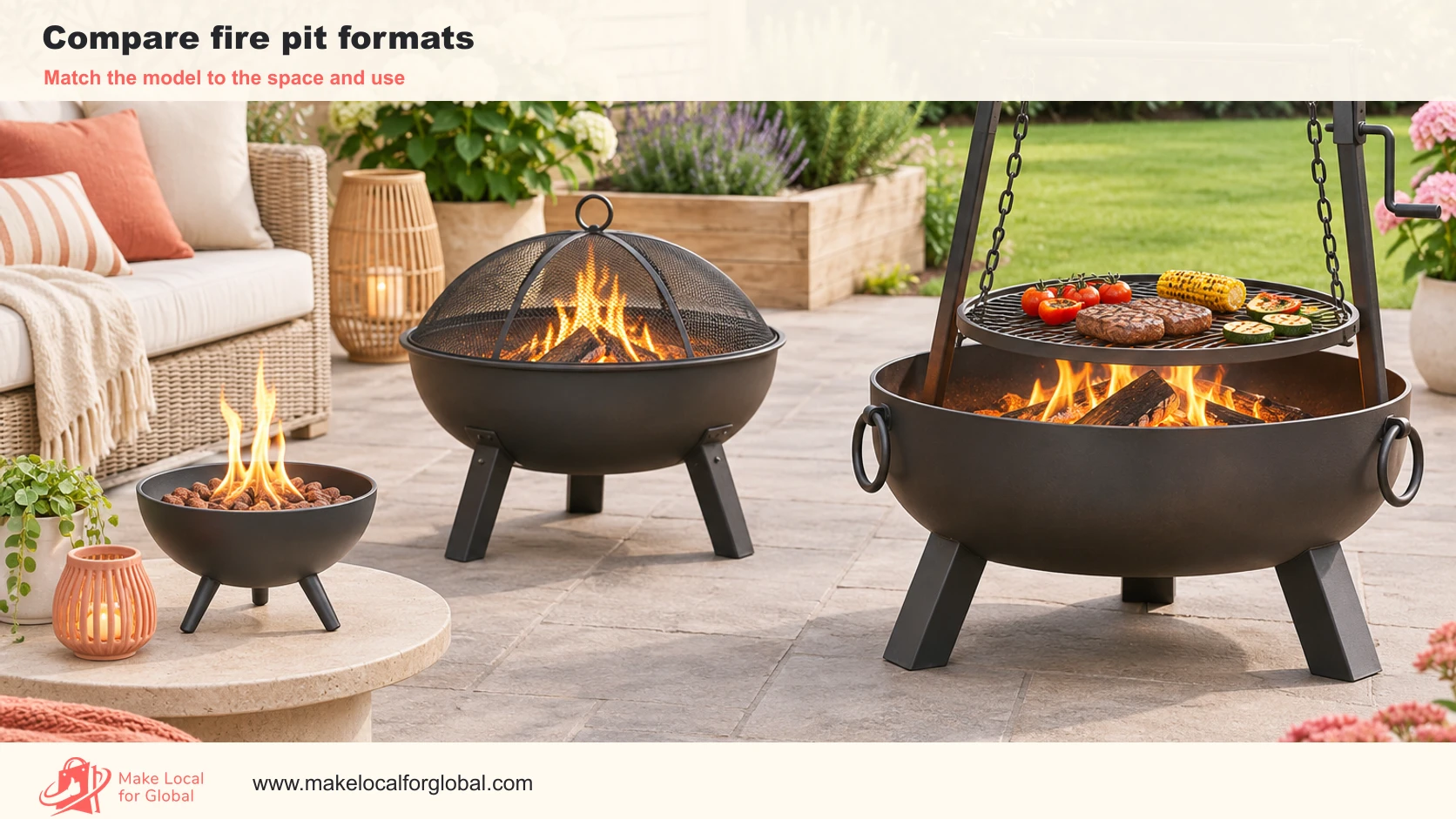
Fire pits are not one uniform category. Fuel, size, portability, cooking design and materials change the way they are used and shipped. Start with a few models that are meaningfully different, not a stack of near-identical bowls with colour variations that make the buying decision harder.
| Product format | Good fit | Questions to answer clearly |
|---|---|---|
| Open wood-burning bowl | Buyers seeking a simple garden gathering point | Fuel size, smoke, ash removal, surface and spark control |
| Bowl with mesh screen | Buyers who want a supplied barrier against rising sparks | Whether the screen is included, fits securely and is for sparks only, not a guarantee against fire risk |
| Cooking fire pit | Buyers who want a grill or cooking attachment | Approved fuel, food-contact surfaces, cooking setup, cleaning and whether the grill is included |
| Chiminea | Buyers interested in a more enclosed form and directed outlet | Assembly, stability, loading, clearances, maintenance and maker instructions |
| Gas fire table or burner | Buyers who prefer controllable flame and a different setup | Appliance documentation, gas type, regulator, cylinder storage, installation and service requirements |
| Portable fire pit | Buyers with a product specifically designed for transport | Packed dimensions, weight, assembly, surface protection and where it may be used |
Do not make an absolute claim that one format is safest, smokeless or suitable for every garden. Actual performance depends on the design, fuel, wind, maintenance and use. “Smokeless” is often used as a product label, yet it should not imply that the device creates no smoke or can be used without regard for neighbours. Explain the manufacturer’s tested claim and its conditions, if there is reliable evidence for it.
A three-tier range can help buyers compare, provided each tier solves a different need. A compact entry option might prioritise a smaller footprint and straightforward assembly. A core model may include a fitted spark screen and stable legs. A premium cooking model might provide a compatible grill, cover and replacement parts. Do not call a model premium only because it costs more. State the material, dimensions, finish, weight, included parts and practical reason for the higher price.
Offer accessories only when the compatibility is verified. A cover must fit the exact model and should be used only when the product has cooled as directed. A heat shield or mat must have manufacturer instructions that match the fire pit and intended surface. A cooking grate needs a suitable food-contact specification. List each bundle component and its standalone value so customers can compare rather than guessing what “complete set” means.
Keep spare parts in mind early. A replaceable grate, screen, leg, fastener or cover can support the product for longer and reduce the need to replace an entire unit. Ask the supplier how long parts will be available, how they are identified and whether the seller can order them individually. Do not advertise support that the supplier cannot deliver.
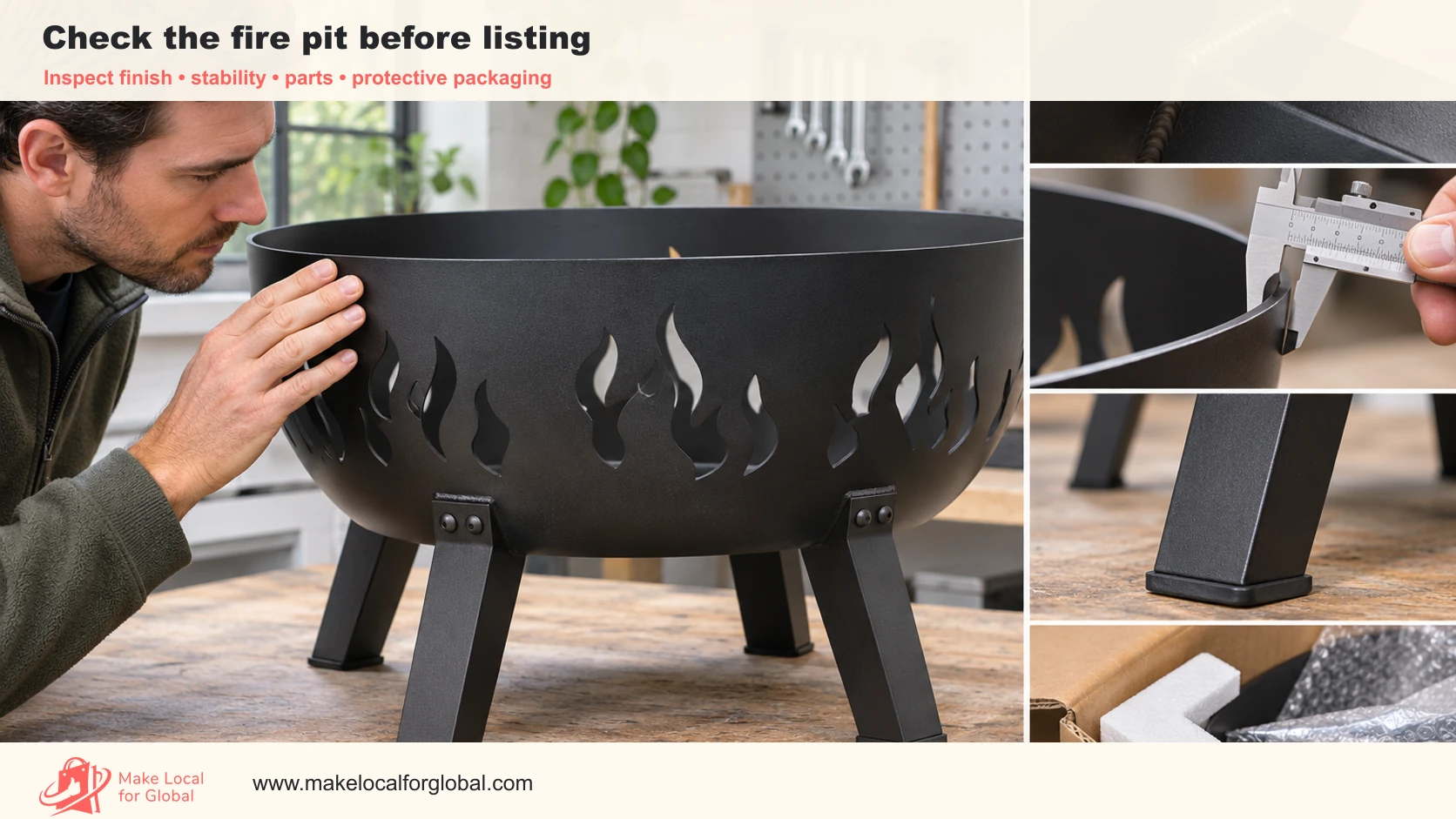
The catalogue description is not a quality inspection. Request a complete specification for each exact model and variant. Confirm the product name, materials, dimensions, assembled and packed weight, finish, fuel type, parts list, assembly steps, warnings, care guidance and any performance claims. For a gas model, request the product’s applicable gas-appliance documentation and ask who is responsible for conformity assessment and market surveillance obligations.
Check that the supplier’s sample matches the production unit. Photograph the carton and all components as they arrive. Assemble it using only the supplied instructions, recording the time, tools required, unclear steps and any parts that do not fit. Check the stability on a level surface and inspect the base, feet, joints, edges, welds, coating and fasteners. Assess whether a screen sits correctly and whether handles become hot during the intended use, following the manufacturer’s procedure and suitable safety precautions.
Do not improvise a burn test if you lack the facilities and competence to do it safely. If a test is necessary to support a claim, use a qualified independent test laboratory or a competent professional and keep the test method and report. A single home demonstration does not substantiate broad claims about emissions, heat output, durability or safe clearances.
Use a sample scorecard rather than relying on memory:
Set acceptance criteria before the sample arrives. If a defect appears, report it with photographs and ask for written corrective action. Do not accept a vague assurance that a production run will be better. Request the revised sample or objective evidence that the issue has been corrected.
In Great Britain, businesses that manufacture, import, distribute or sell consumer products have responsibilities for safe products and traceability. The Office for Product Safety and Standards advises businesses to identify applicable requirements, retain supplier and product records, provide necessary instructions and warnings, monitor safety information and act if a product is unsafe. Read the current product safety advice for businesses and establish which obligations apply to your role and product.
Gas fire pits need particular care because they may be gas appliances within the scope of gas-appliance rules. Requirements depend on product and market; do not assume the same marking, documents or rules apply to every solid-fuel bowl, every gas model or Northern Ireland. The UK Government’s Great Britain gas-appliance enforcement guidance explains the regime for appliances in scope. Have a competent product-safety specialist confirm the classification and documents for the precise unit before listing it.
Keep a product file with supplier identity, invoices, model identifiers, specifications, test reports, risk assessment, artwork and instruction revisions, batch records, customer complaints and corrective actions. If you import directly or place your own brand on a product, your responsibilities may differ from those of a retailer reselling a UK-sourced unit. Confirm the position before committing to a large order. Never use a CE or UKCA logo as decoration or treat a mark alone as proof that a product is safe or suitable.
A seller should help buyers use a fire pit responsibly without making legal promises that do not hold everywhere. Rules, local restrictions and nuisance conditions vary. In England, the general garden bonfire rules explain that smoke must not cause a nuisance and that smoke should not drift across a road so as to endanger traffic. Local authorities may investigate smoke nuisance. Buyers should check local authority guidance and any tenancy, lease, site or park rules that apply to them.
Smoke-control rules are often misunderstood. The Government’s smoke-control-area guidance distinguishes outdoor burning from the rules for smoke emitted from a chimney in a smoke control area. The England enforcement guidance also explains the distinction and local nuisance powers. Do not tell a customer that every outdoor fire pit is banned in a smoke control area, or that being outdoors means nuisance rules do not apply. Link to the relevant official guidance and direct the customer to their council for local advice.
The Scottish Fire and Rescue Service advises people using outdoor heating to place fire pits on a stable, non-combustible surface, keep them away from combustible items, supervise them, keep children and pets at a safe distance and follow the maker’s instructions. Its outdoor heating safety advice also warns against adding liquid fuel to a lit fire. Use the manufacturer’s specified distances and instructions for the exact model; do not copy a generic distance onto a different product as if it were a universal rule.
Your product page can provide calm, useful information: intended outdoor use, approved fuel, required clearances from the manual, surface guidance, supervision, extinguishing and cooling instructions, storage and the contact point for product questions. Avoid advising use under a pergola, awning, enclosed balcony or in any other setting unless the manufacturer explicitly allows it and the arrangement has been assessed. Never advise moving a lit or hot fire pit, refuelling it with liquid accelerants, or leaving it unattended.
Bulky metal products can appear profitable until a courier surcharge, damaged carton, card fee or return is included. Build a per-order model from real quotes and your own records. Here is an illustrative example, not a claim about typical market prices:
| Cost line | Example |
|---|---|
| Customer price, excluding VAT for this example | £189.00 |
| Product landed cost | £72.00 |
| Protective packaging | £8.50 |
| Outbound bulky delivery | £19.00 |
| Payment fee at an assumed 2.0% + £0.20 | £3.98 |
| Expected damage and return reserve | £9.00 |
| Advertising cost allocated to the order | £22.00 |
| Contribution before fixed overhead and tax | £54.52 |
The arithmetic is £189.00 minus £72.00, £8.50, £19.00, £3.98, £9.00 and £22.00 = £54.52. The percentage fee here is illustrative and must be replaced by your actual provider’s rate. If the consumer-facing price includes VAT, calculate the net sales value and VAT treatment correctly for your business. This example excludes staff time, software, insurance, storage, professional advice and income or corporation tax, so it is not net profit.
For each SKU, calculate:
Contribution per order = net sales revenue − landed product cost − packaging − delivery subsidy − payment and marketplace fees − expected returns/damage − variable marketing cost.
Then estimate the break-even volume for fixed monthly costs: fixed costs divided by contribution per order. Use a realistic contribution after variable costs, not gross margin on the product alone. Run a low, expected and high case. Test a heavier parcel, a longer delivery zone, a 10% promotion and one damaged unit. If only the optimistic case works, the range is not ready.
Ask suppliers for price breaks, minimum order quantity, sample cost, lead time, payment terms, carton dimensions, pallet requirements and shipping terms. Clarify whether the quote includes freight, duty and other landed costs. Ask for the cost and availability of replacement components. Compare total landed cost rather than the unit quote.
For a first order, buying a small number of samples across two or three formats can be more useful than a large order of one apparently cheap model. A small order gives you evidence about packing, customer interest and carrier handling. It may have a higher per-unit cost, so include that in the trial decision. Avoid tying up cash in a whole season’s stock before you have tested delivery, quality and content.
Bundles can make a purchase easier when the components solve a real need. A “Patio setup” might combine one exact fire pit, a compatible screen and a fitted cover. A cooking set might add a verified grate and utensils. A bundle should not imply that a heat mat makes an otherwise unsuitable surface safe. Explain which component is compatible, whether it is included, and any limitations.
Calculate each bundle from its actual combined costs, extra packaging and shipping weight. A slightly larger order may move the parcel into a higher carrier band. That can erase the margin gained by adding an accessory. Show the saving only when the standalone prices are real and current. Do not invent a crossed-out price.
When buyers compare fuel, dimensions, bundles and delivery, a well-structured shop helps them choose with confidence.
Before you publish a delivery promise, obtain the exact packed measurements and weight from the supplier. A fire pit can be light enough to lift but still exceed a carrier’s length or girth limit. Get written quotes for the relevant zones and service levels. Confirm whether the quote includes residential delivery, tracking, timed delivery, doorstep limitations, remote postcodes, failed delivery and collection of returns.
Packaging should stop the bowl, screen and legs moving inside the carton. Protect the rim and coating, isolate accessory parts, prevent metal-on-metal abrasion and ensure the assembly instructions are included. Ask the supplier for packaging test evidence if available. Send a sample using the intended carrier and inspect it on arrival. Photograph the packed carton and use the same images to train anyone who fulfils orders.
Write a dispatch checklist: confirm the SKU and accessories, record the batch or model identifier, inspect the outer box, photograph any damage before dispatch, apply the correct carrier label and save the tracking reference. For a high-value unit, consider whether a signature or enhanced cover is appropriate after comparing its price with the expected risk.
UK distance-selling rules include pre-contract information requirements and cancellation rights for many online purchases. Check the current Government guidance for online and distance-selling businesses and get advice if a product or transaction has an exception. Explain delivery charges, dispatch estimates, cancellation and returns in clear language before checkout. Do not present a damaged or faulty product as an ordinary change-of-mind return or imply that statutory rights can be removed by store policy.
Bulky returns deserve a practical plan before the first sale. Decide how a customer contacts you, how you assess damage, who arranges collection, how the unit must be cooled or emptied before return and how you record the outcome. Do not ask someone to package or transport a hot, fuelled or unsafe item. Give safe, model-specific instructions and escalate a safety concern rather than trying to resolve it with a discount.
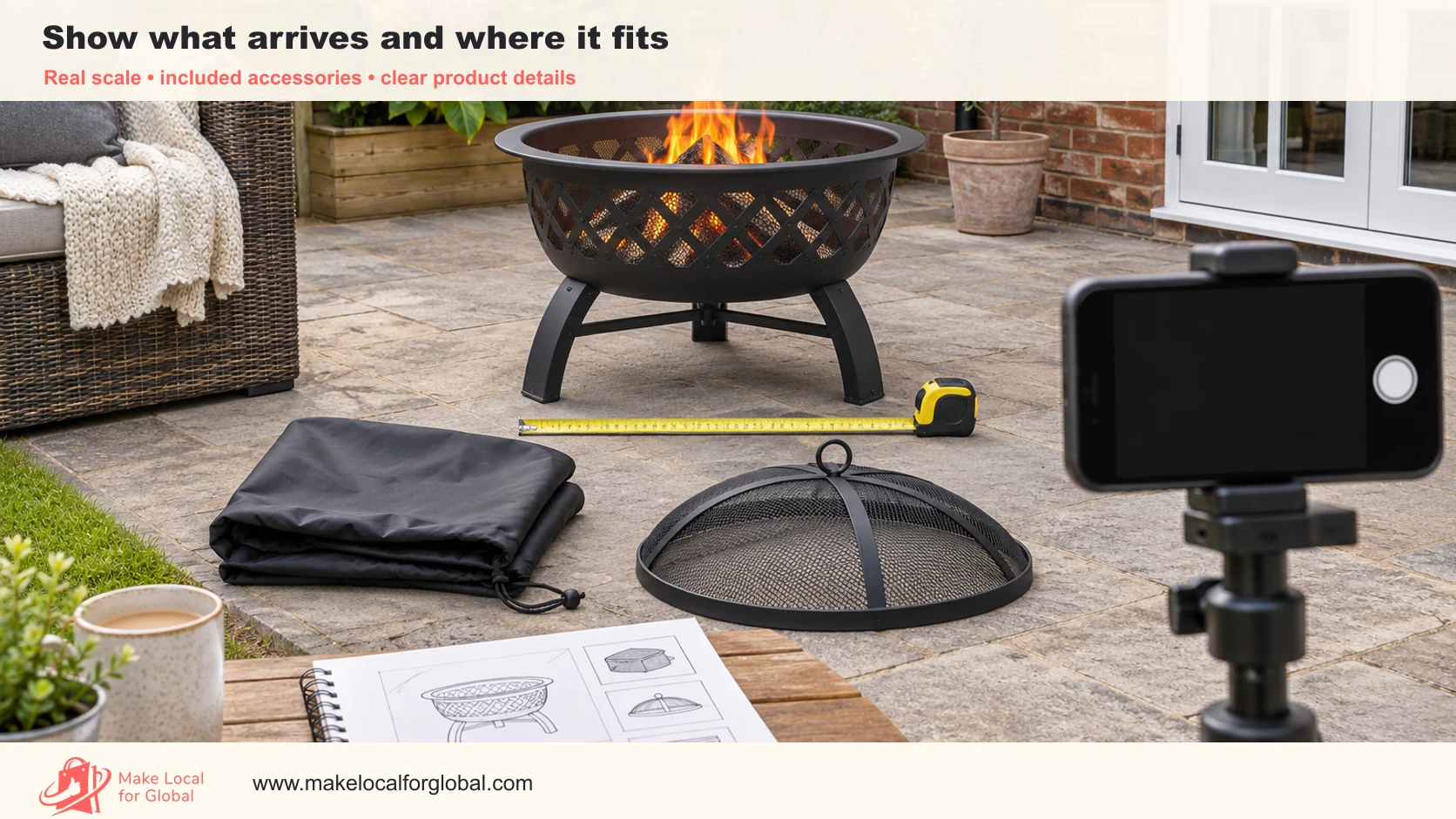
Start with a concise product summary: who the model suits, the verified fuel, its actual dimensions and the strongest differentiating feature. Then give shoppers enough detail to judge whether it fits their space and expectations. Avoid a long paragraph of adjectives in place of specifications.
Include these fields for every model:
Use a comparison table that compares only like with like. For example, show bowl diameter, height, fuel, weight, screen included, grill compatible, cover available and packed dimensions. Do not use a vague “small/medium/large” label without giving measurements. If a heat-output figure is supplied, state the exact source and unit; do not compare a wood-burning bowl’s flame or surface temperature with a gas appliance’s rating as if they measured the same thing.
Add a short FAQ for likely purchase barriers: What fuel is permitted? Is the screen included? Can I cook on it? How should I protect the patio? How does it arrive? What should I do if it is damaged? Answer from the product manual and your actual policy, not from general assumptions.
The lead photo should show the exact model and not promise accessories that are absent from the order. Add a scale view in a recognisable patio setting, a daylight view of the shape and finish, close-ups of the rim, base and joints, a photograph of the supplied screen or grill and an image of the packaging if damage prevention is a selling point. Keep the flame realistic and avoid compositing a fire so large that it misrepresents the product.
Use a consistent camera height and lens perspective when comparing models. Include a ruler or known object only when it does not obscure the product. Photograph both the assembled unit and the parts in the box. Label each file descriptively, compress it appropriately, and write useful alt text for what the image shows. Alt text should describe the particular photo rather than repeat the same keyword phrase on every image.
If customers cannot tell what arrives, add an “included in the box” panel with each component named. This can prevent a buyer from assuming the firewood, gas cylinder, cover, tools or grill is part of the purchase. Make the product’s dimensions visible on mobile without requiring the user to zoom into a tiny diagram.
Your own ecommerce site gives you more room to explain safety, compatibility and delivery. A marketplace can help with discovery but may impose strict listing fields, product-safety requirements, fees and customer-service targets. Review each channel’s current rules before listing a fire-related product. Do not assume a marketplace will accept every fuel type or accessory.
Plan content around customer questions and weather patterns without claiming a precise seasonal sales curve unless your own data supports it. Useful content includes a small patio sizing guide, a comparison of open bowls and chimineas, a guide to reading product dimensions, a care checklist and an explanation of what is included with each bundle. Link those pages to the relevant products with clear anchor text.
Seasonal planning should begin well ahead of the selling period. Confirm supplier stock, freight and returns lead times before you promise a launch date. Keep a smaller year-round message around garden entertaining, then prepare the main range and delivery plan ahead of spring. For late-season orders, make the dispatch cutoff and any weather or carrier limitations explicit.
Use paid promotion only after the product page, stock and fulfilment are ready. Begin with a capped test budget you can afford to lose. Track visits, add-to-cart rate, conversion, average order value, refunds, delivery damage and contribution after advertising. A high click-through rate means the creative attracted attention; it does not establish profitable demand.
Organise the collection by the decision buyers actually make: garden size, fuel, cooking use or portability. Filters should reflect data you have verified. Do not create a “smokeless” filter if you cannot substantiate which products qualify and what the term means. Make incompatible accessories difficult to select by naming the model in each option and checking the combination before fulfilment.
Show delivery and returns early enough to influence the decision. For oversized parcels, a small delivery note near the price can prevent a surprise at checkout. Provide customer support routes for assembly, missing parts and safety questions. If you cannot provide technical advice, say so and direct the customer to the maker’s manual or competent support channel.
Your checkout should preserve the product’s exact model and bundle selection on the order confirmation. Add the product identifier and key safety documents to fulfilment records. After delivery, ask the buyer whether the carton arrived intact and whether the instructions were clear. Use replies to find packaging or communication gaps, but do not ask customers to perform unsafe tests for a review.
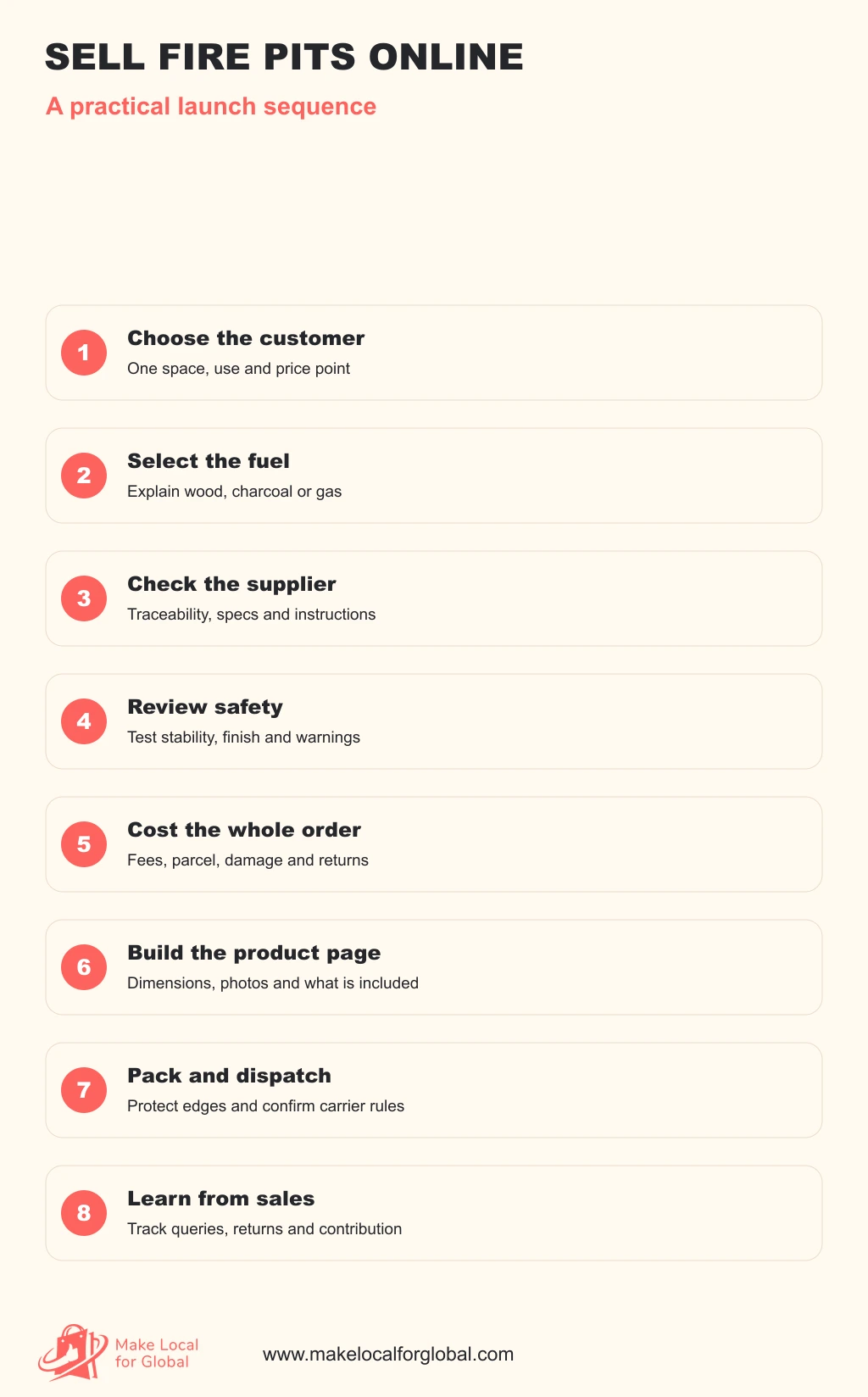
Interview several likely buyers and review competing listings. Record the most common use cases, dimensions, price points, delivery expectations and complaints. Select one lead customer and a small range with real differences. Ask suppliers for full specifications, documentation, terms, samples, packed sizes and spare-part availability. Decide which models require specialist review before you go further.
Receive samples, document the unboxing and assemble them strictly according to the instructions. Complete the scorecard and raise any quality issues with the supplier. Obtain carrier quotes using the real packed dimensions and weight. Build an order-level cost model for each SKU and bundle, including fees, returns, damage and promotion. Reject or renegotiate a model whose expected case does not leave a contribution that supports your fixed costs.
Commission qualified testing or advice where needed. Finalise the product file, safety and care information, compatibility notes and supplier records. Photograph the exact samples in daylight, in a realistic patio setting and with all supplied parts. Build the comparison table, delivery information, returns policy and FAQs. Ask a person unfamiliar with the products to explain which model they would buy and why after reading the page.
Start with a small quantity or a clearly stated preorder only when you can honour the delivery promise. Check the first orders for packaging, carrier handling, support questions and contribution. Keep a record of every defect and return reason. Test a small content or advertising campaign against a clear limit and a specific audience. Review performance weekly and change one thing at a time: product, page, bundle, delivery option or message.
At the end of the month, decide whether the evidence supports expanding, revising or stopping. Useful signals include qualified enquiries, conversion, contribution after variable costs, delivery damage, return reasons, support time and repeat or accessory orders. Do not use gross revenue alone as the measure of success.
It can be, if you start with a narrow range and take product safety, bulky fulfilment and customer guidance seriously. Order samples, verify the documents for each model, calculate delivery and return costs, and test a small launch before buying deeply. A simple steel bowl may be less complex than a gas appliance, but it still involves heat, fuel and safe-use information.
Choose the model that best fits a buyer you have actually researched and for which you can verify quality, documentation, packaging and delivery. A compact wood-burning bowl may suit a small-patio concept, while a cooking model or gas table serves a different need. Use buyer evidence and a cost model rather than a broad claim that one type is always the bestseller.
Only if the specific product’s claim is supported by reliable evidence and explained with its test conditions and limitations. Do not imply that a fire pit produces no smoke or that the word removes the need to follow maker instructions and local nuisance rules. Explain the approved fuel and factors that affect performance.
Do not give a blanket yes or no. Government guidance distinguishes outdoor burning from smoke emitted by a chimney in a smoke-control area, while nuisance and other local rules still matter. Link the customer to current official guidance and ask them to check with their local authority and any site or tenancy restrictions.
No single answer applies to every product type and market. A gas fire pit may fall within gas-appliance requirements, while a simple solid-fuel product has a different classification. Confirm the applicable rules, conformity documents and labelling for the exact model and sales territory with a competent specialist. A mark on its own is not proof that the item is safe.
Give the exact dimensions, weight, fuel, material, finish, included components, assembly requirements, care, maker’s instructions, safety limitations, delivery details and returns process. Use a true scale image and state whether the screen, grill, cover or fuel is included. Make claims only when you can substantiate them.
Use the supplier’s packed dimensions and weight to obtain carrier quotes before setting a price. Include packaging, surcharges, remote delivery, payment fees, expected damage, returns and marketing in the model. Recalculate bundles because one accessory can move an order into a higher parcel band. Review actual invoices after the first shipments.
Potential options include a model-specific cover, fitted spark screen, compatible grill and replacement components. Add them only after verifying fit, use and care instructions. A heat shield or mat must be approved for the product and intended surface. Avoid suggesting that an accessory overrides the fire pit’s manual.
Show accurate dimensions, weight, product scale, included parts and the real finish. Explain smoke, fuel, cleaning, weather care and delivery limitations before checkout. Protect the rim and legs in packaging, inspect the first parcels and keep a clear process for faults and damage. Record reasons for every return and fix repeated expectation gaps.
Order only after comparing sample quality, supplier lead times, minimum quantities, storage costs and the cash available for delivery and returns. Use a small test order when possible and set a reorder trigger based on reliable lead time and actual sales. Avoid treating an early burst of interest as proof that a large seasonal order will sell through.
Make Local for Global can help you plan an ecommerce website for a focused product range and a practical customer journey.
The strongest fire pit shop makes the practical decision feel straightforward. It helps a customer see where the product fits, what fuel it uses, what arrives, how it must be used and what delivery will cost. It also gives you the information needed to fulfil an order safely and profitably.
Start with one buyer and a few models that solve distinct problems. Verify samples and product documents, ask for specialist help where the product category requires it, and do not overstate smoke, heat, safety or durability claims. Price from landed costs through to the customer’s door, then test the packaging and service with real orders.
If you are planning the wider product range, compare your launch assumptions with the wholesale and retailer margin tool. For a complementary outdoor category, see our practical guide to selling BBQ tools online. When you are ready to build a store that presents the range clearly, explore ecommerce website design for small businesses or contact Make Local for Global to discuss the setup.
PREFERRED SOURCE
Like what you’re reading? Add Make Local for Global as a preferred source on Google to see more of our articles when you search.

Build your online presence without having to figure out everything yourself.