Sell adventure books online: a UK guide to starting a niche book shop
A practical guide to selling adventure books online, from choosing your angle and finding stock to building bundles, reducing returns, and launching a professional ecommerce site.
Make Local for Global
Table of content
Selling adventure books is a lovely business idea with a sneaky edge.
People don’t just buy a book – they buy a feeling.
Escape, courage, danger, discovery, and that slightly smug “I read something good” satisfaction.
But if you try to sell “adventure books” as one giant genre bucket, you’ll end up competing with huge retailers on price and convenience.
That’s not the game you want.
The small-seller advantage is curation.
You can Sell adventure books by becoming the shop that understands a specific reader – the person who wants Arctic survival stories, jungle expeditions, nautical classics, or kid-friendly quests that aren’t painfully dull.
When you do that, customers don’t just buy once. They come back for your taste.
This guide walks you through how to sell adventure books online in the UK: choosing a niche, sourcing stock (new, used, or mixed), pricing, shipping, product pages, marketing with SEO and email, and building a shop that looks professional without you getting stuck in tech.
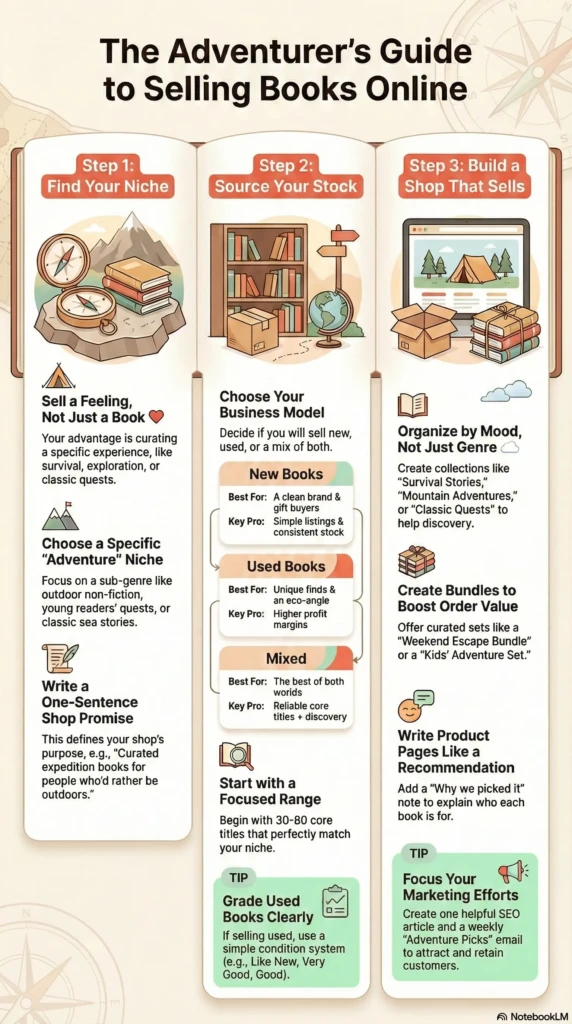
Pick your niche: “adventure” is a whole universe
Adventure is one of those genres where readers have strong preferences.
Someone who loves mountaineering disaster memoirs might not care about fantasy quests.
Someone who wants kids’ pirate stories might not want gritty war survival non-fiction.
So your first move is to choose a clear slice of adventure that you can own.
Niche angles that work well for a small online book shop
Outdoor and expedition non-fiction: climbing, polar journeys, sailing, survival memoirs.
Classic adventure fiction: Jules Verne, Stevenson, Conan Doyle style classics, plus modern editions.
Modern page-turners: contemporary adventure thrillers and “can’t put it down” series.
Travel and exploration: road trips, remote places, cultural journeys with an adventurous edge.
Young readers’ adventure: middle-grade quests, explorers, mysteries, survival stories for kids.
Adventure graphic novels: accessible, giftable, and easy to bundle.
Local and UK adventure: UK coastal walks, canoe routes, cycling journeys, British exploration stories.
Adventure gifts: beautiful hardbacks, boxed sets, illustrated editions, “for the person who wants to travel” bundles.
Write a one-sentence shop promise
This is what makes your shop feel like a destination, not a random catalogue.
“Curated expedition and survival books for people who’d rather be outdoors.”
“Adventure classics and modern quests, chosen for readers who love a proper story.”
“Adventure books for kids who want action, not homework.”
Tip: Pick a niche you can talk about all day. Your marketing will be easier because you’ll naturally know what to recommend.
Decide what kind of shop you’re building: new, used, or mixed
There are a few solid business models for selling books online.
The right one depends on your time, budget, and how much you want to handle stock.
Model 1: New books (retail)
You sell new copies sourced through publishers, distributors, or wholesalers.
Pros:
simple condition expectations
clean product listings
easy bundling with consistent editions
Cons:
tighter margins, especially against big retailers
you need a strong niche and presentation to compete
Model 2: Used and second-hand (curated)
You source pre-owned books and sell them with clear condition notes.
series starters (because series readers buy multiple books)
If you’re selling used books
The best used book shops are not the biggest.
They are the most consistent.
Good sourcing routes include:
local book clear-outs and estate sales
charity shop relationships
bulk lots where you can cherry-pick for your niche
trade-ins from customers (with clear rules)
Create a condition system and stick to it
Used books only work if customers know what they’re getting.
Create 4 simple grades and use them everywhere:
Like new: looks unread or almost unread
Very good: minor wear, clean pages
Good: normal shelf wear, may have light markings
Fair: heavy wear but readable, clearly described
Then always mention key issues: torn dust jacket, inscriptions, highlighting, or smell.
People will accept flaws. They won’t accept surprises.
Tip: If you sell used books, take at least one real photo per item (cover). It reduces disputes and makes your shop feel more trustworthy than generic listings.
Build a range that sells: collections beat categories
Most book shops organise by genre and call it a day.
You can do better.
Adventure readers shop by mood, setting, and stakes.
Collections that make adventure shopping easy
Survival stories: shipwrecks, wilderness, “how did they live?”
Mountains and extreme sports: climbing, skiing, endurance.
Sea adventures: sailing, pirates, naval journeys.
Jungle and desert: expeditions, lost worlds, exploration.
Classic quests: timeless fiction and modern retellings.
Fast-paced thrillers: modern adventure page-turners.
Adventure for young readers: age-banded collections.
Gift sets: bundles and beautiful editions.
Bundle ideas that boost order value
Books bundle beautifully.
Readers love feeling like they’ve “sorted their next few weeks”.
Weekend escape bundle: 2 fast-paced books in a similar mood
Starter set: “If you like adventure, begin here” selection
Bundles also reduce your shipping cost per book because you’re sending one parcel for multiple items.
Pricing: how to make money selling books (yes, it’s possible)
Books can be profitable.
But they are not profitable if you price like a bargain bin.
You need your prices to cover shipping, packaging, and time – and still leave room for growth.
Know what you’re actually charging for
Customers are paying for:
your curation
the convenience of choosing from a focused shop
your packaging and reliable shipping
your trustworthiness (especially with used books)
Price with your costs included
Include:
stock cost (purchase or wholesale)
packaging (mailers, tape, labels, inserts)
postage (and any tracked upgrade options)
payment fees
your time (packing, listing, customer messages)
Use simple pricing tiers
Entry: paperbacks and used bargains
Core: new releases, best sellers, curated picks
Premium: hardbacks, illustrated editions, signed or rare items
Offer free delivery carefully
Free delivery can work, but only with a sensible threshold that encourages bundles.
For example, free delivery when customers buy 2 or 3 books, not for a single paperback.
Tip: Books are a bundle business. If your average order is one book, you’ll work hard for little reward. Use sets and “complete your next reads” prompts.
Product pages that convert: sell the story, but also the details
People buy books on emotion, then justify with details.
Your product pages should do both.
What to include on every product page
Who it’s for: “If you love survival stories” beats “Great read”.
What kind of adventure: sea, mountain, jungle, modern thriller, classic quest.
It can be, especially as a niche shop with strong curation. The way to win is not with endless listings, but with collections, bundles, and recommendations that feel personal.
Should I sell new or used adventure books?
New books are simpler to manage, but margins can be tighter. Used books can have better margins and unique finds, but require more work per listing. A mixed model often works well for a niche shop.
How do I make my book shop stand out from big retailers?
By doing what big retailers don’t: curation and guidance. Use collections by mood and setting, add “why we picked it” notes, and create bundles that feel like a recommendation, not a discount.
How many titles should I launch with?
It depends on your model, but 30 to 80 focused titles is a strong start for new books. For used books, start with enough stock to feel real, but keep it organised so you don’t lose track.
Do I need my own website to sell adventure books?
A website helps you build a niche destination and collect email subscribers who come back for your picks. If you don’t want to build it yourself, you can book a free consultation or Get your website for £99/year with Make Local for Global.
A practical launch checklist
Pick a specific adventure niche and write your one-sentence promise.
Choose your model: new, used, or mixed.
Build collections by mood and setting, not just “adventure”.
Create 3 to 6 bundles to increase order value.
Set up clear condition grading if you sell used books.
Price with packaging and shipping costs included.
Write product pages with “who it’s for” and “why we picked it” notes.
Create one SEO guide page and a weekly themed email.
Launch, learn what sells, and expand your range based on real demand.
If you want to Sell adventure books successfully, don’t compete on being the cheapest.
Compete on being the shop with taste.
That’s how you build a loyal readership and a business that lasts.
PREFERRED SOURCE
Keep finding us on Google
Like what you’re reading? Add Make Local for Global as a preferred source on Google to see more of our articles when you search.
To provide the best experiences, we use technologies like cookies to store and/or access device information. Consenting to these technologies will allow us to process data such as browsing behaviour or unique IDs on this site. Not consenting or withdrawing consent, may adversely affect certain features and functions.
Functional
Always active
The technical storage or access is strictly necessary for the legitimate purpose of enabling the use of a specific service explicitly requested by the subscriber or user, or for the sole purpose of carrying out the transmission of a communication over an electronic communications network.
Preferences
The technical storage or access is necessary for the legitimate purpose of storing preferences that are not requested by the subscriber or user.
Statistics
The technical storage or access that is used exclusively for statistical purposes.The technical storage or access that is used exclusively for anonymous statistical purposes. Without a subpoena, voluntary compliance on the part of your Internet Service Provider, or additional records from a third party, information stored or retrieved for this purpose alone cannot usually be used to identify you.
Marketing
The technical storage or access is required to create user profiles to send advertising, or to track the user on a website or across several websites for similar marketing purposes.