READY TO SELL Art sculptures ONLINE?
Get a store built for you in 5 days, plus training and support to help you start, run, and grow your Alternative business.

A practical, no-fluff guide to selling art sculptures online, from pricing and photography to shipping and marketing – plus how to set up a done-for-you ecommerce shop that makes selling easy.

If you’ve ever looked at one of your sculptures and thought, “This deserves to live somewhere other than my shelf,” you’re already halfway there.
Selling art sculptures isn’t just for gallery favourites with a London postcode and a list of collectors on speed dial.
It’s for makers with messy hands, limited time, and a stubborn belief that good work should pay its way.
This guide will show you how to sell art sculptures online as a real, workable business – without drowning in tech, marketing jargon, or guesswork.
You don’t need to change your style to “fit the market”.
But you do need to understand what people are willing to pay for, what they can display, and what they can physically receive in a box.
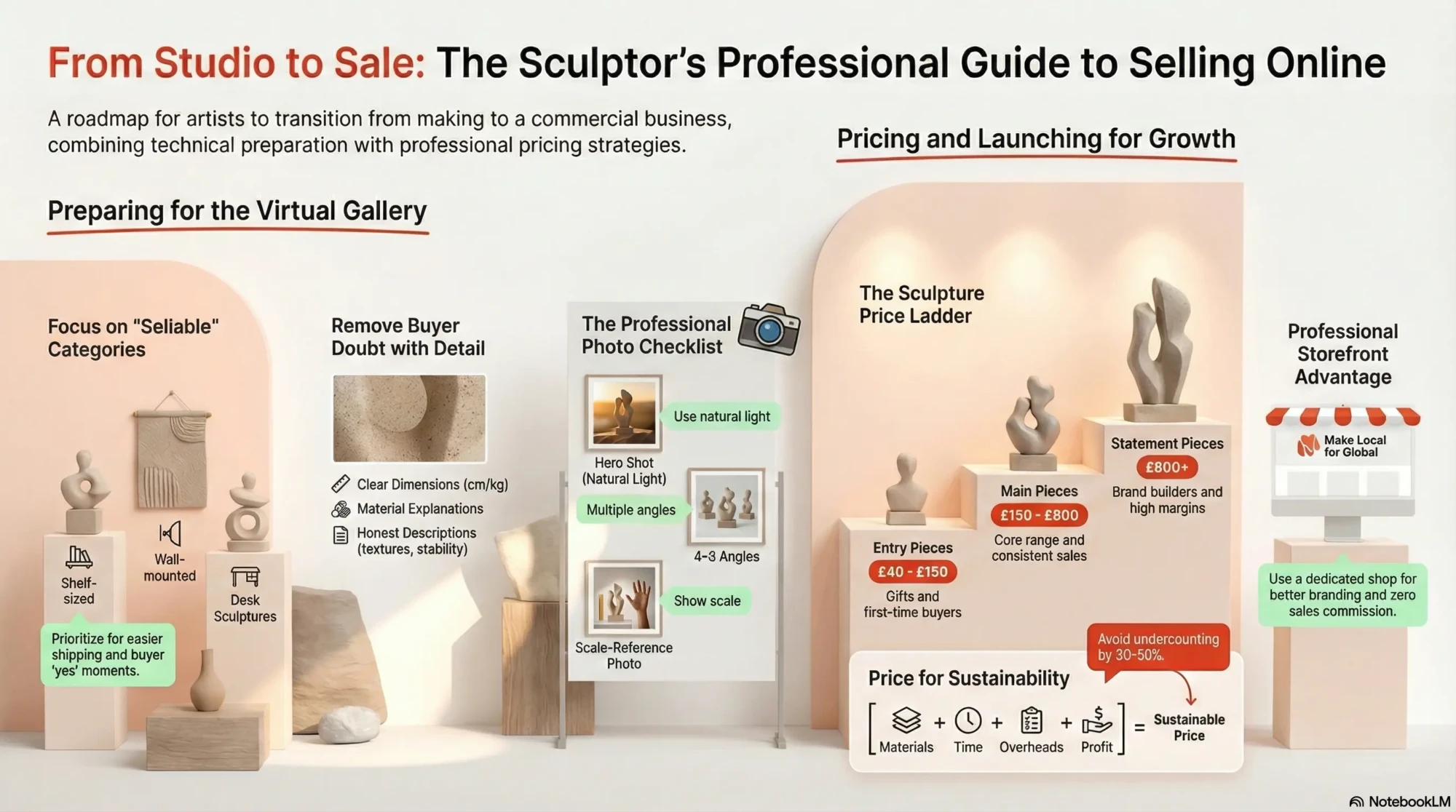
If you’re starting out, these categories tend to move faster because they’re easier for buyers to say yes to.
Online buyers can’t pick it up.
They can’t feel the weight, check the finish, or stand five angles away and squint like they do in a gallery.
So your job is to remove doubt.
Pricing is where most sculpture sellers panic.
They either charge so little it feels insulting, or so much they don’t sell anything and assume “the market is dead”.
Neither is the truth.
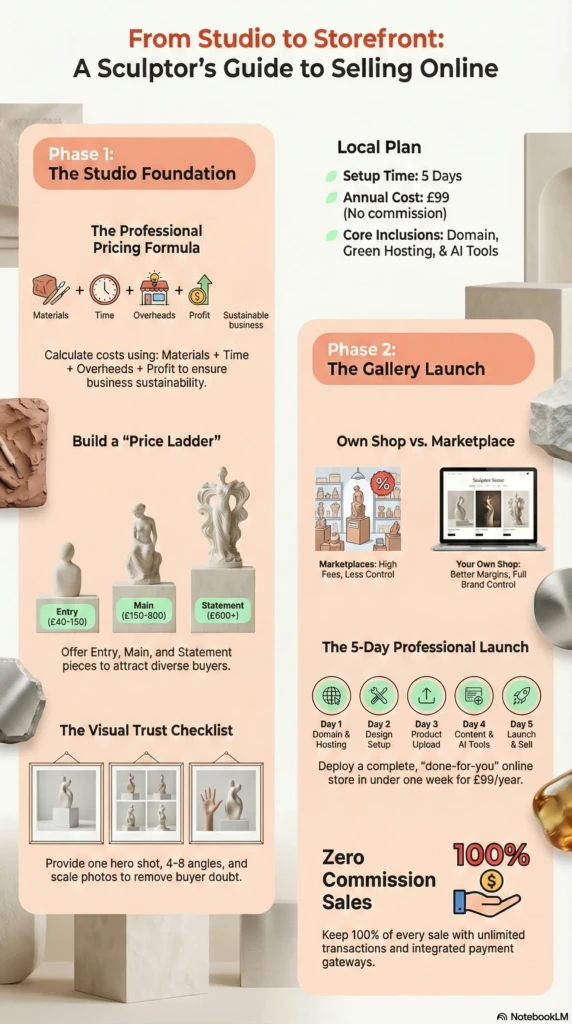
You need a price that covers your costs, pays you fairly, and leaves room for growth.
A practical approach is to set a fair hourly rate and track your time for a month on new pieces.
Most makers undercount by 30 – 50% because they forget drying time management, sanding, photographing, listing, and packing.
If you only sell one price point, you make life harder for yourself.
A smart sculpture shop has a “ladder”:
Even if you’re a high-end maker, an entry piece can be a small wall piece, a miniature, or a study.
It lets people buy into your world without feeling like they need permission.
Yes – if you treat it like a shop, not a post-and-hope routine.
Online lets you sell beyond your local scene, build repeat customers, and test demand without waiting for a gallery slot.
The trade-off is you have to be clear, consistent, and reliable.
That’s not selling out. That’s professionalism.
This is the make-or-break bit.
You can have the best sculpture in the world, but if the photos are confusing, dark, or inconsistent, people won’t buy.
Natural light works.
A bright window and a large sheet or white wall opposite can do wonders.
Avoid direct sunlight, which creates harsh shadows and makes finishes look wrong.
If you use artificial light, aim for two soft light sources from different sides to reduce deep shadows.
You’ve got options, and that’s the problem.
Too many makers spend months bouncing between platforms, changing strategies, and never building momentum.
Pick a starting path based on control, cost, and how much you want to handle yourself.
Marketplaces can bring traffic, but they also bring competition and fees.
Your own shop gives you control and branding, but you need a simple way to set it up and manage it.
| Option | Pros | Cons | Best for |
|---|---|---|---|
| Marketplace listings | Built-in browsing traffic, easy to start | Fees, price pressure, less brand control | Testing demand, quick early sales |
| Social selling (DMs) | Personal, good for commissions | Messy admin, hard to scale, payment friction | Custom work, local collectors |
| Your own ecommerce shop | Control, branding, repeat customers | Needs setup and structure | Building a long-term sculpture business |
| Galleries and pop-ups | Credibility, in-person viewing | Commission cuts, limited slots | Higher-end statement pieces |
A realistic approach for most beginners is:
This is where a done-for-you ecommerce setup makes a huge difference.
Instead of wrestling with themes, plugins, product pages, and payment settings, you get a clean, working shop that’s ready to sell.
If you want that path, you can book a free consultation and talk through what you sell, how many products you have, and what you want the shop to do.
Sculpture buyers aren’t buying “an object”.
They’re buying a feeling, a story, and the certainty it’ll look great in their space.
Your description needs to handle all three.
Use this structure for every piece and you’ll cover what buyers care about without sounding like a catalogue.
Answer these clearly and you’ll get fewer awkward messages and more confident buyers.
Shipping is the thing that scares most sculpture sellers, and honestly, that’s fair.
But it becomes manageable once you standardise your process.
If you sell a lot of one size, design your packaging around that size to save money and time.
There’s no one right answer, but here’s what usually works for sculpture:
The key is clarity.
Surprise shipping costs at checkout kill sales.
Buyers want reassurance, not threats.
Spell out that you package carefully, you insure parcels where appropriate, and you’ll sort issues quickly if something goes wrong.
A calm, clear returns policy is part of being taken seriously.
You don’t need to dance on reels.
You do need a repeatable way to get the right people to see your work.
Pick one and get consistent before adding more.
Posting once and hoping is not a launch.
A simple launch rhythm looks like this:
This is much easier when you have a proper shop link you can share anywhere.
If your current setup is “message me to buy”, it works – but it creates friction, and friction loses sales.
With your own ecommerce site, you can:
And you don’t need to build it alone.
Make Local for Global sets up a done-for-you online shop designed for small sellers who want to focus on making, not fiddling.
If you want a simple, affordable setup, you can Get your website for £99/year and start selling without the usual tech stress.
Commissions can be brilliant, but only if you set boundaries.
If you don’t, they can turn into endless revisions for a price that barely covers your materials.
Commissions should cost more than your ready-made pieces.
They include extra communication, custom planning, and risk.
A common approach is to start at 1.5x your standard pricing for a similar size and complexity.
If that feels high, remember you’re building a piece specifically for one person.
That’s premium.
Selling a few pieces is great.
Building a business means you can keep making without constantly worrying about money.
It’s easy to spend a week “doing marketing” and end up with nothing but a nicer grid.
Track simple things:
You don’t need complex analytics to learn what to make more of.
Collections help buyers understand your style.
They also make your shop look more deliberate, which increases trust.
A collection can be as simple as:
This sounds obvious, but it’s where a lot of artists lose sales.
Your online shop should make it effortless to:
That’s exactly what Make Local for Global is built for – a clean, working ecommerce shop set up for you, so you can focus on creating.
You don’t need a huge audience. You need the right people seeing your work consistently, plus a shop that makes buying easy. Start with one platform, post regularly, and build an email list so you’re not relying on algorithms.
If you want quick exposure, marketplaces can help you test demand. If you want long-term growth, your own shop is the stronger move because you control branding, pricing, and repeat customers. A done-for-you setup is ideal if you don’t want to handle the tech side.
Immobilise the sculpture inside the box, pad protruding areas, and double box fragile or valuable pieces. Standardise packaging for your most common sizes, and factor packaging time into your pricing.
Yes, but start with a few countries first so you don’t overwhelm yourself. Be clear about delivery timelines, customs expectations, and packaging strength. If your pieces are heavy, consider offering smaller works internationally and reserving larger pieces for UK delivery.
Track your materials, time, and overheads for a month and price from real numbers, not vibes. Build a range of price points, and don’t undercharge just to get sales – it usually backfires.
If you’re serious about selling art sculptures, you need a shop that works as hard as you do.
Not a messy link-in-bio workaround, not endless plugin updates, not a half-finished site you avoid opening.
Make Local for Global builds your ecommerce shop for you, so you can focus on making and selling.
You’ve already done the hard part by making the work.
Now let’s get it out into the world – and paid for properly.
PREFERRED SOURCE
Like what you’re reading? Add Make Local for Global as a preferred source on Google to see more of our articles when you search.

Build your online presence without having to figure out everything yourself.