

READY TO SELL baby shoes ONLINE?
Get a store built for you in 5 days, plus training and support to help you start, run, and grow your Alternative business.

Learn how to sell baby shoes online with a focused product range, clear fit information, supplier checks, UK labelling basics, a worked cost example and a 30-day launch plan.


Baby shoes look small, but selling them online asks a big question from parents: will this pair fit, feel right and be worth the price? A clear range, honest fit information and dependable service can make that decision easier. This guide explains how to sell baby shoes online, from choosing your first products to pricing orders and preparing a useful product page.
Make your product range easier to browse with a store built around your brand, products and next steps.
“Baby shoes” covers several needs: soft footwear for photos or gifts, easy-on styles for everyday wear, first-step shoes, occasion pairs and seasonal designs. Trying to stock every style, colour and size at launch can tie up cash before you know what customers want.
Start with one buyer and a small, connected collection. For example, a handmade brand might focus on soft leather pre-walkers and personalised gift packaging. A practical everyday shop could start with washable canvas styles, simple fastenings and neutral colours. Those are different shops, even though they sell the same broad product.

You might make shoes yourself, buy wholesale, work with a manufacturer or use a supplier that dispatches orders for you. Each route changes your control, cash needs and fulfilment responsibilities. Request samples before committing to a large run. Check stitching, fastening strength, sole attachment, lining, size consistency and how the shoes look after ordinary handling.
Ask suppliers for material details, country of manufacture, product specifications, care instructions, available sizes, minimum order quantities and lead times. Keep invoices and product records. If you import or resell, do not assume the supplier’s paperwork removes your own responsibilities to customers and regulators.
Size labels are not consistent enough to stand alone. Show the maker’s size, an insole measurement where available, the fit notes supplied by the manufacturer and a simple guide to measuring a child’s foot. Tell shoppers whether measurements refer to the shoe or the foot, and explain how much room the manufacturer recommends.
Encourage customers to measure both feet and use the larger measurement when consulting your chart. NHS footwear advice for children recommends checking both length and width with a trained fitter. Avoid promising a precise fit from age alone: children grow at different rates, and brands vary.

Add clear photographs from the side, front, back and sole. Show the fastening in use and include a close-up of texture or stitching. A ruler or neutral size reference can help explain scale, but do not use a posed image as a substitute for accurate measurements.
A useful page describes the product, not just its style. Include the materials, colour, fastening, care guidance, available sizes, stock status, dispatch estimate, delivery cost and returns information. If a shoe is handmade or personalised, explain what can vary and how long preparation takes.

Footwear sold in Great Britain has composition-labelling rules. The upper, lining and sock, and outer sole are labelled with the prescribed material information when the relevant material threshold is met. The label should be attached to at least one shoe in the pair. For online listings, explain the symbols in words so shoppers can understand them before buying. Business Companion explains footwear symbols and online listings. Confirm the exact requirements for your product and sales territory.
Products must also be safe in normal and reasonably foreseeable use. GOV.UK general product safety guidance sets out the relevant framework. Keep traceable supplier and batch information where available, respond promptly to safety concerns and check whether extra rules apply to footwear marketed as a toy or costume item. Requirements differ between Great Britain, Northern Ireland and other markets, so check the rules for each place you sell.
GOV.UK distance-selling guidance covers the information online sellers must give before checkout, including who the seller is, product details, total price including taxes, delivery arrangements and cancellation information. Consumers generally have 14 days after delivery to cancel a distance purchase, with exceptions and conditions. Set out the process clearly and check the current rules before writing your policy.
MLFG helps small businesses set up an online store and learn how to manage product pages, orders and payments.
Your selling price has to cover more than the supplier’s unit cost. Add packaging, delivery contributions, payment fees, returns, damaged stock, marketing and a share of fixed costs. The figures below are an example only, not a suggested market price.
| Example cost per order | Amount |
|---|---|
| Baby shoes from supplier | £12.00 |
| Packaging | £1.20 |
| Postage contribution | £3.50 |
| Payment fee allowance | £0.80 |
| Returns and damage allowance | £1.00 |
| Total variable cost | £18.50 |
| Illustrative selling price | £29.00 |
| Contribution before fixed costs and tax | £10.50 |
Illustration only. Replace every figure with your own supplier quotes, postage rates and payment fees. Contribution is not net profit.
At £29, the example leaves £10.50 before fixed costs, tax and your time. If you offer free delivery, the postage still belongs in the calculation. Review the numbers again when supplier prices, packaging or carrier rates change.
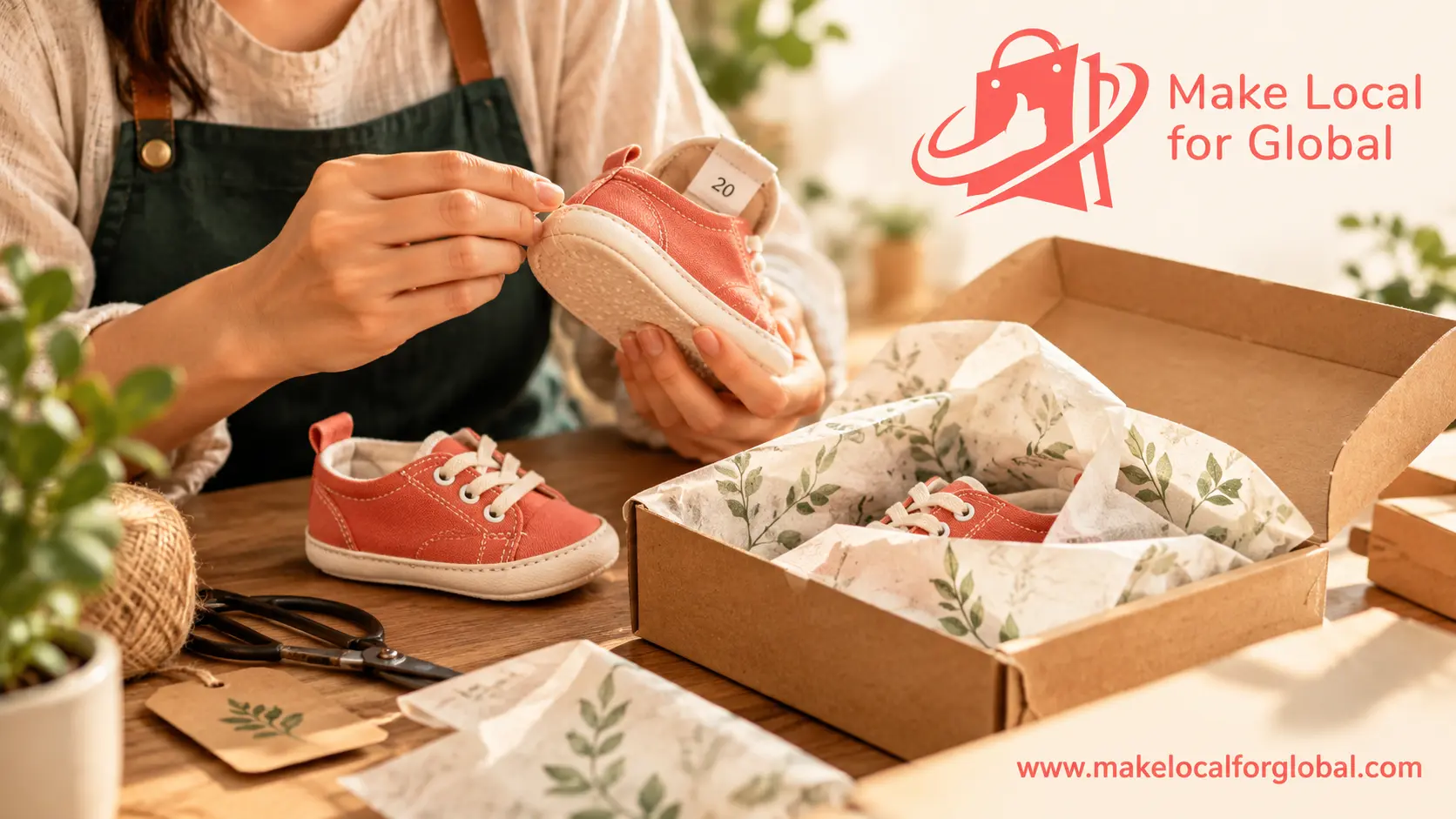
Small footwear orders need careful picking. Store sizes in labelled bins, check both shoes match before packing and include an order slip or care card. Choose packaging that protects the shoes without making the parcel unnecessarily bulky.
Write down what happens if a customer orders the wrong size, receives a damaged item or asks to cancel. Explain return postage, condition requirements, timelines and refund handling in plain language. Your policy must match consumer law, not replace it. Track common fit questions and use them to improve the size guide.
Use specific product names and descriptive page titles, such as “soft leather pre-walker shoes” or “personalised baby shoes for a christening”. Write naturally about the buyer’s questions rather than repeating a keyword. Add internal links between useful shop categories, gift options, size guidance and related articles.
Short videos can show how a fastening works or how a shoe looks from different angles. Gift-focused content can explain packaging and personalisation. Ask customers for honest reviews after delivery, with permission before featuring any child’s image or personal details.
Yes. Test a narrow range, order samples and calculate the full cost of each order before buying substantial stock. A focused launch helps you learn which sizes and styles attract interest.
Show the maker’s size, clear measurements and how to take them, plus the supplier’s fit notes. Explain whether measurements refer to the foot or the shoe, and remind shoppers that sizing can vary by brand.
Footwear composition labelling rules apply in Great Britain, with specific requirements for material categories and labels. Check official guidance for your product and sales territory, and make the material information understandable on the online listing.
You can use social media to introduce products and answer questions, while a dedicated shop gives customers one place to review sizes, prices, delivery and returns before placing an order.
Start with a clear range and a shop that gives customers the details they need to buy with confidence.
For another practical product-selling example, read our guide to selling bottle openers online. The product differs, but the same useful habits apply: explain the product clearly, plan the costs and make checkout straightforward.
PREFERRED SOURCE
Like what you’re reading? Add Make Local for Global as a preferred source on Google to see more of our articles when you search.



Build your online presence without having to figure out everything yourself.