

READY TO SELL Birdhouses ONLINE?
Get a store built for you in 5 days, plus training and support to help you start, run, and grow your Alternative business.

Learn how to sell birdhouses online with a focused nest-box range. Check species fit, supplier records and product safety, price delivery, and plan a practical UK launch.


A birdhouse can look charming in a photograph, yet buyers need more than a pretty roof. They want to know which birds the box is designed for, how it mounts, what it is made from and whether it can handle a wet British winter.
Build a product range around useful differences, describe each box accurately and check supplier and safety details before listing it. Then test the packed parcel, photograph the real product and price every order cost before you scale.
Clear product pages and a straightforward buying journey help turn garden-wildlife interest into enquiries and orders.
“Birdhouse” can mean a nest box, a decorative garden ornament or a feeding station. Name the product precisely. If it is intended for nesting, call it a nest box or bird box and explain its design, rather than promising that it will attract a particular species.
Pick a clear customer group first. A first-time garden buyer may want a simple box and easy mounting notes. A wildlife enthusiast may compare entrance size, dimensions and access for cleaning. A gift buyer may care more about appearance, packaging and delivery timing. A community group or school may need several matching boxes and a clear invoice.
Write down the three questions each group is likely to ask. Ask a few potential buyers to compare sample product cards with different designs and prices. Their questions will help you choose the range and the information your listings need.
Start with a small set of designs that differ for a reason. For example, offer one hole-fronted nest box for small garden birds, an open-front style where the intended species calls for it, and a larger or specialist box only when you can give accurate fitting instructions. Do not multiply near-identical products before you know which choices customers value.

| Product role | Possible design | Details to state |
|---|---|---|
| Starter | A standard hole-fronted box | Species guidance, entrance diameter, body size and mounting method |
| Open-front | A box for species that use an open-front style | Suitable setting, mounting height guidance and shelter considerations |
| Specialist | A larger or building-mounted box | Intended species, fixing requirements, placement and any access limits |
| Gift or pair | A coordinated box with a mounting kit | Every item in the set, fixing components and whether tools are included |
These are range-planning examples, not a recommendation for a particular species or product specification.
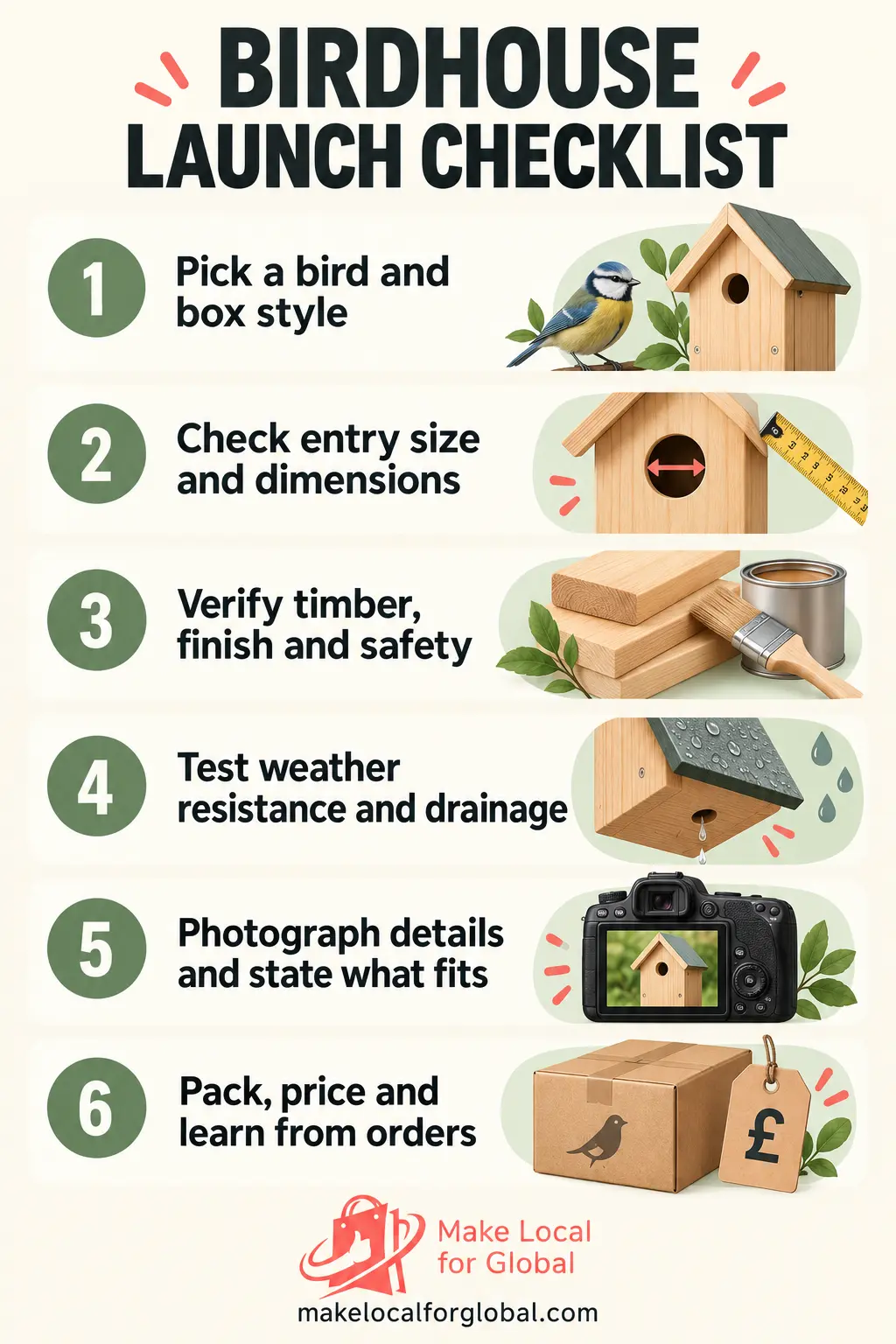
For hole-fronted models, the entrance size is one important design detail, not a guarantee of which bird will move in. The RSPB nest-box building guide gives species examples, including about 25 mm for Blue Tits, 28 mm for Great Tits, 32 mm for House Sparrows and 45 mm for Starlings. The BTO buying guide discusses how to choose a suitable box. Use those references to explain design choices, then check the exact product dimensions with its maker.
Put the measurement in millimetres and show where it was taken. State the box’s overall height, width and depth, its weight, the entrance shape and the wall or tree fixing included. A close-up with a ruler can prevent a buyer from confusing the entrance diameter with the box’s overall size.
Ask the supplier who made the box, what material and finish it uses, how it is assembled and which fixings are included. Request care and installation instructions, traceability details and evidence for any material, durability or wildlife-safety claims you plan to publish.
If you make, import or sell a consumer product in Great Britain, check your responsibilities under the current product-safety rules. The Office for Product Safety and Standards guidance explains the general duties for businesses and points to separate Northern Ireland rules. Requirements depend on the product and your role in the supply chain, so get advice for your circumstances where needed.

Order a sample from the same specification as the stock you expect to sell. Compare it with the product description and supplier drawings. Check that the lid or access panel opens and closes as intended, the fixings are present, and there are no rough edges, loose parts or gaps that are absent from the approved design.
Review how the box sheds rain, allows drainage and can be secured. BTO’s advice on placing a nest box covers location considerations such as mounting and keeping boxes away from busy feeding areas. Turn the main points into practical product instructions, but direct customers to established wildlife guidance rather than implying that a box guarantees nesting.
If you sell an assembly kit, follow the supplied instructions exactly and time a sample build. Photograph tricky steps. A small change such as a clearer orientation mark or a labelled fixing bag can reduce support questions and prevent incorrect assembly.
Lead with the type of box and the clearest verified specification. For example, “Hole-fronted nest box, 28 mm entrance, timber construction” is more informative than a poetic model name alone. Use a model name as a supplement, not a substitute for what the buyer is receiving.

Include overall dimensions, entrance diameter and shape, material, finish, colour, weight, included fixings, assembly needs, care guidance and delivery information. Explain whether the product is a nesting box, feeder or decorative item. Use one labelled diagram if it makes measurements easier to understand on a phone.
Show the roof overhang, interior access, base and mounting points in separate images. Keep props out of the main scale photo. If a picture includes a mounting bracket, finish or accessory that is not included, label that clearly. Write alt text to describe what is actually visible.
Be careful with promises such as “attracts robins”, “predator-proof” or “all-weather”. A box provides a potential nesting site; wildlife chooses where it nests. Make claims only when the exact product supports them, and avoid suggesting a product guarantees a wildlife outcome.
MLFG helps small businesses present products, collect enquiries and build an ecommerce website around the range they want to grow.
A box can be bulky for its weight. Include stock, inbound freight, outer carton, protective corners, payment fee, carrier charge, customer-service time and a reasonable allowance for damage or returns. Check parcel dimensions against the carrier’s current size bands before choosing a retail price.
| Illustrative single-box order | Example amount |
|---|---|
| Customer price, ex VAT | £39.00 |
| Box and inbound freight | £17.50 |
| Carton and protective packing | £2.00 |
| Payment fee allowance | £1.50 |
| Tracked delivery | £3.95 |
| Damage and returns reserve | £2.20 |
| Customer acquisition allowance | £0.60 |
| Contribution before overheads and tax | £11.25 |
Example only, not a supplier quote. VAT, labour, storage, insurance, marketing overheads and tax are excluded.
Calculation: £39.00 − (£17.50 + £2.00 + £1.50 + £3.95 + £2.20 + £0.60) = £11.25. That is contribution before overheads, not net profit. Replace every assumption with your actual supplier quote, carrier rate, payment fee and sales data. Check your VAT position with HMRC or an accountant.
Compare a single box with a two-box bundle or a box-and-fixing kit. A bundle may increase the basket value, but it can move the parcel into a more expensive size band. Calculate each offer separately and test one small batch before buying deeper stock.
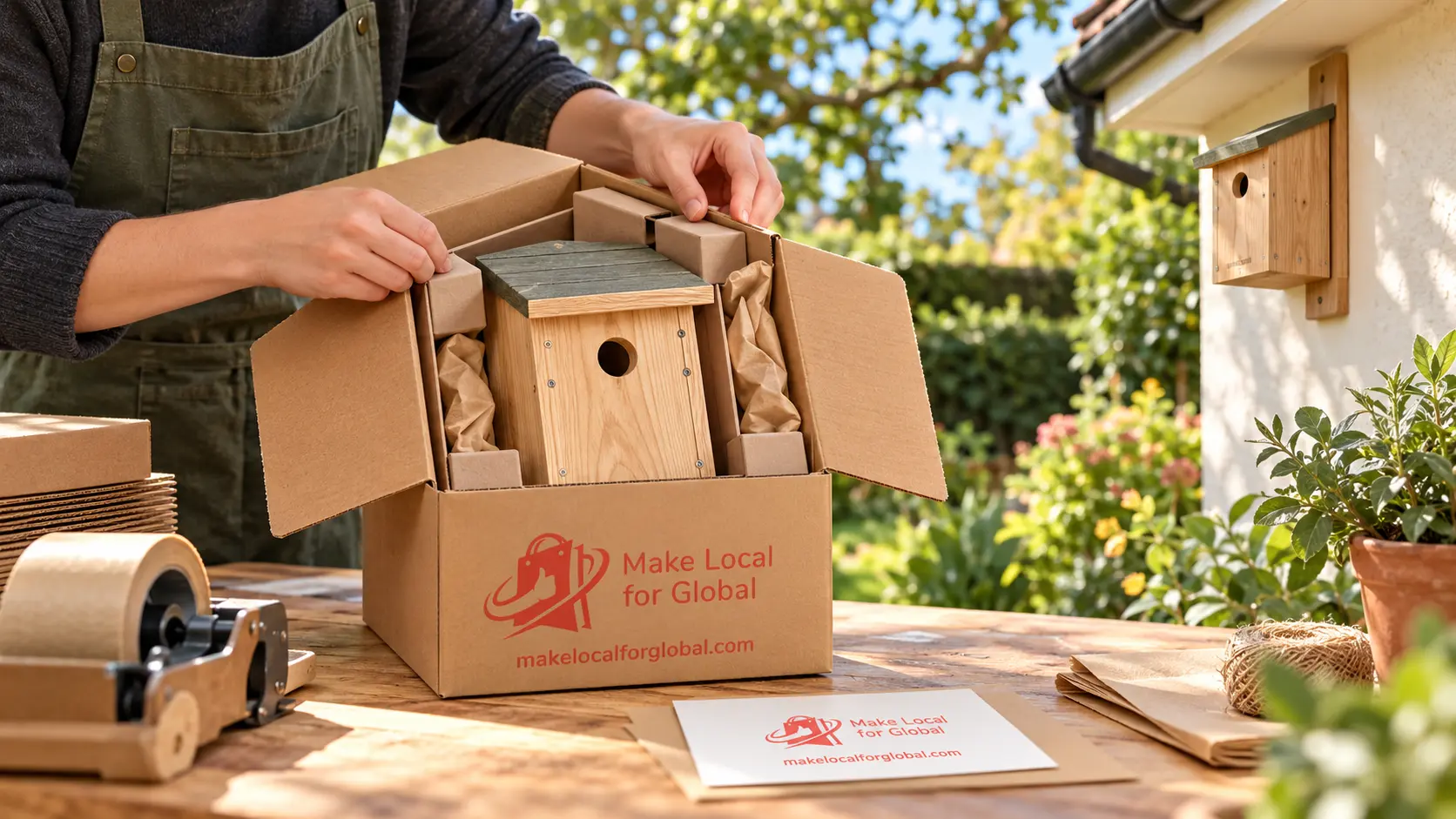
Pack a test order as if it were travelling to a customer. Use a close-fitting carton, protect corners and any projecting roof, and stop the box from shifting. Avoid placing heavy fixings loose against the product. Photograph the packed layout so it can be repeated consistently.
State dispatch times, delivery cost, tracking and what happens if a parcel arrives damaged. GOV.UK’s online and distance selling guidance sets out information businesses must provide before a customer orders. Publish a clear contact route and returns policy that reflects current consumer rules.
Related products can help a focused shop serve more garden-wildlife needs. MLFG’s guide to selling bird feeders online covers another product in this space. Keep the roles distinct: a feeder offers food; a nest box offers a possible nesting site. Do not suggest that placing one guarantees birds will use the other.
State whether it is a nest box, feeder or decoration. Add verified dimensions, entrance size, material, finish, intended use, fixings, assembly needs, care instructions and delivery details. Show useful close-ups of the real product.
No. Design and placement can make a box suitable for certain species, but local habitat and bird behaviour matter. Describe the design accurately and avoid promising that a bird will nest in it.
Test a packed sample, protect projecting roof edges, prevent movement inside the carton and check the parcel size against carrier limits. Record damage reports and review the packing method against the product batch.
Yes, demand may vary with season, gifting and local interest. Keep product information useful throughout the year and avoid implying that a buyer must install a box at a specific time unless supported by reliable wildlife guidance.
Explore MLFG’s ecommerce plans or talk with us about presenting your birdhouse range online.
PREFERRED SOURCE
Like what you’re reading? Add Make Local for Global as a preferred source on Google to see more of our articles when you search.

Build your online presence without having to figure out everything yourself.