

READY TO SELL Ceramic figurines ONLINE?
Get a store built for you in 5 days, plus training and support to help you start, run, and grow your Alternative business.

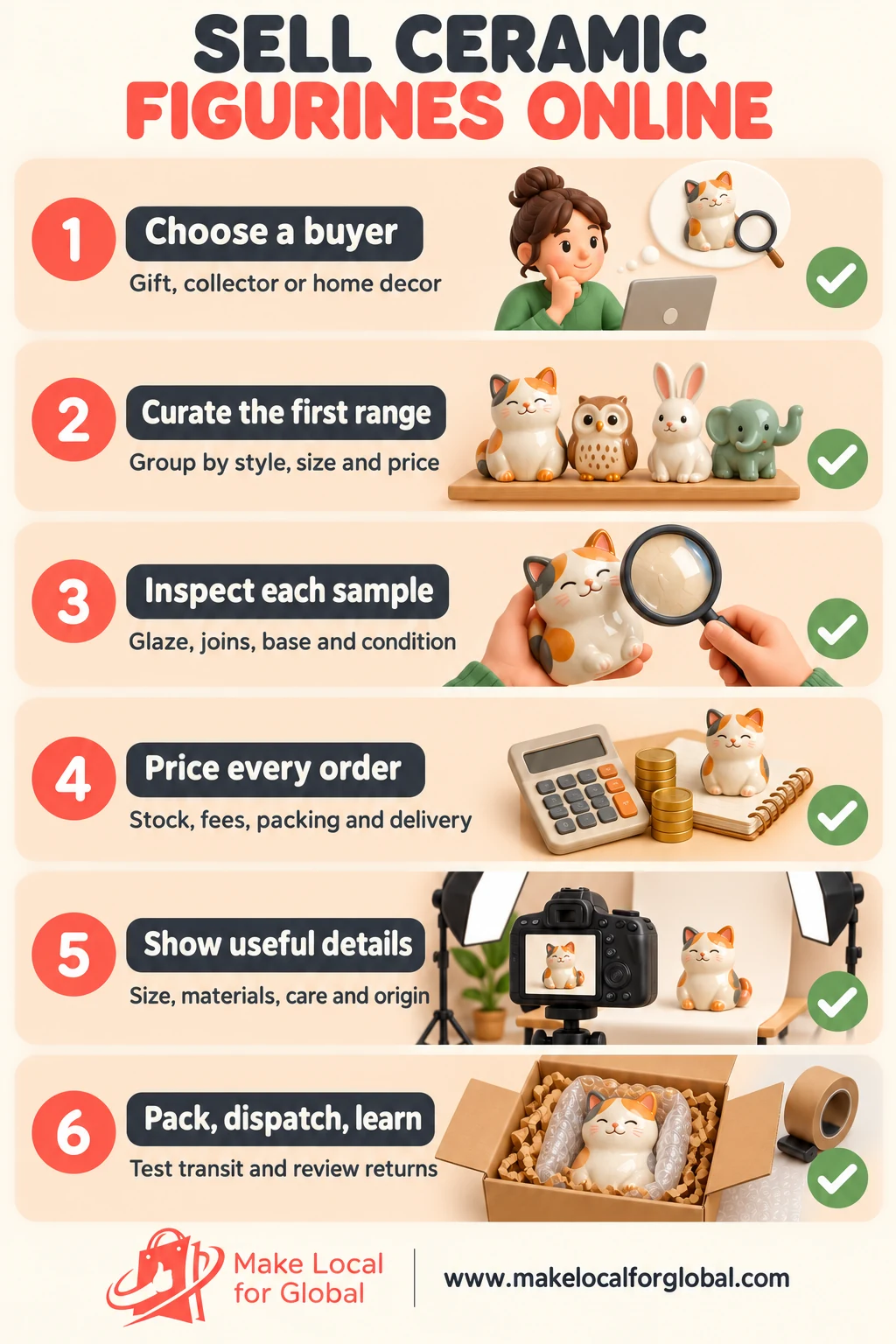
Learn how to choose ceramic figurines for a focused range, inspect samples, calculate full order costs, pack fragile stock and prepare useful product pages.

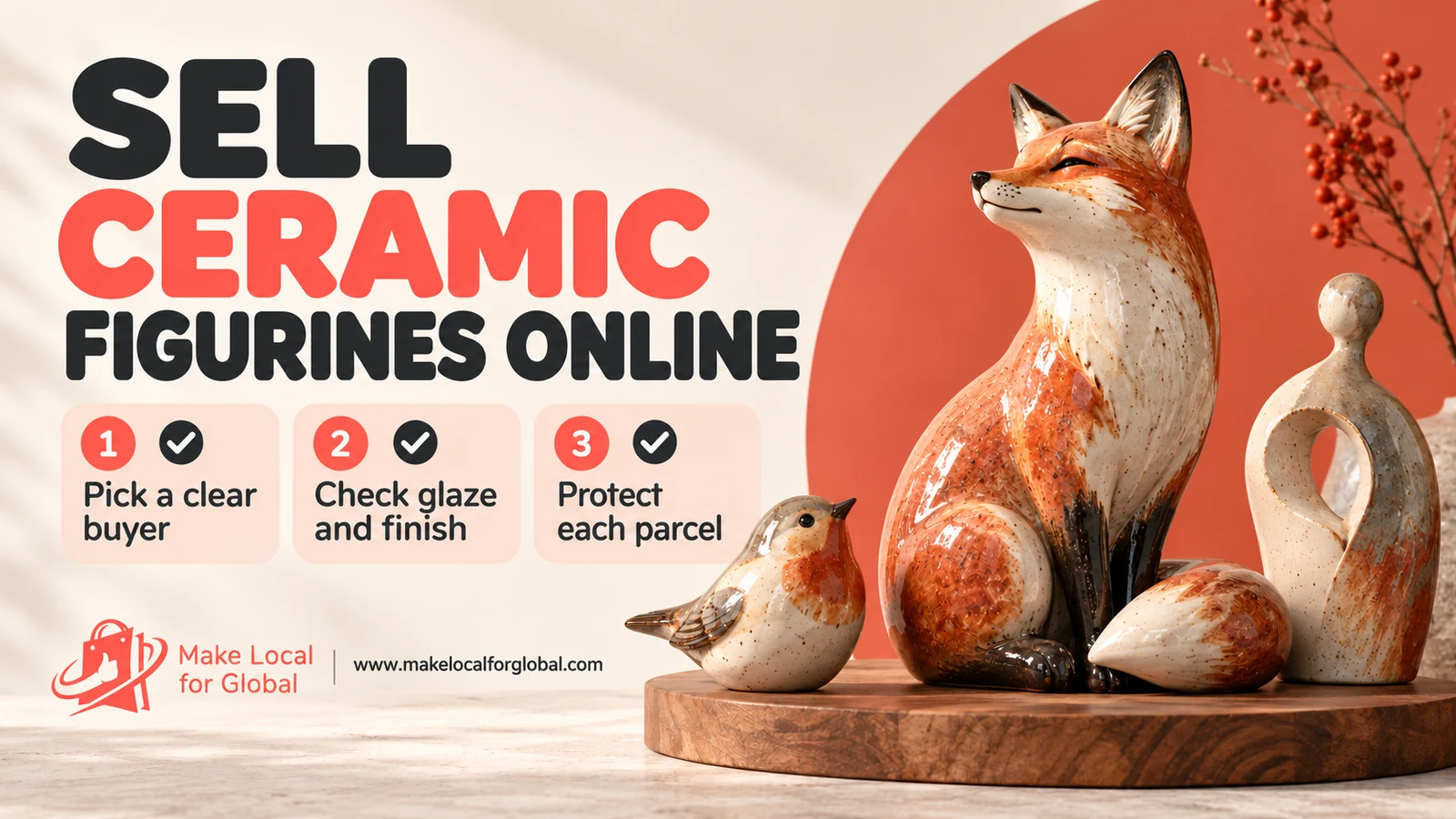
Ceramic figurines can be small enough to store on a shelf and distinctive enough to earn a place in a collector’s home, a gift box or a carefully styled room. The selling challenge is that buyers cannot turn the piece in their hands before ordering. Your range, photographs, descriptions and packing process must answer the questions they would ask in person.
The practical starting point is a narrow collection for one clear buyer. Check real samples, record each figure’s size and finish, calculate the full cost of sending a fragile parcel, and test the packed item before you buy deeply. This article sets out a step-by-step method for choosing the range, finding suppliers, checking safety and quality, pricing orders, creating a useful product page and learning from the first month of sales.
A focused collection needs a shop page that explains what each figure is, who made it and how it will arrive.
“People who like ornaments” is too broad to guide stock, photography or copy. Start with a particular person, occasion or room. Your first customer group might be collectors of a defined animal, people looking for a housewarming present, shoppers styling a nursery shelf, or admirers of a specific craft tradition. Each group values different details.
A collector may ask about the maker, edition, date, condition and whether the base carries a mark. A gift buyer may need a price that feels suitable, a clear dispatch date and a gift-ready box. Someone styling a room may compare colour, scale and the figure’s appearance beside other objects. Pick the buyer whose questions you can answer accurately.
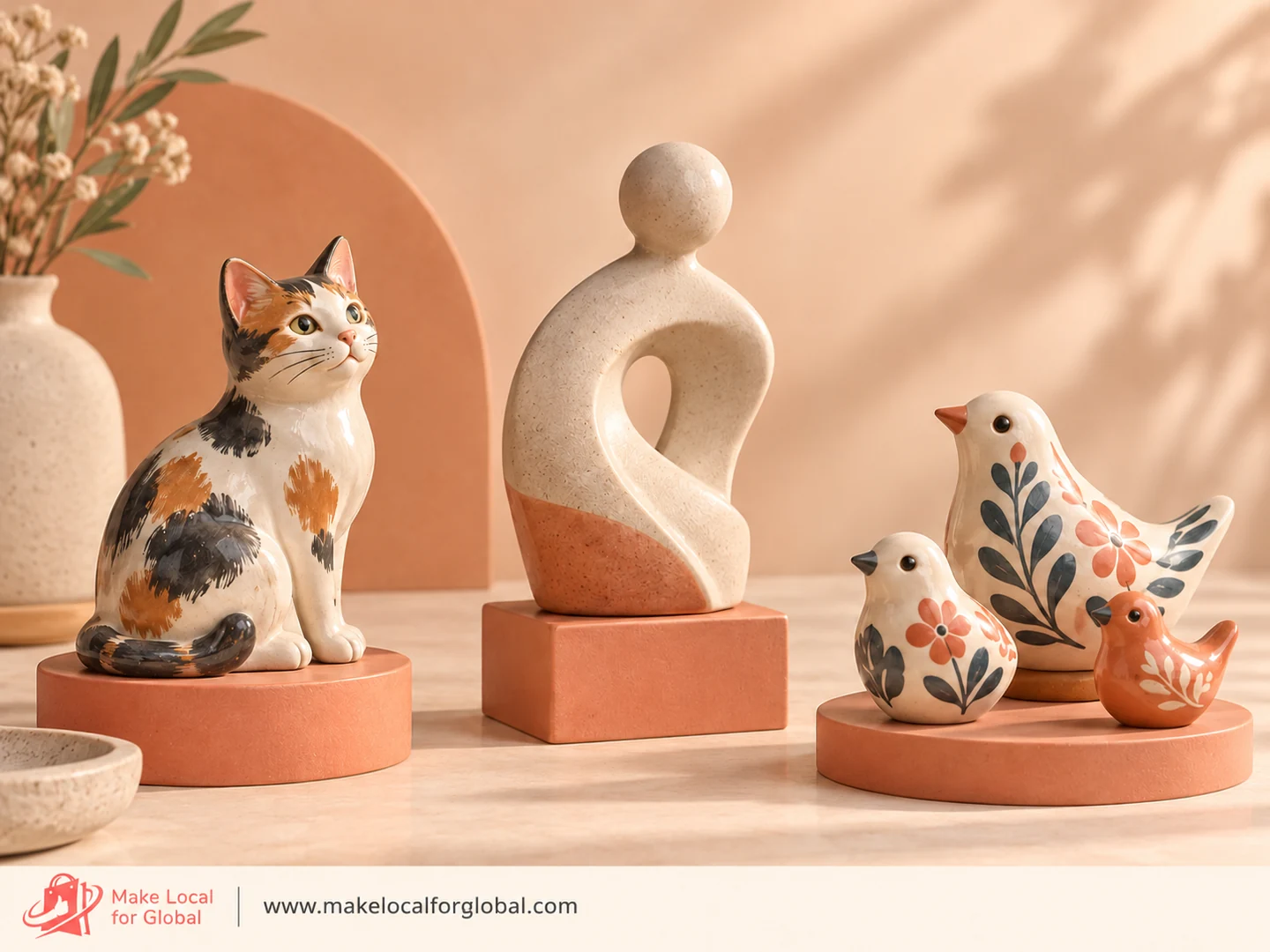
Before ordering stock, write three versions of a product idea for the same audience. For example: a hand-painted fox for woodland-themed shelves, a set of three small birds for a mantel, or a signed studio cat for collectors. Ask potential buyers which one they would click, what information is missing and what price range they expect. Ask people who could plausibly buy, rather than friends alone.
You can test interest with a landing page, a waitlist, a small marketplace listing marked accurately as made to order, or a short social post that links to a product survey. State whether a piece is available now or planned. Do not take payment for an item you cannot supply on the promised terms. Record the number of relevant visits, questions, email sign-ups and sales. A like alone is a weak signal; a buyer asking for a delivery date or joining a list is more useful.
Occasions affect when people shop and how much explanation the listing needs. Gift ranges need readable packaging information and dispatch cut-offs. Collector pieces need provenance and condition details. Home-decor objects benefit from scale photographs and colour notes. A child’s play item brings a different safety question from an ornament intended only for display.
Choose one lead occasion for the first collection. You may serve other occasions later, but one clear promise makes a small shop easier to understand. Keep seasonal stock cautious until you have a record of demand and a plan for pieces left after the occasion has passed.
A new shop does not need dozens of unrelated figures. A short, coherent range makes photography and stock checks manageable. The range should be broad enough to let a visitor compare, yet narrow enough for you to describe each item with care.
| Range idea | Likely buyer question | Useful detail to show |
|---|---|---|
| Small animal figures | How tall is it and what does it look like from the side? | Height, width, glaze, base and a scale reference |
| Bird figurines | Is the beak, tail or perch vulnerable in transit? | Close views of projections and a packing note |
| Abstract figures | What does the finish look like in daylight? | Front, rear, profile and surface close-up |
| Seasonal ornaments | Is this a single piece or a set? | Set contents, dimensions and storage advice |
| Handmade studio pieces | Who made it and are there variations? | Maker details, process and the exact item supplied |
| Vintage collectibles | Is the item authentic and what is its condition? | Marks, age evidence, wear, repairs and known uncertainty |
Choose three to six products at first. A useful opening assortment can have one accessible item, two or three core pieces and one higher-priced statement figure. This is a way to test what shoppers respond to, not a claim that every range needs a fixed price ladder.
An entry item can introduce your style at a lower total order value. A core item should express the collection’s main idea and be available in enough quantity to test demand. A collector or larger piece may suit visitors who already know what they want. If you sell a set, say what is included and show the pieces together and individually.
Do not make the entry product look like a poor-quality version of the premium one. Use a different size, design or finish and explain the trade-off. For example, a smaller unboxed figure may cost less than a large signed piece with a gift box. Buyers should be able to compare actual features rather than guess why the prices differ.
A range can connect through animal type, colour palette, maker, period, shape or intended setting. Write the rule down in one sentence. “Small hand-painted British garden birds in muted colours” is more useful for buying decisions than “lovely ceramic gifts”.
Use the rule to decide what does not belong. A striking item can still weaken the collection if its buyer, materials or price sits far outside the rest. You can test it as a separate collection later instead of mixing it into the first group.
A pair of birds or a group of three miniatures can make a display easier to buy. Sets may raise the order value, but they require enough stock of every piece and create more packing work. State whether the pictured group is sold together. Put the number of figures in the title or first product-page paragraph where confusion is possible.
For a bundle, work out the price from the total product, packaging, payment, delivery and likely return cost. A discount should come from a genuine saving, such as one parcel replacing two, not from ignoring packing labour or breakage risk. If buyers can combine any two items, show the selection process clearly and explain what happens when one item is out of stock.
If you are comparing close product categories, see our practical guides to selling ceramic bowls online and selling ceramic tiles online. They offer useful comparisons for sellers choosing between decorative, functional and surface-design ranges. For seasonal gift planning, our article on selling Christmas decorations online covers timing, storage and post-season stock.
Your route changes your control over finish, lead time, legal duties and stock risk. Compare a few samples before selecting a supplier. Keep the supplier’s name, product reference, invoices, claims and correspondence with the product records.
| Sourcing route | What it can offer | Questions to resolve before launch |
|---|---|---|
| UK studio or maker | Direct detail about materials, process and small runs | Can the maker repeat the finish? What is the lead time and defect process? |
| UK wholesaler | A simpler route to small opening quantities | Who made the item? Can you obtain safety and material information? |
| Overseas manufacturer | Wider design or production choices | What are the import, testing, shipping, duty and documentation needs? |
| Vintage dealer or auction | Older or discontinued pieces with individual character | What supports age and maker claims? Are repairs, chips or replacements disclosed? |
| Your own workshop | Direct control over shape, glaze and presentation | Which safety and record-keeping duties apply to you as maker or brand owner? |
| Consignment arrangement | Less cash tied up in stock | Who insures the piece, handles returns, sets the price and pays for breakage? |
Ask for the business’s legal name and address, product identifiers, material and glaze details, country of origin where known, batch or maker information, care instructions, replacement policy and records supporting safety claims. Ask whether the sample is representative of the production item. If an item has a small batch variation, ask how the supplier defines an acceptable variation and what happens when a sample fails.
A low minimum order can be helpful, but the headline unit price does not tell you whether the business can restock. Ask how many pieces must be bought, whether the first order is mixed across designs, how lead times change at busy periods, and whether colours or dimensions may change. Ask how a discontinued design is communicated and what alternatives are available.
Write down the minimum cash tied up in each design. If a supplier requires twenty pieces of a single figure, estimate how many weeks that stock could take to sell at a cautious rate. Do not use a supplier’s best-case forecast as your own evidence. The first month is a test; the supplier cannot tell you what your audience will buy.
A product that resembles a character, artist’s work, logo or protected design may require permission for manufacture, resale imagery or both. Ask the supplier who owns the design and whether a licence covers the countries, channels and uses you plan. A supplier’s assurance is not a substitute for a written record. Keep the licence, territory, term, permitted edits and marketing-image rights with the product file.
For your own commissioned design, put the ownership and permitted uses in writing. Specify who can make further copies, who owns sketches and moulds, whether the maker can sell the same design to other shops, and how both parties may show the work in a portfolio. GOV.UK explains the basics of copyright and using another person’s work. For a concern about a particular character, mark or design, seek advice from a qualified IP adviser before ordering stock.
Store the final sample photographs, dimensions, supplier details, invoices, product code, manufacturing or maker notes, safety documents where relevant, care information and approved listing copy together. Add a dated note when a supplier changes a glaze, box, mould or factory. This can help you compare later deliveries and answer a customer query about a specific batch.
A practical product record should let someone else identify the item and understand how it was checked. Use your own stock code even when the supplier has a reference. Link every sold unit to a batch, order or maker record where feasible. For vintage one-offs, the listing and purchase record can identify the single piece.
A supplier photo cannot show every flaw. Ask for a physical sample that matches the intended production method, colour and packaging. Inspect it in daylight and under indoor light. Photograph it from the front, rear, side, top and base so you can compare later stock with the approved example.
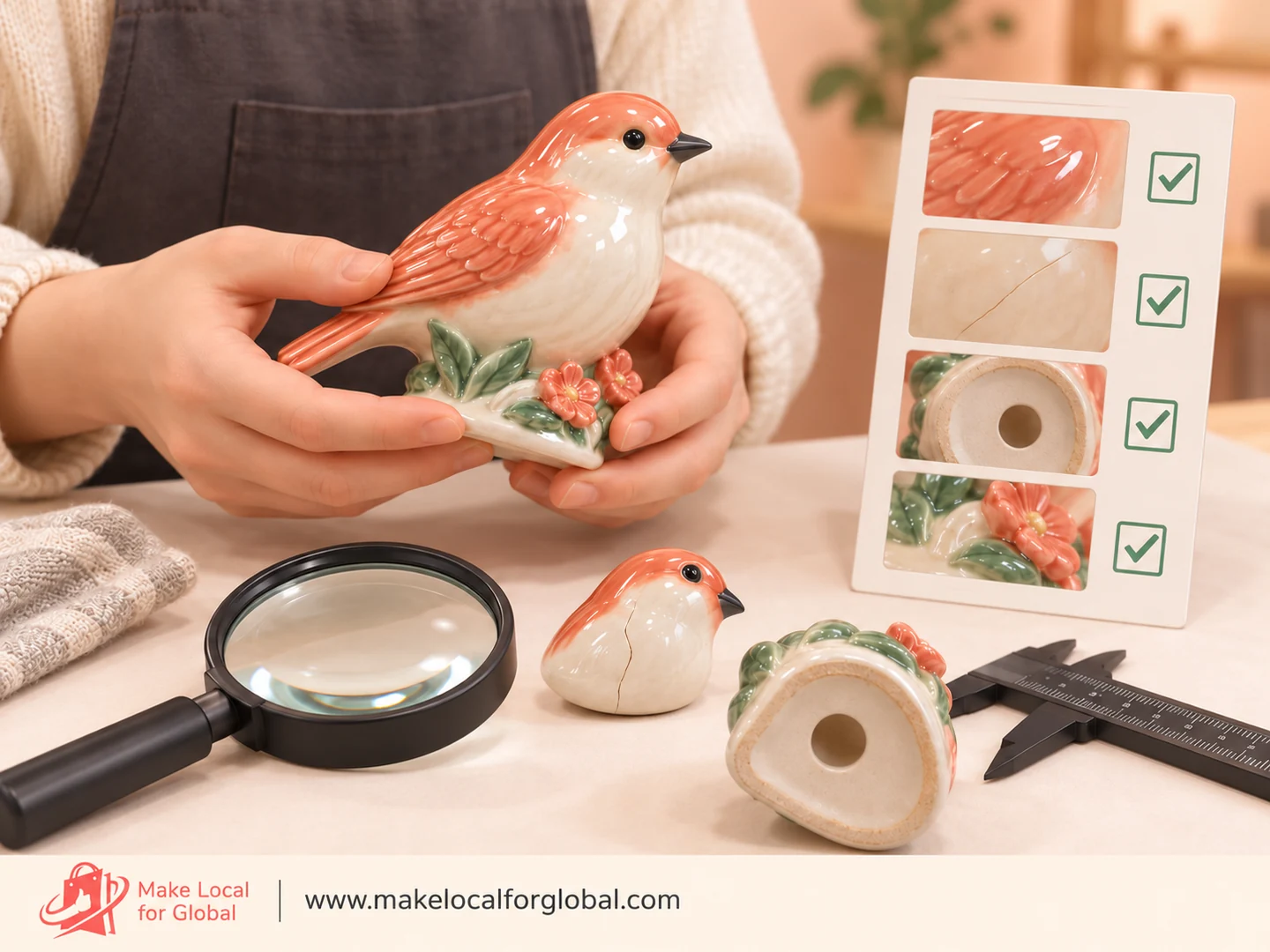
Use a checklist that reflects the form of the actual figure. A bird with a long beak needs more attention at the beak and tail than a rounded abstract shape. A figure with a thin base needs a different stability check from a wide, low ornament.
Set pass and fail rules before the next order. For instance, a visible crack, a loose projection, a sharp edge or a figure that cannot sit safely may be an automatic reject. Small surface variation may be acceptable if it is normal for the stated handmade process and you describe it clearly. Do not quietly lower your standard after paying for stock.
Handmade ceramics can vary in colour, brushwork, shape or glaze placement. Describe the nature and likely degree of variation in simple terms. If each figure is one of a kind, photograph the exact piece and mark it as sold when it leaves. If the buyer receives one selected from a batch, show representative examples and explain what can vary.
Do not use “handmade” as a vague quality claim. State what you know: who made it, which stages were done by hand, and which parts are repeated with a mould or other process. If the supplier has not confirmed a detail, leave it out until you can verify it.
A small ceramic character may look appealing to a child, yet its use and marketing matter. A display ornament and a toy can fall under different rules. Do not call a product a toy, add child-focused language or market it for play only when the maker’s intended use and compliance evidence support that description.
In Great Britain, the Toys (Safety) Regulations 2011 apply to products designed or intended for play by children under 14, subject to the scope and exclusions in the regulations. Read the official GB guidance before placing such a product on the market. Northern Ireland has separate guidance and the applicable product-safety regime differs. Get product-specific advice where the use is not clear.
The retail price is not the amount left for you. A ceramic figurine may need protective material, a double box, a tracked service and time for careful packing. Include costs that occur once per item and costs that occur per order. If a parcel contains two figures, split shared postage and packing sensibly, but do not assume each extra figure has zero cost.
Record the product cost, delivery to you, import costs where relevant, incoming inspection time, labels, boxes, cushioning, tape, payment fees, marketplace fees, customer delivery, expected damage or return cost and marketing cost. Keep fixed overheads such as insurance, software and accounting separate, then include them in the business forecast. Owner time is a real cost whether or not you draw a wage from the first order.
| Cost for one order | Illustrative amount | How to calculate your figure |
|---|---|---|
| Figurine purchase | £18.00 | Supplier invoice divided by saleable units |
| Inbound freight and duty allowance | £2.40 | Allocate the shipment cost across the received units |
| Inner wrap, box and outer carton | £3.10 | Add the actual packaging used for a safe parcel |
| Payment and selling fees | £3.20 | Apply the current fee structure to the order |
| Customer delivery | £5.50 | Use the service and parcel size you plan to offer |
| Handling and label materials | £1.25 | Include consumables and a realistic packing time cost |
| Damage and return allowance | £2.00 | Estimate from your own returns and incident records |
| Customer acquisition cost | £4.00 | Ad spend divided by first-time orders attributable to it |
| Variable costs before VAT adjustment | £39.45 | Sum the listed order costs |
The figures are illustrative, not a supplier quote or expected result. Replace each line with your actual invoice, platform rate, carrier quote and observed return rate. A £2 allowance for damage is not proof that the eventual rate will be that amount; update the model as orders arrive.
Suppose the customer pays £72 including standard delivery and you are VAT registered. Using a 20% VAT example, the sale value excluding VAT is £60. This simple example assumes the whole £72 is treated as a VAT-inclusive sale; the exact VAT treatment of delivery, fees and individual costs depends on your circumstances. Ask an accountant about your case.
If the £39.45 table total is stated before any recoverable VAT adjustments, then £60 less £39.45 leaves £20.55 contribution before fixed overheads, owner pay, tax and any other unlisted cost. If the costs include recoverable input VAT, use their net amounts for the relevant calculation and keep the VAT records. If you are not VAT registered, do not present the customer price and VAT calculation as though you were. The example only shows the method; it does not tell you what to charge.
Contribution is not net profit. It is the amount left after the costs you included, before business overheads and other obligations. A shop that sells a figure for £72 may still lose money if the real marketplace fees, advertising, packing labour or breakage rate are higher than the model.
Calculate a minimum acceptable contribution for each item. Then check that price against comparable products whose materials, size, maker and condition are close enough to be useful. Retail prices can help describe a market, but they do not prove that products sell at those prices or that a seller earns a profit.
When testing a discount, calculate the contribution at the reduced price first. Include delivery if you advertise it as free; the cost still exists. If a bundle saves one parcel, compare the combined packing time, box size and shipping rate with two separate orders. Do not discount a fragile, low-margin figure below its safe fulfilment cost just to create an attractive headline.
Keep a simple record for every order: item code, selling price, discount, delivery charged, payment fees, postage paid, packing materials, marketing attributed, refund or replacement and any damage. Review it monthly. Some figures may attract visitors but rarely sell; other designs may earn more per packing hour or suit a repeat buyer.
Use that information to reorder, revise the price, change the packaging or stop a line. If the item sells but the contribution is weak, test a change to order size, packing method or channel fees before buying more stock. If people visit the page but do not add it to a basket, compare the page details, total delivered price and buyer questions before blaming demand.
Product pages can make dimensions, condition and delivery terms easier for buyers to compare.
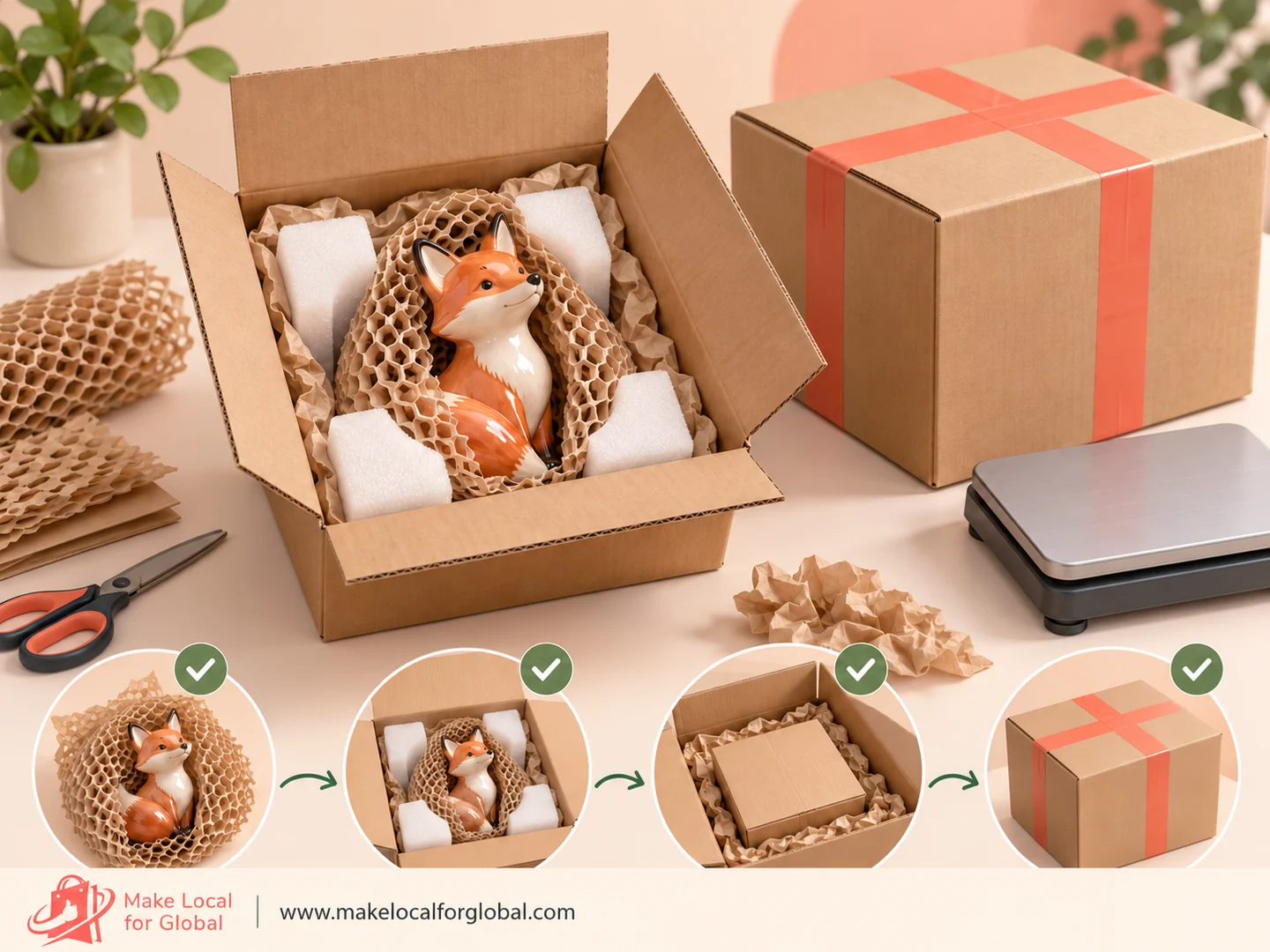
A figurine can be safe on a shelf and vulnerable in a parcel. The package should keep it still, cushion delicate features, stop hard contact with the outer wall and arrive with clear sender details. Use materials suited to the shape and weight; a thin layer of bubble wrap alone may not protect a long beak or thin tail.
First protect the surface from abrasion with a clean, soft wrap. Add cushioning that absorbs impact around the whole figure, with special support for projections. Place the wrapped item in a snug inner box with no room to slide. Cushion that inner box inside a suitable outer carton. Keep the object away from the carton walls and use a closure that stays shut during handling.
For multiple pieces, wrap each one separately and keep them from touching. Dividers should hold their position after the carton is moved. A gift box is presentation, not necessarily transit packaging. Keep the display box clean inside the protective shipping package.
Pack the sample exactly as you expect to pack a customer order. Record materials, dimensions, parcel weight and the packing time. Ask another person to follow the written steps, then check whether they can pack the item consistently. A packing test helps reveal missing instructions and unnecessary materials before a customer receives the box.
Use a sensible internal handling test that suits the product and your carrier service. Do not treat a casual drop test as formal certification. For expensive or complex pieces, consult a packaging specialist or test service. After real shipments, review damage reports by product shape, packaging batch and carrier. Change one factor at a time so you can see which adjustment helps.
Compare services using the final outer measurements and weight, not the figure’s bare dimensions. Check collection and drop-off options, tracking, delivery estimates, compensation limits, exclusions for ceramics, proof of delivery and the process for a damaged parcel. Confirm the carrier accepts the product type and that any cover applies to the actual value and packaging method.
Set a dispatch schedule you can keep. A fragile item may take longer to pack than a soft product, especially when gift notes or batch records are involved. State the usual handling time, last order time for a dispatch day and what happens during closures. Tell buyers early if a delay occurs; do not rely on an automatic carrier estimate to explain a missed date.
Photograph the packed order before dispatch, including the inner restraint and sealed outer box. Keep the tracking number and the product’s batch record together. If a buyer reports damage, ask for clear photographs of the item and packaging, then resolve the case under the carrier terms and your consumer obligations. A prompt, fair response can make a difficult delivery easier to handle.
For most online consumer purchases covered by distance-selling rules in the UK, a buyer may notify the seller within 14 days of receiving goods that they wish to cancel, then has another 14 days to return them. The seller normally has 14 days from receiving the item back to refund, including standard delivery. There are exceptions and the law has details on handling and damaged goods. Read the GOV.UK returns guidance and get advice if a particular item or sale falls into an exception.
Make a return process that protects both the buyer and the object. Explain how to contact you, what information helps, whether the original packaging should be reused and how to arrange a return. Do not write a policy that removes statutory rights. Inspect returned ceramics soon, photograph the condition and record whether they can return to sale as new, need a condition note or must be removed from stock.
A useful listing shows the exact item or an accurate example and provides enough detail for the buyer to judge size, appearance, provenance and delivery. Avoid describing a figure only with praise. A customer needs facts they can compare.
Put the object and a meaningful attribute near the start. For example: “Hand-painted ceramic robin figurine, 12 cm, blue-grey glaze” is easier to understand than “Beautiful bird ornament”. Add the maker or range name when verified and useful. Avoid repeating near-identical phrases or filling the title with search terms.
For a vintage item, include the known maker, period or material only when you have supporting evidence. Use “unmarked” or “attributed to” carefully and explain the basis. If the identity is uncertain, say so rather than presenting a guess as fact.
Use a clean background and consistent light. Photograph the front, back, profile, base and any special mark, flaw or signature. Add a scale reference when dimensions are hard to judge, then give exact measurements in text. A hand can show scale, but hands vary; a ruler or familiar object gives another reference.
Show the figure in a room setting only after the clear product photos. A styled shelf helps a buyer picture the use, but it should not obscure the item or imply accessories are included. Keep colour as true to the object as your camera and editing allow. Do not add props that look like part of the sale without saying they are not included.
For one-off pieces, photograph the exact object. For made-to-order or batch items, show a representative piece and explain which surface details can vary. If the listing uses a sample image, label it and describe the likely variation. A carefully written note can prevent a buyer from expecting an identical brushstroke on every handmade item.
List height, width, depth, weight, material, finish, maker, origin where verified, item count, condition, care, stock status and what arrives in the parcel. For a vintage figure, note chips, repairs, crazing, missing parts, marks and any uncertainty. For handmade work, explain variation and whether the photographed item is the one shipped.
Do not state “food safe”, “non-toxic”, “child safe”, “lead-free” or a similar safety claim without records that support the wording and product use. An ornament is not automatically suitable for food or drink. If you intend to sell ceramics for serving or storage, seek current product-specific compliance advice and keep the evidence for the glaze and intended use.
Start with a plain explanation of what the item is and who may value it. Then describe its design, materials, finish, dimensions, maker or provenance, condition and care. Explain how it ships and whether the package is gift-ready. Keep the details close to the item, not buried in generic shop copy.
A concise description structure can be:
Record questions from early visitors and customers. If several people ask whether a bird is a pair, add the unit count near the title. If they ask whether the base is signed, add a close photo. If they ask whether a figure fits a particular shelf, show the dimensions and a scale image. Every repeated question is evidence that the page can explain something better.
A marketplace can bring access to shoppers who already search for ornaments, vintage objects or handmade gifts. A direct shop gives more control over the brand, customer journey and product records. Local craft events let buyers see the finish, but stock must travel to the event safely. A retailer or gallery can reach a focused audience and may reduce your control over presentation and margin.
| Channel | Useful when | Check before committing |
|---|---|---|
| Online marketplace | Buyers already search for similar figures there | Current fees, listing rules, payment timing, returns and image requirements |
| Your own online shop | You can bring relevant visitors and need control over product detail | Hosting, payment costs, privacy information, accessibility and customer service |
| Craft fair or local shop | Buyers benefit from seeing the finish in person | Stall fee, travel, display security, card payments and unsold stock |
| Gallery or gift retailer | Your collection suits a curated audience | Wholesale margin, exclusivity, delivery terms, damage allocation and settlement time |
| Social selling | You can show the piece and answer questions where buyers already follow you | Platform checkout rules, records, customer contact route and image permissions |
Start with one main sales route and one source of useful traffic. Each added channel brings stock syncing, fees, messages and policies to maintain. If a one-off figure sells on two channels at once, remove or reserve the second listing quickly. A stock sheet should show available, reserved, damaged, returned and sold units.
Read the current primary seller documentation for the platform you use. Fee schedules, listing rules, payment delays and return tools can change. Calculate the fee on a realistic order that includes delivery and a discount, then update your cost sheet. Do not rely on a blog post written for another year or a seller’s anecdote as the official fee rate.
Before launching, confirm how the channel handles customer data, tax records, cancellations, reviews, damaged orders and disputes. Keep copies of your own order and supplier records. The marketplace may support a sale, but it does not remove your responsibility to provide accurate listings and comply with the rules that apply to you.
Use phrases buyers actually use, such as the animal or subject, ceramic ornament, maker’s name, collection, size, finish or vintage period when verified. Use these phrases naturally in the product title, image text alternatives and description. Make each page useful first; repeated keyword strings do not add product facts.
Create short posts or emails that answer a real decision: how to display a small bird figure, how a handmade glaze varies, how you protect a thin tail in transit, or what a buyer should know about a vintage mark. Each piece should link to the relevant item or collection. Avoid copying one generic caption across every design.
Ask for reviews in a neutral way after delivery. Do not offer a reward for a positive review or write a review on someone else’s behalf. Use buyer questions and feedback to improve details and packing. A product page should reflect the item that ships, not a polished promise the stock cannot meet.
A small operation can still benefit from a repeatable order routine. When a sale arrives, confirm the stock code, buyer address, delivery service and promised dispatch date. Check the item against its condition record, pack it using the approved method, capture the label and parcel weight, then save the tracking details. Mark the unit as sold and reduce the live stock count.
Store fragile stock on stable shelves with enough space to lift each piece without touching another. Keep unboxed stock separate from returns, display samples and damaged items. Use dividers, clean padding and clear labels. Avoid stacking heavy boxes over projecting features. Make sure anyone helping with orders understands which figures are one-offs and which may be replaced from a batch.
Set a reorder point based on real lead time and observed demand. For a one-off collectible, there is no reorder. For a repeat design, ask how long a new batch takes and how much cash a reorder ties up. Review stock after a set number of orders or at a regular monthly date; ordering after every busy day can create excess stock, and waiting until the final unit sells can cause avoidable gaps.
Create a simple incident record for late parcels, breakage, wrong descriptions, returns and supplier defects. Include the product code, order date, batch, carrier, packaging, remedy and outcome. Review patterns. If most breakages involve one tail shape, redesign its support. If a supplier changes a glaze without notice, pause that listing until you check the new sample.
Product rules depend on intended use, product type, where it is sold and your role in the supply chain. A person making a product, importing it or selling it under their own name can have duties that differ from those of a retailer reselling a well-documented product. This section is a starting point, not a legal opinion.
The Office for Product Safety and Standards says businesses that make, import, distribute or sell consumer goods in the UK are responsible for product safety and related labelling requirements. Read its current product safety advice for businesses. The GB guide to the General Product Safety Regulations 2005 applies to England, Scotland and Wales. Northern Ireland has a separate regime: from 13 December 2024, the EU General Product Safety Regulation 2023/988 applies there in place of the 2005 Regulations.
Keep product records that support the claims you make and let you identify stock if a problem appears. Ask the supplier for relevant safety information, traceability and warnings. If you make or import the figure, take advice on your specific role and product before sale. A general ornament may still need a safety review based on foreseeable use, shape, materials and audience.
Do not assume that an ornament is outside toy rules on the basis of a box statement alone. Intended or likely play, design, marketing and the product’s characteristics can matter. In Great Britain, the Toys (Safety) Regulations 2011 cover toys designed or intended for play by children under 14, subject to the regulations’ scope and exclusions. Review official guidance for the market where you will sell, including separate Northern Ireland information. Do not attach toy markings or safety claims without the applicable assessment and supporting records.
Some figurines are purely decorative; others are sold as containers, tableware or objects that contact food. Those uses raise product-specific requirements. Do not infer suitability from a glossy glaze or a supplier’s informal message. Ask for evidence that covers the precise material, finish and intended use, then obtain qualified advice on the applicable rules and testing. If you cannot substantiate the claim, describe the item as decorative and make that limitation clear in the listing.
Give customers clear business contact information, the product’s main characteristics, total price, delivery cost, payment terms and delivery arrangements before the order. Make sure the customer can keep a copy of the contract. GOV.UK’s online and distance selling guidance explains information duties and cancellation rules. Its returns and refunds page outlines the usual cancellation and refund timetable for distance sales, alongside exceptions.
Write terms that match the actual process and do not remove statutory rights. If you sell outside the UK, check the destination country’s consumer, product and tax rules before offering delivery there. A carrier accepting a parcel does not confirm that the product can lawfully be sold in its destination.
Vintage figures can have value through maker, age, subject, rarity, condition or a buyer’s memory of a particular style. The same qualities make accuracy important. Avoid presenting an unverified date, maker or material as fact. Use the maker’s mark, catalogues or other reliable evidence and say what the evidence supports.
Photograph the base, marks, repair lines, chips, crazing, paint loss and replaced parts. A flaw that looks minor to you may change a collector’s decision. Give a direct condition statement near the start and repeat major issues in a dedicated condition field if your platform provides one. Do not hide a repaired item behind a display photograph.
Describe uncertainty plainly. “Unmarked ceramic figure, likely mid-century based on the style; exact maker and date not confirmed” is more transparent than an exact attribution without evidence. If you have a reliable source for a mark or production period, link it or name it in your records. Avoid rarity claims without supporting evidence.
For a one-off vintage object, weigh the time needed to research and photograph it against the likely selling price. Some pieces warrant a specialist appraisal; others do not justify that expense. Keep the purchase record and any appraisal, and state whether it is an independent opinion or your own research.
Buyers of fragile, decorative objects often need reassurance about what arrives and how a problem will be handled. Use a monitored email address and reply within a stated timeframe you can meet. Save answers to common questions, but adapt them to the specific item. A standard reply should never promise a property that you have not verified for that figure.
Use clear care instructions from the maker. If none exist, do not invent a cleaning method that could damage a glaze or decoration. Ask the maker for suitable guidance. Distinguish a display recommendation from a safety instruction, and explain when a figure has fragile details that should not be used as a handle.
For gift buyers, state whether the price appears on the packing slip, whether a gift message is available and how the outer parcel looks. Do not promise a delivery date that depends on a carrier you cannot control. Give a realistic dispatch estimate and update the buyer if a delay changes the expected arrival.
If a piece arrives damaged, respond with a clear next step, not an argument about whose fault it is. Gather the photos and order details, arrange a remedy under your policy and the applicable law, and record the incident. A fair process helps you understand whether the supplier, handling, carton design or carrier route needs attention.
The goal for the first month is to gather enough evidence for a sensible next decision. It is not a promise of a sales target. Set weekly observations that fit your budget and the audience you can reach.
Write one sentence describing the buyer and collection. List three likely customer questions and ask a small group of relevant people which product they would consider and why. Review current listings for comparable size, condition and maker, recording their asking prices as observations only. Decide what you can test without committing to a large order.
Contact several possible makers or suppliers. Ask for a sample, repeat lead time, minimum order, material and finish details, maker information, defect process and evidence behind safety claims. Compare the answers in a table. If the supply route or product use remains unclear, pause the purchase and ask a qualified adviser.
Measure and photograph each sample. Complete the inspection checklist, write pass rules and reject any sample that fails a safety or quality requirement. Ask the supplier to explain variation and corrections. Test a finished parcel with the intended materials and record the dimensions, weight, packing steps and minutes.
Fill in the cost sheet using actual costs where available. Mark unknown fees as estimates and contact the platform or carrier for current rates. Calculate the contribution at the proposed price and at a plausible discount. If the result leaves too little for overheads and owner time, change the product, channel, order size or price before launch.
Write the title, product description, dimensions, material, condition, care, dispatch and returns information. Photograph all useful angles. Ask someone unfamiliar with the product to read the page and describe what they expect to receive. Correct any mismatch.
Set the stock record, order steps, packing checklist and damage process. Confirm your terms, contact details, payments, delivery promises and consumer information. Choose one sales channel and a simple method for bringing relevant visitors. Review current platform rules before publishing.
Publish the first focused collection or a small available batch. Tell a relevant audience what is on offer and link to the product page. Track visits, questions, saves or list sign-ups, basket activity, purchases, cost per order, packing time and delivery issues. Do not treat activity as proof of profit.
At the end of the test, sort observations into four groups: product interest, product-page gaps, fulfilment performance and contribution. Decide whether to reorder, revise the description, adjust photos, change the price, improve the package or stop a weak design. Record the reason. A small, documented test can prevent a large order based on guesswork.
Yes, if you start with a manageable range, inspect the stock, describe it accurately and plan safe delivery. Begin with a small test quantity or one-off pieces. Check the rules that apply to your product and location before accepting orders.
There is no universal quantity. Base the first order on the supplier’s minimum, the cash you can afford to tie up, available storage and the results of a demand test. A small group of related designs is easier to photograph and track than a large mixed collection.
Review a physical sample for dimensions, finish, stability, joins, base condition and packaging. Ask about materials, maker, origin where known, repeat supply, minimum order, defects and documentation. Keep the written answers and invoice with the product record.
Add product and inbound costs, packaging, payment and channel fees, delivery, packing time, returns or damage allowance and customer acquisition where relevant. Then account for VAT according to your circumstances and allow for overheads and owner pay. Compare the resulting price with genuinely similar items, but treat market asking prices as observations rather than proof of demand.
Consumer products must meet the rules that apply to their type and market. General product safety requirements apply in Great Britain, with a separate Northern Ireland regime. Products intended as toys or for food contact can have additional requirements. Get product-specific advice if the use, marketing or compliance evidence is uncertain.
Only after you confirm the intended use and meet the toy rules for each market. Great Britain and Northern Ireland have separate guidance. Do not rely on a “not a toy” label alone to decide scope, and do not use toy claims or markings without the right evidence.
Only when suitable evidence supports that claim for the exact item and intended use. A decorative glaze does not prove food-contact suitability. Ask the maker or importer for documentation and seek advice on applicable testing and rules.
Protect the surface, support protruding features, immobilise the figure inside an inner box and cushion that box inside an outer carton. Test the parcel you plan to send, record the materials and weight, then review every damage report for patterns. A display box alone may not be suitable for shipping.
Show the front, back, sides, base, marks, finish and any flaw. Give dimensions and include a scale reference. A lifestyle image can show placement, but keep clear product photographs first and identify props that are not included.
Explain which features may vary, such as brushwork or glaze placement, and show representative examples. If the pictured item is the exact one for sale, say so. Do not promise an identical finish when the maker’s process produces variation.
Show a clear contact route and a policy that reflects the consumer rules for your market. For many UK distance sales, buyers have a cancellation period after delivery, followed by time to send the item back. Check the official guidance for exceptions and refund details, and do not remove statutory rights.
It can interest collectors, but each one-off item needs accurate research and condition details. Photograph marks, repairs and wear, and avoid unsupported claims about maker, age or rarity. Allow time for research and careful packing when deciding whether the item is worth listing.
A marketplace can put products in front of people who already search there; an independent shop gives more control over presentation and customer records. Compare current fees, rules, traffic options and operating costs. Start with a channel you can maintain and expand after your order process works.
Review completed orders, qualified questions, page visits, contribution, return rate, packing time and supplier lead time. A few likes are not enough evidence on their own. Reorder when the data and available cash support the decision, rather than in response to a supplier offer.
Choose one buyer and a short list of ceramic figures that fit that buyer’s taste, budget and intended use. Request samples, record the details and test the parcel before committing to a larger run. Use the first month to learn which designs, product details and delivery methods work for your shop.
If you need a shop that presents a focused collection clearly, explore MLFG website design. For help deciding how to present your business online, contact Make Local for Global.
Once you have checked a sample and priced the parcel, make the collection easy to browse and contact MLFG if you need help presenting your business online.
PREFERRED SOURCE
Like what you’re reading? Add Make Local for Global as a preferred source on Google to see more of our articles when you search.

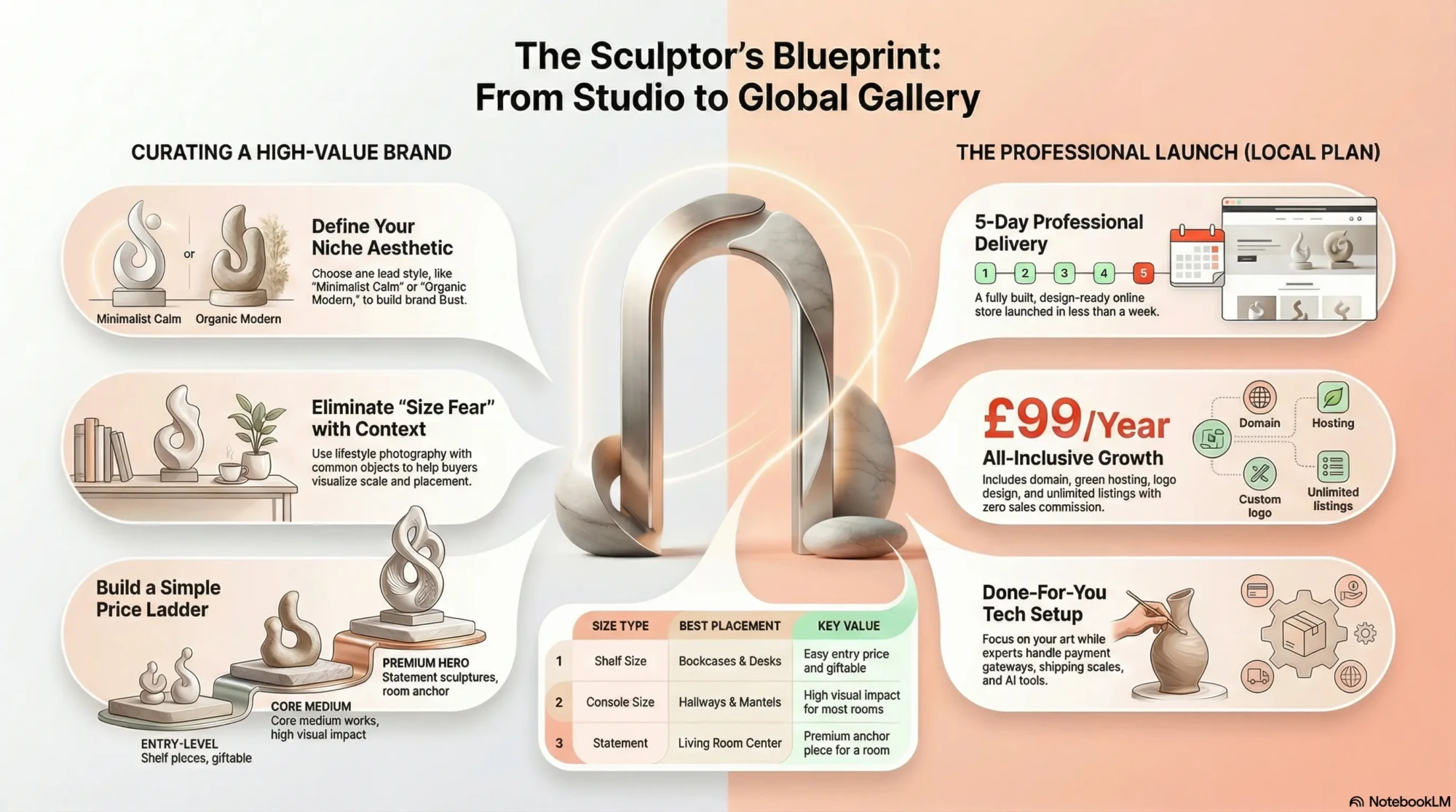


Build your online presence without having to figure out everything yourself.