

READY TO SELL Cotton face masks ONLINE?
Get a store built for you in 5 days, plus training and support to help you start, run, and grow your Alternative business.

Learn how to choose a cotton face covering range, check fibre and fit, price full orders, write accurate listings and test demand with a measured launch.

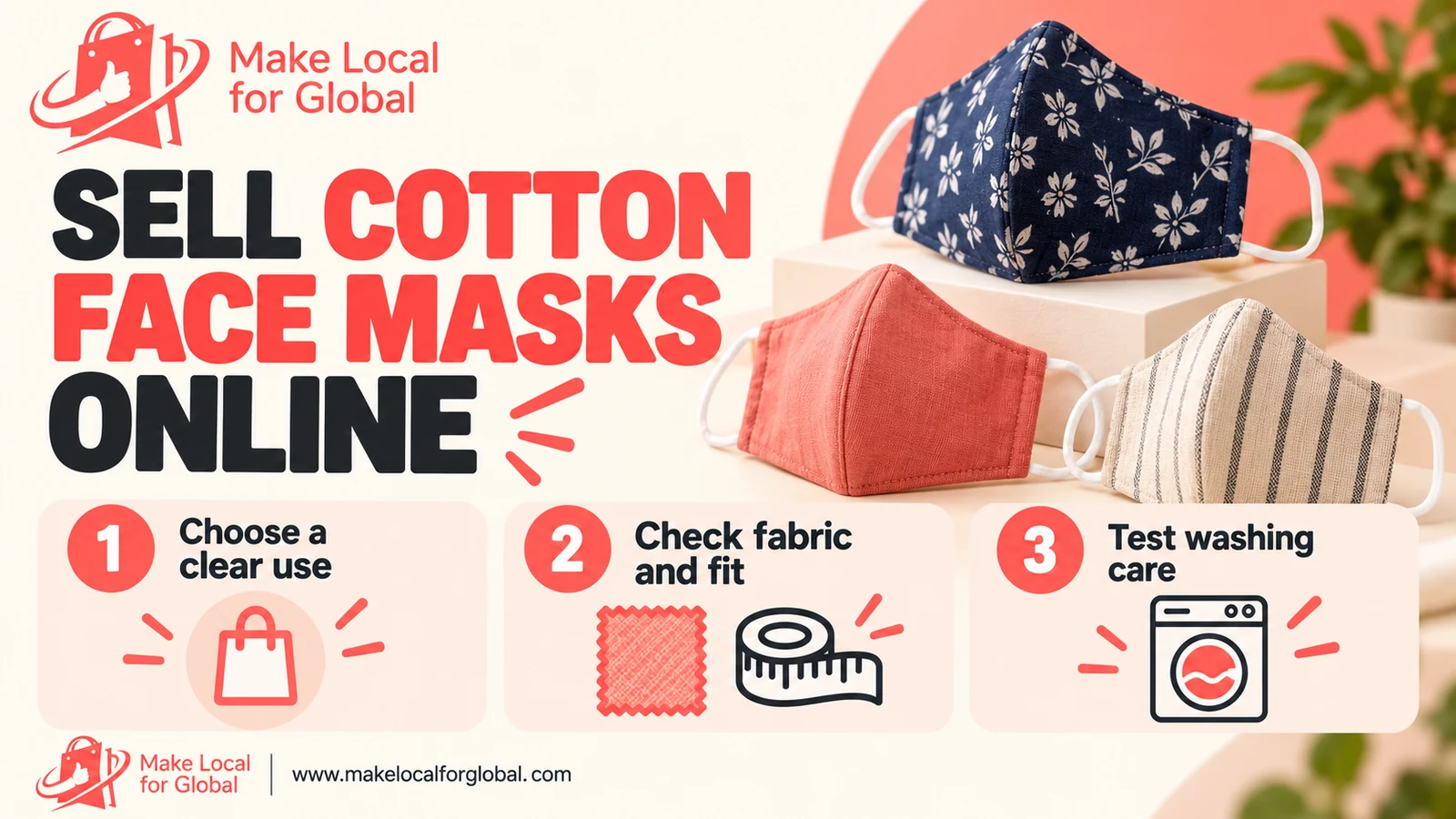
Cotton face coverings can be bought for style, comfort, uniforms or gifting, yet a listing that leaves their purpose unclear can mislead shoppers and create regulatory risk. The seller’s first task is to define what the product is and what it is not. A washable cloth face covering for general use is not automatically a medical face mask or personal protective equipment.
Build the range around a specific buyer, verify the fabric and construction, test fit and washing, and price each order after packaging and postage. Use accurate product wording, fibre details and photos that let shoppers compare size and finish. This practical plan covers research, sourcing, quality checks, product classification, costing, online listings and a measured first month of sales.
A useful shop page can explain who each covering is for, what the fabric contains and how the item will arrive.
Before choosing colours or printing patterns, define the product’s intended use. A cotton face covering marketed to the general public sits in a different category from a surgical mask intended for a medical purpose or a respirator intended to protect the wearer. Product name, packaging, instructions and promotion all help communicate the intended purpose.
The Office for Product Safety and Standards (OPSS) says an ordinary cloth covering sold for general consumer use is not PPE or a medical device. Promotion as PPE or a medical device brings extra regulatory requirements. Read the OPSS guidance for face-covering makers and suppliers and the current government overview of face masks, coverings and equipment. Product status depends on intended use and the claims you make; ask a qualified adviser or the relevant regulator when unsure.
For a standard consumer cloth product, describe its verified fabric, construction, dimensions, fastening and wash care. Make claims about infection prevention, particle blocking, wearer protection, medical standards or clinical suitability only when that product has the evidence and approvals required. A filter pocket does not prove filtration performance. A fabric that feels dense is not test evidence.
“Everyone who wants a mask” is not a useful first audience. Consider adults seeking a reusable fabric accessory, a small business looking for colour-matched staff coverings, a dance or theatre group needing coordinated costume details, or gift buyers who want a washable textile item. Each group asks different questions about fit, colour, quantity, packaging and delivery.
Keep the intended use within the product’s evidence. A uniform buyer may need repeat colours and consistent sizing; a gift buyer may value a neat bundle and dispatch clarity. Do not imply that a covering meets an employer’s PPE needs. If an organisation asks for protective equipment, stop and clarify the specification, compliance evidence and supplier role before accepting the order.
Write a one-line audience statement before buying stock. For example: “We sell adult cotton face coverings in coordinated colours for non-medical everyday wear.” This sentence can guide design, sourcing and copy. If the statement relies on a health outcome, revise it or get product-specific regulatory advice.
Prepare three sample concepts with clear differences: a plain neutral set, a patterned gift set and a colour-matched group order. Show the exact proposed material and size, label each concept as a sample if it is not yet available, then ask likely buyers which option they would choose and what information they need before ordering.
Measure useful actions rather than compliments. Record product-page clicks, questions about fabric or sizes, email sign-ups, quote requests and paid orders. A social post with many likes may not show that people are ready to buy. A question about a bulk quantity, repeat order or delivery date can reveal a real purchasing need.
Use a small test budget. Offer a pre-order only when the stock, terms, shipping date and cancellation process are clear. Do not take money for a design you cannot supply under the promise shown. If you test an event, bring samples and a short survey; note which colours people handle, which sizes they ask about, and whether they ask for single items or multipacks.
The product title should make the item and its intended use plain. “Washable cotton face covering for adult everyday wear” is more useful than a title that says only “protective mask”. If you market a fashion accessory, say that it is for general non-medical use. If the product has a narrower purpose, state it with evidence and avoid drifting into protection language.
Use the same description on packaging, product page, order confirmation and care note. Do not let a marketplace title claim more than the maker’s label supports. If a supplier describes an item as “medical grade” or “antiviral”, ask for the exact certification, test report, intended use and permission to use that claim. Do not repeat the words until they have been checked.
A short range makes fit testing, fibre records and stock counts simpler. Start with a few styles that share a clear design idea. You might offer one plain adult style in three colours, two patterned styles, and an optional set of three. Add further sizes or children’s products only after you have checked the additional fit, safety, marketing and record-keeping questions they bring.
| Range choice | Buyer decision it supports | Evidence or detail to provide |
|---|---|---|
| Plain colour | Match a wardrobe, workplace palette or event | Accurate shade photos and repeat-order notes |
| Printed cotton | Choose a pattern or gift style | Fabric composition, print details and variation notes |
| Shaped or pleated style | Compare coverage and face fit | Measurements and fit description for a sample wearer |
| Adjustable ear loops | Set the fastening length | Adjustment method, construction and sample fit notes |
| Multipack | Choose a weekly rotation or gift set | Number of pieces, colour mix and per-order price |
| Group order | Coordinate several people | Available sizes, minimum quantity, lead time and colour consistency |
Choose only the options you can photograph and replenish. Five patterns in one size may create more work than three core colours and two tested sizes. Every added choice affects sourcing, page details and the likelihood of mismatched stock. When the supplier makes each print run differently, explain that repeat colours may vary slightly.
An opening product can be a single covering, a small two-piece set or a group pack. A single item lets a buyer test size and fabric at a lower order value. A pair or multipack can spread postage and suit a wash rotation, but it ties more stock into one sale and requires clear contents. State the number and colour of coverings before the purchase button.
Use “bundle saving” only when the price reflects a real saving. Compare combined postage and packaging with the costs of separate orders. Include labour for counting, folding and packing. If the buyer can select colours, show each option and explain what happens if one colour runs out.
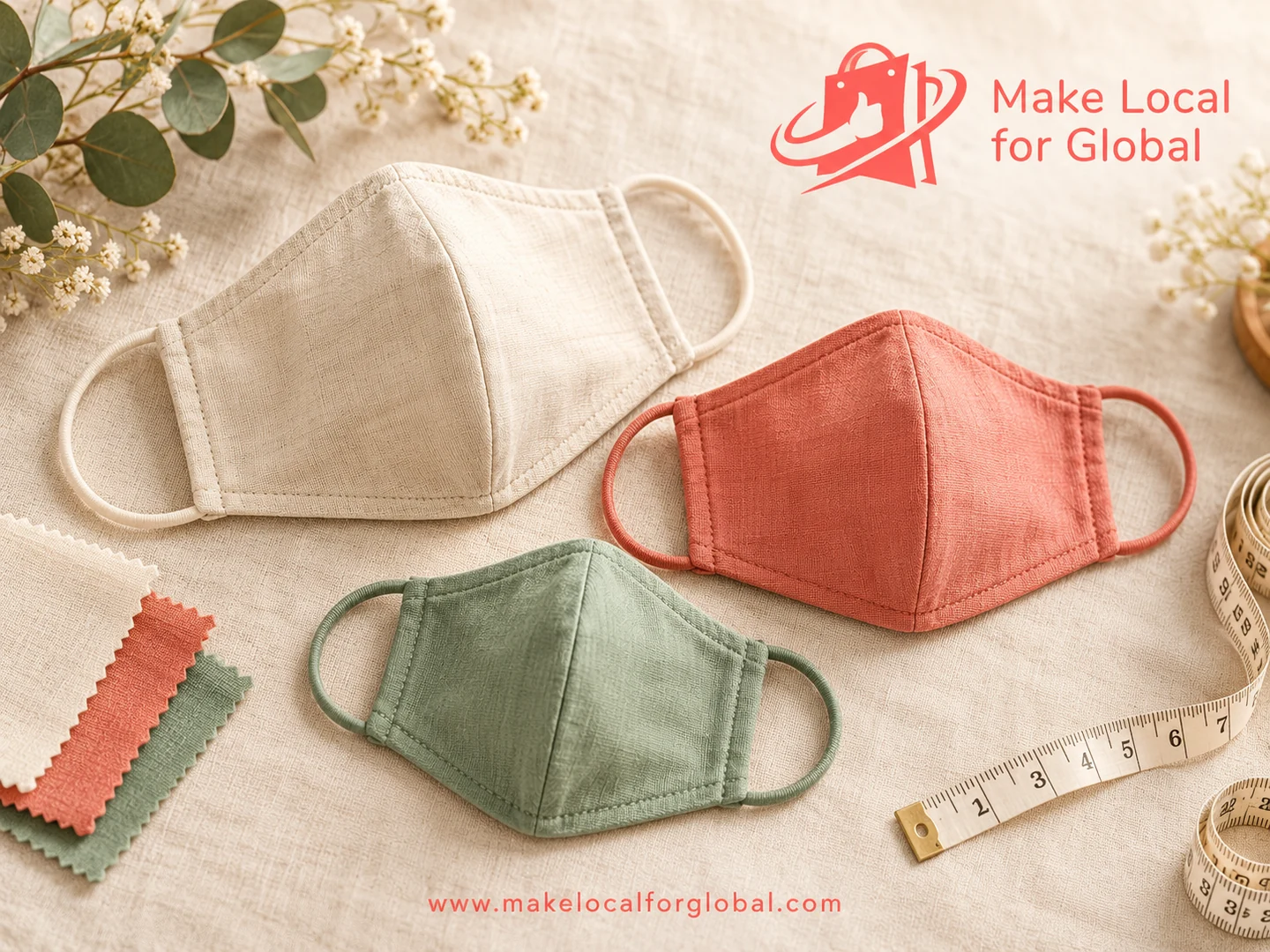
“Cotton” can refer to pure cotton or a blend. Check the product composition and keep the supplier’s specification. A product may include cotton outer fabric, another lining, elastic loops, thread, a nose component or a filter pocket. A buyer’s idea of “100% cotton” may include the entire product, so be exact about which components use which fibres.
Ask how many fabric layers the product has and how the seams, folds, edges and straps are made. A sample should match the planned production process. If a pocket or removable layer is part of the design, state what is included and what is sold separately. Do not imply that an extra layer or filter pocket proves protective performance.
Consider how the fabric behaves after washing. A material may shrink, wrinkle, fade or soften. Ask whether the fabric was prewashed and whether the maker has repeat wash results. Cotton content alone does not determine comfort, fit or durability. The construction and the wearer’s needs matter too.
Use measurements rather than vague labels such as “one size fits most”. Record the finished width and height at specified points, plus strap length or adjustment range. Explain how the measurements were taken. A diagram can show where to measure, and a ruler beside a sample can help with scale.
Test a sample on more than one adult face shape where practical. Note whether the covering rides up, slips, pulls on the ears or leaves the wearer unable to speak comfortably. This is a fit check, not a protection or medical efficacy test. Tell shoppers that facial shape varies and show the sample dimensions so they can decide for themselves.
If you plan a children’s size, treat it as a separate development and compliance question. Do not assume an adult product can be scaled down safely. Review applicable product safety, child-directed marketing and age suitability. Seek expert advice before presenting a face covering as suitable for a child.
If your shop is comparing other textile products, see our seller guides to compression shorts and crib bedding for useful examples of presenting fit, fibre details and size information. Our guide to cotton swabs covers another cotton product category with different safety and use questions.
The sourcing route affects cost, stock control and your responsibilities. A local maker may be easier to talk with and may accept a smaller first run. A wholesaler can supply ready-made sizes, but you still need to inspect the claims and composition. An overseas manufacturer can offer custom patterns or prices, yet import lead time, quality control and documentation add work.
| Sourcing route | Potential advantage | Questions to resolve |
|---|---|---|
| UK sewing studio | Small production run and direct sample feedback | Who supplies the fabric, how is fibre content verified and what is the defect policy? |
| UK textile wholesaler | Ready-made stock and shorter replenishment route | Can it provide composition, maker details and batch consistency information? |
| Overseas factory | Custom shape, print or larger quantity | What import, labelling, product safety and inspection duties apply to your role? |
| Own sewing workshop | Direct control of pattern and finish | How will you document materials, repeat quality and product safety checks? |
| Print or embroidery provider | Adds branding to a base product | Does the treatment change wash care, fibre claims or the product’s intended use? |
| Commissioned designer and maker | A recognisable pattern or fit | Who owns the artwork, pattern, images and right to repeat production? |
Ask for the supplier’s business name and address, product code, fibre content by component, fabric source, origin where known, batch or production reference, minimum order, lead time, repeat-order process, sample policy and defect remedy. Ask for written care guidance and any test records that support claims on the product or packaging.
If the product has an adjustable strap, lining, filter pocket, nose detail or printed finish, ask whether a material or process changes between batches. Confirm what the buyer receives, whether filters are included and what is meant by “washable”. Get an exact description of the sample and production version so that a later batch can be checked against it.
Do not accept a supplier’s generic certificate without checking which product, material, use and market it covers. If it is an imported product or you sell it under your own brand, your duties can differ from a retailer’s role. A supplier statement alone may not discharge your legal obligations. Use OPSS product safety advice for businesses to understand the relevant responsibilities, then ask a qualified product safety adviser about your product.
A printed character, sports logo, slogan, artwork or branded pattern may need a licence. Ask who owns the design, whether the supplier has permission to manufacture it, which countries and channels the licence covers, and whether your listing photos may show it. Keep the agreement and approved image files with the product record.
For a pattern you commission, put ownership and permitted use in writing. Clarify whether the maker can sell it to other shops, whether you may adapt the artwork, who stores the print file, and what happens if the supplier cannot continue. GOV.UK’s guidance on copyright and using someone else’s intellectual property explains the basics; seek specialist advice where a design or mark could be protected.
Give each style and size a stock code. Store the supplier, invoices, fabric composition, sample photos, measurements, wash results, approved copy, label artwork, safety correspondence and batch history in one record. Note the date when the fabric, lining, print, strap or manufacturing site changes. Keep records that let you identify which orders used each batch.
If a customer reports a problem, the record helps you check whether it concerns one item, a particular supplier batch, a seam, a care instruction or an expectation created by the listing. It can help you respond and decide whether to pause a listing, replace stock or contact the supplier. A short record made during inspection is more useful than trying to recreate the details later.
Order physical samples from your preferred suppliers. Compare them under the same light and with the same measurements. A photo on a supplier page cannot show the feel of the fabric, seam strength, strap comfort, shrinkage or colour after washing.
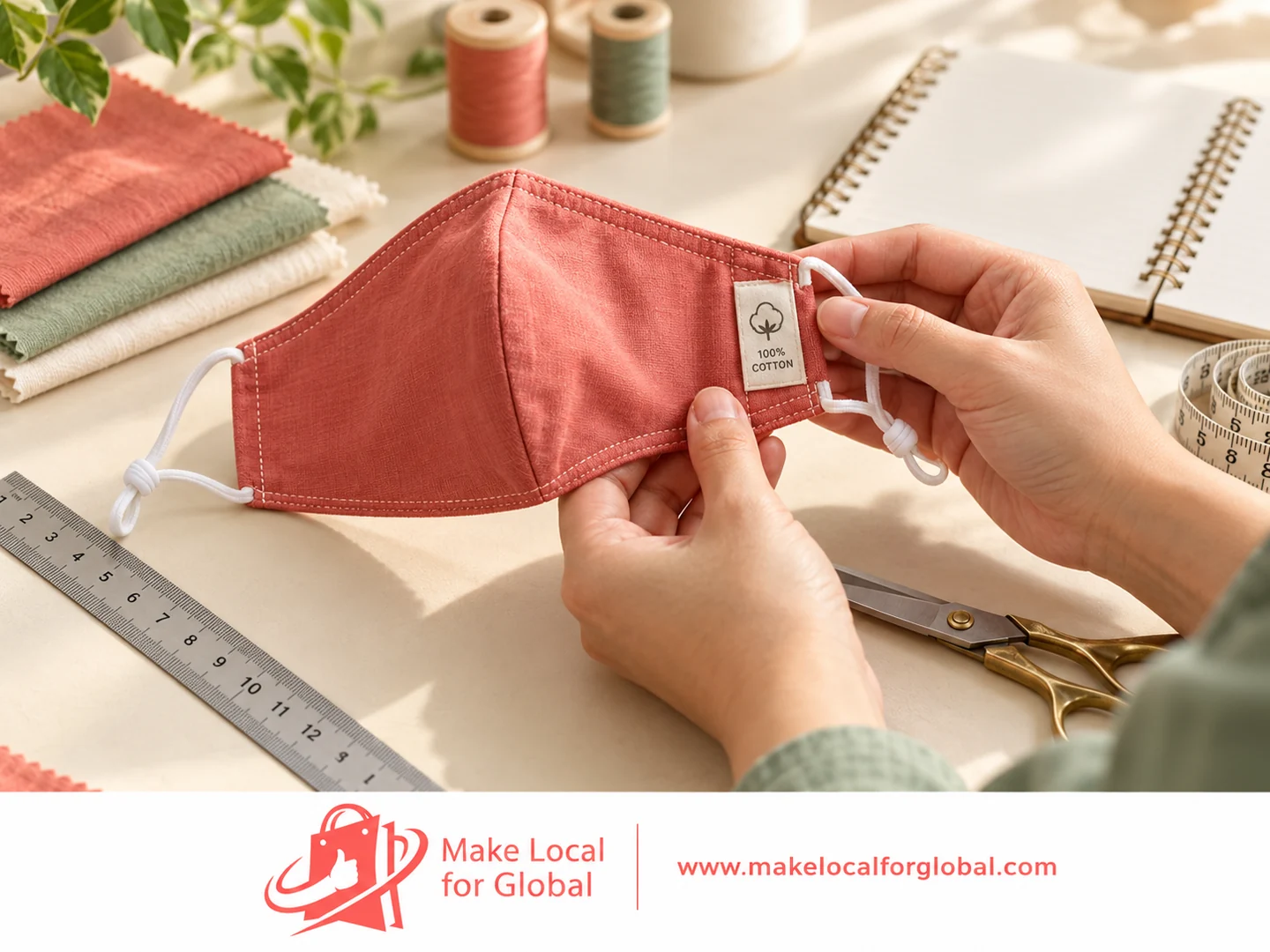
Inspect each style and size with a written list. Compare the result with the approved sample and supplier specification.
Decide your pass criteria before buying a run. A seam that opens during ordinary handling, a loop that detaches or a composition mismatch may justify rejecting a batch. Agree with the supplier what surface or print variation is acceptable. Describe genuine variation in the listing rather than promising every piece will look exactly alike.
Use the same method for each sample. Record the tester’s face measurements only with their agreement and keep personal details private. You may avoid collecting identity details by assigning a simple test code. The goal is to learn whether the stated size and adjustment give a comfortable ordinary fit across the sample group.
Check that the covering stays in the described position during ordinary movement, does not press uncomfortably on the ears, and can be put on and removed as intended. A successful fit check does not establish medical or protective performance. Never convert an internal comfort test into a claim about disease prevention, filtration or workplace PPE.
If one size does not suit all testers, refine the measurements and offer another size, strap length or adjustment option. Explain the dimensions on the product page and invite the customer to compare those with their own requirements. Avoid “one size fits all”.
Ask the maker for the care instructions and the basis for them. Wash one sample using that method and record the result. Repeat the cycle enough times to see whether the fabric shrinks, the seams distort, the print fades or straps stretch. Record the temperature, detergent, drying method and count of washes used in your test.
Recommend boiling, bleach or hot washing only when the supplier’s guidance and your own test support that care method. A high heat setting may change cotton dimensions or damage elastic. If a detachable part or filter is included, state whether it must be removed before washing and whether it is supplied with the product.
The consumer-facing instruction should reflect the maker’s tested care advice. Do not present a limited sample test as a guarantee of indefinite reuse. If the product requires replacement after wear or damage, describe the signs the buyer should check and only use advice supported by the product specification.
Some products are sold with antibacterial, antimicrobial, antiviral or odour-control claims. These words can suggest that a biocidal product or treatment has been used. Ask the supplier what the finish contains, what records and approvals apply, which claims are authorised, and which country rules cover the product. HSE guidance explains biocidal product rules in Great Britain; Northern Ireland operates under a different arrangement for biocides.
If you cannot confirm a treatment and its permitted claims, do not use that wording. A plain cotton face covering can be marketed through verified design, composition, fit options and care details. Health-related copy is not a substitute for product evidence.
Face coverings can have a low unit price, but every order has packing, payment and delivery costs. A multipack may make postage more manageable; it ties up more stock and may need a larger parcel. Work out the cost of a single order before setting a headline price.
Include the covering, inbound delivery, import charges where relevant, labels, packaging, payment fees, marketplace fees, dispatch postage, customer acquisition, handling time, returns or quality allowance, and any discount. Record whether each cost applies per item, per order or per shipment. Add fixed overheads such as insurance and software in your broader plan.
| Illustrative two-piece order cost | Example | What to replace with your own figure |
|---|---|---|
| Two cloth coverings | £5.40 | Supplier invoice divided by saleable units |
| Inbound freight allocation | £0.80 | Shipment cost divided across received stock |
| Product sleeve and mailing pack | £0.55 | Materials used for this parcel |
| Selling and payment fees | £0.90 | Current fee basis for the channel and order |
| Outbound postage | £2.50 | Carrier quote for the packed parcel |
| Packing time and label | £0.65 | Time at a realistic hourly rate plus consumables |
| Returns and quality allowance | £0.40 | Update from actual defects and returns |
| Customer acquisition cost | £1.50 | Attributed promotion spend divided by first orders |
| Variable cost before VAT adjustments | £12.70 | Sum the items above |
Every amount is a fictional working example, not a supplier price or expected result. Replace each line with your own records. The return allowance should change as evidence arrives; it is not a promise that every product will cost the same to return.
Suppose a VAT-registered seller charges £18 including delivery for the two-piece pack. In a simplified example where the full amount is treated as a VAT-inclusive sale at 20%, the sale value before VAT is £15. If the £12.70 cost estimate is stated before any recoverable VAT adjustments, £15 less £12.70 leaves £2.30 contribution before fixed overheads, owner pay, tax and any unlisted costs.
This calculation is an illustration. VAT treatment for delivery, platform charges and each input can depend on your circumstances. Use the tax treatment for your business and ask an accountant if unsure. A business that is not VAT registered should not apply this VAT calculation; it should use the gross amounts it pays and receives.
Contribution is not net profit. If the seller spends another £2 to acquire the order or pays more for tracked shipping, the remaining amount falls. If the order is a single covering rather than a two-piece pack, fixed postage may make the contribution poor. That is one reason to compare bundles, free-delivery thresholds and local collection using real costs.
Choose a minimum contribution that can cover overheads and owner time. Compare the price with products that have a similar use, material, construction, size and number of pieces. An asking price is not proof that an item has sold at that amount or that the seller earns a profit.
Calculate the contribution again for a promotional price, multipack, wholesale quote and free-delivery offer. Include the postage in every case. If a group order takes more time to label and sort, cost that labour. Do not discount below the amount needed to deliver the promised item and service.
Use a cautious sales estimate. If you buy six prints in two sizes, count how many individual combinations you must store and label. A small quantity in each variation can still become a complex stock list. Ask the maker whether colours can be replenished and whether the fabric print run will match the sample.
Set a reorder point from actual sales and lead time, not a supplier’s best-case forecast. Track product code, quantity received, units sold, returns, defects and remaining stock. If one print sells and another sits, ask buyers what they wanted before you reorder both equally.
Clear size, fibre and care information helps visitors assess the covering before they order.
A cloth covering is light, but a thin mailing envelope can crease packaging or let a product become dirty. Use clean packing materials, protect each item from dust and moisture, and keep the label or care card easy to find. For multipacks, separate each piece so the buyer can count the contents and store unused items cleanly.
Choose a postal service from the dimensions and weight of the fully packed order. Check tracking, compensation limits, collection options, delivery estimates and the process for delayed or damaged parcels. Weigh a finished sample before setting a delivery fee; carrier prices apply to the parcel, not the bare fabric product.
Create a short packing checklist: confirm the product code and size, check colour and condition, count pieces, fold to the tested method, pack with the correct insert, confirm the buyer’s address and save tracking. Record any batch code when available. A second person should be able to use the checklist without guessing which parts or filters belong in the order.
Store clean products away from dust, odours, direct sunlight and damp. Keep returned items separate from new stock until you have inspected them. Do not sell a returned covering as new if its packaging is open or its condition cannot be confirmed. Set out how you handle returned products in your inventory records.
Show the handling time, dispatch days, postage cost, delivery estimate and destination limits before checkout. A ready-to-ship style and a custom group order have different lead times; put the right timeline on each listing. State how customers can contact you if an order is delayed, and tell them when a made-to-order product starts production.
Promise an exact arrival date only if your carrier arrangement supports it. If a group order depends on sample approval, agree the design, colour, price and schedule in writing before producing the full quantity. Keep the signed-off sample or photograph with the order record.
Many distance sales give UK consumers a period after delivery to cancel an order, followed by time to return it. The seller normally refunds within 14 days of receiving the return, including standard delivery. Read the GOV.UK returns guidance and the online and distance selling rules for the full requirements and exceptions.
The rules include a narrow exception for sealed goods that cannot be returned for health or hygiene reasons once unsealed. Do not assume every face covering qualifies. The product, its packaging and the facts of the sale matter. Get legal advice before relying on an exception, and never use an exception to deny a remedy for an item that is faulty or not as described.
Write a return process with a clear email or contact route, the information you need to locate an order, how a customer can ask about a fault, and what happens next. Keep the wording calm and specific. Do not tell shoppers that “no returns” apply to all situations.
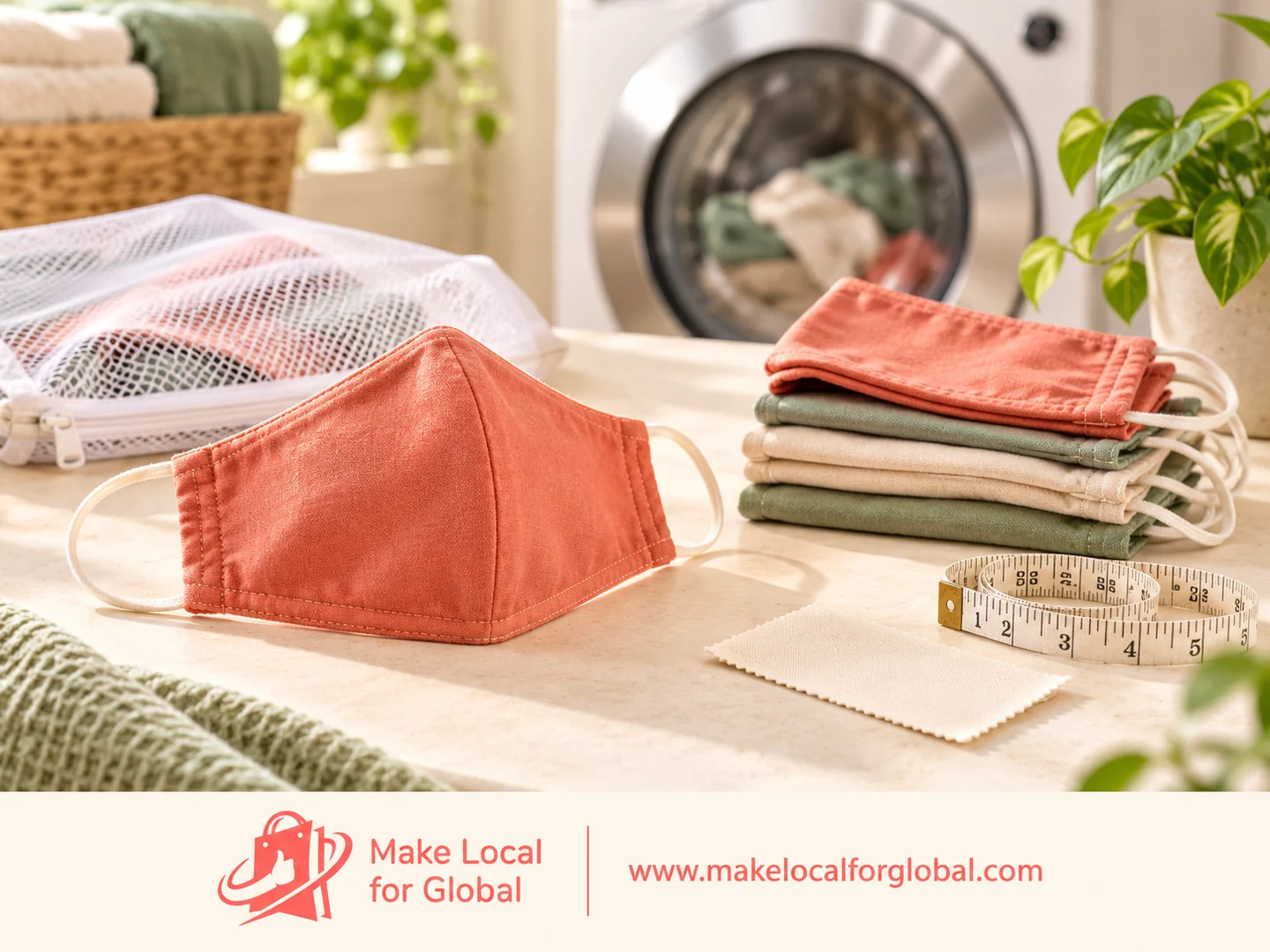
Buyers cannot feel the fabric or test the fit before ordering. A useful listing gives them measurements, fibre composition, fastening type, number of pieces, care advice, intended use and a clear set of photographs. Put the most important facts near the top instead of hiding them below general shop text.
Name the item, material and useful distinction. For example: “Washable cotton face covering, adult size, sage green, adjustable loops” tells a shopper what the item is. Use the phrase “cotton face mask” where it fits naturally for search, but pair it with an accurate statement that it is a general-use cloth covering if that is its intended category.
Avoid titles such as “medical-grade protection” or “antiviral face mask” until you have confirmed the classification and evidence needed for those statements. A title can be misleading even when the long description contains a disclaimer. Keep headings, photos, packaging and product claims aligned.
In England, Scotland and Wales, textile guidance says the label must show fibre content, and multi-component products with different fibre contents must show the content for each. Manufacturers and retailers share responsibility for accurate labelling. See GOV.UK textile labelling guidance. Northern Ireland has separate guidance aligned with the EU textile labelling rules; see NI textile labelling advice.
Ask whether the outer, lining, elastic, ties and any other textile parts use different fibres. Use only composition terms backed by the supplier’s records. If the outer is cotton and the lining is a blend, say so rather than describing the whole item as “100% cotton”. If your item is a custom sewn piece, check whether an exemption applies before leaving the label off.
If shoppers can order directly from a product page or advert, show required composition information in the online offer as well where applicable. Check the rules for each market where you sell. If you sell to Northern Ireland or overseas, verify the current labelling and product requirements for that destination.
Use consistent light so colours are close to the item shoppers receive. Photograph the front, inside, seams, ear loops or ties, adjustable parts, pocket and label where present. Include a ruler or dimension diagram. A face photograph can help a shopper see scale, but use only models who have agreed to appear and avoid editing that changes the product’s shape.
Include one photo of the product folded or packed if gift packaging or storage matters. Add a pattern close-up. For colour variants, keep camera settings and light similar; otherwise “sage” may appear grey in one photo and green in another. Tell the buyer when lighting or screen settings may cause minor colour variation.
Do not use the image of a tested sample to imply that every order has the exact same print or fit if production varies. Mark the image as representative when it is not the exact item. For a custom group order, show a sample and get approval for the final fabric and print before starting the run.
Open with one short paragraph that names the product and its intended consumer use. Follow with scannable details: fabric by component, size, fastening, colours, quantity, care, package contents, dispatch time and any variation. Explain whether it has a pocket and whether a filter is supplied. If no filter is included, say so in a visible place.
Give the buyer enough context to decide whether the fit suits their needs. Include the finished measurements, adjustment range and a clear sizing note. Do not promise “one size fits all”. If the item has a nose piece, state whether it is flexible or fixed only when you have verified the construction.
Use the maker’s tested care instructions and repeat them on the product page and any care card. State the washing and drying method that was checked. Explain how to inspect the seams and straps for wear if the supplier recommends that. Avoid telling a buyer that the item can be reused indefinitely.
Make it plain that an ordinary consumer cloth covering is not a medical device or PPE when that matches the product’s intended classification. Do not place a small disclaimer beneath a large conflicting “protection” headline. Be precise about use and evidence across the entire page.
Record questions from enquiries and orders. If people ask whether the set includes a filter, put that answer beside the product contents. If they ask whether the loop adjusts, add a close photo and the adjustment range. If buyers ask whether a children’s version exists, answer honestly and avoid suggesting an adult product should be used by a child.
Use questions to improve the listing rather than adding a generic FAQ copied from another store. A specific answer can prevent a mismatch and reduce unnecessary exchanges.
An online marketplace can bring shoppers who already search for fabric coverings or accessories. Your own shop gives more control over product details, customer service and the collection’s story. Craft events and local groups let people see fabric colours, but stock, payment and transport require planning. A wholesale order may suit a business or group buyer, but it changes the unit economics and production schedule.
| Channel | Useful for | Review before launch |
|---|---|---|
| Marketplace | Testing a few product styles where shoppers already browse | Current fees, prohibited claims, delivery tools, return procedures and listing format |
| Independent web shop | Explaining sizes, fibre details and repeat orders | Payment and platform costs, policies, accessibility and customer support |
| Local craft fair | Letting visitors compare fabric and patterns in person | Table fee, payment option, stock security and display cleaning |
| Business or group order | Coordinated colours, custom labels or repeated quantities | Written specification, sample sign-off, deposit, lead time and defect terms |
| Social storefront | Showing new prints to an existing audience | Current checkout rules, image permissions and order record process |
Start with a main checkout channel and one traffic source. Every extra channel requires accurate stock counts, current product copy, updated fees and messages to answer. If a small batch is listed in two places, keep a central stock sheet so the same covering is not sold twice.
Read the current seller guidance for the actual channel. Review prohibited medical claims, image requirements, category restrictions, textile composition fields, payment fees, delivery settings and how customer disputes work. Platform fees and rules can change; use its live seller documentation instead of an old forum post.
Do not assume a marketplace’s approval means your product is compliant. The seller remains responsible for what is written on the page and what is supplied. Keep a copy of the listing and the product documents for each batch.
Use search wording that describes the item: washable cotton face covering, fabric face covering, reusable cloth face covering, pattern, size or fastening. Use these terms naturally in a title, headings and description. Add fibre and measurements so the words correspond to real product facts.
Make short posts or emails that answer practical questions: how to measure a covering, how the adult sizes compare, what fibre blend is in each component, or what wash method was tested. Link each explanation to the matching item or size guide. Avoid repeated captions that make every style sound identical.
Ask for feedback after delivery without requiring a positive review. If someone reports a fit issue, check whether measurements and model photos made the size clear. If the product details were accurate but the customer chose the wrong size, use the question to improve the size selector and sizing diagram.
The legal category follows the product’s intended purpose, presentation and claims. A general consumer cloth covering is not automatically personal protective equipment (PPE) or a medical device. A product promoted to protect its wearer or to protect patients can fall into a different regime. A small disclaimer cannot cancel a headline, image or claim that gives a conflicting impression.
The Office for Product Safety and Standards (OPSS) guidance for businesses and individuals says face coverings are normally general consumer products when they are not presented as PPE or medical devices. If a seller markets a covering as protective equipment or a medical product, extra rules can apply. Read the OPSS face-covering guidance and the GOV.UK regulatory status overview before making claims.
The intended use matters. The MHRA borderline products guidance explains that purpose and mode of action help determine whether an item is a medical device. A maker unsure about status should seek specialist advice before the product goes on sale. Do not rely on a supplier’s casual description as legal classification.
Store supplier details, purchase records, component declarations, sample notes, label artwork, care instructions, product photographs, customer complaints and corrective actions together. Use a product code that appears on the stock sheet, order record and packing check. If a supplier changes the fabric or elastic, ask for written confirmation and inspect a fresh sample before treating the new batch as identical.
For Great Britain, start with the current OPSS product-safety advice for businesses. It explains that producers, importers, distributors and retailers have duties appropriate to their role. Northern Ireland follows a different product-safety route for many goods; check the relevant current NI requirements before shipping there. A seller importing finished goods should establish who is the importer and who keeps the technical records, rather than assuming the maker has covered every duty.
Describe measurable product facts: the fabric composition, finished dimensions, fastening, pocket, number of pieces and care test. Make claims about disease prevention, filtration, antiviral action, medical suitability or protection only with an appropriate legal classification and supporting evidence. A filter pocket does not prove that a covering filters particles. A fabric certificate alone does not establish finished-product performance.
Biocidal claims require further checks. If a product is treated with a substance said to kill or control organisms, review the HSE guidance on the UK biocidal products regime. Rules can differ between Great Britain and Northern Ireland. Ask the supplier for the precise treatment, authorisation details, permitted claims and market coverage. A fabric wholesaler’s catalogue wording alone does not support an “antibacterial” claim on your listing.
A buyer should be able to compare the product with another option without sending a message first. Use a title that names the product, material and main variation. A useful title could read “Cotton face covering, adult medium, sage print, adjustable ear loops” if each detail has been checked against the stock.
Use the first lines to state the intended general consumer use. Follow with a short specification list:
Use close photographs for stitching, edge finishing, label, pocket and fastening. A single front-on photograph cannot show a buyer how thick the fabric is or how the straps attach. Add a clear size diagram; avoid suggesting that an adult size will fit every face. Use captions to explain what each photograph shows, not to repeat search phrases.
If a shop offers several designs, provide a small comparison that reflects real choices. For example, compare the fabric print, finished measurements, fastening, pack size and care method. Do not rank one style as safer or more protective without evidence and an appropriate legal basis.
Keep option names plain. “Medium, blue floral, two-piece pack” is easier to compare than an internal code such as “Series 4B”. If the product is custom made, list the exact options a buyer may choose and the point at which changes are no longer possible. Save the approved artwork and fabric selection with the order.
Give only the washing and drying advice verified for the materials and construction. Check whether the elastic, print and stitching withstand the stated method. If the maker’s care label conflicts with an informal supplier message, pause the listing and ask for written clarification. Do not tell buyers that washing restores a particular level of protection before performance is assessed under the correct standard.
The article’s wash-test illustration shows a seller recording a care test. It is an example of process, not evidence that a particular product passed a test. Keep a dated note with the sample code, cycle, detergent, drying method, dimensional change and any observed damage. Repeat the check after a construction change.
This category may be affected by changes in public-health advice, customer routines and marketplace policies. Avoid investing in a large stock position based on a general belief that reusable products are popular. Test a defined audience and use case, then look at behaviour rather than likes alone.
Prepare three accurate product-page concepts for different patterns or use cases. Use the same price and pack size if you want to compare preference. Share them with a small relevant audience or use a low-budget advert that complies with the platform’s current rules. Track product-page visits, add-to-basket events, questions and paid orders for each concept.
Write the decision rule before the test. For example, order a small sample batch only if one concept receives a set number of qualified enquiries or pre-orders at a price that leaves the planned contribution. The threshold is your own business choice, not a benchmark that guarantees demand. If visitors leave after seeing delivery costs, test a different pack size or postal offer before buying more stock.
Make a weekly list of customer questions. Count how often a shopper asks about size, fibre composition, pocket, filters, washing or dispatch. If the same question appears repeatedly, update the product page near the relevant choice. Track exchanges and refunds by reason, not just as a total number.
For a fit issue, compare the customer’s selected size with your published measurements. For a colour issue, compare the supplied product with the photograph under neutral light. For a care complaint, check the batch record and care wording. Use this evidence to decide whether the listing needs a clearer photo, a different size label, a supplier discussion or a pause in sales.
Create short, factual content that answers one product question at a time: how the three sizes differ, what each component contains, how the loops adjust, how to read the care label, or what a two-piece pack includes. Link each item back to its matching listing or sizing page. Use health claims in promotional copy only with specialist regulatory evidence and the correct product status.
For search, use the words buyers use to identify the item, then make each phrase specific to the stock: “washable cotton face covering”, “adult fabric face covering”, or “cotton face covering with ties”. Do not create separate pages that differ only by a pattern word. A useful page should include original product photographs, accurate specifications and a reason for the option to exist.
Use the first month to test the product and the selling process. Keep the test small enough that a poor result does not leave a large batch of unsold stock.
Write down the buyer group, intended use, product status and one reason someone might choose the design. Ask three to five potential buyers which sizes, fastenings and pack quantities they would compare. These conversations are exploratory feedback, not proof of broad demand.
Order or sew a sample. Measure it, inspect the seams and components, test the stated care method, and request records for the fibre content. Confirm the permitted wording and label requirements for each UK nation you plan to serve. Do not make a protection or treatment claim from an unverified supplier statement.
Record landed unit cost, packaging, payment or marketplace fees, postage, labour, promotion and a realistic allowance for faults and returns. Calculate contribution at the planned price and at any discount. Decide what result would make you stop, change the offer or place a small reorder.
Choose a few options with a clear purpose. Assign codes and prepare accurate photographs, size details, fibre information, care wording and dispatch terms. Create a stock sheet before accepting orders.
Put the product on one primary checkout channel. Check the page on a phone, complete a test checkout if the platform permits, and confirm the dispatch message, payment, confirmation email and stock deduction. Ask a few relevant people to review whether the size and contents are clear; ask for honest feedback, not praise.
Use one modest source of traffic. Record spend, visits, questions, add-to-basket activity, sales and the selected variation. Keep the test dates and price with the results. Avoid changing price, image, audience and delivery offer all at once; you will not know which change affected the result.
Compare visits and orders by design, size and channel. Read customer questions and review any delivery issue, return or quality report. Recalculate contribution from actual invoices and time spent. Replace assumptions in the original cost sheet with observed figures.
Choose one action: reorder the option with supported demand, revise a confusing page, ask the supplier to correct a sample issue, test a different pack size, or stop the product. Write down the reason. A small test that prevents an unsuitable bulk order is a useful business result.
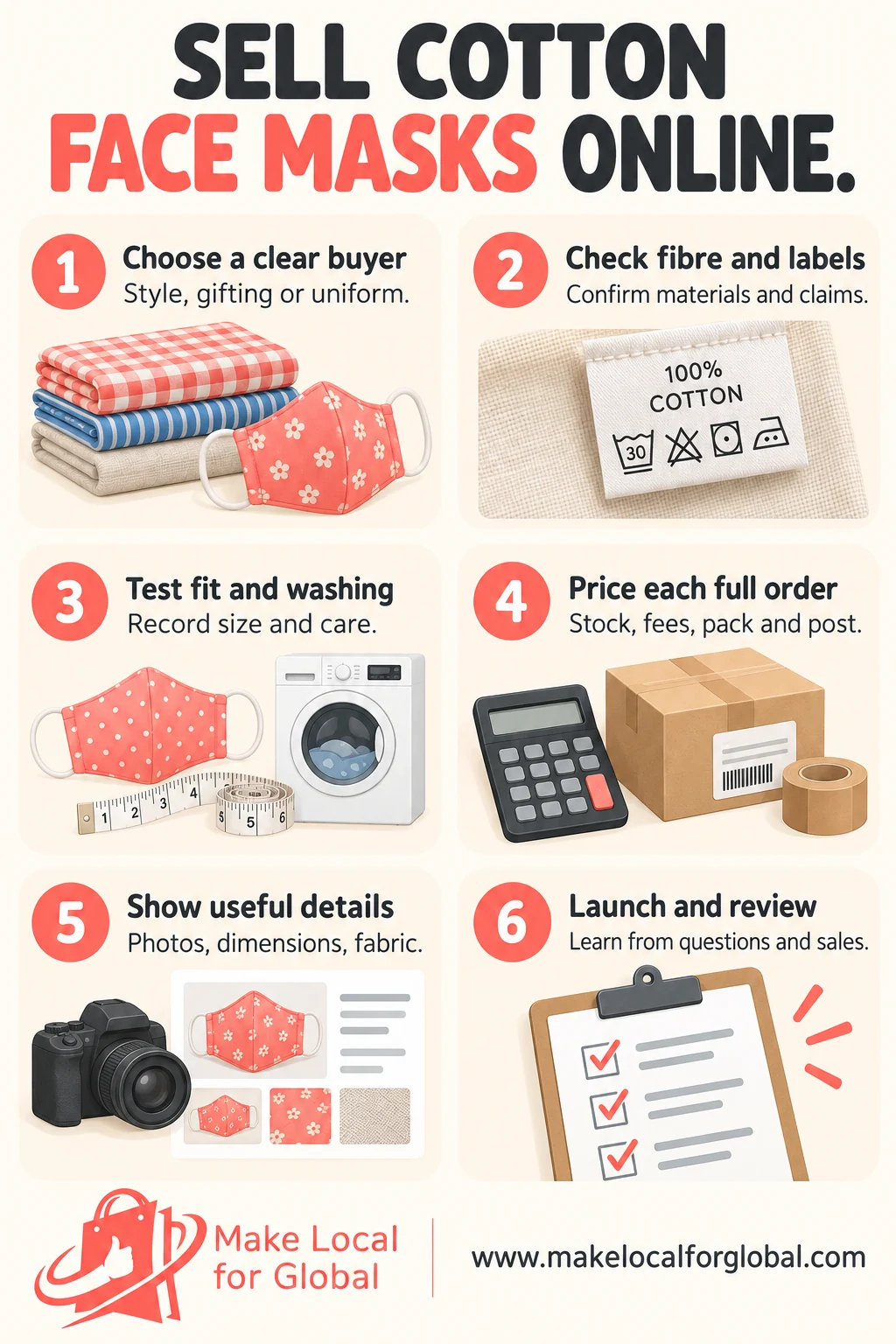
You can sell a consumer textile product if it meets the rules that apply to its design, claims, labelling, safety and destination. Check the intended product status and avoid presenting a general cloth covering as PPE or a medical device without meeting the relevant requirements.
Covering the face or containing cotton does not, by itself, make the item PPE. Intended purpose and claims affect classification. Check the OPSS and GOV.UK guidance and seek specialist advice before claiming wearer protection.
Do not use those claims without confirming the legal classification, required conformity steps and evidence for the finished product. A filter pocket or treated fabric is not, by itself, proof of protection or antiviral performance.
Textile labelling requirements apply to many products and vary by UK jurisdiction. Check the rules for the markets you serve, identify the fibre content of relevant components and give buyers accurate information before purchase where required.
Do not assume all face coverings are excluded from cancellation rights. A limited exception may apply to sealed goods that cannot be returned for health or hygiene reasons after unsealing. The facts and product matter, and statutory rights for faulty or misdescribed goods still apply.
Check finished measurements, fit on the stated size, seam strength, fastening comfort, fibre records, care performance, pack contents, parcel dimensions and supplier lead time. Recheck a sample after any fabric or construction change.
Start with the few options needed to test a clear buyer and use case. A small range reduces the number of stock combinations and makes it easier to see which pattern, size or pack receives interest. Expand only when orders or qualified enquiries support the change.
Before you buy stock, write a one-page product specification with the intended use, material by component, dimensions, fastening, care method, pack contents, claims, supplier and destination markets. Then test a sample and calculate the full delivered order cost. This turns a general product idea into a small decision you can check with evidence.
If you want an online shop that presents a focused collection clearly, explore MLFG website design or contact the team to discuss the scope of your project.
Once your sample, costs and product information are checked, set up a shop page that makes each choice clear.
PREFERRED SOURCE
Like what you’re reading? Add Make Local for Global as a preferred source on Google to see more of our articles when you search.

Build your online presence without having to figure out everything yourself.