

READY TO SELL coat racks ONLINE?
Get a store built for you in 5 days, plus training and support to help you start, run, and grow your Alternative business.

Learn how to sell coat racks online with buyer research, sample checks, clear dimensions, full order costs and a practical 30-day launch plan.


Coat racks look simple until a buyer has to choose between a wall rail for a narrow hallway and a freestanding stand that can move with them. For a new shop, the work is to build a small, safe range, prove the fittings and stability, and price the parcel before ordering stock.
To sell coat racks online, choose a clear buyer, compare wall-mounted and freestanding designs, inspect samples, publish exact dimensions and installation details, and calculate each order from landed cost through delivery and returns. Start with a few models that solve different space problems instead of filling a catalogue with near-duplicates.
Plan product pages around the room, fit and delivery questions your buyers need answered.
Begin with the space and routine the rack should serve. A renter in a small flat may prefer a compact rail that uses wall space. A family may need several sturdy hooks at different heights. A home stager may value a finish that suits a particular look. These are different jobs, so test which one you can serve and source well.
Ask five to ten likely buyers about their entryway, how many coats they hang at once, the wall or floor space available and what has failed with previous hooks. Show a simple product comparison and ask which detail changes their choice. Record the words they use. Those notes can shape listing headings and useful search phrases such as “wall mounted coat rack for narrow hallway” or “freestanding coat stand for small flat”.
A first range could include one compact wall rail, one longer family rail, one freestanding stand and one compatible add-on such as a matching hook set. Give each item a distinct purpose. Avoid adding five finishes until samples show which colours buyers can tell apart and your supplier can restock.
| Range role | Example | What buyers compare | First stock decision |
|---|---|---|---|
| Starter | Short wall-mounted peg rail | Rail length, hook spacing, included fixings | Test one finish and a small quantity |
| Core | Longer multi-hook rail | Number of hooks, overall width, coat clearance | Choose the size that suits the buyer interviews |
| Premium | Freestanding coat stand with broad base | Footprint, assembly, finish and stability | Order a sample before setting any load claim |
| Add-on | Matching wall hooks or spare fitting kit | Compatibility, contents and finish match | List only verified compatible parts |

For every model, check if it ships assembled or flat-packed, whether its hooks are fixed or removable, and whether wall fixings or assembly tools come in the box. A small dimension drawing can prevent a buyer from ordering a rail that is too long for the wall or a stand that crowds a walkway. The Product To Sell article library has more examples of product-range planning.
Compare UK wholesalers, local makers and overseas manufacturers. A local supplier may offer lower minimums or shorter replenishment times; an overseas order may change unit price, freight, lead time, import charges and the responsibilities you take on. Ask each supplier for the same details so the comparison is fair.
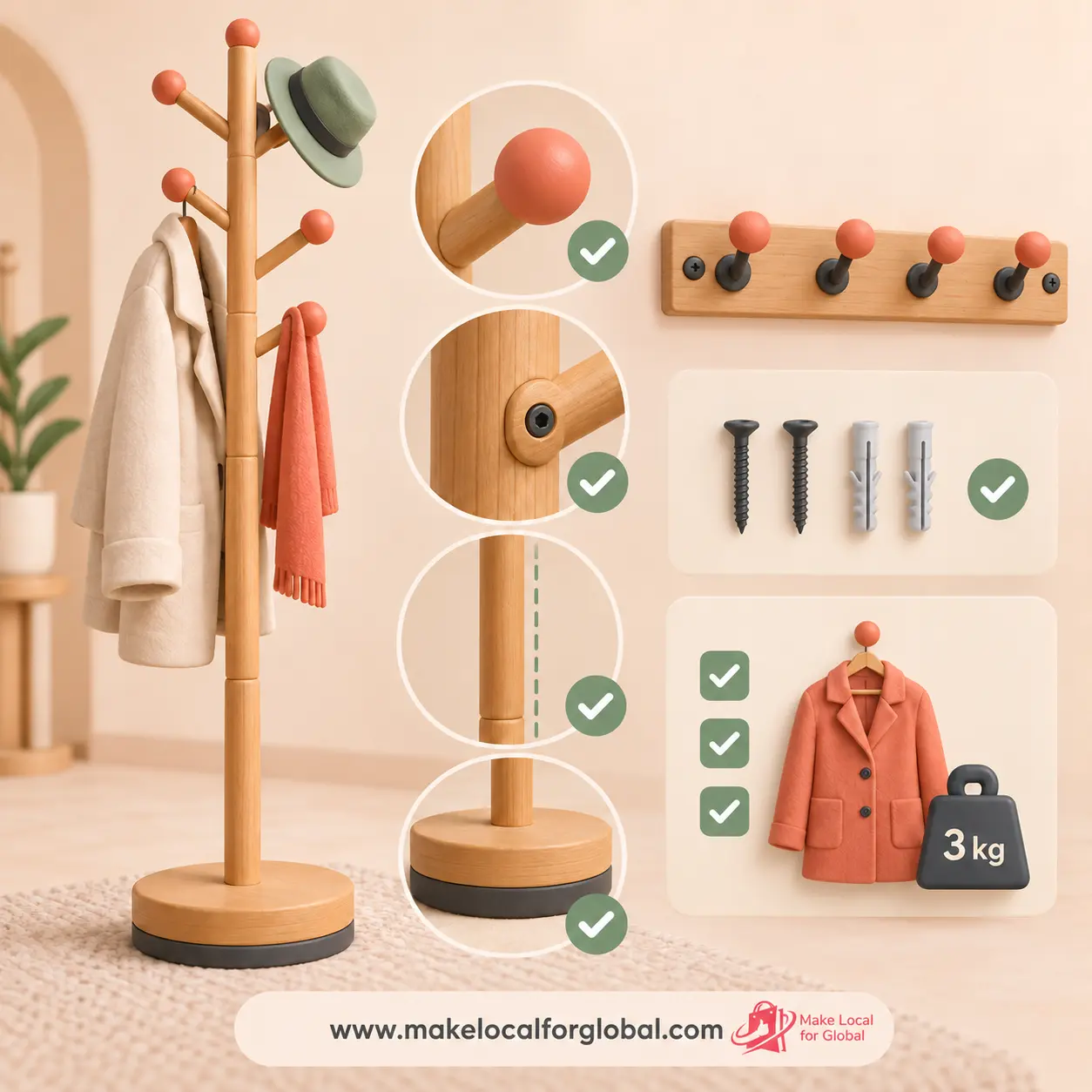
Inspect each sample as a buyer would assemble and use it. Check the surface for splinters, sharp edges, exposed burrs, cracked welds, loose hooks and uneven coating. Assemble it using the supplied instructions. Tighten every joint as directed, place it on a level floor, and check for rocking or parts that loosen during repeated use. For a wall rail, fit the supplied hardware into the wall type named by the supplier and check that the rail sits level and does not pull away during a careful, controlled check.
Do not publish a weight limit from a visual guess or one informal test. Request the supplier’s tested limit and test method. If you cannot verify a load statement, omit it and describe the product’s dimensions, materials, fitting method and care instead. Keep the sample, batch reference, supplier correspondence and dated inspection notes together.
In Great Britain, consumer products must be safe in normal and reasonably foreseeable use. The Office for Product Safety and Standards explains duties for producers and distributors under the General Product Safety Regulations 2005. If you make a rack, import it, add your own brand or distribute another maker’s product, check which duties apply to your role. Keep supplier and product records, use clear assembly and installation instructions, and act on a reported safety fault.
Rules differ for Northern Ireland. The EU General Product Safety Regulation 2023/988 applies there from 13 December 2024. Check the current rules for every market you sell into. Do not add a conformity mark unless a product-specific law calls for it and the product qualifies.
Before an online purchase, give buyers your business contact details, full price, delivery arrangements, cancellation information and a route to resolve problems. Read the current GOV.UK online and distance selling guidance and returns and refunds rules. Keep a clear returns process for a rack that arrives with a damaged finish, missing fittings or a part that does not assemble as shown.
Map the unit, freight, packaging, delivery, payment and returns costs before you commit.
Coat stands often have long poles and awkward legs. The carrier price can depend on the outer parcel dimensions, not only the item weight. Measure and weigh the packed box before publishing a delivery price. Use the following single-order example to see how all the pieces fit.
| Illustrative coat-stand order | Amount |
|---|---|
| Selling price | £69.00 |
| Unit cost plus inbound freight share | −£25.00 |
| Protective packaging | −£3.80 |
| Seller-paid delivery | −£7.50 |
| Example standard UK card fee | −£1.24 |
| Returns and damage allowance | −£2.50 |
| Customer acquisition test | −£8.00 |
| Contribution before overheads, labour and tax | £20.96 |
Illustrative figures, not supplier quotes. The card fee uses Stripe’s published rate of 1.5% plus 20p for a standard UK card on £69. Recheck your payment provider’s current fees. VAT, overhead, your labour and tax are not included. Contribution is not net profit.
Run another version with a discount, a damaged item and a customer-paid delivery option. Record the carton length, width, height and weight, then compare real carrier quotes. Add the cost of storage if cartons occupy shelf space, and consider whether a wall rail can use a smaller parcel than a freestanding stand.
Stripe lists a standard UK card fee of 1.5% plus 20p on its UK pricing page. Other providers and card types can cost more or less. For more help building your figures, use MLFG’s product pricing steps and startup budget planner.
A specific title is easier to understand than “Modern hallway storage”. For example: “Oak-finish wall-mounted coat rail, 60 cm, five hooks”. Use that wording only if the material, finish, length and hook count match the stock you sell.
Make photographs useful: front view, side profile, base, hook detail, assembled scale and the full set of parts in the carton. A dimension diagram can answer whether the stand fits beside a door or the rail clears a nearby shelf. Never stage the rack with more coats than the supplier’s instructions support.
Test pack one sample before buying packaging in bulk. Wrap coated or wooden parts so they do not rub against one another. Protect pole ends and base corners, keep screws in a sealed bag, and stop the parts from sliding along the box. Include instructions that match the exact model and fasteners.

Send a trial parcel through your chosen service and inspect it on arrival. Look for crushed corners, scuffed finishes, loose screws and parts that have shifted. Photograph the packed order before dispatch and keep notes on damage reports. If a component often arrives marked, improve the internal support before changing the product page.
A marketplace can help you test a few listings, though seller fees and category rules vary. Your own online shop gives you room for a comparison chart, installation notes and a full range, but you need a plan for bringing visitors. Start with the channel you can keep accurate and respond to on time.
Build a small search-focused page around questions buyers ask: “wall coat rack with five hooks”, “narrow hallway coat stand” and “how to fit a coat rail to plasterboard”. Use those phrases naturally in titles, headings and image descriptions only where they match the product. Add a short installation video, a measured hallway example and a comparison of wall and floor models. Track visits, add-to-baskets, completed orders, fit questions and damage reports. Use what buyers do to decide what to improve.

Choose the model that solves the clearest buyer problem and that you can inspect, explain and restock. A short wall rail is a practical first test for a narrow-hallway audience; add a freestanding model when buyer feedback supports it.
Check the finish, edges, hook joints, screws, assembly steps, base and supplied wall hardware. Set it up as directed and keep notes, photos and the supplier’s batch details.
Consumer products must meet the safety rules that apply in the market where they are sold. Ask the supplier for relevant evidence, assess the product and its foreseeable use, and get competent advice if your role or the applicable requirements are unclear.
Give overall dimensions, materials, finish, hook count and spacing, supplied fixings, assembly information, parcel details and returns terms. Use photographs that show scale, the base or wall rail, fittings and the full package contents.
Start with the item’s landed cost, then add packaging, delivery, payment fees, returns allowance and customer acquisition. The example above is a method, not a recommended selling price or profit forecast.
A good first coat-rack shop begins with one buyer and a few models that solve different space problems. Check the product, get the measurements right, cost the real parcel and use questions from the first orders to decide what deserves more stock.
Get help shaping an online shop around clear products, useful information and a practical launch plan.
PREFERRED SOURCE
Like what you’re reading? Add Make Local for Global as a preferred source on Google to see more of our articles when you search.

Build your online presence without having to figure out everything yourself.