

READY TO SELL Cocktail mixers ONLINE?
Get a store built for you in 5 days, plus training and support to help you start, run, and grow your Alternative business.

Plan a cocktail-mixer range with clear buyers, repeatable recipes, food-safety records, compliant labels, full order costs and a measured launch.


Cocktail mixers can mean a sharp citrus cordial, a spicy ginger syrup, a premium tonic, a ready-to-pour non-alcoholic drink or a shelf-stable powdered blend. That choice changes your recipe, packaging, food controls, postage and product page. A small seller has a better starting point when one buyer, one format and one clear use case shape the first range.
A sensible first route is to focus on non-alcoholic mixer concentrates or syrups. Choose a narrow flavour family, test the recipe and packaging with competent food-safety advice, confirm the label and online information, then price the whole delivered order. Sell alcoholic drinks only after checking the licensing rules for the product and fulfilment location.
This step-by-step plan covers the decisions behind a real first launch. Use the linked regulator guidance for your own product and location; a recipe that works in a home kitchen does not automatically have a validated shelf life or a compliant commercial label.
MLFG helps small businesses set up an online store and product pages. Review the store route, then decide whether it fits your product and budget.
The phrase spans very different products. A tonic water producer faces carbonation, pressure-rated containers and heavy parcels. A citrus cordial seller needs a dilution instruction, clear ingredients, allergen controls and a defensible date. A powdered garnish blend has a different moisture and packing risk. A seller should decide which product is actually being developed before pricing a brand, buying equipment or writing a listing.
A first range might include a concentrated syrup, a tasting-size bottle and a gift set using the same core syrup. The tasting size lets a new buyer try the flavour; the full bottle supports repeat use; the gift set can add a recipe card or a pair of glassware items. These formats share a recipe and ingredient supply, which keeps the first test manageable.
A second route is a dry mixer kit: a measured spice or botanical blend that a customer adds to a non-alcoholic base. It may be easier to post than glass and liquid, but it brings its own ingredient, allergen, moisture protection and instruction questions. Check the total ingredient list and storage behaviour with the supplier or food technologist.
Ready-to-drink cans or bottles look convenient on screen, yet they add more complexity. Carbonation, closure selection, microbial stability, process control, container compatibility, weight and packaging strength all need technical attention. Do not infer a safe process from a similar product on a shop shelf. Ask a qualified process specialist to review your exact formula, pack and method.
A useful first brief answers four questions: who will buy the mixer, what occasion will it serve, how will the buyer use it and why is this version different? “A small-batch blood-orange and rosemary cordial for alcohol-free supper-party drinks” is clearer than “premium cocktail mixers for everyone”. It gives a maker a basis for customer interviews, samples and photographs.
A home host may want one bottle that makes a special drink without a long list of ingredients. A designated driver may value an adult, bitter or botanical taste without alcohol. A gift buyer wants an attractive box, a reliable delivery date and a clear explanation of what is inside. A café or independent bar may need consistent flavour, dependable stock, wholesale pricing and a larger pour format.
These are different purchase jobs. One product page rarely answers all of them well. Write down what each buyer is trying to do, what might make them hesitate and what proof could help. A gift buyer may ask whether the package is ready to give. A café may ask how many serves a bottle produces. A home host may ask which sparkling water works with the flavour.
Choose the segment where you can collect honest feedback quickly. If you know local cafés, ask a few for a short tasting appointment. If your audience is mostly home hosts, show three prototype descriptions to a small group and ask which occasion, flavour and price they understand. Ask people what they would buy and why, then invite a real preorder only once you have checked that your production and fulfilment route can support it.
Keep interviews neutral. “Would you buy my brilliant new cordial?” encourages polite agreement. Try: “Which of these would you use?”, “When would you serve it?”, “What would you expect to pay for this size?” and “What would stop you ordering it?” Record exact phrases. Repeated requests for smaller bottles, no added sugar, a gift box or a clear dilution ratio can inform the product brief; a single enthusiastic comment does not prove demand.
Use a simple evidence sheet with buyer, occasion, current alternative, likely objection, target format and next test. The point is not to forecast sales from a handful of conversations. The point is to find a specific uncertainty that a sample, landing page or café trial can address before stock is committed.
A compact opening range is easier to make consistently, photograph and describe. Three flavours can give shoppers a choice without making stock control difficult: one bright citrus option, one fruit-led option and one herb, spice or bitter profile. The names should tell the shopper what the flavour is. Poetic brand names can sit beside a plain description, not replace it.
Consider whether a customer wants a single bottle or a discovery set. A three-flavour box can make a strong gift, yet it has a higher packed weight and may raise the cost of fulfilment. A single bottle is simpler to test, but delivery can feel expensive compared with the item price. Model both before choosing the public offer.
Use sizes that map to real usage. If one 250 ml bottle makes a certain number of serves at a tested dilution, show the arithmetic and the assumptions. For example, a bottle used at 25 ml per drink yields ten servings before spillage or taste variation. Do not advertise that yield until the dilution has been tested with your actual recipe and the instructions are clear.
A practical range ladder can be:
The ladder must have a reason. Do not make the gift box a larger version with no added value. Add a tasting card, serving suggestions or a considered presentation, then include the extra pack and labour in its cost. Keep the buyer’s choice simple and make the differences easy to compare.

A repeatable recipe needs written measurements, an ingredient specification and a production record. Record ingredient brand or supplier, lot number, quantity, preparation steps, equipment, batch yield, finished appearance, taste notes and the person who completed the batch. If an ingredient changes, make a new trial record rather than assuming it behaves exactly like the prior one.
Taste on its own and in a finished serve. Mix the syrup with the recommended liquid at the stated ratio. Check whether the flavour is still recognisable after dilution, whether it clashes with garnish, whether sweetness or acidity feels balanced, and whether the colour changes during storage. Use a consistent glass, liquid, ice amount and tasting temperature for each comparison. Ask tasters to note what they actually perceive rather than giving them the answer you hope to hear.
If you offer several use suggestions, test each one. A cordial that works with sparkling water may taste too sweet with tonic. A spicy blend may be clear in a warm drink but muddy when chilled. State a favourite serve, then list alternatives only when they have been tried.
Use a blind comparison where possible. Prepare two or three coded samples and vary one feature at a time: citrus source, sweetness level or dilution ratio. Ask tasters to rank preference and note the reason. Keep the sample count small enough to review and write down what action each result supports. This is product feedback, not a public health safety test.
Taste consistency and food safety are different checks. A recipe can taste fine and still need controls for microbial growth, contamination, allergens or storage. Do not use smell or appearance as a method to decide whether a product is safe. Build food safety decisions into the process with your local authority and an appropriately qualified specialist.

There are three common routes. A maker can produce small batches, use a contract manufacturer or source a finished product for resale under an agreed brand arrangement. Each route changes cash requirements, control and responsibility. A product made by someone else still needs accurate descriptions, suitable supplier records and a clear record of who is responsible for each part of the food business.
Small batches give direct control over flavour and can help a founder learn which recipe customers prefer. They can take more time per bottle, make record keeping harder when the process changes, and require appropriate premises, equipment, hygiene training and food-safety systems. Check whether the domestic kitchen, storage and production setup can meet the local authority’s expectations before taking commercial orders.
Write a process flow from receiving ingredients to dispatch: delivery inspection, storage, preparation, cooking or mixing, filling, sealing, cooling if relevant, labelling, finished stock storage and order packing. At each step, identify what could go wrong and what control, monitoring and record would address it. The method must match the real product; generic checklists do not replace a product-specific hazard assessment.
A manufacturer may offer tested production equipment, larger batches or a route to repeatable output. Request a written specification for the exact formula, process, pack, minimum run, lead time and change-control approach. Ask who supplies each ingredient, who approves substitutes, how allergens are managed, what batch records you receive and how a complaint or recall would be handled.
Request sample references and supporting documents for the exact finished product. Ask whether any shelf-life or process evidence applies to your intended storage, packaging and distribution conditions. A certificate for a facility does not automatically prove the recipe, closure or transport conditions are right for your product.
Resale can reduce formulation and manufacturing work, but it can narrow your control over recipe, packaging and availability. Get permission for brand use, photography and product claims. Confirm that the supplied label and online product data are current and that your own website will display required food information before checkout.
For every model, know the point at which ownership, stock risk, returns and customer service move from one party to another. A supplier’s promise to post an order does not remove your need to handle customer complaints or maintain clear product records. Put responsibilities in writing before launch.
A supplier conversation should uncover both the positive case and the limits. Ask for a written product specification, complete ingredients, allergen statement, current label artwork, storage instructions, net quantity, batch coding method, date-marking approach and evidence for any claim used in sales copy. Ask how changes to ingredients, process or packaging will be notified.
For a packaging supplier, confirm the bottle’s intended use, closure fit, tamper-evident option, shipping carton compatibility and written suitability for contact with the actual drink. Ask whether the chosen liner, cap and label adhesive suit acidic, sugary or oily contents and the expected storage conditions. “Food grade” without a specification or intended-use statement is not enough for a product record.
Request sample quantities and shipping costs. A low unit quote can hide high minimum order quantities, setup charges, import duties, delivery fees, pallet storage or a long re-order time. Ask whether quoted prices include VAT, whether they change by volume, which costs are one-off and which recur for every run.
Create a supplier comparison with columns for unit price, minimum quantity, sample cost, lead time, shelf-life evidence supplied, allergen support, packaging documents, returns for defective stock, payment terms and back-up route. Do not choose from unit price alone. One dependable supplier with a higher price can be safer for a first test than a bargain order that uses up most of the cash before a customer has tasted the product.
Keep a sample log. Photograph the parcel and label, note the delivery date, check for leakage or damage, compare the supplied item with the agreed specification and record questions. Keep invoices and correspondence with the batch records. If the product or packaging differs, stop and resolve the change before writing a public listing.
If you produce, store, handle or sell food, the business may need to register with the relevant local authority. The Food Standards Agency says a new food business or a business taking over an existing one should register at least 28 days before trading or before food operations start. Home-based and online sellers are included. Check the registration route for your local authority and product. Register a food business.
Registration is not a product approval or a guarantee that a particular recipe is safe. You need food-safety procedures based on HACCP principles that fit the food and process. For a small food manufacturer, the FSA’s MyHACCP tool can help build a documented system. A simpler retail process may fit a different pack, and Northern Ireland has separate support material. Ask the local environmental health team which guidance fits your operation.
List the hazards for each step with a competent person: biological growth, chemical contamination, physical fragments, cross-contact with allergens, cleaning chemicals, water quality, glass breakage, packaging failure and incorrect storage. Write the preventive control, the monitoring method, the record and what happens if the control fails. For example, if a batch falls outside the specified process temperature, the record should say how the batch is isolated and who decides its status. Do not invent a critical limit; it must come from a suitable food safety assessment.
Keep cleaning records, staff training, equipment checks, ingredient and packaging supplier details, batch sheets, complaints, product changes and corrective actions. Identify how a batch can be traced from raw materials to every order that received it. A lot code should link to the production record and supplier lots, not be a decorative string without a lookup process.
If you sell through a website, online sales do not sidestep food law. Food information needs to be available to the customer before the purchase and with the delivered food where applicable. The government’s distance-selling guidance for food information explains the distance-selling requirements and exemptions. Build this into the product page and checkout workflow before the first listing goes live.
Shelf life is not a branding decision. It depends on product characteristics, recipe, process, packaging, storage temperature and foreseeable use. A shelf-stable syrup, fresh juice blend, refrigerated mixer and dry mix have different risk profiles. The FSA’s MyHACCP guidance says a seller should think carefully about shelf life and may need testing to verify that the product performs as expected through the proposed period. See its page on describing a product and setting shelf life.
Do not copy a competitor’s “best before” date. Do not set one by tasting the bottle after a few weeks in a domestic fridge. Ask a food technologist or laboratory with relevant experience to advise on the evidence needed for the actual formula and production process. Tell them whether the product is opened or unopened, chilled or ambient, shipped warm or chilled, and how a customer is expected to store it after opening.
The specialist may recommend microbiological or other testing, review of process controls, packaging checks, storage trials or a combination. Keep reports with the version of the recipe and pack they cover. A reformulation, cap change, bottle size change, process change or storage instruction change can affect the evidence. Ask what needs to be repeated before making the change.
Translate the supported result into clear customer wording: storage temperature before opening, refrigeration after opening if required, a date mark, time to use after opening when supported, and a plain instruction not to consume if the closure is damaged or the product has been mishandled. Include dispatch controls that fit the chosen product. Never imply a parcel can stay at room temperature if the recipe requires chilling.
For most prepacked food sold in Great Britain, the seller must show information such as the name of the food, date mark where required, necessary warnings, net quantity, ingredients where there is more than one, relevant origin information, a lot number or date, special storage conditions, instructions where needed and the appropriate business name and address. Check the exact rules for your product and destination with current official guidance: GOV.UK food labelling: what you must show.
A food website has a second job: it must help the shopper make an informed choice before payment. Put required information on the product page in a readable format, not only in an image of the back label. Keep the page aligned with the bottle. If an ingredient, allergen, quantity, pack or storage note changes, update the public page and the printed information together.
Use the supplier’s current specification and your actual recipe. Do not copy an ingredient list from a previous production run if the supplier has changed a flavour, stabiliser or garnish. If a product contains one of the 14 regulated allergens, the name must be highlighted in the ingredient list in the way the rules require. Check the FSA’s allergen guidance for food businesses and the current requirements for distance sales.
A “may contain” statement is not a substitute for managing cross-contact. Record where ingredients are stored, how utensils and equipment are cleaned, how production runs are separated and how staff receive updates. Ask a qualified adviser about the exact risk and wording. Never promise “allergen-free” from a casual kitchen check.
Add a clear ingredient and allergen panel to the online listing. If your platform has a separate allergen field, use it, then make sure the information appears before checkout and remains available after the order. A photograph of tiny type can be hard to read on a phone and should not be the only route to the information.
State the legal or accurate customary name of the food and its net quantity in metric units. Avoid an attractive title that hides the product format. “Rosemary Citrus Cocktail Mixer Concentrate, 250 ml” is more useful than “The Garden Party”. Put the brand name and evocative flavour title beside a plain description that makes the contents clear.
Give dilution instructions using measured units and explain the recommended serve. Show whether the customer adds still water, sparkling water, tonic or another ingredient. If one bottle is presented as ten serves, state the tested serving size behind that number. Use a small chart or recipe card if it helps, but keep the key instruction in accessible text.
Food claims must be accurate and supported. The government guidance says nutrition and health claims are regulated; do not suggest a syrup prevents, treats or cures a disease. Use a nutrition or health claim only when the product and wording meet the current conditions. See GOV.UK guidance on nutrition and health claims.
If you sell an alcoholic ready-to-drink product, check the rules for the exact formulation and sale route before listing it. Retail alcohol sales are licensable in England and Wales; remote sales bring additional questions about the licensed premises and age checks at delivery. Rules differ across the UK. The Home Office’s current alcohol licensing guidance and local licensing authority should be consulted. A non-alcoholic mixer article should not imply that selling a bottle of spirits is the same as selling a syrup.
Packaging should match the contents, temperature, delivery route and customer’s first impression. A clear glass bottle can display colour and feel giftable, but it adds weight and breakage risk. A food-compatible plastic bottle may reduce weight, yet it must be suitable for the specific product and storage conditions. A can may work for a qualified ready-to-drink process, but it is not a plug-and-play container for home carbonation.
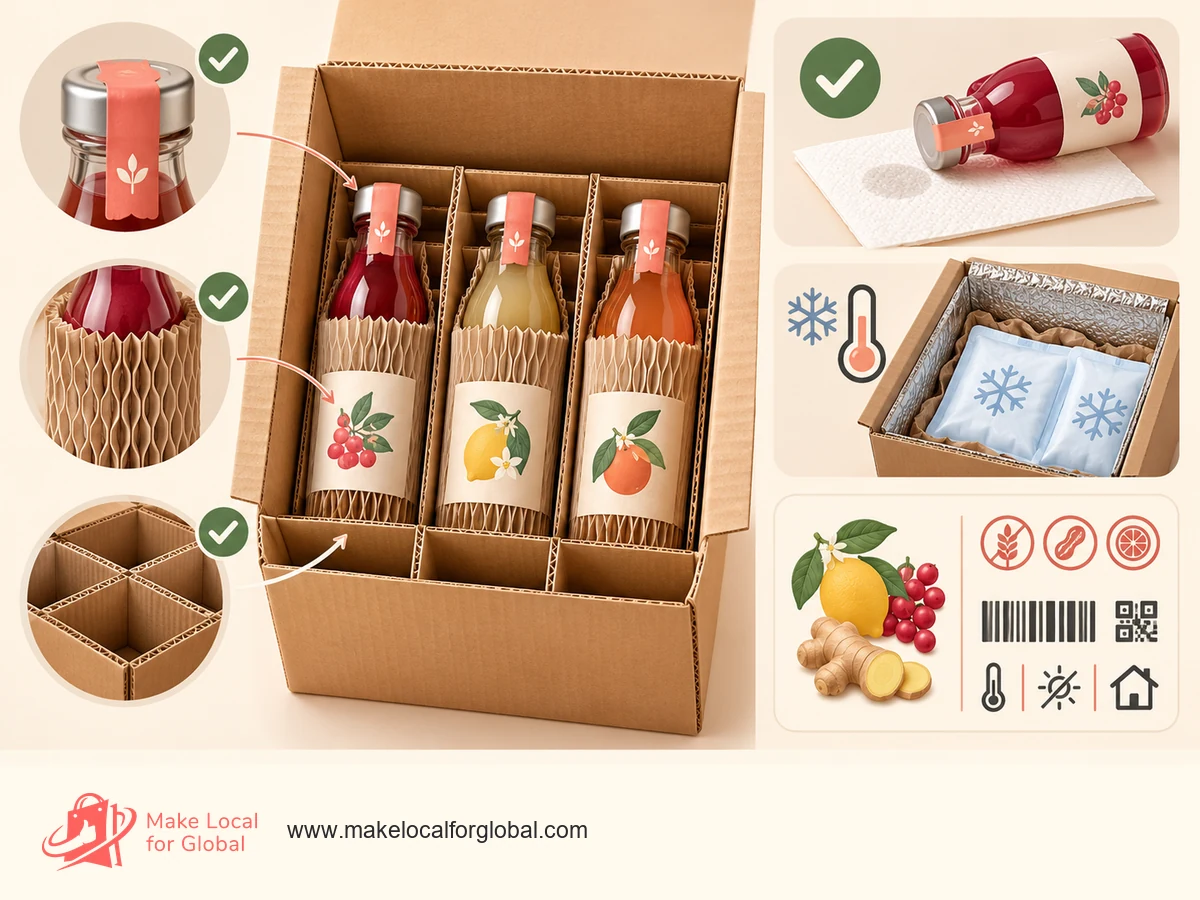
Ask the packaging supplier for documentation covering the food contact use and intended conditions. Check bottle, cap, liner, seal and label together. A closure that fits an empty bottle can leak when the syrup is warm, acidic, stored on its side or shaken in transit. Test a finished, filled pack under advice appropriate to the product rather than assuming a static shelf test covers delivery.
For glass, consider a formed insert or divider that stops movement and separates each bottle. Test the full packed parcel for drop and vibration risks with a repeatable method that reflects your carrier and pack. A successful single parcel is a starting observation, not proof that every configuration works. Record which carton, insert and bottle combination was tested.
For liquid, seal and leak controls matter. Use a closure suitable for the product, a tamper-evident feature if appropriate, a protective bag or wrap, absorbent material where helpful and secondary containment that keeps a leak away from other parcels. Do not pack chilled food without a dispatch plan that can hold the required temperature through a realistic delivery delay.
Put the product, filler card, recipe note and any promised gift element in a fixed layout. Photograph a packed order and create a one-page packing instruction. That makes the experience repeatable when a helper packs orders. Keep packaging materials clean, dry and stored away from ingredients, floor splash and chemicals.
A bottle’s ingredient cost is one line in the calculation. Include the bottle and closure, label, production labour, inbound transport, outer parcel materials, pick-and-pack time, postage, selling fees, customer acquisition and a realistic allowance for leaks, damage or returns. Add fixed costs such as testing, insurance, equipment, website, registration-related business expenses and design to the broader cash plan.
The worked example below is illustrative only. It assumes one 250 ml mixer sold directly to a UK customer at £14.95, a seller not registered for VAT, and no VAT recovery in the listed costs. Actual VAT treatment depends on the product and business circumstances. Confirm it with HMRC or an accountant before setting a price. Some costs vary by parcel, sales channel and order size.
| Cost per order | Illustrative amount | What the seller checks |
|---|---|---|
| Ingredients and measured production loss | £1.40 | Recipe cost plus a small process-loss allowance |
| Bottle, cap and tamper-evident seal | £0.85 | Exact package size and closure |
| Label and serving card | £0.45 | Print run, stock and finishing |
| Direct production labour | £1.10 | Time for preparation, filling, cleaning and record keeping |
| Inbound freight allocated per bottle | £0.35 | Supplier delivery spread across the batch |
| Protective parcel packaging | £0.65 | Box, insert, bag, wrap and tape |
| Customer postage | £3.60 | Tracked service for the packed weight and destination |
| Payment fee allowance | £0.57 | Example set at about 3.8% of the item price; confirm actual fee |
| Customer acquisition test | £1.50 | A small test cost allocated to this order |
| Leak, damage and service reserve | £0.40 | A planning reserve, not a prediction |
| Estimated variable cost | £10.87 | Add the listed costs |
Illustrative planning figures only. Replace them with your current supplier, payment and delivery costs.
At £14.95, subtracting £10.87 leaves £4.08 contribution before fixed overheads, income or corporation tax and any VAT adjustment. It is not net profit. If the customer receives free delivery, the £3.60 postage stays in the seller’s calculation. If a two-bottle order uses one parcel, recalculate the shared packaging and postage per bottle rather than copying the single-unit amount.
If the store has a fixed monthly cost, estimate the number of orders needed to cover it: fixed monthly cost divided by contribution per order. If a hypothetical fixed cost is £120 and the contribution remains £4.08, the arithmetic is 120 ÷ 4.08, or about 30 orders before other fixed costs and tax. This is a simple planning ratio, not a sales forecast.
Run at least three scenarios: a single bottle, a two-bottle bundle and a three-flavour gift set. Add discount, marketplace fees or an ad cost to the relevant route. Do not use an average order value assumption without evidence. Keep your supplier quote, fee schedule and postage quote beside the model and update them when rates change.
A free-shipping threshold can lift order size, but it can erase contribution if it is set from a competitor’s offer. Check the actual parcel weight, bottle count, carrier service, breakage risk and cost. A shipping charge should be visible before checkout. A buyer should not discover a large delivery cost only after giving an email address.
Use MLFG’s Private-label Simulator to compare a few hypothetical batch, unit-cost and sales assumptions. Treat the result as arithmetic, then test demand with real buyers.
Use a plain title with product type, flavour and size. For example: “Blood Orange and Rosemary Mixer Syrup, 250 ml”. Put the brand phrase after the meaningful product terms when possible. Avoid using the full title in every subheading or image filename. Search language should read naturally and describe what the shopper receives.
A useful first paragraph can explain the taste, format and intended use in two sentences. Follow with measured details: net quantity, ingredients, allergens, number of servings only when supported, dilution ratio, storage instructions, date information and the business contact. A shopper should not have to message you to learn if the bottle is a syrup concentrate or a ready-to-drink beverage.
Add specifications such as bottle material, dimensions and packed weight if these help the buyer or shipping estimate. State whether the contents are carbonated, whether the customer needs to refrigerate after opening and what ingredients the customer must supply. Tell gift buyers what arrives in the box and whether a greeting card is included.
Product photography should answer practical questions. Show the whole bottle with label facing forward, the actual volume, a pour or finished serve, scale beside a common glass and the gift box if sold. Keep colour representation close to the product in daylight, use a neutral surface and avoid filters that make a drink look brighter or thicker than it is. Add a readable close-up of required label details, and repeat the information in page text.
A product listing template can keep changes consistent:
Do not write a claim when it sounds persuasive. “Natural”, “craft”, “low sugar”, “vegan”, “organic”, “made in Britain” and “healthier” can carry specific meanings or require proof. Keep supplier documents and product records that support any factual claim. Avoid unsupported promises such as an exact number of days a bottle stays fresh after opening.
Your own online shop gives you control over brand, product detail and customer questions. It asks you to bring visits and manage checkout, customer service, food information and fulfilment. A marketplace can make it easier to test a listing with existing shopper activity, but you still need to read its current rules, fees, shipping expectations and food-product policies.
Local food markets, tasting sessions and independent shops can provide useful reactions to a flavour, label or price. Contact the organiser before booking: ask whether your product type is accepted, what insurance or paperwork they require, how chilled items must be handled and what a pitch costs. A market table is not a way around food registration or labelling duties.
Hospitality buyers can include cafés, alcohol-free venues, bars, caterers and event organisers. They may need a larger container, a pour cost, recipe consistency, staff instructions, an invoice and predictable stock. Prepare a trade sheet with bottle size, tested dilution, serves per bottle, storage, allergen information, wholesale price, minimum order and re-order lead time. Let the venue test a sample before promising a regular schedule.
A social profile can show serving ideas and production details, yet it should send people to a product page with full information. Use short videos to show one pour, one dilution and one recipe. Do not present content as evidence of safety or claim that a drink has an effect on health. Track link clicks and product-page actions rather than likes alone.
For launch, choose one primary sales route and one secondary feedback route. For instance, run a product page on your store and offer a small tasting to local cafés. Keeping the first test narrow helps you identify whether the product, price, page or channel needs work. When a channel is not suitable for refrigerated food, do not force the product into it.
A search-optimised page begins with the product and buyer. Use one clear main phrase in the title or heading, such as “sell cocktail mixers online”, then use related phrases only where they fit: cocktail syrup, non-alcoholic drink mixer, cordial concentrate or gift mixer set. Include the product format so a searcher can tell whether the result is a syrup, tonic or ready-to-drink beverage.
A category page should help shoppers compare flavour, size, format, ingredients and serving use. Each flavour deserves its own accurate description. Avoid copying one description and replacing only “lemon” with “raspberry”. Search engines and people both benefit when the page answers the actual choice the product presents.
Add useful product structured data only through tools that reflect the visible page and current stock, price and availability. Do not mark reviews, nutrition or shipping information that shoppers cannot see. Keep URLs short, alt text descriptive and internal links relevant. An image alt description might say “250 ml citrus mixer syrup bottle beside a sparkling water serve”; it should not be a list of repeated keywords.
A small content cluster can support product pages: a dilution guide, a non-alcoholic serve recipe, a gift-set chooser and a page explaining how the mixer is made. Each page should solve a different question and point naturally to the product or relevant details. Do not make four near-duplicate posts for similar flavours.
For extra inspiration on describing related serving products, see MLFG’s guide to selling cocktail glasses online and its practical article on selling beer mugs online. These serve different buyer needs, so use them as related reading rather than copying their product advice. A product-to-sell directory can help readers explore other product ideas.
Watch your Search Console data after the page has been crawled. Queries, clicks and product-page behaviour can reveal gaps in the title, description, serving instructions or flavour detail. A ranking change is not a guarantee of demand. Keep a log of the page version, the date changed and the measure you expected to move.
Use first-in, first-out stock rotation and keep product lots physically identifiable. Record receipt date, supplier lot, internal batch code, quantity made, quantity held, quantity dispatched and any quality hold. Set a sensible reorder point using the actual supplier lead time, remaining stock and cash available. Do not manufacture a larger batch only when a supplier offers a lower unit price.
Prepare a dispatch routine before accepting volume. Confirm order, select the correct batch, check the date and label, seal the package, add any product information required, weigh the parcel, record tracking and hand it to the carrier within the promised window. For chilled products, use an appropriate service and temperature plan. For shelf-stable bottles, avoid heat exposure if the product specification says to protect it from heat or light.
Write the delivery promise in plain language: order cut-off, working days to dispatch, delivery range, non-delivery route and what a buyer should do if a parcel arrives damaged. Do not promise a precise arrival date when the carrier only provides an estimate. During hot weather or peak-season delays, pause orders if your safety or quality process cannot support the conditions.
Create a complaint log with order number, product batch, issue, photos where relevant, response, refund or replacement, and corrective action. A leaking parcel can point to a closure, pack or carrier issue. A flavour complaint can point to unclear expectations or a batch variation. Treat every report as information, even when the action is a refund.
Check consumer law before publishing your returns policy. Food products can have rules about hygiene seals and cancellation, but faulty or misdescribed goods remain a different issue. Do not write “no refunds on food” as a blanket answer. Explain how customers can report a damaged, missing or incorrectly described order and respond under the rules that apply.
Start by choosing one question. If you do not know which flavour is clearest, test two product descriptions with the same audience. If you know the flavour but not the size, compare a single bottle with a tasting set. If you have visits but few purchases, ask a few shoppers where the listing leaves them uncertain. Change one variable at a time.
A local café trial can give you structured feedback. Give the buyer the exact sample recipe, storage instructions and ingredient/allergen sheet. Ask the staff to record how the drink is made, how much mixer is used, customer reactions and whether the bottle is practical during service. Agree whether the sample is a no-charge test, paid sample or retail order; do not confuse a sample response with a standing supply agreement.
A search test can focus on a specific use phrase such as “alcohol-free citrus mixer gift” or “ginger cocktail syrup for sparkling water”. The page must match the phrase. Set a small test budget that you can afford to lose, set an end date and record impressions, clicks, page visits, add-to-baskets, purchases and cost per order. Stop or change the test if it attracts the wrong shopper or the page has a clear information gap.
Email can help repeat buyers learn about a seasonal flavour or serving idea. Collect addresses with clear consent and tell people what messages they will receive. Keep a simple list of product updates, restock dates and one tested serving recipe. Do not overstate scarcity if stock is not genuinely limited.
Use maker markets and tasting tables as research and discovery, with proper registration, labelling and market permission already in place. Ask visitors which of three flavour cards they would choose, let them read the product details and record questions. Do not rely on vague compliments. A useful signal is a person choosing a format at a stated price, leaving a contact with permission or completing a real purchase.
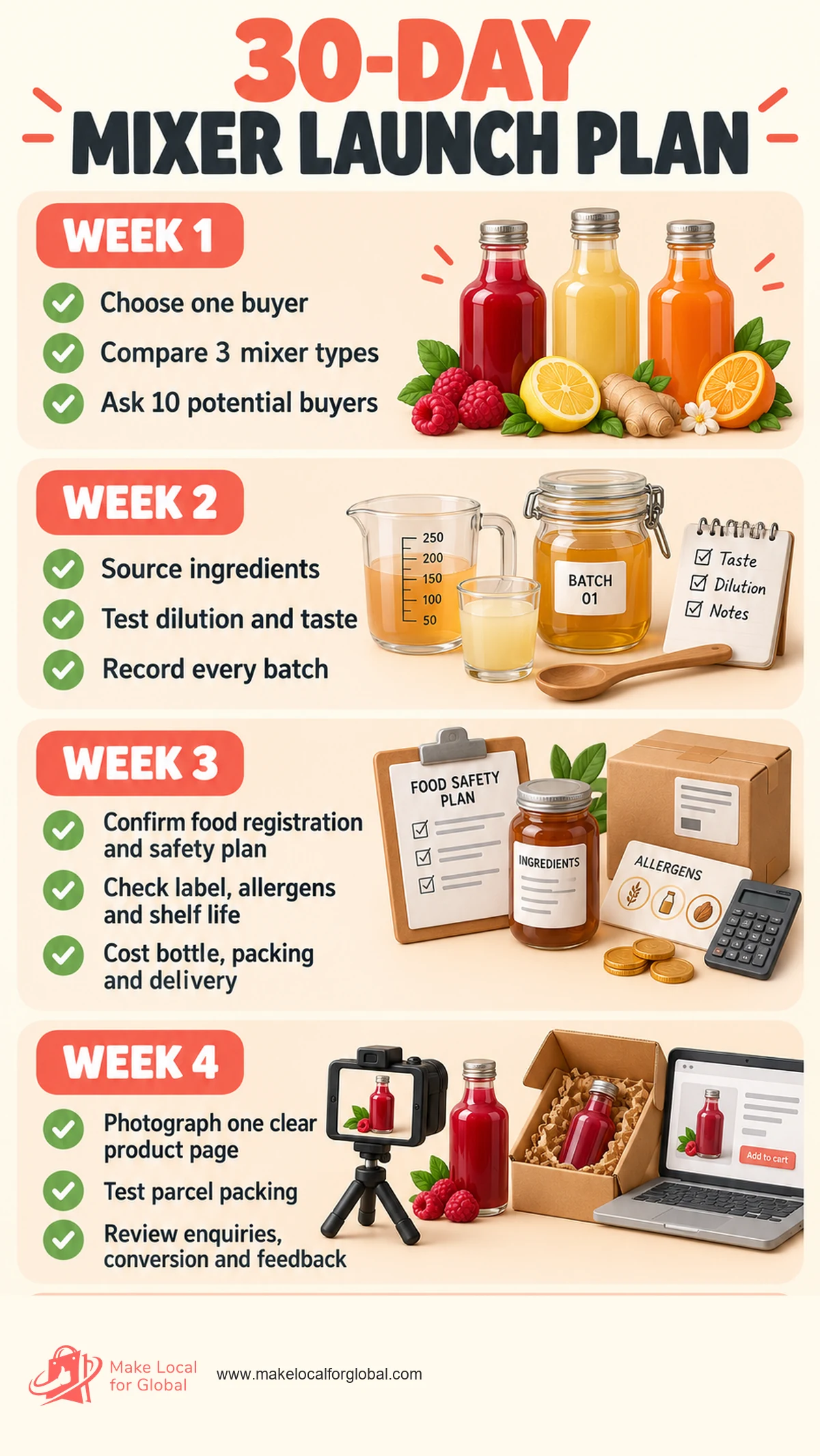
Choose one buyer, one occasion and one product format. Compare three possible mixer concepts and ask a small set of likely buyers about use, flavour, price and concerns. Capture the exact questions they ask. Do not promise a date or order quantity before you know the production route.
Get samples of ingredients, bottles and closures. Record recipe versions and test the dilution, taste, colour and packing configuration. Speak with your local authority about registration timing and food-safety expectations. Get qualified advice on process and shelf-life evidence for the product you intend to sell.
Confirm the full ingredients, allergens, lot coding, storage, date marking, net quantity and online information. Obtain supplier and packaging documents. Price the single bottle and the bundle with actual postage, payment fees, labour and a customer acquisition test. Prepare the listing, photos and dispatch steps. Do not place a larger order until the critical questions have answers.
Open a limited test only when the food operation, product evidence, stock, label, page and dispatch plan are ready. Invite a small, relevant audience or a few venues. Review each order and enquiry. Record product-page visits, questions, add-to-baskets, purchases, delivery time, leakage, complaints and repeat interest. Keep the sample size and date in the record.
At the end of the month, decide whether to repeat the test, revise one feature or stop. If buyers liked a flavour but found the parcel too expensive, test a two-bottle bundle or a local pickup route. If buyers were unsure how to use the product, improve the dilution directions. If the batch or shelf-life work is incomplete, keep the public sales closed until that work is done.
The visual checklist below can be saved as a working reference. It gives a sequence, not a substitute for technical food-safety advice or a local authority conversation.
A home-based business may be possible, but home production does not remove food-business registration, hygiene, food-safety, labelling, traceability or distance-selling duties. Register with the relevant local authority at least 28 days before trading or starting food operations, where the FSA route applies. Ask the authority what is expected for your actual premises and process, then get suitable product-specific safety and shelf-life advice.
Selling through a website does not by itself exempt a food business from registration. If you make, handle, store or sell food, check the rules that apply to the operation and register with the local authority before trading when required. The FSA registration portal includes online and home-based food businesses.
There is no single safe shelf life for all syrups. The result depends on recipe, process, packaging, storage and handling. Ask a food technologist or suitable laboratory what evidence fits the exact product. Use only a date and storage instructions supported by the product assessment.
For distance sales, customers need the required food information before purchase and when food is delivered, subject to the detailed rules for the product. Make allergen information clear on the product page before checkout and keep it consistent with the approved recipe and delivered label. Check the current FSA and GOV.UK guidance for your product type and location.
Only use regulated nutrition or health claims when the wording and product meet the applicable conditions. A general impression can mislead even when the exact phrase is absent. Check the current official claim rules before publishing the packaging or page, and get advice if the wording is uncertain.
Do not treat alcoholic drinks as ordinary mixers. Retail sale of alcohol is a licensable activity and remote orders can raise questions about which premises must be licensed and how the age check works at delivery. Rules depend on location and sales setup. Consult the local licensing authority and current government guidance before adding alcohol.
There is no single best bottle. Compare glass, suitable food-contact plastics or another format against product compatibility, closure seal, shipping weight, breakage, user experience and documentation. Ask the packaging supplier for written suitability information covering the actual contents and conditions, then test the filled parcel.
Add ingredients, measured waste, labour, bottle and closure, label, inbound freight, parcel protection, postage, channel fees, customer acquisition and a damage or service reserve. Subtract variable costs from the customer price to find contribution, then account for fixed costs, tax and VAT treatment separately. Use a current fee and postage quote, not a guess from a competitor’s listing.
Start with the format that matches the buyer and can be fulfilled reliably. A single bottle is a clean product test. A discovery set may suit gifts and can spread postage across several items, but it needs more packaging and a higher upfront price. Calculate and test both with real packed weights.
A small set of two or three related flavours can test buyer response without spreading stock and production work too widely. Choose flavour profiles that are distinct enough to explain. Add another only when orders, enquiries or repeat feedback show a reason and you can support its ingredient supply and records.
A cocktail mixer range combines product development, food controls, packaging and ecommerce. Start with one buyer and a testable product brief, then resolve registration, safety evidence and label questions before selling. Price a real parcel and show the details a shopper needs before checkout.
If you are preparing an ecommerce store, MLFG can help with the website setup and product-page structure. Review the small-business store route and use the private-label simulator to model a hypothetical first batch. The simulator is arithmetic, not demand evidence. For adjacent product ideas, see MLFG’s cocktail-glass selling page.
When the recipe, food information, price and fulfilment plan are ready, MLFG can help you prepare an ecommerce store and learn how to manage product pages and orders.
PREFERRED SOURCE
Like what you’re reading? Add Make Local for Global as a preferred source on Google to see more of our articles when you search.

Build your online presence without having to figure out everything yourself.