

READY TO SELL Crystal kits ONLINE?
Get a store built for you in 5 days, plus training and support to help you start, run, and grow your Alternative business.

Learn how to sell crystal kits with clear product descriptions, supplier checks, safe kit choices, full-cost pricing, protective packing and a practical launch test.

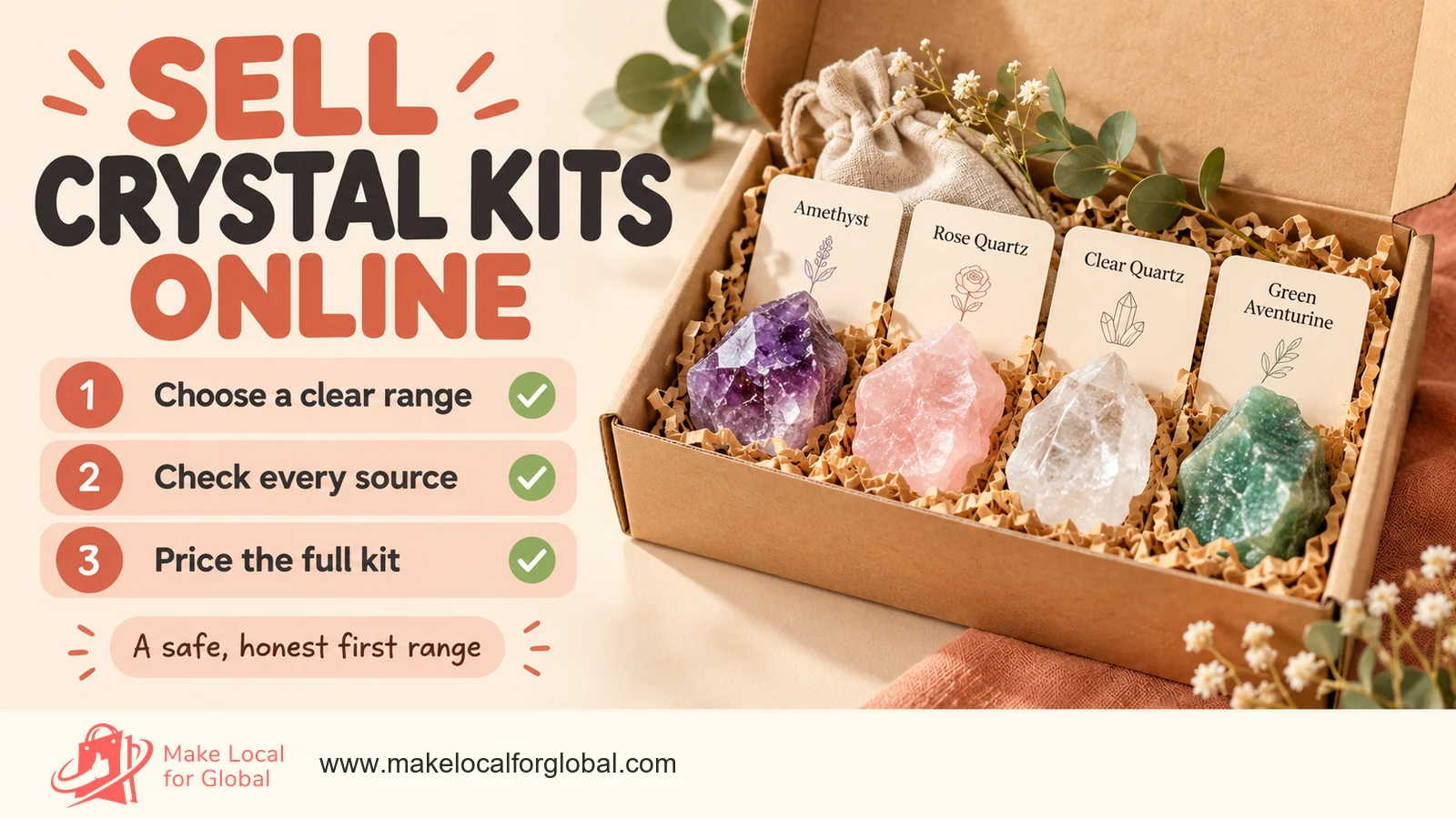
Crystal kits can combine colourful minerals, learning cards and giftable packaging, but a trustworthy offer starts with clear facts. If you plan to sell crystal healing kits online, describe the stones, sizes, treatments, origin information and intended decorative or collecting use. Do not promise that a crystal treats illness, changes a person’s luck or produces a measurable health result.
The phrase “crystal healing kit” is used by shoppers, but that does not make medical or supernatural claims safe to repeat in a listing. The ASA says it has not seen evidence that crystal therapy treats medical conditions, and Etsy permits crystal supplies only without metaphysical claims. See the ASA guidance on crystal therapy claims and Etsy’s current rules for metaphysical items.
A small first range is easier to inspect, describe, pack and cost than a large box of mixed stones. Choose one buyer, verify the material information you receive from suppliers, write plain care notes, test the parcel, then see what people ask before you order more stock.
Choose a crystal range buyers can understand
Build a small kit around verified stone details, clear contents and a parcel cost you can explain.
“Crystal kit” can describe a pouch of tumbled stones, a collector’s starter box, mineral samples with identification cards, a display set, or a gift package with a journal. These products need different product pages and packaging. Decide exactly what a buyer receives before you choose a shop name or order a bulk lot.
Some sellers use the term “crystal healing” to describe a spiritual practice or the customer’s interest. Your product listing must still describe the physical item accurately and avoid unsupported health outcomes. A disclaimer at the bottom does not cancel a medical or supernatural promise made in the title, image text, customer review or social post.
A buyer might value colour, mineral identification, collecting, a room display or a gift ritual. You can describe those features in factual terms: stone name, approximate size and weight, finish, number of pieces, card content, pouch material and storage suggestions. You can say a kit is suitable for a personal reflection activity if it contains a short journal exercise, provided you do not promise that the stones cause an emotional or health effect.
Avoid statements such as “relieves anxiety”, “balances hormones”, “heals trauma”, “protects you from illness” or “guarantees abundance”. The ASA’s guidance says health claims for crystal therapy need strong clinical trial evidence, and its published compliance action has restated that crystals have not been shown to treat medical conditions. Read the ASA’s crystal therapy advice and its recent crystal advertising compliance notice.
For Etsy sellers, the line is stricter in platform terms: crystal supplies may be sold, but not with metaphysical claims. Etsy’s policy covers the title, description and images, and says a disclaimer does not make a prohibited claim acceptable. Check the current Etsy policy before writing listing copy. Other marketplaces have their own rules, so check the one you intend to use.
A focused offer gives shoppers a reason to understand the kit. “Four polished stones in a labelled gift box for a new collector” is more useful than “a magical crystal set for everyone”. The first line tells a person what arrives and who might enjoy it. You can still use calm colours, a thoughtful card or gift wrap to create an appealing experience without promising a result.
Possible buyer groups include first-time collectors, mineral hobbyists, people choosing a small decorative gift, teachers preparing a geology activity, or adults who use journalling exercises as a personal practice. These groups do not all want the same stones. A collector may ask for exact mineral names and locality. A gift buyer may care about presentation, delivery time and whether the recipient needs to know anything about handling.
Pick one group for the first test. Write down what they already know, what they may misunderstand, how they will store the stones, what a fair set size looks like and what details they need before checkout. Ask a few potential buyers to look at a sample box and tell you what they think is included before you explain it.
A beginner’s kit can stay simple: a few known, intact stones, a pouch or divided box, an identification card, and a plain care sheet. Keep the first product free of cosmetics, oils, ingestible products, candles, incense, electrical items and child-directed play components. Those additions can bring separate safety, labelling, transport or platform questions.
Do not design a product that invites customers to put stones in drinking water, swallow chips, apply powders to skin, heat minerals, or use them instead of medical care. Make the intended use clear and add reasonable handling advice for small, hard or sharp-edged pieces. Ask your supplier about any mineral-specific handling concerns and seek advice from product-safety specialists if the proposed kit includes uncertain substances or a new use.
The first collection should answer one simple shopping question. A compact starter set might contain three smooth tumbled stones in a small pouch; a core kit might add a fourth stone, labelled cards and a sturdier box; a gift version might include a display tray or printed journal pages. The additions should improve the buyer’s experience, not just make the parcel heavier.
Keep each version distinct. If a kit has three options called “calm”, “love” and “success”, the labels imply outcomes that you cannot substantiate. Give versions factual names instead, such as “violet and clear collection”, “four-stone starter box” or “green mineral display set”. A number, colour or mineral theme helps someone compare the options without implying a promised effect.
| Range level | Example contents | Main buyer question | What to verify |
|---|---|---|---|
| Entry pouch | Three polished pieces, one simple identification card and a cotton pouch | Which stones and sizes are included? | Names, piece count, smallest-piece dimensions and pouch material |
| Core box | Four to six pieces, individual cards, divided box and care sheet | How do I identify and store each piece? | Stone identity, treatments, card accuracy, box dimensions and weight |
| Gift set | A core set, gift-ready box and optional blank note card | Will the recipient understand what arrives? | All core checks, presentation, dispatch date and safe packing |
| Collector sample set | Smaller specimens grouped by a factual theme | Are these natural, treated, dyed or manufactured? | Supplier documentation, exact labels, variation and locality if known |
The table is a planning aid, not a safety certification. Use a “collector sample” label only when the included items are accurately identified and the product suits that buyer. If you cannot verify a mineral name or treatment, do not print it as fact. Ask the supplier for written details or remove the uncertain piece from the range.

Write a bill of materials for every kit version. Record the item name, supplier code, quantity, size range, expected weight, finish, packaging part and any care note. A kit assembled from mixed wholesale lots can drift over time, so this record helps you spot substitutions before a buyer receives a product that differs from its photographs.
Decide whether every box contains the same stones or whether colour and shape vary within a stated range. If pieces are individually selected, photograph the actual item or state that the buyer will receive a similar specimen. If the variation is substantial, show examples of the range rather than a single perfect piece. This reduces the chance that a buyer mistakes a representative photograph for an exact item.
Set a consistent minimum size or weight if size matters to the offer. A “four-piece kit” can feel poor value if two pieces are tiny, even when the total count is correct. Measure incoming stock, note realistic variation and show a ruler or familiar object in one photograph. Do not exaggerate scale with a close-up that hides the size of the items.
Offer a small choice such as three stones, five stones or a gift box only if each option changes something the buyer can understand. State the piece count, approximate dimensions and packaging for each selection near the option name. Do not make a buyer open a long description to find out that the gift box contains the same stones as the entry pouch.
Bundles should combine items that belong together: a set of four labelled specimens, a pair of matching display pieces, or a box with a clear introductory booklet. Avoid adding unrelated items simply to raise a price. More components mean more supplier checks, product records, stock counts, packing steps and opportunities for a wrong item to be packed into the order.
Keep bundles in stock as kits or use a pick list at packing time. If the same stone appears in three boxes, deduct it from the correct component stock when a kit sells. A simple spreadsheet with kit SKU, component quantities, supplier batch and reorder point can prevent a popular option from being listed after one of its stones has run out.
Search marketplaces and forums for questions people ask about mineral names, size, treatment, colour variation, storage and gift suitability. Read the questions to understand uncertainty, not to copy another seller’s wording or claims. Note whether shoppers ask for a particular colour family, labelled specimens, a gift note, a display box or a lower-cost first purchase.
A marketplace search page is not proof that a product will sell. It can show the words people use and the details existing sellers explain. Record a small sample of competing offers: stone count, exact names, stated size, photos, dispatch time, packaging, returns wording and customer questions. If listings make medical or supernatural claims, do not repeat them as product facts.
Before ordering a wholesale carton, create a sample set from a small verified batch. Show the real contents to ten people who resemble the buyer you chose. Ask them to select between two kit formats, describe what they believe is included and identify any detail that would stop them buying. Record their answers before you explain your choices.
You can test a product page, email sign-up, local market table or short social post with a fixed budget. Track views, saves, questions, sign-ups, checkout starts and paid orders separately. A like is a weak signal; a paid order at a stated price gives stronger evidence, but one order still does not prove a repeatable business.
Write a decision rule before the test. For example, you might order a small second batch only if a certain number of target buyers request the same format and the expected contribution per parcel remains above your floor. The number is your business choice, not a universal benchmark. Keep the test small enough that an unsold batch would not damage your cash flow.
If shoppers ask whether the crystals will treat a condition, improve sleep or bring a result, use the question to improve factual product information. Explain the stone identity, finish and decorative or collecting use. Do not turn a customer question into a promise. Review the ASA and marketplace policies before using testimonials, influencer posts or user-submitted photographs in your marketing.
Check the stones before you buy in bulk
Ask suppliers about identity, treatment and batch details, then inspect a sample before listing it.
Crystal sourcing varies by mineral, processing and supplier. You might buy from a UK wholesaler, a lapidary, a trade fair, a mineral dealer or an importer. A local supplier can make samples easier to inspect, but location alone does not prove the stones’ origin. An overseas wholesaler can provide a useful range, but shipping, customs, batch variation and documentation need to fit the order size.
Start with samples or a small mixed order. Ask the same questions of each supplier so you can compare more than the unit price. Request invoices, product descriptions, stated origin, treatment information where available, item dimensions and any safety or material documents relevant to the stones and packaging. Save the answers with the supplier and lot record.
Use a short checklist before placing a larger order:
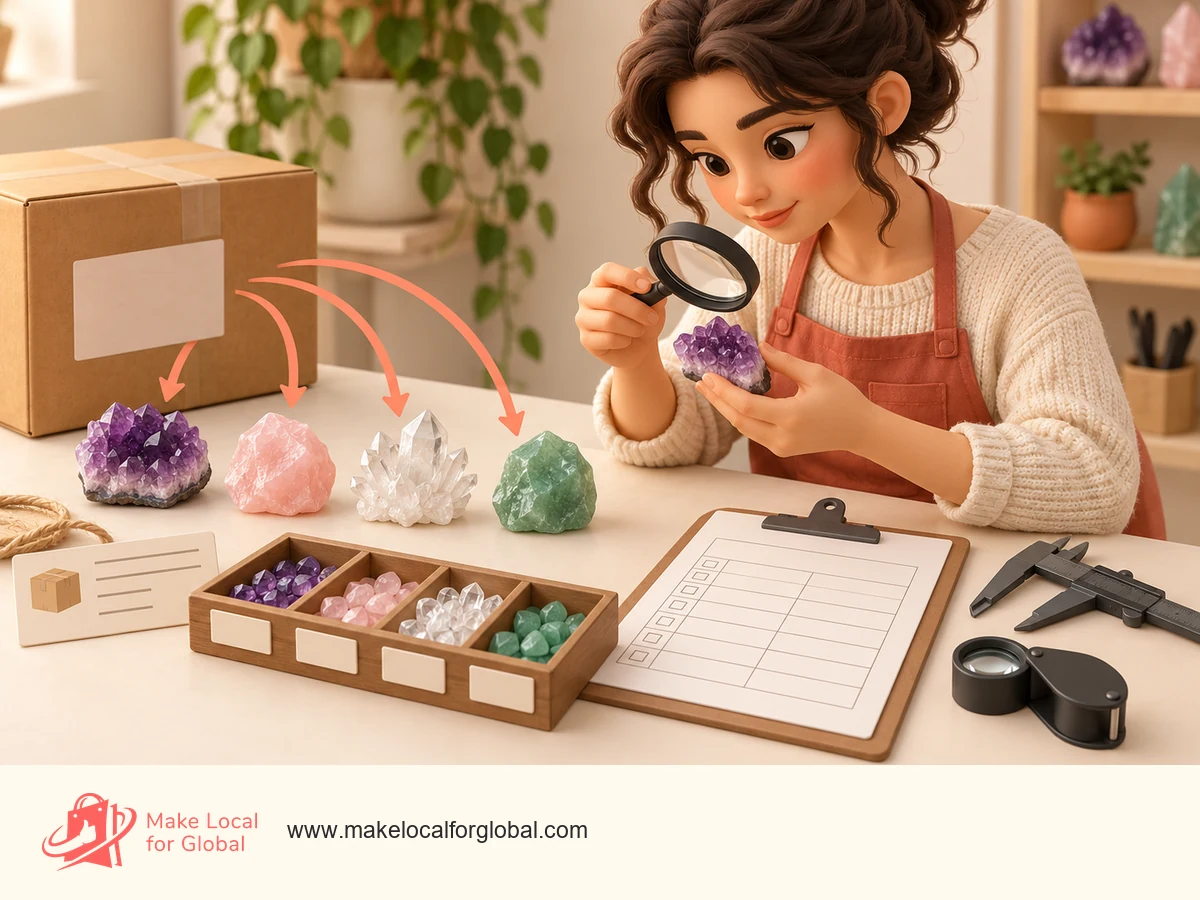
A supplier may not know the original mine or every treatment used earlier in the supply chain. Record “origin not disclosed” or “treatment information not supplied” where that is the truth. Do not transform a seller’s unsupported phrase into a claim such as “ethically mined”, “fair trade”, “untreated” or “conflict free”. A credible origin statement needs evidence you can keep and explain.
On arrival, compare a sample from each lot with the supplier description. Check the colour, surface, polish, edges, size, weight, odour, loose residue and visible cracks. Set aside pieces that are broken, sharply chipped, flaking or inconsistent with the item photographs. Photograph the accepted sample beside a ruler and the batch paperwork.
A visual check cannot identify every mineral or reveal every treatment. Do not claim that a home inspection proves composition or safety. If your product depends on exact mineral identification, unusual properties or a safety statement, use a qualified laboratory or specialist and keep the resulting report with the product record. For a simple gift set, it may be better to choose a supplier with stronger documentation than to sell a claim you cannot support.
Store different minerals in labelled compartments. This prevents a green stone from being confused with another material when the colour varies between batches. Keep supplier codes, dates, quantity received, accepted/rejected counts, photos and customer complaints together. If a later delivery changes in appearance, pause the affected listing until you have checked the sample and updated the product photographs or description.
A buyer cannot tell every treatment from a photograph. If the supplier confirms a stone is dyed, coated or heat-treated, describe that accurately where it matters to the product. If treatment details are unavailable, state that you do not have that information rather than labelling the item “untreated”. Use terms such as “natural” or “genuine” only when you have a sound basis and the words accurately describe the material.
Keep mineral names consistent across the supplier invoice, stock system, card and listing. If you sell synthetic quartz or glass shaped to look like a mineral, say so. If a trade term is ambiguous, add a plain description of the actual material. Buyers should be able to distinguish a mineral specimen from a resin imitation without relying on industry shorthand.
“Ethically sourced” is a broad promise. It may lead a buyer to assume that labour, environmental and community conditions have been checked across the supply chain. A wholesaler saying “ethical” without records does not give you enough detail to support that message. Ask what standard, audit, chain-of-custody document or other evidence backs the exact claim, and what part of the product it covers.
If the chain cannot be verified, describe what you do know: the supplier’s country, the invoice date, whether a named mine or locality was provided and which details remain unavailable. Be open about the limit. Avoid a leaf icon or green packaging language that implies a verified ethical or environmental standard you have not checked.
Businesses that make, import, distribute or sell products in the UK have product-safety duties. GOV.UK says products must be safe in normal or reasonably foreseeable use and that sellers should keep supplier records. The GB and Northern Ireland regimes differ: Great Britain uses the General Product Safety Regulations 2005 guidance, and the EU General Product Safety Regulation applies in Northern Ireland from 13 December 2024. See the Office for Product Safety and Standards business guidance and the Great Britain regulations page. Check the rules for the market where you sell.
The exact requirements depend on what the product is, who it is for, how it is made and what claims you make. A collection of loose specimens sold to adult collectors is not automatically the same product as a toy, cosmetic, candle or wellness device. Use a children’s design, play language or age claim only after checking whether toy rules and relevant testing apply. Ask Trading Standards or an appropriate product-safety adviser if the classification is uncertain.
Small stones can be swallowed by a young child or pet. A fractured point can scratch skin, and loose chips can become a mess or be swallowed. A set can be dropped, placed on a damp surface, carried in a bag or handled by someone who has not read your website. Review these practical scenarios when you choose sizes, packaging, instructions and warning labels.
Do not rely on a small-print “not liable” note to fix a poor product choice. Remove unsuitable sharp or crumbling pieces, separate fragile specimens, protect small parts and tell the buyer how to store the kit. Where a product is intended for adults, say so clearly and keep it away from child-directed imagery. Their appearance alone does not make tiny stones suitable for children.
Do not advise customers to place crystals in drinking water or use them as a food-contact material. Do not include powders or liquids in a kit before checking the separate product rules. A simple instruction such as “Decorative and collecting item; keep small stones away from children and pets; do not ingest or place in drinking water” can reduce confusion, but it cannot make an unsafe product safe.
A listing can describe observable facts: the number of pieces, dimensions, material named by the supplier, known treatment, pouch fabric, box material and actual origin information. It can describe the seller’s own process, such as “each stone is checked for visible chips before packing”, if that check really happens for each order and the records support it.
Do not use health, spiritual outcome or fortune claims as a product feature. This includes captions such as “helps anxiety”, “protects from negative energy”, “brings money”, “balances your body” or “attracts love”. It can include a quote from a customer or influencer if you repeat the promise in your marketing. ASA guidance says testimonials alone do not substantiate a health claim, and Etsy can remove listings that imply prohibited outcomes.
You can discuss beliefs as beliefs in an educational context, with clear attribution and no promise that the item produces that effect. A description such as “some customers use a stone as a cue during a personal reflection routine; this set is sold as a decorative collection and makes no health claim” is clearer than an outcome headline. Do not use a disclaimer to excuse a contradictory product name, photo caption or advert.
Online sellers must show the required pre-purchase information, including who the business is, the product description, total price, payment method, delivery arrangements and cancellation details. GOV.UK lists the requirements for online and distance selling. The rules apply to the details customers can save and review, not only a temporary social caption.
Customers buying online usually have a 14-day period to tell the seller they want to cancel after receiving goods. The law has exceptions, including certain personalised or custom-made products; that does not remove rights for goods that are faulty or misdescribed. Read GOV.UK’s returns and refunds guidance and get current advice for your order type and customer location. Do not put “no refunds” on a crystal kit page as a blanket policy.
The cheapest crystal lot is not automatically the best value. A kit needs enough time for receiving, sorting, checking, card preparation, packing and customer support. Include supplier freight, packaging, platform or payment fees, customer delivery, advertising and an allowance for breakage or mis-picks. Keep fixed overheads and tax separate from the contribution calculation.
The example below is illustrative, not a supplier quote. It assumes the seller is not VAT registered, charges a single £24 selling price with standard delivery included, and pays a simplified selling fee of 5% plus 20p. Replace every figure with a real quotation and your actual platform terms. VAT treatment and fee rules depend on your business and selling channel.
| Cost for one four-stone gift kit | Illustrative amount | How to check it |
|---|---|---|
| Four verified stones and inbound freight share | £6.05 | Divide lot and delivery costs by accepted usable pieces |
| Cards, pouch, inner tray and gift box | £1.15 | Cost one complete packed kit, not a bulk bundle |
| Five minutes of checking and assembly at £12 per hour | £1.00 | 5 minutes ÷ 60 × £12 |
| Outer mailer and protective packing | £0.55 | Weigh and measure the packed order |
| Standard postage | £3.39 | Price the actual parcel and service |
| Selling fee assumption: 5% of £24 plus £0.20 | £1.40 | Example only; replace with current channel rates |
| Damage, return and replacement reserve | £0.60 | Use your own fault and refund history as it develops |
| Customer acquisition allowance | £1.20 | Attribute paid campaign cost to orders, not clicks |
| Variable cost total | £15.34 | Sum of the costs above |
| Contribution before fixed costs and tax | £8.66 | £24.00 − £15.34 |
The £8.66 is contribution before rent, software, insurance, accounting, equipment, unpaid owner time not included in the five-minute line and tax. It is not net profit. If the average order needs a message exchange, re-pack or replacement, time and reserve costs may rise. If delivery is charged separately, show the delivery price clearly and recalculate the seller’s contribution from the amount actually retained.
If your regular price is £24 and variable cost is £15.34, a 10% discount reduces revenue by £2.40. The remaining contribution becomes £6.26 before fixed costs and tax, assuming the percentage fee applies to the discounted item price and no other cost changes. A larger discount can leave too little to pay for overhead or replacements.
Calculate each kit separately. A larger box may add weight, volume, packaging and delivery cost. A gift sleeve may take another minute to assemble. A bundle can lower the per-item packaging cost, but it may increase the parcel size or include a costly display tray. Recheck the price whenever a component or delivery service changes.
Keep separate numbers for item cost, postage charged, delivery cost, platform fee, advertising cost and actual refund amount. This helps identify whether a product needs a price change, a packaging change or a different channel. Avoid copying a competitor’s price without knowing whether their stones, labour, fees or delivery terms match yours.
Use a product name that describes the kit’s contents and audience. For example: “Four-Stone Mineral Starter Kit, Labelled Specimens in a Gift Box”. The opening sentence should state the piece count, material description and what the buyer receives. Avoid a string of spiritual promises or a vague phrase such as “energy essentials”.
A useful description can follow this order:
Do not state a precise country of origin if the supplier cannot support it. Do not guarantee that every stone looks like the hero photograph if pieces vary. Make the variation clear beside the buying options and show a typical selection. The product photograph should not include extra stones, a display stand or a larger box that is absent from the order.
The first photograph should show the actual kit at a scale that helps a buyer understand it. Add a flat lay of all included pieces, a close-up of finish and edges, a ruler or familiar size reference, the card and packaging, and an example of ordinary colour variation. State whether a tray, candle, journal or display prop is included.
Use even light and a neutral background. Colour editing should not make a pale stone look richer or hide cracks. Photograph the size option that is being sold, and keep an image record if later batches look different. Alt text should say what the image shows, such as “Four polished mineral samples in separate paper compartments beside their identification cards”, not a list of search phrases.
Use the phrase “crystal kit” or “crystal healing kit” only where it fits the actual item and the seller’s rules. A search phrase does not require repeating it in every heading. Add descriptive terms buyers may use, such as “four-stone mineral set”, “labelled specimen kit” or “gift box of polished crystals”, then keep the material details accurate.
Write one useful page for each materially different kit. Do not publish near-duplicate pages where only a colour adjective changes. A separate page is justified if the stone list, buyer use, size, composition or fulfilment details are meaningfully different. Link related products so a shopper can compare formats without competing pages saying the same thing.
For your store’s educational content, answer one specific question at a time: how to compare tumbled and rough specimens; what a supplier’s treatment disclosure means; how to size a beginner kit; or what to include on a mineral identification card. Link those pages to the relevant kit and give a reader a useful next step. Do not make a claims page that promises medical results.
Test the exact parcel before advertising a delivery promise. Put each stone in its own compartment or wrap it so pieces cannot knock together. Add enough cushioning to prevent the inner tray moving, then close the box and shake it gently. Use an outer mailer suited to the parcel weight and service rules. Weigh and measure the final package, not the empty gift box.
Send a test parcel through the intended carrier or ask another person to handle it before opening. Check for chipped edges, shifted contents, bent cards, crushed corners and rattling. Photograph the packed sample and keep the packaging specification with the kit record. A small trial can reveal a weak divider before a batch of customer orders is on the way.
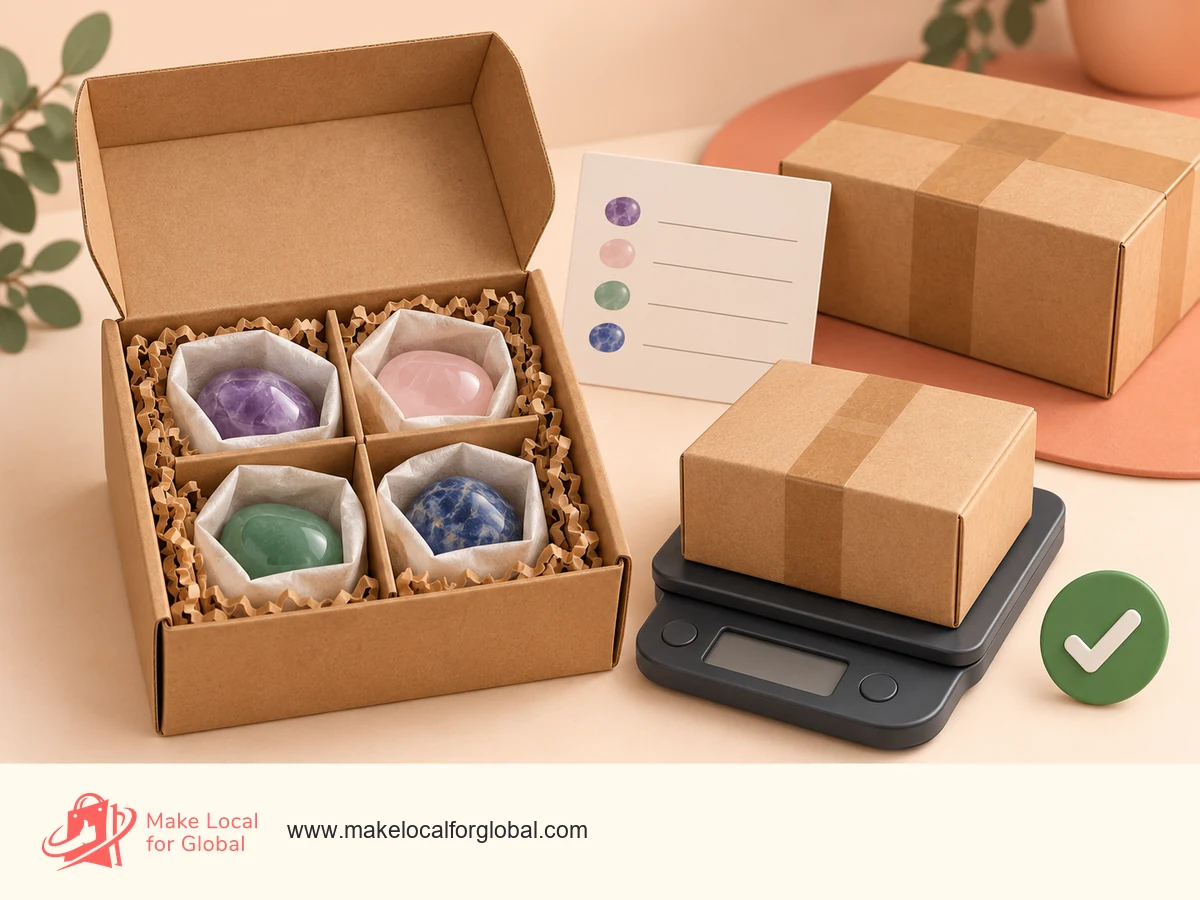
Assign each kit a SKU and maintain component quantities. A simple record might include product code, stone type, supplier lot, number received, number rejected, kits assembled, kits sold, damaged pieces and reorder point. Keep a sample of each batch or clear photographs if holding a physical sample is impractical. If a customer reports a possible safety problem, pause the affected stock and investigate the lot before fulfilling more orders.
Respond to a breakage report with the order number, photographs if useful, the batch code and the customer’s preferred remedy where the law allows. Record whether the damage happened before packing, in transit or after delivery, and look for a repeated pattern. A refund or replacement policy cannot take away statutory rights. Check your legal duties for the country and sale type, rather than using a blanket “no returns” line.
A marketplace can help a beginner reach shoppers, but the seller still needs accurate listings and product records. Etsy’s rules allow crystal supplies without metaphysical claims; read the current prohibited items policy before putting a kit online. A marketplace can change its terms, fee schedule or search tools, so recheck the official dashboard and policy pages before each launch.
A standalone shop gives you more control over product education, email capture and product comparisons, but you need to attract visits and answer customer questions. A local craft or mineral fair can show what shoppers notice about the stones, box and price. Ask the organiser about table fees, insurance, payment setup and any rules for selling the product.
You can test a concept with one sample page and a small audience before making a full range. Track page views by source, questions, add-to-cart actions, completed purchases and returns. If a lot of people ask whether stones are natural, treated or included in the pictured display, improve the description before spending more on promotion.
For a simple acquisition test, choose one audience and one message, set a small budget you can afford to lose, and set a stop date. Do not call every click a customer. Compare advertising spend with orders and contribution after fees. If the traffic is low, check audience fit and product-page clarity before changing every part of the product at once.
If you are working through the wider product-planning process, compare MLFG’s guide to selling craft kits online and guide to selling candle holders online. Those products have different safety and fulfilment needs, but the range, supplier and full-order cost questions can help you build a clearer kit plan.
If you later add verified stones to pendants or other wearable products, use a separate product specification for the metal, fastenings, sizing and skin-contact details. MLFG’s guide to selling crystal jewellery online covers that product format.
A low-priced box of assorted stones can contain inconsistent names, sizes, treatments and quality. Write the offer first, then buy a small sample against that specification. Reject anything that cannot be identified or described with confidence.
A promise about pain, sleep, stress, fertility or disease can mislead buyers and breach advertising or marketplace rules. Describe the product’s material, design and intended non-medical use. Do not rely on a disclaimer to repair a headline that makes a prohibited claim.
The word can imply knowledge of mining, labour and environmental practices. Keep supplier evidence and define exactly what your statement covers. If the chain is unknown, say which details were and were not provided.
Colour alone is not a reliable product description. Keep labels and stock codes tied to the supplier and batch. If you cannot verify a name or treatment, use a more cautious factual description or omit that item.
A bigger gift box can push a parcel into a different postage band and leave the stones loose in transit. Weigh the packed order, test a sample parcel and price the outer packaging into each kit. Review damage reports by carrier and batch.
A new variation creates new photos, records, stock counts and buyer questions. Start with a short list of options and add a version only after shoppers ask for it or the first test gives a clear reason.
| Days | Work to complete | Evidence to record |
|---|---|---|
| 1–4 | Select one buyer, one use occasion and a factual kit concept. Draft a materials list and avoid health or outcome promises. | Buyer notes, draft contents, questions that remain unanswered |
| 5–9 | Contact suppliers, ask about identity, treatment, size variation and batch records. Order small samples. | Written supplier answers, invoices, sample costs and delivery dates |
| 10–14 | Inspect each sample, choose the accepted items, write the card and care note, and assemble one parcel. | Lot photos, accepted/rejected count, draft product details |
| 15–19 | Photograph the actual kit, cost each component, verify parcel weight and write a listing with plain return and delivery information. | Full cost sheet, photo set, listing questions answered |
| 20–24 | Show the offer to likely buyers or run a small paid test with a fixed spend and stop date. | Visits, messages, sign-ups, cart actions, paid orders and spend |
| 25–30 | Review questions, conversion, contribution and damage risk. Keep, revise or pause the range. | Decision, evidence, next batch size and revised price if needed |
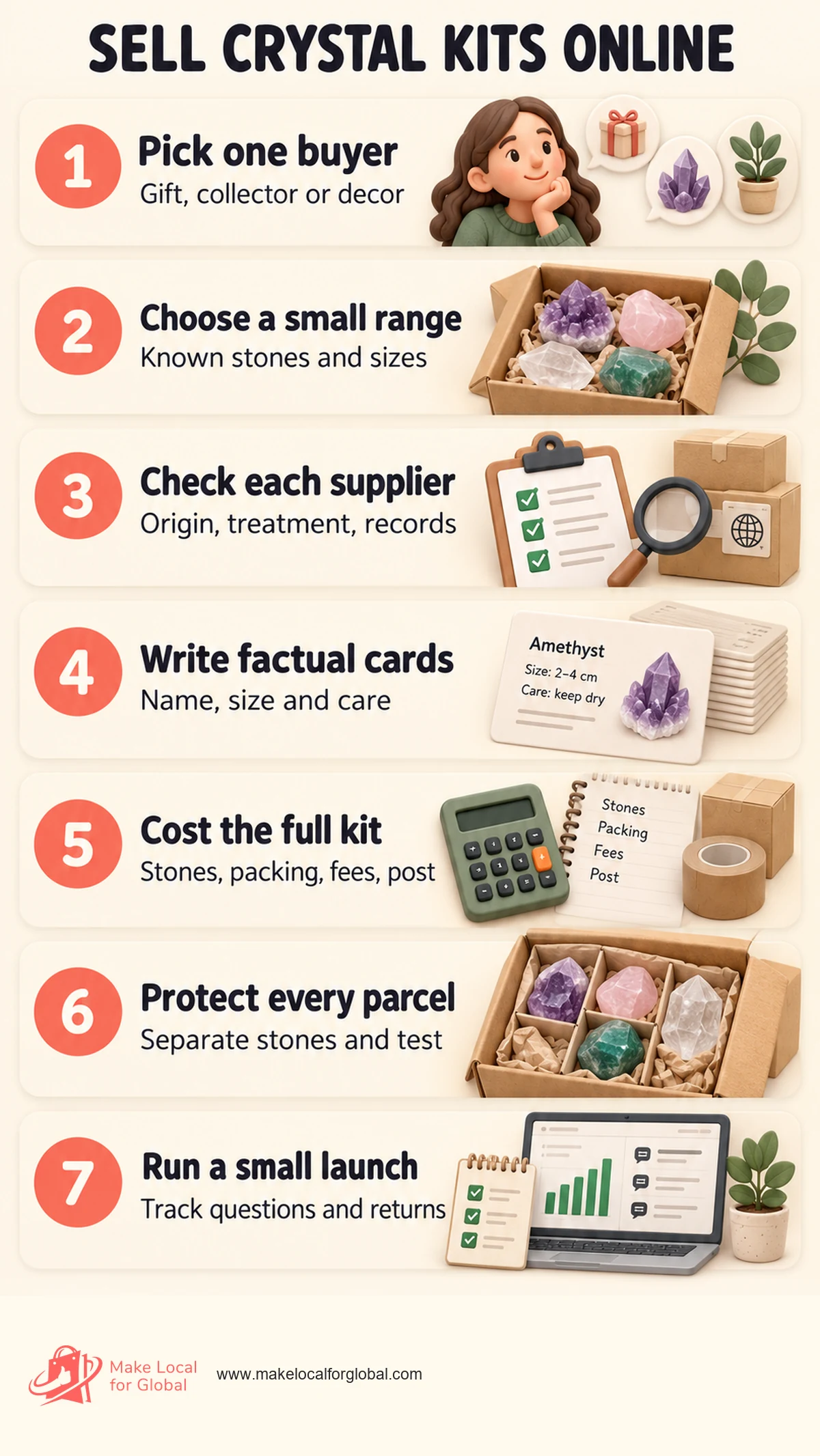
The plan is a short pilot, not a promise of sales. If your samples arrive late or supplier records are weak, shift the test date rather than selling with facts you have not checked. If the result is unclear, change one variable at a time: kit contents, product page, photograph or audience. Record what changed so the next round can teach you something.
Place the order only after your cost and safety checks fit the evidence. A small stock order is a useful test when the amount at risk is manageable and the product information is clear. If the supplier cannot answer basic questions about material, batch or handling, choose another source or narrow the range to products you can verify.
You can sell physical crystal products, subject to local law and each platform’s rules. Describe the actual stones, packaging, size, known treatments and intended use. Do not state or imply that they diagnose, prevent, treat or cure a health condition. Etsy permits crystal supplies without metaphysical claims; other platforms may set different terms.
Make a health claim only when you hold the evidence and meet the rules that apply. ASA guidance says it has not seen evidence that crystal therapy treats medical conditions. Etsy’s current policy does not allow product claims to treat, prevent or mitigate disease or medical conditions. Seek qualified advice before making any claim about a health effect.
Etsy’s help page says supplies such as crystals may be sold when they are not listed with metaphysical claims. Its prohibited items policy restricts medical claims, and the policy applies to listing titles, descriptions and images. Review the live policy before listing; a disclaimer does not override the restriction.
A small kit can contain a few verified stones, individual identification cards, a pouch or divided box and clear handling notes. Set a buyer and use occasion first. Avoid components that introduce extra product rules, such as cosmetics, oils, candles or child-directed play items, until you have checked the relevant requirements.
Ask the supplier for the material description and treatment details in writing, and keep the response with the invoice and batch record. A photograph or home inspection cannot prove every mineral identity or treatment. If that fact matters to your claim, get specialist verification or do not make the claim.
Use that statement only if you have evidence that supports the exact scope of the claim. Ask what standard, audit or chain-of-custody record the supplier can provide. If the source cannot be verified, state what is known and what information was not supplied.
Add the stones, inbound delivery, packaging, labour, payment or marketplace fees, customer delivery, advertising and a reserve for damage or returns. Compare the remaining contribution with fixed costs and tax. Use the worked example as a formula, then replace each assumption with your real prices.
Do not call a kit a toy or target it to children without checking the product classification, age group, small-parts risks and applicable rules. Keep small pieces away from young children and pets, and use clear product information. Ask a product-safety adviser if the intended use or age range is uncertain.
Online consumers usually have a limited cancellation period after delivery, with exceptions for specific product types such as certain personalised or custom-made items. Faulty or misdescribed goods have separate protections. Read current GOV.UK guidance for your business location, customer location and product.
Separate the stones so they cannot strike one another, secure the insert inside a sturdy box and use an outer mailer suited to the packed weight. Send a test parcel through the service you expect to use. Review damage reports and revise the packing if the same failure happens again.
Show all included pieces, a close-up of the finish, a size reference, the identification card and the packaging. If the stones vary, include examples and say that each set will be similar rather than identical. Do not show props that are absent from the order without labelling them.
Write down one buyer, one factual kit specification and one acceptable cost ceiling. Request sample stones and written supplier details before you prepare a large order. Assemble the kit, check small-part and edge risks, test the parcel, then show the real product to potential buyers at the planned price.
Test one crystal kit before expanding
Show the real contents, price the complete parcel and use buyer questions to decide what to change.
PREFERRED SOURCE
Like what you’re reading? Add Make Local for Global as a preferred source on Google to see more of our articles when you search.

Build your online presence without having to figure out everything yourself.