
READY TO SELL Dance costumes ONLINE?
Get a store built for you in 5 days, plus training and support to help you start, run, and grow your Alternative business.

Plan a performance costume range with tested movement, clear group sizing, transparent order costs and delivery timelines that give teachers and performers time to prepare.

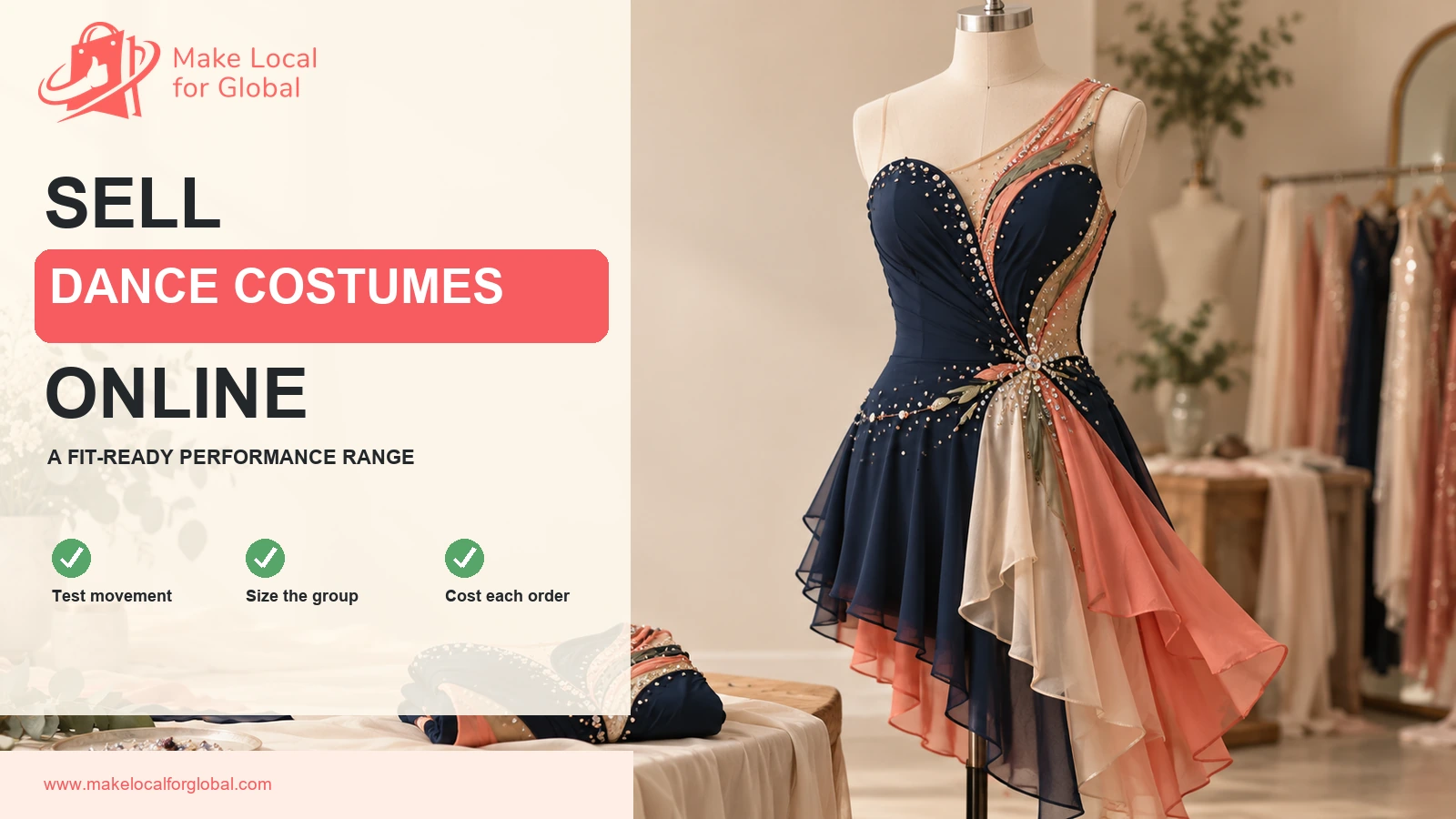
A dance costume has to do more than look striking on a hanger. It needs to suit a performance brief, allow the intended movement, fit the wearer, stay secure during rehearsal and arrive before the show. For a seller, the order can involve a whole troupe, several size combinations, one colour across different fabrics and a tight production deadline.
To sell dance costumes online, begin with one performance customer, source a small group of production samples, test fit and construction in movement, and make the group-order process clear before taking payment. Cost each outfit with the work around it, including measurement support, alterations, packing, delivery and a reserve for remakes. Then publish a product page that helps a teacher or performer select a design with fewer surprises.
This page covers the full performance outfit for a recital, competition, stage production or themed dance event. Separate guides cover dance shoes, everyday dancewear and ballet tutus. A costume shop can serve related needs, but each garment has its own fit, construction and order questions.
Test the performance offer before building a large range
Clarify the buyer, outfit brief, event date and cost assumptions before committing to stock or bespoke production.
“Dancers” describes many kinds of buyer. A school director arranging a year-end show may need 24 matching looks, a clear size collection sheet and a delivery date that leaves time for alterations. An adult competition troupe may choose a distinctive design with colour blocking and movement details. A theatre group may need costumes for named characters, quick changes and repeat performances. A solo performer may order one custom piece and expect a fitting conversation.
Each buyer asks different questions. A teacher may need a quotation by class, cost per person and a simple way to gather sizes from parents. A solo customer may ask about body measurements, fabric stretch, custom length and which changes are included. A production coordinator may need a list of costume components, backup pieces and arrival dates for every cast member.
Pick a first group you can contact and serve. Write down who approves the design, who pays, who supplies measurements, who wears the costume and who will receive the parcels. These may be different people. A parent can provide a child’s size, a school can pay the invoice and a teacher can approve a colour sample. Clear roles reduce delays and make the product page easier to plan.
Before browsing catalogues, write a short performance brief: style of dance, event type, number of wearers, age range, performance date, budget per outfit, colour direction, coverage requirements, quick-change needs and expected delivery location. Record what is fixed and what can change. A production with costumes in a shared colour but distinct individual cuts is a different order from a uniform row of identical garments.
Ask the buyer what they currently do. Do they rent costumes, buy standard stock or commission a maker? Which part takes the most time: choosing a design, collecting sizes, getting a price, coordinating parents, or resolving a late fit issue? Ask about the last event, not only what they might do in a hypothetical future. Existing order sheets, alteration invoices and delivery calendars reveal practical problems more clearly than a general compliment.
Create a one-page offer test from those answers. Show one costume concept, the available components, a measurement form, a sample lead time and an example group quote. Ask a teacher to find the order deadline, the smallest order quantity and the size instructions without your help. If those details are difficult to find, simplify the offer before you invest in a collection.
Interview a few potential buyers from the exact group you want to serve. For a school offer, ask teachers and studio managers how many performers they normally dress, when they start planning and how they collect parent payments. For a theatre offer, ask costume leads how they handle fittings, repairs, storage and quick changes. Keep notes by role so you do not mistake one buyer’s workflow for a rule across the sector.
Test two ideas with the same price and delivery assumptions. For example, show a simple coordinated jazz costume with optional accessories beside a more embellished design that needs a longer sample review. Ask which one they would present to a class, what would prevent an order, and what information they need before sharing it with parents. The result should be a decision, such as “request samples in three child sizes,” not just a list of likes.
A small landing page can collect interest for a defined season or event. State that it is a product test, show the expected order window and ask for only the contact and event information you need. Track qualified replies, size questions, sample requests and deposit-ready enquiries separately. Do not accept money until your production route, cancellation terms and delivery plan are ready to support the promise.
Performance costumes vary by dance discipline, choreography, venue and the brief from the teacher or producer. The labels below are starting points for research, not universal specifications. Ask the intended buyer what the class, syllabus, competition or production allows before deciding what belongs in the first range.
| Costume direction | Buyer need to investigate | Product details to show | First sample checks |
|---|---|---|---|
| Lyrical or contemporary | Flow, coverage and movement through floor work | Bodice, skirt panels, lining, leg or arm coverage | Stretch, opacity, snag points and skirt movement |
| Jazz or commercial | Strong stage presence and secure trim | Fringe, colour panels, neck and back design | Trim security, weight, range of motion and quick-change closure |
| Character or musical theatre | A recognisable role and repeatable scene look | Jacket, waistcoat, skirt or themed accessories | Mobility, fastening, fit over layers and care route |
| Ballroom or Latin performance | Coordinated appearance for a pair or team | Bodice or shirt, skirt or trousers, trim and matching details | Partner movement, closure security and trim retention |
| School recital set | Reliable ordering across a broad age and size mix | Standard colour, garment pieces, size method and delivery batch | Size consistency, packaging list and alteration time |
| Competition group design | A shared design with individual wearer fit | Colour placement, approved embellishment and production tolerance | Repeatability across sizes, light reflection and wear checks |
Keep this offer separate from a general dancewear catalogue. A practice leotard can belong in a year-round class range; a recital costume is planned around a show, a cast, a visual brief and a date. A seller can offer both, but the product pages and quotation flow should identify which order process applies.
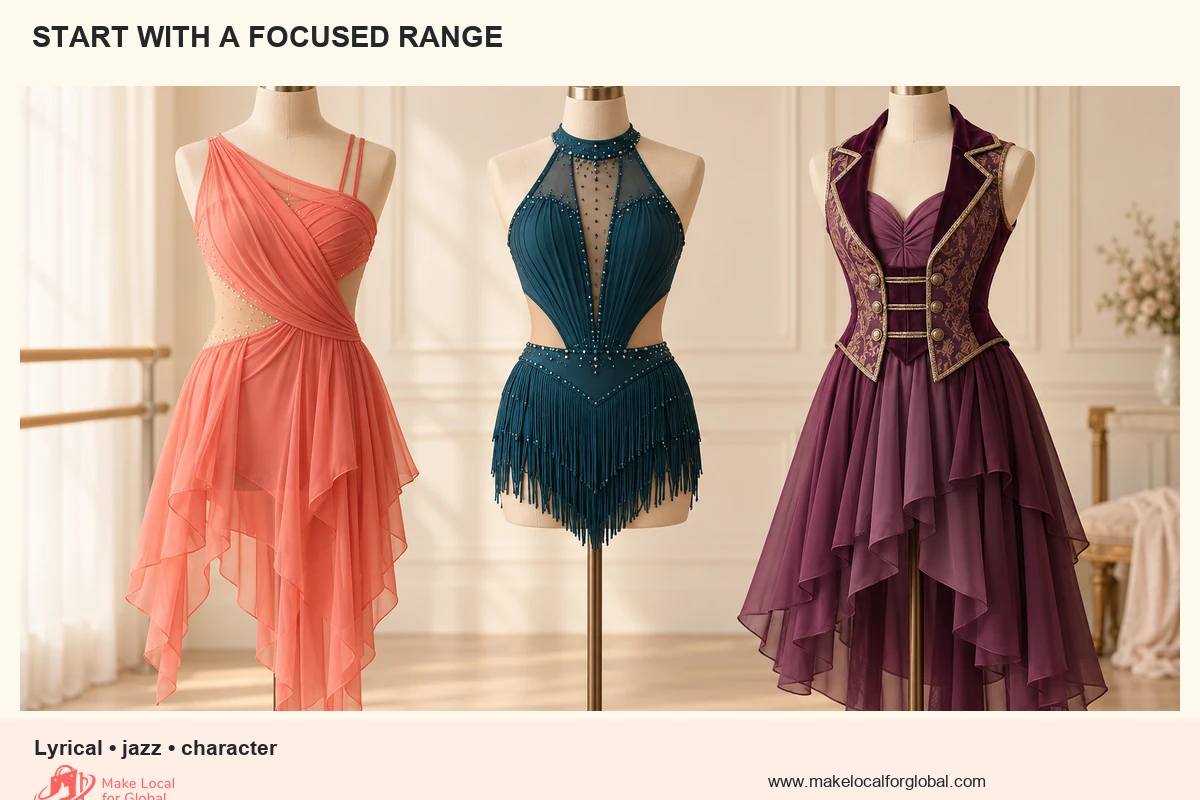
A small range can have three useful roles. An entry costume can offer the core garment with restrained trim and a simple size route. A central design can add a skirt, jacket or colour panel that fits the selected performance brief. A higher-priced option can include confirmed custom artwork, extra trim or a coordinated accessory, if those additions can be supplied and checked consistently.
These roles describe what each offer includes. They do not predict which will sell best. A premium price needs a specific reason that the buyer can see: documented fabric, careful finish, an approved design service or dependable group support. A more elaborate costume is not automatically a better product if it complicates movement, storage or replacement.
Bundles work when the pieces solve a single planning problem. A costume plus a matching headpiece may help a theatre group keep a character look together. A costume with a garment bag and care card can help a school issue, store and return outfits after a performance. Keep optional pieces separate when performers already own them or when the teacher has not approved them.
Limit options until you have repeat orders. Every neckline, sleeve, trim, colour and skirt length can create another sample, size question, product image and stock record. Start with options that a buyer has asked for and that you can source or make before the event date.
No single fabric suits every dance costume. Ask the maker or supplier for the fibre content of the main fabric, lining and separate components. Request samples in the exact colours and finishes you plan to sell. A photograph may suggest drape, shine or texture, but it cannot confirm how a fabric feels, stretches, recovers after movement or looks under bright performance lighting.
For a fitted one-piece costume, the amount and direction of stretch can affect whether the torso and leg openings sit comfortably during movement. A mesh panel can change coverage and support. A satin-style woven piece can keep a structured look yet behave differently from a stretch bodice. A layered skirt changes how a costume moves, packs and hangs. Treat these as product questions to test on the exact sample, not general promises about fibre names.
Ask for the construction notes behind each design: seam type, lining coverage, closures, elastic placement, hem finish, stretch direction and how decorative items are attached. If a garment has sequins, crystals, fringe, feathers or appliqué, request an agreed placement image or specification. Confirm which embellishments are included and whether placement may vary slightly between production pieces.
Check how each fabric reacts to the care instruction you intend to provide. Do not publish “machine washable”, “colourfast” or “sweat-proof” based on a supplier’s casual description. Ask for written care directions and test a sample by following them. If a costume needs specialist cleaning, say so before checkout and include the likely care route in the buyer’s cost planning.
Ask the supplier to identify the fibre composition accurately. In Great Britain, the government says textile labels must show fibre content; if different components have different fibre content, each must be shown. The guidance applies to England, Scotland and Wales, so check the separate rules for Northern Ireland and each export market. Read the current GOV.UK textile labelling guidance and match product copy and labels to supplier records.
If you make a claim such as recycled polyester, organic cotton or a particular fibre percentage, keep evidence for the exact product and its component parts. The Competition and Markets Authority says fashion businesses should describe fabric claims precisely and support stated proportions. Its fashion environmental claims guidance helps sellers avoid a broad claim that a small trim or a mixed-fibre garment cannot support.
Keep a fabric and trim sheet by model. Record supplier, colour name, lot or batch reference, fibre composition, lining, stretch direction, care information, embellishment type and any substitute the supplier may use. Ask the supplier to contact you before changing a material or trim. A substitute can alter colour, weight, movement, care or the way the outfit fits.
Possible sourcing routes include buying finished costumes from a dancewear wholesaler, placing a group order with a costume maker, commissioning a local designer, making garments in-house or arranging a private-label line. Each route changes control, lead time, initial spend and the tasks you must check. A supplier that sells only to studios may have a different order process from a shop selling one costume at a time.
Ask suppliers for current line sheets, measurements, stock availability, production capacity, minimum quantities, group pricing, sampling fees, lead times, fabric information, care instructions, packaging options, alteration terms and defect remedies. Ask which details are confirmed and which are estimates. Get a written answer for the event date, colour match process and the final date for a size list.
Ask whether an order can be split by size and keep the design consistent. Confirm whether the quoted price includes one sample, sample postage, design work, standard adjustments, labels, garment bags, packing and delivery. Ask what happens if one size is unavailable, a trim is out of stock or a costume arrives after the agreed date. For a custom group design, clarify who approves the drawing and sample, how many changes are included and who owns the artwork.
Some costume suppliers publish group-order thresholds or lead-time windows. For example, Razzle Dazzle Dance Costumes’ group-order information describes its own current process, sample choices, turnaround and minimum quantities. Treat this as one supplier’s terms, not an industry standard. Confirm current conditions directly with every supplier before quoting a customer.
Use the same questions for each route. Score sample quality, range fit, measurement support, minimum order, replenishment, response time, documented materials, payment terms, late-order remedy and landed cost. Keep a note that explains each score. A maker with a higher unit price might reduce risk if it can produce a replacement quickly. A low quote may create cash pressure if it requires a broad size run up front.
| Route | What you control | Main cost or risk | Useful evidence before you commit |
|---|---|---|---|
| Ready-made wholesaler | Selection, listing and buyer support | Size gaps, limited design changes and stock availability | Samples across the size range, live stock confirmation and reorder terms |
| Group-order costume maker | Theme, selected details and coordinated batch | Minimum quantity, sample timing and event deadline | Written production schedule, approved sample and group-size process |
| Local costume designer | Design conversation and some fit adjustments | Higher labour time and dependence on individual capacity | Fitting plan, written scope, material sourcing and change-order fees |
| In-house production | Work sequence, sample and repair decisions | Equipment, skill, hours, waste and safety responsibilities | Timed sample, reliable materials, documented checks and production capacity |
| Private-label factory | Brand and agreed product specification | Larger commitments, import duties and product-control duties | Production-equivalent sample, technical file, batch records and inspection plan |
Buy at least one production-equivalent sample before offering the full group range. If you intend to sell a short set of sizes, check those sizes or ask for a graded sample run. A single sample proves little about fit consistency across a child-to-adult size spread. Keep one approved reference outfit and take photos of the inside, closures, hems and trim.
Dance costumes often take inspiration from a story, character, brand, film or performance. A customer’s request to reproduce a famous logo, character image or copied design does not grant permission. Check that your own sketches are original and ask clients to confirm they can supply any artwork they request. If a design depends on a protected work, discuss licensing with the rights holder before selling it. GOV.UK copyright guidance explains that protected material usually needs permission or a valid legal exception.
When you commission a designer or maker, write down who owns the sketches and final production files, which party can reuse the design, whether you may use photographs in adverts and what changes are allowed. Set the permitted use, region, length of licence and any credit requirement. A short written agreement can prevent a buyer, designer and seller from each assuming that the other owns the artwork.
A costume displayed on a form cannot show every issue. Test the approved size on an appropriate fit model with consent, or use a dress form and movement checks with a competent wearer. Follow the buyer’s performance brief. A garment used for floor work needs different checks from a character jacket that will be worn over a base layer for a short scene.
Record model code, size, colour, sample date, supplier, reviewer and result. Photograph the front, back, inside construction and detail areas using the same light. Keep notes beside each photo so you can compare later versions. Mark pass, revise or reject for each check rather than writing “looks fine”.
Keep tests proportionate to the costume. A fitted design with a back zip, lined bodice and detachable fringe may need separate notes for each feature. A uniform shirt with minimal trim may require a simpler check. If a product is intended for children, make the age and intended use clear to the supplier and seek competent product-safety input for the exact design and market.
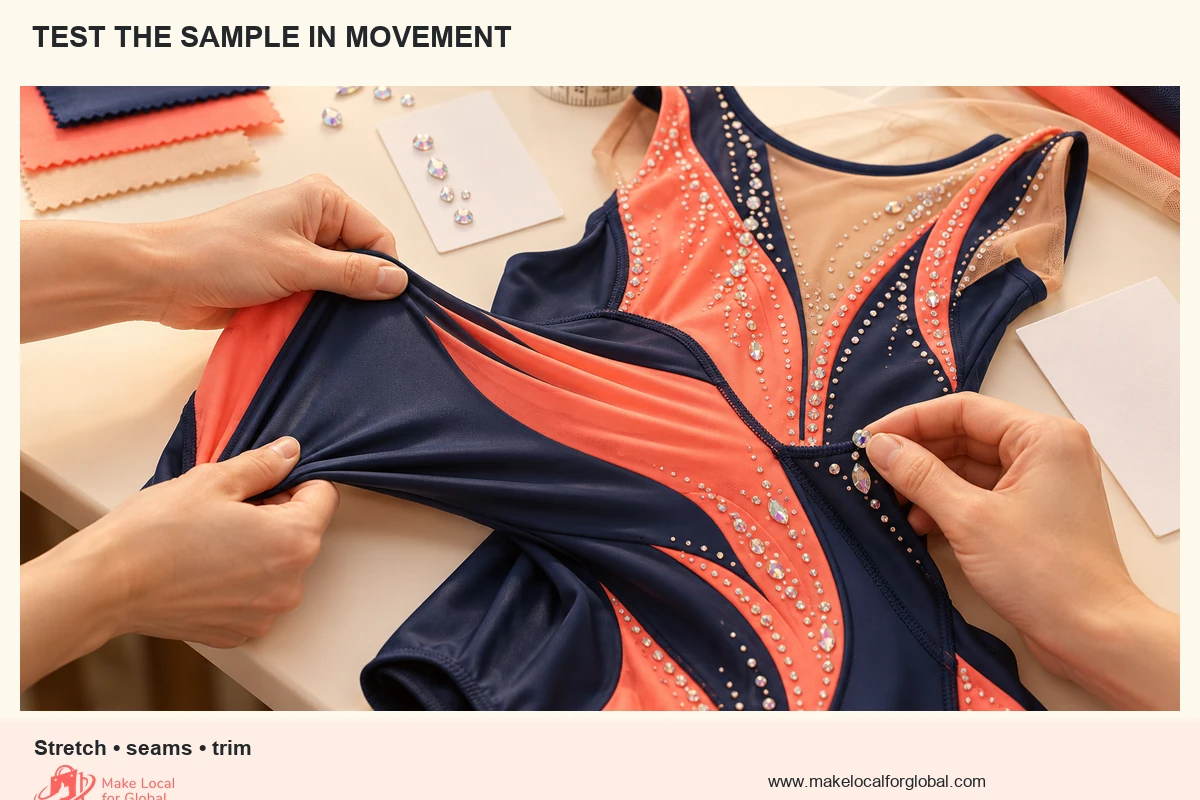
Check whether a dancer can reach the closure without assistance where that matters. Test zips from the top and bottom of their travel. Look for exposed fastener edges that catch fabric or skin. Check whether hook-and-eye tape, snaps or elastic can open during the movement that the costume is intended to support.
Move through the rehearsal sequence with a teacher or suitable wearer. If a skirt swings across a partner’s face, a cape reaches the floor during a turn or a long tie brushes a prop, the sample may need redesign. Do not ask a child to perform difficult choreography during a seller’s quick check; arrange a safe, supervised fitting with the adult responsible for the performance.
Inspect embellishments before and after movement and care checks. Record the number and location of loose stones, beads, sequins or fringe ends. Ask the supplier how production pieces are checked and what remedy applies if trim arrives loose. The point is to understand the actual product and to avoid publishing a durability claim your checks do not support.
For group costumes, sizing is a process, not a dropdown. One chart may use chest, waist and hip measurements; a fitted one-piece costume may need torso girth as well. A skirt or separate jacket may use its own measurement points. A size code from one maker may not match another maker’s size, so do not transfer measurements across brands without checking the actual garment.
The costume maker The Line Up’s measurement page describes torso girth and other measurements for fitted garments and recommends consistent measuring technique. A UK dance-costume supplier’s size-chart guidance similarly distinguishes body measurements from garment measurements and notes that fabrics can differ in stretch. Use these as examples of the information buyers may need; publish the chart and method supplied for the exact costume you sell.
Give a diagram or clear written instruction for every measurement. Say whether the tape should rest against the body or over a base layer, which posture to use, where the starting point is and whether the value is body or costume measurement. Tell the buyer who should take measurements and whether the dancer should wear fitted clothing. The same instructions should be used for every person in a group order.
If a measurement sits between sizes, do not give an automatic “size up” instruction when the maker does not support that choice for the exact model. Explain which measurements drive the fit and when to ask for help. A longer torso, broader shoulders or a distinct leg length can change the fit even when chest and waist match the chart. A teacher may know what range of movement the dance requires, but that knowledge does not replace the maker’s size information.
Set one adult contact for collecting children’s measurements. Use a secure form, limit access to people preparing the order and keep the data only for the purpose and period you need. The Information Commissioner’s Office says to collect personal data that is adequate, relevant and limited to what is necessary; see its data-minimisation guidance for children’s information. Do not invite young dancers to send measurements through public comments or social messages.
Plan backwards from the performance date. Set a date for design approval, sample sign-off, group measurements, the final size list, production, incoming inspection, distribution and any alterations. Put a buffer between the promised delivery and rehearsal. A supplier estimate should not become a public delivery promise until you have confirmed the order slot and the time needed to check every outfit.
For a troupe, send a consolidated order sheet with one row per performer and columns for garment name, measurements, chosen size, colour, accessory, alterations and confirmation status. Use an order reference instead of a child’s full name on an external supplier file where practical. Reconcile the final invoice against the approved list before production. A simple size-change record helps you see whether a corrected measurement was received before the cut-off.
Offer a sample-fitting session when the order size and budget support it. Write down whether the fitting is included, where it happens, how many changes are allowed and who pays for postage or alteration work. If remote fitting is the only option, offer a clear photo and measurement checklist, describe its limits and direct uncertain fit cases to the maker or a qualified fitter.

Use a cost sheet that follows the outfit from supplier invoice to the customer’s door. Include garment cost, freight to you, duty or brokerage where relevant, sample allocation, labels, packing, payment fees, platform fees, pick-and-pack time, delivery, customer acquisition, fitting support, alteration time and a reserve for late, damaged or remade items. Group sales can lower some costs per garment but add administration and coordination time.
The example below uses an illustrative individual online order and assumes all values are excluding VAT. It is not a supplier quote, recommended selling price or profit forecast. Replace each number with your own invoices, fee schedule and order time. If your business charges VAT, use the correct VAT treatment for the product and sales territory when setting the customer price. Include fixed overhead and tax separately when you estimate net profit.
| Cost per costume | Example amount, excluding VAT | How to replace the assumption |
|---|---|---|
| Costume purchase price | £34.00 | Current supplier quote for this style and size |
| Inbound freight and import allocation | £3.20 | Divide the shipment cost, duties and brokerage across units |
| Sample and design allocation | £2.50 | Spread the sample and setup cost across a realistic first run |
| Inspection, folding and order admin | £4.50 | Time the actual work and apply a fair hourly cost |
| Garment bag, tissue and outer packaging | £2.10 | Weigh and measure the packed costume |
| Customer delivery | £4.80 | Use a current carrier quote for the parcel size and cover |
| Payment and selling-channel fees | £3.00 | Apply the channel’s current fee to the expected basket |
| Customer acquisition allowance | £6.00 | Use actual campaign spend divided by orders, or label the estimate |
| Returns, alteration and remake reserve | £4.00 | Build from your own issue rate and average remedy cost |
| Total variable cost | £64.10 | Recalculate by channel and garment type |
| Example selling price | £89.00 | Test against buyer evidence and all costs |
| Contribution before overhead and tax | £24.90 | Selling price minus listed variable costs |
The arithmetic is £89.00 minus £64.10, leaving £24.90 before rent, software, insurance, wages not already costed, income or corporation tax, and other overhead. That amount is contribution for the stated order. It is not net profit. If your channel fee is percentage-based, update it when the selling price changes. If delivery is charged separately, show the customer charge and the actual carrier cost as separate lines rather than quietly omitting either.
For a group quotation, calculate the fixed work first: design discussion, sample, fitting session, measurement review, pattern adjustments and artwork preparation. Then calculate the per-costume variable costs and multiply by the number of outfits. Add any payment or delivery fees that depend on the order. A group price can reduce packing and customer-acquisition cost per outfit, but it may add spreadsheet checks, parent questions, sorting and distribution time.
For example, an illustrative group of 18 costumes might have £180 of fixed design and fitting work, plus £51 of variable cost per costume. The estimated cost before overhead is £180 + (18 × £51) = £1,098, or £61 per outfit on average. If the customer budget is £75 per outfit, the total quote is £1,350 and the remaining amount is £252 before overhead and tax. That £14 per outfit has to cover all business overhead and provide the intended contribution. It is not a guaranteed margin.
Make the quotation state the number of outfits, the design version, what is included, which changes are chargeable, payment dates, size-list deadline, delivery method and the date by which the buyer must approve the sample. Quote for size distribution rather than assuming one size per person. If a late size change requires a remake, say how you will price and schedule it before the buyer accepts.
Do a break-even check before ordering. Divide the fixed launch costs by the contribution per group order to see how many comparable orders are needed to recover that spend. Keep one-off design income, recurring costume income and accessory sales separate. A full set of matching accessories may raise order value, but only count the amount once the buyer confirms it.
Cost the complete performance order
Include garments, sample development, alterations, admin, packaging, delivery, payment fees and a reserve for rework.
Use a product title that names the costume type and the buyer’s practical decision. “Coral lyrical performance costume with mesh sleeves” gives more information than a collection name alone. If the design name matters, put it after the garment type. Do not use a size or fabric claim that the supplier has not confirmed.
Open the description with the costume’s intended use, the garment pieces in the order and any detail that may affect planning. For example: “A coordinated contemporary performance costume with a lined stretch bodice, coral mesh sleeve panels and a separate chiffon skirt. Suitable for a studio or stage group after the teacher confirms the choreography and coverage.” Edit that sample text to match the real item. It should not appear on a product page if those specifications are not verified.
Display the size chart beside the costume and identify whether it uses body or garment measurements. Add a link to the measuring method and a clear contact route for measurements that fall between chart values. Say which components are included: leotard, skirt, jacket, belt, headpiece, tights or accessories. State what appears in the photographs but is sold separately.
For a group quote, ask the buyer for the event date, total performers, size range, colour preference and whether a sample is needed. Do not ask for children’s full names or birth dates when those details are not needed to make the quote. Explain when the production clock begins: sample approval, deposit or complete size list. Give a realistic range for production and delivery, and define which factors can change it.
Include fibre composition, care, coverage and alteration details where you have confirmed them. Explain how colours may look under studio lighting and on different screens. If the garment has delicate trim, describe the care steps supplied by the maker. If a costume needs a professional clean or hand care, say so before the buyer makes a decision.
Use a full front and back photograph at a level angle. Add a close detail of the fabric, lining, closure, hem and trim. Show scale with a ruler or a clear size reference, and include a movement image or short clip only with permission from the performer and their guardian where relevant. Photograph a real approved sample. If the image shows custom trim or an accessory that is not included, label it clearly.
Show a consistent colour reference when practical and avoid filters that change fabric shade. For a group order, show the same design across a few actual sizes or use accurate flat sketches to show how the design changes by size. A photo of one adult model does not demonstrate child sizing. Ask permission before publishing a dancer’s image, and describe the wearer and pose respectfully.
Add captions that help the buyer assess the design. “Back zip and lined bodice shown on the sample” is more useful than “beautiful costume”. Give image alt text a plain description of the costume and view. Avoid repeating the same search phrase in every image field.
Use specific statements that you can verify: fabric composition, garment measurements, included accessories, closure type, care route and order process. Avoid claims such as “perfect fit”, “unbreakable trim”, “safe for every child” or “arrives in time for any show”. The buyer needs the conditions and the seller must be able to meet the delivery promise.
Show what the costume does not include when it may be mistaken as part of the set. State whether tights, shoes, jewellery, hair accessories, undergarments or garment bags are sold separately. If the design is supplied in a standard set of colours, describe those options rather than implying unlimited custom colours.
A marketplace can help a new seller learn which product photos and descriptions bring qualified questions, but fees, listing rules, custom-order functions and message handling vary by platform. Review the current fee schedule and policy before you depend on a channel for a seasonal launch. Make sure you can display size instructions, event deadlines, cancellation terms and customisation questions clearly.
Your own shop can support a structured group enquiry form, detailed size pages and separate listings by dance style. It requires you to bring visitors and provide customer support. A social profile may help a costume studio show work in motion, yet an image feed is a poor substitute for a signed quotation, size record and payment terms. Use social content to introduce the work and direct a buyer to the order process.
Local schools, theatre groups and performance teams can offer a practical way to learn group-order needs. Contact them with a concise sample and a clear question, not a bulk message that assumes they need your product. Ask whether they accept supplier proposals and when their next show planning begins. If they already have a costume supplier, ask whether they need one specialist design, emergency replacements or alterations.
Use search phrases that match real product choices: “children’s jazz competition costume”, “adult lyrical performance costume”, “matching dance costumes for a troupe”, “theatre costume group order” or “custom dance costume size guide”. Put the phrase in a relevant page title and explain the specific offer in natural language. Search visibility depends on many factors; these phrases are clues for useful pages, not guarantees of rank.
Create practical content around the buyer’s decision. Examples include a measurement checklist for one-piece costumes, a group-order timeline, a comparison of costume components, a care note for embellished garments and a sample approval form. Show how the buyer selects a size, confirms the design and receives the order. Avoid using the same title, description, heading plan and photograph across every product page.
Costumes may be ordinary performance clothing or may fall into another product category depending on how they are designed, marketed and intended to be used. A children’s dress-up item marketed for pretend play can be treated as a toy; a stage outfit used for a dance performance may follow a separate route. Do not decide the classification from the word “costume” alone. Describe the intended user and use accurately, then confirm the exact requirements for your product and market with a competent product-safety adviser.
For Great Britain, the government’s general product safety guidance explains producer and distributor duties under the General Product Safety Regulations. Businesses that make or import goods can have responsibilities beyond a retailer reselling a known product. Keep supplier and batch records, assess reasonably foreseeable use, and provide relevant safety information.
If the item is a toy in Great Britain, the Toys (Safety) Regulations 2011 guidance covers the requirements for toys placed on that market. Northern Ireland has separate rules. A costume marketed for play may need a toy-safety route, conformity assessment and marking. Do not apply a toy mark or make a compliance claim without the relevant documentation.
Children’s clothing can raise issues around cords, drawstrings, small parts and flammability. The Office for Product Safety and Standards has published a risk assessment on non-compliant cords and drawstrings in children’s clothing, and its 2024 costume warning reports testing of children’s dress-up products. This does not mean every dance costume is a toy; it shows why the intended use, age, construction and market must be assessed rather than assumed.
For online orders, include your business identity, contact information, garment description, full price and taxes, delivery costs and expected timing, payment terms, and cancellation information before checkout. See GOV.UK online and distance selling guidance. Many distance sales have a cancellation period. Made-to-order or clearly personalised goods may fall within an exception. A costume selected from standard choices is not automatically bespoke. Explain your policy accurately, and note that faults and misdescription remain a separate issue. Read the current returns and refund guidance and take advice for unusual custom orders.
Keep these responsibilities distinct on the product page. A fibre label does not prove a garment safe for every use. A sample movement check does not replace a legally required conformity assessment. A supplier’s certificate is useful only if it applies to the exact product and market. Ask for documents that match the model, age group, material and production batch you are selling.
Before you choose packaging, fold and pack the sample the way you expect to ship it. Measure the parcel, weigh it and check the fabric after it has been packed and stored for several days. A garment bag may help a troupe carry costumes, but it may increase volume and delivery price. Tissue or a protective sleeve can separate delicate trim from a zip or embellishment on another garment.
For a group order, pack by class, scene or wearer only after the buyer approves that sorting method. Put an order reference on the package, not an unnecessary child’s name. Include a discreet packing list that lets the teacher confirm every outfit. If accessories are separate, count them separately and protect them from snagging the costume during transit.
Choose a carrier using the packed dimensions, declared value, collection schedule, tracking and cover. Set the dispatch date from your actual incoming quality check, not the supplier’s promise alone. Provide a delivery range and a contact route for a parcel that arrives damaged or incomplete. For a costume needed on a fixed event date, agree what happens if a delay occurs before you take the order.
Post-event support can create repeat work if it is planned. A customer may need a replacement fastener, a re-order for a new dancer, a repair or the same colour for the next production. Ask the maker how long materials and trims remain available. Keep a product record and approved design file so a later order can match the original more closely. Promise a future reorder only when the supplier can support it.
For rental or resale models, establish a separate check-in process. Record item condition, missing trim, cleaning status, repair needs and storage location. Set a clear policy for deposits and damage, and check local consumer and contract requirements before relying on a fee. Rental may lower the buyer’s upfront spend but adds cleaning, inspection, storage, fit scheduling and loss risk for the seller.
A buyer may discover a size issue, a changed cast list or a revised performance brief. Your order terms should say when the buyer can change the design, size list or delivery address; what production stage limits changes; how the price changes; and what happens if a performer leaves the group. Give these terms before taking payment. Keep a versioned approval record with the design, sizes, price and date.
Do not promise that every custom costume is non-returnable. Under UK distance-selling guidance, goods made to a consumer’s specifications or clearly personalised can be exempt from the usual cancellation right, but the boundary depends on the actual order. Choosing a colour and size from a standard range may not be enough to make an item bespoke. If you rely on an exception, explain the basis before checkout and get professional advice for uncertain cases.
Separate a change of mind from an item that is faulty, incorrectly described or different from the approved sample. Have a procedure for photographs, packing records and supplier escalation. If the business made the error, explain the remedy and expected time. If the issue arises from measurements provided by the buyer, review the form and instructions before deciding who bears the cost. A fair process can identify whether the source was chart confusion, data entry, a supplier defect or a late change.
For groups, agree one contact who can approve changes on behalf of the buyer. Do not accept conflicting changes from multiple parents when the contract does not allow individual choice. Keep a change log with the request date, approval, cost and effect on the delivery timeline. This prevents a late colour change from being treated as part of the original price when the maker must restart production.
The first month can help a new seller validate a costume offer before a large seasonal commitment. The plan below assumes the supplier can provide a sample within the period. If production takes longer, extend the schedule rather than skipping the fitting or incoming check.
| Period | Work | Evidence to save | Decision |
|---|---|---|---|
| Days 1–7 | Choose a buyer group, review past costume orders and contact a few teachers or troupe leads | Interview notes, event dates, frequent questions and budget range | Select one performance brief and one first offer |
| Days 8–14 | Request comparable quotes and order a production-equivalent sample | Supplier replies, fabric and care details, sample and lead-time record | Keep, revise or reject the supplier and design |
| Days 15–21 | Measure the sample, perform movement checks, test care and create a group quote sheet | Sample photos, fit notes, check results and full cost calculation | Approve the model only if its limits and costs are clear |
| Days 22–30 | Build the product page, run a test enquiry and practise the order-to-pack workflow | Mobile page review, enquiry questions, timed admin and packed parcel dimensions | Open a small order window, revise the offer or continue testing |
Use measurable observations. Count the number of buyers who request a quote, complete a measurement sheet, approve a sample or ask about order timing. Record how long each enquiry takes to resolve. A few positive comments do not prove a market, but repeated budget-ready requests for the same style can justify a second sample.
Set a clear stop point. If the supplier cannot confirm materials or a date, hold the launch. If a sample restricts movement or sheds trim during the intended check, revise it. If the group price does not cover the work, change the offer or buyer group before accepting orders. A small test is useful when it changes a decision.
Start with a costume for a buyer group you can reach and a performance brief you understand. A school recital set, a small adult competition range and a theatre character offer all have different needs. Ask potential buyers about their last order, then test one design and one supplier before adding styles.
There is no fixed number. A small opening range with a few distinct designs is easier to sample, describe, size and cost. Add another design when buyer evidence supports it and you can confirm the material, fitting process and delivery window.
Use the chart supplied for the exact garment. It may include chest, waist, hips, torso girth, height or garment length. Explain whether the values refer to the body or the garment, show how to take each measurement, and identify which measurement guides a one-piece costume.
Only if your maker can measure, pattern, fit and fulfil custom work with a written process. State what is custom, which changes are included, who approves the sample, how many revisions are allowed and what the buyer pays for. A costume assembled from standard size and colour choices may not qualify as clearly personalised for return purposes.
Add the fixed costs for design, samples, fitting and size administration to the variable cost per costume. Multiply the variable amount by the number of outfits, then add delivery, fees and any accessory or alteration work. State assumptions, size-list deadlines and the change process in the written quotation.
Yes, subject to the rules that apply to the exact product and market. Classify the item by intended use and presentation, check product safety and textile-labelling duties, assess children’s clothing risks and give a clear fit and care route. A costume marketed for pretend play may be treated as a toy. Get competent advice if the category is uncertain.
Some goods made to a consumer’s specifications or clearly personalised may be exempt from the usual distance-selling cancellation period. The exemption depends on the order, and standard choices of size or colour may not be enough on their own. Faulty, damaged or misdescribed items raise separate rights. Check current guidance and explain your policy before payment.
Set the event date, sample approval date, final size-list date, production window, incoming inspection time and buyer distribution date before taking the order. Confirm supplier capacity in writing and add time for corrections. Do not publish a date that assumes every stage will finish instantly.
Show the front and back, full silhouette, fabric and trim detail, closure, lining where relevant, and every component included in the price. Include the costume on a real approved sample or dress form, a scale reference, the size information and any item sold separately. Use permissioned performer images only.
Do not assume a public performance or customer request grants the right to reproduce protected artwork, logos or character designs. Get permission or a suitable licence from the rights holder, and write down the permitted use. Original themes reduce reliance on third-party creative assets.
Selling dance costumes online is a service process wrapped around a garment. Choose one performance customer, turn the brief into a small range, confirm the supplier’s measurements and material information, test a sample in movement and calculate every cost before quoting a group. Show the buyer how to approve the design, submit sizes, receive the order and ask for help if a costume needs attention.
Keep the first launch small enough to check every outfit and reply to every sizing question. Save the sample notes, design approval, size list, supplier specification and incoming inspection record together. Review enquiries and completed orders after the event window, then make the next range decision from actual questions and costs.
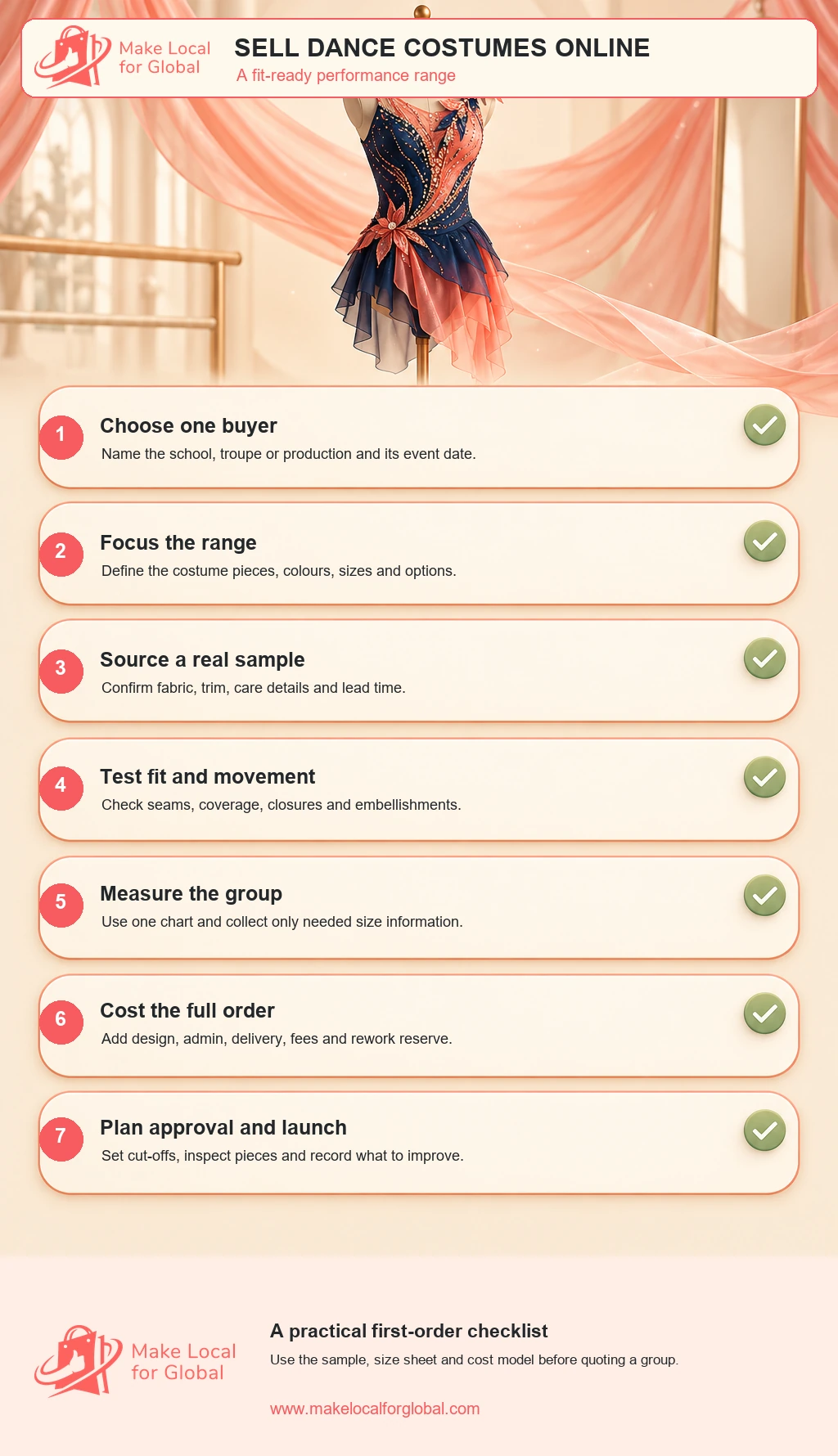
Check the first costume offer before launch
Review the sample evidence, sizing route, product information, order process and early buyer feedback before expanding.
PREFERRED SOURCE
Like what you’re reading? Add Make Local for Global as a preferred source on Google to see more of our articles when you search.

Build your online presence without having to figure out everything yourself.