

READY TO SELL Digital watches ONLINE?
Get a store built for you in 5 days, plus training and support to help you start, run, and grow your Alternative business.

Learn how to choose digital watches for a focused first range, verify product claims, calculate the full cost of each order and build a store that answers buyer questions before checkout.

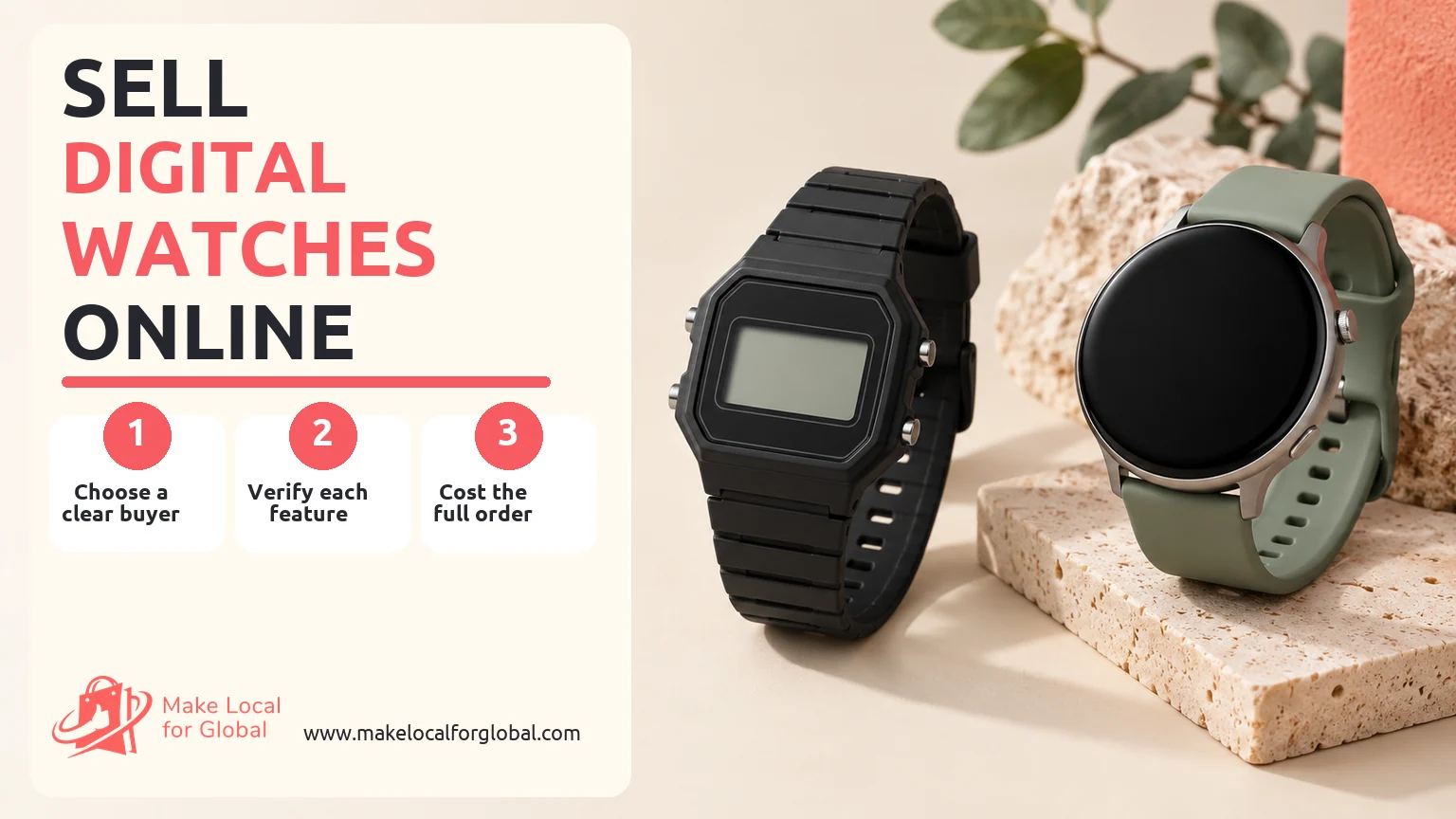
Digital watches look simple in a product photo. A buyer still needs to know whether the display is readable, the strap fits, the alarm is loud enough, the battery can be replaced and the water-resistance claim suits the way they plan to use it. If you sell connected models, phone compatibility, software support and radio equipment rules add further checks.
That gives a new seller a practical route into the category: start with a clear buyer and a small range, test samples against the claims on the product page, then price the complete parcel and make the limits easy to understand. You do not need dozens of models to learn whether an offer is useful. You do need accurate specifications and a returns process that matches what you promise.
This article focuses on digital watches, from basic LCD alarm watches to connected smartwatches. Treat the two groups as related but distinct products. Their customers, return reasons, support needs, compliance checks and stock costs can vary. Browse more Product To Sell ideas if you are still comparing categories.
“For everyone” is not a useful range brief. A digital watch can serve a school-age child, a shift worker, a runner, a traveller, a person who wants a simple time display, or someone who wants phone notifications. Those buyers compare different details and expect a different level of help after purchase.
Write down one primary customer and the situation in which they wear the watch. For example: “A warehouse team member wants a readable time display, a timer and an easy-clean strap for a long shift.” That sentence can guide the first model, the sample tests, the images, the page copy and the advertising.
| Buyer group | Job the watch needs to do | Questions likely to affect purchase |
|---|---|---|
| Everyday basic-watch buyer | Show time and date without phone setup | Is the display clear? How is the time set? Can the battery be changed? |
| School-age child and parent | Provide a simple, comfortable watch for daily use | What is the case and strap size? Is the buckle secure? Is the product age-appropriate? |
| Shift worker | Make time, alarms or a timer easy to check during a shift | Can the screen be read indoors? Can the alarm be heard? Is the strap comfortable for long wear? |
| Runner or outdoor user | Time a session and use a watch around sweat or rain | What functions are present? What conditions does the resistance claim cover? |
| Connected-watch buyer | Pair a watch with a compatible phone and use selected apps | Which phone versions work? Which functions need an account or subscription? How long is software support stated to last? |
| Gift buyer | Choose a watch that feels complete and ready to present | Is the box suitable for gifting? Are setup and sizing instructions included? |
These are hypotheses, not market research. Test them with a small set of real conversations and page behaviour. Ask five people who match the proposed buyer to compare two product descriptions, say what would stop them ordering and point to information they expect to see. A repeated question is a sign to improve the offer or the page.
Start with evidence that costs little. Review search suggestions for phrases such as “easy to read digital watch”, “digital watch with timer” or “simple digital watch for work”. Check whether the search results show product pages, comparisons or troubleshooting content. That can help you decide what question your store should answer. Search volume alone does not prove that a product will sell.
Ask prospective customers what they use today, when it lets them down and what feature they would pay extra for. Avoid asking only “Would you buy this?” People may say yes to be polite. Show an actual sample or a clear specification card and ask them to compare it with another option.
You can test a landing page with a small, clearly labelled initial range and a waitlist, provided it does not imply stock is available when it is not. Track qualified enquiries, email sign-ups and the questions people ask. Decide in advance what result would justify ordering samples, not a large production run.
Test the watch idea before committing to stock
Gather buyer evidence about the use case, display, functions and questions that should shape your first offer.
The broad category hides important differences. A basic digital watch may need a small number of functions and little support. A smartwatch can involve phone pairing, an app, data permissions, charging habits, firmware changes and customer questions about notifications. Do not treat a smartwatch as a basic watch with more features printed on the box.
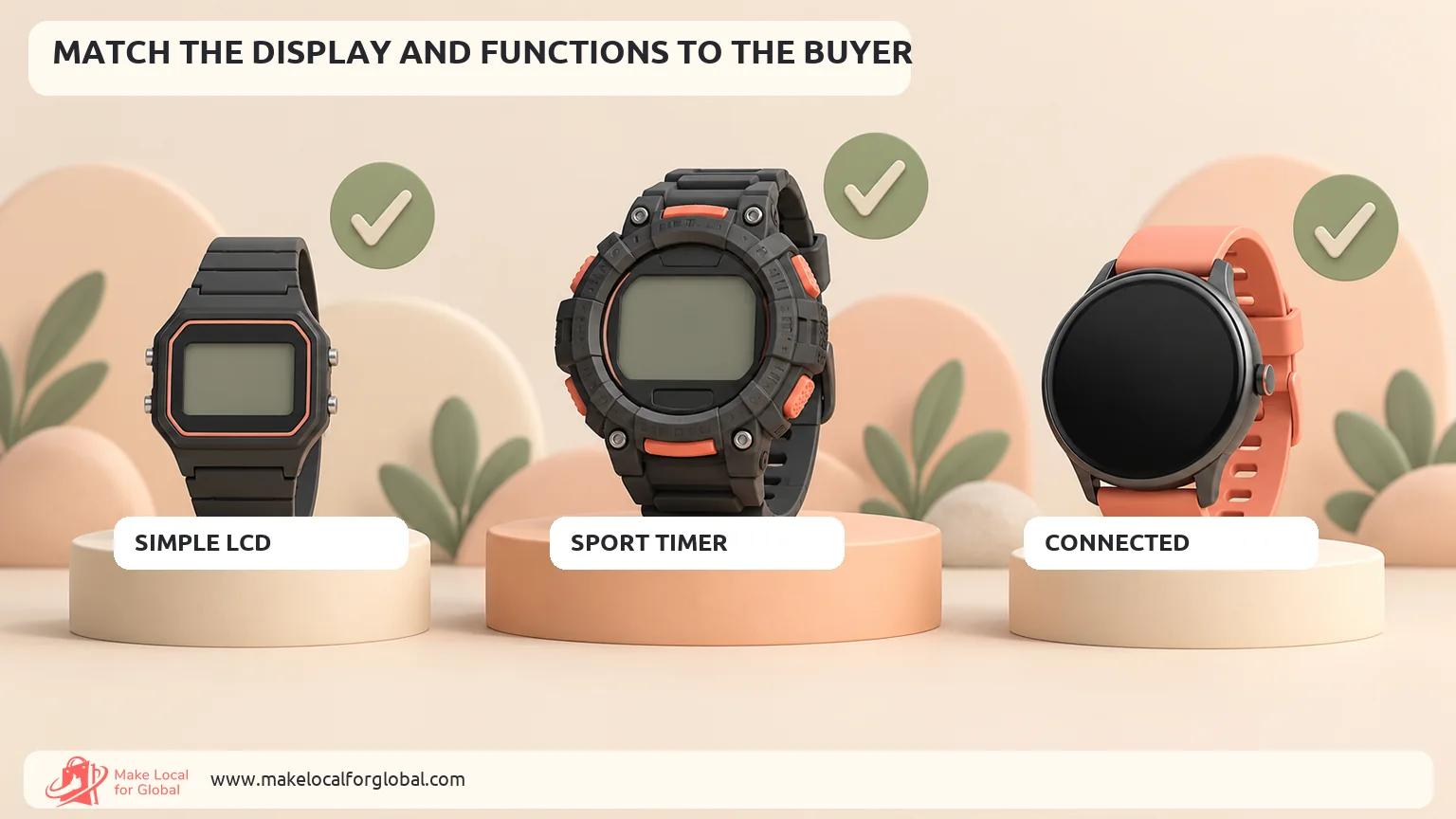
These may show time, date, alarms, a stopwatch, a countdown timer, a backlight or a second time zone. Their appeal can be easy operation and a familiar display. Check whether the buttons make sense, the display can be read in the conditions you describe and the watch retains settings after a battery change.
“Sport” is a positioning word, not proof that a watch suits every sport. If you sell one for running, test the stopwatch and button operation during movement. If you sell one for swimming, check the manufacturer's exact resistance rating and permitted use, then avoid adding broader claims of your own.
Connected models may support calls, notifications, activity estimates, GPS, music control or health-related readings. Feature lists vary by phone, operating system, app, country and firmware. A specification that works on one phone can fail on another. If your product idea is focused on wrist-worn activity measurement, see our related guide to selling activity trackers online.
Before ordering, build a compatibility matrix. Record the supported operating system versions, required app, account requirements, permissions, languages, update process and any functions that depend on a phone connection. Verify the matrix on the current product, not from a supplier's old catalogue. If a feature is unavailable on a common phone model, say so before checkout.
Be careful with health language. A consumer smartwatch reading should not be presented as a diagnosis or as a replacement for medical advice. Do not make claims about detecting, preventing or treating a health condition without the evidence and regulatory status needed for that claim. Keep the product page within the manufacturer's substantiated wording.
You can start with three offers that solve one customer's problem: an entry watch with a clear display and alarm; a core model with a timer, backlight and a more adjustable strap; and a premium model with a specific, verified feature that the buyer group values. This is a structure to investigate, not a requirement to stock three versions.
If the sample evidence points to a simpler range, launch one or two models. Each additional colour, strap size or software variant ties up cash and adds a chance of picking the wrong item. Begin with options that help a buyer choose. Do not create variants simply to make the catalogue look large.
| Range tier | Possible offer | What must be verified |
|---|---|---|
| Entry | Basic time, date and alarm | Display, button layout, time setting, case measurements, battery type |
| Core | Timer, backlight and a more adjustable strap | Readability, strap fit, function sequence, battery life claim and replacement method |
| Specialist | A buyer-led feature such as phone notifications or a specific activity function | Compatibility, support period, app permissions, exact feature limits and relevant conformity evidence |
Use this table as a decision worksheet. Your own models may not fit these tiers. A premium label should reflect a useful benefit that can be shown and supported, not a higher price alone.
Supplier pages can combine details from several versions. Make a version-controlled specification sheet before you compare prices. Record the maker and model number; case width, thickness and weight; display type and dimensions; strap material and adjustment range; button functions; battery chemistry and replacement method; charger type if applicable; supported languages; included accessories; warranty terms; and the exact water-resistance statement.
For a connected watch, add app name and current app store links, supported mobile operating systems, pairing steps, permission requests, data handling information supplied by the maker, update process and stated support period. Ask which features work without the phone nearby, which need a phone connection and which require a paid plan.
Ask the supplier to identify the factory and responsible manufacturer, provide the exact model documentation, confirm the product version and tell you how changes are controlled. Request test reports and declarations that match the exact model and radio configuration you intend to import. A logo on a generic certificate is not enough if the model, lab or test scope does not match.
If you are buying an existing UK or EU-branded product for resale, ask who holds the compliance records and what instructions and traceability information you receive. Your legal role can change if you import goods, sell under your own brand or make material changes. Do not assume that a supplier's assurance transfers every obligation to them.
Request a sample and a written quotation for the same model, colour, packaging and order quantity. Ask for the minimum order, lead time, sample cost, production payment terms, defect policy, spare parts, packaging dimensions, shipping terms, customs documents, warranty handling and process for reporting a safety concern.
For connected products, ask how firmware is maintained and how long the app will remain available. Find out whether replacement straps, chargers, batteries or other parts can be ordered separately. If the app's support stops, can a buyer still use the basic time and alarm functions? A low unit cost can become expensive if every simple question needs a long support exchange.
Compare the supplier's answer quality as part of the sample decision. Clear model identification, dated documents and responsive correction of a specification error reduce uncertainty. Vague answers about “all phones”, “all waterproof” or “CE approved” should lead to further checks, not copy on your store. Our digital cameras selling guide covers a related electronics range where exact model details and included accessories shape the offer.
Use a repeatable checklist and keep a dated record, photos and video. Test every sample version. A single display failure or an awkward pairing flow can create avoidable returns when repeated across dozens of units.
Check the case, screen, edges, strap holes, buckle, pins and clasp under bright light. Look for sharp edges, loose parts, uneven gaps, cracked display covers, marks, dust under the glass or printing that rubs off. Measure the case and strap with a ruler or calliper, then compare them with the listing and packaging.
Put the watch on wrists of different sizes within the intended customer group. Note the smallest and largest comfortable fit, whether the strap tail catches and whether the buckle stays closed. A strap described as adjustable still has a practical fit range. Publish measurements rather than relying on that word.
Check the buttons with dry hands and after the strap is fitted. Are the functions easy to find? Does a long press perform a different action? Can the watch be set without an instruction video? Give the instructions to someone who has not seen the product and observe where they get stuck.
Read the display indoors, near a window and outdoors. Check at different angles and in low light. If there is a backlight, test how it activates and how long it stays on. Photograph the display without hiding glare or changing the product's actual contrast.
Test the clock, date, alarm, stopwatch, countdown, chime and any claimed second time zone. Confirm how each setting is changed and whether the watch keeps the correct time after the stated battery-saving or battery-replacement process. A feature is not ready for the product page until you can demonstrate it.
For an alarm, check the sound in a quiet room and in a normal household setting. Do not claim that it will wake every sleeper. For a timer, check whether it counts down as described and how it signals completion. Keep the tested result, not a supplier's superlative, as the basis for your copy.
Pair the sample with the main phone types you expect your buyers to use. Record the operating system version, app version and watch firmware. Try the advertised notification, call, GPS or activity feature, then disconnect the phone and see what still works.
Read the app permission requests before recommending installation. Check what the supplier says about account creation, data collection, storage, deletion and updates. If the information is missing or unclear, ask the manufacturer. Do not make privacy promises that you cannot verify.
Test setup from a factory reset. Measure how many steps and how much time it takes. Note confusing translations, QR-code dependence, failed pairing and any requirement to use a personal account. This is practical product evidence: a watch that looks impressive but cannot be set up by its intended buyer is a poor opening offer.
Do not convert a pressure or depth figure into a promise that a watch is suitable for every underwater activity. ISO 22810 describes testing for water-resistant watches, and the permitted use still depends on the actual watch, its condition and the maker's instructions. Gaskets can age, cases can be damaged and button operation may be restricted.
Ask the manufacturer for the model's test basis and exact activity wording. Use only the claim they substantiate and explain any limits in the listing and supplied instructions. Avoid “waterproof” when the product's legal and technical basis permits that exact claim. A buyer should not have to infer pool, shower or underwater use from a vague number.
Record your evidence in a sample log: model and batch, date, test, method, result, photo or video filename, supplier response and decision. If a result fails, ask whether the sample was faulty or the specification inaccurate, then test a replacement. Do not silently accept a failure to meet the listing.

The rules that apply depend on where you sell, where the goods are placed on the market and your role in the supply chain. Importing, own-branding or modifying a watch can create duties that differ from reselling a product already placed on the market by a UK supplier. Get specialist advice for the exact model and route if the role is unclear.
Watches with batteries or charging components may fall within electrical and electronic equipment rules. The UK producer responsibility guidance defines producers by activities such as manufacturing under a brand, importing and distance selling from outside the UK. It describes registration and reporting routes that depend on tonnage. Read the current GOV.UK EEE producer responsibility guidance and confirm whether your business is a producer under the rules.
A Bluetooth or other radio-enabled watch may be within the Radio Equipment Regulations. The Great Britain guidance covers conformity assessment, technical documentation and marking. Its current page says CE or UKCA marking can be used for covered goods placed on the Great Britain market following the 2024 amendment. Northern Ireland has a separate position, and EU sales have their own requirements. Read the relevant Great Britain Radio Equipment Regulations guidance and check the route for each destination.
Ask for a declaration and test records that identify your exact model, radio modules, electrical configuration and manufacturer. Verify the label, importer details and instructions that should accompany it. If the supplier offers a certificate for a similar-looking model, ask for evidence that it covers your version.
Battery obligations can apply when your business first places batteries, including batteries inside a device, on the UK market. The government guidance describes registration and take-back duties based on the business's status and volume. See Waste batteries: producer responsibility and the battery regulations overview. Check whether you or another party is the producer, and keep the answer on file.
WEEE rules can require electrical equipment producers to register, report sales and finance collection or treatment. The route depends on the amount of equipment placed on the market and whether you belong to a compliance scheme. Do not treat a small order as proof that no rules apply; use the official thresholds and registration guidance for your circumstances.
RoHS restricts certain hazardous substances in covered electrical and electronic equipment. The manufacturer, importer and distributor may have different responsibilities. Read the current Great Britain RoHS guidance and obtain relevant technical records before taking an unsupported supplier statement as proof.
The Great Britain product safety advice for businesses explains general duties and what businesses should do if they identify an unsafe product. Great Britain and Northern Ireland can follow different safety frameworks. Northern Ireland uses the EU General Product Safety Regulation route, so a seller serving both markets should verify the right responsible person, traceability and online listing details for each.
Keep supplier invoices, model and batch records, conformity documents, product instructions, incident reports and customer complaints together. Create a process to stop sales and contact the supplier if a defect could create a safety risk. If a recall is required, your records should let you identify affected units and buyers.
The UK rules on unfair commercial practices require truthful information in consumer sales. The CMA guidance on the Digital Markets, Competition and Consumers Act unfair commercial practices regime explains how the regime applies from 6 April 2025. Keep a record for objective claims such as battery life, accuracy, waterproofing, step count and compatibility.
Do not promise a battery will last a fixed period when the basis and conditions are clear. A rechargeable watch's runtime can change with screen brightness, GPS, notifications and usage. State the maker's test conditions where provided, then describe real-world variation without presenting the best case as a guarantee.
Online buyers have cancellation rights under distance-selling rules, subject to exceptions and the correct process. The GOV.UK online and distance selling guidance explains information that should be supplied before an order. The separate returns and refunds guidance describes cancellation and refund rights.
Publish clear contact details, delivery charges and timing, return steps, refund timing and warranty terms. Do not label a fault as “wear and tear” before you have assessed the product. Keep returns data by reason: setup, strap fit, display, battery, compatibility, water exposure or expectation mismatch. The pattern helps you improve the range and page.
This section is an operational checklist, not legal advice. Rules vary by product, role and market. Confirm your obligations with the relevant regulator or a qualified adviser before importing or making claims.
A watch's supplier price is only one line. Add inbound freight, import charges if applicable, inspection time, packaging, payment or marketplace fees, dispatch, expected returns and customer acquisition. Separate per-order costs from fixed monthly costs so a price does not look healthy if the work is left out.
The example below is illustrative, not a market quote. It assumes a UK seller buying a watch for £12.00, spreading inbound transport and inspection over units, and selling one watch per order. VAT treatment, duty, postage and platform fees vary, so replace each line with your own figures.
| Cost per order | Illustrative amount | How to replace the assumption |
|---|---|---|
| Watch purchase | £12.00 | Use the supplier invoice for the actual model and order tier |
| Inbound freight and handling allocation | £2.20 | Divide actual shipment cost and eligible handling by sellable units |
| Import duty or clearance allocation | £1.30 | Check the commodity code, origin and customs paperwork for your shipment |
| Product inspection and intake allocation | £0.70 | Record the time and materials needed to check each unit |
| Retail box, mailer and protective packing | £1.40 | Weigh and measure a packed sample, then price the real materials |
| Outbound delivery paid by seller | £3.25 | Use a current carrier quote for the final packed parcel and service |
| Payment fee assumption | £0.85 | Replace with the rate and fixed charge for your checkout route |
| Returns and faults allowance | £1.50 | Review your own return, warranty and defect data over time |
| Illustrative variable cost before marketing | £23.20 | Add the figures above |
At a £39.00 selling price, the illustrative contribution before marketing and fixed costs is £15.80: £39.00 minus £23.20. If the seller spends £5.00 to attract one order, the contribution becomes £10.80 before fixed costs, tax and owner pay. This is not net profit.
If VAT applies, calculate the revenue and recoverable input VAT correctly. A VAT-registered seller should not treat VAT collected from a customer as sales income. For an accurate decision, use your accountant's VAT treatment and current government threshold rather than copying this simplified example.
Count the time needed to answer pairing questions, replace a strap, check a returned watch, reset a connected device and update a compatibility page. Include charger and spare-part costs, packaging inserts, testing tools, damaged packaging and a reasonable allowance for failed units. A model that needs frequent customer support has a labour cost though each support message is free to send.
For bundles, calculate each parcel's full cost. A watch with an extra strap or protective case may raise perceived value, but it can change package weight, postage, picking time and return handling. Discounting the bundle without recalculating those amounts may reduce contribution.
Create a small worksheet for each product and order type. Add the sell price, VAT treatment, product landed cost, packing, postage, payment fee, marketplace fee, expected returns and customer acquisition. Review a low, expected and high scenario for returns and advertising cost.
Then check the price against the buyer's alternative. Compare the actual features, setup help, support, return terms and verified product evidence. If the offer cannot compete without an implausible claim or a price that fails your cost floor, choose another model or customer group.
Price the complete watch order
Add the product, inbound freight, protective packaging, delivery, fees, returns and customer acquisition.
Use a title that names the type of watch and the feature that matters. “Digital Watch with Stopwatch and Backlight” tells a buyer more than “Ultimate Sports Timepiece”. Avoid terms such as “military grade”, “medical grade” or “waterproof” when you can substantiate the exact wording.
Include the case width and thickness, display size or type, weight, wrist fit range, strap material, functions, battery type, battery replacement or charging method, included accessories and warranty route. For a connected watch, show supported phone operating systems, app requirements, setup steps and features that need a connection.
Explain which details vary. If one colour has a different strap material, state that on the variant. If battery life changes with GPS or notifications, provide the maker's test basis and a plain explanation of the factors. Do not hide a limitation in a PDF that a buyer is unlikely to open.
Show the watch on a plain background, on a wrist from a useful angle, beside a ruler or familiar object, and with the display turned on. Include a close view of buttons and strap fastening. For a smartwatch, show the actual app screens or notification functions only if you have permission and the interface matches the product version.
Use original images of the model you sell. Do not use a supplier render that shows a different case, strap, screen or accessory. Avoid compositing a display that implies a feature the watch lacks. Alt text should describe the image for someone using a screen reader, for example: “Black digital watch showing the time and stopwatch, with case width marked at 42 mm.”
Link a short setup page or include a clear instruction card. Show how to set the time, change the display, silence an alarm, pair a phone and reset the watch. Give a route to get help. For connected models, tell the buyer what account, app or phone access is needed before they order.
Answer questions that predict returns: “Will it fit a 14 cm wrist?”, “Can the alarm be turned off?”, “Does it work with my phone?”, “Can I change the battery myself?” and “What does the water-resistance statement allow?” Answer only from the model's verified instructions. If a detail is not confirmed, ask the maker before listing.
Pack a sample parcel before setting a shipping price. Check that the watch cannot press buttons in transit, the screen is protected, the box does not crush under normal handling and the instructions remain readable. Photograph the packing process so another person can reproduce it.

If the watch contains a lithium battery, shipping rules depend on the battery, whether it is installed, the packaging, service, route and destination. Royal Mail and other carriers publish restricted-item guidance and may distinguish domestic from international services. Check the current carrier rules for the exact shipment before accepting an order; do not infer that an installed battery is accepted on every route. Damaged or recalled batteries need special treatment and may be prohibited.
Record the battery chemistry and watt-hour rating from the manufacturer. Keep the item protected from movement and accidental activation, and provide any required markings or documents for the selected service. If you cannot confirm the shipping conditions for a country, restrict checkout to routes you can fulfil safely and lawfully.
For returns, create a simple check-in process: record order and model, inspect packaging, note the customer's reason, check the watch condition and reset any linked account or personal data before resale. Do not resell a returned connected device until you have removed prior pairing and confirmed it can be set up again.
Offer a clear warranty contact route and keep common answers for battery replacement, strap sizing, pairing and display settings. If replacement parts are available, state their model compatibility. If there is a suspected safety defect, pause the affected listing and follow your product-safety process rather than sending another unit without investigation.
Your own store gives you space to explain setup, compatibility and returns. A marketplace can provide buyer reach and familiar checkout, but its fees, listing rules, return processes and product-category requirements must be included in the cost sheet. Read the current rules for the channel you choose before listing a battery-powered or connected product.
Start with one primary sales route and one source of qualified visitors. Examples include search content answering “how to choose a simple digital watch”, a short setup video, a local sports or work community, or a small paid search test for a specific use case. Do not run a broad campaign before you know which product page converts qualified visits and what questions buyers ask.
Use search phrases naturally in product titles, headings and image descriptions. A useful page might answer “digital watch with stopwatch”, “watch with large display”, “digital watch for small wrists” or “digital watch compatible with [verified phone system]”. Do not create near-identical pages for every phrase. Give each page a real reason to exist, such as a distinct model, buyer need or fit range.
Track product page visits, add-to-cart rate, checkout starts, orders, return reasons, support time and contribution after advertising. Set a minimum review period and a decision rule before spending. If visitors leave after looking at compatibility, improve that explanation. If orders arrive but returns cite strap fit, revise the size guidance or the model.
Content should help a buyer decide whether the watch suits them. Useful ideas include a plain comparison of basic digital and connected watches; a photo-led guide to case and strap measurements; a short tutorial for setting an alarm; a verified phone compatibility table; and an explanation of the exact water-resistance wording for your model.
Show the method behind any comparison. If you test battery runtime, state the settings and duration. If you compare display readability, explain the lighting and angle. A short honest test is more useful than an unsupported superlative.
Before writing a listing, create a one-page brief that keeps the team aligned. Include the primary customer, product model, three verified reasons to choose it, the limitations a buyer should know, the price floor, support contact, delivery region and return route. Link to the supplier file and your sample log.
This brief helps prevent a common catalogue problem: the headline promises a feature that the specification table quietly limits. Ask someone who did not write the page to compare the brief with the photos, packaging and checkout terms. A second reader can catch a wrong colour, mismatched strap or unsupported compatibility statement before it reaches customers.
For a product with several similar versions, keep a comparison sheet on the product page and in the picking area. Use the model number, case colour, strap, battery type and software version as identifiers. A photograph of the watch face alone may not help staff distinguish two versions with the same appearance.
Each variant selector should describe an actual model choice. Use names such as “black case, 20 mm strap” or “model D2, rechargeable” instead of “option 1”. State whether the variant changes the display, strap material, charger, app or included accessories. Keep the product identifier visible in the order confirmation and dispatch record.
If a strap comes in several lengths, publish the measured range and show how to measure a wrist. If sizing relies on removing links, explain whether a tool is included and whether the customer can make the adjustment. Do not imply that a watch fits every wrist simply as the clasp has several holes.
Use simple, consistent photos for variants. A customer should not select a black strap and receive a blue one if the gallery changed only the product image and not the selected variant. Test every selector on a phone, since many first visits will be on a small screen.
A bundle can solve a practical problem: a spare compatible strap, a protective case for a child, or a gift box with a simple setup card. It can create a support burden if the accessory does not match every watch version. Verify model fit and update the bundle when the base watch changes.
Calculate the bundle as its own order. Include the added item, packing dimensions, postage, pick time, fee and likely return outcome. Decide what happens if one item is faulty or the customer wants to return only part of the bundle. Explain the policy before checkout and follow consumer law.
Do not bundle a low-value accessory just to claim a higher original price or a large saving. Show the usual individual price only where it is genuine and supported by the way you sell the products. Buyers value a bundle when it removes a real purchase or setup task.
A passed sample does not prove every production batch matches it. Agree with the supplier how changes are approved and how a defect is reported. Ask whether components, firmware, battery supplier, packaging or factory can change without notice. Require notice and a new approval sample for changes that affect performance or compliance.
On arrival, compare outer cartons, labels and model codes with the order. Check a defined sample of units for display, buttons, strap, buckle, charger and accessories. The sample size should reflect the order size, defect risk and your ability to test; seek quality advice for a large order or safety-sensitive product.
Record the batch, quantity checked, issues found, photographs, supplier response and disposition. Quarantine units that may be unsafe or materially different from the approved sample. Do not blend them into good stock and rely on customer complaints to reveal the problem.
If a product is repaired or reworked, retest the affected functions and keep the work record. Make sure the replacement parts are approved for that model. A different battery, charger or radio module can change how the product performs and what documents apply.
Use a folder or product-information system with a predictable structure: supplier and invoice; specification and version; declarations and test reports; photos and approved copy; sample and batch checks; packaging and carrier instructions; customer questions; returns; and safety incidents. Use dates and model numbers in file names so the latest version is clear.
Limit editing rights for approved claims. If someone changes the product title or adds a feature, require them to point to the relevant evidence. When an old supplier document is replaced, archive it with a date rather than deleting it. This creates an audit trail if a supplier later disputes what version was delivered.
Review the folder before reordering. Confirm the model is still available, the product has not changed, documents are current and the supplier can still provide parts. Reordering from an old email without this check can produce a new version under the same catalogue name.
Create a short support library after testing the watch. Include how to set time and date, change the alarm, use the backlight, replace or recharge the battery, adjust the strap, pair the app, reset the device and request a return. Use the manufacturer's exact steps, then test them yourself.
Keep answers specific to the model. A generic article that tells a buyer to hold a button for five seconds can damage the experience if the watch uses another sequence. Put the model identifier at the top of each support page, and link to it from the order confirmation or product listing.
For a connected product, explain the distinction between a Bluetooth connection and an internet connection. Explain whether the watch can show the time when the phone is elsewhere, whether calls require a phone nearby and which functions stop when the app is removed. This avoids assumptions about what “smart” means.
Set a response process for account and data questions. Do not ask customers to send passwords, verification codes or sensitive health information by email. If a device needs to be reset, point the buyer to the tested reset instructions. If you cannot safely access or delete a customer's data, refer the issue to the manufacturer or app provider using the agreed support route.
Ask before launch which components can be replaced and who performs the work. A basic watch may need a battery, strap or pin. A rechargeable watch may need a charger, battery service or a full replacement. A connected model may need firmware support. Obtain realistic lead times and costs rather than promising a repair that the supplier cannot provide.
Decide how to handle a fault during the warranty period and how to separate it from accidental damage. Keep the process fair and consistent with statutory rights. The warranty is an additional promise; it does not remove consumer rights.
If parts are unavailable, decide how you will handle a discontinued model. Remove it from active advertising, keep the support page accessible and tell existing buyers where to get help. If a connected app is scheduled to end support, consider the effect on the watch's advertised functions and discuss it with the manufacturer before continuing to sell.
Plan a photo list before the shoot. Capture the front with the display active, side profile, back and sensor area, buckle, strap adjustment, charging port, included items and packaging. Add one wrist photo with a clear size reference. Do not retouch away scratches or show a larger display than the real product.
Photograph the menu sequence for core tasks if the display is legible. A buyer can understand a two-button watch faster when the listing shows what each button does. For an app, show actual screens and obtain permission for any customer name or notification content visible in a screenshot.
Keep a neutral image for the main listing and use explanatory images after it. A strong lifestyle photo can help a person picture the watch in use, but it should not replace specification evidence. Make sure a child is shown safely and appropriately if the product is aimed at families.
Name image files by model and purpose, such as model-d2-front-display.webp or model-d2-strap-measurement.webp. Write alt text that conveys what is visible, not a list of search terms. Compress files so pages load quickly, and check that the product remains clear on a phone screen.
Build one main page for each distinct watch model or real buyer need. Do not create many near-duplicate pages that differ only by a search phrase. A practical article about setting a digital watch can support a product page if it genuinely answers the setup question and points to the exact model whose instructions it covers.
Use headings that say what the section explains: “How to measure a watch strap”, “Which phones work with this watch?” or “What the water-resistance rating covers”. Make the answer easy to scan. Avoid repeating “digital watch” in every sentence; describe the buyer's problem naturally.
Add structured product data only through a trustworthy commerce plugin or documented implementation. Keep price, availability, identifier, brand and rating information accurate. Do not invent reviews or mark up a rating that is not visible to buyers. Check Google Search documentation before making technical changes to product markup.
Use Search Console or your reporting tools to inspect impressions, clicks, landing pages and checkout behaviour once the site has enough data. Treat the numbers as clues. A page with impressions but few clicks may need a clearer title or a better match to search intent; a page with clicks and no add-to-cart may have a price, trust or fit problem. Change the page based on evidence, then review again.
Write the process so a customer knows what to do before they order. State how to start a return, which address or portal to use, whether the watch should be reset, what packaging is needed, how refunds are handled and how a faulty item is assessed. Follow the statutory cancellation period and refund rules that apply to your sale.
Do not use a blanket “no returns on opened watches” statement without checking the law and facts. A customer may need to inspect a product to decide whether it meets their needs. A product's condition and use can affect the amount of a deduction in some cases, but you should not create a policy that removes legal rights.
On receipt, record the condition and reason code. Check for incorrect model, fit, app setup, battery, display, defect or change of mind. If the reason is a listing misunderstanding, revise the relevant copy or image. If it is a defect, check batch records and ask whether other stock is affected.
Track sellable stock, units reserved, open purchase orders, supplier lead time and demand variation. A reorder point should leave enough units to cover the time from ordering through inspection and receiving, with a buffer based on uncertainty. Do not assume the supplier's best-case lead time will hold during every season.
If a model has several colours or strap sizes, review each version separately. A total of 40 watches can hide a stockout of the most requested size and excess stock of another. Use sales and return data to adjust the next order rather than splitting inventory equally by habit.
Review ageing stock and product versions monthly. If a model is slow, do not automatically discount it before checking whether the page explains it well and whether the right buyers saw it. If a model is being replaced, account for the old inventory and parts support before committing to a new version.
Selling to another country can change product marking, responsible-person details, consumer information, language, tax, battery shipping, returns and data requirements. A product that is ready for Great Britain is not automatically ready for Northern Ireland, the EU or another market.
Create a destination checklist before enabling each country at checkout. Confirm local product rules, the legal role of the importer, language requirements, consumer cancellation rights, taxes, customs declarations, carrier restrictions and a workable returns address. If a buyer must pay an unexpected import charge, explain who pays and when.
Start with a small number of destinations that you can support. Use tracked services where appropriate and communicate realistic delivery windows. Review failed delivery, customs delay and return cost before adding more countries.
Watch materials and battery disposal claims can influence a buyer, but broad language such as “eco-friendly” needs evidence. State the specific fact you can support: the packaging contains a measured recycled share, the strap can be replaced using a named part, or the manufacturer offers a repair route. Do not imply an entire product is recyclable if only its box can be recycled.
Check local disposal guidance for batteries and electrical equipment. Tell customers not to put a battery-powered device into ordinary household rubbish where the applicable collection system says otherwise. Use official recycling instructions for the country you serve.
Avoid claiming a product is carbon-neutral or environmentally harmless without a clear, verifiable basis. If a supplier provides an environmental certificate, verify what it covers, who issued it, the date and the exact model. A document for the factory does not automatically substantiate a claim about every watch.
Write down who receives an incident report, who contacts the supplier, who can pause sales and where affected stock is held. Make sure customer service knows to escalate reports of overheating, swelling batteries, burns, shocks, sharp edges or unexpected strap failure. Do not ask a customer to keep using a product that may be unsafe.
Capture the model and batch, order date, symptoms, photographs if the customer is willing to share them, and any action taken. Protect the customer's personal information. Contact the supplier and relevant authority as required, and seek qualified product-safety advice when the risk or reporting duty is uncertain.
If you need to withdraw a model, stop ads and checkout, identify open orders and stock, then follow the recall or safety notice process. Keep a record of affected customers and the messages sent. A quick, clear response can reduce harm and helps you understand whether the issue is isolated or widespread.
Review a complete set of signals together: orders, contribution, customer acquisition, return rate, reason codes, support time, defect reports, stock age and supplier reliability. No single measure can tell you whether the range is healthy. A high conversion rate with repeated battery complaints can still be a poor offer.
Compare versions only when the audience and period are similar. A sale during a gift period may not predict a normal month. A discount can raise order count and lower contribution at the same time. Keep a note of any promotion so the next buying decision reflects the conditions under which sales happened.
Set a decision date for each test: continue, improve, pause or stop. If you continue, specify the next question to answer, such as whether a longer strap would reduce returns or whether a setup video lowers support time. If you stop, record why so the team does not repeat the same test later.
The goal for the first month is to reduce uncertainty and learn from real buyer behaviour, not to order the largest catalogue.
| Week | Actions | Evidence to keep | Decision at week's end |
|---|---|---|---|
| 1: Define | Select one buyer and use case; review search questions; speak with five likely buyers; compare two range ideas | Notes on repeated needs, objections and required functions | Which one problem deserves a sample test? |
| 2: Verify | Ask suppliers for exact model details and documents; order or inspect samples; test fit, display, functions and setup | Dated sample log, photos, model documents and supplier answers | Which model meets the stated requirements, and what remains unverified? |
| 3: Cost and prepare | Build a full landed-cost sheet; check shipping and return steps; draft product page and help content | Cost scenarios, package test, page questions and verified claims | Can the offer work at a defensible price and be fulfilled on the routes offered? |
| 4: Soft launch | Open a limited range; invite a small qualified audience; answer support questions; review page and order data | Visits, questions, orders, contribution, returns and support time | Keep, revise, pause or test a second model? |
Do not treat a quiet first week as proof that the product has no demand. Check that the right people saw the offer and that the page answered their questions. Equally, do not scale from a handful of sales without checking returns, customer acquisition cost and the supplier's ability to repeat the same quality.
Group feedback by a reason that can guide action. Compatibility confusion may call for a clearer table. A strap-fit pattern may call for a different model or better measurements. Battery complaints may point to an exaggerated claim, a faulty batch or an unclear charging routine. A late delivery points to fulfilment, not necessarily to the watch itself.
Change one part of the offer at a time when possible. Keep the old page version and the date of the change. Then compare the same measures over a reasonable period. This makes it easier to see whether the change helped.

Colours and feature combinations look inexpensive when viewed as a list. Each variant can carry a minimum order, tie up cash and create a separate compatibility or support question. Start with the versions that help the selected buyer make a real choice.
A catalogue may combine test results or features from several models. Confirm each claim on the exact sample and in its documents. If you cannot confirm a claim, remove it or ask for evidence.
App support can change, and feature access may differ by operating system. Maintain a dated compatibility list and show the version tested. Tell buyers how to check their phone before ordering.
Resistance claims have conditions. A rating does not tell every buyer what activity is allowed, and a damaged watch may no longer meet the original test. Use exact substantiated language and explain limits.
A smartwatch may have a low return rate for physical defects but still create many setup questions. Test reset, pairing, account requirements and app permissions. Make sure the maker has a support path and an update plan.
Fees, postage, packing, returns and advertising can consume a large share of the selling price. Use actual quotes and replace every illustrative amount in the example with your own data.
Buyers need to know how to return a watch, request a refund or report a fault. A confusing process can harm trust and take more time than the product margin supports. Make the route visible and train anyone handling messages.
Start with the model that matches a buyer need you can test and support. A basic watch may need less setup help. A smartwatch can offer more features, but it brings phone compatibility, app, privacy and update questions. Sample evidence and the full cost should guide the choice.
There is no fixed number. One well-tested model can be a sensible test if it solves a clear problem. A small entry, core and specialist structure can help comparison where the differences are useful. Avoid stock variants that have no evidence of buyer demand.
Ask for the exact manufacturer and model, full specification, minimum order, lead time, defect process, spare parts, battery details, warranty route and conformity documents relevant to your sales markets. For a connected watch, ask for app links, compatible phone versions, setup steps and software support information.
Use only wording supported for the exact model and permitted by applicable rules. Ask for the manufacturer's testing basis and activity limits. Do not turn a depth figure or a supplier's shorthand into a broader promise.
Your duties depend on the product, market and role. Importers, own-brand sellers and distributors may have different responsibilities. Check the current rules for electrical equipment, radio functions, batteries, substances and general product safety, and obtain documents that match the exact model.
Show measurements, fit range, strap and case materials, display, functions, battery or charging method, included items, compatibility, setup needs, water-resistance limits, delivery, returns and warranty contact details. Use images of the version you actually sell.
Start with the product's landed cost, then add inspection, packaging, delivery, payment or marketplace fees, expected returns and customer acquisition. Check VAT treatment and fixed costs separately. Contribution after variable costs is not the same as net profit.
It depends on the battery, packaging, carrier, service, route and destination rules. Check current carrier instructions before offering an international service. If the requirements are unclear, limit the delivery destinations until you have a verified route.
Follow your published returns and warranty process, record the model and batch, and inspect the product. Look for patterns across complaints. If there may be a safety issue, stop sales of the affected product as you investigate and follow the relevant product-safety reporting process.
A digital-watch business is easier to assess when each product has a clear buyer, a tested specification and an honest product page. Start with the decisions that reduce avoidable uncertainty: verify the sample, calculate the whole order, check your responsibilities and make the limits visible to the buyer.
Use early orders and questions to decide what to keep, improve or stop. A focused range with a clear support route gives you better evidence for the next stock decision than a catalogue of untested features.
Review the first watch offer before widening it
Check product evidence, buyer information, fulfilment and support before ordering another model.
PREFERRED SOURCE
Like what you’re reading? Add Make Local for Global as a preferred source on Google to see more of our articles when you search.

Build your online presence without having to figure out everything yourself.