

READY TO SELL Drawer Organizers ONLINE?
Get a store built for you in 5 days, plus training and support to help you start, run, and grow your Alternative business.

Learn to sell drawer organizers online with accurate fit checks, material choices, product-page measurements, a worked order-cost example and a focused first launch.

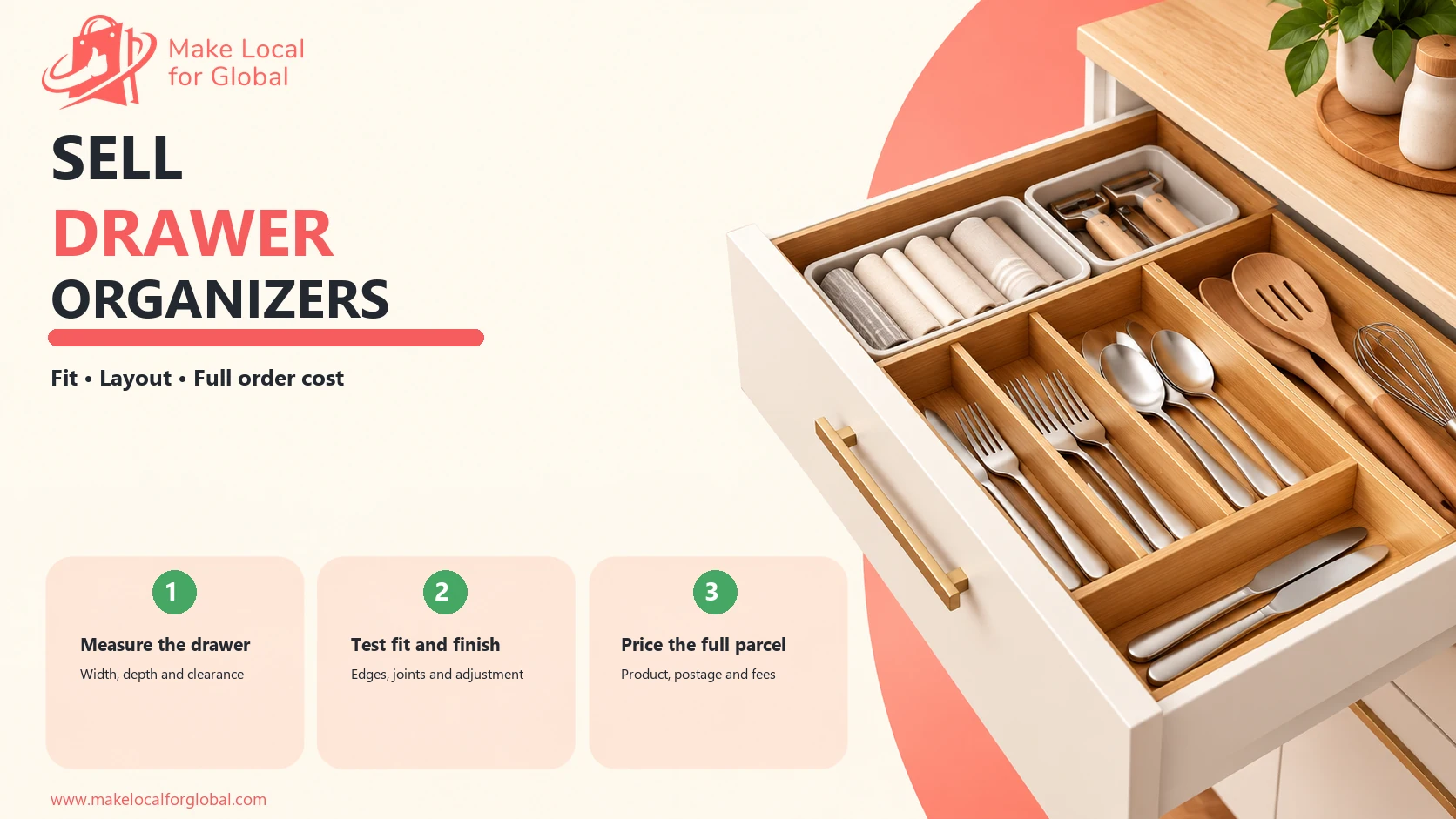
Drawer organizers look simple until a customer tries to fit one into a drawer that is a few centimetres narrower, a little shallower, or interrupted by a runner or hinge. That gap between a product photograph and a real drawer is where returns, low reviews and wasted stock begin.
Yes, you can sell drawer organizers online through a focused home storage shop, a marketplace, or your own ecommerce site. Choose a specific drawer and buyer problem, measure the products and the drawers they are intended for, test the material and finish, and show the dimensions in a way a customer can use before ordering. Start with a controlled range of trays, dividers or modular sets, then expand only after questions, orders and returns show what people need.
This is a practical plan for a first-time seller. It covers product selection, material checks, sourcing, fit information, cost and pricing, product-page content, fulfilment, customer acquisition, a first-month test and the UK rules that can affect online sales.
Check drawer fit before you commit to stock
Compare a buyer problem, sample dimensions, supplier terms and the total cost of a first range.
“Drawer organizer” can mean a cutlery tray, an expandable kitchen divider, a modular desk insert, a makeup tray, a sock compartment set or a padded jewellery insert. Those products serve different rooms, drawer sizes and habits. A first range becomes easier to source and explain when it solves one recognisable problem.
Write a short buyer statement before asking suppliers for catalogues. For example: “A flexible cutlery tray for renters with narrow kitchen drawers,” “A modular desk set for people who want stationery visible,” or “A low-profile vanity insert for small bathroom drawers.” These statements are hypotheses to test, not claims that a market has already been proven.
Ask potential buyers what currently frustrates them. A cutlery drawer may have mixed utensils, a tray that slides around, or an awkward gap beside the tray. A desk drawer may contain pens, chargers and sticky notes in different sizes. A bathroom drawer may need shallow sections that can be lifted out for cleaning.
Speak with five to ten people who match the buyer you have in mind. Ask them to show the drawer if they are comfortable doing so. Record its internal width, depth and usable height, plus any obstructions such as a centre support, runner, screw head or curved front. Ask what they have tried, what did not fit and what they would need to see before buying another insert.
Do not lead with “Would you buy my organizer?” People may say yes to be polite. Ask what they use today, when they last changed it, what they paid and which part remains annoying. A recent purchase, a measured drawer and a specific complaint give you more useful evidence than a positive reaction to a mood board.
Create three concept cards with a realistic picture, dimensions, material, compartments and an indicative delivered price. Ask each person which one suits their drawer, what they would store and what information is missing. Record choices and objections separately. If a buyer likes the appearance but cannot tell whether the item will fit, the next test is a dimension-led product page, not another colour.
Use a simple landing page, a marketplace draft, or a waitlist with accurate product details. Make clear whether the product is a sample, available stock, or planned production. Do not take payment for a product you cannot supply on the stated terms. Track which concept gets a qualified question, a waitlist sign-up, a request for a particular measurement, or a real order.
For a small online test, show a close-up of the compartments and a diagram with the outside width, depth and height. Ask people to measure their drawer with a tape measure and compare it with the item. A product that gets fewer clicks but more questions about fit may have a useful problem-solving angle; it still needs evidence from actual purchases and returns.
Choose a small group of products that work together. A seller focused on kitchen drawers might start with one expandable cutlery tray, one set of movable dividers and one small utensil insert. A desk-storage seller might start with two modular tray footprints and one cable section. A broad “everything for every room” catalogue creates more supplier checks, photographs, dimensions, packaging sizes and stock variants before you know which use case matters.
Use range roles to explain why each item belongs in the shop.
| Range role | Example | Buyer question | Evidence to show |
|---|---|---|---|
| Entry product | Fixed-width cutlery tray | Will it fit the drawer I use most? | Outside dimensions, compartment widths and usable drawer range |
| Core product | Expandable bamboo-style tray | Can it cover a wider drawer without leaving a gap? | Minimum and maximum width, locking method and care instructions |
| Modular add-on | Two or four separate bins | Can I change the layout later? | Each module size, connector type and sample layouts |
| Specialist product | Shallow vanity insert | Will the height clear the drawer front and runner? | External height, internal depth and a side view |
| Bundle | Tray plus divider set | What exactly arrives together? | Component count, sizes, materials and bundle saving arithmetic |
These are possible roles, not a recommended count. Your first assortment may need only two products if they answer the same buyer need. A focused shop can offer meaningful choice through size or layout without stocking a large number of unrelated designs.
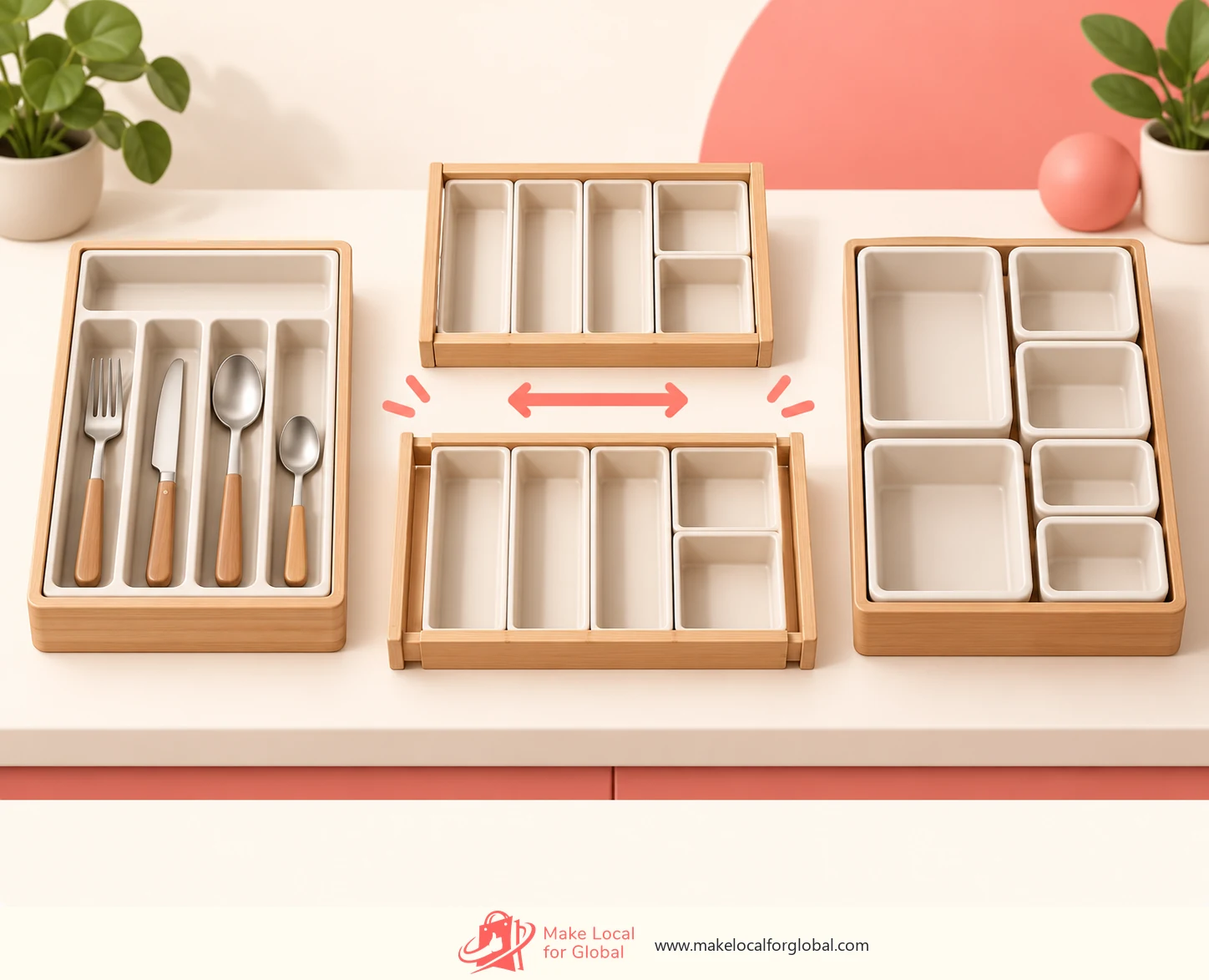
Fixed compartment trays are straightforward to explain when their dimensions suit common drawer sizes. Their drawback is that a rigid footprint can leave unused space or fail to fit an unusual drawer. Measure the actual outside dimensions and the width of each section. A photograph with forks or pencils can help a shopper understand the scale, but it cannot replace a dimension drawing.
Expandable trays use sliding sides or nested sections to cover a range of widths. Check the stated minimum and maximum width, then test the item at several settings. Look for gaps that expose the drawer base, weak locks, sections that pinch, or a tray that shifts under normal use. State the usable range and how the product stays in place.
Adjustable dividers create compartments inside an existing drawer. They may suit buyers who want to change layouts, but the fit depends on the drawer’s internal width and the divider mechanism. Record divider length, adjustment range, end-pad material, installation steps and whether the product requires adhesive or a tool. Test the pads on a spare surface before describing them as non-marking.
Modular bins can be combined into different layouts and sold as singles or sets. The module dimensions, connector method and compatibility between product versions must be clear. If a set shown in a photograph contains accessories that are not included, label the image or show a second picture of the exact contents. This prevents a visual bundle from creating the wrong expectation.
Roll-up or flexible inserts may fit drawers that are not perfectly square, but the material can crease or move. Inspect the underside, stiffness, edge finish and cleaning directions. Felt-lined or fabric organizers may be useful for accessories that can scratch, yet buyers need to know whether the inserts can be removed, washed or wiped.
Every size, colour and module combination can create another product variant. Three colours across four sizes already produce twelve combinations before you add sets. Variants can split your cash, make stock counts harder and lead to customers selecting the wrong option.
Start with the dimensions supported by your supplier and the drawers observed in your interviews. If a wider size appears useful, order one sample and test it before adding it to the live range. Keep colour choices few until buyers show that colour changes the purchase decision. For an organizer, fit and layout often matter more than a large shade list, though you must test this with your own buyers.
If you create a bundle, make its value legible. List the products included, the normal individual prices, the bundle price and the amount saved. Do not advertise a saving against a price that was not genuinely offered. A set can raise the order value, but it can increase packing volume and create a return in which one component is missing or damaged.
The material affects appearance, weight, handling, cleaning, packaging, sourcing and customer expectations. Do not rely on a supplier’s generic description. Ask for the exact material and finish of the model you plan to buy, including liners, pads, coatings, connectors and any mixed-material parts.
Bamboo or wood products can have a warm appearance and a solid feel. Check whether the item is solid wood, bamboo, veneer, composite board or a mixture. Look at joints, sanding, splinters, sharp corners, cracks, gaps and finish consistency. Ask how the material should be cleaned and whether it can warp with moisture. Avoid unsupported terms such as “waterproof”, “non-toxic” or “sustainable”. If the supplier makes an environmental claim, ask what evidence applies to the exact product and supply chain before repeating it.
Plastic organizers can be light, wipeable and easy to ship. Resin type, wall thickness, moulding marks, colour consistency, odour and flexibility vary. Press each compartment and check whether it flexes enough to deform under normal storage. Inspect edges for flash or sharp spots. A glossy surface may show scratches; a textured surface may collect dust. Test the actual finish and clean it using the method you intend to recommend.
Metal dividers or baskets can suit drawers where visibility and stiffness matter. Check welds, folded edges, coating, feet, and exposed corners. Run a cloth around edges to find burrs that may snag fabric or scratch a drawer. For powder-coated finishes, inspect sample corners and contact points after repeated handling. Do not describe a finish as rust-proof or scratch-proof without credible product evidence.
Fabric, felt and foam organizers are soft and often used for jewellery, watches, socks or small accessories. Examine stitching, seams, lining adhesion, odour, thickness and colour transfer. Ask whether the insert can be washed or only surface-cleaned. If a textile product has different fibre contents across components, check whether textile labelling duties apply to that product and market. The UK government’s textile labelling guidance describes fibre-content requirements for textile products in England, Scotland and Wales; check the current rules for Northern Ireland and each overseas market separately.
Mixed-material products need inspection at the join. A bamboo tray with plastic connectors, a fabric insert with a coated base, or a metal divider with rubber feet can fail where parts meet. Pull, twist and reposition connectors using ordinary care. Look for adhesive residue, loose pads, gaps and parts that detach. Ask whether replacement connectors or pads can be obtained, especially if they are a wear item.
Fit is the main product risk in this category. A customer may measure the drawer opening instead of the usable interior, overlook a runner or forget that a lip narrows the top. Your product page needs to teach a quick measurement method and make clear whether dimensions refer to the organizer or the drawer it can fit.
Measure every sample yourself. Use a rigid ruler or tape and record the outside width, depth and height at the widest and tallest points. For a tray with tapering sides, measure both top and base widths. For expandable products, note the exact settings tested, not just the supplier’s stated maximum. For dividers, record compressed length, full length and how much adjustment remains at each end.
Check usable drawer space at several positions: near the front, centre and back. Drawers can be narrower at one point or have runners that reduce the floor area. Measure the internal depth from the front inside edge to the back obstruction. Measure height from the drawer base to the lowest point of the closed drawer or counter. Include any lip, hinge, screw head, central bar or curved front that changes the space.
Record whether the organizer requires clearance to open or slide. A tray can fit when placed into an empty drawer and still catch on the frame when the drawer closes. Test with the drawer fully open, partly open and closed. If the item has a sliding expansion, move it through its range and look for pinch points. A quick phone video of the test can become a useful internal quality record.
Find three to five drawers in the buyer group you plan to serve, with permission from their owners. Choose different dimensions and layouts rather than selecting only a perfect fit. Record the internal measurements and obstructions, install the organizer, load it with ordinary items and open and close the drawer repeatedly.
Check for rocking, sliding, rattling, pressure against the sides, interference with runners and parts that move when the drawer closes. For adjustable dividers, reposition them and check the end pads again. For modular bins, lift one module out and return it. For cutlery organizers, place the typical objects in their sections and see whether the compartments are genuinely useful.
Use the claim “fits most drawers” only after defining the range and gathering evidence to support it. A more useful statement is “Fits an internal drawer width from 34 to 46 cm; measure at the front, middle and back; allow 1 cm clearance at each side.” Use the actual product specification and test results. If no range is known, list the organizer’s outside dimensions and tell buyers how to compare them.
Create a measurement card for each product. It should include a top view with width and depth, a side view with height, the material, each compartment width where relevant, and a drawer measurement checklist. Use centimetres as the primary unit for a UK audience. Add inches only if you convert accurately and label both units. Never infer dimensions from a photograph or scale an image without a known reference.
You can source drawer organizers from a UK wholesaler, an overseas manufacturer, a local maker, or a contract supplier. The right route depends on the design, order quantity, cash available, lead time, shipping size and how much control you need over finishes or packaging. Compare suppliers on the same written specification so a lower quote does not hide a thinner material or smaller organizer.
Ask each supplier for:
Record the model number and date on each quote. A supplier may reuse a product photograph for several sizes. Confirm which image and specification correspond to the item you would receive. If a dimension is important to fit, ask the supplier to measure a finished unit and share a photograph with the ruler in place.
Calculate the cost to receive one sellable unit at your location. Include the item, shipping to you, customs or import costs where relevant, inspection, damaged units, labels, packaging and storage. If quotes use different currencies, convert them on the same date and include any bank or payment conversion charge. Keep assumptions beside each figure and update them when a shipment arrives.
For overseas supply, establish who is responsible for freight, insurance, customs declarations and import charges. Ask a qualified freight or customs adviser when the route is unclear. Do not assume that a supplier’s phrase “delivered” means all taxes or border charges are covered. Keep commercial invoices and model identifiers with the stock record.
Buy a sample of every size and construction you are considering. A sample is a check, not proof that every unit in a later shipment will match it. Compare the sample with the written specification and keep photographs of the packaging, label, dimensions and any defect.
Use a simple sample sheet. Record the date, supplier, model, colour, dimensions, material, finish, package condition and results of each check. Mark issues with a photograph and a clear pass, hold or reject decision. If the supplier changes the model after approval, request a new sample before ordering the revised item.
The aim is to catch defects before a buyer finds them. Test normal handling, not destructive abuse. Keep a record of the sample and method so another person can repeat the same check on a future delivery.
For rigid trays, place them on a flat surface and check for rocking. Press each corner and compartment wall. Inspect mould lines, glue, sharp edges, cracks and colour variation. Put common items in the compartments and lift the loaded tray in the way a customer might. Check whether thin walls bend or the base bows.
For expandable designs, test the minimum, middle and maximum settings. Slide the sections in and out repeatedly. Look for uneven friction, poor stops, exposed gaps, pinching, wobble and sections that drift under load. If the item uses a latch, check whether it closes securely and whether a buyer can release it without excessive force.
For dividers, install them in more than one drawer width. Follow the supplier’s directions. Check the locking mechanism, pressure pads and any adhesive. Remove and reposition the divider to look for residue or marks on a spare surface. Do not state that it will not damage cabinetry without testing the material and method on suitable surfaces.
For wooden or bamboo organizers, check joins, corners, surface finish, splinters, warping and finish consistency. Wipe a discreet area with a damp cloth if the care instructions allow it. Note whether moisture changes the surface. Do not soak the product or recommend a care method that conflicts with the supplier label.
For fabric-lined inserts, check the lining for loose fibres, weak stitching, colour transfer and separation from the base. Place typical objects inside, lift the tray and inspect the seams under load. Follow stated cleaning guidance on a sample. Record any shrinkage, fraying or change in shape after cleaning. Promise machine washing only when the exact sample and care label support it.
Check packaging too. Shake the packaged product gently, then open it and look for transit marks, crushed corners, loose parts or abrasion. A package that is too large can raise postage and allow movement; one that is too tight can crush corners. Take photographs of the pack-out and write a repeatable packing step for any fragile finish.

If a defect affects fit, safe handling or durability, hold the batch and ask the supplier for a response. Keep affected units separate. Note orders that might include the same model or batch. The UK government’s product-safety advice says businesses that make, import, distribute or sell consumer products have responsibilities for product safety and supply-chain records. Review the current guidance for the territory where you sell, and get qualified advice if a product incident occurs.
Rules depend on where you sell, what the organizer is made from, whether you import it, and whether another product-specific rule applies. This section is a starting point for a UK seller, not a substitute for checking the rules that apply to your particular item and trading route.
In Great Britain, consumer products must meet the applicable safety requirements for normal and reasonably foreseeable use. The Office for Product Safety and Standards provides product safety advice for businesses and guidance on the General Product Safety Regulations in Great Britain. The government states that businesses should keep supplier records that make products traceable. Northern Ireland follows a separate product-safety regime; check the current rules for Northern Ireland before offering there.
For a drawer organizer, consider foreseeable contact with hands, stored objects and drawer surfaces. Check the construction for sharp edges, splinters, loose parts, unstable fittings, strong odour or parts that detach during ordinary use. Do not make claims about food contact, child safety, fire resistance, antimicrobial action, or chemical safety without confirming that the exact model meets the relevant requirements and that the claim is supported.
If the product contains textile components, check whether fibre labelling rules apply. GOV.UK textile labelling guidance says textile products in England, Scotland and Wales must show fibre content, including fur and other animal parts, and that products with components of different fibre content may need those contents shown. Confirm the position for the product and market you actually sell into.
Online product pages need clear information about the goods, total price and delivery cost before an order is placed. The government’s online selling guidance describes information that distance sellers must give customers, including a clear description and total price or calculation method. The guidance covers order confirmation and delivery too. Check current consumer rules for returns and cancellation, and make your policy consistent with the law. Do not use “no returns” as a blanket statement for online consumer sales.
Keep product and supplier records: model number, order date, batch or carton code where available, supplier contact, material specification, test notes, complaints, incidents, corrective steps and customer notices. If a buyer reports a sharp edge or a divider that detached, record the issue and pause affected stock until you have assessed it. A product record makes a supplier discussion and any necessary corrective action more informed.
Price the actual package that reaches the customer. A £12 organizer does not cost only its supplier unit price. You may pay freight to your premises, a protective sleeve, postage, payment fees, marketplace charges, pick-and-pack time, returns and customer acquisition. A bundle can change the parcel size and fee, so calculate it separately.
The example below is illustrative, not a supplier quote or expected profit. Assume one modular kitchen organizer sells for £29.00 including customer delivery. Assume the business is not VAT registered for this simplified example, and there is no marketplace commission. Replace the figures with live quotes and the fee schedule for your channel.
| Cost per order | Illustrative amount |
|---|---|
| Organizer purchase cost | £6.20 |
| Inbound freight and import allocation | £1.10 |
| Inspection and handling allocation | £0.45 |
| Protective packaging and label | £1.15 |
| Customer delivery | £3.40 |
| Payment fee assumption | £0.70 |
| Returns and damage allowance | £0.90 |
| Customer acquisition allowance | £2.00 |
| Variable cost estimate | £15.90 |
| Contribution before fixed costs and tax | £13.10 |
The arithmetic is £29.00 minus £15.90 = £13.10. This is contribution after the listed variable costs. It is not net profit. It does not include the owner’s full labour, ecommerce subscription, photography, insurance, accounting, storage, VAT or income and corporation taxes.
The fee assumption needs particular care. Payment providers and marketplaces calculate charges differently. Some charge a percentage, a fixed amount, a listing fee or a commission on shipping. Check the current rate for your plan and sales territory. If a marketplace charges a percentage of the customer delivery amount, include that in the calculation too.
Run a low, expected and high case. For example, model a £2 increase in postage, a higher return rate, and a lower sale price during a promotion. If the contribution becomes too small, test a lighter package, a bundle that shares postage, a different supplier, or a higher price supported by product quality and useful information. Do not solve a weak margin by hiding mandatory delivery costs until checkout.
Start from a price customers can compare with the value and convenience of the product. Look at competing products with similar material, dimensions, construction and delivery terms. Do not compare a basic tray with a made-to-measure wooden insert or assume the lower price wins. Record the differences in product and service that a buyer can see.
Test price with a landing page or a small paid batch. Track views, add-to-cart activity, checkout starts, completed orders, questions about dimensions, average parcel cost, returns and contribution. A price poll is weak evidence; a completed order at a disclosed price is stronger. Keep records of discounts so a temporary offer does not become your only demand signal.
If you sell a bundle, calculate the total cost and parcel dimensions for the bundle. A set of four bins may require a larger carton and more void fill than four separate orders. Compare contribution for the single item and bundle after fees and delivery, then decide whether the set still has a useful price advantage.
Review the product, package and launch plan
Bring sample checks, full order costs and the first customer test into one practical review.
The product title should name the product and a useful distinguishing feature. Examples include “Expandable Bamboo-Effect Cutlery Tray, 34–50 cm” or “Modular Desk Drawer Trays, Set of Six, Shallow Profile.” Do not state “bamboo” if the organizer is only bamboo-effect plastic. Use the true material name and the real adjustment range.
The first paragraph should say what is included, which drawer or storage job the product suits and which measurements matter. Put dimensions near the top rather than burying them after a long lifestyle description. A buyer should quickly know the outside size, height, compartment layout, material, finish, care method and package contents.
Use a diagram or short video that shows the inside width, usable depth and clearance height. Tell the buyer to measure the drawer interior at the front, centre and back. Ask them to check runners, lips, hinges and screws. If the opening narrows near the top, explain whether the organizer needs to pass through that opening or sits below it.
Use an example with made-up dimensions only if you label it as an example. For instance: “If your narrowest internal width is 38 cm and the tray is 36 cm wide, it leaves 2 cm total side clearance.” Do not imply that all drawers need the same clearance. The correct amount depends on the product shape and whether it slides or expands.
Distinguish organizer measurements from compatible drawer dimensions. “Organizer width 34 cm” describes the product. “Suitable for an internal drawer width of 35–48 cm” describes a claimed fit range and requires testing. If you have not tested the range, publish the organizer dimensions and explain the measurement method instead of presenting a guessed compatibility promise.
Plan a consistent image set: the organizer alone against a plain background; top view with a ruler or clear dimension labels; a side view showing height; compartments with typical contents; a close-up of corners, joins and finish; and one installed in a drawer with the drawer dimensions noted. Avoid props that make the organizer look larger or deeper than it is.
Show the exact bundle contents. If a lifestyle picture includes knives, stationery, jewellery or cosmetics that are not supplied, say “accessories shown for scale” in the caption. Keep colour consistent between products. For pale wood or fabric, photograph in balanced light so buyers can see the actual shade and texture.
Write alt text that describes the image’s useful content, such as “Expandable cutlery tray shown at its narrow and wide settings with the width range labelled.” Do not use a list of repeated keywords. Give a decorative background image empty alt text if it adds no information.
Use the product phrase naturally in the title, first paragraph and relevant headings. Buyers may use terms such as “drawer organiser”, “drawer organizer”, “cutlery tray”, “drawer divider”, “modular drawer bins”, “desk drawer insert” or “makeup drawer organiser”. Select terms that describe your product rather than placing every variation into one title.
Write a distinct page for each product where material, dimensions or layout differ in a way a buyer cares about. Avoid copying one template and replacing only the colour or size. Explain which drawer it suits, how it is installed, what it holds, how to clean it and what comes in the package. Add a comparison table if your products have different dimensions or compartment layouts.
Use a short URL that names the product. Add a concise meta description that states the product type, the measurement or layout benefit and a reason to view the page. Search engines may choose a different snippet, so make the opening paragraph useful without relying on the meta description. Keep claims accurate and do not promise a Google position or sales outcome.
Place a plain FAQ on the product page for genuine decision questions. Useful questions could be: “How do I measure my drawer?”, “What is the organizer’s outside height?”, “Are the modules included separately?”, “Can I wash the tray?”, “Does the expandable section lock?”, “Is the item made from solid wood or a veneer?” and “What is the return process?” Answer from the actual specification, not assumptions.
If a product has uncertain fit, say who should measure or contact you before ordering. Make customer support practical: provide the product code, measurements and a way to send a photo of the drawer if you choose to offer fit help. Do not ask customers to share information you do not need.

Your own store gives you control over layout, comparison pages and customer data, but it requires traffic and a clear path from search or promotion to checkout. A marketplace has built-in shopper discovery and its own fees, listing rules, image requirements and returns process. A social shop may suit short demonstration videos, but the checkout and product data must still be accurate.
Choose one main channel and one small supporting test. Do not build a large multi-channel operation before you can keep inventory and product details in sync. Compare current fees and policies directly from each platform before pricing. Record listing charges, commission, payment fee, advertising and any charges on shipping.
Content ideas should show real product use: how to measure a drawer, how an expandable tray changes width, how to choose between fixed and modular compartments, what fits in a desk insert, and how to check tray height against a drawer runner. Demonstrate with a real sample and label any illustrative dimensions. A useful clip can answer a fit question before a customer contacts you.
For search content, build one product page per distinct item and a helpful category page explaining the range. A short article on measuring kitchen drawers can link to the matching tray, and a comparison page can help a buyer choose between expandable and fixed organizers. Avoid making several pages that target the same phrase with near-identical copy. Give each page a different task.
Test one small promotion with a clear audience and a landing page. For instance, show a measured before-and-after drawer layout to people who follow home organization content. Track spend, sessions, product views, add-to-cart, purchase, average order value and contribution. Pause a promotion if it creates clicks without meaningful product-page engagement or sales. A view count is not proof of a viable offer.
Ask early customers for feedback about fit, movement, finish, cleaning and what they stored. Request permission before using their words or images. Keep the product feedback separate from a marketing review. A complaint about a sharp corner or a wrong dimension is a quality issue, not just a reputation issue.
Organizers vary widely in weight and parcel shape. Measure and weigh the packed product, not just the bare item. A flat organizer may ship in a slim carton; a tall tray may need corner protection; several bins may nest but still slide and scuff. Use a package that protects the corners and surface without making the parcel needlessly large.
Test the pack-out using a sample. Place it in the proposed packaging, close the carton, gently move it and inspect the product. Check whether dividers or modules rub together. Add a simple insert with setup, care and contact details if it helps the customer use the product. Keep inserts accurate and avoid unsupported environmental claims on packaging.
Compare delivery providers using parcel dimensions, weight, tracking, collection, insurance, remote area surcharges and claims process. The cheapest rate may be unsuitable for a fragile finish or high-value bundle. Record the dispatch service promised on the product page and have a fallback if a carrier delays or rejects the parcel.
Create a return inspection routine. On receipt, photograph the package and product, compare it with the condition record, count bundle components and log the reason the buyer gave. Separate resaleable returns from damaged or incomplete items. If the same item is repeatedly returned for a sizing issue, revise the dimensions or stop selling that variant until you know what is wrong.
Show delivery timing, costs and return information before checkout. The UK’s online selling guidance covers required information and order confirmation. Check current consumer law for cancellation rights, exceptions, refunds and return postage. A custom-made product can be treated differently from a standard stocked item; get current advice before relying on an exception.
For packing comparisons with larger home products, see the practical decisions in our guide to selling bed frames online. The products differ, but the same discipline applies: know packed dimensions, test protection and include delivery in the order cost.
Track each product model, size, colour, supplier and batch separately. A spreadsheet can record units ordered, units received, defects, units reserved, available stock, sales, returns and reorder lead time. Count physical stock on a schedule and compare it with the recorded balance. Small organizers are easy to miscount when several modules look alike.
Set a reorder point using actual sales pace and supplier lead time, with extra time for inspection and shipping disruption. Do not copy a generic “two weeks of stock” rule. If your supplier takes six weeks and you sell two trays per week, a reorder decision must account for the units you expect to sell before the delivery arrives and the cash tied up in the order.
Keep variant inventory under control. Put a clear code on each item, such as KITCH-EXP-01 or DESK-MOD-06, then use the same code in purchase records, product pages and return logs. Photograph labels or cartons that identify the batch. When a supplier changes a component, create a new revision in your records rather than treating it as identical without checking.
Set a cash limit for the first buy. Include samples, freight, import costs if applicable, packaging, photography and any platform setup. Keep money for refunds and replacement units. Do not spend all available cash on colours that have not been tested. A small range can show whether the buyer values adjustability, modularity, finish or price before you commit to a larger order.
Review stock after every test period. Look at sales by variant, questions about missing dimensions, stockouts, returns, defects, delivery damage and contribution. If one product sells but gets repeated fit questions, improve its measurement card before ordering more. If a bundle is popular but costly to ship, test a flatter packing method and recalculate it before expansion.
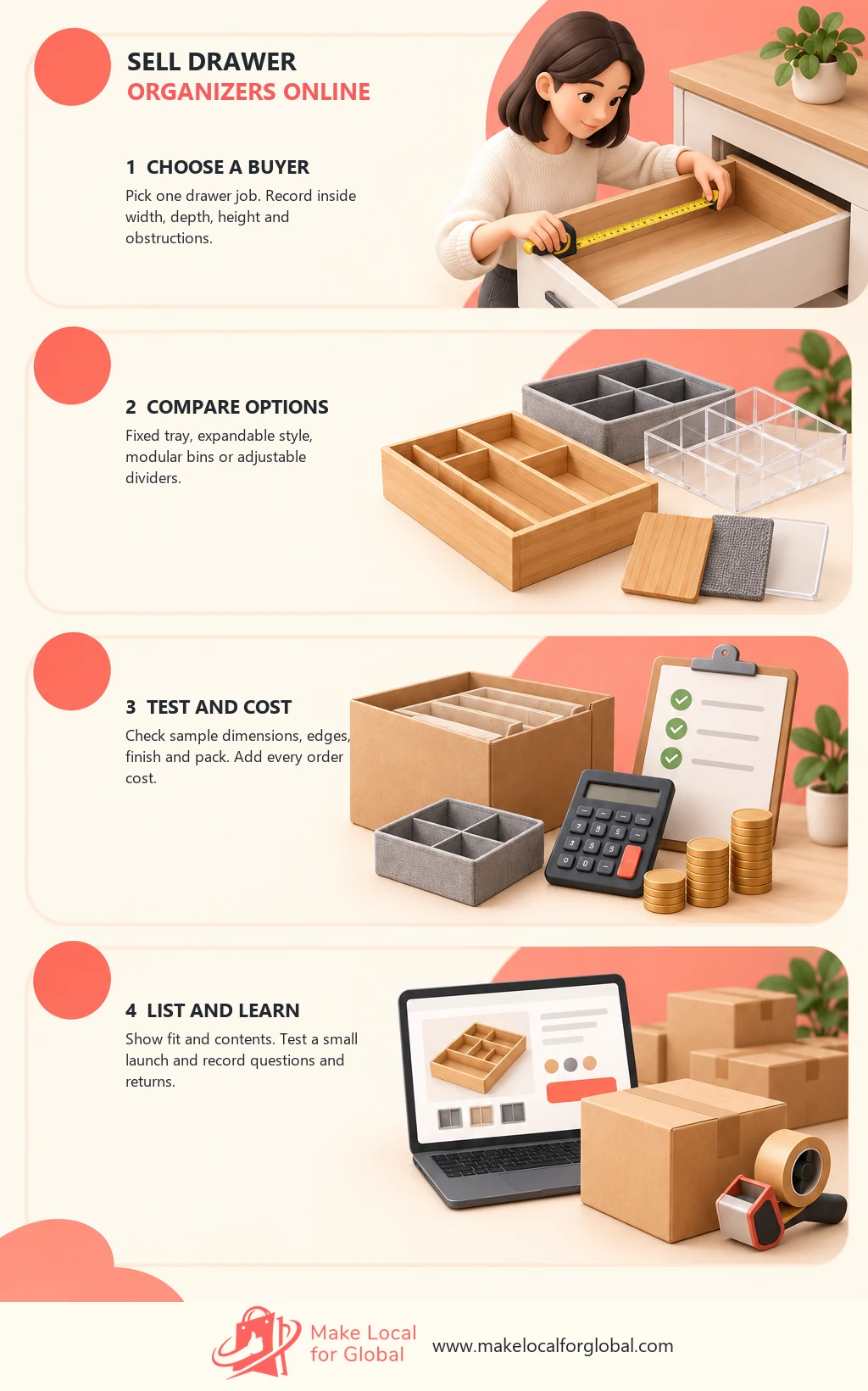
Use the first month to answer four questions: which buyer problem is clearest, which product fits it, what does a delivered order cost, and what needs to change before a reorder? The schedule can move around supplier lead times. Keep a brief record of decisions and evidence.
Write one buyer statement and interview five to ten people who match it. Ask them to measure a drawer and show the current organizer, if possible. Record usable width, depth, height, obstructions, storage contents, the product they use now and what failed.
Choose three product concepts that address the same problem. Request exact dimensions, material details, sample cost, minimum order quantity, parcel size, lead time and current images from suppliers. Remove any option with unclear material or no reliable fit information.
Order one sample of each shortlisted design. Compare it with the written specification and record dimensions. Test it in more than one drawer, check the joints and finish, load typical contents and open and close repeatedly. Photograph any issue and ask the supplier for a response.
Draft a one-page measurement card for each sample. Ask someone who has not seen your notes to measure a drawer and decide whether the sample fits. Note where they hesitate. If they cannot follow the instructions, revise the card before publishing a product page.
Use current supplier and delivery quotes to calculate a low, expected and high order cost. Add packaging, payment or marketplace fees, damage and returns allowance, and acquisition cost. Check contribution at the price a customer sees, including delivery.
Photograph the sample from above, the side, the compartments and the underside. Show the item installed with dimensions and identify props. Write the title, first paragraph, specifications, measurement method, care, delivery, return details and FAQs. Ask a person unfamiliar with the product to find the answer to “Will this fit my drawer?”
Publish a small number of units or a clearly described made-to-order offer. Run one controlled promotion or share a useful measurement demonstration with the intended audience. Track qualified page views, questions, purchases, delivery cost, defects, returns and customer comments.
At the end, decide what to change. If many visitors leave after the dimensions, test the layout of the measurement information. If orders arrive but packages show scuffed corners, alter the pack-out. If a size sells through, compare its contribution and return rate before reordering. Add another colour or module only when buyer evidence and cash allow it.
Yes. Choose a clear storage use, confirm the product’s materials and dimensions, inspect a sample, describe the item accurately and meet applicable product-safety and consumer requirements. Duties can vary by sales territory and supply route, so check current rules for Great Britain, Northern Ireland and any overseas markets you serve.
The best starting product is the one that solves a specific buyer problem and can be measured, inspected, packed and explained clearly. A focused cutlery tray, modular desk set or shallow vanity insert may suit different audiences. Interview buyers and test samples before selecting one.
Measure the usable interior width at the front, middle and back, then measure depth and clearance height. Check runners, lips, screws and hinges. Compare those measurements with the organizer’s outside dimensions and any installation clearance required by the product.
Expandable organizers can address a wider range of drawer widths, but the adjustment mechanism needs testing. Check the minimum and maximum settings, stability, gaps, movement under load and how the section locks. Publish only a range that you have verified on the actual model.
Choose a material based on the buyer’s use, drawer conditions, cleaning needs, weight, price and sample results. Wood, bamboo, plastic, metal, fabric and mixed-material products each have different finishes and care needs. Confirm the exact composition and avoid claims that the supplier cannot support.
Start with a manageable set that solves the same problem. Two or three well-tested products can provide useful choice without multiplying every size and colour combination. Expand after sales, fit questions, returns and cash records show which variant deserves more stock.
Show the organizer’s outside width, depth and height, compartment sizes, material, finish, care method, package contents, delivery and return information. Explain how to measure the drawer and show the product from above, the side and inside a real drawer. Mark any props that are not included.
Add the product, inbound freight, inspection, packaging, customer delivery, channel or payment fees, return and damage allowance, and customer acquisition. Compare that total with the price the buyer sees. Contribution after variable costs is not the same as net profit.
Only use that phrase if you can define what “most” means and support it with fit evidence. A clear internal-width range and a measurement method are more useful. If you have not tested compatibility, list the organizer dimensions and ask buyers to compare them with their drawer.
Do not use environmental or safety claims based only on a supplier’s generic description. Ask for evidence that applies to the exact model, materials and supply chain. Check current guidance for the market where you sell and use wording that matches the evidence.
Pack and move a sample using the proposed carton. Check corners, surface finish and loose parts after the test. Keep the product from rubbing against itself, use suitable corner protection and compare the packed size with carrier limits before promising a delivery rate.
A useful drawer-organizer range starts with a real drawer problem, not a large catalogue. Choose a buyer, measure the space, test the product and explain exactly what will arrive. Use supplier records and a repeatable sample check to catch changes in dimensions, finish or construction.
Start with a small range and calculate each delivered order. Show the total price and delivery terms before checkout, keep the fit guide close to the purchase decision, and track questions and returns beside sales. Let that evidence decide whether to add another size, bundle or material.
Check whether the listing answers fit questions
Review dimensions, material, package contents, images, delivery and returns before inviting buyers to order.
PREFERRED SOURCE
Like what you’re reading? Add Make Local for Global as a preferred source on Google to see more of our articles when you search.

Build your online presence without having to figure out everything yourself.