

READY TO SELL Fabric Storage Bins ONLINE?
Get a store built for you in 5 days, plus training and support to help you start, run, and grow your Alternative business.

Learn how to choose, source and sell fabric storage bins online with accurate sizes, checked samples, useful product pages and full order costs.


Fabric storage bins look simple on a product grid, yet the right range depends on more than colour. Shoppers need to know where a bin fits, what it holds, how it folds, how it is cared for and how much delivery costs. A seller who answers those questions with accurate measurements and close-up product details can make comparison easier and reduce avoidable returns.
This guide explains how to research, source and sell fabric storage bins online. It covers product formats, sample checks, fibre information, pricing, fulfilment, shop pages, marketing and a 30-day launch plan. Examples are for sellers; they are not safety claims or promises of sales.
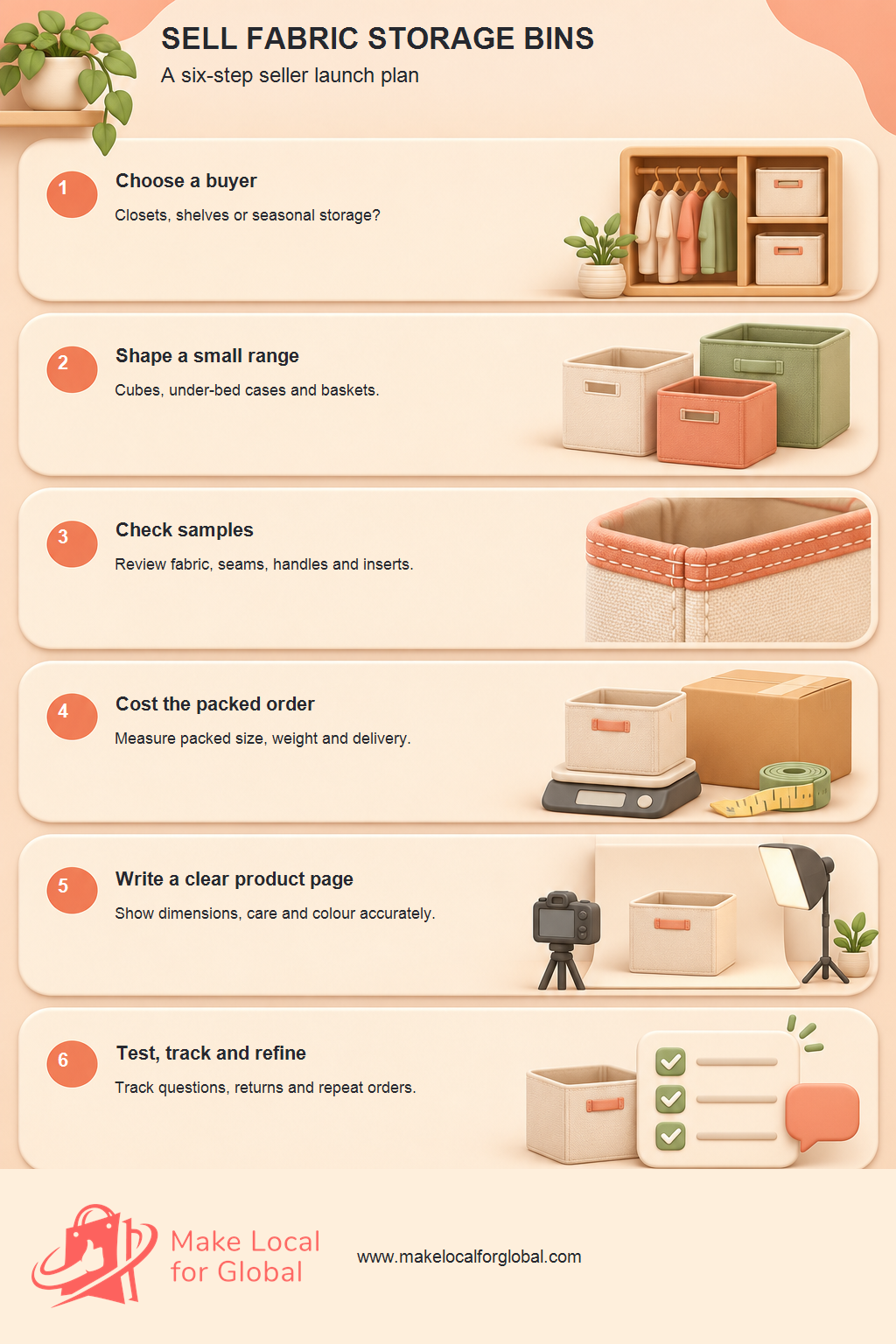
Map the buyer, the supplier evidence and the full order costs before you commit to a first run.
A first range becomes easier to explain when it serves a clear storage situation. A renter with shallow shelves may want collapsible cubes. Someone packing away winter clothes may compare a long under-bed case with a lidded wardrobe box. A craft seller may need open bins in repeatable dimensions for shelves or stock picking.
Pick a buyer group and ask what they store, where the container will sit, how often they will open it and what they find frustrating about current options. Ask for a photo of the shelf or space when you can handle that information responsibly. A simple sketch or written measurement can be enough for early research.
Look at customer reviews on competing products and record recurring, verifiable questions: unclear dimensions, a weak base insert, handles that feel uncomfortable, colour differences or a bin that arrives creased. Treat reviews as clues for questions to investigate, not proof that every unit has that defect.
Use free search suggestions, marketplace listings and your own customer conversations to learn the words shoppers use. Compare phrases such as “fabric storage cube”, “foldable wardrobe box”, “under-bed storage bag” and “canvas basket”. The phrasing can reveal separate formats, so do not force them all into one broad listing.
Make a one-page concept sheet with the buyer, the room or shelf, the proposed size, material description, colours, expected price and the main question still unanswered. Ask a small group of likely buyers which details they would need before ordering. Record what they say without leading them to praise the idea.
Where possible, test interest with a waitlist or a product page marked as unavailable, with clear wording that no order is being taken. Track qualified enquiries, email sign-ups and the questions people ask. These signals are not a forecast. Use them to choose the next sample or improve the product description.
Review the competition for positioning, not to copy it. Note the visible sizes, colours, included inserts, photography angles, price bands and delivery terms. Then decide what useful information your own page can show more clearly, such as an external dimension diagram or a photo of the bin folded flat.
Fabric storage products can be grouped by shape and use. A cube usually suits shelves or modular furniture; a soft basket may suit open storage; a lidded case can help keep dust off stored items; an under-bed style is long and low; and a hanging organiser uses shelves or pockets inside a wardrobe. These are different product jobs, with different dimensions and shipping shapes.
Common constructions include non-woven polypropylene, woven polyester, cotton canvas and blended fabrics. The outer fabric is only one part of the specification. Ask about lining, coating, base board, stiffeners, handle tape, thread, zips, fasteners and any removable insert. Use labels such as “natural”, “recycled”, “water-resistant” or “sustainable” only when supplier evidence supports the precise claim for the finished item.
Some designs arrive rigid; others depend on a base board or side support. A folding cube may recover its shape when assembled; an under-bed case may need a zip that runs smoothly around corners. Confirm whether the product is sold individually or as a set, what parts are included and whether the seller or customer assembles anything.
Think about care and storage. Can the item be spot-cleaned, hand-washed or machine-washed? Can the base insert be removed before cleaning? Does the maker advise against water or heat? Use the supplier’s instructions for the exact model; never infer a care method from the fabric name alone.

Start with a small number of choices that solve distinct needs. One cube size, one low under-bed case and one soft basket can be easier to photograph, store and explain than a grid of near-identical colours and sizes. Choose options only when the supplier can keep their specifications and stock identities distinct.
A practical range can include an entry item, a larger core size and a set that combines two formats. Give each item its own SKU, product dimensions and image set. A bundle should have an obvious reason to exist, such as a pair of matching cubes for one shelf, not just a larger checkout total.
Keep colour choices tied to what you can replenish. A neutral palette may help products coordinate with different rooms; one accent colour can help a smaller brand stand out. Check colour variation under daylight and indoor lighting, then photograph every colour offered. Never use one colour sample to represent several options.
Use a range matrix before ordering: buyer, format, external dimensions, usable interior, material, colour, packed size, landed cost, minimum order and likely parcel band. A blank cell is a question for the supplier, not a detail to guess. Compare the range against the shelf or storage dimensions your buyer described.
Potential sources include UK wholesalers, manufacturers, importers, trade shows and private-label factories. Compare the role each supplier will play, the size of its minimum order, lead time, available colours, sample cost, packaging and route for handling faults. If you import directly, ask a qualified adviser which obligations apply to your role and destination market.
Request a written specification for each model. Ask who makes it, where it is made, which fibres and components it contains, how dimensions are measured, whether the insert is included, how products are packed and how batch changes are recorded. Ask the supplier to notify you before a fabric, lining, handle or construction changes.
Ask for invoices and records that identify the supplier and product model. Keep order confirmations, specification sheets, care information, product photographs and correspondence together. If a supplier cannot connect a document or sample to the exact product you intend to sell, pause that SKU until the gap is resolved.
Compare total sourcing terms, not just the unit quote. A low factory price may be offset by a large minimum order, slow replenishment, inspection costs, complex packaging or high freight. Ask how defects are reported, what evidence is needed for a claim and what happens when stock arrives in the wrong colour or with missing inserts.
Order samples from the same specification and production route you are considering. Record the date, supplier, SKU and colour. Compare each sample against its written description and photograph it next to a ruler or known-size object. Do not infer performance from a single attractive sample.
This is a seller-side identity and quality review, not a laboratory test or a load rating. Advertise a weight capacity or other performance figure only when the maker’s evidence applies to the exact model and supports the wording.

Show external dimensions in a consistent order, such as width × depth × height. State the unit and measurement method. For soft-sided products, explain whether measurements are taken flat, filled, assembled or at the widest points. A fabric wall can bulge, so do not imply that external dimensions equal usable interior space.
For a cube, tell shoppers the shelf opening they should compare with the product’s assembled dimensions. For an under-bed case, give height at its fullest point, whether the lid is included in that figure and how the handle or zip changes the space required. For a hanging organiser, state the hanging method and any compatible rail details from the maker.
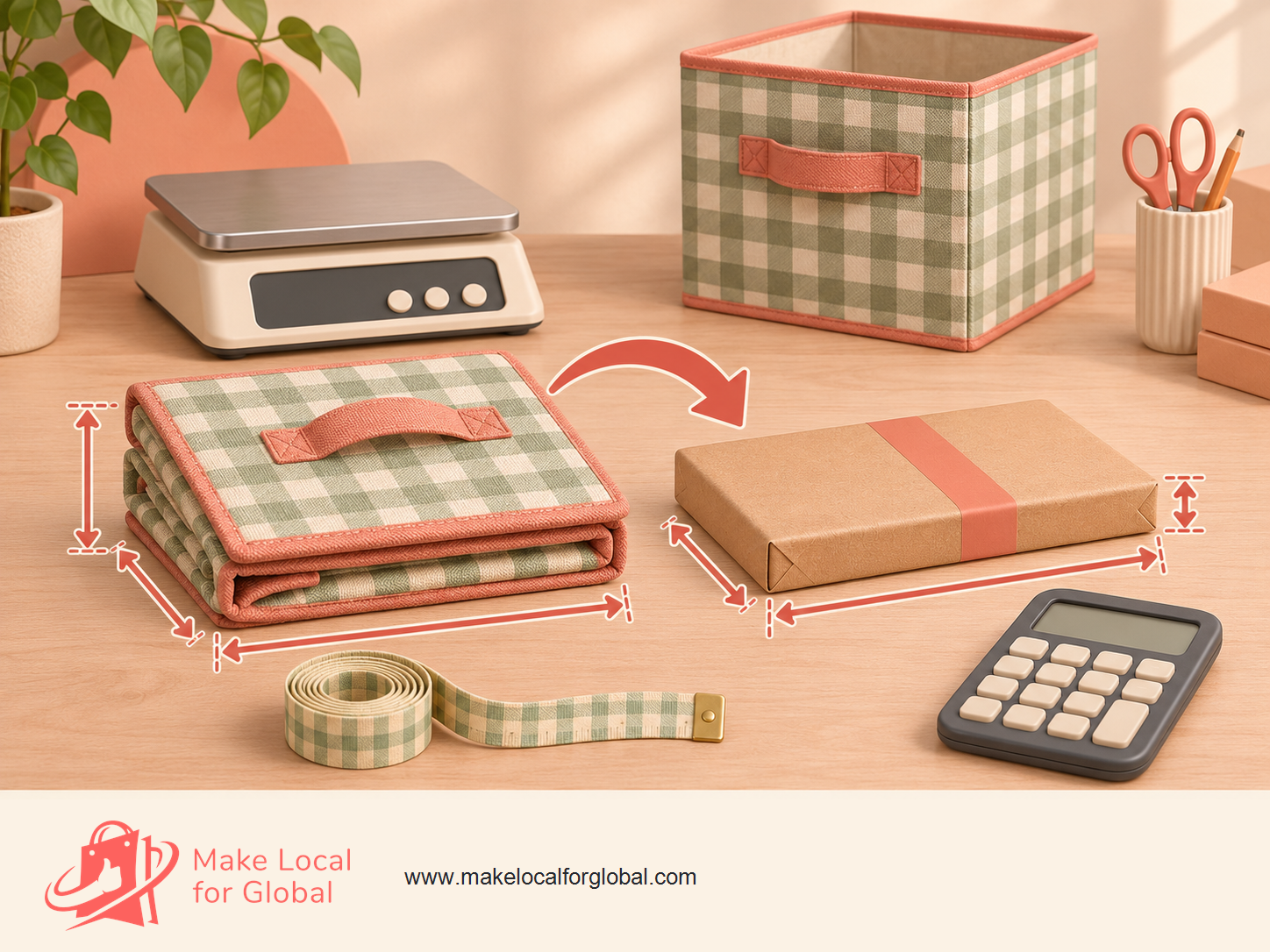
If the product collapses, show its folded dimensions and the steps needed to assemble it. If it includes a base board, list the number of boards and whether they can be removed. A photo of the open item beside the folded item can make its storage and delivery shape much easier to judge.
Use simple line diagrams alongside real photos. Keep labels away from edges and use the same dimension order on the product page, packaging and instructions. If your supplier changes a pattern or measurement, update the listing before sending more orders.
GOV.UK says businesses that make, import, distribute or sell consumer products in the UK share responsibility for product safety. Sellers need records that can identify suppliers, and unsafe products must not be sold. The rules vary by product and market; Great Britain and Northern Ireland do not follow identical general product-safety regimes. Read the current OPSS product-safety advice for businesses and get qualified guidance where your role or model raises questions.
Ask the supplier for accurate fibre composition and check whether the item falls within textile fibre labelling rules for the market where you sell. For England, Scotland and Wales, read the GOV.UK textile labelling guidance. The item, packaging and online description should not conflict. If a bin has mixed components, ask how the maker describes the main textile and any separate materials. Do not turn a supplier’s informal phrase into a formal label without checking its scope.
Keep objective claims tied to records. “Recycled”, “organic”, “waterproof”, “mould-resistant”, “machine washable” and “holds 20 kg” all need evidence for the exact product and the exact wording. A claim about one fabric, coating or test does not automatically apply to every colour or size. Store the supporting documents with the SKU.
For product and marketing claims, read the ASA guidance on substantiation. Do not claim a fabric bin is suitable for children, food or damp locations without design details and evidence that support that use. Put the maker’s care instructions and product limitations in plain view.
Plan images that help a shopper compare: front view, side view, open interior, folded shape, handle attachment, base insert, closure and any included accessories. Use a plain background for the main product image and a real scale reference for size. Make sure each colour variant has matching photos.
Show the product in a shelf, wardrobe or under-bed context only when the proportions are honest. Add a measurement graphic for dimensions; avoid digitally enlarging the bin or filling it with objects that suggest an unverified capacity. Keep the fabric texture and colour close to the sample.
Use descriptive alt text to explain the image for people who cannot see it, not to repeat a list of search phrases. For example: “Sage fabric storage cube with reinforced handles on a white shelf.” The cover image should explain the topic at a glance and stay distinct from the three supporting illustrations.
Lead with the product format and its main verified distinction. A title such as “Foldable Fabric Storage Cube with Removable Base, 30 × 30 × 30 cm” is clearer than “Beautiful Home Organiser”. Use measurements and features only where they apply to the exact option selected.
Put the key information in a consistent order: item type, external and internal dimensions, material composition, colour, closure, handle and insert details, care instructions, what is included, packed dimensions, dispatch estimate and returns policy. Use a short opening paragraph to explain who the format suits, then use a scannable specification list.
For example, a page could say: “A collapsible fabric cube with two stitched side handles and a removable base insert. Check the assembled external dimensions against your shelf opening. The stated fibre composition and care method are listed below.” Replace each detail with the supplier’s verified wording. Promise compatibility with a particular furniture brand only when the maker has confirmed it.
Separate variant information when it changes. If a large cube uses a different base panel, weave or handle construction from the small cube, show those details under the relevant option. A variant selector should not leave buyers guessing which photos, size or care information match the item in their basket.
Explain the packed condition. Tell buyers whether the product arrives folded, flat-packed or assembled, whether a board needs inserting and whether any packaging can be kept for a return. Use plain care instructions and link to the maker’s document when available.
Use the main phrase “sell fabric storage bins online” naturally in the article title, first section and one relevant subheading. Product pages can use the format shoppers seek, such as “fabric storage cube” or “under-bed fabric storage case”. Keep each page focused on one product family and describe differences in plain language.
Google Search Central recommends helpful, people-first pages and clear words in prominent places such as page titles and main headings. That is a useful standard for product copy: explain the product, answer its size and care questions, and do not repeat a phrase in every heading. Read Google’s current Search Essentials and link guidance.
Write separate title tags and meta descriptions for the store’s main categories and useful products. A title can include the format and a real feature; a description can state what the item is, the material details the supplier confirms and the main size options. Do not copy one generic description across every colour.
Use descriptive image file names and alt text. A supporting photo alt might read, “Folded sage fabric storage cube beside its removable base insert.” If the image contains a dimension diagram, alt text should describe the diagram’s purpose. Decorative background images can use empty alt text where the content-management system supports it.
Add internal links only where they help a shopper or seller continue. A guide to selling drawer organisers online is relevant for readers comparing shelf and drawer storage products. Use anchor text that says what the destination covers, not a series of repeated exact-match phrases.
An own-brand shop gives you control over product information, bundles and customer support. That leaves you to bring visitors to the site and manage checkout, fulfilment, returns and questions. A marketplace may already attract shoppers, but its fees, listing rules, image requirements and return processes can change. Review current seller terms before choosing a channel.
Choose one primary channel for the first test, then add another only when stock records, customer messages and dispatch can stay accurate. Keep the same SKU, measurements, fibre description and care information across channels. Write down who updates a listing when a supplier changes an item or withdraws a colour.
If products are genuinely made by you or your team, explain the making process and the origin of materials with evidence. If you resell sourced items, do not imply they are handmade by your business. Clear sourcing language helps set accurate expectations and fits marketplace rules.
Fabric bins can be light yet bulky. A folded cube may cost less to deliver than a rigid basket at the same retail price; an under-bed case may need a longer carton. Weigh and measure the packed item, then ask carriers which size and weight bands apply to your parcels.
The table below is an illustrative one-order calculation, not a supplier quote or a recommended retail price. It assumes £34.99 customer revenue, a seller not registered for VAT, no VAT on the listed costs for simplicity, and variable amounts that must be replaced with your own invoices. Tax, fixed overhead and owner pay are not included.
| Order item | Illustrative amount | Check for your shop |
|---|---|---|
| Customer revenue | £34.99 | Use the actual selling price and VAT treatment. |
| Product purchase | £8.40 | Use the model’s current supplier cost. |
| Inbound freight allocation | £1.10 | Divide freight and import charges across saleable units. |
| Protective packaging | £0.75 | Include carton, mailer, label and void fill. |
| Pick and pack | £1.25 | Include your own paid time or fulfilment invoice. |
| Customer delivery | £3.30 | Use the parcel’s measured band, not the product’s flat weight. |
| Marketplace and payment fees | £2.10 | Use the channel fee on the full transaction. |
| Returns and damage allowance | £0.80 | Base this on your own return and replacement records. |
| Customer acquisition | £2.50 | Include paid promotion allocated to the order. |
| Total listed variable cost | £20.20 | Add each cost above. |
| Contribution before fixed costs | £14.79 | £34.99 less £20.20; this is not net profit. |
Illustrative arithmetic only: £8.40 + £1.10 + £0.75 + £1.25 + £3.30 + £2.10 + £0.80 + £2.50 = £20.20. Replace every input with current costs. VAT registration, tax, fixed overhead, discounting and refunds may change the result.
Run a second calculation for a two-item set and a free-delivery offer. A bundle may save one outer carton or one label, yet it may raise the parcel into a higher dimension band. Compare the total costs before presenting a saving to customers.
Keep contribution separate from profit. Contribution is what remains after the listed order costs; rent, software, insurance, accounting, unsold stock, returns outside the allowance and tax still sit elsewhere in the business. Use your accountant’s guidance for VAT and tax decisions.
Product pages, images and checkout details should work together. MLFG can discuss website design and the practical information your shop needs to present.
Test the actual pack-out before choosing a box or mailer. Fold the bin the maker’s way, protect handles and edges, keep inserts flat and prevent accessories from rubbing against the fabric. Photograph the sample in its package and record packed dimensions and weight for each SKU.
Review the carton after a normal parcel journey or use the carrier’s packaging guidance to set a suitable method. Look for crushed corners, dirt, moisture, loose labels and shifting inserts. A package should protect the product without adding avoidable volume or excessive material.
If your business fills, imports or sells packaged goods, check whether it has packaging Extended Producer Responsibility duties. The thresholds and reporting tasks depend on turnover, packaging weight and activity; a small seller should not assume every business has the same obligations. Start with the latest GOV.UK EPR packaging checker and record the result.
Record stock by SKU and colour, including units held for samples, damaged products, open returns and orders awaiting dispatch. A spreadsheet can work for a small test if one person owns updates and checks the count against shelf stock at a fixed interval.
Use supplier lead times and actual sales to choose a reorder point. A new store may not have a stable sales rate yet, so avoid treating the first week as a reliable forecast. Ask the supplier how quickly a colour can be replenished and whether a substitute fabric or insert might be used.
Keep cash available for freight, packaging, refunds and replacements. A profitable-looking unit cost can still create pressure if the supplier requires payment months before inventory arrives. Use a small test order only when its total cost and storage requirements fit the funds you can risk.
Publish a returns policy before checkout. For many UK distance sales, customers have 14 days after receiving an item to tell the trader they wish to cancel, followed by another 14 days to return it, subject to the rules and exceptions. Read the current GOV.UK guidance on returns and refunds and confirm how it applies to your shop.
Explain how to contact you, where returned goods go, how refunds are handled and what to do if the item arrives damaged or differs from the description. Keep the product and packaging easy to identify from the order number, SKU and supplier batch where one exists.
Log complaints by type: wrong size expectation, colour, stitching, missing base, damage in transit, care question or supplier mismatch. Look for repeated patterns by SKU and batch. A pattern may point to an unclear page, a pack-out issue or a product change that needs a supplier review.
If a report raises a safety or compliance concern, pause the affected listing, keep the messages and batch records, and contact the supplier and relevant adviser. GOV.UK’s business notification guidance explains reporting duties for unsafe or non-compliant products.
Create short, factual content around questions buyers ask: how to measure a shelf, how a collapsible cube differs from an under-bed case, what measurements describe the usable interior and how each item is cared for. Use only the maker’s instructions and your checked sample for claims about the product.
Show one practical comparison per image or video. A flat fold beside an assembled bin can explain storage and delivery shape. A close-up can show a handle attachment. A dimension diagram can help compare sizes. Avoid presenting a staged load test or a dramatic before-and-after as evidence of capacity or durability.
Test channels with one clear measure. For search pages, track qualified organic visits and product clicks. For a newsletter, record replies or click-throughs from people who are likely to use the product. For paid adverts, cap the trial budget and include the actual cost per completed order in the contribution calculation.
Use a product comparison page only when it helps people choose. Keep size, material, care, form and packed dimensions in parallel columns. Link the comparison to the matching products and update it when a supplier changes a specification.
Days 1–7: learn the buyer. Choose one use case and speak with a small group of likely shoppers. Record where they plan to store the item, what they measure and which product details they need. Review competing listings for format gaps and repeated questions. End the week with one short range concept, not a full catalogue.
Days 8–14: compare suppliers and samples. Request model details, fibre composition, care information, insert details, lead time, minimum order, carton dimensions and traceability records. Compare sample quality with the written specification. Decide which unanswered questions must be resolved before an order can be made.
Days 15–21: cost and prepare the shop. Measure the packed formats, obtain current delivery and channel fees, and calculate a single order and a bundle. Photograph each colour and option. Draft the page with dimensions, materials, care details, included parts, dispatch and returns. Ask an independent reader to find these facts on a phone.
Days 22–30: run a controlled launch. Release a small number of verified options. Track visits, add-to-basket actions, completed orders, customer questions, dispatch time, delivery cost, returns and defects by SKU. Compare actual costs with the plan. Decide whether to restock, change the page, test another size or stop the range.
Choosing colours before uses: a large palette can hide the fact that the range has no useful size for the target shelf. Choose formats first, then add colours the supplier can reproduce.
Using one image for every option: the wrong colour or insert in a photo can lead to avoidable disappointment. Photograph the actual model and label variant images clearly.
Publishing a single measurement: outside dimensions, interior dimensions and folded dimensions answer different questions. State each one by name and explain how it was measured.
Assuming all fabric behaves alike: a cotton canvas, a coated polyester and a non-woven polypropylene item may differ in care, structure and feel. Verify the fibre and care information for the actual product.
Skipping delivery tests: unit weight does not reveal the parcel band. A long, compressed case or a set of cubes can cost more to ship than expected. Measure the packed order before setting the price or a free-delivery threshold.
Calling contribution profit: the worked example excludes overhead, tax and VAT. Use a separate monthly view for software, insurance, storage, accounting, unsold stock and owner time.
Using attractive but unproved claims: “eco-friendly”, “waterproof”, “mould-proof” and a stated load capacity can create risk if the documents do not cover the precise product and use. Use neutral, factual descriptions in the meantime.
Ordering beyond the evidence: a supplier’s catalogue photo is not a substitute for your sample and product records. Check the exact item, parts, variant and packed form before making it available for sale.
Choose a format based on one buyer and one storage space. A shelf cube, a long under-bed case and an open basket serve different jobs. Compare likely buyer questions, supplier reliability, dimensions, packed costs and your ability to explain the choice before adding variants.
They can be tested in a focused range, but the business case depends on sourcing, parcel size, product quality and demand. Start with samples and actual delivered-cost calculations. A low unit price on its own does not show whether a product can support a healthy contribution.
Compare its dimensions, fibre description, seams, handles, base insert, closure, care instructions, colour and included parts with the supplier’s written specification. Record the model and date. Keep any test limited to normal seller inspection, not a made-up strength or load test.
Check whether the exact item and the market where you sell fall within applicable textile fibre labelling rules. Ask the supplier for the composition of the textile and each relevant component. Do not rely on a general material name if the maker cannot substantiate it.
State external dimensions, usable interior dimensions, the measurement method and the unit. For a folding product, include folded dimensions. For an under-bed case, give its full height and identify whether the lid or handle is included in that figure.
Start with product cost, inbound freight, packaging, pick and pack, delivery, payment or marketplace fees, a returns allowance and customer acquisition. Calculate contribution after these variable costs, then account for fixed overhead, VAT and tax with professional advice. Treat example figures as planning inputs, not market facts.
Use an environmental claim only when evidence supports the exact wording for the finished product. Ask for documents that identify the material, proportion and product model. A recycled packaging claim does not prove that the storage bin itself uses recycled fibres.
A third-party fulfiller does not remove the need to understand your role, keep supplier and product records, describe the item accurately and handle customer concerns. Confirm which model will ship, how variants are checked, who handles returns and how defects are reported before taking orders.
Check the order variant, product photos, measurement method and supplier batch. Respond under your published returns and consumer-rights process, then record whether the cause was a page error, sample mismatch, colour variation, packaging damage or a product issue. Update the affected listing when its information is unclear.
Use the smallest quantity that gives you a fair product and fulfilment test within your cash limit. Compare the supplier’s minimum order with storage capacity, lead time, expected return costs and the cost of unsold stock. Set a written restock trigger based on actual order history.
Many distance sales give customers 14 days after delivery to notify a cancellation, then another 14 days to return the item, with rules and exceptions. Read the current GOV.UK guidance and confirm the requirements for the product and market before publishing your policy.
For another storage product example, read our guide to selling drawer organisers online. Keep each product page specific to its own sizes, materials and use.
Bring your buyer questions, sample notes and delivery figures together before you decide what to order next.
PREFERRED SOURCE
Like what you’re reading? Add Make Local for Global as a preferred source on Google to see more of our articles when you search.

Build your online presence without having to figure out everything yourself.