

READY TO SELL Fondue Sets ONLINE?
Get a store built for you in 5 days, plus training and support to help you start, run, and grow your Alternative business.

Choose a fondue set format, verify suppliers and food-contact records, price the full parcel, and build a clear first range for online sale.


A fondue set can be a useful centrepiece for shared meals, winter evenings, small celebrations and gift occasions. The product looks simple in a photograph, yet a seller has to make a series of practical decisions: which heat source to offer, what parts belong in the box, how to prove the bowl is suitable for its intended use, and how to deliver a breakable kit without losing the margin to parcel costs.
If you plan to sell fondue sets online, start with the customer’s occasion and the exact type of set. A compact electric model suits a different household and product page from a ceramic pot used with a candle or a metal set with a separate burner. Build the range around verified specifications, inspect samples, cost the full packed order and explain safe use through the maker’s instructions. A small, well-described first range is easier to test than a large catalogue of near-identical colours.
This article gives new sellers a practical route from first idea to first order. It covers electric, candle and burner styles, supplier checks, food-contact evidence, product photography, pricing, parcel testing, returns and a measured 30-day launch. The figures below are worked examples for planning, not supplier quotations or promises of sales.
Use a practical business tool to review the buyer, product fit and first-order costs before committing cash.
Fondue sets can be bought for a home dinner, a gift, a small gathering or a seasonal event. The buyer may want a chocolate set for fruit and sweets, a cheese set for bread and vegetables, or a general-purpose model for more than one type of fondue. Treat those as separate needs until the product maker confirms that one bowl and heat source suit each intended use.
Write a short buyer profile before asking a supplier for a catalogue. Note how many people the buyer expects to serve, where the set will be used, whether a suitable mains outlet is available, how much storage space they have, and whether they prefer a ready-to-use kit or a simple pot. The answers influence the pot size, included forks, cord length, storage box, fuel type and product-page information.
Ask potential buyers about the last time they served fondue or considered buying a set. What did they compare? Did they need a mains supply, separate fuel, a particular number of forks or a simple way to clean the bowl? Record the language they use. A person saying “I need a chocolate fountain alternative for two” describes a different product job from a host looking for a cheese dinner set for six.
Avoid using broad labels such as “for everyone” to define a range. A student buying a compact set for occasional use may care about cupboard space and price. A gift buyer may care about packaging, included accessories and a clear delivery date. A host may compare serving capacity and ease of set-up. Each is a possible group to investigate; interviews and real orders tell you whether one is worth serving.
Electric fondue sets use a powered base or heating element, often with a temperature control. Confirm whether the bowl detaches, how the controls work, the rated electrical details, the plug supplied for the destination market, the cable route and the manufacturer’s cleaning instructions. Do not assume an electric model is suitable for every fondue recipe. Use the maker’s stated purpose and temperature guidance in the listing.
Non-electric models may use a candle, gel fuel, another burner or a pot heated separately before it is placed on a stand. These arrangements are not interchangeable. Each needs its own instructions, compatible fuel information and safety wording. Call a set “fuel included” only after confirming that the exact order contains the stated fuel and that its transport and sale are permitted for your route and market.
The bowl material can include ceramic, stoneware, enamelled metal, stainless steel or another manufacturer-specified construction. Material alone does not prove how a bowl should be heated or cleaned. A ceramic bowl may be designed for a particular stand or heat source; a metal insert may be removable; a non-stick finish may have care limits. Ask for the model-specific use instructions and keep them linked to the SKU.
Build a comparison sheet with one line per actual model. Add heat source, bowl material, volume from the supplier’s specification, number and material of forks, stand, burner, temperature controls, detachable pieces, dimensions, packed dimensions, weight, cleaning method, warranty terms and included instructions. Leave an unknown field blank until the supplier confirms it. This prevents a plausible-looking guess from becoming a product claim.

Start with free search suggestions, marketplace search results and questions from potential buyers. Compare phrases such as “electric chocolate fondue set”, “cheese fondue pot with burner”, “fondue set for two” and “fondue set gift”. Different wording may reveal different product types. Use it to shape research; do not claim a phrase has a particular search volume without current evidence.
Review competing listings by recording factual details: visible price, set contents, heat source, serving size claim, material wording, image angles, delivery cost and returns summary. Date your notes and revisit them before purchasing stock. Prices and availability can change. The aim is to identify information gaps and product choices, not to copy another seller’s copy or photographs.
Speak to a small group of likely buyers. Show a one-page concept with the use case, exact type of set, draft price range and a neutral image. Ask what they would need to know before ordering. Give them time to respond without prompting them to praise the idea. Record both interest and practical objections, such as “I do not want a flame on the table” or “I cannot store another large box”.
You can test interest with an email sign-up or a product page marked as unavailable, provided it is clear that no order is being taken. Track qualified questions, sign-ups and requests to be notified. A click is not a sale and a small sample is not a forecast. Use the feedback to decide whether to inspect a model, revise its description, test another audience or stop the idea.
Set a stop rule before spending. For example, decide that you will not place a stock order until a supplier provides the full specification, you have inspected one sample, the parcel quote is known and your minimum contribution target is met. Write down the maximum amount of cash you can tie up in slow-moving stock. A clear stop rule turns research into a business decision rather than an open-ended project.
A first range could start with one electric set and one non-electric style, or with two models that solve different serving occasions. The right choice depends on sample quality, supplier reliability, handling costs and buyer feedback. Do not add several colour options just to copy the supplier’s catalogue. Each colour can create a separate stock and photo requirement.
Use an entry, core and gift-oriented structure only when the products have clear differences. An entry model might include one pot and a small number of forks. A core model may include a stand and a complete set of matching forks. A gift-ready option could add a verified storage case or packaging from the supplier. A higher price needs a visible reason, not decorative copy.
Give each variation its own stock keeping unit. Record the exact bowl, base, burner, fork count, colour and packaging combination for that SKU. If the supplier changes a part, treat it as a change to verify rather than assuming it remains equivalent. Photographs, instructions, compliance documents and returns records should refer to the same model code.
Choose quantities only after comparing the minimum order with cash, shelf space and expected replenishment time. A small order can cost more per unit but limit the cash at risk. A larger order may lower unit cost but raises storage, insurance, breakage and markdown exposure. Ask the supplier for the cost of a sample, a small production run and a repeat order, not just a headline unit price.
Keep a range matrix with the buyer, occasion, heat source, bowl material, contents, exact set dimensions, carton size, unit cost, inbound freight, supplier lead time, minimum order and unresolved questions. Review the matrix with the product sample beside it. If a product does not add a distinct use or price option, leave it out of the first test.
Potential suppliers include UK wholesalers, importers, manufacturers and private-label factories. A domestic wholesaler may make replenishment and product questions simpler. Direct importing may offer a broader choice but can place more responsibilities on your business. A marketplace supplier may offer low minimum quantities; check how long the listing has existed and whether the actual stock matches the pictures and documentation.
Ask who makes the set, who imports it, which legal entity will invoice you and which model number appears on product documents. Ask for the current specification, instructions, packaging list, rated electrical information for powered models, materials for every food-contact surface, test or compliance records and a process for notifying you of model changes. Documents should identify the actual item rather than a family of visually similar products.
Ask the supplier to confirm lead time for a sample and a repeat order, minimum quantity per model and colour, payment schedule, shipping terms, carton dimensions, replacement parts and defect process. For fragile ceramic, ask how the supplier packs the stock before it reaches you. Ask what evidence they need for a breakage or missing-component claim and how long the claim window lasts.
Check the supplier’s business identity and payment details independently. Confirm that the name on the invoice matches the entity you agreed to buy from. Keep quotations, invoices, product documents, sample photographs and messages together in a folder named for the SKU. If the supplier cannot show that a certificate or test applies to the specific model, treat that as an unanswered question.
Compare the full commercial offer. Include sample delivery, currency conversion, import charges, freight, inspection, packaging, storage and any payment fees. Ask the supplier to price the exact set and carton you want to sell. A low unit price can be offset by slow replenishment, a high minimum order, damaged arrivals or a costly replacement process.
Order the sample through the same route and from the same model specification you are considering for stock. Note the supplier, date, model, colour, box condition and tracking reference. Photograph the unopened carton and every part as you unpack it. Those images create a record of what arrived and help you compare later units or replacement parts.
Check the contents against the packing list. Count forks, stands, lids, control parts, detachable bowls and instructions. Look for chips, cracks, sharp edges, loose handles, finish defects, missing fasteners and parts that do not sit securely as described. Stop handling a sample if you see a defect that might make ordinary use unsafe; keep it isolated and ask the supplier for a written response.
Measure external dimensions in the same order for every listing, such as width × depth × height. Measure the packed carton separately. If the supplier gives bowl capacity, clarify its measurement method and whether it is a maximum fill or a usable serving volume. Convert capacity into a number of guests only when the manufacturer supplies that guidance and it fits the way the product is intended to be used.
For electric models, check the model label, plug, cable, controls, detachable parts and instructions against the supplied documents. Do not take apart the appliance, modify its plug or carry out improvised electrical tests. A visual sample check is not a conformity assessment or electrical safety test. If records do not identify the model, pause the SKU and request the correct documents.
For burner sets, compare the burner, stand, pot support and instructions with the product specification. Do not trial unapproved fuel or perform a flame test as a seller-side shortcut. Follow the maker’s instructions for any permitted use, and use a qualified testing provider if a required test or performance claim cannot be established from the supplier’s evidence.
Record each point as pass, fail or awaiting supplier evidence. Keep the sample checklist with the purchase decision. The aim is to verify identity, condition, included parts and the accuracy of your listing. It is not a substitute for legal documentation, product testing or specialist advice.

If you make, import, distribute or sell consumer products in the UK, you have responsibilities for product safety. The Office for Product Safety and Standards explains that goods should be safe in normal or reasonably foreseeable use, and that businesses need records that let them identify suppliers. Read the current GOV.UK product-safety advice for businesses and check the rules for your role and destination market.
Electric fondue sets fall within electrical-equipment rules when their design and rating bring them within scope. The Great Britain guidance for the Electrical Equipment (Safety) Regulations 2016 describes requirements for businesses placing equipment on that market, including manufacturer and importer obligations. Separate Northern Ireland guidance applies there. Check current marking and documentation rules rather than relying on a generic “UK compliant” statement.
If you import a powered set or sell it under your own brand, your responsibilities can differ from those of a retailer buying from a UK supplier. Confirm which entity is the manufacturer or importer, which conformity route applies and whether the declaration and technical records name the exact model. Ask a qualified adviser or Trading Standards service when your role is unclear.
Keep records for each SKU: supplier identity, invoice, model number, product documents, user instructions, test reports, batch or date code, listing version, customer reports and corrective actions. If a complaint describes an electric shock, overheating, fire, broken glass or another safety risk, pause sales of the affected model as you assess it. Preserve the evidence, contact the supplier and follow the notification guidance that applies to your product and market.
Do not write your own safety instructions from memory. Use the maker’s instructions for set-up, supervision, cleaning, compatible fuel, storage and intended use. If the product arrives without instructions in the language required for your market, or the instructions conflict with the product, do not list it until the gap has been resolved.
Fondue bowls, forks, lids and some utensils touch food. Food-contact requirements can apply to materials intended to contact food or reasonably expected to do so. The Food Standards Agency’s food-contact materials guidance points to rules for relevant materials. Ask the supplier for written evidence for the exact bowl, coating, glaze, plastic part or utensil you plan to sell.
Ask whether a declaration of compliance or other supporting record is required for the material and product. Confirm the document covers the model, intended food types, temperature conditions and use conditions. A general certificate for a factory or raw material may not establish that the finished set is suitable for the use in your listing. Keep the answer in the product record.
Describe the material with the manufacturer’s exact terms. Do not infer “stainless steel”, “lead-free”, “food-safe”, “non-toxic”, “dishwasher-safe” or “non-stick” from appearance. A ceramic glaze, painted handle, adhesive or coating can have a different specification from the body of the pot. Ask for the care method and use limits for each part.
Separate product care from a performance guarantee. If the instructions say to hand-wash a bowl or remove an electrical base first, repeat that accurately in the listing and insert the manufacturer’s instructions with the order. Do not promise that a coating will remain intact after a cleaning method the maker has not approved. Photograph any removable part so a customer can see what detaches before ordering.
Food-contact rules and market arrangements can differ between Great Britain and Northern Ireland. An overseas sale can involve separate requirements in the destination country. Use the current regulator guidance for each market you plan to serve. This article is a seller planning resource, not legal advice or a compliance assessment.
Give each model a title that names the type and a useful verified detail. For example: “Electric Chocolate Fondue Set with Detachable Bowl and Four Forks”. Replace the sample details with those confirmed for your model. If the product is intended for cheese or another use, name it only when the manufacturer supports that use.
Start the description with what is in the box and the heat source. State the bowl material, stated capacity and how the maker defines that figure, number of forks, base or stand, colour, dimensions, cable or fuel details, cleaning method, assembly, instructions and warranty terms. A buyer should not have to infer whether a burner, fuel, lid or serving forks are included.
Add a specification table or clear bullet list. Keep measurements and units consistent. Give the product’s packed size or dispatch carton details where that affects storage or delivery. State the electrical rating and plug type as specified by the manufacturer. Explain if the buyer must supply a compatible fuel, but do not name a fuel type until the manufacturer confirms it.
Show model-specific limitations where a buyer sees them. If the bowl should only be warmed using a particular base, say so. If the model is not designed for direct hob use, do not suggest otherwise through a photograph or title. Include the manufacturer’s instructions for supervision, set-up and cleaning, without turning a short product page into a rewritten safety manual.
Use plain language for dispatch and returns. Give a realistic dispatch estimate based on your fulfilment process, delivery options, customer-service route and the returns policy that applies. Avoid a delivery promise you cannot meet in seasonal periods. Record the date you last confirmed stock availability so the product page does not keep accepting orders for a discontinued model.
Once model details, photos, pricing and returns are ready, review the ecommerce setup options for your product range.
Use a clean main image that shows the whole set, not just a pot. Add a top view of the bowl, a side view of the stand or base, close-ups of controls and handles, and a flat lay of every included item. Use the actual colour and model in each variant. Keep the product proportions realistic and do not digitally add a fork, lid or burner that is not in the shipped box.
Show the set in a home context only when the scale is honest. A ruler or dimension graphic helps a buyer compare shelf space and table size. A serving image can explain the intended occasion, but it cannot prove a capacity rating or safe cooking method. Use prepared foods as a styling choice, not a nutrition or safety claim.
Photograph packaging and internal protection for your own fulfilment notes. A product may look attractive at the table yet arrive damaged if its bowl moves against the stand. Take pictures of the sample inside its retail box and the retail box inside your shipping carton. These views help you design a repeatable packing method and answer a customer who reports transit damage.
Write alt text for the image itself. Examples include “Electric fondue bowl beside its detachable temperature base” or “Ceramic fondue pot and stand packed in separate protective compartments”. Avoid stuffing the same search phrase into each alt field. Captions can state which parts are included or what the image helps the buyer compare.
Name each file clearly, such as `electric-fondue-set-bowl-and-base.webp` or `fondue-set-parcel-protection.webp`. Keep the original high-quality file, confirm image dimensions after upload and check the thumbnail crop on a phone. A clear, distinctive visual helps a person identify the product before reading every specification.
A bundle can make ordering simpler when the parts fit together and the supplier confirms compatibility. A set with the pot, stand and matching forks is more useful than a loose group of accessories with no clear role. List every included component and show it in the flat-lay photograph.
Gift packaging can help a seasonal buyer, yet it adds cost and can increase parcel size. Ask whether packaging comes from the maker or whether you will pack it yourself. Check that a gift box protects the bowl in transit and that the outer parcel still fits the carrier’s size band. Do not advertise a gift box when the item uses standard brown transit packaging.
You might test a cheese-oriented bundle with verified serving forks, or a chocolate set with a small serving accessory from a supplier. Check the food-contact status, compatibility and care of each added item. If the accessory comes from another supplier, keep its model details and compliance evidence with the bundle record.
Compare the bundle’s cost with buying each product separately. Include the extra handling time, outer packaging and higher delivery band. A “save £X” message needs a real reference price for the same items sold separately. If you cannot show that the comparison is fair and current, describe the bundle contents without a discount claim.
Ask gift buyers about delivery deadlines and outer packaging preferences. A parcel that says “chocolate fondue set” on the outside may reveal a gift. Neutral outer packaging can protect privacy, but use correct handling labels where needed and keep legally required product details available. Make sure gift notes do not hide returns or safety information.
An own-brand store gives you control over the product detail page, bundle, customer support and checkout. It requires you to bring visitors to the page and keep stock, orders and returns accurate. A marketplace may provide a familiar place to compare products, but its listing fees, product rules, image standards and customer service processes can change.
Choose one primary sales channel for the first test. Make sure its rules permit the product and any fuel-related wording. Use a second channel only when you can keep the SKU, dimensions, included parts, price and stock count in sync. A feed that leaves out a plug type or makes a separate burner look included can create customer complaints.
Check the checkout from a phone. Confirm that the selected model, quantity, shipping cost and delivery estimate are clear before payment. Send yourself the order confirmation and verify that it names the correct variation. A fondue set that requires separate parts or special instructions should not be described as ready to use if customers must source something else.
Review the channel’s return process and who pays for return postage under its current policy. A marketplace may have stricter response times than your own shop. Set a daily process to answer questions, update stock and upload tracking. Record sales by SKU so you can tell which set type and image attracts a real order.
If another business fulfils orders for you, confirm which model and packaging they will use, who checks variants, what happens after a breakage and how the customer receives instructions. Dropshipping does not remove the need to describe the product correctly or respond when the item differs from the listing.
Do not set the retail price by multiplying the supplier’s unit cost. A fragile kitchen appliance has inbound freight, outer packaging, pick time, delivery, payment fees, possible marketplace fees, returns and customer acquisition. A seasonal promotion can reduce the order revenue at the same time that parcel demand raises delivery costs.
The example below is for one order at £89.99. It assumes a seller who is not VAT-registered and uses illustrative inputs only. It excludes VAT charged by suppliers for simplicity. Replace the amounts with actual quotes and invoices; change the VAT treatment with advice for your business.
| Order item | Illustrative amount | Check for your shop |
|---|---|---|
| Customer revenue | £89.99 | Use the actual selling price and VAT treatment. |
| Fondue set purchase | £25.00 | Use the supplier invoice for the exact model. |
| Inbound freight allocation | £3.75 | Divide freight and import charges across saleable units. |
| Protective packaging | £4.50 | Include inner supports, outer carton, tape and label. |
| Pick and pack | £1.25 | Count paid fulfilment or your own work time. |
| Customer delivery | £7.40 | Use the measured parcel and delivery zone. |
| Channel and payment fees | £3.20 | Check the current fee on the full transaction. |
| Returns and damage allowance | £3.00 | Replace with your own return and breakage record. |
| Customer acquisition | £5.00 | Include paid promotion allocated to the order. |
| Total listed variable cost | £53.10 | Add all listed variable costs. |
| Contribution before fixed costs | £36.89 | £89.99 less £53.10; not net profit. |
Illustrative arithmetic only. This example assumes a seller not registered for VAT and excludes supplier VAT, tax and fixed overhead. Replace the inputs with current business figures.
The arithmetic is £25.00 + £3.75 + £4.50 + £1.25 + £7.40 + £3.20 + £3.00 + £5.00 = £53.10. The contribution before fixed overhead is £89.99 − £53.10 = £36.89. This is not net profit. It excludes rent, insurance, storage, software, accounting, unsold inventory, tax, owner pay and any costs not listed.
The £7.40 delivery figure is a planning placeholder. Measure and weigh a packed set, then request a quote for the destination zones you intend to serve. A heavier electrical base may push a parcel into another band. A double set can require a larger carton at a low combined weight.
Check payment fees against the channel’s current terms. Some fee schedules use a percentage of the full transaction and a fixed charge; marketplaces may add listing, fulfilment or promotional costs. Do not reuse a percentage from an old blog post or another account. Add the fee from the current statement for the same order value and delivery treatment.
Run a second version of the calculation for a discounted order, a bundle, a returned unit and a damaged delivery. A set with a positive contribution in the normal case might lose money after a paid return label and replacement shipment. Record an acceptable minimum contribution and a maximum acquisition cost before launching an advert.
Test the complete pack-out with the actual retail box, not a rough estimate. Keep the bowl from moving, protect handles and controls, and prevent forks or a stand from striking the food-contact surface. Use the maker’s packing method if it preserves parts and instructions. If you add internal cushioning, confirm that it does not press on a control or damage the finish.
Measure the packed parcel in centimetres and weigh it after sealing. Record the carton, cushioning, tape, label and any outer box. The carrier bills the packed order under its own rules, which may consider both weight and dimensions. Get a quote for the actual parcel rather than one from an empty sample box.
Run a documented handling check that suits your operation. Inspect whether the retail box has internal supports, close it, shake it gently only as part of ordinary handling, then reopen and check for movement or contact marks. This is not a certified drop test. If you need transit-performance evidence, consult the packaging supplier or a qualified test service.
Take photos at each packing stage. Keep a simple record of carton model, cushioning quantity, parcel size, weight and staff time. Review the record after every damage claim. If a pattern emerges, pause the affected pack method and inspect whether the bowl, burner, base or forks can move inside the box.
Check packaging obligations for your business. GOV.UK’s EPR packaging checker explains that organisations need to assess whether they count as producers and whether they meet the thresholds for reporting or fees. Do not assume that a small online shop is automatically exempt; check current definitions and record the outcome.

Record stock by SKU and variation. Keep saleable stock separate from samples, opened returns, damaged boxes, units awaiting inspection and replacements set aside for a customer. A simple stock sheet can work for a short test if one person owns updates and checks the count against the shelf at a set time.
Fondue sets may attract attention around gift seasons and colder months, but sales timing varies by audience. Do not order a large quantity on the assumption that a seasonal window guarantees demand. Use your own sales, enquiries and campaign response to decide whether a replenishment is justified.
Ask suppliers for the lead time on a repeat order and whether the model, accessories or packaging might change. Set a reorder point that includes that lead time and a small buffer you can afford. Avoid stocking a substitute version without checking the model documents and product page. A similar photograph does not prove two appliances or burners are equivalent.
Plan for products that arrive late or are discontinued. Set a maximum order quantity for an untested SKU. Keep cash available for refunds, replacements and freight. If a launch misses its intended season, decide whether to hold stock, discount it transparently or stop buying rather than concealing the delay from customers.
Review stock age and sell-through monthly. A slow model may need a clearer product page, a different buyer focus or a smaller reorder. A discount can shift inventory but should not hide a loss-making unit economics problem. Record the decision and the outcome so the next range uses actual store evidence.
Before checkout, explain how buyers can contact you, how long dispatch normally takes, what to do if the parcel arrives damaged, and how a return is started. For many UK online purchases, the customer can notify the seller of cancellation up to 14 days after delivery, then has a further 14 days to send the goods back, subject to the rules and exceptions. Read the current GOV.UK distance-selling guidance and get advice for your business.
The cancellation right is separate from a complaint that an item is faulty or not as described. Keep these routes clear in your support template. Do not tell a buyer to use a cancellation process when they have reported a safety issue or a broken bowl. Check the current consumer law guidance before writing refund terms.
Ask a buyer who reports a damaged set to share the order number, outer parcel photographs, box label and pictures of the affected parts. Do not delay a remedy to request unnecessary evidence. Log the supplier model, parcel route, carton and date. Use the information to identify whether the damage occurred before dispatch or in transit.
If a powered set is reported as overheating, sparking or producing an unexpected smell, tell the customer to stop using it and follow the manufacturer’s safe instructions. Escalate the report to the supplier and follow relevant incident procedures. Keep the model and batch record. Do not diagnose the fault by message or instruct the buyer to open the appliance.
Use a short service checklist: acknowledge the report, identify model and order, protect the customer, explain the next step and record the resolution. Review the reasons for returns by SKU each month. Frequent “too small” returns suggest that dimensions or capacity wording may be unclear. Missing accessories can point to a packing check. Repeated bowl damage can indicate an inadequate carton.
Create useful content that answers buyer questions rather than repeating the product name. A short video can show what is included in the box. A comparison can explain how an electric base differs from a separate burner. A sizing image can show the measured footprint beside a dinner plate, provided the scale is honest.
Use a small content plan: a “what’s in the box” post, a close-up of the model label and parts, a meal-planning idea that follows the maker’s use instructions, and a packing demonstration. Do not show a flame or hot bowl in a way that contradicts the supplied instructions. Do not state the set reaches a temperature or serves a particular number of people without model-specific evidence.
For seasonal promotion, set a start and end date, stock limit and margin floor before publishing the offer. Confirm that the displayed price comparison is real and the discount applies to the same model. Include dispatch cut-offs based on fulfilment capacity and the carrier’s current service information. Use “guaranteed arrival” wording only when your agreement supports it.
Test one channel or creative idea at a time. For an organic page, monitor relevant visits, product views and questions. For a paid campaign, set a fixed budget and record completed orders, average delivery cost, returns and contribution after advertising. A high click count with no orders may reveal a mismatch between the image, price and details.
Ask customers for feedback after delivery using a neutral question. Do not offer a reward in exchange for a positive review. Use authorised product images, respect customer privacy and obtain permission before sharing a customer’s photo. Feedback can identify useful details to add to the listing, such as the actual shelf space needed or a clearer view of the plug.
Use one main search topic per article and product page. The phrase “sell fondue sets online” fits a seller guide; a product listing can focus on a particular electric or burner model. Use natural variants such as “electric fondue set” and “cheese fondue pot” only in sections that genuinely cover those formats.
Google’s Search Essentials recommend helpful, people-first pages and clear, descriptive page content. Answer the questions a buyer or seller needs: what the set contains, how the heat source works according to its maker, what materials contact food, what the packed dimensions are, and how to request a return. Avoid repeating the same phrase in every heading.
Give the article and product page distinct title tags and descriptions. The guide title can focus on selling and range planning. A product page title should identify the model type and one verified feature. A short meta description can summarise the covered choices without promising rankings, sales or profit.
Connect useful pages on your site. Readers who are comparing tableware can continue to sell dessert plates online. Someone considering gift add-ons can read the guide to sell chocolate boxes online. Each link should help the reader decide what to research next, not exist only to repeat keywords.
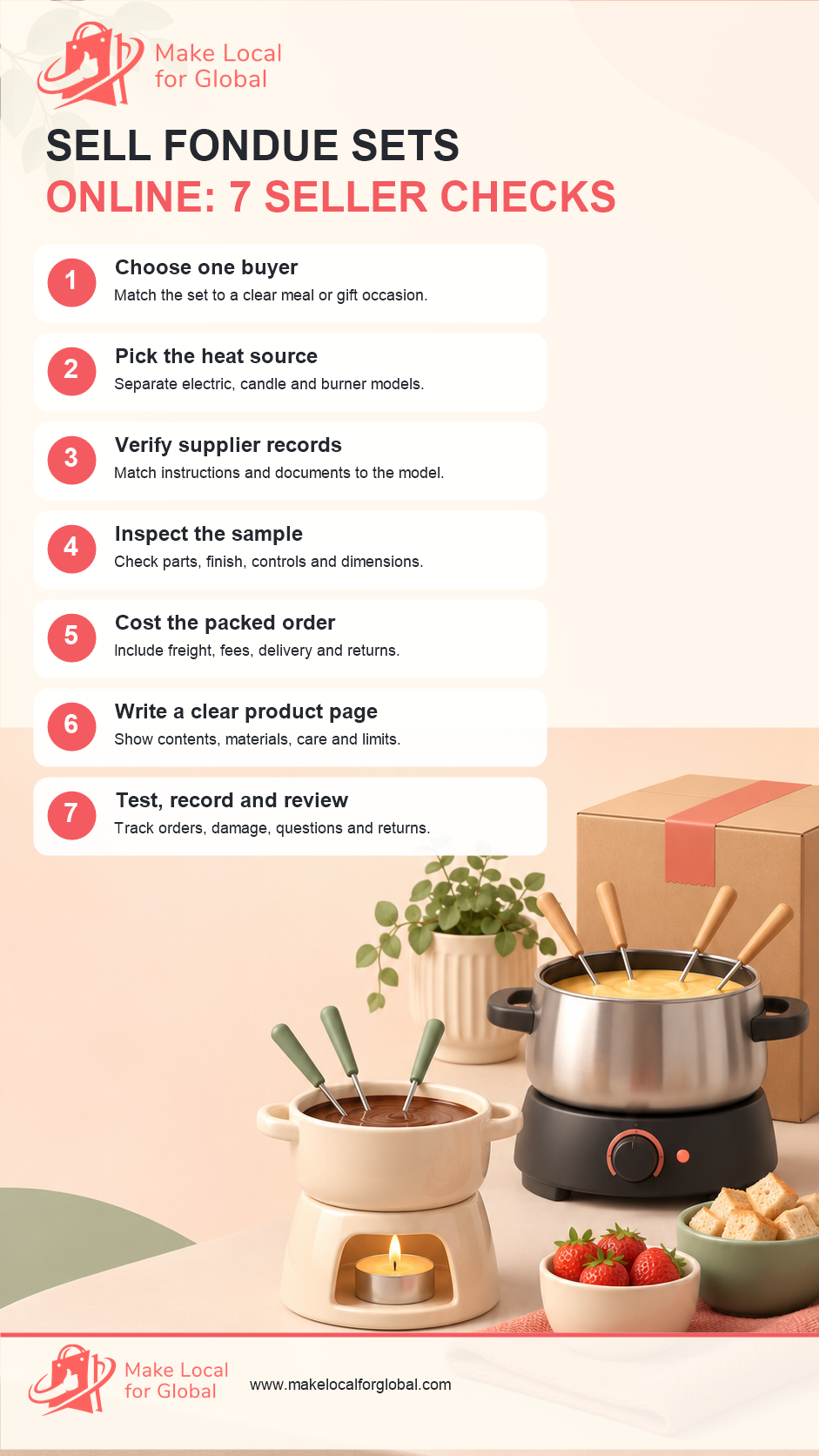
Describe images in alt text based on their visible content. Keep the cover’s alt text focused on the fondue set and seller checks shown. Do not use alt text to list search phrases. Compress the images to a sensible file size without making labels unreadable, and verify the actual uploaded file loads from its public URL.
Put product details in a predictable order so a shopper can compare options. Begin with the set type, heat source, included items, bowl material and dimensions. Follow with cleaning, instructions, warranty, dispatch, returns and contact information. If you sell several models, keep the order identical across pages so the differences stand out.
Use a variant selector only when the choice changes the item being shipped. A selector labelled “colour” should not conceal a different heat source or fork count. Keep images tied to the selected model. Make sure the basket and confirmation email name the exact model and variation.
Show stock status honestly. If only one sample is available, do not label the product “in stock” for multiple orders. If a supplier needs several weeks to replenish a specific model, state a realistic dispatch estimate and update it when circumstances change. Customer trust depends on the order arriving as described.
Add a concise comparison table when a shopper needs to choose between models. Use fields such as heat source, parts, bowl material, storage size, cleaning and verified use. Do not label one model “best” without explaining the buyer and evidence behind that recommendation. A small decision table can help a gift buyer, a couple or a host identify the right product faster.
Review the full path from search result to confirmation email. Check the main heading, price, selected image, specification, shipping amount, payment screen, confirmation and returns link. Ask an independent person to find the bowl material and included fork count on a phone. If they cannot locate the answer quickly, improve the page before putting more money into promotion.
Write down two possible audiences and the occasion each set serves. Look at current listings, record the set types and details that sellers publish, and note questions that are hard to answer. Interview a few likely buyers with neutral questions. Create a one-page concept for one audience and record objections, unknowns and the next research step.
Do not order stock this week. Decide your cash limit, target contribution and evidence you need from a supplier. If buyer interviews show that people want an electric set but your candidate is a burner model, test another product rather than trying to change the audience’s preference with copy.
Contact suppliers with the same question list. Request the exact specification, instructions, model identifiers, food-contact documentation, electrical documents where relevant, sample cost, lead time, minimum order and packed dimensions. Compare two suppliers against the same fields.
Order the sample only when documents identify the model you plan to test. Photograph the carton, count the parts, measure the set, compare the controls or burner with the instruction leaflet and record any mismatch. Ask the supplier for missing evidence in writing. Do not order sale stock if the answer leaves a material safety or product-identity question unresolved.
Build the full per-order cost sheet from current quotes. Calculate a regular order, a bundle and a returned or damaged order. Ask a carrier for the parcel charge using the real carton dimensions and weight. Confirm current channel and payment costs from their published terms or your account.
Photograph the exact sample and its included parts. Write a product page with the heat source, contents, measurements, materials, care, instructions and dispatch. Prepare the support and returns policy. Ask a test reader to compare the product page with the sample and find anything that is missing or inconsistent.
List a limited quantity through one primary channel. Keep stock, product and parcel records for every order. Track visits, model views, checkout starts, completed orders, questions, cancellations, delivery cost, damage reports and returns by SKU.
At the end of the month, compare actual orders with the cash and contribution plan. Decide whether to restock, improve a product image, change the audience, clarify a specification or stop the model. Do not treat a few early visits as proof of stable demand. Record the next test and the date you will review it.
Treating different heat sources as equivalent: An electric base, candle stand and separate burner have different instructions and use limits. Keep separate listings or make the differences unmistakable in a model selector.
Assuming a pot material proves its use: A ceramic bowl may look like cookware, but the maker’s instructions determine how that model should be heated and cleaned. Ask for product-specific evidence.
Listing a set before checking the contents: A supplier image can show optional forks, a fuel burner or a lid that is not in your stock. Open the sample and photograph every part before you publish.
Choosing a price from the unit cost: Carton, inbound freight, parcel delivery, payment fees, breakage, returns and advertising can change the order contribution. Cost the packed sale rather than a bare pot.
Using generic safety wording: “Safe for all users” says little and may create a claim you cannot support. Use maker instructions, model records and accurate restrictions.
Ignoring product documents from a local wholesaler: Your role still matters. Keep supplier and model records, and check what your responsibilities require for the product and sales market.
Copying a competitor’s images or text: Another seller’s listing may describe a different model or include accessories you do not supply. Create original images and write from your sample and supplier documents.
Ordering a full seasonal quantity after one positive conversation: A compliment does not confirm an order. Test several evidence sources and keep the first quantity within the amount you can afford to hold.
Combining unrelated accessories to raise the order value: A bundle should be compatible, documented and useful. List each included part and recalculate handling, postage and contribution.
Leaving a product live after its model changes: A supplier can update a coating, base or control without changing a retail image. Compare replenishment stock with the approved sample and revise documents and images before sale.
Neither type is automatically easier to sell. An electric model needs an appropriate plug, model-specific electrical records and its stated electrical rating. A burner style needs the exact compatible burner and maker’s instructions. Test buyer preference, supplier evidence, product price, packed cost and your ability to fulfil each type before choosing.
Start with one or two models that serve distinct use cases, such as an electric set and a separate non-electric design. Keep each model’s parts, heat source, dimensions and care details distinct. Add colours or bundles only when they solve a real choice and your supplier can replenish the exact specification.
Use only the purposes supported by the manufacturer’s instructions for that model. Different foods and heating methods may have different requirements. Ask for the model-specific guidance and avoid showing an unapproved use in photographs or copy.
Request the model specification, user instructions, supplier identity, material details for food-contact surfaces, relevant test or compliance documents, electrical information for powered sets, packing list, warranty terms and change-notification process. Confirm that documents identify the exact product and destination market you plan to serve.
Compare the delivered parts with the packing list, inspect the bowl and finish, check the stand or electric controls, measure the product, read the instructions and compare the documentation with the model label. Do not modify the appliance or conduct improvised flame or electrical tests. Record results and supplier questions.
Add product cost, inbound freight, packaging, pick time, delivery, current channel and payment fees, return and damage allowance, and customer acquisition. Calculate contribution after those variable costs, then account for fixed overhead, tax and VAT with professional advice. Replace every illustrative figure with your own business data.
Use a carton and internal supports suited to the bowl, stand and accessories. Prevent parts from moving or touching the food-contact surface. Measure and weigh the sealed parcel, document the pack method and review every damage report for a repeated pattern. Ask a packaging specialist about formal transit testing where needed.
Materials intended to contact food are covered by relevant rules. Ask the supplier for written evidence for the exact bowl, glaze, coating, fork or utensil and intended use. Check current regulator guidance for Great Britain, Northern Ireland and each overseas market where you plan to sell.
Many distance sales give consumers 14 days after delivery to notify the trader that they wish to cancel and a further 14 days to send goods back, subject to rules and exceptions. A faulty product complaint is different from a change-of-mind cancellation. Read current GOV.UK guidance and obtain advice for your business.
Do not assume that a fuel type is compatible, permitted or suitable for your shipping route. Check the maker’s instructions and current carrier, marketplace and legal requirements before offering it. If the set needs separate fuel, describe what is and is not included clearly.
Choose a quantity that fits your cash limit, available storage, supplier minimum and evidence of demand. Include the cost of unsold stock and damaged or returned units. If the minimum order is too large for a fair test, ask for a smaller run or find a supplier with a suitable sample or trial quantity.
Bring the buyer’s occasion, supplier records, sample checklist, product photographs and parcel costs together before placing an order. A fondue set listing works best when the product itself is clear: its heat source, included pieces, food-contact materials, instructions, dimensions, delivery and returns all match the item you will send.
If you are ready to turn the product plan into an online shop, talk to Make Local for Global about the next step for your business.
Bring your buyer notes, supplier documents, sample checks and parcel costs to a conversation about your online shop.
PREFERRED SOURCE
Like what you’re reading? Add Make Local for Global as a preferred source on Google to see more of our articles when you search.

Build your online presence without having to figure out everything yourself.