


READY TO SELL Framed Art Prints ONLINE?
Get a store built for you in 5 days, plus training and support to help you start, run, and grow your Alternative business.

Plan a focused framed art print range with clear artwork rights, tested print and frame samples, a full order-cost example, accurate product pages and a practical launch plan.


A framed print is a physical product, a piece of wall decor and, in many cases, a gift. Customers want to know how large it will look, what the frame is made from, how the colours compare with the image on screen and whether it will arrive intact. A first-time seller needs to answer those questions before ordering a broad range.
The most manageable starting point is a small collection for one identifiable buyer or room, made from artwork you have permission to reproduce. Test a few print sizes and frame finishes, inspect production samples, measure a packed parcel, then price the full order. This approach gives you evidence on demand, returns and contribution before you commit to deeper stock.
This article is for a UK seller planning physical framed prints. It covers original artwork, licensed designs and print-on-demand routes. It does not assume that every decorative print receives the same VAT treatment or that made-to-order products automatically fall outside cancellation rights.
Turn artwork rights, sample choices and a clear buyer into a practical first collection plan.
Start by writing one sentence that describes your offer. For example: “I sell quiet coastal illustrations in oak-look frames for people furnishing a small home office.” The sentence helps you choose artwork, sizes, prices, photography and the places where you test demand.
Avoid launching as a general wall-art shop with hundreds of unrelated images. A large catalogue creates more proofing, product-page, stock and photography work. It can hide which subject, size and finish a buyer actually prefers.
There are three common models. An artist may create and print their own artwork, a seller may license an artist’s files and arrange printing, or a seller may use a print-on-demand partner to print and frame each order. Each model moves the cost and control to a different place.
| Model | What you control | What to verify before launch |
|---|---|---|
| Create and print | Artwork, paper choice and production schedule | Printer profile, proofing, labour time, frame supply and stock cash |
| License and fulfil | Range curation, product page and customer experience | Licence scope, territory, term, permitted formats, edition limits and credit |
| Print on demand | Artwork files, positioning and storefront | Sample quality, frame options, packaging, dispatch times, returns route and per-order cost |
Ask who is responsible for the print, frame, glazing, packing, customer support and replacement after damage. A partner’s promise to fulfil an order does not remove your responsibility to present accurate information to your own customer.
“People who like art” is too broad to guide a first range. Use a buying situation you can observe: a renter styling a compact room, a new homeowner buying a housewarming gift, a café sourcing a set of prints, or a parent decorating a child’s room.
Write down where the print will hang, what the customer may already own, the likely wall space, the expected price range and what might prevent the purchase. A buyer choosing a present may need gift packaging and a reliable arrival date. A café may care more about consistent sizes, easy replenishment and a quantity quote.
Speak with a few people who fit the buyer description. Show them actual artwork concepts and a scale mock-up. Ask what they would compare, which room they have in mind and what information is missing. Do not treat polite interest as proof of demand. A paid preorder, a clearly labelled waitlist or a small test campaign with measurable enquiries gives stronger evidence.
If a design uses a three-dimensional object or sculptural form, compare your audience and photography needs with the related guide to selling art sculptures online. Framed prints need their own size, surface and packing information, so use related products to inform your audience research rather than copying their product pages.
An opening collection should be coherent enough to browse and small enough to inspect. A practical pilot might use three to five designs, two print sizes and one or two frame finishes. The exact number depends on production minimums and cash available; it is not a universal formula.
Use a collection idea to connect the prints. It could be a set of local landscape drawings, abstract colour studies for workspaces, or a series of botanical illustrations. A customer should be able to understand the common thread in a collection page or product photograph.
For more examples of how a focused art offer can be presented, see MLFG’s art business page and wall-art business page. These pages describe shop setup; use your own artwork rights, production samples and framed-product costs to shape this offer.
An entry option might be a small framed print with a standard finish. A core option can use a larger size or upgraded frame. A premium version could use archival paper, a distinctive frame or a signed and numbered edition, if that description is true and the edition is managed accurately.
Do not call a print “limited edition” if you can produce unlimited copies or have not defined the edition size. Record the edition number, production date and artist signature where those are part of the offer. A digital download of an artwork and a framed physical print are separate products with different fulfilment expectations.
Use bundles only when they make sense for the wall or buyer. Two coordinated small prints may suit a narrow hallway. A triptych could work over a sofa if the images and spacing have been tested together. Explain whether the bundle includes three separate frames, one multi-opening frame or a single wider frame.
List the finished outside dimensions, print opening, image area and mount width. These measurements are different. A nominal A-size print inside a mount will not necessarily have the same visible image area as a full-bleed print of that paper size.
Check whether the artwork crops cleanly at each proposed aspect ratio. Keep important subjects, signatures and borders away from the crop edge. If the source artwork is portrait, do not force it into a landscape product by stretching it or cutting off a relevant part.
Build a size matrix before creating variants. Each row should identify the design file, print size, frame outside size, orientation, mount choice and package size. This makes product options easier to explain and reduces mistakes when a design appears in several finishes.
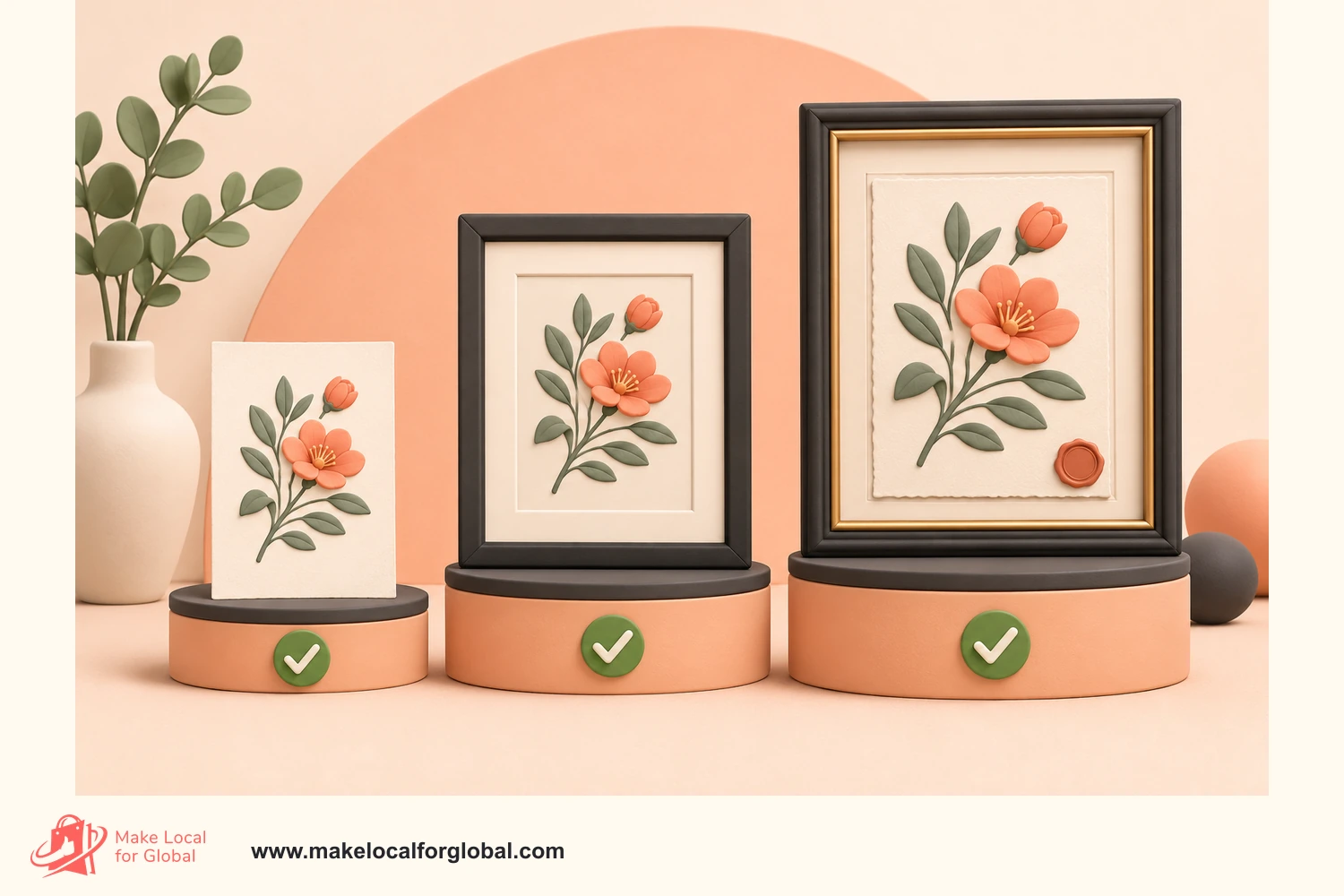
Keep the differences between variants visible in a simple table or selector. A buyer should see what changes when they select “small”, “large”, “black frame” or “oak-look frame”. Avoid giving several near-identical options names that do not explain their size or finish.
For a small pilot, make one comparison page with the three designs and show each in the same room scene. Use the same camera angle, wall colour and approximate furniture scale. A second close-up can show texture, mount and frame corner. The purpose is to make the difference between choices visible, not to create a lifestyle image that disguises the product.
Before taking orders, establish that you may reproduce and sell each artwork. Buying a painting, downloading an image, receiving a file from a friend or finding an image in a search result does not by itself give you permission to make and sell copies. UK copyright guidance explains that the copyright owner controls acts such as issuing copies to the public, including copies offered for sale. Read the GOV.UK overview of copyright and guidance on using somebody else’s intellectual property.
If you made the artwork, keep dated source files and records of the creation process. If another artist made it, use a written licence or assignment that identifies the work and the commercial uses allowed. A licence should state whether it covers framed prints, online product photographs, paid advertising, marketplaces, social posts, territory, term, permitted quantities, exclusivity, royalties and artist credit.
Ask whether the artist has included fonts, photographs, textures, stock elements or other third-party work. The artist may own the illustration but lack the rights to grant you a broad merchandise licence for an incorporated photograph. Keep the permission for each component in the same product file.
An old image is not automatically free to reproduce. Copyright duration depends on the type of work, who created it and other facts. A modern photograph of an old painting may have its own rights, and a museum’s access terms may apply to its digital image. If the status is uncertain, select a different design or obtain advice from an intellectual-property professional.
Do not use film characters, sports badges, musicians, brand marks or celebrity images as a shortcut to demand. A customer’s request to print a protected character on a personal order does not make commercial reproduction lawful. Ask a qualified adviser about a planned design if you are unsure.
Create a rights register with the product SKU, creator, source file, permission document, permitted use, term, territories, edition limit, credit line and renewal date. Pause a listing when a licence expires or the artwork changes. Store the register where a colleague can check it before reprinting.
Decide whether you will print in-house, use a local print lab, buy wholesale framed stock or route each order to a print-on-demand provider. Compare the full delivered cost, control over colour and packaging, minimum quantities, lead time, replacement process and what happens when a frame or paper is discontinued.
Request written specifications for paper weight, surface, image size, frame material, glazing type, mount, hanging hardware and packaging. “Premium paper” is not a measurable description. Ask for the paper name, finish and manufacturer specification, then decide whether those details matter to your target buyer.
For a made-to-order route, place an order to your own address. Check the item as a customer would: confirmation email, dispatch messages, protective packing, carrier label, print condition, frame alignment, glazing, hanging fittings and the accuracy of the product page. Photograph the opened parcel and keep the order reference.
Paper choice affects surface appearance, feel, reflectivity and how colours appear. A smooth matte sheet may reduce glare in a bright room. A textured sheet can suit a painterly image. A glossy finish can make colours look stronger, but reflections can affect how the framed piece reads behind glazing.
Ask the printer how the file should be prepared. Confirm the target pixel dimensions, resolution guidance, colour profile, bleed, safe area and accepted file type. Request a proof at the actual size when the work includes fine lines, pale detail or a large area of a single colour.
Frame descriptions need care. “Solid oak”, “oak veneer”, “oak effect” and “wood-look” describe different products. Use the supplier’s verified material description. If you sell metal or composite frames, name the material only when you have evidence from the supplier.
Glazing may be glass or a type of acrylic. Ask about clarity, reflection, weight, breakage risk, cleaning and whether the panel has a protective film. Do not claim UV protection, shatter resistance or archival performance unless a manufacturer document supports the statement.
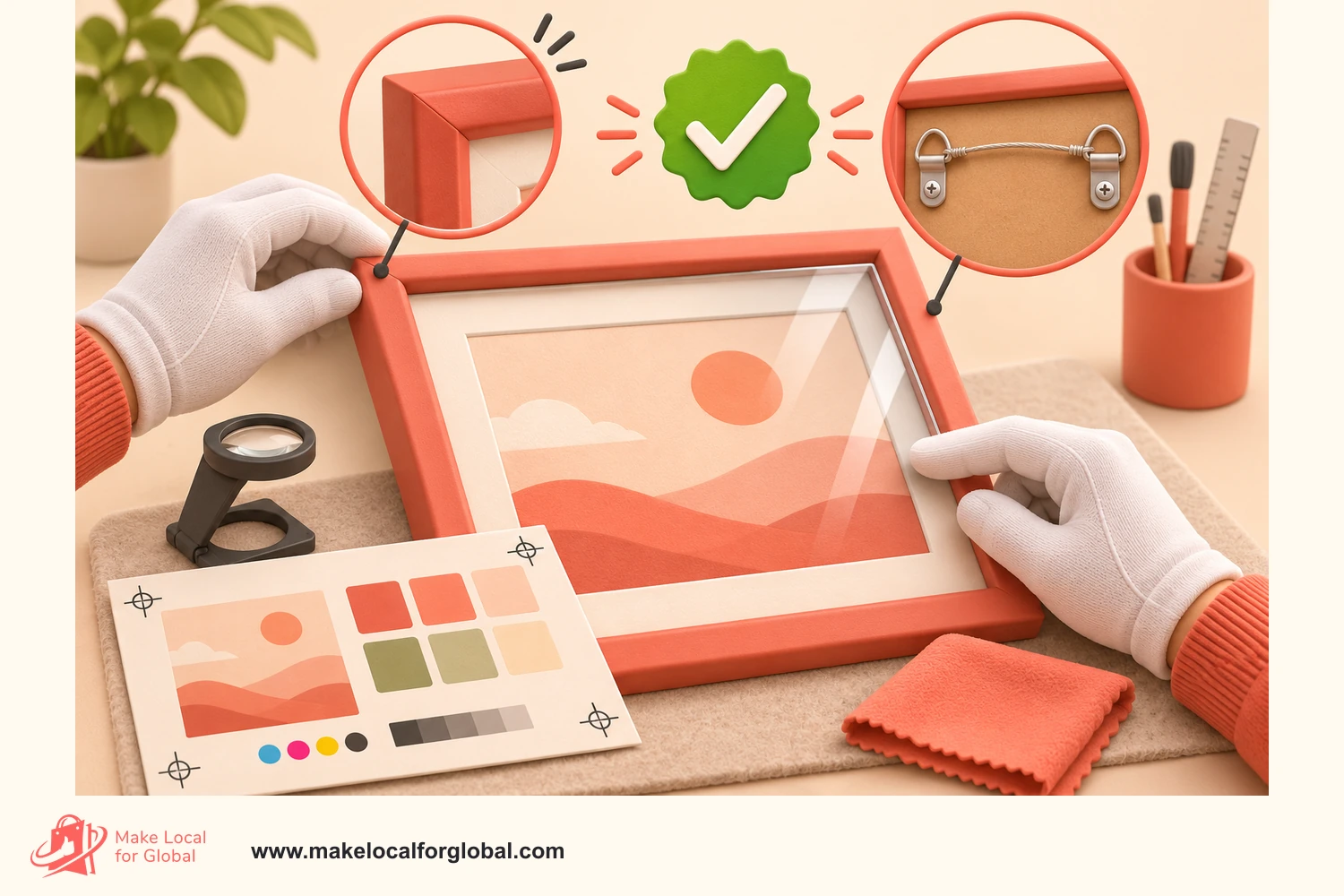
Make a sample checklist and use the same one every time. Confirm the image, orientation and crop against the approved proof. Inspect the print under daylight and ordinary indoor lighting for colour shifts, banding, scratches, dust, marks and edge damage.
Check that the artwork sits square in the frame, the mount is even, the frame joints meet cleanly and the backing does not bulge. Test the hanging hardware with the frame weight and inspect how the product sits against a wall. Record the supplier, batch or order reference and date.
If the first sample fails, write down the defect and ask the supplier for a corrective sample. A single replacement does not prove that the cause is fixed. Ask what changed in the print file, production setting, frame assembly or packing method, then inspect the next sample before opening sales.
Price from the money collected for an order down to the costs that vary with it. Include the print, frame, mount, glazing, inbound freight allocation, packaging, pick-and-pack labour, payment or marketplace fees, delivery, damage or return allowance and any customer-acquisition cost you are testing.
The example below is illustrative, not a supplier quote or expected profit. It assumes one framed print sold through a direct shop. The figures are hypothetical and should be replaced with invoices and current platform rates.
| Per-order item | Example cost |
|---|---|
| Print, frame and mount from supplier | £24.00 |
| Inbound freight allocation | £2.00 |
| Protective packaging | £3.00 |
| Packing labour allocation | £2.50 |
| Payment and platform fee estimate | £3.20 |
| Delivery charged by carrier | £6.50 |
| Damage and return allowance | £2.00 |
| Customer acquisition test allocation | £4.00 |
| Total variable cost | £47.20 |
| Illustrative customer price including delivery | £69.00 |
| Contribution before fixed overhead and tax | £21.80 |
The arithmetic is £69.00 less £47.20 = £21.80. This contribution is not net profit. It excludes fixed software, studio, insurance, accounting, photography, design, storage and tax costs. If the seller pays VAT on a transaction, check whether the prices and cost lines include or exclude VAT before comparing margins.
Framed goods may arrive with a dented corner, scuffed glazing or a damaged outer box. Use your own pilot data to estimate how often this happens and the cost of sending a replacement. Until enough orders exist, create a provisional allowance and review it monthly.
Keep a damage log with product, frame size, packing method, carrier, damage location, refund or replacement cost and photos. If the same corner fails, change the package design and repeat the drop or transit test. A postage label scan is not proof that your pack can withstand the route.
Do not assume that all art prints have a reduced or zero VAT rate. The UK definition for certain works of art is specific, and mechanically reproduced poster-style prints do not automatically qualify as original works. HMRC guidance describes standard-rated goods as common, and its notice on printed matter applies to defined kinds of printed publications rather than every image on paper.
Check the product, production process, seller status and transaction with an accountant or HMRC before setting a VAT treatment. Start with HMRC’s guidance on VAT rates, how much VAT to charge and Notice 701/10 on books and printed matter. If you are VAT registered, include the effect of VAT in the price model rather than treating it as extra contribution.
Compare the print, frame, packaging, fees, delivery and damage allowance before you set a price.
Build the retail price from the costs and the value proposition. Compare products in the same format, size and frame type. A small unframed poster is not a sound direct comparison for a large framed print with glazing and a tested parcel.
Record your comparison date, product details and listed price. A competitor’s price is a market observation, not proof that the product sells at that price. Do not copy a discount when another shop uses a crossed-out number. Use real sales, enquiries and conversion data from your own test to make a decision.
Set a clear price for each variant and state whether delivery is included. If you offer free shipping, include the shipping cost in the product economics. If shipping is charged separately, show it before the customer completes the order and avoid unexpected optional extras.
Check how price changes affect contribution. If a £5 price reduction removes nearly a quarter of your example contribution, consider whether a smaller size, simpler frame or bundle provides a better offer than lowering every price. Test one change at a time so you can learn which factor affected demand.
Use a specific title such as “Coastal Dunes Framed Art Print, A3, Natural Oak-Effect Frame”. It names the design, product type, size and finish. Avoid a title that only says “Beautiful Wall Art” when a buyer cannot identify the actual item.
Show the print at scale in a room, on a plain background and in a close-up. A styled scene helps a customer picture placement, but it should not imply that furniture or accessories are included. Add a dimension graphic or a person holding the unframed print, where useful and accurate.
State the actual outside frame dimensions, visible image area, print size, orientation, mount, frame material and glazing type. Explain whether hanging hardware is attached, whether wall fixings are supplied, and whether the item arrives ready to hang. If hardware is not included, say so before checkout.
Describe colour honestly. Screens and room lighting vary. Photograph the product in daylight and include a close-up of the paper and finish. Do not digitally increase saturation so the photographed print differs from the item shipped.
Coastal Dunes Framed Art Print, A3, Natural Oak-Effect Frame
Bring a calm coastal palette to a study or living space with this A3 print of rolling dunes. The illustration is printed on matte archival paper and supplied in a natural oak-effect frame with a white mount and acrylic glazing. The frame measures 42 × 59.4 cm externally; the visible image area is 27 × 40 cm. The print arrives ready to hang with two rear fittings. Wall screws are not included.
This is an example only. Use “archival paper”, exact materials, sizes and hanging details only when the supplier specification confirms them. Add dispatch estimates, care instructions, packaging details and your current returns policy near the purchase information.
Before publishing a product page, ask a person who has not seen the product to locate the outside dimensions, delivery estimate, frame finish and returns information. If they struggle, improve the page before buying more traffic.
Use a variant selector with text labels and clear images. A swatch alone may be difficult to interpret. Label a frame as “black”, “natural oak-effect” or a verified material description, and show the profile in a close-up.
Add image alt text that describes what a shopper needs to understand, such as “A3 coastal dune print in a natural oak-effect frame above a pale desk”. Do not stuff the same keyword into every image. Use filenames that identify the product and view, for example coastal-dunes-a3-frame-detail.webp.
A marketplace can put your product in front of people already searching for wall art, but it can charge listing, transaction, advertising or payment fees and set rules for product and delivery claims. Read the current fee schedule and seller policies on the platform you choose before calculating contribution.
A direct shop gives you more control over product pages, collection structure, email capture and customer data, but you are responsible for bringing qualified visitors. A mix may suit a small business that uses a marketplace to learn which designs attract enquiries, then tests a direct collection with its own audience.
Before choosing, compare total monthly cost, per-order charges, payment timing, image options, variant limits, shipping integrations, cancellation policy tools, tax settings and how customer service works. Create one test listing and place a test order if the platform permits it.
Use wording a buyer may actually type: “framed botanical print”, “large framed landscape print”, “A3 wall art with black frame” or “local coastline illustration”. Search suggestions and marketplace categories can help you form hypotheses, but a suggestion does not prove search volume or sales.
Write a distinct page title, product description and image captions for each design. Explain what is in the image, what size and finish are available and which room or gift use it may suit. Avoid creating many near-identical pages whose only change is one colour word.
Make a small content plan around buying questions: how to measure a wall for a framed print, how to choose a frame finish, what “print size” means, how to arrange a pair of prints, and how to protect a framed piece in transit. Each page should answer its own question, and relevant product links should help the reader rather than interrupt the answer.
Measure and weigh the completed parcel, not the print alone. Include the frame, corner protection, sleeve, rigid boards, outer carton, tape and any gift wrap. Carriers have service-specific limits and prices, so check current size and weight terms with the carrier you plan to use. Royal Mail’s parcel measurement guidance warns that inaccurate dimensions or weight can affect delivery.
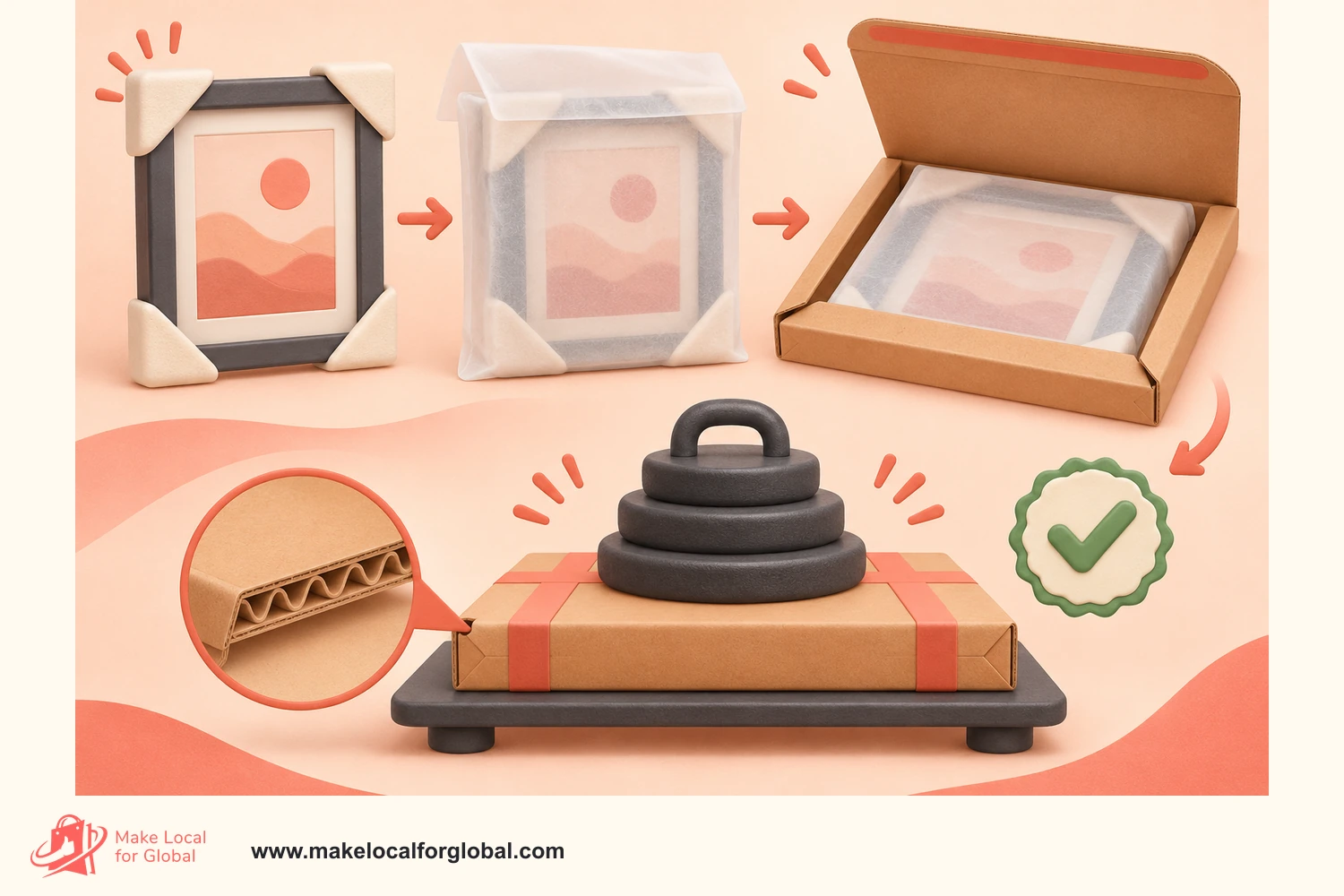
Use corner protectors and a rigid outer pack sized to reduce movement. Separate the framed face from other hard surfaces with a suitable protective layer. Prevent the print or glazing from rubbing, and keep hardware from pressing into the artwork. Follow the frame supplier’s safety instructions for glass or acrylic glazing.
Test a packed sample by carrying it through the steps you expect in your fulfilment route. Check for movement inside the parcel, corner compression, surface scuffs and whether the delivery label remains readable. Do not describe a parcel as “fragile-proof”. Record the test and revise packaging if the frame shifts or corners are exposed.
For fulfilment at home, keep stock dry and upright where the supplier recommends. Store prints flat or in suitable sleeves, and keep finished frames away from sunlight, damp and pressure. Use a location and SKU system so a small print in a black frame is not confused with a larger oak-effect variant.
Before a customer places an online order, give clear product information, the total price or how it is calculated, delivery options and costs, trader contact details and applicable cancellation information. GOV.UK’s online selling rules and distance-selling guidance describe the information traders need to provide.
For many online goods, a customer can cancel within a defined period even when the product is not faulty. There are exceptions for some goods made to the consumer’s specifications or clearly personalised. A print selected from your standard catalogue is not necessarily personalised simply by printing it after an order. Review the facts and your obligations before stating that a product is non-returnable. See GOV.UK’s returns and refunds guidance.
Make a practical returns workflow. Tell the customer how to contact you, what information to include, how a return is arranged and which address to use. On receipt, photograph the frame and packaging, record the condition and decide whether it can return to sale. Keep faulty, damaged and unwanted-item cases distinct in your records.
If a product arrives damaged, ask for clear photos of the outside package, corners and print. A prompt and helpful response can establish whether the issue arose in production, packing or transit. Use the evidence to make a fair decision under your consumer obligations and update the packaging process where needed.
Framed prints appear simple, yet frames, glass, fixings, coatings and packaging all create claims that need support. Verify supplier information before you state that glazing is shatterproof, a frame is sustainably sourced, paper is acid-free or inks are lightfast. Avoid safety promises based on a product name alone.
If a frame includes glass, describe that fact clearly and follow handling advice from the manufacturer. Do not tell customers to hang a heavy framed item with an unspecified nail or adhesive. State the approximate finished weight where known and direct the customer to use fixings suitable for their wall and the item’s weight.
Keep supplier invoices, material specifications, product photos, batch or order details, and complaint records. If you change a frame, glazing supplier, mount or print process, inspect a fresh sample and update the product page. A listing should reflect the item shipped now, not an earlier version.
Select one collection and one likely buyer. Publish a small number of accurate product pages or a landing page with a clear price and delivery estimate. Share it with a relevant audience or run a modest, time-limited promotion that you can afford to lose. Set the observation before launch: qualified product-page visits, add-to-basket actions, questions about size, paid orders or quote requests.
Track the design, size, frame, visit source and result. If people view the page but leave after checking delivery, review parcel cost or dispatch information. If visitors ask for a different size, compare the cost of adding it with the value of the requests. If one design attracts interest but no orders, ask whether the product image, price, product details or audience is the barrier before drawing a conclusion.
Do not treat one social post or a handful of clicks as a reliable demand forecast. Repeat a test with a similar audience and one change at a time. Avoid buying a large quantity when friends compliment a design or a competitor has a large catalogue.
Use a SKU that encodes design, size and frame in a readable way, such as DUNE-A3-OAK. Record the artwork version and supplier SKU separately. If the same design changes file crop or colour, update the artwork version so an old file is not sent to the printer by mistake.
For stocked products, count finished units and unframed stock separately. Note reorder lead time, minimum order quantity, units reserved for open orders and any discontinued supplier part. Set a reorder point from observed sales and lead time, then check cash before ordering. A reorder rule is a reminder to review, not an automatic instruction to spend.
For print-on-demand, compare each order report to the customer order. Check the artwork variant, frame, shipping address, dispatch notice and tracking link. Keep a list of production and damage issues by supplier so the next supplier review uses evidence rather than memory.
Start close to the buyer you can reach. Share a mock-up with a local interiors group, invite a small retailer to view samples or offer a limited wholesale test to a café that needs a coordinated set. Be clear that samples are for review, not a guaranteed sale.
Ask customers where they plan to hang the print and what they compared before buying. After delivery, request permission before using a customer photo or review in marketing. A review should represent a real customer and should not be edited to change its meaning.
Build helpful content that supports the buying decision: a size guide with a person and wall reference, a frame finish comparison, a guide to hanging a pair of prints, or a short explanation of how a print is made. Link from that content to relevant collection pages with clear anchor text. Do not create thin pages that repeat the same paragraph for every design.
An email list can help you announce a new collection, a restock or a local event. Collect sign-ups with clear consent and explain what type of email the person will receive. Do not add customers to marketing emails without a lawful basis and the correct permission or exception; check current data protection guidance for your setup.
Give readers a next step that fits their stage. Someone still choosing a product can use the Business Idea Stress Test to organise assumptions and questions. A seller pricing framed prints can compare stock, packing and fulfilment costs with the Wholesale Retailer Margin Lab. A seller ready to build a direct shop can review MLFG’s website design service.
Internal links should help someone complete the next task. A product page can link to the size guide; a packaging article can link to delivery information; a collection page can link to the artist’s process. Use descriptive anchor text instead of “click here”. Check every link after a page move or product change.
If you need a clear place to plan the first collection, use a short worksheet with columns for design, buyer, size, frame, rights, sample result, cost and evidence. Record the next decision beside each row. This stops an attractive visual idea from moving straight to a large production order without a sample or cost check.
Write reusable answers for the questions that come up often: whether the print is framed, its outer dimensions, the glazing material, the dispatch estimate, how it is packed and how to contact you about damage. Keep the answers specific to the product. A generic reply that ignores the frame size or delivery date can increase uncertainty.
Before dispatch, check the product against the order, clean the glazing according to supplier advice, inspect the frame corners, confirm the hardware and photograph the packed parcel. Do not include a cleaning product or mounting accessory unless it is approved for the frame and listed in the product information.
After a complaint, record the customer’s description, order reference, photos, production partner, parcel condition and resolution. Review repeat issues by design and frame. If one finish produces repeated scratches, pause that variant until the supplier or protective packaging issue is addressed.
The schedule below is a working sequence for a small pilot. Shift the timing to fit supplier lead times and your available hours. Each week ends with a decision based on evidence.
| Week | Work | Evidence to keep | Decision |
|---|---|---|---|
| 1 | Pick a buyer, collection theme and three to five designs. Confirm the rights route and speak with likely buyers. | Interview notes, artwork register, questions and objections | Keep the designs buyers understand and you can lawfully reproduce |
| 2 | Select sizes, frame options and production route. Order samples and record all specifications. | Quotes, licence terms, sample order and cost assumptions | Correct colour, crop, frame and packaging concerns before listing |
| 3 | Photograph samples, draft product pages, measure a packed parcel and build the contribution model. | Product photos, page checklist, carrier quote and model | Set prices and delivery terms that cover the complete order |
| 4 | Publish the pilot, share it with a defined audience and review results. | Visits, enquiries, basket actions, orders, returns and damage log | Reorder, revise one part, or stop a design based on observed results |
At the end of the month, compare your planned and actual costs. Include returns, replacements and advertising if they occurred. Keep the model simple enough that you can update it after each batch.
Ordering too many designs at once. You spend time proving every crop, frame and listing. Start with a smaller collection and expand only where the evidence supports it.
Using a mock-up as the only product image. A room scene can show scale, but it cannot show paper texture, frame corners or glazing. Photograph a real sample and label any digital mock-up clearly.
Describing the frame loosely. A term such as “wood” may imply a material that the supplier does not use. Confirm the specification and repeat it consistently across the listing and packaging insert.
Ignoring the artwork licence. A file that can be downloaded is not necessarily cleared for printing. Keep permission and third-party asset records before listing.
Pricing from the supplier invoice alone. A print and frame are only two lines. Add delivery, packing time, fees, damages, returns and customer acquisition before deciding what the order contributes.
Treating made-to-order as automatically non-returnable. Printing after an order does not by itself prove that a standard catalogue product is clearly personalised. Check the actual rules and product facts before writing a returns statement.
Making quality claims without proof. Use terms such as archival, fade-resistant or sustainable only when the supplier provides evidence that matches the exact product.
Expanding before testing the parcel. A sample that looks good on a table can still arrive with frame damage. Pack and measure the real item, then test the route and review customer outcomes.
In many cases, yes. The fact that you own a physical painting or found a digital image online does not usually give you permission to produce and sell copies. Obtain a suitable licence or assignment, check third-party elements and ask an IP professional if the rights are unclear.
Not automatically. UK VAT definitions are specific, and many mechanically reproduced decorative prints do not meet the definition for certain original works. Check HMRC guidance for the exact work and process, and get tax advice before setting the VAT treatment.
Do not assume that every made-to-order print is exempt from distance-selling cancellation rights. The exception applies to goods made to a consumer’s specifications or clearly personalised. A standard design printed after checkout may not be enough. Check the product facts and current law before setting a returns policy.
Choose sizes your printer and frame supplier can make consistently, then test them with the buyer and room you selected. Two useful sizes may be easier to explain than many variants. Check the image crop, outside frame dimensions, parcel cost and visible artwork area for each size.
It can reduce the amount of finished stock you hold, but each order may cost more and you have less control over production and packing. Order samples, read current service terms and test the full order process before you list the product.
Show the artwork at scale and close up. State print and outside frame dimensions, orientation, mount, frame and glazing materials, hanging hardware, dispatch estimate, price, delivery charge and returns route. Only include specifications you have verified.
Protect the corners, stop movement inside a rigid outer pack, separate the face from hard surfaces and measure the finished parcel. Test the exact packing method and record damage reports so you can improve the weak point.
Offer both only if you can explain the difference, protect both formats and fulfil them reliably. An unframed version costs less to ship, but the customer must source a frame. A framed version offers convenience and requires more careful packing. Test demand and contribution for each before adding more options.
There is no fixed right number. Choose a small collection you can proof, photograph and describe accurately. Three to five designs can be a manageable pilot for one theme, but supplier minimums, audience evidence and your available cash should set the actual number.
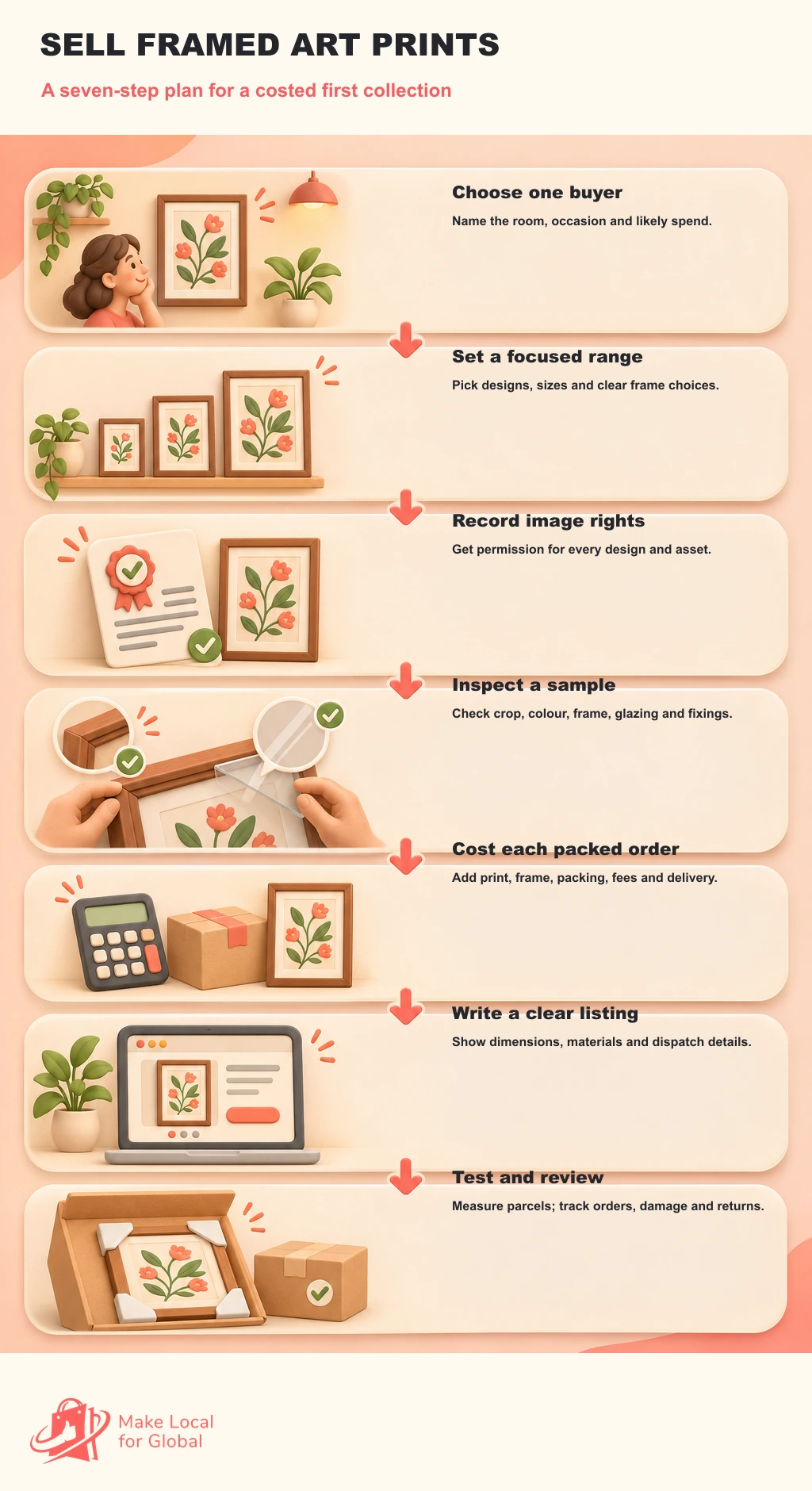
Selling framed art prints is a sequence of choices: secure reproduction rights, define a buyer, prepare a coherent range, inspect a real sample, cost the packed order, describe the product accurately and learn from a measured launch. A narrow pilot gives you a way to improve the offer without committing your cash to a catalogue you have not tested.
Use the first orders to update the size, frame and packaging decisions. Keep the assumptions that proved true, change one weak part at a time and preserve the rights and supplier records behind each design.
When the first collection has repeatable sales and fulfilment, decide whether the next investment should go into a new design, another frame finish or a stronger direct shop. Let customer questions, order costs and return reasons guide that choice.
Use artwork permission, sample results and packed-order costs to pressure-test the offer before adding more designs.
PREFERRED SOURCE
Like what you’re reading? Add Make Local for Global as a preferred source on Google to see more of our articles when you search.



Build your online presence without having to figure out everything yourself.

