READY TO SELL French fry cutters ONLINE?
Get a store built for you in 5 days, plus training and support to help you start, run, and grow your Alternative business.

Plan a French fry cutter range with verified grid sizes, safe sample tests, supplier records and a full delivered-order cost. Learn how to write a useful listing, protect the cutter in transit and review a 30-day launch test.

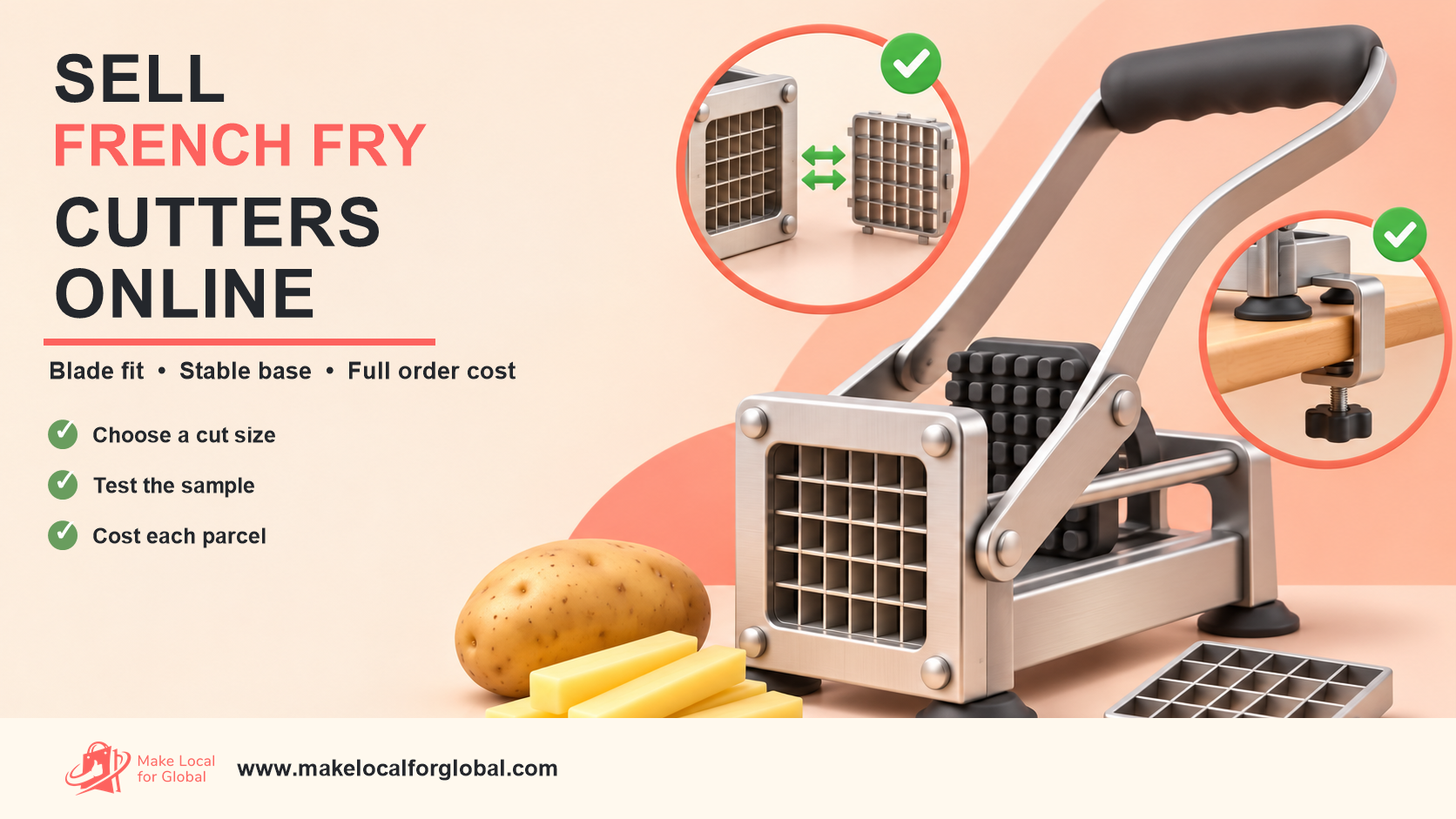
A French fry cutter looks simple until a buyer asks which grid size it includes, whether it will stay put on a worktop, how the blade comes out for cleaning, or whether it will cope with the potatoes they use. A vague listing makes each of those questions a reason to leave the page. A clear product range, a tested sample and a full-order cost give a small seller a much better starting point.
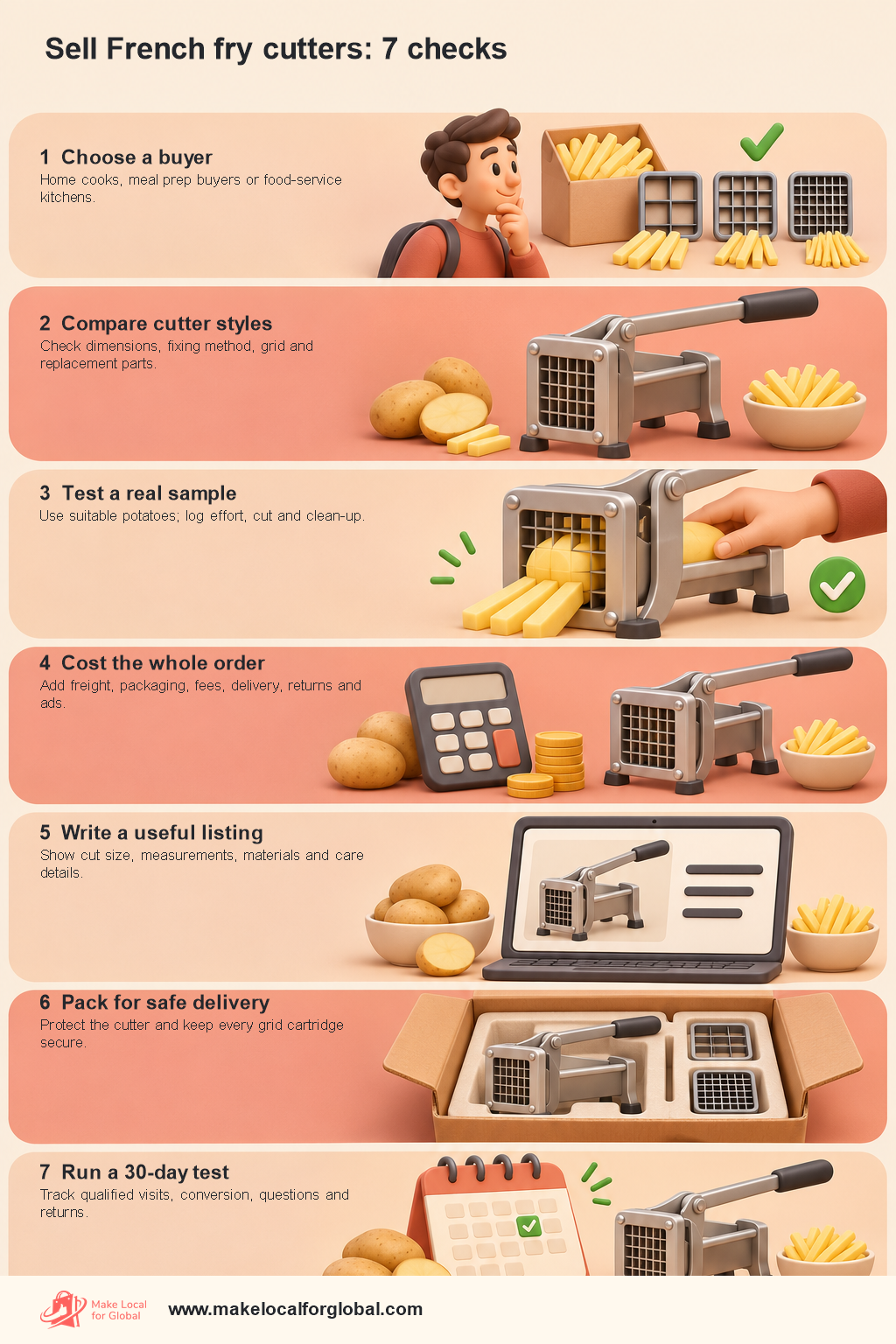
To sell French fry cutters online, choose a defined buyer first, compare the cutter's fixing method and cutting grid, test each claim against a real sample, and price the delivered order after fees, packing, returns and promotion. Start with a compact range of manual models and accessories; consider powered food-service equipment only after you can meet its higher sourcing, delivery and support demands.
This article is for a UK-based founder planning to sell new manual potato fry cutters to home cooks, meal-prep buyers or small food businesses. Commercial powered machines need separate checks for electrical rules, installation, maintenance, warranty support and freight. Describe a hand-operated countertop press as a commercial appliance only if its maker supports that use.
Present the verified grid size, mounting method, box contents and delivery terms so a buyer can judge the cutter before checkout.
The product is a hand-powered press that pushes a potato through a grid of blades. The pusher, blade cartridge, frame, handle and base work together. A buyer is not simply comparing metal and plastic. They are asking if the tool can make a chosen cut, if their potato will fit, if the cutter will stay stable, and if cleaning will be manageable after use.
For a home cook, storage size and occasional use can matter more than speed. A meal-prep buyer may value repeatable portions and a spare grid. A small café or takeaway may ask about service life, output, spare parts and cleaning between batches. Those buyers need different proof, different prices and different service expectations. One product page cannot credibly promise all three use cases.
Write one sentence that names the first buyer and the job to be done. For example: “A home cook wants a countertop tool for making regular potato batons for family meals, with a grid that can be removed for cleaning.” That sentence narrows the first range. It points to a compact manual model, understandable dimensions, a clear cutting-size statement and care instructions.
If the initial buyer is a food-service business, write the job differently: “A small kitchen needs a cutter that mounts securely, can be cleaned between service periods, and has replacement parts available.” That version creates more questions about expected throughput, mounting surface, spare blades, warranty, cleaning method and commercial suitability. Those questions should be answered by the manufacturer, not guessed from a product photo.
Interest in kitchen gadgets is not proof that a particular product will sell profitably. Use low-cost checks to learn what people ask before you commit to a broad stock order. Review marketplace searches for repeated questions about cut size, stability, cleaning and replacement grids. Read the product questions and low-star reviews for patterns, without copying other sellers' claims. Note whether complaints relate to a weak pusher, awkward cleaning, a narrow potato channel, missing parts or poor instructions.
Use a simple demand log with the date, source, phrase, buyer type and unresolved question. If several people ask whether a model works with sweet potatoes, that is a research question, not an advertising claim. Check the maker's written use guidance and then test a sample. If no suitable evidence exists, say the model is intended for the foods named by the manufacturer and leave unsupported foods out of the listing.
You can test a product page before buying a large opening stock order. Build a basic product page or a waitlist page with truthful product details, a delivery estimate and a clear note if the item is not yet available. Share it with relevant cooking groups only where promotion is permitted. A small paid test can measure product-page visits, add-to-cart actions and questions, but treat early results as signals. A handful of clicks does not establish stable demand.
Ask potential buyers what they currently use, which cut they want, how often they prepare fries, and what would make them return a cutter. Avoid leading questions such as “Would you buy this brilliant cutter?” Ask for specific past behaviour: “How did you prepare your last batch?” A detail about current effort or an existing workaround is more useful than a polite promise to buy someday.
Manual potato cutters vary by body material, handle, mounting method, feed opening, pusher and blade cartridge. Many listings use “French fry cutter” for compact handheld presses, counter-mounted lever models, wall-mounted equipment and powered machines. Treat the phrase as a category label, then inspect the actual construction and maker's intended setting.
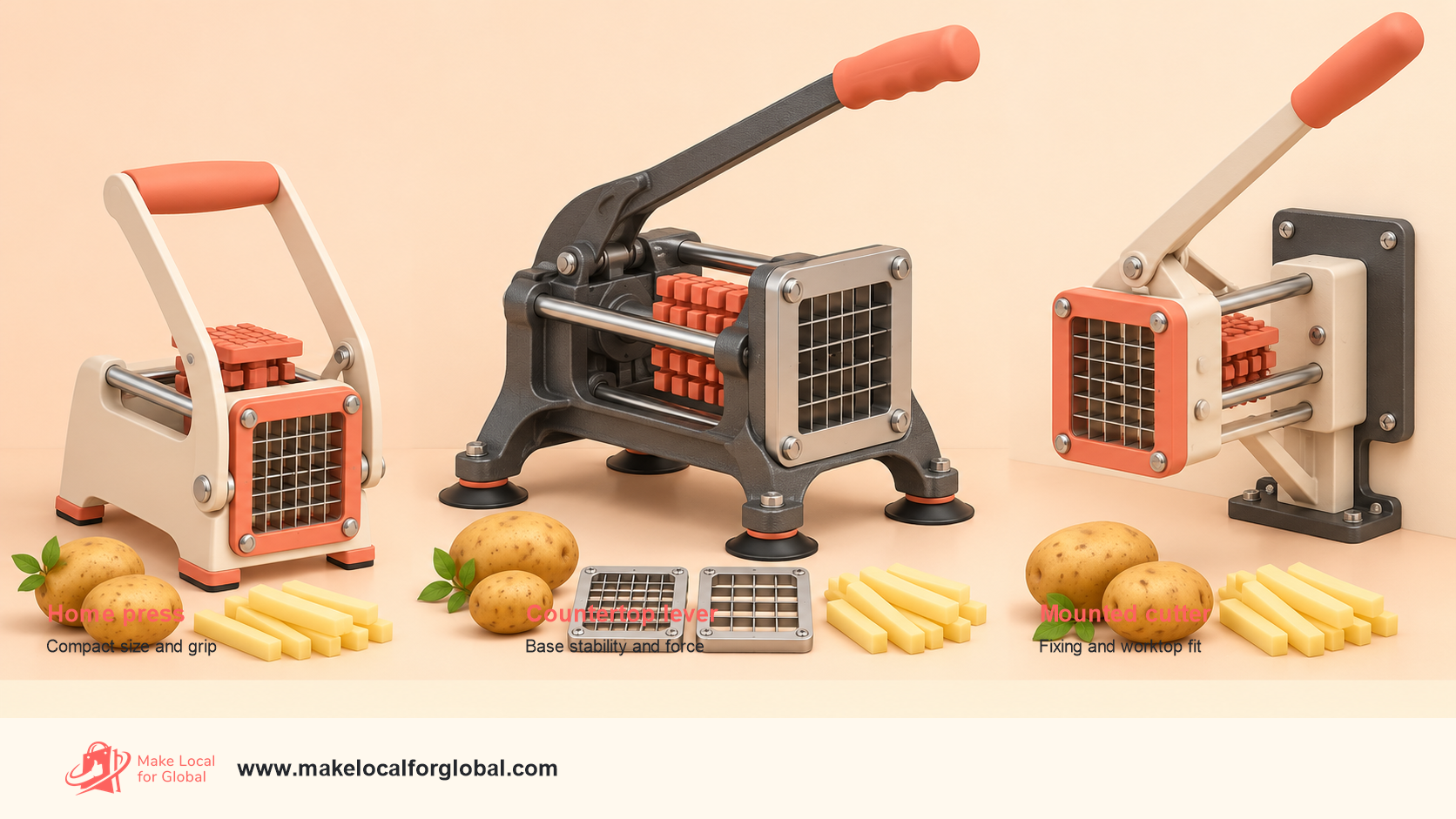
A small press can suit a buyer who wants occasional use and has limited storage. The product may have a plastic body, a metal grid, a short lever or a push-down mechanism. Check the maker's dimensions, the space needed above the worktop, the potato channel width, the method for keeping the cutter steady and the grid's removal process.
Do not infer durability from a shiny finish. Ask what the body, pusher and grid are made from, whether the material specification applies to the food-contact parts, and how replacement grids can be ordered. Photograph the complete included set. If the model includes only one grid, do not show extra cartridges as if they are supplied.
A countertop lever model gives the user a longer handle and a more substantial base. Some use suction feet; others need a clamp or a bolted fixing. Those are not interchangeable features. Show the actual attachment method, the footprint and the height of the handle when raised. State the worktop requirements from the maker's instructions, including any surface limits.
An image of a cutter with a long lever can make it look effortless, but a seller should not promise that. The force depends on the model, potato size and condition, grid, pusher alignment and mounting. Test the sample with the foods and sizes the manufacturer says are suitable. If it requires an unusual amount of force, slips or bends, pause the listing and ask the supplier for an explanation.
A wall-mounted tool can suit a fixed kitchen station. Buyers need to know how it attaches, what wall or bench material is appropriate, whether fixings are included and whether installation is required. Do not imply that a model can safely attach to every surface. A professional kitchen may ask for model-specific documentation, spare parts or service contacts before ordering.
Some commercial food-preparation systems have replaceable cartridges, high output or specialised mounting. These can need a larger budget and a more involved returns plan. Confirm the machine's intended service setting, capacity claims, parts availability and warranty process with the manufacturer. A product title that includes “commercial” does not prove the item is suitable for all kitchens.
A motorised cutter may need electrical safety evidence, UK plug and voltage details, installation requirements, technical support, and a plan for heavier delivery and repair. If you import such a product, your responsibilities can differ from those for a small manual kitchen tool. Do not add powered models to a first range just to make a category page appear broader. First work out the regulatory, insurance, freight and after-sales costs with the relevant manufacturer and professional advisers.
| Format | Likely first buyer | Questions to answer before listing | Main operating concern |
|---|---|---|---|
| Compact manual press | Home cook or occasional user | Overall size, feed opening, included grid, safe cleaning method | Stability and ease of use |
| Countertop lever press | Frequent home user or small kitchen | Handle travel, base fixing, supported potato sizes, spare grids | Mounting and effort |
| Wall or bench mount | Fixed preparation station | Fixing surface, fixings, installation, maker support | Fit, installation and parts |
| Powered machine | Established food-service buyer | Electrical documents, rated use, service, warranty and freight | Compliance and after-sales support |
The table is a research checklist, not a guarantee that every model fits the named buyer. Use the exact product manual and supplier evidence for each listing.
An opening range can contain one carefully checked core cutter, a second format that solves a different buyer's problem, and a spare grid only if the manufacturer confirms compatibility. Avoid stocking three products that differ only in the colour of the handle. A purposeful range makes it easier to explain why a buyer should select one model over another.
One possible first range is a compact home model for occasional use, a countertop lever model with a larger footprint for repeated batches, and compatible spare grids in two verified opening sizes. A second possibility is one countertop cutter plus a replacement pusher and a protective blade storage case, if the brand offers those accessories. These are planning examples; they do not describe products you have tested or supplier stock.
Use an entry, core and higher-value offer only when the contents make sense. An entry pack might include a single grid. A core pack could add a confirmed compatible grid and a safe storage sleeve. A higher-value bundle could contain two verified grid cartridges plus a written cleaning and use guide. Do not invent “premium” by bundling unrelated kitchen tools that create extra safety and returns issues.
You can source through a UK wholesaler, a manufacturer, an importer or a private-label arrangement. Each route has a different balance of control, minimum order, lead time, documentation and service. A local distributor may make it easier to inspect a sample and obtain replacement parts. Buying direct may give a wider choice of specification, but you may need to verify factory identity, import costs, shipping terms, documentation and what happens after a defect.
Treat marketplace supplier listings as a lead, not as compliance evidence. Ask for the product's exact model number, maker name, material details for food-contact parts, use and cleaning instructions, compatible replacement parts, warranty terms and records showing what market the product was made for. If a supplier answers with generic certificates that do not name the product or material, ask how those documents relate to the model you intend to sell.
Send a written questionnaire and save the replies with the model record. Useful questions include:
The answer should identify a specific model and its evidence. Keep the supplier's identity, purchase order, invoice, batch or lot details, product versions, photos, correspondence and inspection notes together. If a later customer reports a problem, a traceable record helps you identify the affected stock instead of relying on memory.
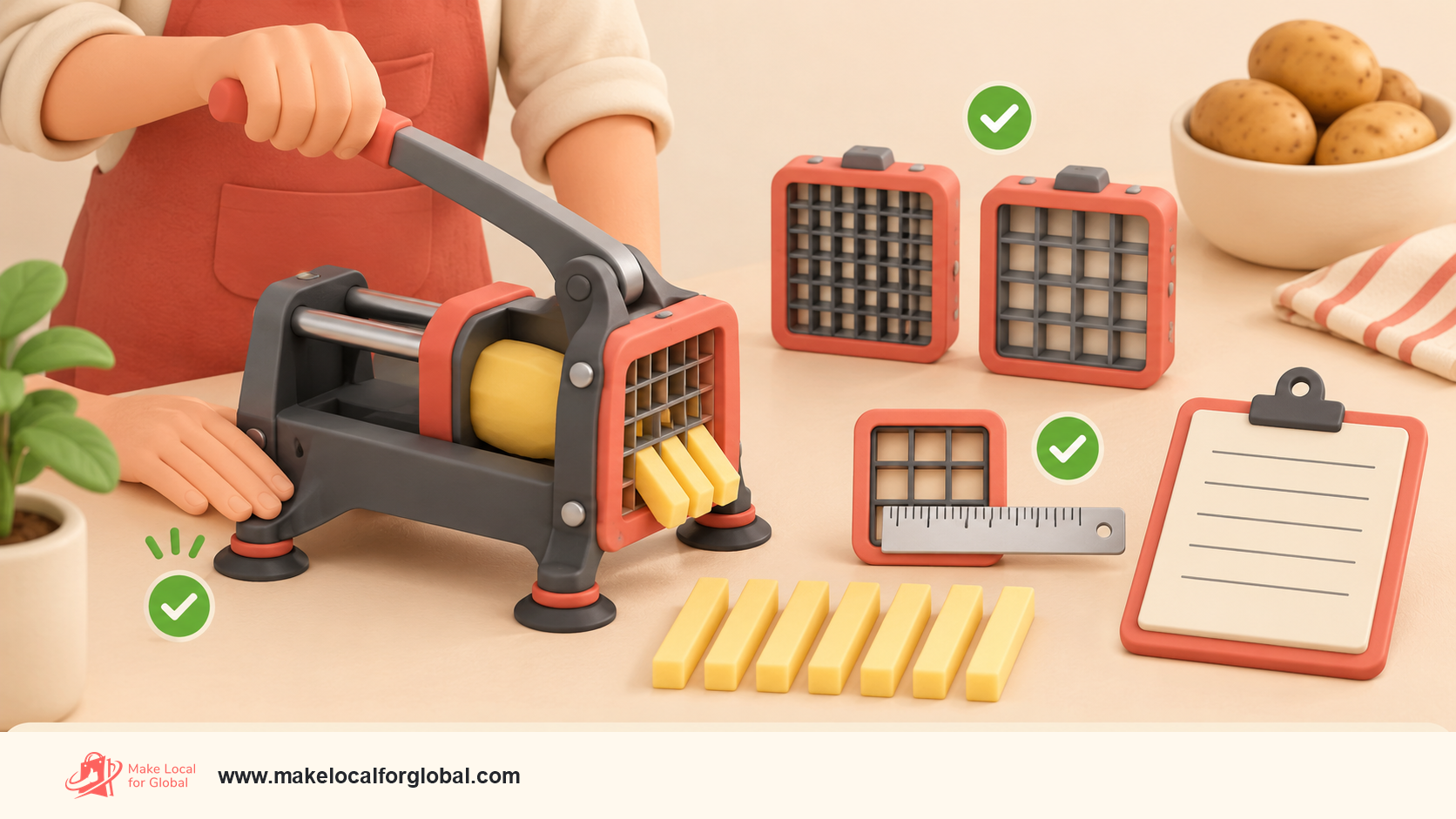
First compare the sample with the sales sheet and manual. Check that all parts listed as included are present, the model number matches, and there are no loose fasteners, sharp burrs, cracks, bent guides or visibly uneven grids. Do not take the cutter apart in a way the manufacturer says not to. Record the condition with photos and a short dated inspection log.
Set the cutter on the surface and fix it exactly as the manufacturer instructs. Test whether the feet or clamp hold during the intended action. Look for rocking, sliding, lifting, flexing or a handle that contacts a nearby wall or cupboard. Stop the test if the cutter moves, the mounting loosens or a part deforms. A product that makes a neat photo but shifts under pressure is not ready to list as a stable tool.
Use potatoes within the stated use guidance. Record the potato type, approximate diameter, condition and whether the maker supports peeling or unpeeled use. Keep the potato centred in the pusher. Apply the handle movement described in the manual; do not force a potato that does not fit. A potato that needs trimming may be normal for that grid, but an unexplained jam needs a supplier answer before you claim the cutter handles that size.
For each test, log the effort, whether the pusher aligns, whether the potato cuts fully, and whether the resulting pieces look consistent enough for the product's stated purpose. Test more than one potato if the manufacturer permits it. A single easy potato does not prove every potato will pass through. Do not claim a cut thickness or output rate based on a visual estimate; measure the actual grid and check the manufacturer's stated specification.
Clean the cutter using only the manufacturer's method. Many hand tools have sharp grid edges that can be difficult to wipe. Follow the written steps for safe blade removal, washing, drying, sanitising if applicable and storage. Recommend a dishwasher only if the instructions explicitly support it. Photograph the steps from the buyer's point of view, keeping hands away from cutting edges and never implying that a loose cartridge can be handled casually.
Test assembly and replacement grids separately. Check whether a cartridge seats fully, locks, and aligns with the pusher. Record the model and part number for each compatible accessory. If the maker provides no compatibility list, do not claim that a grid fits “most cutters.” You can make compatibility useful by saying exactly which model it fits and how the buyer can check their existing unit.
A French fry cutter is kitchen equipment that contacts food. The Food Standards Agency describes food-contact materials as materials that touch food, including utensils, and outlines national regulations for England, Wales and Northern Ireland in its food contact materials regulations overview. Ask your supplier for evidence tied to the exact materials and model. A general statement that a cutter is “food grade” is not a substitute for the relevant documents.
Check which parts touch the potato: blade, grid frame, pusher face, chute, tray and any coating. Ask what the material is, what cleaning agents and temperatures are supported, and whether a coating can wear or chip. If the supplier gives a declaration or test report, check the issuer, date, material, intended use and product identity. If the document covers only a raw material and not the finished part, ask the supplier what further evidence applies.
Do not put a certification badge on a product page until you have verified the model and the scope of that approval. NSF marks and similar claims belong to products whose certification can be checked against the issuing organisation and correct model. A supplier photo with a logo is not enough. Keep the document that supports each public claim and remove the claim if the supplier cannot substantiate it.
UK sellers who make, import, distribute or sell consumer products have responsibilities for product safety. The Office for Product Safety and Standards says products should be safe for normal or reasonably foreseeable use and that manufacturers and importers need appropriate risk controls, technical records, labelling and safe-use instructions. Read the current GOV.UK product safety advice for businesses and use the relevant rules for the product and territory.
Great Britain and Northern Ireland do not share identical general product safety rules. The General Product Safety Regulations 2005 continue to apply in Great Britain; Regulation (EU) 2023/988 applies in Northern Ireland from 13 December 2024. Check the current Northern Ireland product safety guidance before offering the cutter there, and get advice for your own role if you import or private-label it.
Keep supplier records that identify the source of the goods. Maintain a product file with supplier details, model and batch identifiers, invoices, instructions, material declarations, inspection results, customer complaints and any corrective action. If a safety incident comes in, stop advertising the affected stock, preserve the record and contact the manufacturer or supplier. Follow the applicable notification process and obtain professional guidance. Do not wait for several complaints before taking a credible report seriously.
Use the maker's instructions as the base for your product page and enclosed leaflet. Do not improvise blade warnings from a generic template if the model has different hazards. Explain the intended operation, fixing method, safe loading, cleaning, drying and storage in plain language. State that users should follow the supplied instructions and keep hands clear of the cutting grid if that reflects the product's official guidance.
If you translate or rewrite the instructions, compare every safety step with the source manual. Keep the current language version with the model record. A confident but wrong instruction can create risk. Where the manual leaves a question unanswered, request a written answer from the maker before writing your own.
The supplier's unit price is only one line in a sale. Your model should include landed stock, packaging, payment or marketplace fees, delivery, returns and promotion. For a manual cutter that ships in a long or heavy carton, the postage band can change the economics more than a small reduction in product cost.
Consider an illustrative UK order at a customer price of £29.99 plus £3.99 delivery, for a total charge of £33.98. The example assumes a VAT-registered seller applying the 20% standard VAT rate to the full customer charge, a payment fee of 5% of the total charge plus 20p, and no recovery of input VAT in the cost figures. Real VAT treatment and recoverable input tax depend on the business and transaction, so check your figures with an accountant. The GOV.UK VAT guidance lists the current standard rate; GOV.UK explains VAT-inclusive price calculation.
| Per order item | Illustrative amount | How it is used |
|---|---|---|
| Cutter sale price | £29.99 | Product amount paid by customer |
| Delivery charged | £3.99 | Amount collected for delivery |
| Total customer payment | £33.98 | Product plus delivery |
| Sales value excluding 20% VAT | £28.32 | £33.98 ÷ 1.2, rounded |
| Cutter purchase price | £9.40 | Supplier unit amount |
| Inbound freight and duty allowance | £1.30 | Per-unit share of inbound costs |
| Protective packaging | £1.25 | Carton, sleeve, padding and tape |
| Payment fee estimate | £1.90 | 5% of £33.98 plus £0.20, rounded |
| Outbound delivery cost | £3.99 | Carrier charge for the parcel |
| Returns or damage allowance | £1.00 | Planning provision per order |
| Customer acquisition cost | £4.00 | Illustrative paid promotion cost |
| Estimated contribution before overhead | £5.48 | £28.32 less the costs above |
The arithmetic is £28.32 less £9.40, £1.30, £1.25, £1.90, £3.99, £1.00 and £4.00, leaving £5.48 before fixed overhead. This is not net profit. It does not include photography, web hosting, insurance, professional advice, staff time, income tax, corporation tax or an unexpected defect. The example assumes the full delivery fee forms part of the VAT-inclusive customer charge and that the listed costs are the amounts used for this simple illustration. Ask an accountant to check the treatment of VAT on sales, fees, imports and costs for your circumstances.
Use a spreadsheet with one row per model and a separate column for every cost. Put supplier currency, exchange-rate date, freight basis, unit quantity, duty, customs fees, packaging, payment fees, delivery cost, return rate assumption and ad spend in the record. Calculate cost per sale using the order quantity that the supplier will actually let you buy. A quotation that assumes a thousand units does not help you model a first order of twenty.
Work backward from your target contribution and the known costs. If fixed order costs are £18.84 before advertising and delivery revenue, and the example's net sales amount is £28.32, the remaining contribution is £9.48 before acquisition cost. Spending £4.00 to win a sale leaves £5.48. If your real target is £8.00, you need to change the price, reduce a cost, lower the acquisition cost, raise the order value through a useful compatible add-on, or decide this model is not right for the shop.
Do not simply raise the price until the spreadsheet turns green. Check current comparable models, included grids, support and delivery. Your price needs a reason a buyer can see. A tested spare grid, clear care instructions, a documented warranty route and a well-packed order can support a higher price only if those benefits are genuinely supplied.
A spare grid or secure storage sleeve may be relevant for buyers who use the cutter often. The bundle only helps if the accessory is verified compatible, priced separately in your cost model and described accurately. Record the single-model contribution and the bundle contribution side by side. If an accessory increases pick-and-pack time or creates a higher parcel band, include that cost.
Use a small test to compare the offer, not a broad discount. For example, run the cutter alone and a cutter-plus-compatible-grid option with the same product photography and customer group. Track purchase rate, average order value, contribution after advertising, questions and return reasons. A bundle that lifts revenue but lowers contribution is not automatically a better offer.
Your own online shop gives you control over the product page, email follow-up and brand presentation, but you must bring visitors and handle the checkout, policies and support. A marketplace can expose the product to shoppers who already use that platform, yet its fee rules, competition and listing requirements affect the margin. A social channel can demonstrate the cutter visually, but views alone do not show purchase intent.
Choose one primary channel for the first test and one supporting channel. If you use a marketplace, read the current seller fee schedule and restricted-product rules before setting the price. If you use your own shop, verify that the payment, delivery, tax and returns settings match your business. If you sell through social commerce, check current product-link and advertising policies for the country and account.
Do not open on every channel on day one. That spreads stock and support work across separate dashboards and makes it hard to see what is driving a sale. Start with one product page, one clear stock location and an order process you can follow. Add another channel after you can keep stock counts, prices and customer replies aligned.
Record qualified product-page visits, add-to-cart rate, purchase conversion, revenue per order, contribution after variable costs, customer acquisition cost, delivery time, cancellation rate, return rate, damaged-parcel rate, customer questions and review themes. Use the same time window and sales definition each week. Do not treat one large order from a friend as evidence that cold visitors will buy at the same rate.
For early traffic, small numbers can move sharply. A change from one order to two may look like a 100% increase, yet it may not predict future sales. Keep the raw counts beside percentages. Compare similar traffic sources and note changes in price, offer, delivery promise or images. If you test two listing versions, change one important element at a time so the result is easier to interpret.
Set a stop point before spending on advertising. For instance, agree that after a fixed number of qualified product views or a capped budget, you will review search terms, questions and conversion. If visitors leave after viewing the price, compare the offer and delivery cost. If they repeatedly ask about grid size, make that specification easier to see. If the page gets few relevant visits, adjust the channel or audience before buying more stock.
Use the words a buyer would use for the model in the title, first description and specification area. Possible phrases include “manual French fry cutter”, “potato chip cutter”, “countertop potato cutter”, “replacement fry cutter grid” and the exact cut size in millimetres if you have verified it. Search phrases vary by region; do not place every variant in one sentence.
Write a clear page title such as “Manual potato fry cutter with 10 mm grid and counter clamp”, but only if the model and size are verified. If the grid size is not stated by the maker, measure carefully and confirm the method before using the figure. Do not list a number from a similar model or a competitor's page.
Plan useful supporting pages based on real questions: how to measure a cutter grid, how to clean and store the model safely, and how to choose between countertop and wall-mount formats. Link to an appropriate kitchen tool article such as selling apple slicers online or the food processors selling guide only where the reader would benefit from related product-selling advice. Internal links should make sense in the sentence; a link is not a substitute for a complete answer on the current page.
Use original images that show the supplied model, grid, attachments and dimensions. A stock photo of fries cannot prove what arrives in the box. Photograph the actual product from the front, side, top and underside; show the feed opening with a ruler; and show every included cartridge separately. Add a close image of the attachment method and one of the storage arrangement. Keep protective covers in place if they are required for handling.
Start with a title that names the product format and its verified distinguishing feature. In the first paragraph, state who the model suits, what is included and the cut it makes. Use plain specifications beneath the description so a buyer can compare models without searching through promotional copy.
Title: Manual countertop French fry cutter with [verified grid size] grid
Opening: “Prepare potato batons with this manual countertop cutter. The box includes [confirmed contents]. Check the feed opening and worktop fixing requirements below before ordering.”
Specifications: model number; body and food-contact materials; overall dimensions; feed opening; grid opening; included grid count; mounting type; compatible replacement part numbers; supported foods; care instructions; warranty route; country of origin where required; package contents; packed parcel dimensions and weight.
That copy is a template, not a factual description of a particular product. Replace every bracket with verified information. If an attribute is unknown, ask the supplier or leave it out. Do not convert “no information supplied” into a quality claim.
Use a scale card or ruler only if the product does not have a more accurate measurement method. Keep it in the same plane as the item so perspective does not distort the apparent size. Show the full assembled tool, the grid close-up, the pusher, handle travel, mount and complete box contents. If you make a demonstration video, use the maker's instructions and keep the camera angle safe. Never make a hand-placement technique appear safe if it conflicts with the manual.
Add captions that identify what the image proves: “Included 10 mm grid” only if that is the exact supplied item; “Clamp attachment shown” only if the clamp is included; “Example cut using the manufacturer's supported potato size” only if you have tested that exact combination. Descriptive alt text should tell a screen-reader user what is in the image, not repeat the same sales phrase on every asset.
State outer dimensions and the feed opening. If the tool is large, show the height of the raised lever and how much counter space it occupies. Explain whether the model needs a fixed installation or whether the base can be moved. State the supplied grid opening in a consistent unit and say whether the number refers to the blade spacing, finished cut or the maker's specification.
List exactly what comes in the box. Distinguish an included blade cartridge from one shown as an optional accessory. Give the care method and any maker limits around dishwasher use, soaking or abrasive cleaning. Set out the returns route, warranty contact and expected dispatch time. Clear product details can prevent an order from a buyer whose needs the model does not meet.
Create a short response bank from verified documents. A buyer may ask whether a specific potato fits, whether the grid is dishwasher safe, whether it can be fixed to a stone counter, how to buy a replacement cartridge or what size the fries will be. Use the maker's exact answer and link to the relevant section of your page. If you cannot verify the answer, say you are checking and follow up only after getting evidence.
Save recurring questions with the model record. If the same concern appears repeatedly, improve the listing or reconsider the product. For example, several questions about counter mounting may indicate that the product photos hide the clamp or that your listing lacks the underside view. Several questions about cleaning may point to missing instructions rather than a need for a longer sales pitch.
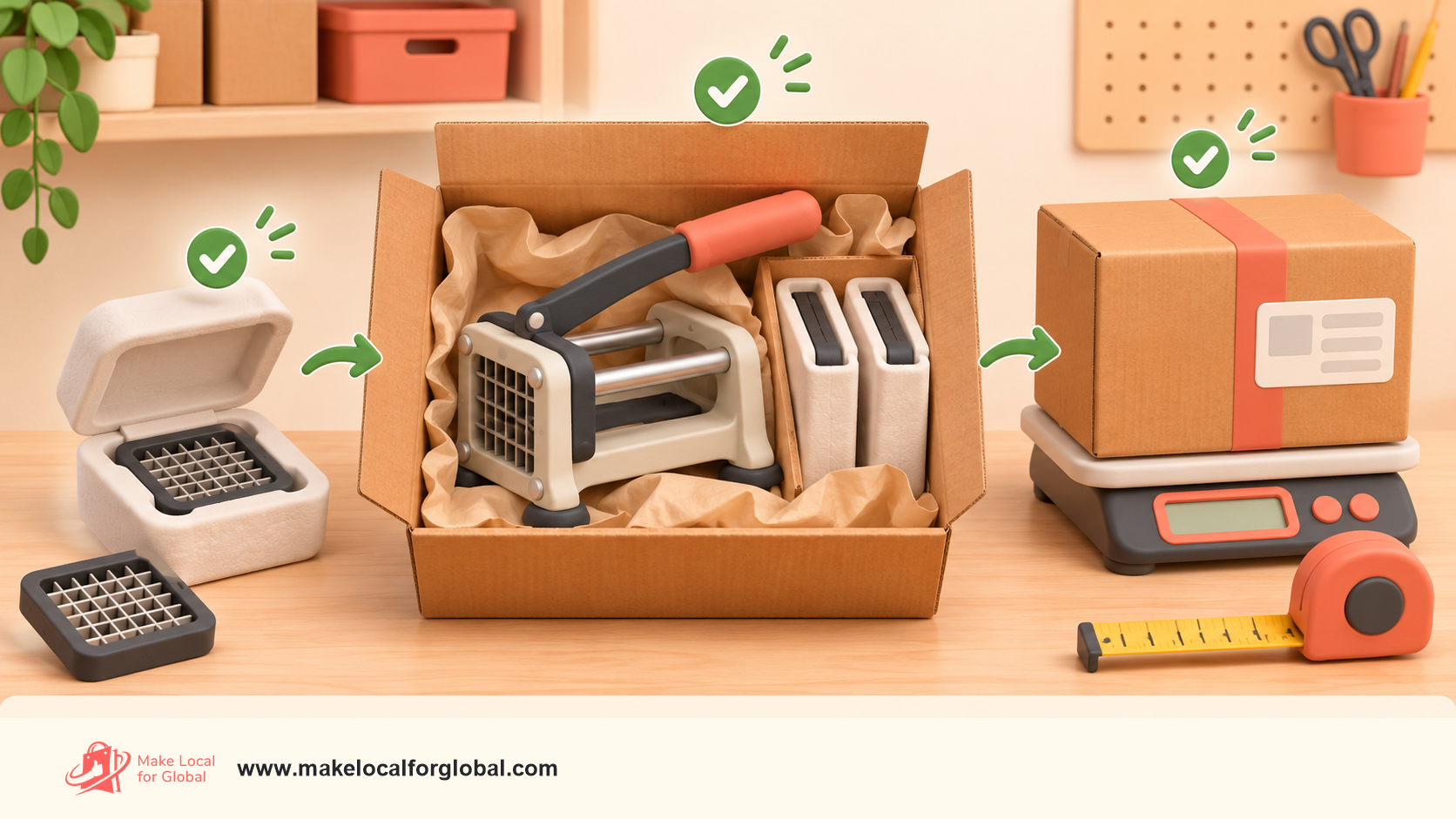
The handle, frame and grid cartridges can move or rub inside a parcel. Use packaging that protects the tool from impact and prevents the cutting surface from contacting other contents. Keep each grid in its maker-supplied sleeve or a rigid protective holder; add an outer layer that stops it escaping if the sleeve opens. Do not use loose paper as the only protection for a sharp grid.
Pack a sample order, close the carton and check for movement. Weigh the sealed parcel and measure length, width and depth. Royal Mail's parcel measurement guidance says to include the box and packaging in the weight and to measure the three parcel dimensions. Use the carrier's current size and weight rules before choosing a service. A parcel that crosses a price band may erase the margin you expected from the sale.
Photograph the packed layout and write a packing checklist. Include the cutter, exact supplied grid, instructions, any safety leaflet, and the order record. Scan the model or batch identifier into the fulfilment record. If a parcel arrives damaged, you can see how the parts were arranged and check whether the packaging choice needs improvement.
Estimate order processing time from stock location, pick time, packing time and carrier collection. Add a buffer for weekends and supplier delays. State the delivery charge and expected time before checkout. Do not copy a competitor's dispatch promise if your operation cannot meet it.
For imported stock, model normal and delayed inbound delivery. Do not sell stock as ready to dispatch if it is still at a supplier or in customs. If you use a preorder, state the expected date and what happens if it changes. Keep enough cash to refund or replace an order if the product is delayed, damaged or unavailable.
For many online consumer purchases, buyers can cancel up to 14 days after delivery. The GOV.UK distance-selling guidance sets out information that needs to be provided before an order and the cancellation right for covered purchases. Read the current rules for your channel and selling territory, including any exceptions. Do not tell every buyer that a kitchen tool is “non-returnable” solely on the ground that it contacts food; check the actual rules and circumstances first.
If a cutter is returned, follow a documented inspection process. Keep it away from saleable stock until you can check the grid, pusher, handle, mounting and cleanliness. Record whether the item is complete, used, damaged or faulty. Apply your returns policy and consumer law consistently. Do not resell an item as new if its condition or food-contact cleanliness cannot be established.
For a reported defect, record the model, batch, order date, issue, photos and any injury or damage. Pause sales of affected stock if the report raises a credible safety concern. Contact the supplier and follow the applicable reporting path. A consistent record protects buyers and helps identify whether the issue relates to one unit, one batch, the packing method or the instructions.
Packaging obligations depend on what your business does, annual turnover and packaging tonnage. GOV.UK says businesses must check whether they are a producer under Extended Producer Responsibility for packaging, including certain businesses that fill or import packaging. Review the current EPR packaging threshold checker, count your relevant activities and keep records. Small parcel size alone does not settle the question.
A cutter is easier to understand in motion, but the content needs to prove something specific. Film a short clip that shows the actual model, mounting, loading and result, using the manufacturer's method. Add captions for the measured grid and the food tested. Do not cut to a perfect result and leave the buyer unsure which model or potato produced it.
Make a small set of posts from the buyer's questions: compare two grid sizes, show how the clamp sits on a suitable counter, demonstrate the included parts, explain the cleaning steps from the manual, and show the parcel layout. Keep promotional claims tied to the model. If a video compares a 10 mm grid with a 12 mm grid, identify the cartridges accurately and avoid suggesting that a different model includes both.
Build a useful search page around a question instead of repeating the product title. A page about choosing a French fry cutter can explain dimensions, blade care and mount types. A buying checklist can help a food business prepare questions for suppliers. These pieces should make the product page easier to choose from, not promise health benefits, restaurant savings or a guaranteed cut quality.
Collect customer feedback with permission and publish it only in line with platform rules. Do not rewrite a review to make the tool sound more powerful or safer. If a buyer says installation took longer than expected, treat that as a signal to clarify the mounting information. If a buyer praises a specific feature, check that the feature is present on every model before using the quote on a category page.
Compare fulfilment, returns and website costs before deciding how many models to stock.
Record stock by exact model and grid configuration. A “cutter” count alone is insufficient if one model has a 10 mm cartridge and another has a 12 mm cartridge. Store replacements in labelled, protected packaging, and keep their compatibility table close to the stock record. When a bundle is sold, reduce both the cutter and accessory quantities at checkout.
Set a reorder point based on supplier lead time, recent sales and the cash you can commit. A simple starting rule is to review stock once a week and compare available units with orders plus any promised preorders. Do not copy a reorder formula from a high-volume business before your sales history is large enough to support it. Use a small first order to learn damage, defect and return patterns.
Write a support guide for the questions you can answer safely: checking included grid size, identifying the model number, following the supplied cleaning instructions and requesting a replacement part. Escalate questions about unsupported foods, installation, food-contact materials and product safety to the manufacturer. Keep the response and evidence in the model file.
Choose a realistic response time and monitor it. A product that needs explanation can create support work that does not appear in the product margin. Record minutes spent on each order and each pre-sale question. If too much time goes to repeated questions, improve the page, packaging insert or manual route. Do not promise a support service you cannot provide consistently.
When a customer reports a problem, ask for the model, batch, purchase date, description and photos where appropriate. Do not ask the buyer to repeat a dangerous test. If a tool slips, bends or breaks during normal use, treat it as a potential product-safety concern. Stop the buyer from using a damaged item, preserve the report, notify the supplier and consider pausing affected stock until you have an answer.
Log how you resolved the issue: replacement part, refund, return, supplier credit, instruction update or batch hold. Check whether other orders came from the same stock lot. If the issue involves risk of harm, follow current official notification guidance and obtain professional advice. A quiet support inbox is not evidence that the product is safe; it only tells you what has been reported.
Use the first month to learn whether the range, page and fulfilment process work. Keep goals observable. The point is to gather evidence and make a decision, not to hit an arbitrary sales number.
Choose one primary buyer and collect a small set of repeated questions. Compare manual formats and select two or fewer sample candidates. Ask suppliers for exact model numbers, parts lists, manuals, material evidence, mounting requirements, care instructions, defect terms and reorder timing. Open a record for each supplier and save the replies.
Do not place a broad opening order if basic evidence is missing. Put a deadline on supplier replies and define the terms that would disqualify a model: absent model identity, no replacement part route, unclear food-contact materials, no cleaning method, unstable mounting, or unsupported use claims. When a supplier cannot answer, price another source or leave that model out.
Receive samples, photograph the unboxing and compare every piece with the packing list. Test mounting, handle movement, pusher alignment, supported potato fit, cut result, cartridge removal and cleaning under the manual. Record each test instead of relying on a general impression. Ask the supplier about any movement, unusual force or inconsistent cut.
Build the landed-cost model for the real minimum order. Include inbound freight, duty, VAT treatment, packaging, carrier, payment or marketplace fees, return allowance and planned customer acquisition. Pack a complete test order, weigh and measure it, then update the delivery cost. Choose a model only if its documented contribution is acceptable after realistic costs.
Write the title, opening, specifications, care information, returns details and included-parts list from the verified model file. Photograph the actual cutter and grid. Add one clear single-product offer and one optional compatible bundle if the supplier confirms it. Review the page on a phone, check that size and grid data are easy to find, and test a checkout from start to order confirmation.
Share the page through one relevant channel and collect questions. Set a small spending cap if using paid promotion. Record traffic source, visits, questions, add-to-cart events, orders and contribution. If traffic is unqualified, change the audience or channel. If visitors ask for information already present, improve its placement.
Pack every order from the written checklist. Record actual packing time, postage tier, delivery time, customer questions, cancellations, damage and returns. Compare the actual result with the spreadsheet. Update the model if carrier or fee assumptions were wrong. Keep customer feedback beside the exact model and batch.
At day 30, choose one of three actions: reorder the tested model, revise the listing or packing and retest, or stop the offer. Reorder only if you can explain which buyer purchased, which feature mattered, what contribution remained and what support or defect burden appeared. If the result is too small to interpret, extend the test with a defined budget and stop date rather than buying more stock by instinct.
Choosing by photo alone. A persuasive render or supplier image does not tell you if the model is stable, complete, easy to clean or supported. Test the sample and keep evidence linked to the model number.
Treating grid dimensions as interchangeable. Different cutters may use the same nominal size but have different cartridge shapes or fitting points. Record the exact compatible part number and do not promise cross-brand fit without proof.
Promising every potato will work. Size, variety, condition and preparation affect the result. Use manufacturer guidance, test a representative sample and state the limits plainly.
Skipping the food-contact records. A “food grade” phrase without supplier evidence does not tell you what materials touch food or what cleaning conditions are supported. Request model-specific documents and check their scope.
Underpricing delivery. The weight of the cutter is only part of the parcel. A handle or sturdy carton may change its dimensions. Measure the packed sale unit and use the carrier's current pricing band.
Showing accessories that are not included. A product photograph may show several grids, but the box may contain only one. Make every image and bullet consistent with the confirmed pack contents.
Treating returns as a separate afterthought. Cancellations, damaged parcels, inspection time and refunds change contribution. Include them in pricing and write the returns route before the first order.
Making a broad commercial claim. A countertop press is not automatically suitable for service kitchens. Match the use case to the manufacturer's stated capacity, build and support.
Buying too many variants. Every grid and body variation adds stock, compatibility and page upkeep. Start with a narrow range and add a variant only when buyer evidence justifies it.
You can run a small online retail operation from home if your setup, business records, product safety duties, tax position, insurance, storage and local requirements are suitable. Check the legal requirements for the product and territory, especially if you import or apply your own brand. Keep stock dry, secure and separate from household use, and follow supplier storage guidance for the cutter and its grid cartridges.
Start with one manual model that fits a clear buyer and has a verified instruction set, supported grid, stable mounting method, replacement-part route and acceptable delivered-order cost. A home-use press may be simpler to explain than a powered food-service machine. Let sample tests and buyer questions guide the choice rather than selecting the most impressive-looking product image.
Offer only a size the supplier identifies for the exact model and cartridge. If you want to measure it yourself, confirm what the measurement represents and use a consistent method. Describe the nominal grid opening and resulting cut carefully; they may not be identical. Do not guarantee the exact finished shape for every potato.
That depends on the specific materials, finish, design, care conditions and relevant evidence. Ask the supplier for documentation covering the actual food-contact parts and model. The phrase “stainless steel” alone does not establish that the complete cutter is appropriate for every food or cleaning method.
Check the model's manual. Some parts may have different care directions, and a grid cartridge may be difficult or risky to handle. Claim dishwasher safety only if the manufacturer explicitly confirms it for the exact parts and cycle conditions.
Not for every opening range. A spare grid can add value for repeat users, but it creates a compatibility and inventory task. Sell one only after you can verify its exact model fit, cutting specification, stock status and protective packaging.
There is no single reliable start-up figure. Add samples, opening stock, inbound transport, import charges, packaging, product photos, storefront or marketplace costs, payment fees, insurance, returns provision and promotion. Use the supplier's real minimum order and the packed parcel's real delivery class. A low unit price can still require substantial cash if the minimum order is large.
Rules depend on the buyer, channel, jurisdiction and circumstances. GOV.UK explains the cancellation information and 14-day cancellation period for covered distance sales. Set out the policy before checkout and check whether a claimed exception genuinely applies to this item. Do not assume that contact with food removes every cancellation or refund right.
Only if the manufacturer supports that description for the exact model and intended working conditions. Ask about capacity, expected use, warranty, spare parts, cleaning and service. A heavy frame or long handle does not prove commercial suitability.
It can be difficult to dropship if the supplier cannot verify model identity, material evidence, safe packaging, delivery time, returns and replacement parts. A grid can be damaged or exposed if packed poorly. Order a sample through the same route the buyer would receive and inspect its packaging, manual, model markings and parts before taking orders.
Take the report seriously, ask for the model and batch details without asking the buyer to repeat a risky test, preserve the correspondence and contact the supplier. Pause affected stock if the facts suggest a safety concern. Follow current reporting obligations and seek professional advice. Keep a written record of the steps you take.
Choose one buyer, shortlist two manual models and request the model-specific instructions and material records before committing to stock. Test the samples on a stable surface with a suitable potato, calculate the packed order and list only the claims that your evidence supports. A careful first range is easier to explain, fulfil and improve than a catalogue full of untested cutters.
If you are setting up a shop around a tested kitchen product, MLFG can help you plan the ecommerce side and choose a suitable website route. Keep your product testing, compliance evidence and price model specific to the cutter you will sell.
Use verified cutter details, a complete order-cost model and a safe packing method to prepare your first listing.
PREFERRED SOURCE
Like what you’re reading? Add Make Local for Global as a preferred source on Google to see more of our articles when you search.

Build your online presence without having to figure out everything yourself.