

READY TO SELL Hair Ties ONLINE?
Get a store built for you in 5 days, plus training and support to help you start, run, and grow your Alternative business.

A practical guide to selling hair ties online: choose scrunchies and elastics, check samples, price the full order, and prepare accurate product pages.

Hair ties look simple until a customer asks whether the elastic will hold, stretch out, snag, feel comfortable, or match the fabric shown on screen. Selling them well means making those details easy to judge before someone orders. A focused range, tested samples and honest product pages give you a better starting point than a large mix of colours chosen from a supplier catalogue.
This guide covers fabric scrunchies, slim elastics, spiral coils and related hair ties. It helps you choose a customer and use case, source and inspect products, calculate the cost of a delivered order, plan packaging, and test demand without tying up too much cash. The advice is for sellers building a small online range; it does not promise that a particular product or channel will sell.
“For everyone with long hair” is too broad to guide a first order. Start with a routine you can describe. Someone may want a tie that stays on a wrist between workouts, a soft-looking accessory for a gift set, a compact coil to keep in a work bag, or a set of neutral colours for everyday use. Each example points to different product details, photographs and price expectations.
Write one buyer hypothesis in a sentence: “I want to test whether people who put their hair up during a workday prefer a small set of fabric ties in muted colours, with the size and fabric clearly shown.” This statement is something you can test. It does not claim every person with the same routine will choose the same product.
Ask people who resemble the buyer about the item, the use and the price together. Show two real samples and ask which they would choose for a named task, what might stop them ordering, and which detail they would need to see on the page. Record the options and price shown. A compliment is useful context; a specific choice or paid order is stronger evidence.
Do not define your audience only by age, gender or hair texture. Hair density, length, styling habits and comfort differ within every group. Describe the product’s actual dimensions and construction. If you intend to serve a particular styling need, test the sample for that use and explain the limits of your test.
Use a structured planning tool to identify the next decisions for your product range, costs and online shop.
“Hair tie” can mean several constructions. A fabric-covered scrunchie has an elastic core inside a gathered tube. A slim elastic is a loop with a joined or knotted seam. A spiral coil is a moulded plastic loop. A wide fabric band, ribbon tie or bow accessory has a different shape and may suit a different range. The product’s construction affects its size, packing, photos and care instructions.
Scrunchies can vary by fabric, tube width, gathered fullness, internal elastic, seam finish and overall diameter. A voluminous scrunchie takes up more space in a parcel and can look much larger in a close crop than it does beside a hand. A slim tie may be sold singly or in a multipack. A coil should be checked for its shape, surface and the way it returns after stretching. Use names buyers understand, then add a style name if it helps organise the collection.
Choose a short set of formats that answer related questions. For example, a core cotton scrunchie, a satin-finish option and a slim multipack may give a buyer choices in texture and quantity. A spiral coil can be a companion product if the same person might reasonably choose it. A large collection of unrelated hair bows, headbands, clips and ties would take more stock and listing work before you know which offer has demand. See the separate hair accessories selling guide for broader accessory categories and how to keep a range coherent.
Use one clear reason for every item: a size comparison, a different fabric, a useful pack count, a colour option or a tested use. “More colours” is not by itself a reason to carry every shade. Every additional variant needs a stock record, images, a SKU, a place in storage and a picking check. Start with fewer combinations than you think you need, then add products when customer choices show a gap.
Make a range matrix before you ask for a quote. Record the format, colour, fabric or stated material, diameter or length, width, pack quantity, supplier, sample version, minimum order, lead time, unit weight, landed cost and intended buyer. Add a short note explaining what the product lets a customer compare. If you cannot explain why an item belongs, leave it off the first order.
Variants multiply quickly. Four colours in three formats create twelve stock combinations. If a supplier requires a minimum per colour, the cash commitment can grow before the shop has a single order. A small first set might use one format in three colours and a second format in two colours. Treat that as a test plan, not a formula. The correct assortment depends on your supply terms and customer evidence.
Think about pack architecture. A single tie is easy to understand but may not support the delivery cost. A multipack offers a different value comparison, but each colour and piece count must be clear. A gift set may need a card or box and extra packing time. State whether a set contains fixed colours or a customer-selected mix. Show every piece included and do not use props that look like extra items without making their status clear.
Set a maximum first-order spend before you contact suppliers. Include samples, delivery to you, import charges if relevant, packaging and a small reserve for defects. Decide what evidence would justify a reorder: for example, paid sales at the planned price, a low rate of fit-related returns, or repeated requests for a particular size. Write down the decision rule before the first test so one exciting week does not prompt a much larger order than your cash can support.

You can make hair ties yourself, buy finished goods wholesale, customise a supplier’s blank product or commission a design. Each route has different costs and control. Handmade stock gives you direct oversight of fabric selection and assembly, but your time, repeatability, tool cost and waste belong in the calculation. Wholesale stock can be quick to list, but the supplier’s specification and batch consistency matter. Custom production may offer a distinct size or colour while bringing higher minimums and longer lead times.
Ask a supplier for its legal business name and address, product specification, source, materials, pack count, dimensions, minimum quantity, sample price, lead time and how it identifies batches. Ask whether the material or construction can change between samples and production. For elastic-core products, find out whether the elastic type, join, fabric casing or seam differs across variants. Keep replies with your purchase order and sample record.
Do not treat a catalogue photograph as proof of production quality. Request a sample from the same supplier and specification that would fill the order. Compare its colour, dimensions, finish and construction with the written description. If the supplier cannot say what changed between two samples, do not assume that a bulk order will match the better one.
A UK wholesale listing can help you understand the kinds of specifications suppliers provide. One current example lists a two-piece textured fabric scrunchie pack with stated dimensions and a minimum order. Its price and stock status may change, and it is not a quotation for your business. Request your own written quote, confirm VAT treatment, postage, pack count and delivery timing, and save the date and version of every specification you rely on.
Ask what evidence supports claims such as “silk”, “organic cotton”, “recycled”, “colourfast”, “hypoallergenic”, “gentle”, “damage-free” or “sustainable”. The term “satin” describes a weave or finish, not automatically a fibre. A satin-finish product may be made from different fibres. Use the exact material information the supplier can substantiate, and keep the scope of each claim narrow.
Check whether supplier photographs or artwork can be used in your shop and advertisements. Ask for permission in writing. Do not copy another seller’s product photographs, logo or distinctive designs. If you make an original print or shape, save dated files, samples and supplier instructions. A supplier’s assurance that a design is “safe to use” may not establish who owns its artwork.
Use a written inspection for each sample. Check fabric for holes, pulls, uneven dye, loose threads and stitching that opens when the tie is stretched gently. Look at the join in the elastic and any seam that could rub against hair or skin. For a spiral coil, inspect for a rough join, cracks or sharp mould marks. For slim elastics, inspect the knot or bonded join and note whether it creates a bulky point.
Measure the product at rest. Record outer diameter, band width, fabric-tube width or coil diameter as appropriate. For a multipack, count every piece and check that the colours match the order. State the measurement method and allow for ordinary variation where handmade construction or gathered fabric changes the shape. Avoid relying only on supplier labels such as “mini” or “large”.
Stretch samples gently and consistently. Note how they extend, how they return and whether the seam, casing or surface changes. Do not use an invented number of cycles as a public performance certification. If you run an in-house check, document the method as your own sample check, then repeat it on replenishment stock. It cannot replace any applicable testing or supplier documentation.
Ask consenting volunteers to try the sample only if they are comfortable, and explain what you are testing. A few informal trials can reveal a snagging edge, a difficult join or a fit question, but they do not prove that a tie works for every hair type or causes no damage. Record the hairstyle, approximate product size, how long it was worn and the person’s comments. Do not publish a comfort or performance claim based on one person’s experience.
Repeated tight hairstyles that pull on the hair can contribute to traction alopecia, according to NHS Gloucestershire Hospitals’ hair-care advice. That is a reason to avoid claims such as “damage-free” or “prevents breakage” unless robust product-specific evidence supports them. It is safer to describe dimensions, materials, construction and the sample checks you actually completed. Encourage buyers to choose a comfortable fit and avoid pulling a tie tighter than they need.
Keep a sample log with the date, supplier, product version, measurements, observations, photos and decision. Label any sample you reject and explain why. If a supplier changes the elastic, fabric, dye, join or seam, assign a new version and repeat the checks affected by that change. Pause a product with a sharp edge, loose section or unexpected breakage while you investigate. Do not silently repair questionable stock and sell it as new.

Product obligations depend on what you sell, your role and the territory. A seller who imports, manufactures or places a product under their own brand may have different responsibilities from a retailer reselling a UK-sourced item. Read the current GOV.UK product safety advice for businesses and establish which rules apply to the finished product. Keep the supplier, specification, batch and customer complaint records needed to trace stock.
Do not assume a simple accessory has no safety considerations. Think about foreseeable use, loose components, sharp joins, choking or entanglement risks, chemical claims, skin contact and how a product might fail. If the product is designed or marketed for children, or includes decorative parts, get the product classification and applicable requirements checked before listing. Avoid “safe for children” or age suitability statements without evidence for the product and its intended use.
Textile labelling rules can apply to textile products, but a hair tie may need product-specific assessment to determine scope. Check the current GOV.UK textile labelling guidance and whether your product and sales territory are covered. Great Britain and Northern Ireland can have different arrangements. Do not guess fibre content by touch or copy it from an unverified marketplace listing.
If you sell into Northern Ireland or the EU, check the current rules for that market rather than copying a Great Britain checklist. Your responsibilities can depend on the supply chain, the claims on the label, the product’s intended use and where it is offered. When the supplier cannot give a clear answer, get specialist advice before placing a commercial order.
Prepare a simple incident route before launch. Give customers a way to report a defect, record the SKU and batch, and have a procedure to pause sales while you investigate. If you suspect a serious risk, follow current regulator guidance and contact the appropriate authority. A spreadsheet of stock and a retained sample from each batch can make it easier to identify which orders need attention.
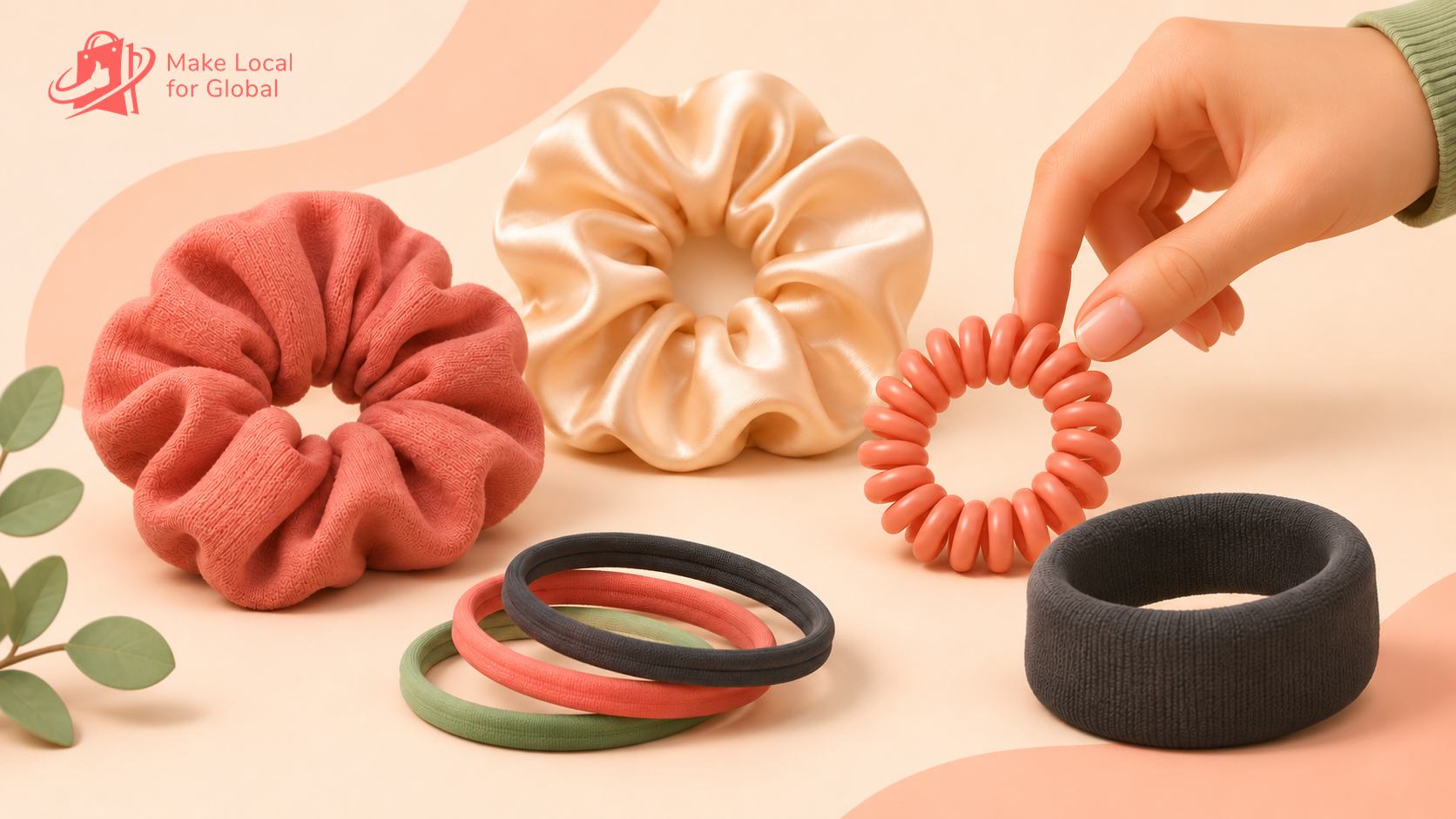
The illustrations in this guide explain selling decisions; they are not evidence of real product size, fibre, comfort or performance. Product listings need photographs of your actual sample or finished stock. Do not use generated editorial art as a substitute for a product photo. The buyer needs to see the product they will receive.
Plan a compact photo set: one clear main image on a neutral background, a view that shows scale, a close-up of the join or stitching, the product stretched gently if that is a normal way to present it, and a view of every item in a set. A scrunchie photographed from above can hide its thickness; add a side view. A slim elastic photographed around fingers can look larger than it is; add a ruler or another consistent scale reference.
Use the same lighting and white balance across colours. Compare the image with the sample before publishing. Do not change a colour in editing to fit a seasonal palette. If a handmade tie varies slightly in pattern placement, say so and show a representative item. If one order contains three ties, show all three and state the count in the listing copy.
Leave margin around the product. Preview the main image at the actual product-card and social-thumbnail sizes, because a square crop can cut off a bow or stretch the product’s proportions. Keep the image itself free of overlaid headline text; a separate page title explains the article, while the image should show the product clearly. Use concise alt text that describes what appears in each picture rather than repeating search terms.
Save files with descriptive, lower-case names such as coral-cotton-scrunchie-front.webp or spiral-hair-tie-stretch-check.webp. Compress images to a sensible file size while retaining visible stitching and texture. Keep the original photograph and an edited web copy so you can revisit the crop or colour if a customer reports a mismatch.
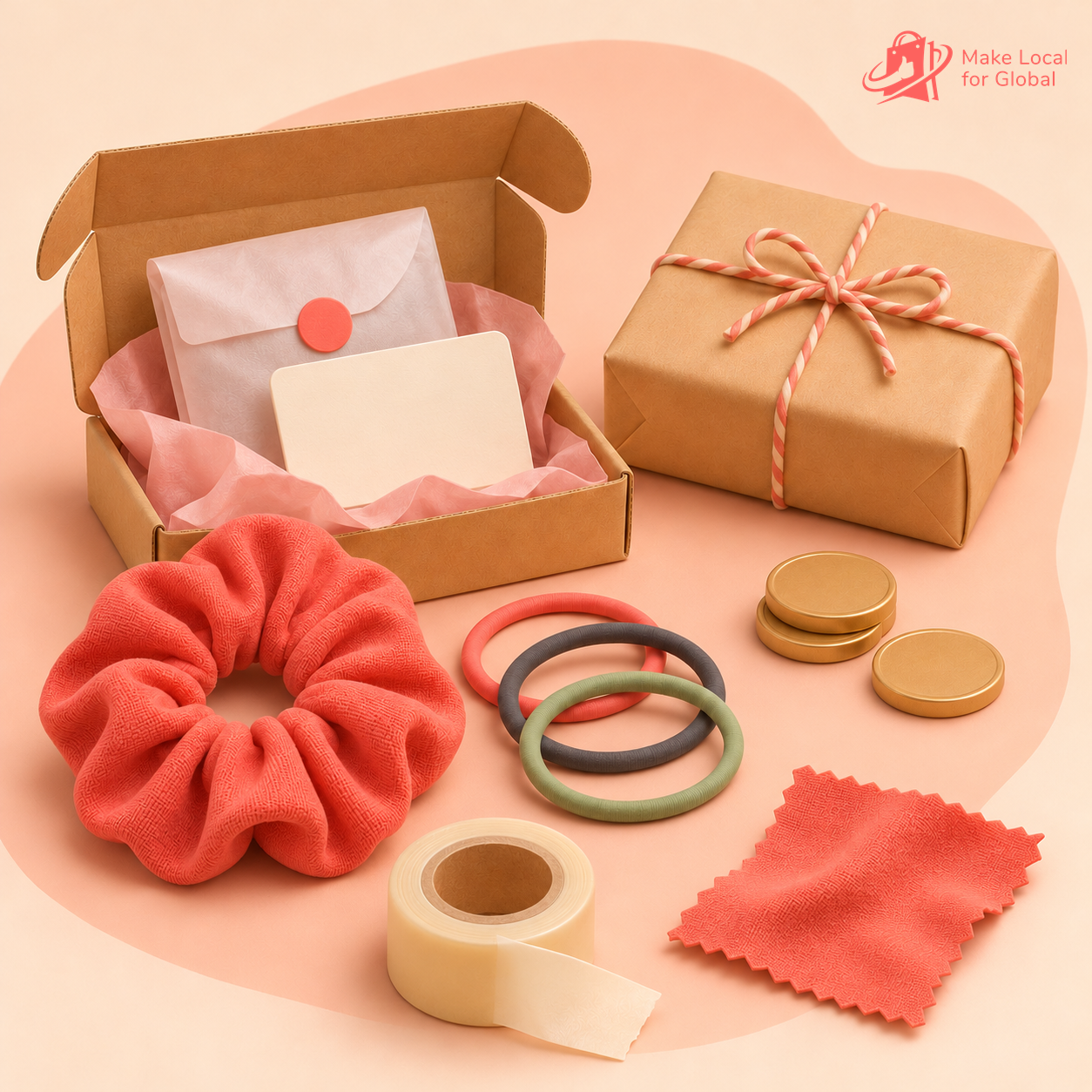
Start with a functional title: “Cotton scrunchie, 9 cm, coral” is clearer than “The Sunset Edit”. A style name can follow the product type and size, but should not replace them. For a set, include the pack count and the key distinction, such as “Three slim hair elastics in neutral colours”. Use only facts that match the item in stock.
The first lines should help a buyer decide whether to open the full description. State the format, colour, dimensions, material where verified, quantity and dispatch estimate. Explain whether the tie is sold singly, in a fixed set or as a chosen colour mix. Do not hide an important size detail below a long brand story.
A useful facts section can cover the dimensions at rest, band width, fabric or fibre information, elastic type if known, seam or join, number of pieces, care guidance supplied by the maker, package contents and any variation across handmade stock. Say how you measured. If a supplier cannot confirm a fibre or finish, leave that detail out rather than guessing.
Write care instructions from reliable product information. If a supplier provides no care guidance, ask before adding one. Avoid generic directions that could damage fabric, coating or elastic. Explain whether the tie arrives on a display card, in a pouch or loose in a mailer, and whether gift packaging costs extra.
Make every option easy to identify. Use a separate, accurate photograph for each materially different colour or format. If a buyer selects “sage”, do not show a coral image. State whether fabric pattern placement varies. List the quantity included and whether the visible accessories in the photo are props.
Read the listing from the buyer’s point of view. Can they tell how many ties arrive, how large they are, what material you can verify, when you expect to dispatch and how to contact you? If the same question keeps appearing in customer messages, move the answer into the product details. A useful hair clips range guide can help when you are also considering adjacent hair accessories, while the present article stays focused on ties.
A low unit cost does not tell you whether an order can support your business. Add the product cost, inbound delivery allocated across sellable units, import charges if applicable, packaging, handling time, payment fees, outbound postage, customer acquisition, expected defect or return cost and a share of fixed overhead. If the customer pays delivery separately, show that revenue and carrier expense as separate lines.
Use a worked example to test your own worksheet. Suppose a three-piece set sells for £16 with standard UK delivery included. Assume the seller is not VAT registered and the provider charge below is only an illustrative 2.9% plus 30p. Replace it with your actual account rate and carrier quote; this is not a recommended price or profit forecast.
| Cost for one delivered order | Illustrative amount |
|---|---|
| Three ties from supplier | £3.30 |
| Inbound freight allocated per set | £0.45 |
| Backing card, tissue, mailer and label | £0.70 |
| Pick and pack time | £0.60 |
| Payment assumption: 2.9% of £16 plus 30p | £0.76 |
| Outbound delivery | £3.25 |
| Returns and defect allowance | £0.45 |
| Customer acquisition allocation | £1.00 |
| Estimated variable cost | £10.51 |
| Customer price, delivery included | £16.00 |
| Contribution before fixed overhead and tax | £5.49 |
Illustration only. Replace every assumption with your business’s current supplier, payment and delivery costs. The contribution is not net profit.
The arithmetic leaves £5.49 before fixed overhead and tax. You still need to account for samples, insurance, storage, website costs, bookkeeping, returns administration and your own time if it is not already in the handling line. Check VAT with HMRC or an accountant if your circumstances require it. HMRC’s current registration threshold is based on taxable turnover, and the rules can change; see GOV.UK VAT thresholds before making a decision.
Calculate a single tie, a multipack and a gift set separately. They may need different packaging, handling and postage. A second item might add less cost than a second parcel, but a discount can also erase the contribution you expected. A gift box may improve presentation while pushing the order into a more expensive size band. Use your own measured parcel and current carrier price rather than a guess.
When comparing marketplace fees, use the current policy and your expected order location. Etsy’s UK seller page currently lists a £0.15 listing fee and a transaction fee, with payment processing and possible advertising fees also affecting the order. Those terms and rates can change. Check the live Etsy UK fees and seller information immediately before publishing a listing, then include the charges that apply to your account and sale.
Review actual orders monthly. Replace estimates with supplier invoices, postage bills, payment reports and advertising spend. Separate fixed overhead from per-order costs. If the set only appears profitable because labour, a platform fee or customer postage has been omitted, adjust the price, bundle or channel before ordering more stock.
Get help reviewing your planned shop and the decisions that affect its first product pages and customer experience.
Your own website lets you control the product page, visual presentation, bundle and customer service. It does not automatically bring visitors. You need a route to relevant people, clear delivery and returns information, stock accuracy and time to answer questions. A marketplace can offer discovery and a familiar checkout, but its fees, policies and competition are part of the economics.
Etsy’s rules do not make every ready-made accessory eligible. Its current seller policy and Creativity Standards describe which items may be listed, including the requirements for handmade, designed, vintage and sourced products. Read the current Etsy seller policy and Creativity Standards before listing. Do not describe a generic wholesale product as handmade or designed by you if that is not true.
Social channels can help people see a product demonstration, compare colours or ask about a set. A post with views is not the same as paid demand. If you test a post, keep the price, product version, audience and date so you can compare responses. Do not use another person’s hair or photograph without permission. If you use a creator or affiliate, agree on the product, disclosure and image use before the content goes live.
Start with one primary sales channel and one clear traffic source. For a small independent shop, a targeted email or a short product demonstration to an audience already interested in accessories may be more informative than posting everywhere. For a local salon or boutique, take samples and a simple range sheet with dimensions, pack count, wholesale price, lead time and reorder terms.
A trade price needs its own worksheet. Include the shop’s expected margin, case quantity, packing time, delivery to the retailer and any display card. Do not offer a wholesale price based on your direct-to-consumer price unless both businesses can cover their costs. Put payment terms, delivery date and product version in writing.
Small products can still arrive crushed, stretched, dusty or tangled. Choose a card or sleeve that holds each item without pulling the elastic. Separate a textured fabric from a surface that could snag it. If a set includes several colours, arrange them so the buyer can count and identify them at a glance.
Assemble one complete parcel exactly as you plan to pack daily. Check that the mailer protects the product, then weigh and measure it when sealed. The thickness can affect the postage band even when the item is light. If the parcel will travel through a letterbox, check the packaging after a short test route and confirm the carrier’s current dimensions.
Make packing repeatable. A pick list can include SKU, colour, pack count, card or pouch, parcel type and customer note. Keep similar shades in separate labelled locations. Check the order against the list before sealing it. A clear packing method can reduce wrong-colour dispatches and the service work that follows.
Use the least packaging that protects the product and makes the order presentable. If you make an environmental claim, check its scope and evidence. The UK packaging EPR rules depend on the business’s role, size and packaging weights; check the current GOV.UK packaging obligation checker rather than assuming that a small parcel is automatically exempt.

Before someone orders, explain who is selling, what the item includes, its price and taxes, payment method, delivery options and cost, expected timing, and cancellation information. GOV.UK’s online and distance selling guidance sets out information requirements for distance sales. The exact duties depend on your business and product, so check the current guidance before launch.
For many online consumer purchases, a buyer can cancel within 14 days after receiving goods, then has a further period to send them back. Exceptions are specific and fact-dependent. Do not assume hair ties are exempt because they touch hair, or because you put them in a sealed bag. Check the current rules and obtain advice before writing a hygiene exception. Faulty or misdescribed goods have separate rights.
GOV.UK explains the consumer’s cancellation rights and seller duties in its returns and refunds guidance. Make your process easy to find. State how a customer contacts you, what details to include, what happens when an item is faulty and how a refund is arranged. Do not write a policy that removes statutory rights.
Set a dispatch estimate you can meet with your actual stock and working hours. Distinguish dispatch from delivery. If you use made-to-order colours, say how long making and dispatch usually take and contact the buyer if the date changes. Confirm the product, quantity, total price and delivery details after checkout. The legal guidance generally requires delivery within 30 days unless the seller and buyer agree another time, but check how this applies to the order you offer.
Track the reason for each return or complaint: size, comfort, colour, stitching, elastic, packing, wrong item or delivery. A pattern can show whether to revise the product, photograph, description, supplier or packaging. Do not dismiss complaints about fit as buyer error; if the listing hides dimensions, improve it before buying a larger batch.
Assign each variant its own SKU. A short code can combine format, colour and size, such as SCR-COR-09 for a coral scrunchie with the recorded size. Keep the meaning documented. Avoid codes that are so elaborate you need to look up every character to pick an order.
Track ordered quantity, received quantity, inspected quantity, held stock, damaged stock, sold units, returns and current availability. Record the supplier and batch for every delivery. When a new batch arrives, compare it with the approved sample before placing it in sellable inventory. Check more than one inner pack if the shipment contains several cartons or lots.
Set a reorder point based on lead time and sales evidence. If a supplier takes six weeks and your order volume is uncertain, avoid accepting orders against an unconfirmed replenishment date. You can mark a product unavailable while you verify supply. For handmade items, estimate production time using actual work sessions and leave room for packing, customer support and a rejected piece.
Keep a weekly routine for checking inventory and unanswered questions. A small range can still become difficult to manage if colour labels differ between the storage bin, product page and packing slip. Use the same colour names everywhere. Save a current product photo with each SKU so you can compare a replacement batch and resolve a mistaken pick.
This guide targets a seller researching how to sell hair ties online. A product page serves a different search: a person choosing a specific scrunchie, elastic or set. Keep those purposes distinct. Do not create several nearly identical guides with the same title and same advice just to target small phrase variations.
Write a title that names the product and a useful angle. A product listing might say “Three cotton scrunchies in neutral colours” if the materials and contents are accurate. An article title can focus on building a costed range. Use the main phrase naturally in the title, opening and page metadata, then vary the headings to answer real questions about format, sizing, sourcing and shipping.
Make the meta description a direct summary rather than a string of keywords. Give the article its own social title, description and cover image. Check that the page title, metadata, headings, excerpt, cover alt text and actual images describe this topic specifically. A plugin’s green light can catch missing fields, but the article still needs to answer the reader’s needs and avoid unsupported claims.
Link to related guides when they help with the next decision. The hair accessories guide covers the wider category; the hair clips article discusses closure and sizing for a neighbouring product; and the hairbrushes guide covers another hair-care range with different product checks. Use descriptive link text and avoid placing the same link in every paragraph.
Image alt text should say what is visible: “Three fabric scrunchies and a spiral coil on a cream surface” is more useful than repeating “sell hair ties online”. Keep the image file name short and specific. Check that the featured image crop retains every product and that the smaller social preview does not cut off the logo or important product details.
A month can organise your work, but it cannot guarantee a sale. Use four checkpoints and pause if a sample, supplier record or cost estimate fails. The goal is to learn whether a specific assortment can be sourced, presented and fulfilled at a price customers accept.
| Week | Work | Evidence to keep |
|---|---|---|
| 1: Choose | Write the buyer hypothesis, select a few formats, show real samples and test the price. | Buyer notes, range matrix, price shown and questions. |
| 2: Source and inspect | Request written specifications, inspect samples, measure and test the packed parcel. | Supplier details, sample log, dimensions and current cost quotes. |
| 3: Prepare the offer | Photograph actual stock, write product details, set delivery and returns information, and present the offer to a defined audience. | Listing version, photo set, price and response. |
| 4: Fulfil and decide | Ship a limited test, record costs and complaints, then keep, adjust or stop each item. | Batch, postage, returns, service time and contribution. |
In week one, settle the product task and the price before asking for feedback. If buyers choose a satin scrunchie at £12 but not at £18, record the actual offer they saw. Ask what they would need to know, not whether they “like” it. Separate feedback on colours from willingness to pay and ability to find the product.
In week two, keep weak samples out of the shop. Ask the supplier questions while there is still time to change the order. Check the material statement, measurements, lead time, minimum and defect process. Replace placeholder figures with quotes for inbound freight, packaging and outgoing delivery. If no supplier can confirm a key product detail, revise the offer or pause it.
In week three, show actual items and the exact price you plan to charge. A page should include the product, dimensions, quantity, delivery and contact information. If you use a marketplace, check its current listing policy and fee schedule. Save the page version and photo set so you know what a buyer saw during the test.
In week four, fulfil a small order quantity or run an honest demand test with clear stock and dispatch information. Record what happened for each SKU, including customer questions and time spent. Compare contribution per order with your worksheet. Decide whether to reorder, make one change and retest, or stop. A reasoned stop decision can preserve cash for a better-supported idea.
It can be worth testing if you can offer a distinct reason to choose your product, source it reliably, explain the dimensions and price the complete order. Small size does not remove the need for careful costs, product photos, stock control or customer service. Begin with samples and a narrow range, then look for paid demand at the price and terms you intend to keep.
Choose the format that matches a buyer task you can describe and reach. A small set of fabric scrunchies, a multipack of slim elastics or a few spiral coils could each be a test, but the product and audience evidence should decide. Compare sample quality, supplier terms, material information and the cost of a delivered order before choosing a larger order.
Use the fewest colours that let a buyer make a meaningful choice. A core shade, a darker neutral and a brighter accent may be easier to stock and photograph than a full colour card. The right count depends on supplier minimums and cash available. Add colours when customer choices or repeated requests show a real gap.
Measure the outside diameter at rest and the width of the fabric tube, then state how you measured. The inner elastic and gathered fabric affect how it stretches and sits. Avoid relying only on “small” or “large”. If you have tested it in a particular style, describe that test and its limits rather than claiming universal fit.
Only if the fibre content is verified for the item you sell. “Satin” can describe a fabric structure or finish and does not prove the fibre is silk. Ask the supplier for product-specific documentation and use the term that matches it. If the material is not confirmed, describe the visible finish without making a fibre claim.
Do not make a health or performance claim unless you have suitable evidence for the exact product and wording. Hair type, fit, tension and styling routine affect the experience. A safer product page describes construction, dimensions and any sample checks, then asks the buyer to choose a comfortable fit. Avoid “damage-free” or “works for all hair”.
Ask for the business identity, product specification, material information, dimensions, sample, minimum order, lead time, batch identification, defect process and notice of any construction changes. Confirm whether the quote includes VAT and delivery. Ask what evidence supports claims such as recycled, organic, colourfast or silk, and whether that evidence covers your exact product version.
Textile labelling duties depend on the product and territory. Check the current GOV.UK textile labelling guidance for your exact item and sales area, including any differences between Great Britain and Northern Ireland. Do not assume the rule applies or does not apply based only on a supplier’s brief description. Get product-specific advice if you are unsure.
First establish the intended user, how the product is marketed and which product safety rules apply. Small parts and foreseeable use deserve review. A simple accessory is not automatically a toy, but age claims and design can affect classification. Avoid saying a product is safe for children unless you hold evidence for that item and its intended use.
Do not assume that they are. Cancellation exceptions for sealed goods are specific, and faulty or misdescribed goods have separate protections. Check the current consumer rules and obtain advice before relying on a hygiene exception or writing a policy. Make the cancellation and fault process clear before checkout.
Add the cost of all ties, allocated inbound freight, packing materials, handling, payment and marketplace fees, outgoing postage, expected returns or defects and customer acquisition. Check the real weight and thickness of the parcel. Compare the contribution at your planned price with fixed overhead and tax separately; a low supplier cost alone does not show whether the order works.
Use the channel whose rules, fees, traffic needs and service workload you can manage. An independent site gives control but requires a way to reach relevant customers. Etsy has eligibility rules and fees that vary by sale and can change; check its live policy before listing. Choose one main channel for the first test and record what it costs.
Show actual dimensions, material information, pack count, colour and delivery timing. Photograph the product at scale and include a close view of the join or seam. Record why customers return items. Use those reasons to improve product selection, photographs, measurements or packing rather than relying on a generic policy statement.
Order samples, photograph the actual item, show the planned price and delivery terms to a defined audience, and record choices and concrete actions. A waitlist or preorder must explain availability and expected dispatch clearly. Likes and compliments can guide the next question, but they are not evidence of a profitable order by themselves.
Use a clear main image, a scale view, a close-up of stitching or the join, a view of the product stretched gently if relevant, and a full view of every piece included. Photograph actual stock and keep the colours accurate. Leave enough margin for product-card and social crops.
Use actual sales, lead time, stock on hand, supplier minimums, cash and defect records. Reorder only when the product still matches the approved sample and the contribution supports another batch. If the supplier changes construction or misses a lead time, update your plan before accepting more customer orders.
Start by choosing a buyer and a use case, then compare a small number of real samples. Record dimensions, materials you can verify, supplier terms and the full delivered-order cost. Photograph the items customers will receive and write product pages that make quantity, size, dispatch and returns easy to find.
When you learn which products customers choose and which details they still ask about, update the range using that evidence. Keep a record of your supplier, batch and test. A small, well-understood assortment gives you a better basis for a reorder than a large collection built from catalogue images alone.
Use the Ecommerce PathFinder to organise the early business questions, or contact Make Local for Global if you need help planning the next step for your online shop.
Review what you have learned about the buyer, product, costs and delivery before placing a deeper stock order.
PREFERRED SOURCE
Like what you’re reading? Add Make Local for Global as a preferred source on Google to see more of our articles when you search.

Build your online presence without having to figure out everything yourself.