

READY TO SELL Home cleaning products ONLINE?
Get a store built for you in 5 days, plus training and support to help you start, run, and grow your Alternative business.

Plan a focused cleaning-supplies range, check supplier and UK product requirements, cost a parcel and test demand before committing to stock.


Cleaning products can be a practical online niche, but the work starts before you list a bottle. A new seller needs a narrow buyer, safe and correctly labelled stock, delivery rules that fit the product, and a margin that remains after every order cost.
The simplest starting point is often a small range of sealed, ready-labelled household products from a reputable UK supplier. This article shows how to choose that range, check the paperwork, cost a parcel and run a 30-day test. Rules can differ across Great Britain, Northern Ireland and overseas markets, so confirm the requirements for each place you sell.
Use MLFG’s business tools to compare a focused product idea with the time, budget and skills you have available.
“Cleaning supplies” covers too much for one new shop. Pick one buyer and one use case, such as households with pets, small holiday-let hosts, renters moving home, or people who want a compact cleaning kit for a particular room.
Talk to five to ten people who fit that group. Ask what they buy repeatedly, what runs out first, what they dislike about current options, and what they would expect in a bundle. Record the exact words they use. Then compare those answers with search suggestions, marketplace listings and questions in relevant community groups. Interest is a signal to investigate, not proof that a product will sell.
Start with a few products that serve one task. A kitchen starter set might pair a labelled surface cleaner with reusable cloths and a non-scratch brush. A pet-home set could focus on washable cloths, a lint tool and a supplier-labelled detergent. Keep chemical products sealed and in their original packaging for an initial test.
Offer an entry product, a core bundle and one higher-value option only when each has a clear reason to exist. For example, the entry item might be a cloth set, the core offer a cloth-and-brush kit, and the higher offer the same kit with a sealed cleaner. Show what each contains, the quantity, intended surface and any care instructions.

Read the product-to-sell category for more examples of focused, costed ranges, including our guides to planning a clear ballet-tutu range and selling bed frames online.
Ask suppliers whether they are the manufacturer, importer, wholesaler or distributor. Find out who is responsible for the product’s UK compliance, which countries it can be sold in, what documents and labels apply, how batches are identified, and how damaged or leaking stock is handled. Request a current product list, safety information where applicable, case quantities, minimum order, lead time and written delivery terms.
Order samples before committing to cases. Check that closures stay secure, labels are readable, packaging is intact and product details match the supplier’s listing. For cloths and brushes, check dimensions, seams, bristle retention, wash guidance and colour transfer. Keep notes by product and batch. Do not decant a chemical, cover its label or combine products into a new formula for a first launch.

Household cleaning products can fall under different rules depending on their ingredients, claims and your role in the supply chain. In Great Britain, the Health and Safety Executive’s detergents guidance explains obligations for businesses that manufacture, import, reformulate, re-label or package detergents, along with product information and labelling duties. A distributor that only resells sealed goods still needs to check that the products are properly labelled and that its supplier is legitimate.
Products making disinfectant, antibacterial or other biocidal claims need particular care. HSE says biocidal products must be authorised before they are made available in Great Britain. Check the exact product and authorised claims against the HSE biocides guidance; do not add claims that the approved label does not support.
For hazardous mixtures, packaging and hazard labels may fall under GB’s chemical classification and labelling rules. HSE’s guidance for distributors and chemical storage explains when distributors can rely on upstream classification and what checks still apply. Importing, changing a formulation, relabelling or repacking can change your legal responsibilities.
Northern Ireland follows a different chemicals regime in some areas. Check the current NI requirements before listing there, and check the rules again before selling into the EU or another country. The UK product-safety advice for businesses covers seller responsibilities, traceability and reporting safety issues. Keep invoices, supplier details and product or batch records so you can identify stock if a safety concern arises.
Use environmental wording with evidence. Claims such as “non-toxic”, “eco-friendly”, “chemical-free” or “biodegradable” can mislead if they are broad, unclear or unsupported. The Competition and Markets Authority’s Green Claims Code guidance applies to words and presentation. Describe a specific, verifiable feature instead of making a vague promise.
Online shops must give customers required pre-sale details, including the seller’s identity, product information, total price and delivery arrangements. Review the current GOV.UK distance-selling rules and explain cancellation and returns rights in plain language. Some goods have exceptions, so check how the rules apply to each item rather than assuming every opened product is exempt.
Map the next steps for sourcing, product checks and launch activity before you place a larger order.
Use real supplier, packaging, carrier and payment figures before ordering stock. The example below is illustrative, not a forecast. It assumes a VAT-registered seller charging the standard 20% VAT rate on an eligible bundle at £14.99 including VAT. Recoverable input VAT is excluded from the cost lines; a business that cannot reclaim VAT should use its actual gross costs.

| Order line | Illustrative amount |
|---|---|
| Customer price including VAT | £14.99 |
| Sales value excluding 20% VAT | £12.49 |
| Stock, net of reclaimable VAT | £4.00 |
| Inbound freight per bundle | £0.45 |
| Packaging and protective material | £0.40 |
| Payment fee example | £0.43 |
| Outbound delivery | £2.70 |
| Returns or damage allowance | £0.45 |
| Customer acquisition allowance | £1.50 |
| Estimated contribution before overhead | £2.56 |
Illustrative arithmetic only: £12.49 net sales less £9.93 variable costs = £2.56 contribution. It is not net profit. It excludes fixed costs, income or corporation tax, insurance, labour, unsold stock and any unrecoverable VAT. The payment line uses Stripe’s published standard UK card rate of 1.5% + 20p at the time checked; fees can change, so check the provider’s current UK pricing page.
Repeat the calculation for each bundle and delivery zone. Add a second parcel-size scenario if a glass bottle, refill pouch or multi-item kit changes the carrier price. A free-delivery threshold can lift order value, yet it only helps if the extra revenue covers the extra stock and postage.
Write a product title that names the intended task and contents. “Kitchen starter kit: 1 surface cleaner, 2 cloths and 1 brush” is clearer than “Ultimate home-care bundle”. Use accurate photographs of the products and packaging you will ship. Do not imply that a pictured item, accessory or result is included if it is not.
Keep liquids upright and use outer packaging suited to the carrier’s rules. Test a packed parcel with the exact bottle, cap, insert and box you plan to send. Check the carrier’s prohibited and restricted-items list before buying labels; liquid acceptance, quantity limits and service terms can differ by carrier and destination.
Store products according to supplier instructions, away from heat, direct sun, food and incompatible goods. Use first-in, first-out stock rotation and record batch or lot details. Create a simple response process for a leak, damaged package, adverse reaction or safety complaint: pause affected stock, keep the customer’s details and batch information, contact the supplier and follow the relevant reporting guidance.
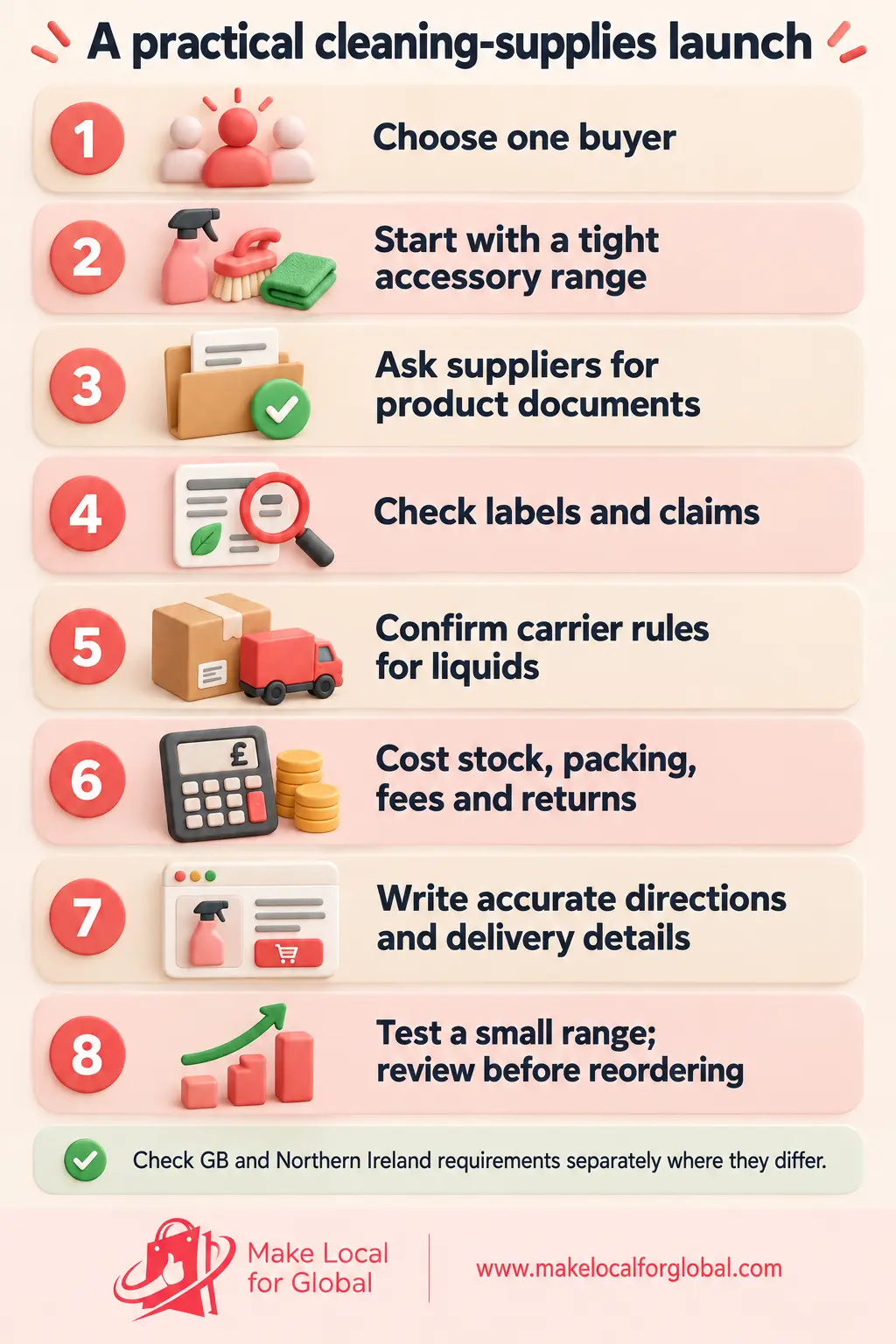
At day 30, compare evidence with your assumptions. If people ask for a different use, revise the range before ordering more. If clicks arrive but few people add the product, review the offer, price, photographs and product details. If orders arrive but the contribution is too low, adjust the bundle or fulfilment approach before scaling.
Many new sellers choose sealed products from an established UK supplier. Check the product’s labels, claims, safety information, destination rules and your role in the supply chain before listing it.
Making, importing, reformulating, repacking or relabelling a cleaner can bring additional chemical, product-safety and labelling duties. Identify the exact rules for the formulation and market before production or sale. Get advice from the relevant regulator or a qualified specialist if your responsibilities are unclear.
Only use claims supported by the exact product authorisation and label for the market where it is sold. In Great Britain, HSE authorisation applies to biocidal products made available for sale. Check the product and wording before publishing a listing.
Choose one buyer and one task, then combine a few compatible items with clear instructions. A tool-led bundle can be simpler to test than a broad collection of chemicals, provided the tools meet the buyer’s needs and the order maths works.
Start with useful product pages and questions your chosen buyer asks. Demonstrate the intended use without unsupported performance or health claims. Try one small channel test at a time and record visits, enquiries, orders and contribution per order.
Check each carrier’s current rules for the product, quantity, packaging and destination. Some products or routes may have limits. Confirm acceptance before advertising a delivery option or taking an order.
A cleaning-supplies shop is easier to manage when its range stays focused and each claim, label, cost and delivery promise is checked. For more product ideas and practical selling steps, browse the Product To Sell article collection or explore MLFG’s website packages.
Explore MLFG’s business tools or get in touch to discuss a clear route from idea to online shop.
PREFERRED SOURCE
Like what you’re reading? Add Make Local for Global as a preferred source on Google to see more of our articles when you search.

Build your online presence without having to figure out everything yourself.