

READY TO SELL cocktail glasses ONLINE?
Get a store built for you in 5 days, plus training and support to help you start, run, and grow your Alternative business.

Learn how to choose cocktail glass styles, check food-contact and supplier details, price a complete order, write helpful product pages and pack fragile sets for delivery. A practical UK guide for launching a focused online range.

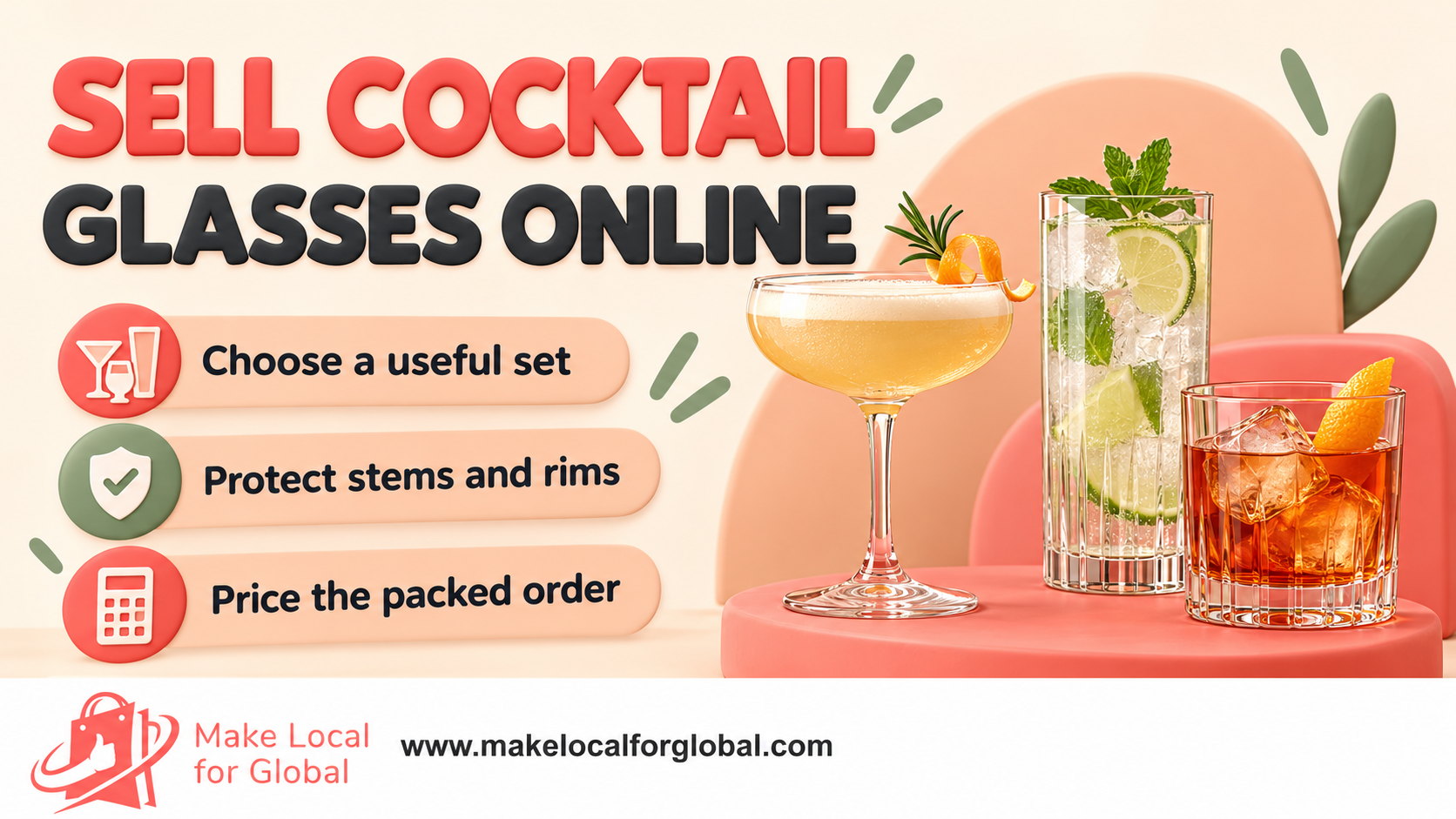
Cocktail glasses can look simple in a product photograph, but an online range succeeds only when the glass feels right in the hand, suits a specific drink, arrives intact and leaves enough margin after packing and delivery. A new seller does not need a bar full of every silhouette. A focused selection, tested against real customer needs and a complete order cost, is easier to explain and manage.
Plan a focused product range
Use MLFG resources to turn your product idea into a clear, costed online offer.
This guide explains how to research cocktail-glass buyers, choose a sensible opening range, evaluate suppliers and samples, write accurate product pages, price multi-glass orders and protect them in transit. It is written for a small UK seller starting with a modest budget. Rules and fees can change; check the official links below for the market and date that apply to your business.
“Cocktail glass” is an umbrella phrase. It can mean a stemmed coupe, a small Nick and Nora glass, a V-shaped martini glass, a short rocks glass or a tall highball. A customer furnishing a home bar may want one versatile set. A cocktail enthusiast may care about bowl shape, capacity and balance. A wedding buyer may want coordinated quantities and gift packaging. A bar or event caterer may value repeat supply, stackability and a predictable replacement process. These buyers compare different things, so identify one first.
Start with a short customer statement: “I help ___ make or serve ___ by offering ___.” For example, “I help first-time home hosts serve a small menu confidently with a coordinated set of coupe and highball glasses.” A useful statement names a customer, occasion and problem. It stops the opening range from drifting into unrelated wine glasses, shakers, jiggers, ice moulds and novelty accessories before the core offer has been tested.
Write down the buying situation, not just a broad demographic. Is the buyer replacing chipped glasses, preparing for a housewarming, putting together a home bar or choosing a gift? What quantity do they need? Do they have limited cupboard space? Are they likely to use a dishwasher? Which drinks do they actually serve? Short interviews with people who fit the customer description can reveal specific language and concerns. Ask what they use now, what disappoints them, how many pieces they would buy and what information they need before ordering. Do not lead them toward the answer you hope to hear.
Then check real search wording and marketplace categories, but treat search suggestions as clues rather than proof of demand. Review competing listings and note the assortment, capacity, set size, care directions, delivery promise, breakage policy and review themes. Look for repeated customer questions: “Will these fit a large ice cube?”, “Are replacements available?”, “Can I put them in a dishwasher?” Those questions can become product specifications and page content. A competitor’s popularity does not prove the same product or price will work for your shop.
Test interest before placing a large order. Show a small, clearly labelled range to prospective customers, ask them to choose a preferred set and price band, and record actual expressions of intent separately from polite compliments. A simple landing page, waitlist or small preorder can reveal whether the offer is understandable. Do not advertise availability or accept payment until you can meet the delivery promise and comply with consumer obligations. If demand is uncertain, buy samples first and keep the first commercial quantity deliberately small.
Match each silhouette to a serving job. A coupe suits many short, spirit-forward cocktails and can also serve sparkling wine or a small dessert. A Nick and Nora is a smaller stemmed option with a narrower bowl. A martini glass has a broad, open bowl that presents a drink clearly but can feel less stable when full. A rocks glass is short and useful for drinks served over ice. A highball is taller and offers room for a long drink, mixer and ice. Names and capacities vary between manufacturers, so use dimensions and measured capacity on the listing rather than relying on the shape name alone.
Choose a clear first assortment, such as one stemmed set and one tumbler set. You can offer a single-glass sample only if the packaging and postage still make commercial sense, then build two- and four-piece bundles for customers who want matching quantities. Avoid a dozen colour and decoration options at launch: each variant makes stock control, photography and replenishment more complicated. If personalisation is central to the offer, test one decoration method and one placement before opening a wide customisation menu.

Set an assortment rule before you order. Every item should have a distinct reason to exist: a different drink style, capacity, use case or price point. A quick range table can expose duplication. If two products look nearly identical in your photos and descriptions, a first-time customer may not understand why both are there. Ask a person unfamiliar with the range to explain the difference after reading the page. If they cannot, simplify the choice or improve the explanation.
| Glass style | Common role | Buyer question to answer | Test before listing |
|---|---|---|---|
| Coupe | Short cocktails and small serves | How much does it hold? | Measure capacity and check stem balance |
| Nick and Nora | Compact stemmed serves | Is this smaller than a coupe? | Photograph beside a ruler or familiar object |
| Rocks | Short serves over ice | Will a large cube fit? | Check internal width and usable capacity |
| Highball | Long drinks with mixer and ice | Does it fit my cupboard or shelf? | Measure height, rim and base |
Use a simple range ladder if it serves a real customer need: an accessible core set, a more distinctive finish or shape, and a gift-ready bundle. A premium tier should add something visible and verifiable, such as a documented manufacturing detail, a useful care guide, a presentation box or a distinctive design. Do not call a product “lead-free crystal”, “hand blown”, “dishwasher safe” or “commercial grade” unless the supplier can substantiate the exact claim for that model and you have checked that it is true. Avoid implying that a more expensive glass is automatically safer or stronger.
Bundle by occasion and quantity, not by adding unrelated items to raise the basket value. A four-coupe set is easy to understand. A “home bar starter kit” only makes sense if every included item is useful, compatible and described accurately. Work out the packed cost and shipping weight for each bundle. A set may reduce packing cost per glass, but a heavier parcel and greater replacement exposure can offset that gain.
Possible sources include UK glassware wholesalers, specialist barware distributors, manufacturers, importers and private-label suppliers. A local supplier may offer smaller minimums, faster replenishment and a clearer route for resolving damage. An overseas factory may provide more control over shape or decoration, but you need to account for freight, customs, lead times, quality inspection and the responsibilities that come with importing. Compare delivered cost and control, not just the unit price shown in a catalogue.
Ask each supplier for the exact model number, current specification sheet, material, dimensions, capacity, unit and case quantities, packing configuration, country of origin, lead time, minimum order, payment terms, defect procedure and replacement policy. Confirm whether the quoted price includes decoration, cartons, labels and transport to your door. Ask how product changes are communicated. If you are importing, clarify who is the importer of record and obtain the records needed to trace the supplier and batch. A sample from one production run does not guarantee that every future batch will be identical, so agree how tolerances and defects will be handled.
Glassware intended to contact food or drink is food-contact material. Food Standards Scotland explains that food-contact materials include tableware and kitchenware and are subject to a general framework; rules for specific materials and substances differ. Do not assume that a generic certificate covers every shape, coating, decoration or colour. Ask for documentation and written assurances that apply to the exact model and intended use. If the product has a painted rim, printed design, metallic decoration or coating, ask whether the contact surface and care instructions have been assessed for that treatment. The applicable requirements depend on the material and destination market. See Food Standards Scotland’s food-contact materials guidance.
Keep a supplier file with the model, version, order date, invoice, specification and correspondence. Record the product batch or lot where available. Ask what happens if a buyer reports a crack, sharp edge or contamination concern, and how quickly the supplier can investigate. A vague assurance such as “all our glass is certified” is not enough for your own records. Request the relevant document or a clear statement tied to the product SKU, and have a qualified adviser review it if you are unsure about your obligations in a market where you sell.
Product safety responsibilities apply to sellers and supply-chain businesses. Great Britain has its domestic general product-safety framework; Northern Ireland follows relevant EU product-safety rules. Your exact duties depend on your role, product and sales destinations. Read the current GOV.UK product-safety advice for businesses and the related guidance for Great Britain and Northern Ireland. Do not add a CE or UKCA mark merely because a product is sold online; ordinary glassware is not automatically in a marked category. Verify the rules for the exact product and any electrical or other regulated accessory in a bundle.
Ask about packaging specification and breakage rates in writing. A supplier’s export carton may protect stacked cases in a pallet but may not be suitable for a single parcel to a consumer. Request an example of the exact retail and shipping pack, then test it yourself. Find out whether the supplier replaces transit damage, manufacturing defects, or both, and what evidence and reporting deadline it requires. Build a backup supplier or substitute plan before the first source runs out; do not promise indefinite availability when a product is seasonal or made to order.
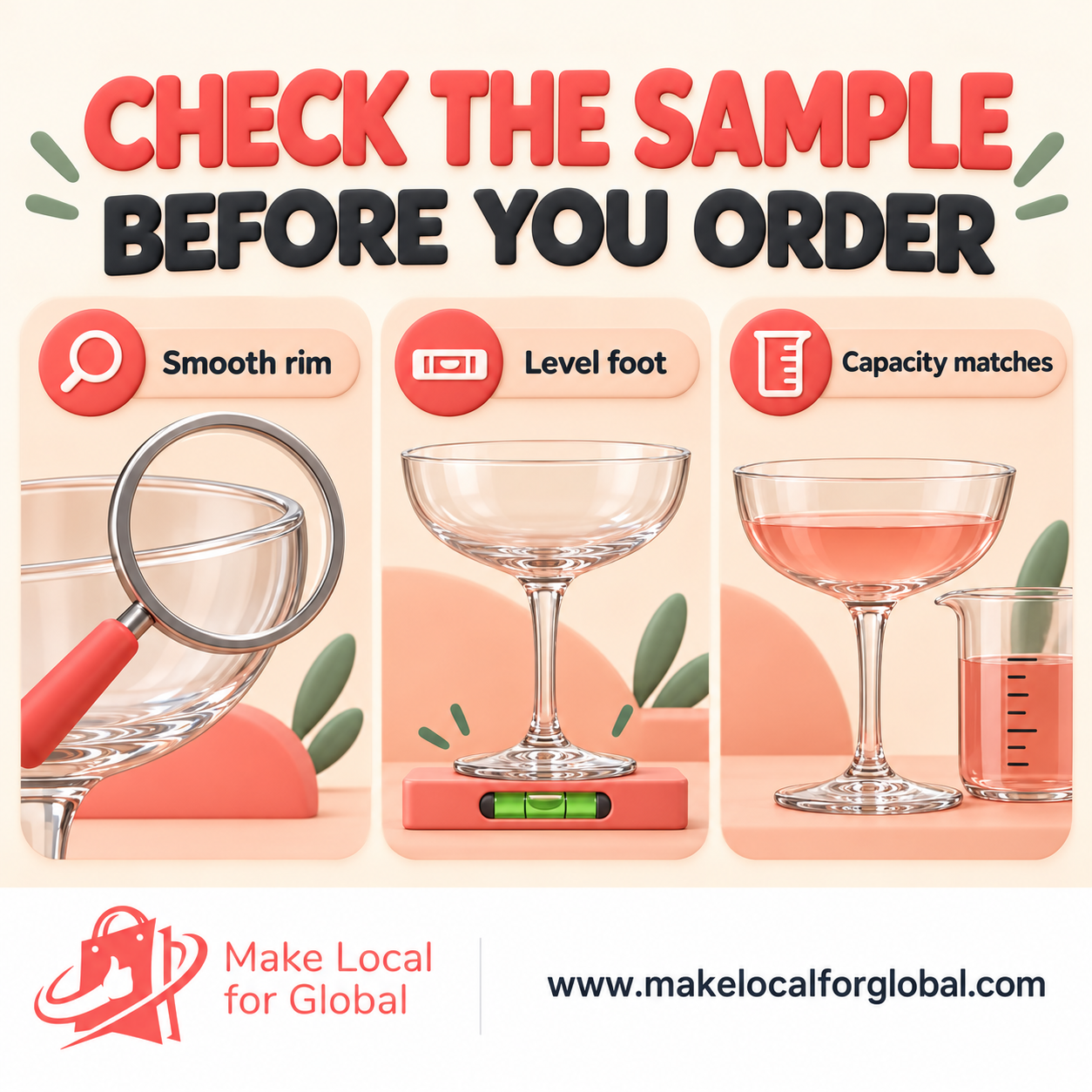
Order samples of every model, decoration and size you intend to sell. Use each sample as a customer would: wash it according to the proposed care guidance, handle it with wet hands, set it on different flat surfaces and test the drink or ice use described on the product page. Inspect it under bright light, rotate it and compare matching pieces. Keep one untouched reference sample and photographs for later comparison. Record the supplier, model and date, since sample evaluation is useful only when it is traceable.
Check each rim for chips, sharpness, uneven thickness and rough finishing. Run a clean fingertip around the rim without applying force. Inspect the base and foot for wobble on a level surface. For stemware, look for a straight, well-joined stem and check that the bowl does not lean. Look for bubbles, seams, scratches, cloudiness, colour variation and decoration marks. Some manufacturing variation may be normal, but do not set a tolerance by guesswork; get the supplier’s specification and decide which visible defects would disappoint a buyer or make the item unsafe.
Measure height, widest diameter, base width and rim diameter. Measure usable capacity by filling to the level you will describe, not to the very top where a real drink could spill. State dimensions in centimetres and capacity in millilitres, with a note that small production variations can occur if supported by the specification. Photographs can include a ruler for scale, but the written specifications should still be easy to find. Compare at least three pieces from a set. If they differ noticeably, ask the supplier whether the sample is representative and request a replacement batch sample before committing.
Test claims instead of copying them. If a supplier says dishwasher safe, ask for the manufacturer’s exact care instructions and any limits on temperature, programme or detergent. Never test an item in a way that risks injury. Follow the stated care method and record the outcome, but remember that one home wash does not prove long-term durability. If you cannot substantiate a care claim, use restrained wording such as “follow the care instructions supplied with the glass” until evidence is available.
Check fit for the actual use case. Put the glass under the shelf or cupboard where a typical customer might store it. Try the type of ice you mention on the page. Confirm that a garnish or straw fits only if that detail matters to the buyer. For event or hospitality customers, test repeated handling and washing with a small number of cycles while monitoring for wear. Avoid describing ordinary household products as suitable for commercial venues unless the supplier provides evidence and the product has been assessed for that level of use.
Make an acceptance checklist before the delivery arrives: correct model and quantity, clear surfaces, sound rims, stable bases, consistent dimensions, secure decoration, no unexplained odour or residue, and packaging condition. Photograph a damaged outer carton before opening it and take images of any defects. Separate questionable stock and do not dispatch it. Keep the checks proportionate to your scale, but consistent enough that you notice when a supplier’s quality changes.
A low wholesale price does not tell you whether a glassware product can make money. The cost belongs to the order, including inbound freight, protective materials, pick-and-pack time, payment fees, delivery, customer acquisition and a realistic reserve for damage, refunds or replacements. Allocate shared costs sensibly. If a case has 24 glasses and delivery costs £24, the inbound freight allocation is £1 per glass before you account for any other charges. Do not hide your own packing time simply because no invoice arrives for it.
Here is an illustrative example for a four-coupe set priced at £42, with the customer charged £4.95 for delivery. It assumes a UK domestic card transaction and a seller who is not VAT registered. The example uses Stripe’s published standard UK card rate as shown at the time of writing; check the current Stripe UK pricing page and your own account terms before setting prices. It is not a forecast or a recommended price.
| Order item | Example amount | How to think about it |
|---|---|---|
| Customer pays | £46.95 | £42.00 set plus £4.95 delivery |
| Glass set landed cost | £14.40 | £12.00 goods plus £2.40 allocated inbound freight |
| Protective packaging | £4.10 | Inner protection, dividers, outer carton and tape |
| Packing labour | £2.80 | Time to pick, inspect, pack and label |
| Outbound courier | £5.60 | Example parcel rate; obtain your own quote |
| Card fee | £0.90 | Approx. 1.5% of £46.95 + £0.20 |
| Damage and returns reserve | £2.00 | A planning allowance; replace with actual results |
| Customer acquisition | £5.00 | Example blended cost per order |
| Estimated contribution | £12.15 | £46.95 less £34.80 listed variable costs |
Make your numbers work before ordering
Price the full order and plan how your shop will present, fulfil and support the range.
In this example, the payment fee is £46.95 × 1.5% + £0.20 = approximately £0.90. The listed variable costs total £34.80, leaving £12.15 contribution before fixed overheads, business taxes and owner pay. The delivery charge is income in the calculation and the courier cost is an expense. If you forget one side, your margin looks wrong. If the product is VAT rated and your business is VAT registered, rebuild the calculation using the VAT treatment that applies to the sale and your recoverable input VAT. Do not simply subtract 20% from every line; ask an accountant or use current HMRC guidance for your circumstances.
Breakage reserve should come from evidence once you have orders. Initially, estimate a cautious allowance and update it as you learn. For example, if 2 out of 100 orders need a replacement and each replacement costs £18 including postage and materials, the observed average is 36p per order before you include time or any refund costs. A small sample is volatile, so keep watching it. Track damage by glass shape, carton, courier, route and packing method. A cluster often points to a fixable cause.
Run the calculation at multiple prices and basket sizes. A single glass can be costly to ship relative to its value, while a set may spread packaging and delivery over more pieces. A larger set can also increase parcel size, weight and risk. If a discount only makes the order work when a customer buys a bundle, say clearly what the bundle contains and do not make the single-item price artificially misleading. Compare contribution after discounts, affiliate commissions, marketplace fees and advertising, not the headline retail price.
Decide in advance what contribution makes the work worthwhile. The answer depends on your fixed expenses, sales volume, working hours, returns and growth plans. Include website subscriptions, insurance, bookkeeping, photography, storage and any recurring marketplace charge in your monthly budget. For VAT registration, GOV.UK currently states the registration threshold as taxable turnover over £90,000, but circumstances and rules can change. Verify the current position at GOV.UK VAT thresholds and speak with an accountant about your situation.
Lead with the glass type, set quantity and a clear use. “Four clear coupe cocktail glasses, 240 ml each” is more informative than “premium barware set”. Include dimensions, capacity, material and finish. State whether the price covers one glass or a set. Explain whether boxes are gift suitable and whether the shown garnish, drink or accessories are included. Make variant selection explicit. A customer should not have to infer the number of pieces from a photograph.
Photograph the item from the front, side, top and base. Show the full set together and one glass beside an everyday object for scale. Include a close view of the rim, stem join, foot and any decoration. A styled cocktail photo can show the mood, but also use clear, neutral product images that accurately show shape and colour. Keep backgrounds and lighting consistent across variants. Do not digitally remove a seam, exaggerate clarity or show a glass larger than it is. A short video can show the glass in a hand and on a level surface, provided it represents the item being sold.
Describe the difference between models in plain terms. Explain approximate capacity and what the shape accommodates without promising a particular cocktail outcome. List care instructions from the manufacturer. If the glass is not confirmed dishwasher safe, say so clearly rather than leaving a customer to guess. State country of origin when required or when it helps the buyer make an informed decision. Avoid environmental, ethical, durability or safety claims unless you have evidence that supports the exact wording. The UK Competition and Markets Authority’s Green Claims Code explains how environmental claims should be clear and substantiated.
Show delivery cost and estimated dispatch times before checkout. If an item is made to order, explain the production lead time. Describe how the product is packed, but avoid suggesting that damage is impossible. Explain your process if a parcel arrives broken, and provide a simple route to report it with order details and photographs. State the returns policy in language consistent with the law. Online shoppers generally have cancellation rights, with exceptions; read the current GOV.UK returns and refunds guidance before writing policy. For distance selling, disclose key business, price and delivery information before the buyer places an order; consult GOV.UK online and distance selling rules.
Use searchable language naturally: cocktail glasses, coupe glasses, rocks glasses or highball glasses when relevant. Add meaningful image alt text such as “Four clear coupe cocktail glasses with short stems arranged on a cream table”. Alt text should describe the actual image for people using assistive technology. It is not a place to repeat keywords or list every feature. Keep page titles and descriptions specific to the product and buyer. Avoid repeating the same phrase in every heading; a well-organised page is easier to read and more useful than keyword-heavy copy.
Include practical care and use guidance after the specifications. Mention that glass should be inspected before use and that chipped or cracked items should be set aside. Explain storage if stems or delicate decoration need care. Keep any safety wording proportionate and factual. If products are sold as a set, tell customers how to check the quantity and report a missing item. Link to relevant guides on your own site where they help a buyer, such as how to sell beer mugs online and how to sell cocktail shakers online. These links help readers explore adjacent barware ideas; they should not distract from the glassware offer.
Packaging is part of the product experience and a major driver of replacement costs. Do not assume the supplier’s retail carton is a safe parcel box. A glass can break when it touches another glass, hits the outer wall or moves inside a loose carton. The packing system should hold each item in place, cushion impact from every direction and keep the outer box intact through normal handling. Test with the exact set configuration and box size that you intend to ship.
Start by separating every glass with a fitted divider or individual protective sleeve. Protect stems, rims and feet, which can be vulnerable to knocks. Use enough cushioning to prevent movement and fill empty spaces, but do not force material against a delicate rim. Place the protected set in a sturdy inner box and then use an appropriately sized outer carton with cushioning around all sides. Royal Mail’s guidance for sending fragile items advises cushioning, keeping items from touching and using a strong outer package; its specific recommendations include around 5 cm of protective cushioning. See Royal Mail’s fragile-item packaging advice and review the carrier’s current requirements.

Test a packed sample before shipping to a customer. Gently rotate and tilt the closed carton; the contents should not shift or knock together. Inspect the outside for weak seams, compression points and exposed corners. For a more formal drop test, follow a recognised packaging test method or use a qualified fulfilment partner; informal home testing is not a guarantee against all courier conditions. Keep a record of the packaging version, contents, test and results. Change one component at a time when investigating damage so you can tell which adjustment helped.
Marking a parcel “fragile” may help communicate the contents, but it is not a substitute for good packaging or a guarantee of gentle handling. Keep evidence of how you packed each order where it is practical, especially for higher-value sets. Follow the carrier’s compensation terms and packaging rules before relying on compensation. Royal Mail publishes a damage compensation policy; other carriers have their own conditions. Clearly explain your customer service route if something breaks in transit, and respond quickly rather than leaving the buyer to chase multiple parties.
Measure and weigh the final parcel, not the glass set alone. A second carton can move the shipment into a higher price band. Check whether the chosen carrier will accept the parcel dimensions, whether collection is available, and what delivery confirmation costs. Compare at least two services for your expected destinations. Make sure the packaging quote reflects the real quantity you can store and the time required to assemble it. A cheap carton that wastes space or requires excessive hand-packing may cost more overall.
Your own online shop offers control over the product page, customer journey and repeat-buyer relationship. It also means you must attract visitors, maintain the site, manage payments, answer questions and handle customer service. A focused launch can begin with a few well-presented products and a useful guide to choosing glass shapes. Measure product-page views, add-to-cart rate, conversion, average order value, delivery cost, breakage and support contacts. These numbers show whether the offer is understandable and operationally sound.
Marketplaces can provide discovery but add fees, rules and competition. Review the current category terms, listing fees, transaction fees, payment processing and advertising options before calculating a margin. Etsy’s Creativity Standards and seller rules are important: generic ready-made resale may not fit its permitted categories, while qualifying handmade, designed, vintage or craft-supply listings have specific conditions. Read the current Etsy Creativity Standards and Etsy Seller Policy before listing. Do not assume that adding a logo or a gift box makes an otherwise generic resale product eligible.
Local markets, homeware fairs and pop-ups let customers feel the weight and inspect the finish before buying. They can help you learn which shapes people understand and which questions arise. Include stall fees, travel, display materials, card fees and unsold stock in the event calculation. Transport a small display set separately from sale stock and have a safe way to replenish it. For trade orders, provide a clear price list, case quantities, lead times and a process for reporting breakage. Avoid offering a wholesale discount before confirming that the larger order remains profitable.
Choose one primary channel and one learning channel at first. A small seller can struggle to keep prices, stock, delivery promises and customer messages consistent across several platforms. Add another channel when the product data and fulfilment process are reliable. Keep a single inventory record and reconcile it promptly after each sale. If selling across Great Britain, Northern Ireland or internationally, check the product, consumer and tax requirements for each destination. Do not copy the same delivery estimate everywhere if transit times differ.
Make content that solves a real choice: coupe or Nick and Nora, rocks or highball, what size glass fits a large ice cube, how to measure cabinet clearance, how to choose a useful set for a small home bar, or how to care for decorated glassware. Show the actual products and cite manufacturer guidance for care claims. A short comparison chart, a clear photograph and a practical explanation can help a buyer more than a generic cocktail recipe that never mentions your products.
Build an email list with a relevant resource such as a concise glass-shape guide or a home-bar checklist. Tell subscribers what they will receive and honour their preferences. Use product emails to explain a new shape, a restock, a gift set or an improvement to packaging. Do not send excessive promotions. Track which messages lead to useful visits and orders, not just opens. Your privacy notice and marketing permissions should match the tools and jurisdictions you use.
Ask customers for honest feedback after delivery. Invite them to mention fit, feel, packaging and whether the written dimensions matched their expectation. Do not offer a reward only for positive reviews or write reviews on a customer’s behalf. Use recurring questions to improve the listing and instructions. If a buyer reports a chip or an incorrect item, resolve the issue first; a good support response can be more valuable than an automated request for a review.
Keep a small creative testing plan. Try two accurate lead images, one showing the full set and one showing a single glass in context. Change one element at a time, such as the main photograph or headline, and compare results over enough visits to reduce random noise. Do not infer that a colour or discount caused sales to change if you also changed traffic sources, stock or delivery time. Record dates and changes so future decisions are based on what actually happened.
In week one, define the buyer and occasion, list the three most important product questions, compare competing offers and speak with potential customers. Select a focused assortment and write an initial target contribution. If the supplier or product claims remain unclear, do not rush to launch. Use the time to resolve the exact model, care instructions, food-contact information and delivery specification.
In week two, order samples and test them against a written checklist. Photograph the products, measure capacity and dimensions, compare each piece and test your planned packaging. Request any missing supplier documentation. Prepare the product page, delivery terms, customer support process and breakage-report form. Verify costs with current supplier and carrier quotes. Keep a record of assumptions that still need real order data.
In week three, launch a small quantity to the selected audience. Make the offer easy to understand and show the product honestly. Ask a handful of people unfamiliar with the page to find the set size, glass capacity, care directions, delivery date and returns information without your help. Fix confusion before scaling paid promotion. Start with a modest budget you can afford to learn from and set a spending limit in advance.
In week four, review traffic, questions, conversion, basket size, packing time, damage reports, delivery performance and contribution. Separate a weak offer from a weak page or an unqualified traffic source. If visitors look but do not add to cart, test whether the product, price or information is unclear. If carts fail at checkout, inspect shipping charges and delivery estimates. If orders arrive damaged, pause the affected pack method while you investigate. Reorder only when sales and replenishment lead time support it.
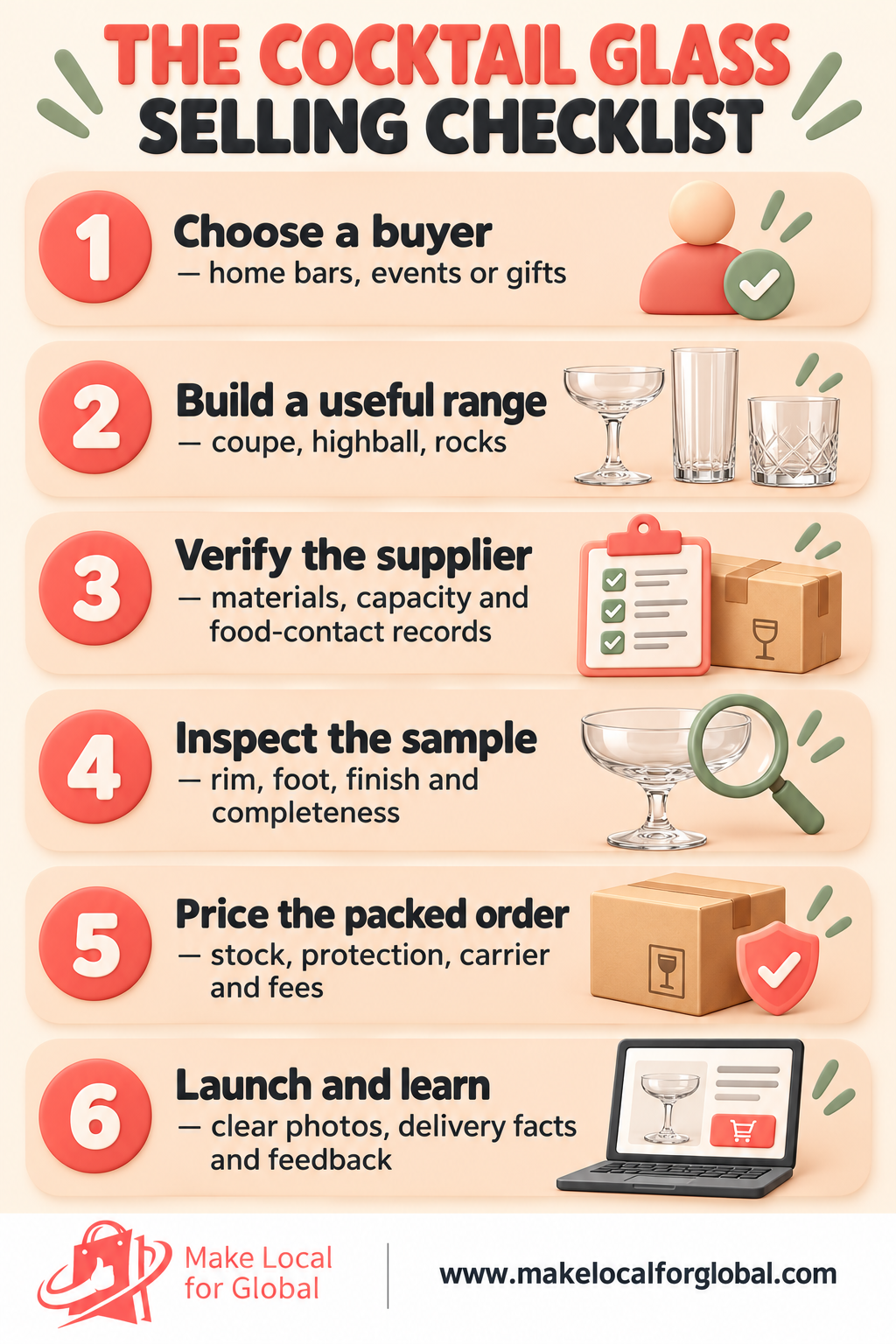
Ordering a broad range too early. A large colour and shape catalogue ties up cash and makes the offer harder to explain. Start with the products that solve clearly different needs. Add variants when customer evidence supports them and you can maintain accurate stock information.
Choosing on unit price alone. Freight, duty, rejected pieces, packaging, storage, delivery and payment fees can change the economics. Build a landed-cost sheet before you compare quotations. Make the supplier quote comparable by matching model, quantity, packaging and delivery terms.
Copying generic specifications. Capacity, dimensions and care claims differ between models. Verify them against the exact item you ship. A customer may accept a small variation when it is explained, but a misleading size or dishwasher claim can cause complaints and returns.
Using attractive images that hide scale. A cocktail scene creates atmosphere but does not show how large the glass is. Pair lifestyle photography with neutral images, a set count and written dimensions. Make sure the colour, finish and shape are represented honestly.
Assuming the retail box is a shipping box. The product carton may not withstand parcel handling. Separate each glass, cushion the inner pack and secure it within a strong outer carton. Test the actual configuration and update it when the set size changes.
Pricing before breakage and labour are known. Every replacement involves product, packing and delivery cost, and a support task. Include an initial reserve, then replace estimates with observed results. Include the time required to inspect, wrap, label and answer questions.
Making claims because a supplier said so. Ask for evidence tied to the product model and intended market. Use precise, modest claims. Keep copies of specifications and correspondence. When requirements are unclear, get competent advice instead of adding a mark or certificate badge to reassure customers.
Selling across many channels before the process works. Multiple channels can create stock errors and conflicting dispatch promises. Learn to fulfil consistently in one place, then add another channel with a reliable inventory and customer-service process.
Choose one or two styles that serve distinct needs and that you can source, inspect and pack reliably. A stemmed coupe and a rocks or highball tumbler can create a clearer starting range than many similar stemmed shapes. Confirm demand with prospective buyers, then test the exact samples and landed costs before ordering more than a small initial quantity.
Ordinary glassware is not automatically subject to CE or UKCA marking simply because it is sold in Great Britain or Northern Ireland. Marking rules apply to defined product categories. Check the rules for the exact product and any bundled regulated item, and do not apply a mark unless the applicable legislation requires and supports it. Read the current official product-safety guidance or obtain advice for your circumstances.
Ask for the exact model and version, specification sheet, material, measured capacity, dimensions, care instructions, case quantity, country of origin, lead time, minimum order, packaging details, traceability information and written defect and breakage terms. For food-contact use, request documentation and assurances that apply to the specific model, finish and intended use.
Separate every glass, protect the rim, stem and foot, cushion all sides and stop the inner pack from moving inside a strong outer carton. Follow your carrier’s current packaging guidance and test the exact pack configuration. Track damage by model and packaging version so you can identify whether a particular component or handling route needs attention.
Do not assume that generic ready-made resale is eligible. Etsy’s current rules define the types of items and seller participation it permits, including specific conditions for designed, handmade, vintage and craft-supply products. Check its Creativity Standards and Seller Policy before listing. A shop name, logo or gift box does not by itself make a product eligible.
There is no reliable universal profit figure. Calculate each order using the selling price and delivery charge less product, inbound freight, packaging, packing time, courier, payment fees, acquisition cost and a reserve for returns or damage. Then account for fixed costs, tax and owner pay. Compare that contribution with actual sales and breakage data before scaling.
State the shape, exact quantity, capacity, dimensions, material, finish, care directions, price, dispatch estimate, delivery cost and what is included. Use clear photographs that show the full set and scale. Explain the process for reporting damage and provide returns information consistent with current consumer law.
No. Care suitability depends on the product, manufacturing, decoration and supplier instructions. Check the exact model’s care guidance and do not copy a claim from a different glass. If you cannot verify dishwasher suitability, say so plainly and direct the buyer to the manufacturer’s instructions supplied with the item.
A viable cocktail-glass shop begins with a clear buyer and a small range that solves real serving needs. Confirm the product specifications, investigate food-contact and product-safety duties for the markets you serve, inspect samples, test the complete parcel and calculate the real order contribution. Then publish a page with useful measurements, honest care guidance, accurate photographs, clear delivery terms and a practical response for breakage.
Use the first orders as evidence. Review which shapes customers choose, what they ask before buying, whether the packed glass arrives intact and what remains after every variable cost. Improve the product or process before increasing stock. For help planning a small online offer, see Make Local for Global’s pricing options, explore our Product To Sell guides, or contact the team about the next step for your business.
Take the next step with your online shop
Explore support for planning your store or contact MLFG with your next question.
PREFERRED SOURCE
Like what you’re reading? Add Make Local for Global as a preferred source on Google to see more of our articles when you search.

Build your online presence without having to figure out everything yourself.