

READY TO SELL Fishing Tackle Boxes ONLINE?
Get a store built for you in 5 days, plus training and support to help you start, run, and grow your Alternative business.

Plan a tackle box range with verified dimensions, tested dividers and closures, clear product claims and realistic packed-order costs.

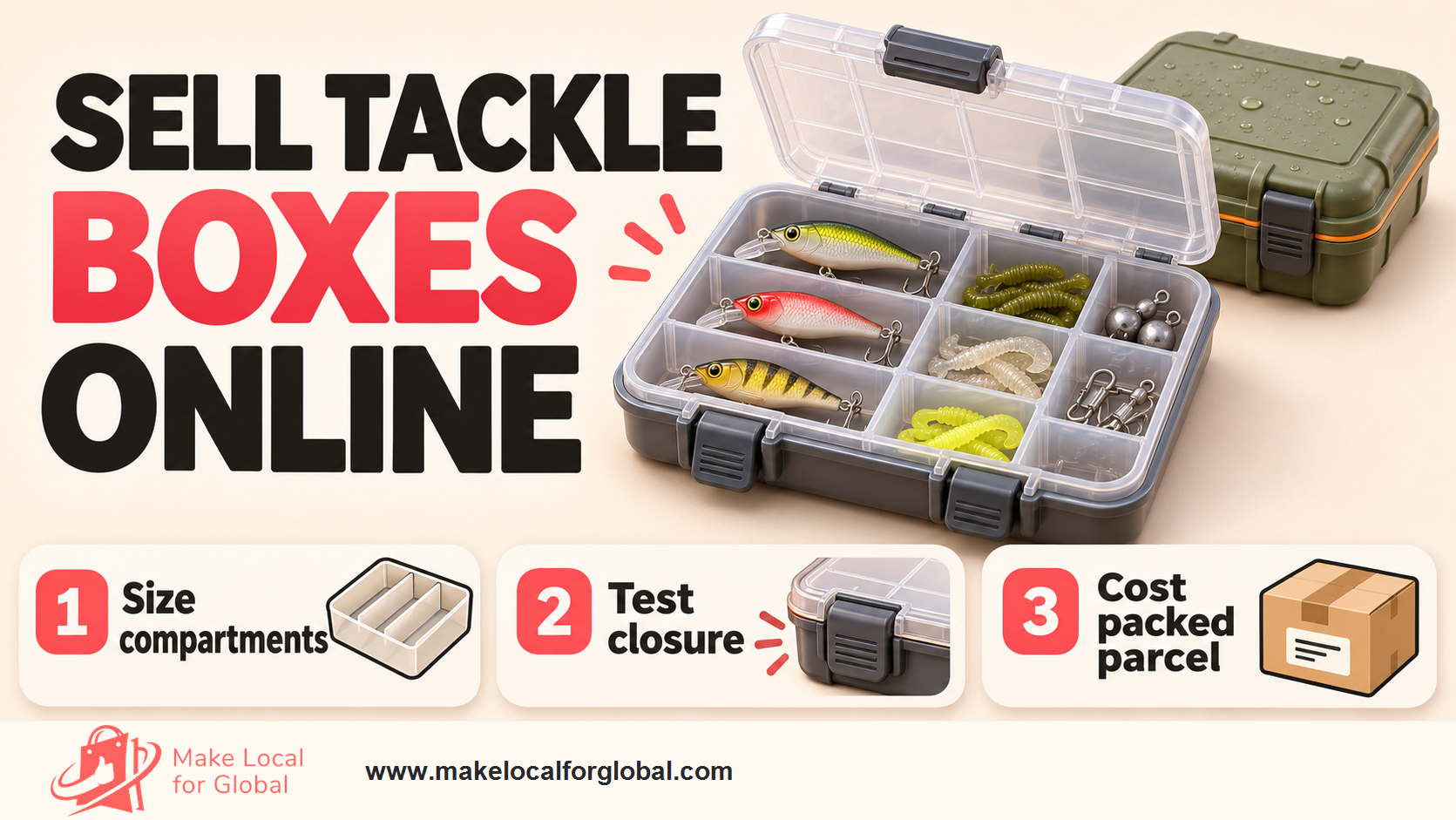
Tackle boxes solve different storage jobs: a long lure organiser, a divided terminal-tackle tray and a compact utility case are not interchangeable. A seller can start with a focused range, test samples with real kit, describe measurements and closure limits clearly, then price the full packed order before committing to stock.
This plan covers buyer research, formats, supplier checks, sample testing, online listings, shipping costs and a 30-day launch. Use the product facts you can verify; do not promise that a box is waterproof or suitable for every lure without evidence for that exact model.
Map a target buyer, first range and likely order costs before you commit to a supplier order.
A tackle box is a storage product, so the useful starting point is not “fishers need boxes”. Ask who is frustrated by a particular storage task and what they carry. One buyer may need a shallow lure organiser for small hard baits. Another may want a compact tray for hooks and swivels inside a larger bag. A third may store tools and spare line in a vehicle. Each problem leads to a different size, layout, pack quantity and product-page promise.
Start with a short test plan. Compare a fixed-compartment organiser, an adjustable-divider model and a compact accessory case. Show clear photographs or accurate supplier samples and ask the same questions about storage capacity, lid visibility, latch feel and packed size. Record which feature people notice first, which one they would pay for and which one confuses them. A consistent method makes the answers more useful than a stream of casual opinions.
Separate curiosity from purchase intent in your notes. If a person says they might buy a box, ask what they would store in it, what size they need and what price they compare it with. If they volunteer to place a refundable reservation, understand the payment and cancellation rules before taking money. A survey response, sign-up and paid order have different strength as evidence. Keep the sample size and the way you recruited people beside the result, since a handful of club members with strong interest may not represent casual buyers or a wider online audience.
Use a simple test card for each format: target buyer, problem, key feature, expected price, competing alternative, sample cost and next decision. Set a threshold before the test begins, such as a minimum number of qualified conversations or orders at the intended price. If the result falls short, adjust the offer or stop. Avoid moving the target after every small change. A defined threshold prevents a founder from treating any positive comment as proof and helps preserve cash for a better-supported product.
Fishing storage covers several related products. A lure box may use long channels for hard baits, smaller cells for soft lures or adjustable walls for mixed tackle. A terminal-tackle organiser may have many small compartments for hooks, swivels, beads and weights. Utility cases may have fewer, larger sections for pliers, line or accessories. The names used by suppliers vary, so compare the physical layout and intended contents rather than relying on the product label alone.
Think about the shape of the contents, not just the number of compartments. A long lure may need one uninterrupted channel. A set of small hooks can fall into a cell that is too wide or shallow. A spool of line needs clearance around its rim. Draw a rough diagram of the intended contents and compare it with the inside of each sample. That exercise makes differences visible and gives you a useful photograph for the listing.
Some anglers use trays within a larger bag or boat storage system. If you plan to sell a tray for that purpose, ask buyers for the dimensions of the receiving space and test the sample in it. Do not imply compatibility with a named bag, seat or storage system without checking the exact model. A phrase such as “fits standard tackle bags” is too broad; define the tested dimensions and the models checked before using it.
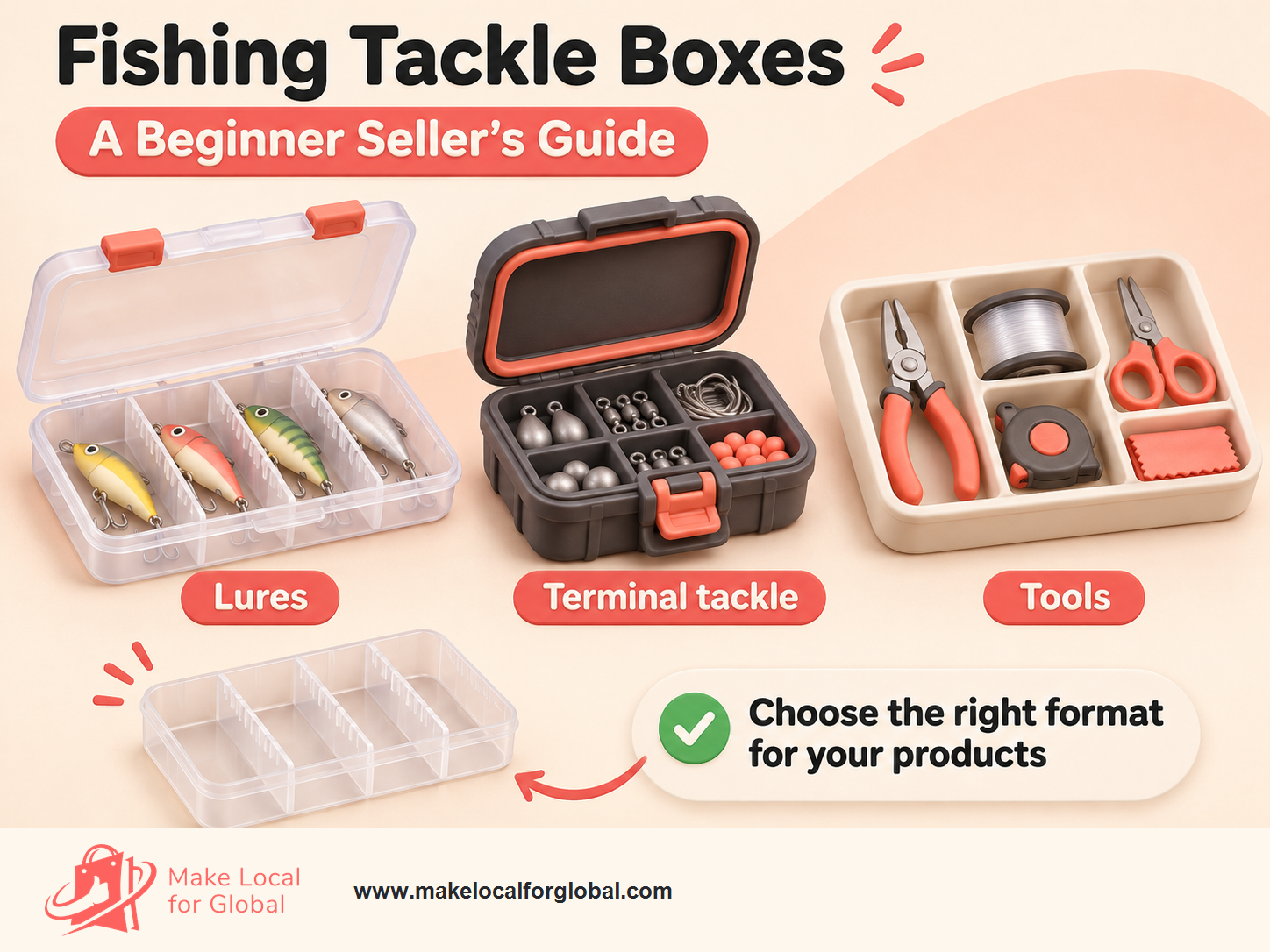
A first range can be organised by job rather than by every available size. For example, offer one long lure box, one adjustable organiser and one compact small-parts case. Add a multipack only after you know which formats buyers commonly use together. A focused range is easier to photograph, store, count and explain. It gives you a clean way to compare which product attracts questions, conversions and returns.
Assign each proposed item a simple product code and a one-line purpose. For example, Lure-01 may be a long clear case, Small-02 may be an adjustable mixed organiser and Utility-03 may be a deeper tray. The code should connect the product page, purchase order, storage bin and return record. Keep the names clear for shoppers and use the code for internal stock control. This reduces the chance of shipping a similar box with a different divider arrangement.
Decide which variations are meaningful before adding colours. Colour can help shoppers separate kit, yet every colour may create another stock line and minimum order. Start with one or two colours only if buyers identify colour as a real choice. Confirm that the colour on the sample matches production and online photographs. A focused colour plan is easier to replenish and lowers the risk of having slow-moving units left over in one variant.
You can buy a finished product from a UK wholesaler, import a standard design, work with a supplier on a branded version or develop a design with a manufacturer. Each route changes lead times, minimum quantities, quality control and your responsibilities. A local wholesaler may let you inspect samples and replenish more often. Importing may offer more control over colour or layout, but can add freight, customs administration, longer cash tied up and extra compliance duties.
Ask the supplier how samples relate to production. Find out whether the sample came from a normal production run, a hand-finished prototype or an older model. Request a pre-shipment inspection process if you place a larger order. Agree what happens if the delivered batch has a different latch, a missing divider or a crack rate above the level you accept. Record those points in the purchase terms rather than relying on a chat message that may be hard to trace.
Compare quotes on the same basis. One supplier may quote a unit price without export packing, another may include inner cartons, and a third may quote a delivered price with a different destination. List the currency, quantity, freight method, Incoterm if relevant, duty and tax treatment, lead time and payment schedule. If you import, get advice on customs and product responsibilities before placing the order. A lower quoted unit cost can be outweighed by freight, delays, defects or the cash tied up in a large minimum order.
Order samples before a bulk commitment. Check the hinge for alignment and uneven movement. Open and close each latch repeatedly using the maker’s instructions. Look for sharp moulding edges, loose pins, cracks, poor fit between lid and base, cloudy patches that block visibility and corners that deform under ordinary handling. Photograph defects beside the model number and date so you can compare the next sample or production batch.
Create a repeatable test sheet rather than relying on memory. Note the date, model, sample source, dimensions, weight, divider count, latch feel and visible finish. Use the same opening and closing routine for each sample. Photograph the lid open and shut, close-ups of each hinge and any issue. If you later compare a production unit, repeat the same checks and compare the record. A simple sheet can reveal whether one supplier consistently sends samples closer to the agreed specification.
Check the box after it has been packed and unpacked as a customer would receive it. Look for scuffs, dust inside compartments, labels that cover a clear lid and movement that can stress the hinges. Try the product with the types of stored items shown in the listing. Use a safe method before showing sharp or hazardous gear in a public demonstration. The aim is to learn how the storage case performs in ordinary use, not to create a test result that sounds scientific without a defined method.
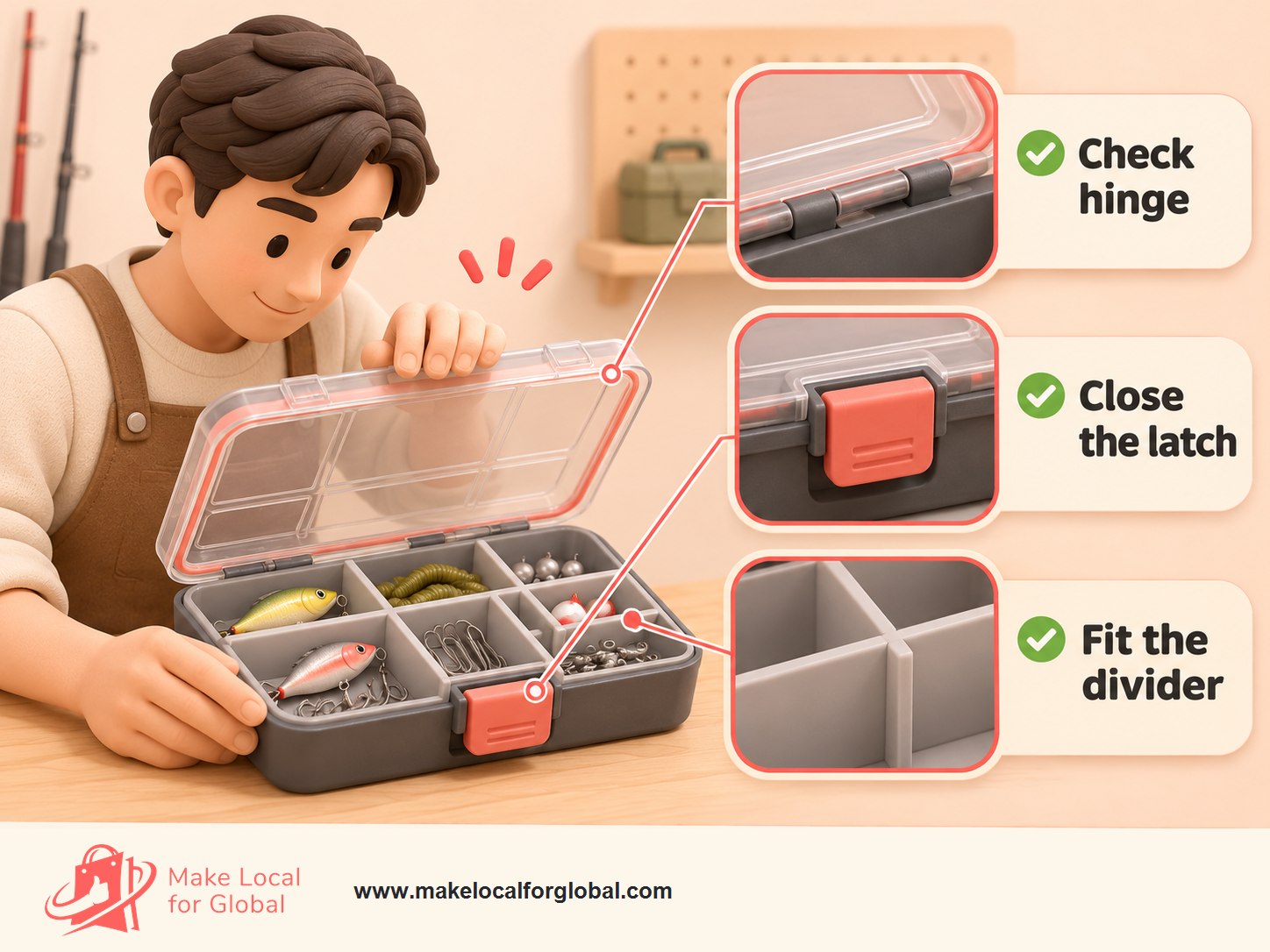
Tackle boxes may use different plastics, seals, hinges and latch designs. Ask the supplier for a precise material name and any supporting evidence before putting a technical claim on the page. If the description says polypropylene, for example, check that the document refers to the item or the correct component. Avoid assuming that every clear box uses the same resin or that a coloured lid proves UV stability.
A supplier specification may use a generic term such as “strong plastic” or “water resistant”. Ask for the material name, the exact component covered and any test report. Check the model and revision on the document against the item you will sell. If the report covers only a lid material, do not apply it to the complete box. Keep the original document and a note explaining how you interpreted it. If a claim is unclear, leave it out of the product page until you have evidence.
Make distinctions easy to understand. “Clear lid” is an observable feature. “Closes with a gasket” describes a component if you have confirmed it. “Waterproof” can imply a much higher level of protection. You can say that a customer should keep the box dry if the supplier provides no validated resistance claim. A precise description may sound less dramatic, but it can reduce confusion and avoid a customer relying on a protection level that was never tested.
The ASA guidance on substantiation says marketers should hold documentary evidence before making objective claims that consumers are likely to rely on. Keep the report tied to the exact box model and make the product-page wording no broader than the test. If the supplier cannot provide suitable evidence for a water-resistance statement, describe visible construction features instead of implying a protection level.
Businesses that make, import, distribute or sell consumer products in the UK have safety responsibilities. Keep a record of suppliers and product references, assess reasonably foreseeable use and act if a product concern is reported. The Office for Product Safety and Standards sets out the general duties in its current product safety advice for businesses. Requirements can vary between Great Britain and Northern Ireland, including the product-safety framework, so check the rules that apply to where you sell and source.
Keep the business record simple and complete. Store the supplier’s legal name and address, invoice, product reference, batch details, written specification, test documents and complaint records in one place. For imported goods, record who arranged the import and keep the relevant customs and delivery papers. Review the product safety guidance that applies to each UK jurisdiction and your sales territory. This general article is not a legal determination for a particular import route or product configuration.
Write a short incident procedure before you need one. Ask staff to record the customer’s description, order number, model and batch, date, photographs if available and any action already taken. Escalate a possible safety risk to the relevant supplier and seek appropriate advice. If the same issue appears more than once, stop and review affected stock rather than answering each report in isolation. Clear records help you identify the scope and respond consistently.
If you supply or import packaging, check whether extended producer responsibility applies to your business. GOV.UK says obligated-producer duties depend on the packaging activity and thresholds, including UK establishment, annual worldwide turnover of at least £1 million and more than 25 tonnes of packaging supplied or imported in the previous year. All producers should assess their position. Read the current packaging EPR guidance and confirm the rules for the reporting year that applies to you.
For most UK distance sales, a consumer can notify the seller within 14 days of receiving goods that they want to cancel, then has another 14 days to send them back. There are exceptions and conditions, so check the current GOV.UK returns and refunds rules and the requirements of each marketplace you use. Explain how to contact you, where to return the item and how refunds are handled.
A product that costs £8.40 from a supplier does not cost £8.40 to sell. Add inbound freight and import costs allocated per unit, protective packaging, payment or marketplace fees, delivery paid by the business, a returns or damage provision and any planned customer acquisition cost. Include the labour and overhead picture separately. If you pay VAT, check whether each cost and selling price should be treated as VAT-inclusive or VAT-exclusive for your calculation.
Check each cost against an actual quote or invoice. An inbound freight share can be calculated by dividing a shipment’s landed charges by the number of saleable units, then increasing it if damaged or missing units reduce the batch. Ask your payment provider how its percentage and fixed charges apply to the item and delivery. Read the marketplace fee schedule for the category and fulfilment option you will use. Put the source and date beside each assumption so you can refresh it when the terms change.
Model a slower sales case as well as the hoped-for case. If only half the order sells during the first month, storage and cash remain tied up longer. If delivery costs more for a remote address or a larger carton, your average contribution may fall. Make one version for direct shop orders and one for marketplace orders. The purpose is not to forecast the future exactly; it is to see whether the offer can withstand plausible costs and to identify which number needs a supplier quote before launch.
| Per order item | Illustrative amount | Why include it |
|---|---|---|
| Tackle box landed cost | £8.40 | Unit cost plus allocated inbound freight and duty |
| Protective packaging | £0.85 | Outer carton, sleeve, infill, tape and label |
| Payment and channel fees | £1.20 | Estimated percentage and fixed transaction charges |
| Delivery paid by seller | £3.95 | Actual chosen service for the packed parcel |
| Returns and damage allowance | £0.80 | A planning provision, updated from real order data |
| Customer acquisition test | £2.00 | An illustrative share of a small paid test |
| Total variable cost | £17.20 | Sum of the listed order-level costs |
| Example selling price | £24.99 | A test price, not a market average |
| Contribution before overhead and tax | £7.79 | £24.99 less £17.20; not net profit |
Illustrative figures only. Excludes fixed software, storage, labour, insurance and tax. Check whether VAT applies to your business and how your provider calculates fees. Replace every value with supplier quotes and actual carrier rates.
Use a specific title that tells the buyer what kind of organiser it is and the feature that distinguishes it. For example: “Adjustable lure box with removable dividers, clear lid and measured external dimensions”. Add the model’s real dimensions, approximate internal capacity only if measured consistently, material when verified, divider count, closure type, pack quantity and whether accessories are included. Do not borrow a competitor’s technical claims.
Use a dimension diagram with arrows and labels for external length, width and height. If internal clearances matter, show them separately and identify any ribs, hinges or lid shape that reduces usable space. Keep units consistent and round only to a precision your measurement method supports. A buyer comparing a tray with a bag needs the actual outer dimensions; a buyer checking a lure needs the inside clearance. State both when you can measure them reliably.
Explain what is included, what is not and how the box is sold. If the photo includes lures for illustration, state clearly whether they come with the order or are props only. List divider count and whether the dividers detach. Add a short care note based on supplier instructions. If boxes are packed as a set, give the count and dimensions of each case. Use bullets for technical details and a paragraph for the buyer’s use case.
Review which work you can handle in-house and where specialist help may save time before your shop opens.
Photograph the closed box from above and from the side, then show it open with dividers in place. Add a photograph that demonstrates the empty contents, since a staged box full of lures can imply that those items are included. Use a scale reference only if it is accurate and consistent. A ruler or tape measure in frame can help show physical size, but the listing should still give written measurements.
Use a consistent image sequence across the range: closed product, open product, divider arrangement, dimensions, latch detail and parcel-ready view. A consistent sequence lets shoppers compare models without hunting for the same information. Take the photographs in even light and keep reflections off clear lids. If a measurement graphic is used, check it against the actual model before publishing. Save the image files under a name that identifies the product and view.
Do not place loose hooks or sharp tackle in a way that could lead to unsafe handling in a photograph or video. A box can be shown with representative contents, but use a clear caption to separate the storage case from any props. If you show it inside a boat, bag or vehicle, make sure the scene does not imply compatibility or protection that you have not tested. Accessibility text should identify the box and the feature the image demonstrates.
A standalone online shop gives you control over product education, bundles and customer questions. It requires you to bring relevant visitors and to manage payment, fulfilment, returns and site maintenance. A marketplace may already attract people searching for tackle storage, but you must work within its listing, fee, fulfilment and customer-service rules. Read the current terms of each channel and calculate fees from its own published schedule before relying on a margin estimate.
Before choosing a marketplace, review its current restricted-product policy, seller fees, return process, fulfilment options and product-image rules. A storage case is often straightforward to list, but selling it with hooks, knives, batteries or other accessories can change the policy picture. Check your exact bundle. Do not base the decision on a forum post or another seller’s old fee estimate; use the platform’s current seller documentation.
For wholesale, prepare a compact line sheet with one row per model. Include SKU, clear photograph, case size, material when confirmed, divider count, wholesale price, case pack, lead time and reorder contact. State whether the quoted price includes delivery and tax. Give the retailer a sample or a close photograph of the actual product. Ask for feedback on the range and packaging. Record the buyer’s requested changes and do not treat a discussion as a committed order until the retailer confirms it.
Use the words a tackle-box buyer uses to describe the job: lure storage, adjustable compartments, small terminal tackle organiser, clear tackle case, compact box for a bag or multipack storage. Research suggestions in your own search results, marketplace autocomplete and customer questions. Treat these as language clues, not as evidence of sales volume. Put the accurate product phrase in the page title, first paragraph and useful subheadings where it reads naturally.
Search phrases should match the choice the page helps the buyer make. A product page can target a phrase for a clear-lid lure box with adjustable compartments; a help article can explain how to measure a tackle organiser for a bag. Use the phrase in a natural title and describe the product accurately. Add related phrases only when the page genuinely covers that topic. Avoid copying every phrase into every description or using hidden keyword text.
Google’s published guidance asks site owners to create helpful, reliable, people-first material and use clear words for the subject and links. It does not promise a ranking for a particular phrase. A good product page can still have low visibility if the site is new or the offer is not competitive. Review Search Console or the analytics you use, then improve a page when the data shows a useful question is unanswered.
Add contextual internal links where they help the buyer plan a wider shop. A seller comparing outdoor product categories may read MLFG’s guide to selling fishing rods online and the guide to selling camping gear online. Keep these links in useful sentences and review them if the destination pages move. They give readers a relevant next step and help search crawlers discover related pages.
Measure and weigh the box in the form it will actually ship. The parcel’s outer dimensions and carrier rules may change the service and cost. Select a carton that protects corners and latches without excessive empty space. A clear box can be scratched by loose contents, so protect the surface and make sure accessories cannot move around inside the package. Use enough internal packing to limit movement, then close the parcel and test the seal.
Test the packed box using the carrier’s current size and weight limits. Measure the longest points, including bulging packaging and tape, then weigh the final carton. Check the chosen service can accept the parcel and whether tracking or compensation fits the value of the order. Rates can change, so save the quote or tariff reference and revisit it when a carrier updates its terms. Do not estimate shipping by looking at the empty case alone.
Photograph a sample parcel before dispatch and record the packing method. Make sure the carton does not crush the lid or put pressure on the latch. Prevent the box from rattling inside the outer package, but do not overfill so tightly that the lid bows. If a product is sold as a multipack, separate the cases so their surfaces do not rub together. A short packing check can prevent avoidable damage, replacements and negative reviews.

Write a returns policy that reflects the current rules and your selling channel. Tell customers how to begin a return, where it goes, who pays for return postage where permitted, and when a refund is made. Do not assume that a hygiene seal or a fishing-related use automatically removes cancellation rights for a storage box. Ask for the model reference and a photograph if a customer reports a defect, but do not make evidence collection an obstacle to a legal remedy.
Build a returns page that answers the same questions your support team receives: how to contact you, what information to provide, how to package the case and when a refund or replacement is considered. Follow consumer law and the terms of the channel used. Keep the language plain and do not promise a refund deadline shorter than your process can meet. Link the policy from the product page and order confirmation.
Review return reasons every month. A mismatch between internal dimensions and the buyer’s gear may need a clearer measurement diagram. A loose divider may point to a sample or batch issue. A scratch can indicate inadequate packing. A buyer who expected lures in the parcel may not have noticed a caption that was too small. Sort returns by cause and change the most frequent, controllable source first.
Before a larger order, check the minimum order quantity, lead time, payment terms and reorder point for each format. A low-price accessory case may be easy to store but slow to sell; a popular lure box can run out before a long supplier lead time ends. Use actual weekly sales and supplier lead times to plan replenishment. Do not base a reorder only on a supplier discount if the stock will tie up cash or storage space.
Set a reorder point from observed weekly sales and the supplier’s actual lead time, then add a buffer only if you can afford the cash tied up. A new business may have too little data for a precise forecast; write down the assumption and review it after every delivery. If an item sells faster than expected, check whether the buyer is responding to the product, the channel placement, the price or a short promotion before raising the purchase quantity substantially.
Count stock regularly and reconcile returns, replacements, damaged units and samples. Mark units that are not saleable and keep them separate from available stock. If you use several channels, update the available quantity across them after each order. Record the cost of a free replacement in your service expense rather than hiding it in product cost. Accurate stock information helps prevent cancelled orders and gives you a sound basis for purchasing.
Days 1–7: speak with target anglers and visit shops or club settings where appropriate. Ask about the kit they store, the box they currently use and the exact problem they have had. Write three buyer profiles in plain language and remove any that do not lead to a distinct product or listing. Search current competitor offers to understand how they describe dimensions and dividers; do not copy their wording, photographs or claims.
Before the first order, write the decision you expect each week to answer. Week one can ask whether the target buyer has a repeated storage problem. Week two can test whether a real sample fits the contents and meets the product description. Week three can check whether the page gives enough information for a buyer to compare models. Week four can test whether the order can be packed and delivered at the cost used in your price calculation.
Set a review time and record actual observations in the same document. Include questions, clicks, orders, average parcel cost, packing time, damage, returns and repeat requests. Change one part of the offer at a time, such as the image order, title clarity or bundle configuration. If demand is weak, ask what evidence supports the next purchase. Continuing a test is a choice; it is not the default. Keep enough cash to respond to customers and to fulfil orders already accepted.
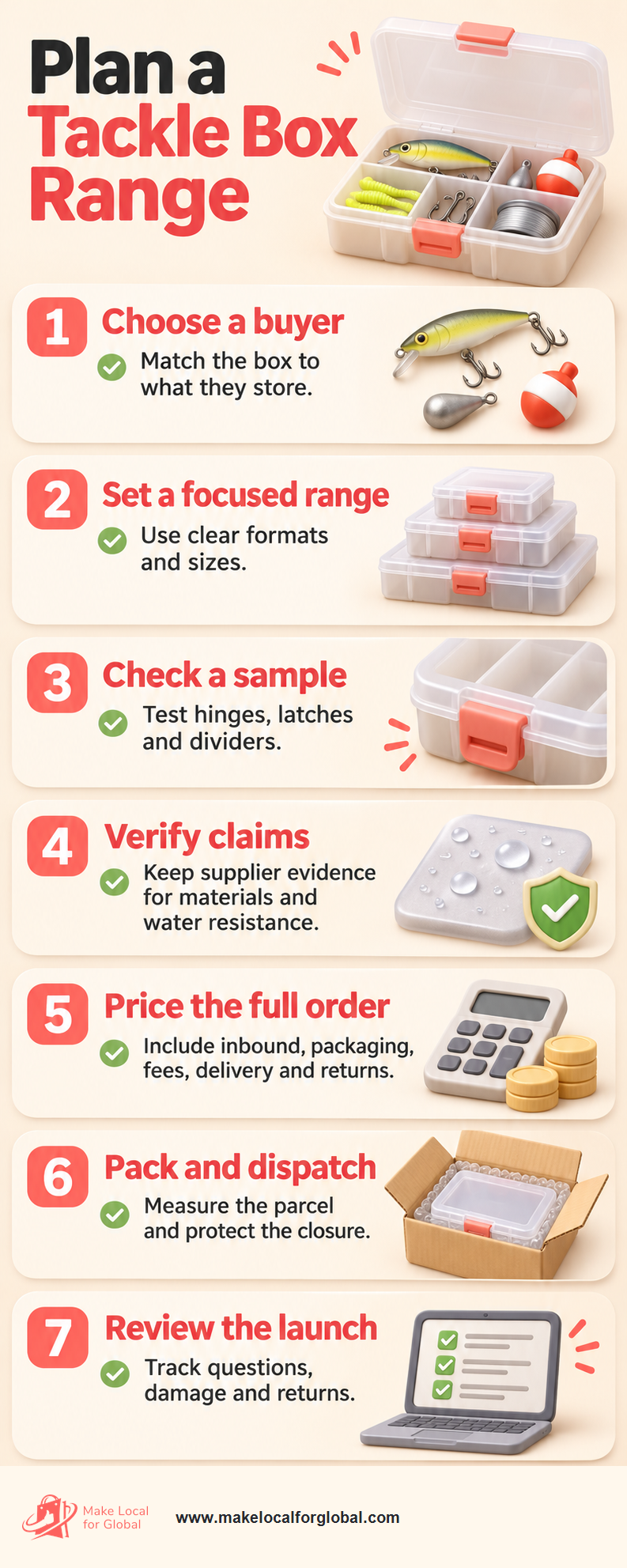
Begin with one storage job you can explain, such as a clear lure organiser with tested removable dividers. Compare at least two samples and check what target buyers already use. Add another format only when it serves a distinct job, such as a shallow terminal-tackle tray or a compact utility case.
Measure the items buyers plan to store and compare them with the internal length, width and depth of the sample. Account for hooks, line spools and lid clearance. Publish external and internal measurements and state where you measured. Avoid saying that a box fits every lure.
Neither format is best for every buyer. Fixed cells give a stable layout and can suit small items. Adjustable dividers offer flexibility but need secure slots and gaps small enough for the intended contents. Test with representative items and show the arrangement in your product photographs.
Use that term only when evidence supports it for the exact model and conditions buyers will understand. A gasket or a supplier’s informal assurance is not proof of a rating. Check the test method, scope and result, then describe the limits clearly. If evidence is missing, give measured construction facts and do not use the claim.
Compare full landed costs, lead times, minimum orders, sample access, supplier records and who handles product information. A UK wholesaler may make small replenishments easier. An import route can add freight, customs work and extra responsibilities. Ask each supplier for comparable specifications and written terms.
Inspect hinge alignment, latch engagement, lid fit, material consistency, sharp edges, divider fit and closure after repeated normal use. Load the box with relevant items, turn it gently and check if items cross compartments. Measure and weigh the sample. Keep photographs and notes tied to its model reference.
Add the landed product cost, packaging, channel and payment fees, delivery, likely returns or damage, and any customer acquisition test. Subtract those variable costs from a tested selling price to estimate contribution. Include fixed overhead, labour and tax separately; the remaining contribution is not net profit.
UK distance sales commonly give consumers a 14-day period to notify the seller they want to cancel after receiving the goods, plus another 14 days to send them back. Conditions and exceptions apply. Read current GOV.UK guidance, follow the marketplace rules and state your process clearly.
Show the closed box, open compartments, divider layout, hinge, latch, external dimensions and the box empty. If accessories are shown, label whether they are included. A brief clip demonstrating the closure and divider movement can answer practical questions. Keep images accurate to the model being shipped.
Choose the fewest formats that serve distinct storage needs and can be sampled, costed and described accurately. A small range reduces the number of stock lines and makes it easier to compare demand. Let buyer questions and order data guide the next addition.
Protect the lid from scratches, prevent movement inside the parcel and shield the latch from impact. Choose packaging after measuring and weighing the real packed order. Test the sealed carton with normal handling and make sure the shipping label and model record match the order.
Keep the supplier name and contact details, model reference, purchase order, invoice, batch or delivery information, written specification, test documents and complaint correspondence. These records help trace stock and compare a sample with later deliveries.
Talk through your product range, site structure or launch questions with Make Local for Global.
PREFERRED SOURCE
Like what you’re reading? Add Make Local for Global as a preferred source on Google to see more of our articles when you search.

Build your online presence without having to figure out everything yourself.