READY TO SELL Fireplace Mantels ONLINE?
Get a store built for you in 5 days, plus training and support to help you start, run, and grow your Alternative business.

Learn how to source, size, price and sell fireplace mantels online, with practical checks for supplier records, safe installation information, bulky delivery, returns and a profitable first range.

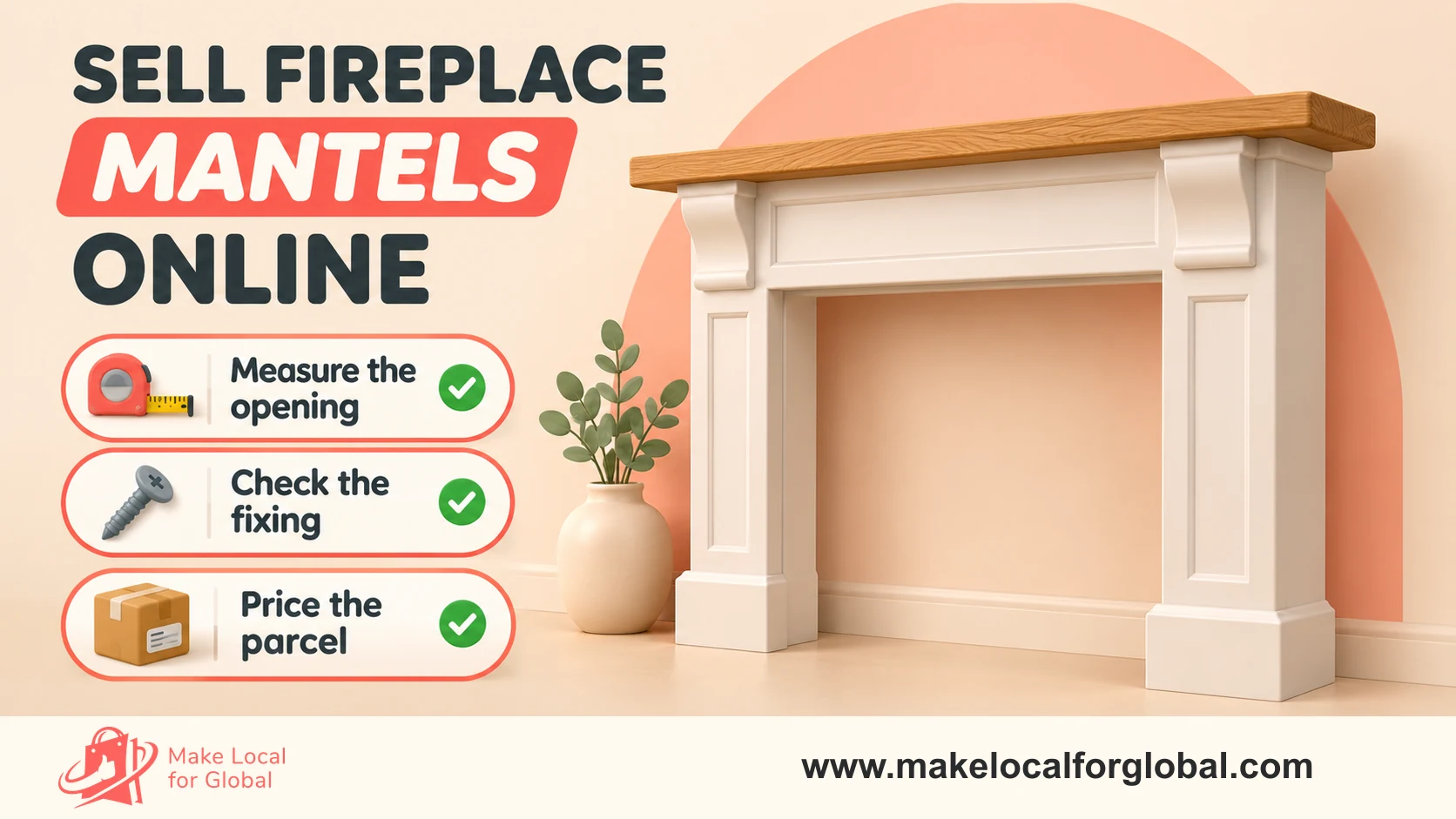
A fireplace mantel is a room feature, a large parcel and, in many homes, a product that sits beside a heat source. That combination changes the selling job. A buyer needs to understand the style, exact opening dimensions, material, finish, fixing method, installation information and delivery plan before checkout.
To sell fireplace mantels online, choose one defined product format and buyer, inspect the exact model and its installation documents, show every measurement clearly, and price the complete packed order. Start with a manageable range of mantel shelves, beams or full surrounds. Add heavier stone or made-to-measure options only when you can verify their sourcing, installation support, packaging and return process.
This article is for a UK business planning to sell new fireplace mantels or surrounds to consumers. It covers commercial decisions and product-page checks. It is not an installation manual. The correct fitting method and clearances depend on the product, wall and appliance. Refer customers to the exact manufacturer instructions and a suitably competent installer.
Show the fireplace opening, product format and fixing documents clearly before customers commit.
People use mantel, mantelpiece, mantel shelf, fireplace surround and overmantel loosely. Suppliers may use those terms differently too. Ask for drawings and a model number before comparing quotes. A product photograph alone cannot tell you whether a listing describes a floating beam, a shelf with corbels, a complete surround or a decorative frame.
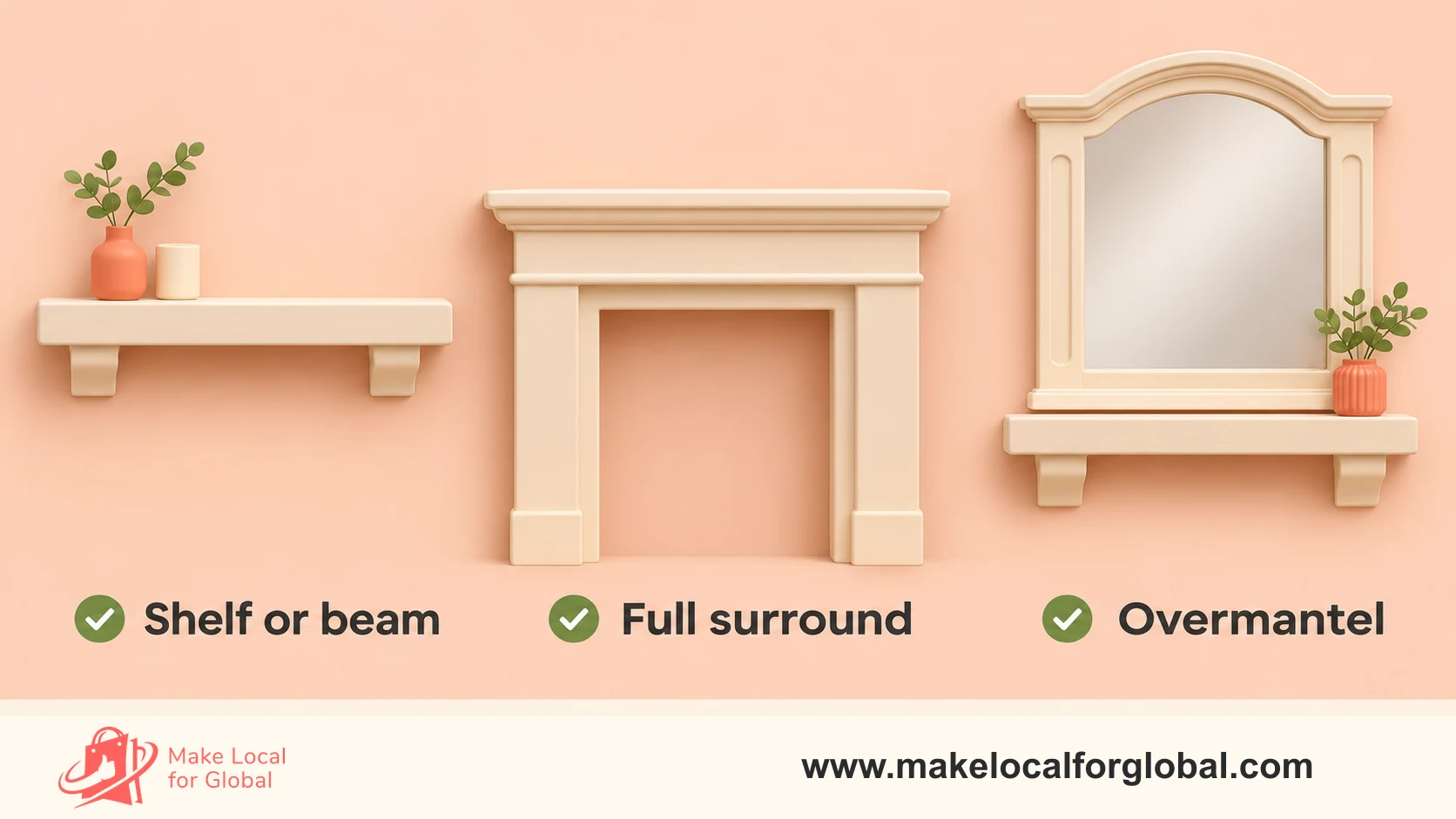
A mantel shelf or beam is the horizontal piece above the fireplace opening. A complete surround usually includes the shelf and vertical legs or pilasters, and may include a back panel or slips. An overmantel can add a mirror, frame or architectural panel above the shelf. Some manufacturers sell coordinated parts separately; others package a complete suite.
A seller can begin with one of three clear offers:
An electric fire or stove is a separate product with its own instructions, electrical or combustion requirements and supply-chain questions. Do not bundle an appliance into the first offer just to increase the order value. If you later sell a combined suite, confirm which business is responsible for each component, what the appliance manufacturer permits, and how product documents and delivery are handled.
Different buyers ask different questions. A homeowner refreshing a living room may care about finish, proportions and delivery timing. A renovator replacing a broken shelf may already know the opening and need a compatible width. An installer or interior designer may need repeatable dimensions, clear drawings, dependable lead times and a trade quotation process.
Choose one primary customer for the first range. Write a short description such as: “A homeowner replacing a dated timber mantel wants a painted shelf with a specified width and a clear product-only fitting guide.” This gives you a useful filter for supplier conversations and listing content.
Do not assume every buyer has an existing fireplace opening. Some customers use a decorative surround against a blank wall; others have a working open fire, gas appliance, stove or electric fire. The product and the intended setting affect the questions you must answer. If you cannot verify appliance compatibility, state that the buyer must check the model's documentation with a qualified installer before ordering.
Fireplace mantels are not easy impulse items. A wrong width, finish or delivery expectation can create a costly return. Learn what prospective buyers ask before committing to several designs.
Review search suggestions, retailer product questions and reviews for repeated concerns: “Will this fit my opening?”, “Is the shelf solid timber?”, “What is the rebate?”, “Does the package include fixings?”, “Can it be delivered upstairs?” or “Will this work with my stove?” Record the source and the exact question. Do not copy a competitor's safety or installation claim as evidence for your own product.
Speak with a small number of likely buyers or local fitters. Ask what they purchased last time, which measurement they needed, what made the order difficult, and how they selected a finish. Ask them to compare two real product pages and tell you which details they still need. Their questions can help you choose the first measurements, photographs and FAQs.
You can test interest with a product page or landing page before carrying stock. Show a real supplier sample or a clearly labelled concept, give an honest availability date, and invite an enquiry or notification request. Do not accept money for an item you cannot supply under the terms you have stated. Track qualified visits, size questions, quote requests and signs of willingness to pay. Treat early responses as clues, not proof of ongoing demand.
A focused range should let buyers compare meaningful differences. An entry product, a central offer and a higher-priced option can work if each one changes a feature the customer values. Avoid a catalogue with many near-identical profiles that make the choice harder.
| Product format | Buyer question it answers | Details to check before listing |
|---|---|---|
| Shelf or beam | “Can I replace or add the horizontal mantel?” | Overall length, depth, thickness, wall fixing, appliance compatibility and included hardware |
| Complete surround | “Will the legs and shelf fit my opening?” | Opening width and height, external width and height, rebate, plinth or hearth relationship, part count and assembly sequence |
| Overmantel | “What is included above the shelf?” | Overall height, mirror or panel dimensions, hanging or fixing details, whether the shelf is included and whether parts ship separately |
| Coordinated suite | “Can I order matching pieces together?” | Exact model compatibility, finish batch, package count, delivery method and which parts are supplied by each maker |
| Made-to-measure piece | “Can the product suit my unusual opening?” | Measurement process, drawing approval, tolerances, finish, lead time, packaging and cancellation terms |
The Stovax Malmo wood mantel page gives one model-specific example: its published overall width is 1,370 mm, overall height 1,155 mm, shelf depth 203 mm and opening 965 by 940 mm, with a choice of 25 mm or 75 mm rebate. It lists white, warm white, oak veneer and walnut veneer finishes, with MDF construction for its smoother painted versions. Those figures describe that named product only. They are not standard mantel dimensions. See the manufacturer's Malmo specification when checking the example.
A finish name does not tell the whole construction. “Oak” might mean solid oak, veneer over a panel or an oak-effect wrap. Ask the supplier for the core material, outer finish, edge treatment, weight and care instructions for each SKU. Use the exact written construction in the listing.
| Material or construction | Possible selling strengths | Questions and risks to check |
|---|---|---|
| Solid timber | Visible grain, repairability for some finishes and natural variation | Species, moisture, grain differences, joins, finish consistency, movement guidance and weight |
| MDF with paint or veneer | Consistent profiles, smooth painted options and repeatable colour batches | Core specification, edge sealing, veneer identity, surface damage, cleaning method and safe use beside the named appliance |
| Natural stone | Individual veining, a substantial appearance and a product with clear variation between pieces | Stone type, finish, batch photos, weight per part, lifting and fixing information, stone care, packaging and transit damage process |
| Cast stone or manufactured stone | Repeated shapes and a defined profile can be easier to present as a coordinated range | Exact composition, surface finish, assembly design, internal reinforcement, fixing points, installer documents and repair route |
| Lightweight decorative construction | Lower parcel weight or a simpler decorative offer may be possible | Exact core and coating, what the product is intended to support, heat limitations and whether a “stone effect” description could mislead |
Use samples to describe colour. A printed swatch, room render or supplier's phone photograph cannot promise that every delivered piece will look identical. Stone veining, timber grain and painted batches can vary. Name the finish and explain the expected variation using the maker's information.
The right first range might be three shelf widths in one profile, a shelf plus a complete surround in one finish, or two full surround profiles with well-documented openings. It does not need to offer every colour, material and size at launch. Every combination becomes a SKU to price, photograph, check and replenish.
Record dimensions with a consistent reference point. For a complete surround, the buyer may need the external width and height, opening width and height, shelf depth and rebate. For a shelf alone, identify overall length, depth, thickness and any rear cut-out or fixing channel. Label each measurement on a diagram and say whether it is the mantel's overall dimension or the opening it is designed to suit.
The word “rebate” can be unfamiliar. Use a simple side-view drawing that shows the recess behind the front face and state the actual measurement. Do not assume a buyer knows whether the figure refers to the wall gap, panel thickness or overlap. Add a short definition beside the diagram, not only in a help page.
A simple first range might use one painted profile in two widths and a natural timber beam in one length. A different core option could be a complete surround in a matching finish. Add a deeper shelf, alternative leg, custom width or stone option only when customer questions and supplier evidence justify the added complexity.
A shelf and matching legs can simplify a purchase if the supplier confirms that the pieces are designed to work together. A bundle might combine the surround with an overmantel, or include two coordinated profiles for a renovation project. Show exactly which pieces are included and whether the buyer needs to order a hearth, slips, fixings or decorative trim separately.
Keep the stock code and package count visible. A “complete set” should not imply an appliance, hearth, wall fixings or installation service unless those items really are included. Check that the bundle's combined size does not change the carrier, delivery appointment or return cost.
Potential sources include a UK fireplace manufacturer, a joinery workshop, a stone fabricator, an importer, a fireplace wholesaler or a private-label supplier. A local maker may offer custom dimensions and direct communication. A wholesaler may hold established stock and product documents. Importing can create more choice and price options, but it adds duties, lead time, packaging review and greater responsibility for checking the product before you place it on the UK market.
Ask for a quote tied to the model code and revision. Compare like with like: a shelf-only price is not a full-surround quote, and a price without packaging or delivery terms may not be comparable with a delivered price.
Request the following information in writing:
A certificate or test report must refer to the exact product and question being assessed. A general quality certificate does not prove that a surround fits a certain opening or that a shelf is safe beside every appliance. If the supplier cannot identify the model or provide the documents behind a product claim, pause the order.
Check the sample against its drawing and quote when it arrives. Measure the overall width, height, depth and relevant opening dimensions in more than one place. Compare the pieces for squareness, alignment, finish, join quality and whether the legs meet the shelf in the manner shown in the supplied documents.
For timber or MDF, inspect the front, end grain or edge, back, underside, joins and fixing points. Look for chips, crushed corners, lifted veneer, exposed substrate, uneven paint, rough sanding, glue marks or an inconsistent sheen. Ask how the supplier expects the finish to be cleaned. Do not use solvent or household cleaner as a test if the care instructions do not permit it.
For stone and cast products, inspect visible veining, filled areas, chips, hairline cracks, edges, corners, joint faces and any reinforcement or fixing pockets described by the maker. Photograph the sample from the same angles you plan to use online. Record what counts as acceptable variation and what should be treated as damage or a defect.
Check the product's own parts and documents, not a substitute from another model. Confirm that shelves, legs, back panels and mounting components correspond to the drawing. If the instructions do not explain how a component is retained, or if they disagree with the supplied hardware, ask the manufacturer for a written answer. Do not invent your own installation method for a product page.
Plan the product photographs before you order stock. Capture the front, side profile, underside, back, finish close-up, fixing points, dimensioned drawing, individual parts and packaging. Photograph the actual item against an uncluttered background. A rendered room can show style, but label it as a room visual if it is not the product itself.
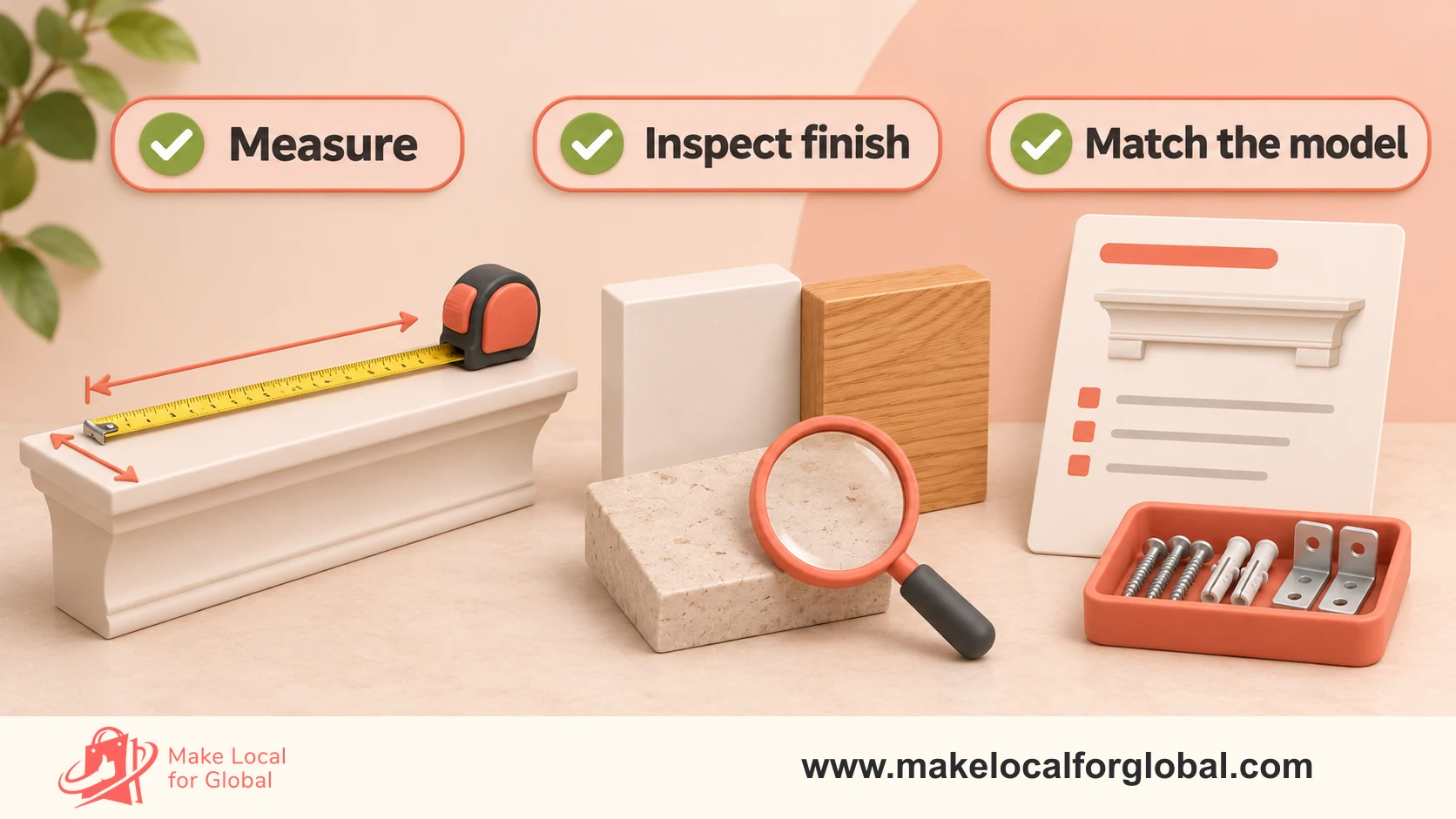
A mantel is often fitted near an open fire, stove, gas appliance or electric fire. That is a safety-sensitive setting. The same shelf material can have different limits depending on the appliance, distance, construction, fixing system and instructions. Do not put a generic clearance measurement in your listing or generated image.
Approved Document J in England covers air supply, discharge of combustion products, protection of the building and information for hearths, fireplaces, flues and chimneys. It does not give sellers one universal mantel height or clearance for every appliance. Other parts of the UK have their own building-regulation arrangements. Direct the buyer to the appliance maker's current instructions and an appropriately competent installer for the exact setup. See Approved Document J.
The Health and Safety Executive has warned that modular stone and artificial-stone fireplace surrounds can create a serious toppling risk if the pieces are not securely joined and fixed to a suitable wall or floor. Its guidance says some individual components can exceed 50 kg. The bulletin asks suppliers to make wall and floor suitability, fixing positions, assembly sequence, adhesive guidance, curing time before a fire is used and any mantel loading information clear to installers. Read the HSE fireplace surround safety bulletin and check whether the exact product documents cover those points.
A seller should provide the installation instructions before purchase when authorised to do so, or explain how the customer can obtain them. State what the supplier has documented. Avoid claims such as “fits any fireplace”, “suitable for all stoves”, “heatproof”, “easy DIY fit” or “supports heavy ornaments” unless the exact product evidence supports the wording and context.
Do not use a mantel photo with a roaring fire to imply a tested clearance or heat rating. A decorative scene should not be mistaken for an installation example. If a customer asks whether a particular model fits a particular appliance or wall, give them the manufacturer document and recommend confirmation from an installer when the setup is uncertain.
GOV.UK says businesses that make, import, distribute or sell consumer products in the UK have product-safety responsibilities. A seller must not supply a product they know, or should know, is unsafe. The requirements and route vary between Great Britain and Northern Ireland, and product-specific rules can apply. Read the Office for Product Safety and Standards advice for businesses and the product-safety guidance for manufacturers and importers.
Keep supplier invoices, model and batch references, drawings, instructions, sample photographs, inspection notes and customer complaints together. If a customer reports a loose or fallen stone piece, burn, cracked component or suspected fixing failure, record the details and stop relying on the affected product claim until the supplier has investigated. Follow the relevant notification and corrective-action route when a risk is identified.
Your customer service process should ask which model and batch they bought, what happened and whether anyone was injured. Do not ask the customer to recreate a potentially unsafe installation or put weight on a suspect product. Keep the record with the product traceability details.
A large mantel may be heavy, fragile or oversized. Its parcel often includes more protective packaging than an ordinary homeware item. The cost model should cover supplier price, inbound freight, packaging, outbound delivery, payment charges, expected damage and returns, marketing and the seller's time.
Here is an illustrative example for one painted mantel surround sold by a VAT-registered business. The figures are hypothetical and should be replaced with the seller's quote, parcel measurements, carrier terms and actual payment rate. It assumes standard-rate VAT of 20% on the full customer payment and treats input tax as recoverable for this simplified contribution calculation.
| Order line | Example amount | Calculation or assumption |
|---|---|---|
| Mantel price | £369.00 | Customer-facing price, VAT inclusive |
| Delivery charged | £30.00 | Customer-facing charge, VAT inclusive |
| Total collected | £399.00 | £369.00 + £30.00 |
| Sales value excluding 20% VAT | £332.50 | £399.00 ÷ 1.2 |
| Product purchase cost | £140.00 | Seller's cost excluding recoverable VAT |
| Inbound freight and handling | £18.00 | Allocated per order |
| Protective packaging | £22.00 | Corner blocks, wrap and outer carton |
| Outbound delivery | £36.00 | Illustrative carrier quote for the packed parcel |
| Payment fee estimate | £11.87 | Assumed 2.9% of £399 plus £0.30 |
| Damage and return allowance | £18.00 | Planning provision per order |
| Customer acquisition | £25.00 | Illustrative cost to secure one order |
| Contribution before overhead | £61.63 | £332.50 less the listed costs |
Check the arithmetic before using this example: £332.50 less £140, £18, £22, £36, £11.87, £18 and £25 leaves £61.63 before fixed overhead. It is not net profit. It excludes labour, storage, insurance, website costs, professional fees and tax on profit. A real seller may have different VAT recovery, price and delivery treatment, or a provider fee calculated on a different basis.
If the customer pays £30 for delivery but the carrier charges £36, the seller absorbs the £6 difference. A “free delivery” offer does not remove the delivery cost; it means the cost must fit inside the product price and contribution target. Calculate each size and material separately. A stone mantel may need a pallet or specialist service and could have a very different cost from an MDF shelf.
Create one spreadsheet row for each model, size, finish and bundle. Record supplier currency and quote date, purchase quantity, delivery terms, packaging materials, packed dimensions, carrier service, customer delivery charge, payment fee, damage provision and expected marketing cost. After the first orders, replace estimates with actual carrier invoices, damage claims and return handling time.
Made-to-measure products need time for measuring questions, drawings, sign-off, cutting, finishing, inspection and packaging. Add those steps to the quote. If the buyer must approve a drawing, keep the approved dimensions and finish with the order record.
Do not label a custom product “non-returnable” without checking the applicable consumer rules and the order's facts. Some goods made to a consumer's specification can be treated differently under distance-selling rules, but the seller must confirm the actual exception and still meet other legal obligations. Explain the terms before payment and seek professional advice for a policy that will be used commercially.
A bulky or fragile delivery may need a booked slot, kerbside drop or two-person service. Confirm exactly what the carrier will do. Do not describe a delivery as room-of-choice or installation unless the service includes it. Tell buyers if they need help unloading or carrying heavy pieces, using a clear, non-alarmist statement drawn from the carrier or maker's instructions.
A useful mantel listing lets the buyer identify the product and compare dimensions without decoding a catalogue drawing. Start the title with the format, material or finish and a real measurement where useful.
Example title: “Painted MDF fireplace mantel surround, 1,370 mm overall width, warm white”. Use that only if the named model and width match. If the product is a solid timber beam, say so. If it is a veneer, name the core and veneer accurately.
A useful description should explain:
Put the important dimensions near the price and options. A buyer who must download a PDF to find the shelf depth may abandon the page or order the wrong piece. Use the same units throughout. If you display both millimetres and inches, check the conversion and label which one is the rounded figure.
Use a size diagram with arrows, not a styled room image alone. For a full surround, show the front elevation and mark overall width, opening width and height, total height, shelf depth and rebate. If the manufacturer permits, add a side view that shows the rear profile. Do not scale dimensions from a photograph.
Include an accurate image of the box contents. Separate the shelf, legs, panels and fixings so a customer can count what is included. A finish sample beside the product can help shoppers compare tone, but state if the sample is not the complete product. Write useful alt text such as “Warm white mantel shelf, shown from the front and side with the 203 mm shelf depth marked.” Avoid repeating the same keyword in every image description.
Use the real sample in daylight and a neutral indoor setting. Capture a close-up of the paint or grain, the underside, ends, joints, fixing position and any visible bracket. Photograph one complete package before dispatch to show how the product is protected. Give the dimensions in a diagram and place the exact model instruction link beside the compatibility notes.
A product comparison can explain which range option may fit a customer's project, but do not call a size “standard” when your supplier has not defined it. Use language such as “the 1,370 mm model shown” or “check your opening against these model dimensions”. The customer should measure their own space and confirm the relevant appliance and installer requirements.
Use phrases that match the product: “fireplace mantel”, “mantel shelf”, “wood mantel”, “fireplace surround”, “mantel beam”, “overmantel” and the actual finish or dimensions. Search terms are useful only when the product really matches them. A shelf listing should not try to rank for a complete fireplace suite if it does not include the surround.
Use the focus phrase naturally in the page title, opening, a relevant subheading and description, then write for the buyer. Answer questions such as “What size mantel do I need?”, “What is a rebate on a fireplace surround?” and “Does the price include fixing hardware?” A clear answer may help a shopper decide even if the wording differs from the phrase they typed.
Publish supporting pages only when each has a distinct purpose. A guide to choosing a fireplace surround size can explain how to read the supplier drawing. A care page can compare manufacturer-approved methods for timber, painted MDF and stone. A mantel article can link naturally to MLFG's advice on selling floating shelves when a reader is considering another home display product, or to framed art prints when planning a broader wall-decor range.
An independent shop gives you room for dimension drawings, finish comparisons, downloadable documents and detailed delivery information. You must attract visitors, maintain stock and manage checkout and customer service. A marketplace may have home-improvement shoppers, but its image, delivery, returns and oversize-item rules may change your economics. Read the current seller policy for the exact platform before adding a heavy product.
Choose one main channel for the first test. Make one listing easy to inspect on a mobile screen. Put the dimensions, included pieces, fit document and delivery charge near the purchase decision. Add one supporting channel only if you can keep stock, finish names, model references and lead times consistent.
Content can answer a specific mantel question:
Do not show a fitting sequence unless the manufacturer allows it and the content matches the exact model. Never use a staged fire, a generic screw or an unverified load test as proof of product performance.
Test acquisition with a defined budget. For one month, track qualified product-page visits, dimension-diagram engagement, quote requests, add-to-cart actions, purchases, cancellation questions, damage reports and contribution after variable costs. Keep the audience and offer consistent long enough to learn from the result. A high number of likes is not the same as an order.
Work through product, protection, carrier, payment and return costs before choosing a selling price.
Measure the complete package after adding the protection, not the bare mantel. Royal Mail's parcel guidance asks senders to include the box and packing materials when weighing and to measure the finished parcel. Its standard UK medium parcel limit is 61 × 46 × 46 cm and 20 kg, while other services have their own dimensions, weights and terms. A full mantel or stone surround may exceed those limits. Compare the actual packed dimensions with a suitable carrier or specialist service before publishing a delivery promise. See Royal Mail's guide to weighing and measuring a parcel.
Test a complete pack with a representative product. Protect every corner and exposed edge. Stop the product shifting inside its carton. Keep brackets, screws and metal pieces from rubbing against the finish. Use the manufacturer's packaging method where available, and record any changes you make. For stone, check whether the supplier requires a pallet, specific orientation, mechanical restraint or specialist handling.
A mantel shelf and a complete surround may need different packing. Long beams can bend or suffer edge impact if the carton has too little support. Multi-part surrounds need the parts separated so one component does not strike another. Do not assume foam alone protects a fragile corner through multiple handling points. Test the packed unit with an appropriate packaging professional or carrier where the likely damage cost warrants it.

Create a pack checklist with product code, finish, package count, component count, fixings, manual, protective pieces, outer dimensions, gross weight and photographs of the closed carton. This helps resolve “missing part” reports and gives you evidence when a parcel arrives damaged. Keep a replacement part route for components that can be shipped separately.
Before checkout, a UK distance seller must give customers required information such as the business identity, product description, full price, payment options, delivery arrangements and cancellation information. GOV.UK explains the distance-selling information businesses must provide. Give a realistic dispatch and delivery estimate. State whether the parcel arrives to a doorstep, kerbside or another agreed place. Do not promise a timed slot until the carrier has confirmed that service for the buyer's postcode.
Online consumers generally have a cancellation period for covered goods, with exceptions for some products made to the buyer's specifications. Read the current GOV.UK returns and refunds guidance and apply it to the exact order. Do not claim a mantel is exempt simply because it is heavy, made to order or assembled after delivery.
Set a damage process. Ask the customer to keep the packaging, record the product code and send clear photographs if a piece is cracked, chipped or missing. Arrange a safe resolution under your policy and legal obligations. If the report points to a safety issue, record it and contact the supplier before sending another part from the same batch.
Packaging may bring Extended Producer Responsibility obligations. GOV.UK says businesses should assess whether they are producers under the scheme, including businesses that pack goods, import packaged goods or sell filled packaging. The current checker explains the activities and thresholds. Check the EPR packaging guidance and keep weights by packaging material if your role requires reporting.
If you register for VAT, check how VAT applies to your sales, delivery charge and purchase costs with current HMRC guidance or an adviser. A pricing spreadsheet should distinguish gross customer payments, VAT and contribution. Do not call the contribution line “profit” when it excludes overheads and tax.
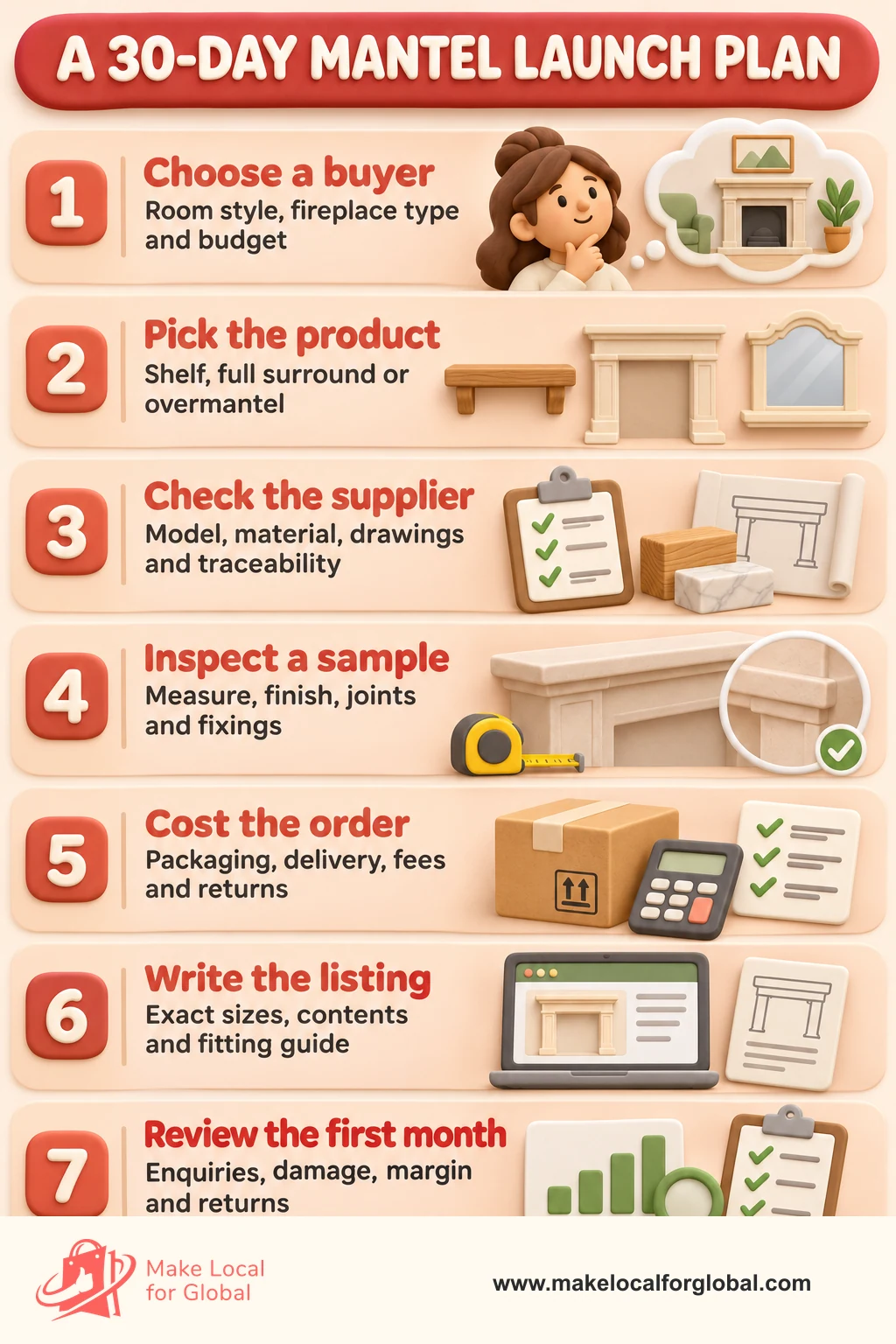
The first month should answer whether one product, its presentation and its delivery process work together. Decide in advance what result would justify reordering, changing the offer or stopping. Set a sample or stock limit and record the date you will review it.
Pick a single first use case, such as a painted shelf for a buyer replacing an existing mantel. Compare a few supplier models with complete drawings, finish information, weight, documents and delivery terms. Choose only the dimensions you can display and support. Ask a few likely buyers which product questions the listing must answer.
Write down the reasons you would reject a model: no exact code, unclear material, incomplete dimensions, unsupported appliance claim, no fitting instructions, weak transit protection or no response to damage reports. Ask the supplier to fill the gaps before paying for stock.
Order the sample or obtain a sample that matches the production item. Measure it and photograph its front, side, back, underside, finish and packaging. Compare every part with the supplier drawing. Follow the maker's documents only as a product check; do not improvise an installation.
Pack a representative order. Measure and weigh the complete parcel, then ask carriers for quotes using the actual figures and destinations. Add product, packaging, fees, delivery, return provision and marketing to the cost sheet. If the contribution is too small, adjust the offer, delivery charge or supplier terms before launch.
Build one page for one product model. Add the correct overall and opening dimensions, material, finish, included items, instruction link, delivery expectation, cancellation information and contact route. Use a front image, a dimension diagram, a finish close-up and a packed-order view.
Ask several people to find the opening dimensions, rebate, package contents, delivery price and fitting document on a phone. Note where they hesitate. Fix unclear labels before driving more traffic to the page.
Share the page through one relevant channel or a small paid campaign with a set budget. Record qualified visits, enquiries, sales, time spent answering fit questions, carrier charges, parcel condition and returns. Keep the product, price and audience stable enough that the numbers can be interpreted.
At day 30, choose to reorder, revise and retest, or stop. Reorder only if the sample, supplier record, contribution and delivery route meet your decision rules. Revise when buyers repeatedly ask the same dimension question or the carton needs more protection. Stop if the supplier cannot support product claims or the order economics do not work. If the sample is too small to interpret, extend the test with a new budget and review date rather than buying a broad range.
A mantel shelf or beam is the horizontal piece above an opening. A surround normally includes side pieces as well as the upper shelf. A listing should say exactly which parts arrive and whether panels, hearths, fixings or an overmantel are separate.
Use the dimensions the manufacturer supplies for the exact model. A shelf may need its overall length, depth and thickness. A surround may need overall width and height, opening width and height, shelf depth and rebate. Label the measurements on a drawing and avoid deriving them from a photograph.
Choose the material you can source consistently, inspect and describe accurately. Timber, painted MDF, natural stone and cast products have different weights, finishes, care needs and delivery risks. Start with one manageable option and add more only when buyer questions and supplier evidence support it.
Only make a compatibility statement that the exact product and appliance documentation support. Clearances, heat exposure and fixing requirements vary by model and setting. Direct buyers to the manufacturers' instructions and a competent installer when compatibility is not clear.
A mantel-only offer is easier to scope. An appliance adds its own documents, supply chain and safety requirements. If you decide to sell a combined suite, verify who supplies and supports each item and how the product instructions work together.
Pack a representative full order, protect corners and edges, separate hardware from finished surfaces, restrain parts inside the carton and measure the completed parcel. Record the package contents and packing method. Stone and multi-part surrounds may need specialist freight or a pallet.
Do not assume so. Some goods made to a consumer's specification may come within a distance-selling exception, but the details matter. Check current guidance and the exact order terms before describing a product as non-returnable.
Begin with one clear buyer and a small number of verified models. A shelf-only option, a complete surround or a second finish can form a focused range if each variant has exact dimensions, supplier documents and a viable delivery cost.
Before ordering stock, connect the drawing, sample, installation document, customer page and packed parcel for one exact mantel model. If those pieces agree, you can explain the product more clearly and make a better decision about whether to expand the range. If they do not, ask the supplier to resolve the mismatch before a customer has to.
Use verified dimensions, model documents and a tested parcel to decide whether the first mantel range is ready to sell.
PREFERRED SOURCE
Like what you’re reading? Add Make Local for Global as a preferred source on Google to see more of our articles when you search.

Build your online presence without having to figure out everything yourself.