READY TO SELL Fire starters ONLINE?
Get a store built for you in 5 days, plus training and support to help you start, run, and grow your Alternative business.

Choose a fire starter type, verify supplier and carrier details, calculate every order cost, and build a product page that answers use, storage and delivery questions.


Fire starters look like a simple product, yet the name covers different goods. A paper-wrapped wood-wool twist, a waxed ignition cube, a bag of dry tinder, a ferro rod and a bottle of lighter fluid do not share the same use, safety evidence or delivery route. That distinction can decide whether a new shop has a workable first range.
To sell fire starters online, choose one product type and buyer, obtain the exact product and safety documents from the supplier, test a sample under the maker’s directions, and confirm in writing which carriers will accept it before you buy stock. Build the product page around verified materials, quantity, safe-use instructions, storage and delivery limits. This article focuses on commercially supplied solid firelighters and manual ignition accessories. It does not give instructions for making firelighters or for starting a fire.
Use MLFG business tools to organise your product questions, first costs and launch tasks before you order stock.
Shoppers use “fire starter” as a broad phrase. Sellers should use a precise product name and keep products with different ingredients, claims or transport status on separate pages. Start with one category rather than a mixed bundle of everything that can create a flame.
| Product group | What the buyer receives | Questions the seller must settle |
|---|---|---|
| Wood-wool firelighters | Twisted wood fibre with a combustible coating, often sold in a counted pack | What coating is used, what warnings apply, how is each piece protected from moisture, and which carrier accepts the product? |
| Wax or solid fuel cubes | Moulded pieces made from a documented solid fuel or wax mixture | What is the complete composition, how does the label classify it, and what are the package and transport requirements? |
| Dry tinder or natural kindling | Dry plant material or small wood pieces sold for ignition support | What species or material is included, how is it dried and protected, and what rules apply to the origin and destination? |
| Ferro rod and striker | A reusable manual spark-making tool, usually paired with a striker | What is the rod material, length, striker design and intended user? Are there sharp edges or age warnings? |
| Lighter fluid, fuel canisters or pyrotechnic products | Liquid, gas or explosive ignition products | These are separate product and transport categories. Do not treat them as ordinary firelighter stock. Get specialist compliance and carrier advice before considering them. |
Product labels vary by supplier. “Natural”, “eco”, “smokeless”, “odourless” and “safe” are claims, not descriptions that a seller can infer from a photograph. Ask for the exact product identity and evidence behind any statement you intend to repeat. If the supplier cannot explain the formula or materials, choose a different item.
Potential customers include householders with a wood-burning stove, campers, outdoor cooking buyers, barbecue owners, people buying a practical gift, and retailers who need a wholesale case. Their buying questions differ. A stove owner may want a compact pack that stores neatly. A camping shop may look for weight, weather protection and clear destination restrictions. A gift buyer may value the presentation and a simple explanation of what the pack contains.
Write one sentence for the first offer: “A counted pack of documented solid firelighters for UK households using a compatible stove, with storage and carrier information shown before checkout.” Replace the example with the actual product and use you can substantiate. Avoid claims that make an everyday firelighter sound suitable for every appliance or setting.
Ask prospective buyers what they need to know before ordering. Show a real sample or an accurate mock-up. Record whether they ask about piece count, burn time, odour, packaging, storage, appliance compatibility or delivery. Those questions can shape the product page and tell you which details matter more than colour or a broad “outdoor lifestyle” message.
Do not treat a polite compliment as evidence of demand. Offer a choice between two real pack sizes with actual prices, ask which they would buy, and record the reasons. A small paid test can reveal more than a social post with likes, but state stock status and delivery timing honestly. Do not take payment for a product you cannot supply on the promised date.
Firelighters sold for household stoves, outdoor cooking, camping and survival kits can overlap in appearance. The use instructions, claims and expected delivery route may not. A product sold alongside a camping stove should not imply compatibility with every stove. A ferro rod is a reusable tool, not a consumable firelighter. A lighter-fluid bottle is not a solid firelighter.
If you sell adjacent products, create distinct product pages and link between them where the customer’s task calls for it. MLFG already has guidance on selling camping gear online and selling BBQ tools online. Those pages can help a reader comparing the wider outdoor range, and this page stays focused on fire-starting goods.
A first range needs enough choice to answer a buyer need and little enough stock complexity to measure. A new seller might begin with one documented solid firelighter in two pack counts, then add a reusable ferro rod only if buyer conversations support a separate product page. That gives a clean comparison without mixing a consumable with a tool.
Consider an entry, core and gift-ready offer only when the numbers and actual stock support each one. An entry pack can let a new buyer try the product. The core pack can provide the seller’s main value proposition. A gift set could add a storage tin or a fire-starting tool, but only if the supplier has verified compatibility, packaging, weight and delivery treatment for every item in the bundle.
For each variation, state what changes: number of pieces, size of each piece, packaging format, included tool or supplier-confirmed use. Do not create colour variants where colour has no buying meaning. Avoid five near-identical products with new names, as each listing adds stock records, photos, questions and the risk of dispatching the wrong pack.
For each SKU, maintain a record containing the supplier code, pack count, ingredient or material description, label version, batch or lot reference where supplied, package dimensions, packed weight, storage direction and approved carrier route. If a supplier changes a coating or package, do not assume the old page remains accurate. Pause the affected listing and compare the new documentation and sample.
Use a range table in your planning sheet. Add the landed unit cost, minimum quantity, shelf life or supplier’s storage statement, parcel size, carrier charge, expected returns and reorder lead time. Keep the evidence beside the figure. A range that looks simple at the product level may involve different case sizes and shipping terms behind the scenes.
Check existing search questions, competitor listing language and marketplace categories. Record buyer questions rather than copying another seller’s claims. Search phrases might include “solid firelighters delivery”, “wood wool firelighters pack size”, “stove firelighter storage” or “ferro rod fire starter kit”. Use only the ones that match the stock you can actually supply.
Ask a small group of target buyers to compare two offers. Give them the pack count, product type, price, delivery estimate and carrier limitation. Ask which option they would choose and what makes them hesitate. If the first response is “Can this be posted to my address?”, shipping eligibility is part of the product offer and needs resolving before any stock order.
Track the source of each enquiry and the next action. A waitlist sign-up, a request for a sample or an order at the displayed price carries a different strength of evidence from a page view. Define in advance what result would lead you to place a small order, change the pack size or stop the idea.

The supplier route changes your workload. A UK wholesaler may offer smaller quantities and domestic support. A manufacturer may supply more detailed product and packaging information. An importer may give you more choice in formulation or pack design, but can make you the importer responsible for market and chemical obligations. A fulfilment service may store and dispatch goods, yet its carrier contract may exclude this category.
Dropshipping does not remove the need to identify the item, describe it honestly or resolve a safety report. Ask where stock sits, which carrier will transport it, what happens if an order is refused in transit, whether the service ships to islands or remote areas, and how an urgent recall would reach you. Order the exact advertised item to your own address if the supplier and carrier permit it.
Ask the supplier to answer in writing:
Do not rely on a marketplace badge, a short product page or an old email. Keep the supplier response, latest document revision, label photographs, purchase order, invoice and sample notes together. If a document names another product code or another formula, ask for the correct file before listing the product.
| Route | Possible advantage | Check before committing |
|---|---|---|
| UK wholesaler | Smaller test order or faster restock may be available | Confirm the wholesaler’s role, traceability, exact stock code and written carrier acceptance |
| Direct manufacturer | Product specification and packaging answers may be closer to the source | Request test evidence, current documents, batch controls and the process for change notices |
| Import of finished goods | Wider choice of pack design or product type | Verify importer duties, customs treatment, responsible economic operator details, labels, transport classification and total landed cost |
| Private label | Brand presentation and pack sizes can match your shop | Review artwork, claims, minimum quantities, chemical classification, warning text and carrier acceptance before production |
| Fulfilment or dropship supplier | Less stock handling at your own premises | Obtain written confirmation that its warehouse and carrier will accept the product and destinations you plan to offer |
Use the supplier’s safe handling and use directions. Never conduct an ignition test where the product label, instructions, premises or local conditions do not permit it. The purpose of a sample check is to compare the delivered goods with the specification and learn whether the packaging, count, appearance and storage match the promised offer. It is not a home certification test.
Record the parcel on arrival: outer damage, water exposure, seal condition, product code, batch reference, label, warning text, unit count, dimensions and actual packed weight. Photograph the unopened pack and each side of its label. Note whether the materials match the supplier’s description and whether the pack closes securely for ordinary storage.
If the product’s intended use involves ignition, follow only the supplied instructions in a permitted setting with appropriate precautions. Do not compare products by setting them alight indoors, by adding fuel, by testing them in an appliance the maker does not name, or by asking a child to handle them. Publish “burns for X minutes” only when exact product evidence supports that figure and the conditions are clear.
Use a test record with columns for question, source, observation, evidence and decision. For instance: “Does the sample contain the listed number of pieces?” Source: pack label. Observation: count matched. Evidence: dated photo and sample record. Decision: pass. For a question such as “Will Carrier A take this item?”, the evidence must come from Carrier A’s current written policy or an account-specific confirmation, not a guess based on product appearance.
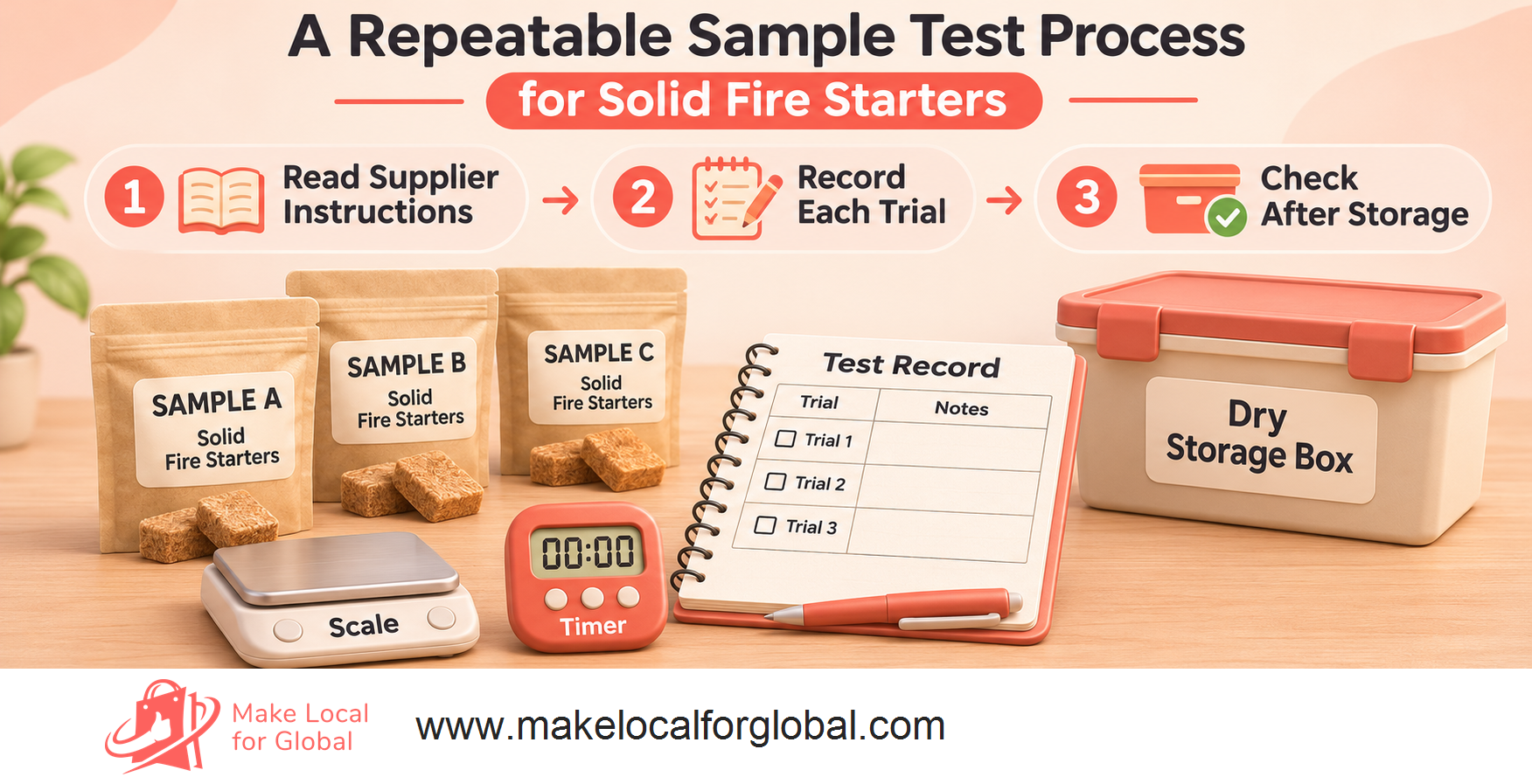
Set pass, query and fail conditions before the delivery arrives. A pass might require a readable matching label, undamaged packaging, correct count and documents for the precise SKU. A query might be a specification that does not clearly distinguish the pack coating from the wood fibre. A fail might be a different product code, missing warnings or a supplier unable to confirm the exact composition.
Hold inventory approval with any safety document, label or shipping question unresolved. Send the supplier photographs and exact questions, then save its response. If it substitutes an item, ask for the replacement’s documents and sample rather than treating it as a minor variation. A small product can still create a costly stock or carrier problem when the information is wrong.
For a reusable ignition tool, inspect the rod and striker against its product specification. Check the handle, lanyard, edges, finish, included sheath and instructions. Keep the tool separate from combustible consumables in photography and packaging notes. Do not imply that a tool makes fire starting risk-free or suitable for use by unsupervised children.
Shipping can decide whether a firelighter product is viable. Do not calculate postage from the parcel’s size alone. The product’s transport classification and the carrier’s prohibited-goods policy can rule out a service even when the parcel is small and the product is sealed. The UK government states that the sender is responsible for classifying, packaging and marking dangerous goods for transport. Check the item’s classification and the current carrier rules before forecasting a delivery cost.
The table below is an illustrative planning example for a hypothetical manual ignition tool sold without a combustible product. It is not a supplier quote, carrier quote or expected margin. Figures are assumed costs per order, excluding recoverable VAT for a VAT-registered seller. Replace them with current invoices and service rates before using the calculation.
| Cost line | Illustrative amount |
|---|---|
| Ferro rod and striker set | £7.20 |
| Inbound freight allocation | £0.55 |
| Protective packaging and label | £0.70 |
| Pick and pack time | £1.10 |
| Marketplace or payment fee | £1.25 |
| Outbound carrier service confirmed for the tool | £3.60 |
| Returns, damage and loss allowance | £0.65 |
| Attributed customer acquisition cost | £2.00 |
| Total variable order costs | £17.05 |
| Example selling price, excluding VAT | £25.00 |
| Contribution before fixed overheads | £7.95 |
Arithmetic: £7.20 + £0.55 + £0.70 + £1.10 + £1.25 + £3.60 + £0.65 + £2.00 = £17.05. £25.00 – £17.05 = £7.95. Contribution is not net profit. It does not include fixed software, insurance, accountancy, rent, business rates, income tax or the owner’s time. If you are not VAT registered, your calculation may treat input VAT and the selling price differently. Ask an accountant how your own position affects the figures.
Do not reuse this tool calculation for solid firelighters. First verify whether your planned carrier accepts the exact solid product. If a carrier prohibits the item, a spreadsheet estimate of £3.60 does not create a valid delivery route. Consider a carrier with an appropriate contracted service only after it has confirmed acceptance in writing, or select a different product category.
Allocate inbound freight and import charges across saleable units, not the gross order quantity if some goods may be damaged or unsellable. Count the outer carton, cushioning, labels, tape, inserts and any safety packaging the carrier requires. Add your labour using a consistent handling-time assumption. Include marketplace payment fees, advertising, replacement shipments and refunds that follow the seller’s policy.
Model the parcel after fully packing one order. Weigh and measure it. Ask the chosen carrier about the precise product and contract type, then save the answer with the rate. Do not list a delivery option simply as an option within the checkout plugin. Hide services that cannot take the product or destination.
If you want to offer free delivery, add the delivery cost to the product economics. A multi-pack bundle may spread the carrier charge over several units, yet it can cross a parcel threshold or a dangerous-goods quantity limit. Recalculate every bundle with the actual packed dimensions and carrier terms.
Compare the product, packaging, delivery and selling costs before you set the first price.
For a solid firelighter, confirm the carrier route and storage requirements before setting a dispatch promise. The current Parcelforce prohibited-goods guidance names firelighters among flammable solids and says they are not allowed in UK or international mail. That policy is one carrier’s published restriction; it does not prove that every product has the same legal classification or that another carrier will accept it. Ask the chosen carrier to assess your exact SKU and service, and retain the written answer. Do not put a restricted item into a standard parcel network in the hope that the label will pass unnoticed.
If the carrier gives written acceptance under a specialised contract, document staff training, packing steps, quantity limits, declaration requirements, collection rules and delivery areas. Review the policy at intervals and after any product or package change. If a carrier declines the goods, do not substitute an unapproved service. Pause the listing or change to a product the available route can carry.
Store stock in line with the supplier’s directions and local fire-safety requirements. Keep products in their original packaging until you have checked whether relabelling or repacking changes your obligations. Separate them from ignition sources and incompatible goods as the current safety documents require. Maintain a stock location and batch record so a specific lot can be identified if a concern is reported.
Prepare a dispatch checklist: match the SKU and pack count, inspect the outside package, include required instructions, select an approved service, confirm the address and note the tracking number. If a parcel is delayed, damaged or refused, tell the customer plainly and record the cause. Never describe a return parcel to a carrier as an ordinary parcel if it contains a product the carrier restricts.
The rules depend on the product, seller’s role, formulation, claims and market. This section is an initial checklist for a seller, not legal advice. Ask a qualified product-safety or dangerous-goods adviser where the classification or transport route is unclear.
For Great Britain, the government’s General Product Safety Regulations guidance explains the safety rules for consumer goods placed on the market in England, Scotland and Wales. The seller’s duties can vary if they manufacture, import or distribute the item. Keep product identification, supplier details, risk information, label versions, batch details and customer complaint records. Northern Ireland follows a separate general product safety regime, so check the current NI requirements before offering stock there.
If your shop imports or commissions the product, read the government’s product-safety advice for manufacturers and importers. Get the manufacturer’s identity, a product specification, risk assessment or test evidence where applicable, and instructions for the intended use. A supplier’s assurance does not replace your duty to understand your role in the supply chain.
Some firelighter products are mixtures; others may be treated as articles for particular rules. Ask the supplier to identify the applicable category and provide the correct document. HSE says substances and mixtures placed on the Great Britain market must be classified and labelled under GB CLP, with supplier classification responsibility depending on the role and product. Read the current HSE guidance on GB classification and labelling and the GB CLP guidance for GB and Northern Ireland. Do not create a hazard label from a template or copy symbols from a similar listing.
Check that the label, online description and supplied documentation match the item in the box. Preserve any required hazard statements, precautionary statements, product identifiers and supplier details. Do not remove a warning when applying a private label. If you are importing a chemical mixture into Great Britain, confirm whether your role makes you an importer under GB CLP. Northern Ireland applies EU CLP rules, so do not assume the GB process covers NI.
Supply classification and transport classification answer different questions. A product may need to be assessed against dangerous-goods transport criteria before a carrier accepts it. The government’s dangerous-goods classes page identifies Class 4.1 as flammable solids and places responsibility for classification, packaging and marking on the consignor or sender. The exact classification has to follow the product and applicable transport rules. Do not rely on a short supplier description such as “natural wax”.
Check each carrier’s current restricted-goods terms for domestic and international service. Parcelforce’s published list gives one clear example: its rules prohibit firelighters in mail. Other carriers may have different services, exclusions or approval processes. Get a product-specific decision for your account and destination before advertising postage. A marketplace delivery label does not override the carrier’s conditions.
GOV.UK’s online and distance selling guidance lists information to provide before a customer orders, including the trader’s identity and contact details, product description, total price including taxes, payment, delivery arrangements, cancellation information and the standard form where applicable. Give the customer a copy of the contract in a form they can keep, and state a realistic delivery time.
Most online goods purchases include a 14-day cancellation period after delivery, subject to the regulations and specific exceptions. Read the current GOV.UK returns and refunds guidance. Do not label a product “non-returnable” solely on the basis that it is combustible or to avoid taking returns. Get advice on the exact item, its packaging and any relevant exception. Statutory rights for faulty or misdescribed goods still apply.
Use a product title that names the actual product, material or type, pack quantity and verified use. For example: “Wood-wool firelighters, pack of 24” is clearer than “Ultimate Eco Fire Starter”. Only use “wood-wool” and “24” when those details match the delivered product. Put a different product such as a ferro rod on its own page.
The first paragraph should tell the reader what arrives, how many units the pack contains, who the item is intended for and which delivery restrictions apply. Add a specification section with dimensions, weight, material or documented composition, storage directions, warnings, manufacturer or supplier details, batch information where relevant and current delivery area. Use measurements from the actual sample or official pack specification.
Photograph the exact item and package in a bright, neutral setting. Include the front of the pack, the count laid out for scale, the back label, package dimensions and a packed parcel. Add close-ups of any material that distinguishes this product from a similar one. A diagram can show pack count and storage information, but it should not replace a label photograph.
Do not photograph the product burning or encourage unsafe handling for a marketing image. Do not edit a product to remove safety information, change its colour, enlarge pieces or imply a performance result. Use alt text that describes the actual image, such as “Pack of 24 wood-wool firelighters beside the sealed paper package”. Avoid repeating the search phrase in every image alt field.
The product page mock-up below is a planning example. The dimensions and shipping cap are illustrative, not specifications for a real product. Replace every figure and phrase with supplier-confirmed data before publishing a real listing.
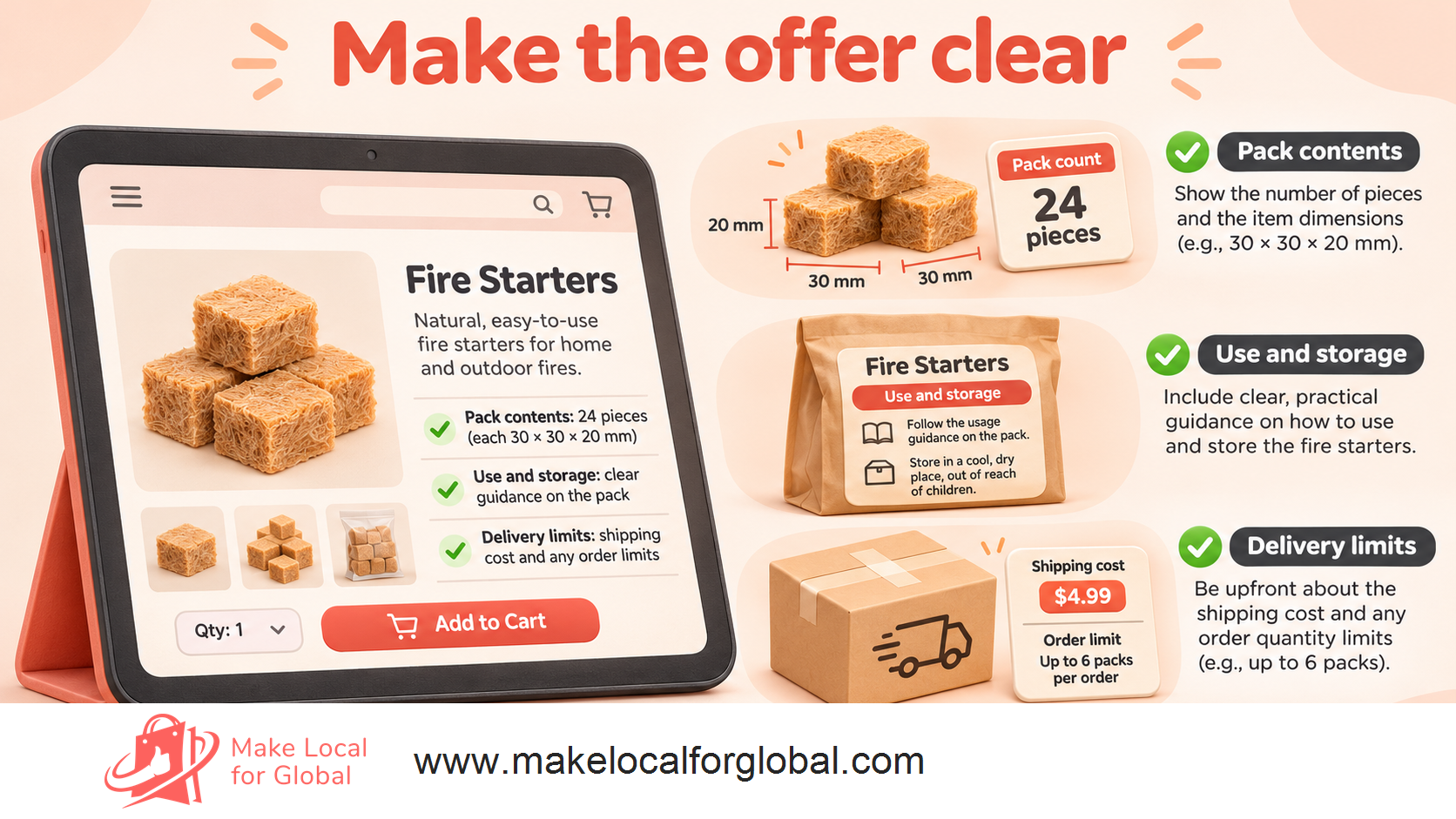
Add a concise comparison table if you sell several pack sizes. Include the number of pieces and total delivered price, not just a unit price. State when a product cannot be sent to a destination. Keep the warning and delivery details visible before checkout, not buried in an FAQ or footer.
A direct ecommerce site gives you control of the product information and buyer questions. A marketplace may bring search traffic, though its category rules and fulfilment arrangements can impose additional restrictions. A local retailer or specialist outdoor shop can give you a route for collection or approved local delivery. A subscription box or gift shop may be worth testing only after the supplier, packaging and carrier arrangement meet the buyer’s requirements.
Ask each channel whether combustible products are permitted and whether the channel’s fulfilment service accepts the exact item. Check the fee schedule, storage terms, prohibited products, returns path and buyer-protection policy. A product allowed in a seller’s own shop may be blocked by a marketplace’s fulfilment warehouse. Do not activate a listing until stock availability and the carrier option agree.
For organic search, build one precise page for each distinct product type. Use a product page for transaction details and supporting articles for questions such as how pack counts differ, how to read a firelighter label, or what to check before buying a ferro rod. Avoid doorway pages that repeat a template that changes only the product name. Do not promise buyers a result that your product records cannot support.
Send useful content to the product page. An article about checking a stove-compatible firelighter can link to the exact SKU and its instructions. A guide to outdoor cooking equipment can link to a separate product group. The existing fire extinguishers selling article covers a related but distinct category. A firelighter does not extinguish a fire; keep their products and claims separate.
Start with a product demonstration that stays within the maker’s directions and local safety requirements. A packaging close-up, pack-count comparison or storage explanation can answer a question without staging an unsafe fire. Ask a specialist retailer what information it needs on a wholesale sheet. Test one search ad or one relevant email with a fixed spending cap, then compare enquiries and orders with the contribution calculation.
Avoid unsupported claims such as “zero smoke”, “non-toxic”, “carbon neutral”, “100% safe”, “chemical free”, “works in any weather” or “burns for ten minutes”. A natural material may still need handling advice; a product’s appearance does not prove that it is non-hazardous. Keep the claim log: exact wording, supporting document, product code, market, date checked and reviewer. Remove a claim when the evidence no longer applies.
When writing a social post, name the product type and count, show the label, identify the allowed delivery area, and link to the exact listing. Do not use images of a different formula or pack size. If a campaign produces questions about the same missing detail, update the page before spending more on promotion.
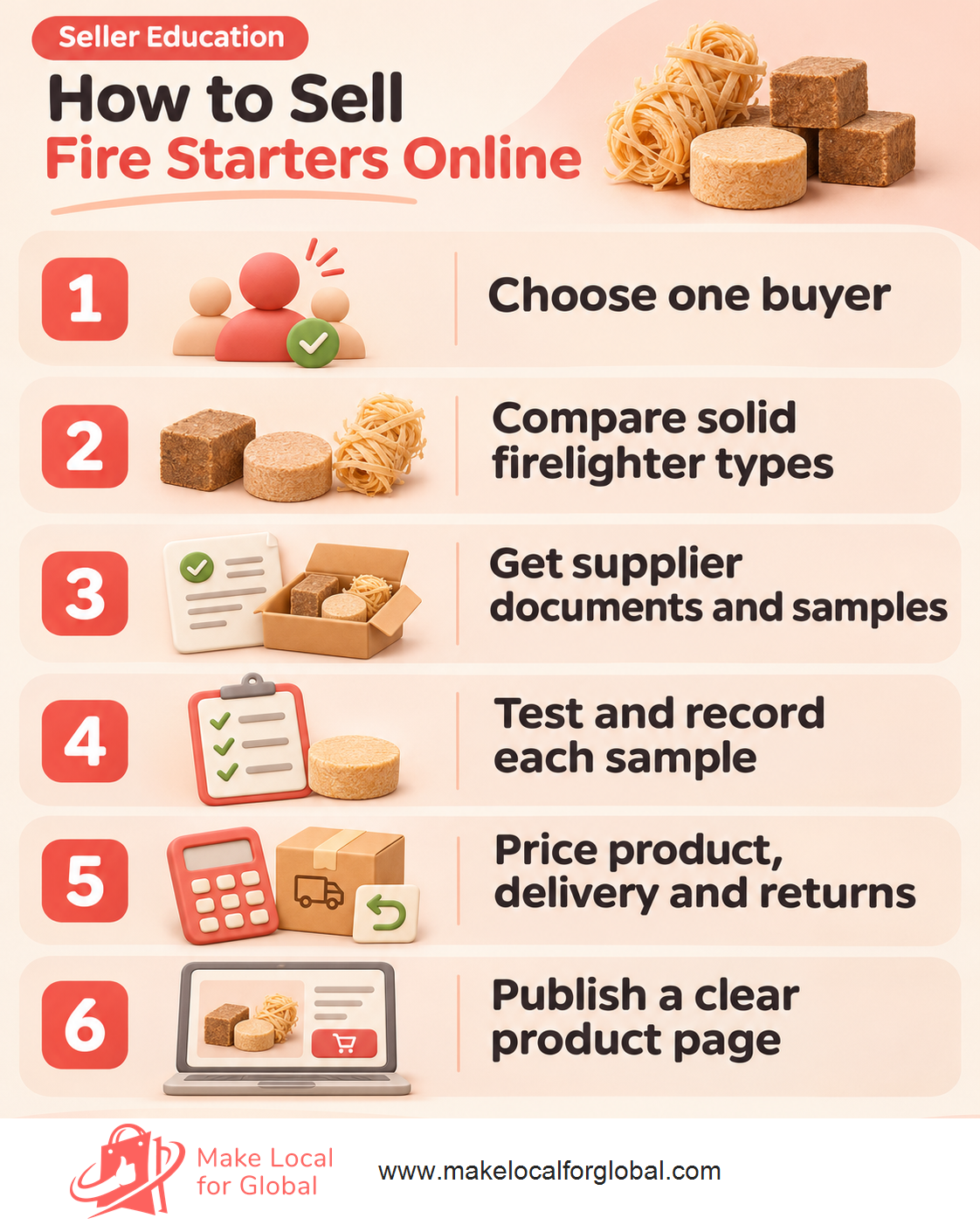
Pick one buyer and one product group. Request documents and a sample from at least two suppliers using the same written questions. Ask each proposed carrier whether it accepts the exact SKU, formula, pack and destination. Record each response. Stop if you cannot establish a lawful safe route to the customer.
Speak with a small group of likely buyers. Give them the actual proposed pack size, expected price and delivery statement. Ask which information they need before ordering. Record the questions and use them to decide whether the product remains a good fit for the range.
Compare the delivered sample with the product code, specification, label and package. Record the count, dimensions, weight, pack condition and batch reference. Use only the manufacturer’s safe instructions for any permitted use check. Do not treat a home demonstration as proof of safety or compliance.
Resolve differences with the supplier in writing. Ask for the correct document when a label or product code does not match. Decide whether the sample passes using your prewritten criteria. Keep the decision and evidence in one product folder.
Measure and weigh the packed order. Use the carrier rate and acceptance confirmation for the intended route. Build cost calculations for one pack, a larger order and a promotion. Include supplier cost, inbound freight, import charges, packing, handling, sales fees, outbound delivery, returns, marketing and tax treatment.
Write one listing with the verified product name, contents, material or composition, dimensions, warnings, storage instructions and delivery limits. Ask a person unfamiliar with the product to read the page and explain what they believe will arrive. Fix unclear language before taking orders.
Order only the quantity supported by the supplier evidence, carrier route, cash budget and demand test. Check each received lot against the approved sample. Pack and weigh an order, then use the contracted service. Record pick time, actual fee, delivery outcome, customer questions, cancellations and returns.
At day 30, compare actual order contribution with the estimate. Decide whether to keep the product, change the pack, renegotiate the carrier route, revise the page or pause. A small test is useful when it gives you a decision, whether or not you restock.
The first mistake is treating every fire starter as the same product. A solid combustible, a liquid, a gas, a ferro rod and natural tinder can have different supplier documents, labels and shipping rules. Name the exact item before comparing it.
The second is relying on “natural” as a safety assessment. Ask for a current product specification, chemical classification where applicable, directions and supporting claims. Keep the records matched to the actual supplier code.
The third is checking postage only after the stock arrives. A carrier can refuse a firelighter even when it is safely packaged. Confirm acceptance for the SKU and service before committing cash or advertising delivery.
The fourth is using one price calculation for every pack. A larger case can change package size, carrier eligibility, handling time and fees. Recalculate each offer using packed measurements and current service terms.
The fifth is hiding the restrictions at the bottom of the page. The buyer needs the product contents, warnings, storage guidance and delivery territory before paying. Put the important facts beside the purchase decision and repeat them at checkout where the system allows.
When the product, paperwork and delivery route are clear, discuss the practical steps for putting the offer online.
You can sell a product only after you identify what it is, meet the product and chemical requirements that apply to your role, describe it accurately and arrange an accepted delivery route. Requirements can vary by formula, product type, business role and UK nation. Ask a specialist adviser about an unclear classification.
Do not assume that you can. Parcelforce’s current published restrictions list firelighters among flammable solids and prohibit them in UK and international mail. Other carriers may have different services. Ask the specific carrier for a written decision on your exact product before listing delivery.
No. They can differ in material, coating, product classification, package instructions and transport treatment. Request the documentation for the exact item and keep separate product pages where the buyer needs different information.
Use a claim only when the supplier evidence supports that wording for the product you sell. “Natural” does not establish that a product is harmless or exempt from classification. Explain the verified material and avoid broad environmental claims without suitable evidence.
Possibly, after checking both products, their packaging, label instructions and delivery route. A bundle can combine goods with different transport treatment. Ask the carrier about the complete packed kit and state exactly what the buyer receives.
Ask for the product code, full composition or material specification, current label artwork, use and storage directions, product safety documents, relevant test evidence, batch or lot information, and written carrier classification or acceptance information. The supplier should confirm each document applies to your exact item.
Name the item, state pack count and dimensions, list the documented material or composition, show the label and warnings, describe storage and intended use, identify delivery limits and provide contact, cancellation and returns information. Use the exact supplier data rather than assumptions.
Choose a quantity supported by a small demand test, the supplier’s minimum, the cash you can keep tied up, storage conditions and the confirmed delivery route. If the product cannot ship through your planned carrier, do not buy stock on the assumption that the route will change later.
This article does not provide a manufacturing recipe. Making or blending a combustible product can bring product safety, chemical classification, labelling, workplace, environmental and transport duties. Get qualified compliance advice before developing or selling a formulation.
The consignor needs to identify the hazards and classify the product under the transport rules that apply. Ask the manufacturer for the transport classification and consult a dangerous-goods adviser or carrier when the information is missing. A retail label alone may not answer the transport question.
Follow the consumer rules that apply to the transaction and the carrier’s return conditions. Do not ask a customer to put a restricted product into ordinary post. Give a suitable return method where required, and get advice on any product-specific exception before changing the policy.
Only if the same exact product, instructions, claims and delivery route support both uses. When the product or buyer expectations differ, use separate listings and link between them. Do not imply that one product suits every stove, grill or outdoor setting.
Show the real pack and label to the intended buyer, publish the exact delivery limit and ask which detail still prevents an order. A small, capped campaign or local retailer conversation can test the offer. Track paid orders and questions rather than treating reach or likes as proof of demand.
Start with one product type, one supplier whose documents match the sample, one delivery route the carrier has accepted and one offer you can cost from end to end. If any of those four pieces remains unresolved, pause the stock order and settle the question first.
PREFERRED SOURCE
Like what you’re reading? Add Make Local for Global as a preferred source on Google to see more of our articles when you search.

Build your online presence without having to figure out everything yourself.