READY TO SELL Garden Carts ONLINE?
Get a store built for you in 5 days, plus training and support to help you start, run, and grow your Alternative business.

Compare garden cart types, inspect a sample, price delivery and prepare a clear product page before running a focused first sales test.

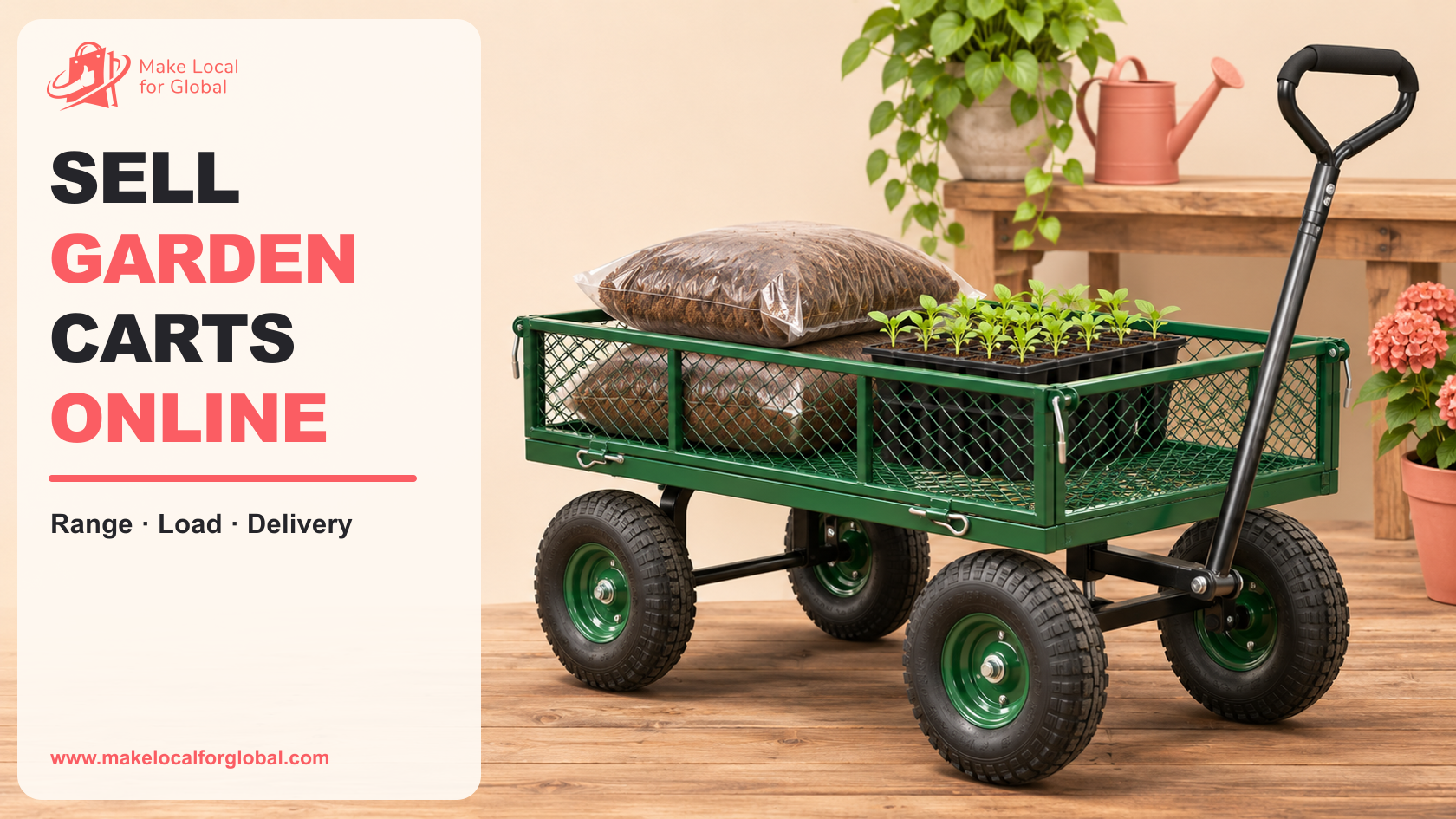
A garden cart can look simple in a product photo, yet the wrong combination of bed size, wheel type, frame, load limit and packed dimensions can create expensive returns. A compact folding wagon for pots is a different offer from a steel mesh cart for moving bags of compost. Treating them as the same product makes the listing vague and the delivery plan unreliable.
The practical way to start is to select one buyer and one job, compare a small number of cart types, inspect a physical sample, and cost the packed order before you commit to a wide range. This article focuses on hand-pulled garden carts and utility wagons for consumer use. It does not cover powered dumpers, ride-on tractor trailers, mobility devices or child-carrying wagons. Those products can bring different product safety and insurance questions.
Gardeners do not all move the same loads over the same ground. A person with a paved courtyard may want a narrow cart for compost bags and hand tools. An allotment grower may need a larger load bed and air-filled tyres for gravel paths. A landscaping contractor may care about frame stiffness, replacement wheels and repeated heavy use.
Write a one-sentence buyer hypothesis before contacting suppliers. For example: “I am testing a mid-sized mesh cart for allotment holders who carry soil, hand tools and plant trays along uneven paths.” The sentence gives you a first set of questions: how wide are the paths, what loads are common, where does the cart need to be stored, and how much lifting is acceptable?
Use a recent task as the starting point. Ask likely buyers what they carried, what route they used, what slowed them down and what they would change about their current solution. A buyer who uses a wheelbarrow may value a cart that balances differently. Someone who carries small pots may prefer a low-sided bed that makes loading easy.
Do not ask only whether someone likes the idea. Show a plain description or a sample photo and ask what they would use it for, what might stop them buying, and what information they would need before paying. Record their words. If they mention a garage doorway, narrow gate, shed shelf, steep path or wet grass, those details can shape dimensions and product-page images.
Potential first audiences include:
These groups are starting points for research, not proof of demand. A small set of conversations can reveal missing details, but it cannot establish the size of a market or guarantee sales.
Choose one cart type and one buyer group for the first test. Put a short description in front of people who match the buyer. Include the bed dimensions, stated load limit, wheel type, packed size and proposed price. Ask them to compare it with their present method of moving items.
Use more than one evidence source. Search garden forums and retailer reviews for repeated questions about tyre punctures, turning space, awkward assembly, corrosion, cleaning and storage. Record the product, date, source and exact issue. A review may describe one customer’s experience rather than a general fault, so check whether the same concern appears elsewhere.
You can run a small landing-page or listing test before buying a large batch. Use accurate copy and images. Make clear whether the item is available, a sample, or part of a research test. Do not accept payment for stock you cannot supply within the stated terms. If you collect enquiries, ask a clear question such as “Which path surface would you use this on?” and store responses in a simple sheet.
Set a decision rule before the test begins. You might continue if several suitable buyers ask for the delivery price or request a sample viewing. You might revise the bed size if people repeatedly mention narrow paths. You might pause if the packed parcel is too costly for the proposed price. A test helps when it changes a decision; a large pile of unclassified comments does not.
Use the free launch assessment to organise your buyer, cost, delivery and first-test questions before committing to a wider range.
“Garden cart” covers products with different frames, wheels and handling. Use the supplier’s product name as one clue, then compare measurable specifications. A photograph can make two carts look alike even when one folds for storage and another is built for a heavy load.
| Cart type | Typical buyer use | Questions to check before sourcing |
|---|---|---|
| Two-wheel tipping tub cart | Compost, loose soil, garden waste | Does the tub tip smoothly? What is the maximum load? Can the buyer lift or manoeuvre it when full? |
| Four-wheel steel mesh utility cart | Bags, tools, planters and mixed loads | Are the side panels removable? Can they fold? What are the wheel diameter, bed size and stated load limit? |
| Poly tray cart | Wet soil, feed, pots and general garden jobs | Can the tray be removed or cleaned? Does it flex under the test load? Are replacement wheels available? |
| Folding fabric wagon | Light garden supplies, plant pots and outdoor events | What are the unfolded and folded dimensions? Is the fabric removable? Do the small castors suit the surface? |
| Low platform cart | Large pots, heavy boxes or awkward items | Is the load secured? Can the user turn it through a gate? Is the handle comfortable at the expected height? |
A product can sit in more than one category. For a useful range, classify each item by the job it performs and the condition it suits. Avoid a list of near-identical carts where the only visible variation is colour.
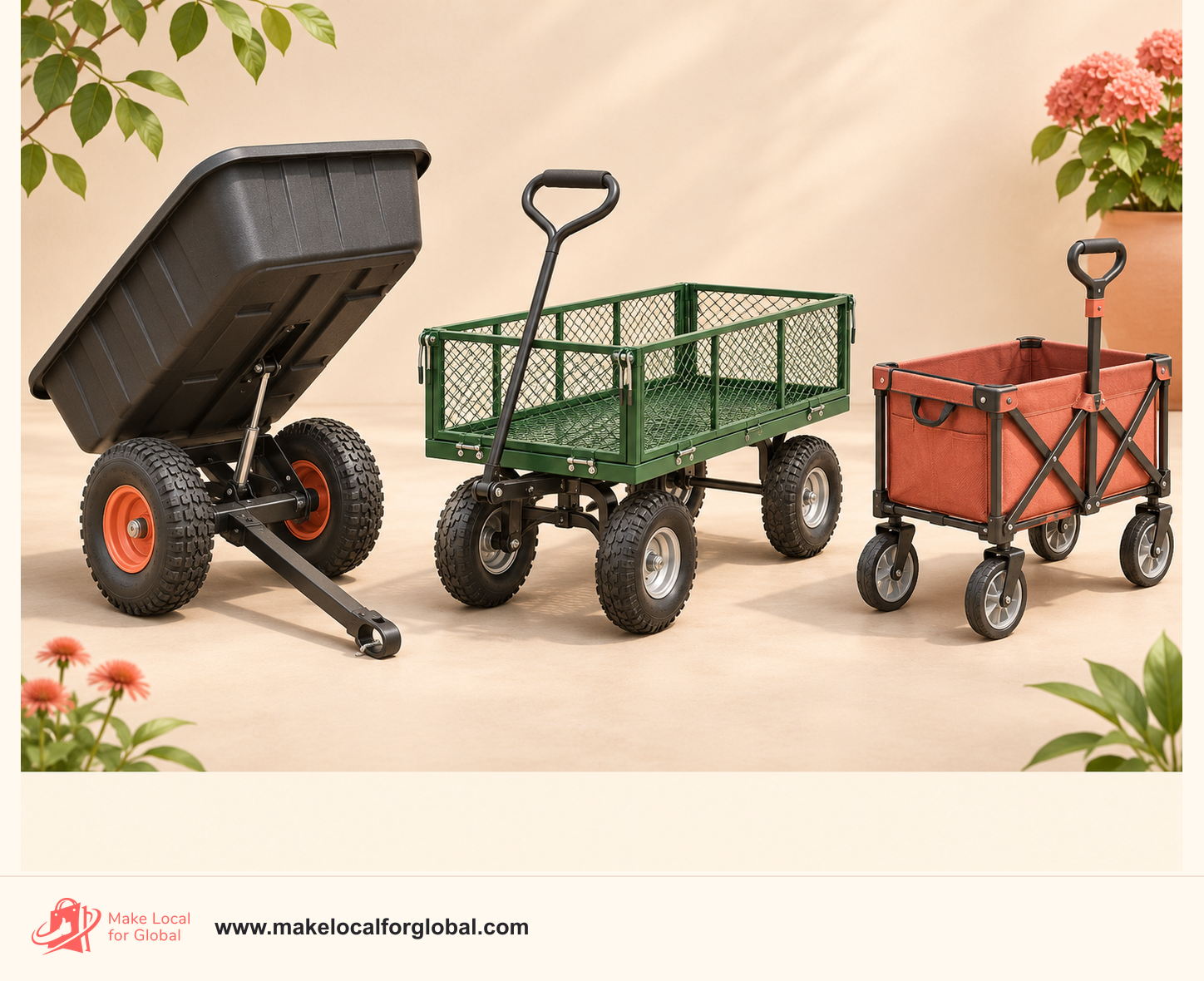
Compare the cart bed and wheel design with the buyer’s actual task.
Start with one clear main product and at most one or two alternatives. A practical first offer might include a compact folding wagon, a mid-sized steel mesh cart and a tipping tub cart. That gives the buyer a choice across storage, mixed loads and loose materials. It gives you distinct specification and packing questions to test.
An entry, core and premium structure can work when each step makes a clear change:
Do not use “entry” as a way to hide weak information or safety concerns. The lowest price should still have a useful product description, tested components and clear limits. A premium price needs a reason the buyer can see, such as a more suitable bed size, better wheel specification or available replacement parts.
Bundles can add value when the extra item fits the job. A cart with a liner, cover or tool holder may suit a buyer moving loose compost or keeping smaller tools together. Before creating a bundle, check that the accessory fits the exact frame and does not obstruct folding, tipping or safe loading. Show what arrives in the box and which accessories are optional.
A product title should help a buyer distinguish one cart from another. “Heavy Duty Garden Cart” is vague when it gives no dimensions, wheel type or supported load. A clearer title could be “Four-Wheel Steel Mesh Garden Cart, 95 L Bed, Folding Sides”. Use the true product measurements and supplier wording only where you have verified it.
Use “kg” for load capacity and include the supplier’s stated limit without rounding it upward. Capacity may depend on the cart being used on a suitable surface and loaded evenly. If a supplier provides a working load limit, a static load limit and a towing limit, do not merge them into one number.
Possible sourcing routes include a UK wholesaler, a UK importer, a manufacturer, a trade distributor or a private-label arrangement. Each route changes the order size, lead time, documentation and the amount of product responsibility you may hold. A UK supplier can make sample checks and returns simpler, though the product may still have been manufactured elsewhere. An overseas factory can offer more control over design, yet it can require larger orders and closer checks on documents, freight and compliance.
Start by collecting the same information from each supplier. Ask for:
If your first store will cover larger garden goods, compare its offer with the separate guides to selling garden arches online and selling garden trellises online. Their assembly, dimensions and delivery questions can help you map the extra work that comes with bulky outdoor stock.
Ask for the exact model number and confirm that the sample, quotation and eventual shipment refer to the same model. Supplier pages can change. Save a dated PDF or screenshot of the relevant specification, then check the delivered sample against it.
Do not compare suppliers by the factory unit price alone. Add inbound freight, duty or customs charges where applicable, insurance, handling and any inspection cost. If you import into Great Britain, product safety guidance says an importer can have obligations beyond those of a distributor. Read the current GOV.UK product safety advice for businesses and the Great Britain guidance for the General Product Safety Regulations 2005.
Keep supplier paperwork connected to each product model and batch. Record the supplier, invoice, delivery date, quantity, model code and any inspection result. If a fault appears later, that record can help you identify other units from the same shipment.
When a supplier says a cart can carry a particular load, ask how that limit was tested and what use conditions apply. Ask for the manual, parts list and available test reports. A sentence in a sales email is not the same as a test record. If the supplier cannot explain the load claim, do not repeat it as a tested fact on your product page.
If you plan to sell under your own brand, ask a product safety specialist what responsibilities apply to that arrangement. Your legal role can change with the way you source, import, rebrand or distribute a product. Requirements can differ between Great Britain and Northern Ireland. For Northern Ireland, read the current GOV.UK guidance on Regulation (EU) 2023/988. Seek qualified advice for a specific product or route.
A photo will not reveal loose wheel hubs, sharp mesh edges or a handle that twists under load. Assemble at least one sample from the same model you plan to sell. Follow the supplied instructions and record each issue as you go.
Look at welds, corners, mesh ends, tray edges, hinge pins and bolt holes. Run a gloved hand along metal edges, then inspect any area that touches the user’s hands or clothing. Check for uneven coating, bare patches, rust, cracked plastic, loose trim or deformation.
Fit each side panel and remove it again. Check whether the latch engages cleanly and stays in place during ordinary movement. Fold the panels down and confirm they do not jam against the wheels or handle. If the cart tips, test the release and return action with the cart empty before adding a controlled load.
Spin each wheel by hand. Listen for scraping and look for wobble. Check that wheel fixings are secure and that pneumatic tyres hold air after inflation to the supplier’s stated pressure. Solid or puncture-resistant tyres may avoid punctures, yet they can roll differently on soft ground. Do not present one tyre as suitable for every path.
Turn the loaded cart in a clear area. A four-wheel cart with a turntable front axle may need more clearance than a two-wheel model. Test it through the width of a typical gate or doorway if that is part of the target buyer’s use. Check handle length and grip comfort with a person of typical intended height, without implying that one test represents every user.
Follow the manufacturer’s test guidance first. If you carry out an internal check, use a controlled, evenly distributed load below the stated limit. Keep bystanders away and do not stand beneath raised or tipping parts. Do not ask staff or customers to ride in a cart. Stop if a wheel shifts, a panel bends, a latch releases, a fastener loosens or the frame makes an unusual movement.
Test the cart on the surfaces you intend to describe: flat paving, compacted soil and a short section of gravel can produce different results. Record the cart model, load, surface, distance, turns, date and outcome. Treat a short sample check as your own inspection, not as proof that the product is safe in every condition.
Remove soil from the tray and frame, then dry the cart as the instructions require. Check whether water collects in corners or around fasteners. Fold or dismantle it using the supplied instructions and note the space it needs for storage. If the product uses proprietary wheels or hinges, ask the supplier how a customer can obtain replacements.
Keep a simple inspection record:
| Check | What to record |
|---|---|
| Assembly | Missing parts, unclear instructions, time to assemble |
| Frame and bed | Sharp edges, deformation, coating, loose mesh |
| Wheels | Wobble, rotation, tyre condition, turning behaviour |
| Handle and panels | Grip, latches, folding and tipping movement |
| Load | Load amount, placement, surface, distance and result |
| Pack and storage | Packed size, protection, fold or dismantle steps |
If the cart fails a check, contact the supplier and pause the listing. Do not try to fix a structural problem with a cosmetic adjustment. A new sample from a revised production run needs another inspection.

Inspect wheels, latches and the cart bed on the exact model you plan to sell.
Bulky goods can absorb a surprising share of their selling price in delivery and damage handling. Work out the cost of one typical order before you choose a retail price. Build separate lines for the item, inbound freight, packaging, outbound delivery, payment and marketplace fees, customer acquisition and an allowance for returns or damage.
The figures below are illustrative, not supplier quotes or a suggested market price. Suppose a VAT-registered seller charges £240 including standard-rate VAT for one garden cart. Under the current 20% standard rate, the sale value excluding VAT is £200. Most goods use that rate, but sellers must check the treatment for their own business and products on GOV.UK VAT rates.
| Order line | Illustrative amount | Notes |
|---|---|---|
| Customer price, VAT included | £240.00 | Consumer-facing price |
| Sales value excluding VAT | £200.00 | £240 ÷ 1.20 |
| Landed cart cost | £90.00 | Item and allocated inbound freight |
| Carton and protective materials | £8.00 | Measure the actual packed model |
| Outbound delivery | £16.00 | One hypothetical service and zone |
| Payment fee allowance | £7.40 | Hypothetical 3% of £240 plus £0.20 |
| Returns and damage allowance | £6.00 | Planning allowance, replace with observed data |
| Customer acquisition cost | £20.00 | Example allocation from a small promotion |
| Contribution after listed variable costs | £52.60 | £200 − £90 − £8 − £16 − £7.40 − £6 − £20 |
Illustrative figures only. Replace them with current supplier, carrier and payment quotes for your route.
The £52.60 is contribution after the listed variable costs. It is not net profit. It does not cover store subscription, insurance, storage rent, staff, bookkeeping, equipment, income or corporation tax, nor the owner’s time. Recoverable input VAT is not included in the cost figures above; a non-registered seller needs a different calculation. Payment fee rates and courier quotes vary, so replace these assumptions with current provider terms and quotes.
Run the same calculation at a lower price and at a slower sales pace. If contribution becomes too small after a modest discount or one return, the offer may need a different supplier, pack format, service level or buyer. A low unit cost will not rescue a cart if most orders require a costly oversize service.
If monthly fixed costs for the shop and storage are £600 and the example order contributes £52.60, dividing £600 by £52.60 gives about 11.4 orders. In practice, the seller would need at least 12 orders at that contribution to cover those fixed costs, before tax and owner’s pay. This calculation assumes the listed contribution is available on every order, which is unlikely to match real conditions exactly.
Use the calculation as a question, not a prediction. Can the supplier deliver enough units? Is there room to store the cartons? Can you pack each order within the assumed labour cost? Does the delivery price hold for every postcode you plan to serve? A spreadsheet should distinguish confirmed quotes from estimates so a change in one line does not get hidden in the total.
If you are not registered for VAT, do not copy a VAT-registered seller’s figures without adjustment. Check current HMRC VAT registration guidance. The registration threshold can change and the rules depend on taxable turnover and business circumstances.
Set out sample, stock, storage, packing and promotion costs, then check how much remains for the next stage.
Compare carts using contribution per order, packed volume, returns risk, stock cash tied up and the buyer need served. A smaller cart may contribute less per order but cost less to store and dispatch. A larger model may have a higher ticket price, yet require pallet storage and a two-person lift. A cart that folds could be easier to store, though its joints and fabric need their own testing.
Do not set a price by copying the first retailer result. Retail pages can list different sizes, bundles, sale prices and delivery terms. As one example of the spread in the category, UK retailer pages list small folding garden wagons at one end and a 300 kg multi-purpose cart at another. The Wilko garden trolley listings and the Handy multi-purpose garden cart at Wickes show how unlike products can sit under similar search terms. Treat listed prices as examples observed on the page, not as proof of average sales or profit.
The product page should help a buyer decide whether the cart suits the job and whether it will fit through the route and storage space. Put the most useful facts near the purchase decision. Use a clear title, direct summary, specification table, delivery note and photographs of the product in use.
For each cart, state:
Use a diagram or photograph with a tape measure to show the physical size. A capacity in litres does not tell the buyer the length of the bed, and a length measurement alone does not show how much soil or equipment can sit inside. Avoid describing a cart as suitable for steep slopes, rough ground or a specific weight if the supplier supports the claim and your inspection backs the product details.
Prepare a consistent photo set:
Use one image to show the cart’s actual scale. A person or standard object can help, but avoid false perspective that makes the cart appear larger. If a supplier photo shows accessories that do not come with the product, replace it or label the accessories clearly.
When you sell several models, use the same specification labels on every page: bed dimensions, overall dimensions, load limit, wheels, net weight and packed dimensions. A concise comparison table can help a buyer see why one cart costs more. Avoid a comparison based on vague labels such as “stronger” or “best” without a measurable source.
State the product’s limits. If the cart is designed for hand-pulling only, say so. If the supplier permits use with a garden tractor or towing hitch, show the exact approved configuration and conditions. Do not infer that an ordinary handle can safely tow behind a vehicle.
Garden carts can be awkward parcels even when their weight is modest. The wheels, long handle, side panels and frame shape can push a carton into a carrier’s size band or attract a bulky-item surcharge. Measure the product in the exact form in which it will ship.
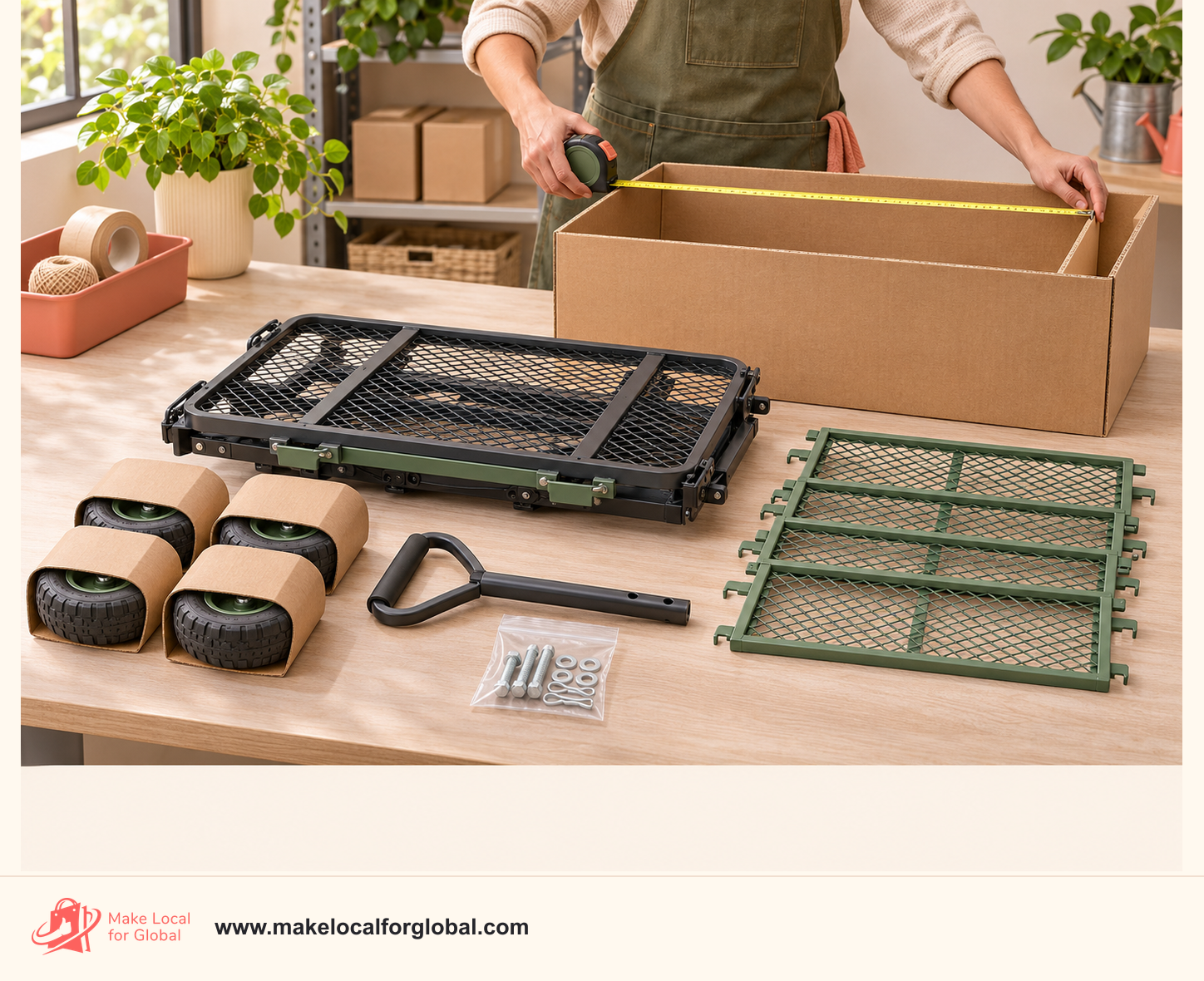
Measure the carton and protect each component before you request a carrier quote.
Ask the supplier to send a sample carton or pack a sample in the proposed packaging. Measure length, width and height, then weigh it. Check whether a wheel, handle or panel can puncture the carton during sorting. Place edge protection around metal corners and keep loose fixings in a sealed, secured bag.
Drop tests should follow the packaging supplier or carrier’s guidance. If you carry out a simple in-house check, document the height, orientation and surface. Inspect the contents afterward for wheel misalignment, chipped coating, bent panels, cracks or missing fixings. A single parcel trial does not guarantee that every shipment will arrive undamaged, so record customer reports and revise packaging when a pattern appears.
Before checkout, show the delivery cost, postcode restrictions, handling time and estimated transit time. Large items may not go to every offshore or rural address on the same terms. Some suppliers and carriers exclude Northern Ireland, islands or remote postcodes. Do not show a universal delivery promise until you have checked the service area.
Explain whether the cart arrives assembled, partly assembled or dismantled. If the parcel is heavy or bulky, state whether the carrier delivers to the doorstep or another point. A buyer should know whether another person is needed to carry the box and whether assembly tools are supplied.
If you use a third-party warehouse, ask for the pick fee, storage rate, oversize rules, receiving charge, stock count process and return inspection cost. Run a complete order with one sample before moving a full batch. Track the time from order to dispatch, the first scan, delivery, customer contact and any damage report.
General consumer products sold in Great Britain must be safe in normal and reasonably foreseeable use. The Office for Product Safety and Standards describes producer and distributor obligations under the General Product Safety Regulations 2005. Product safety advice applies to businesses that make, import, distribute or sell consumer products; it includes traceability and responding to known safety issues.
Northern Ireland has a different general product safety regime. From 13 December 2024, Regulation (EU) 2023/988 applies there. Read the Northern Ireland guidance for the relevant route. A seller shipping across Great Britain, Northern Ireland and the EU should check the rules that apply to each market before listing.
Online sellers must provide key information before a customer places an order. GOV.UK’s online and distance selling guidance explains information about the business, goods, total price, delivery, cancellation and a standard cancellation form where relevant. Most distance sales of goods include a 14-day cancellation period after delivery, subject to legal exceptions. Read the guidance and build the correct policy for your business. A returns page cannot remove statutory rights.
The Consumer Rights Act requires goods to meet relevant standards such as satisfactory quality, fitness for purpose and description. Product pages should match the item shipped. If a load limit, dimension, material or accessory changes, update the listing and the fulfilment notes before more orders are taken.
Packaging rules can apply to businesses that sell or import packed goods. Check the current GOV.UK packaging EPR guidance against your activity, turnover, packaging weight and group structure. Do not assume that a small first product range removes the need to check.
These points are a starting checklist, not a legal review. The seller’s role can depend on the contract and supply chain. Ask a product safety adviser, Trading Standards or a qualified professional about a specific product, import route or customer market.
You can sell through your own ecommerce site, a marketplace, garden-centre partnerships, local trade networks or a mix. A marketplace can give access to shoppers already looking for a cart, but its listing rules, fees and delivery requirements can change. A direct site gives you more control over the product page and customer support, yet you have to bring buyers to it.
Choose a first channel based on the questions you need to answer. If the main uncertainty is whether a buyer wants the compact or heavy-duty type, a small listing test may help. If you need to explain why one cart suits narrow paths, your own site may give more space for diagrams and comparison. If buyers want to inspect a heavy product in person, a local garden centre or demonstration day may help you collect better questions.
For adjacent outdoor products, see how the product-page questions change in MLFG’s guides to garden sprayers, garden lighting and garden flags. The same shop can serve related garden buyers, yet each item needs its own dimensions, use notes, care and delivery information.
Research actual query language using a search engine, marketplace autocomplete, customer questions and keyword tools. Possible starting phrases include “garden trolley”, “garden cart”, “folding garden cart”, “tipping garden cart”, “garden cart with pneumatic wheels” and “heavy duty garden trolley”. Each phrase points to a different product feature or use case. Check the search results before deciding that two phrases mean the same thing.
Use the main phrase naturally in the page title and first paragraph. Use the product type, dimensions and verified feature in subheadings and image alt text where they help describe the page. Write for a buyer comparing carts, not for a keyword counter. Avoid repeating “garden cart” in every sentence.
Short product demonstrations can answer questions a static photograph cannot. Show the cart turning through a gate, folding for storage, tipping a light load, or fitting into its carton. Use the actual product and state the model. A demonstration should not imply that every cart in the range works the same way.
Other helpful content includes:
Use a small test with a defined audience and question. For example, show two accurate product pages to allotment holders and ask which specification is missing. Keep notes about who saw the test, what they did, and what decision you changed. A view, like or comment alone does not establish a sale opportunity.
If you want help checking product assumptions before buying a wider range, use the MLFG B2C Launch Assessment. It can help organise questions about need, contribution, fulfilment and evidence; it does not verify legal compliance or guarantee a result.
Track stock by model and batch. Record what arrived, what passed inspection, what is reserved and what is available to sell. Store long cartons on a stable surface and check the supplier’s storage guidance for moisture, stacking and temperature.
Set a simple reorder trigger based on lead time and expected order pace. Include a buffer for supplier delay or a damaged batch. Do not buy more stock after one social post receives attention. A small number of enquiries can be useful, but a reorder requires evidence from orders, sell-through, storage capacity and cash position.
Create a support checklist before the first order:
For ordinary change-of-mind returns, explain the process before purchase and follow the rules that apply to the transaction. For a faulty or unsafe cart, the customer may have separate rights. Do not treat every return as a discretionary store-policy question.
After each delivery, record whether the carton arrived intact, the product matched the listing, and the buyer had enough assembly information. Ask for feedback after the customer has had a fair chance to use the cart. Keep the question neutral. Repeated comments about a loose fastener, wheel alignment, awkward packaging or unclear assembly call for a supplier check and a listing update.
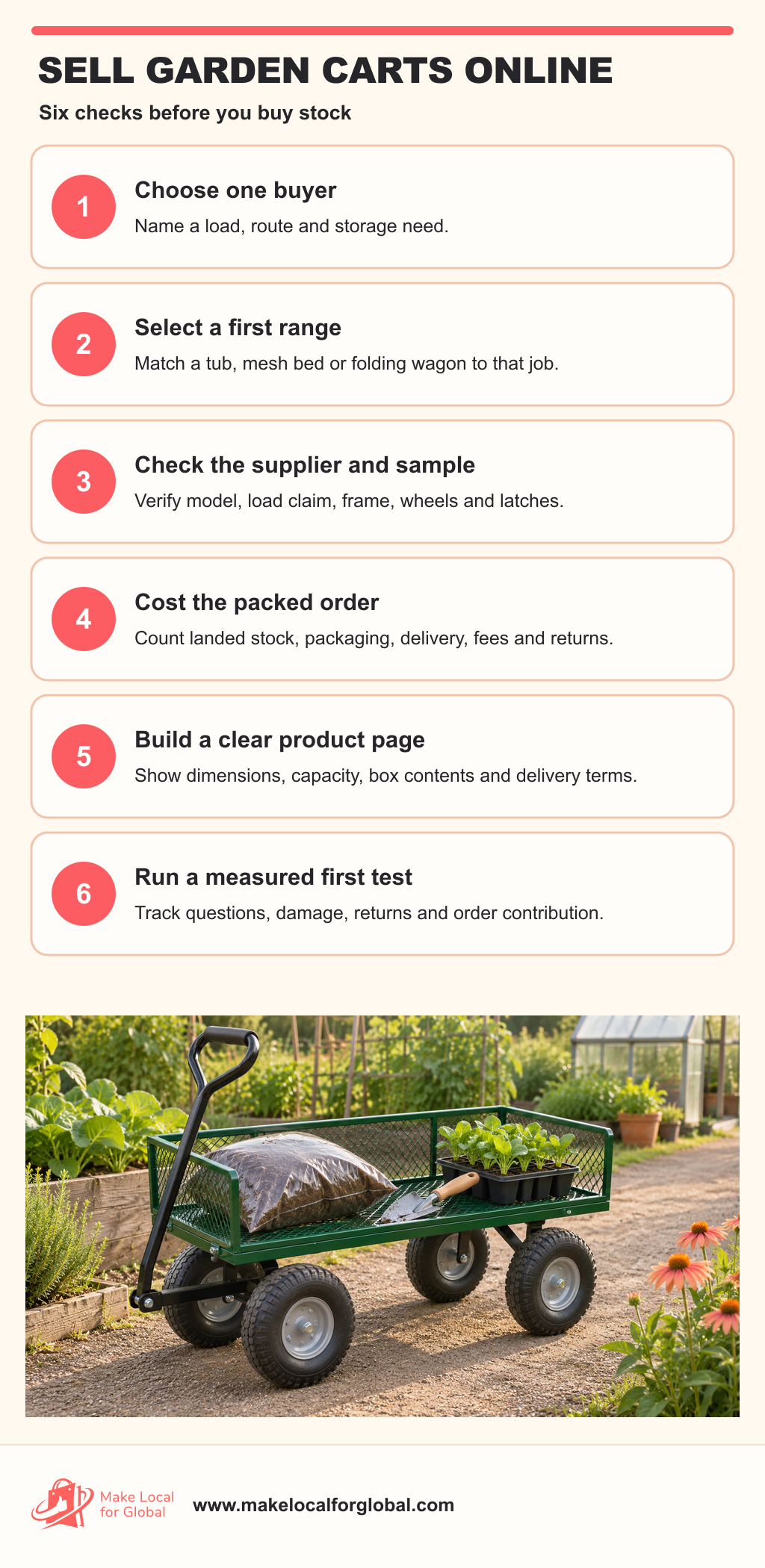
Use six checks to move from a buyer hypothesis to a measured first test.
The aim of the first month is to learn whether one specific cart, buyer and fulfilment route deserve more investment. The schedule below is a planning example. Adjust the dates to your sample lead time and budget.
Choose one buyer group and one job. Gather ten current product pages from UK sellers. Record product type, bed dimensions, wheels, stated load limit, folded size, price, delivery note and recurring buyer questions. Note the date and seller for each observation.
Speak with five to ten likely buyers. Ask what they currently use, what they move, what surfaces they cross and where the cart is stored. Avoid leading them toward a particular answer. Use the responses to identify one unresolved product choice.
Write a first specification sheet with the maximum carton size you can handle, the minimum verified load limit, the wheel type and the target contribution per order. Keep these as test criteria, not as claims to publish until a sample and supplier document support them.
Contact several suppliers with the same questions. Compare minimum orders, landed cost, lead time, spare parts, documents and return terms. Request a sample of the model that best fits the first buyer and job. Save the exact model number and current specification.
Request a shipping carton measurement and quote before you approve a larger purchase. If the supplier cannot provide the dimensions, ask for a sample carton or arrange a measured test before fixing your retail price. Do not use the empty-catalogue weight as a substitute for the packed consignment weight.
Assemble the sample and follow the inspection table above. Record the wheel, panel, handle, fastener and load results. Photograph the actual model. If a check fails, stop and ask the supplier for an explanation or a revised sample.
Build a cost sheet for one order and test three prices. Include the product, inbound freight, packaging, outbound delivery, fees, returns allowance, promotion and relevant tax treatment. Use current quotes. Mark every estimate clearly. Keep fixed overheads separate from direct order costs.
Write a product title, concise description, complete measurements, load limit, material list, box contents, assembly guidance, care notes and delivery terms. Ask a person unfamiliar with the cart to find its folded size, wheel type, delivery cost and included accessories on a phone. Record what they miss.
Pack the sample as you would for a customer. Measure and weigh the final parcel. Request a carrier quote using the exact size, weight and delivery region. Check collection requirements, tracking and damage-claim process. If a direct-to-customer shipment would exceed your workable cost, consider a smaller cart or a different fulfilment plan.
Show the accurate listing to a small group that matches your buyer. Ask them to explain the product back to you and name one remaining concern. Track page visits, questions, delivery quote requests, add-to-basket actions and paid orders separately. Each measure answers a different question.
Review what happened against the rule you set at the start. Continue if the product and delivery route meet your minimum contribution and buyer questions are answerable. Revise the cart choice or page if buyers are confused by a dimension or option. Pause if the sample, packed cost or safety documentation fails a requirement. Keep the evidence with the next supplier or pricing decision.
A higher number can look persuasive, but it says little about wheel behaviour, frame stiffness or safe handling by itself. Begin with the load and route the buyer needs. Check how the supplier supports the stated limit. State the conditions accurately and avoid encouraging overload.
A cart can be affordable to buy and expensive to dispatch. Confirm packed size, carrier service area and damage protection before you approve the order. A second carton size can change the shipping price enough to affect the product choice.
A tall tub suits loose loads differently from a low platform or folding wagon. Explain the job and surfaces the product suits, then state known limits. “All terrain” or “for every garden” needs strong evidence and a clear definition.
Models with the same brand or colour can use different wheel diameters, bed lengths or side panels. Check the item code on the supplier document and sample. Update old photos and product pages when a specification changes.
Each size, colour and accessory adds stock and product-page work. One tested core product gives you a cleaner first signal. Add alternatives when buyers raise a specific need that the range can serve.
A clean product image matters, but buyers need measurements, handle movement, included parts and storage size. Add photographs that answer those questions. Do not use an accessory or load in the photo if the page does not say whether it is included.
It may be worth testing if you can identify a buyer, source a cart with documented specifications, check a sample and deliver the packed product at a workable cost. Demand and contribution vary by cart type, supplier, channel and fulfilment route. Use a small test before buying a large quantity.
Choose the type that fits one buyer’s task. A narrow courtyard buyer may value a compact folding wagon. An allotment buyer may need larger wheels and a stable bed. Someone moving loose soil may prefer a tipping tub. Interview likely buyers and test a sample before choosing.
There is no one load limit that suits every customer. Match the limit to the job, path surface, frame and wheels. Ask the supplier for supporting information, test a sample within safe conditions, and reproduce only the verified claim on the product page.
Pneumatic wheels can absorb bumps, but need suitable inflation and can puncture. Solid or puncture-resistant wheels avoid inflation checks, yet may feel different on loose or rough ground. Test the exact model on surfaces your buyers use and describe the trade-off accurately.
The amount depends on sample cost, minimum order, landed unit cost, storage, packing materials, delivery, platform setup and promotion. Make a one-order cost sheet first, then add any stock purchase and fixed start-up costs. Use quotes rather than a generic budget figure.
Stock gives you a chance to inspect, photograph and pack the actual cart, though it ties up cash and storage. Dropshipping can reduce initial stock holding, yet you rely on supplier stock data, packing and delivery service. Ask whether the supplier supports the route, how returns work and whether you can trace the product model and batch.
Possibly, though branding can change your product safety role and responsibilities. Check the product’s documentation and get advice before applying your mark or importing a product. GB and NI rules differ, and selling into other markets can add requirements.
Measure and weigh the packed product, then ask carriers for a quote using the delivery zones you intend to serve. Test protection around wheels, corners and long parts. Tell buyers whether the product arrives assembled, how delivery works and whether the carrier serves their postcode.
Consumer rights depend on the transaction and reason for return. Online distance sales usually have a cancellation period for change of mind, and faulty or misdescribed goods bring separate rights. Read current GOV.UK distance-selling guidance and get advice for your specific terms.
Show internal and overall dimensions, load limit, wheel and tyre details, materials, weight, folded size, carton size, assembly requirements, included parts, delivery costs and returns information. Add photographs of the actual product, scale and moving parts.
Make the product page specific enough for a buyer to check fit before ordering. Show the cart beside a measuring reference, state the packed and assembled size, explain the wheel type, and show which parts arrive in the box. Record return reasons and change the source, packaging or listing when a clear pattern appears.
Choose one garden cart, one buyer group and one delivery route. Check the sample, cost the packed order, write down the evidence behind each product claim and set a review date for the first test. Use the B2C Launch Assessment to organise a practical review. For help planning a store around a tested product, explore MLFG website design or contact Make Local for Global.
Bring your product measurements, delivery route and buyer evidence into a clear online store brief before you invite customers to order.
Selling a garden cart involves more than sourcing a frame with a large capacity number. A clear buyer, tested sample, honest specification and workable parcel route give you a better basis for the next stock decision.
PREFERRED SOURCE
Like what you’re reading? Add Make Local for Global as a preferred source on Google to see more of our articles when you search.

Build your online presence without having to figure out everything yourself.