

READY TO SELL animal figurines ONLINE?
Get a store built for you in 5 days, plus training and support to help you start, run, and grow your Alternative business.

A practical, no-fluff guide to selling animal figurines online – from choosing a range and pricing properly to packaging, marketing, and getting a done-for-you shop set up.

You’ve probably seen it yourself – a little animal figurine that somehow makes people stop, smile, and reach for their wallet.
They’re small, giftable, collectible, and oddly addictive.
If you want to sell animal figurines, you’re in a good place – as long as you treat it like a real business, not just a nice idea.
Before you worry about logos, websites, or packaging, you need to answer one boring question.
What exactly are you selling?
“Animal figurines” covers everything from tiny handmade clay hedgehogs to premium resin dragons, from kids’ toys to serious collector pieces.
If you try to sell all of it, you’ll end up selling none of it.
These groups buy differently, and they care about different things.
You can serve more than one group later.
To begin with, choose the group you can speak to clearly.
You don’t need to invent a whole new art movement.
You do need something people can recognise without reading your name.
When someone sees three of your pieces together, they should feel like they belong in the same world.
There’s no moral medal for doing everything the hardest way.
Some sellers sculpt by hand, mould and cast, then hand paint.
Others design digitally, 3D print, then finish and paint.
Some buy blank bases and customise them.
All of these can work – as long as you’re honest and you price based on time and quality.
You don’t need a spreadsheet that looks like it belongs in NASA.
You need a few quick signals that people are already searching and buying.
Those questions are gold because they tell you what your product pages must answer.
Most people who sell animal figurines start by making whatever they fancy.
That’s fun.
It’s also a fast way to end up with 27 one-off items that are impossible to restock and hard to photograph as a “collection”.
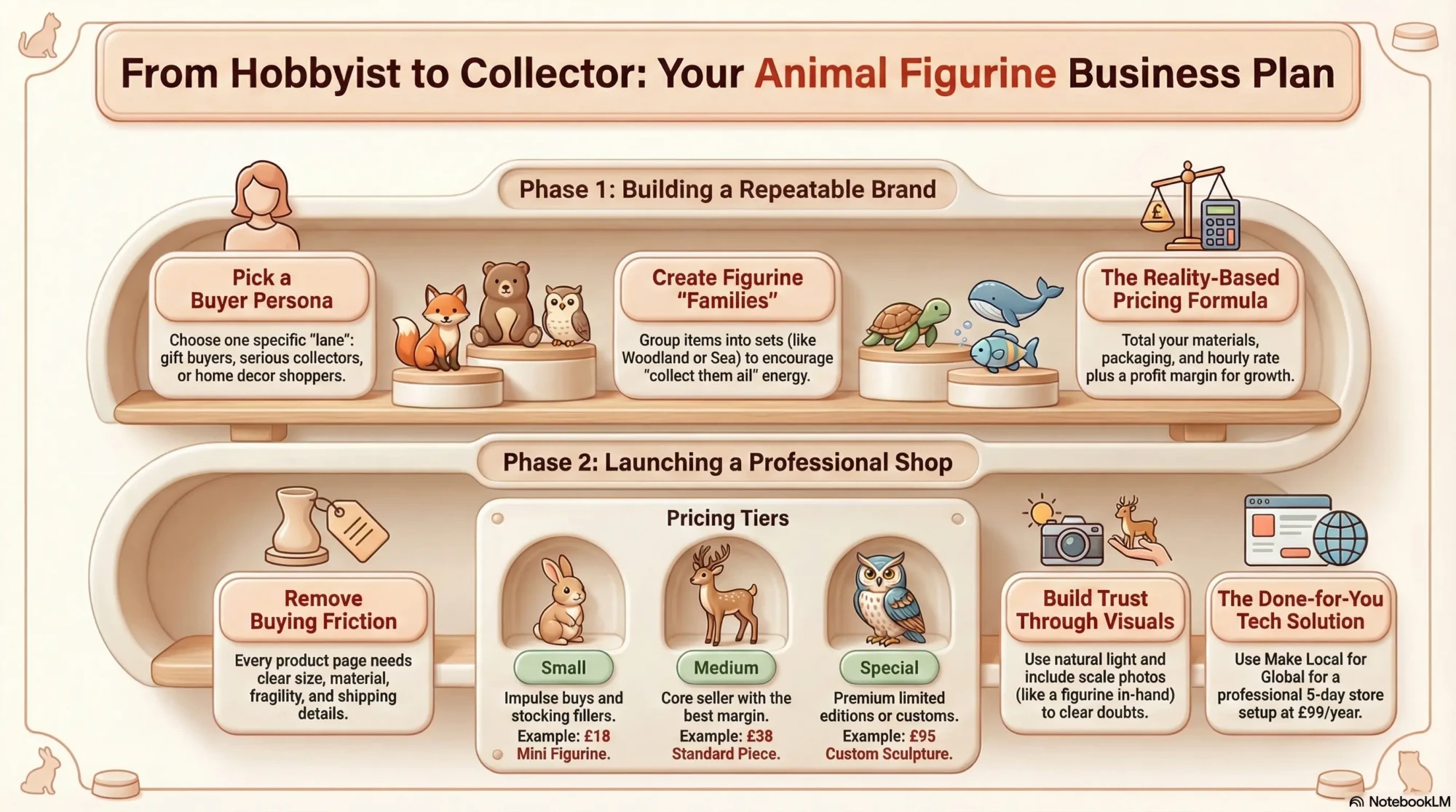
The trick is to build a range that’s repeatable, even if each piece is unique.
Families sell better than lone items.
People love sets, series, and “collect them all” energy.
When you release them as a group, you get built-in upsells.
A buyer who came for the fox might add the owl because it “matches”.
People like choice, but not too much choice.
A simple three-tier setup works well:
This makes your shop feel like a proper place to browse.
It also stops you relying on one type of sale.
Custom figurines can be brilliant.
They can also take over your life.
If you offer them, set boundaries:
Otherwise you’ll spend your evenings negotiating the exact eyebrow expression of someone’s nephew’s hamster.
Even if you’re a side hustler making these at the kitchen table, you want a rhythm.
Buyers feel safer when your shop looks active and reliable.
A simple restock system could be:
This also helps you manage your time.
Pricing is where many makers quietly sabotage themselves.
Not because they’re bad at maths.
Because they’re trying to be “reasonable” for strangers while being completely unreasonable to themselves.
If you want to sell animal figurines long-term, your prices need to cover time, materials, overheads, and a profit that makes it worth continuing.
That little voice saying “No one will pay that” is not a business plan.
It’s just nerves.
Instead, price based on reality.
Try this:
If you don’t know your hourly rate, pick one that respects you.
If you’re selling in the UK, many people start with something around a fair living wage and adjust as demand grows.
Anchor pricing is simple.
You offer one premium product that makes the mid-range feel like a great deal.
For example:
Not everyone buys the £95 one.
But it can make the £38 one feel like a sensible treat.
Animal figurines can be delicate.
Shipping and packaging need to be decent, not hopeful.
Decide whether you’ll:
Whatever you choose, make it clear and simple.
Surprises at checkout are where sales go to die.
Where you sell matters almost as much as what you sell.
Here’s a practical comparison of common options.
| Channel | Best for | Downside | What to do about it |
|---|---|---|---|
| Marketplaces | Fast exposure and early validation | Fees, competition, and you don’t own the audience | Use them to test products, then move repeat buyers to your own shop |
| Craft fairs | In-person sales and instant feedback | Time, travel, and weather-based stress | Collect emails, include a card directing people to your online shop |
| Social-only selling | Community and storytelling | DM admin, missed messages, awkward payments | Use social to market, but take payments through a proper shop |
| Your own ecommerce site | Control, repeat buyers, and brand-building | Tech setup can be a barrier | Use a done-for-you setup like Make Local for Global |
This is where a lot of talented makers get stuck.
Not because they can’t do it.
Because setting up an online shop is a different skill from making beautiful animal figurines.
And it’s very easy to burn out trying to do everything at once.
You don’t need a complicated site.
You need a shop that does a few things really well:
Anything beyond that is optional at the start.
If you want to sell animal figurines online, your product pages have to answer buyer worries before they ask.
You’re not being “too detailed”.
You’re removing friction, and friction kills sales.
You don’t need a fancy camera.
You do need decent light and a bit of consistency.
If you can, add one lifestyle photo so buyers can imagine it in a home.
A little figurine on a shelf next to a plant does a lot of work.
Many animal figurines are one-offs.
That’s part of the appeal.
But it can make your shop look empty if everything sells and disappears.
A few ways around it:
The aim is to keep your shop feeling alive.
If your brain melts every time you think about templates, payments, and checkout settings, you’re not alone.
This is exactly why Make Local for Global exists.
It’s a UK-based ecommerce service that sets up your online shop for you – properly – so you can focus on making and selling.
If you want to talk through what you’re selling and what your shop should include, you can book a free consultation.
And if you want a straightforward way to get a real online store without tech drama, you can Get your website for £99/year.
Marketing doesn’t have to mean dancing on camera or posting 12 stories a day.
It does mean being visible, consistently, in a way that suits you.
When you sell animal figurines, you’re not just selling an object.
You’re selling a feeling: cute, nostalgic, whimsical, calming, “that’s so me”, “that’s perfect for her”.
Spreading yourself across five platforms is how you end up exhausted and resentful.
Pick one main platform for the next 90 days:
You can still claim your name on other platforms.
Just don’t try to feed them all at once.
Not all content is equal.
Some content entertains but doesn’t sell.
Here are types that tend to move people towards buying:
Keep your captions human.
Talk like you’d talk to a customer at a stall.
Seasonal sales can be great for figurines.
But don’t let it become your only plan.
Good seasonal hooks include:
Build seasonal pieces into your range, but keep your evergreen best sellers available too.
SEO doesn’t have to be mysterious.
It’s mostly about using the words your customers use.
On your product listings and categories, use phrases like:
And yes, include “sell animal figurines” style phrases in blog content and guides, because that’s what aspiring sellers search for too.
Social platforms are noisy.
Email is quieter and more direct.
If you do craft fairs or markets, an email list is especially useful.
You can offer a small incentive like:
The point is to build repeat buyers who come back without needing to be “convinced” every time.
Animal figurines can be tiny works of art.
If they arrive broken, none of that matters.
Packaging is not just “what you wrap it in”.
It’s part of the product.
You want two things at once: protection and presentation.
A good baseline setup:
If your figurines have delicate parts, consider a small inner box or shaped padding.
Movement is what breaks things, not distance.
Be clear in your listings.
Tell buyers what it is and what it isn’t.
This reduces returns and awkward messages.
It also builds trust, which is priceless.
You don’t need a 12-page policy document.
You do need a clear, fair approach.
Decide upfront:
Write it in plain language.
When people know the rules, they’re usually reasonable.
Once you’ve made a few sales, the real question becomes: how do you keep it going?
Growth doesn’t have to mean hiring staff and renting a warehouse.
It can mean steady, sustainable improvements that make selling easier.
Pay attention to what sells without needing lots of explanation.
Those are your “workhorses”.
Double down on them with:
Keep the creative experiments too, but let best sellers carry the business.
Bundles feel like a treat, and they make buying easier.
Ideas:
Bundles also reduce packaging time per item.
Social proof sells your figurines for you.
After purchase, ask buyers to share a photo on a shelf or desk.
Then reuse that (with permission) on product pages and social posts.
It helps future buyers picture the figurine in a real home, not just your photo setup.
People don’t read about pages for your CV.
They read to answer: “Can I trust you?” and “Is this for me?”
A strong about story includes:
Keep it warm and direct.
If you’re awkward about self-promotion, write it like you’re explaining it to a curious customer at a market stall.
Marketplaces can bring early sales.
But they’re not “yours”.
Rules change, fees change, and you’re always one algorithm tweak away from panic.
Your own shop is your home base.
It lets you:
If you want that without getting buried in setup tasks, Make Local for Global is built for this exact situation.
You make the figurines.
They help you sell them online with a done-for-you ecommerce setup.
It can be, because figurines are giftable, collectible, and easy to ship compared to larger home decor, but it’s worth it only if you price properly for your time and create product pages that answer size, materials, and shipping questions clearly.
Popular “safe” sellers tend to be cats, dogs, foxes, owls, and seasonal favourites like robins or hares, while niche themes (frogs, axolotls, reptiles, mythical creatures) can perform brilliantly when you build a clear style and market to the right community.
Start with materials, packaging, and your time at a fair hourly rate, then add overheads and profit, because underpricing might get you sales but it usually leads to burnout and makes it hard to grow into a steady business.
You can start with social, but a proper online shop makes buying easier, reduces admin, and builds trust, especially when you’re selling fragile items like figurines that buyers want clear shipping and returns info for.
Use a snug sturdy box, wrap the figurine, stop all movement with padding, and include clear “fragile” handling and care notes, because movement in transit is the main cause of damage rather than distance itself.
If you don’t want to wrestle with tech, a done-for-you service like Make Local for Global can set up your shop properly so you can focus on making, photographing, and marketing your animal figurines instead of troubleshooting checkout and settings.
If you want this to feel real, not just “one day”, use a short plan.
Here’s one that works whether you’re starting from scratch or restarting with more focus.
If you want help building the shop side without losing your evenings, you can book a free consultation and talk through what you’re making and how you want to sell it.
Or, if you’re ready for a simple done-for-you setup, you can Get your website for £99/year and get the online shop sorted without the usual tech spiral.
Either way, the goal is the same.
Make your animal figurines.
Sell them in a way that feels sustainable.
And build something you’re proud of – not something that drains you.
PREFERRED SOURCE
Like what you’re reading? Add Make Local for Global as a preferred source on Google to see more of our articles when you search.

Build your online presence without having to figure out everything yourself.