READY TO SELL adjustable shelves ONLINE?
Get a store built for you in 5 days, plus training and support to help you start, run, and grow your Alternative business.

A practical guide to selling adjustable shelves online, from building a product range and pricing for profit to shipping safely, marketing with before-and-afters, and setting up a shop without tech stress.

Adjustable shelves sound simple until you try to sell them.
Then you realise you’re not just selling wood and brackets – you’re selling space, order, and the feeling of a room finally making sense.
If you want to sell adjustable shelves online, you can do really well, as long as you get clear on who they’re for, what problem they solve, and how to ship them without drama.
Most sellers start with the product: “Here’s my adjustable shelf. It’s nice.”
Buyers start with a problem: “I’ve got clutter, wasted space, or awkward walls.”
Your job is to connect the two.
There are a few common buyer types, and each one cares about different things.
Pick one main buyer group to focus on first.
You can still sell to others, but your messaging will be sharper if you choose a priority.
This is where your product descriptions, photos, and marketing should live.
If you can name the problem in plain language, people will feel like you’re reading their mind.
Not all adjustable shelves are adjustable in the same way.
Get specific, because “adjustable” is a broad word that can confuse buyers.
The clearer you are, the fewer “Will this fit my…” messages you’ll get later.

Adjustable shelves can be a brilliant product category because people often buy more than one.
But only if your range feels consistent and easy to understand.
People shop by room more than they admit.
Even if the shelf could go anywhere, buyers love being told where it belongs.
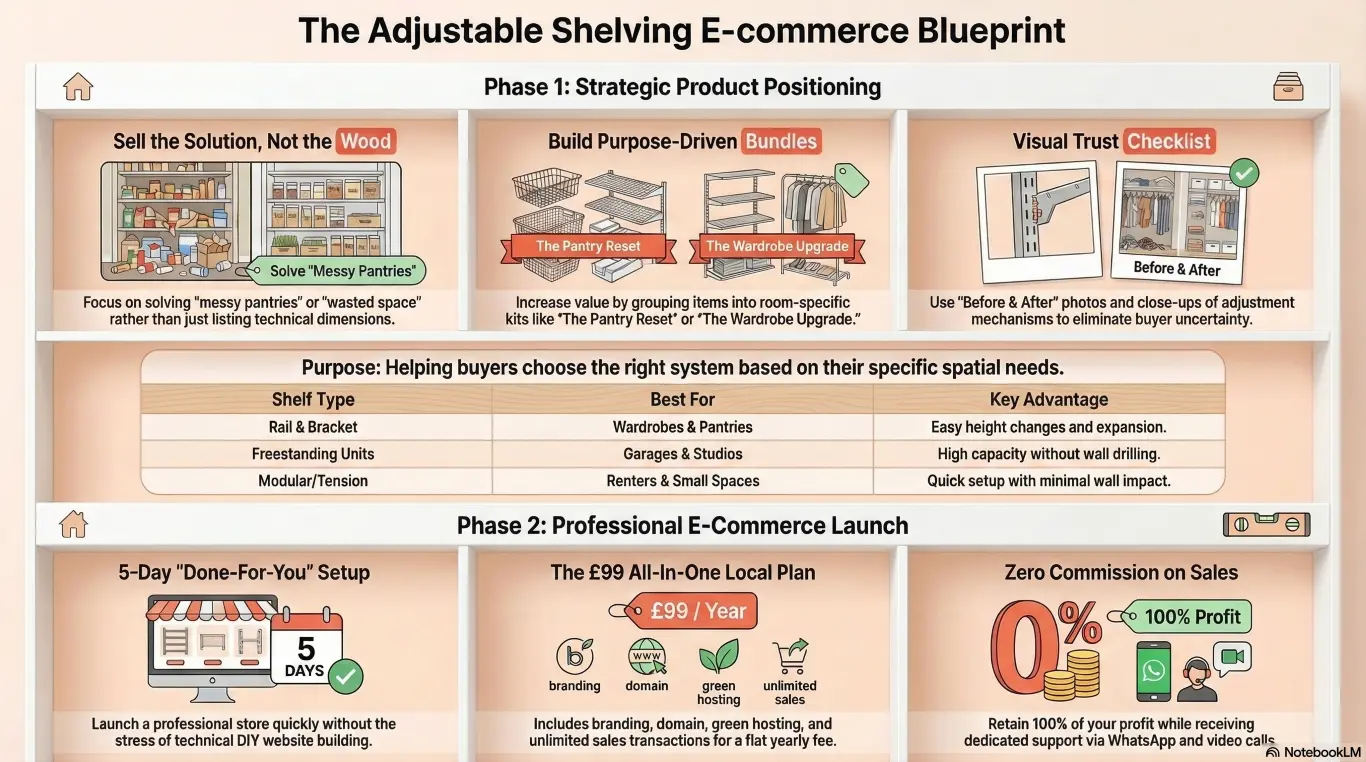
Create categories and product bundles that match these spaces.
It makes your shop feel organised – which is exactly what your product promises.
Many shelf sellers guess sizes based on what’s easy to produce.
Buyers think in terms of what needs to sit on the shelf.
Instead of “Small, medium, large”, consider listings like:
You can still include measurements, but naming by purpose helps people choose confidently.
Adjustable shelves are easy to misunderstand online.
Show how they adjust, not just how they look once installed.
If your product is modular, show a few configurations.
People buy flexibility when they can see it.
Buyers want clarity.
They don’t want surprises after the checkout.
Be explicit about what’s included:
If fixings aren’t included because wall types vary, say so in plain language.
That comes across as professional, not stingy.
Adjustable shelves work brilliantly as bundles because people usually need a set.
Bundles also increase order value without needing more marketing effort.
The goal is to make buying feel easy.
People will pay more for “this solves it” than for “choose every part yourself”.
Shelves can look deceptively simple.
That can make sellers underprice, especially if they’re comparing themselves to mass-produced options.
If you’re selling adjustable shelves as a small business, your pricing needs to reflect real costs and real value.
Even if you’re reselling rather than making, you still have costs that need covering.
Then you add profit.
Not as a luxury, but as the thing that keeps the business alive.
Buyers aren’t paying for a shelf.
They’re paying for their kitchen cupboards to stop being annoying.
That’s why these value signals matter:
If your shelves solve a problem better than the cheap options, you’re allowed to charge for that.
This keeps your shop from feeling like a single yes-or-no decision.
Not everyone needs premium.
But having it can make your core option feel like a great deal.
Different buyers want different shelf types.
Use a simple comparison like this in your shop or blog content to help people choose.
| Shelf type | Best for | Pros | Watch-outs |
|---|---|---|---|
| Rail and bracket adjustable shelves | Wardrobes, pantries, offices | Easy height changes, expandable over time | Needs accurate fitting and suitable wall fixings |
| Freestanding adjustable shelving units | Garages, studios, stock rooms | High capacity, no wall drilling, movable | Can look industrial and take up floor space |
| Modular stackable shelves | Small spaces, renters, flexible layouts | Reconfigurable, easy to expand, quick setup | Stability depends on design and load distribution |
| Tension-based adjustable shelves | Renters and temporary storage | Minimal wall impact, fast to install | Lower load limits and needs correct surface fit |
When you sell adjustable shelves online, the biggest barrier is uncertainty.
Will it fit?
Will it hold the weight?
Will it be a nightmare to install?
Good product pages remove that anxiety.
Think of this as your “trust checklist”.
If you include these, you’ll reduce refunds and increase conversion at the same time.
It’s tempting to write like you’re explaining it to a professional fitter.
Most buyers are just trying to stop their spices falling over.
Swap this:
For this:
Clear sells.
People don’t enjoy measuring.
They enjoy shelves that fit.
Help them choose quickly by adding:
And if you offer multiple widths, make the dropdown names obvious.
“600 mm” is fine, but “600 mm – fits most cupboards” is better.
Shipping is where shelf businesses either level up or quietly bleed money.
Adjustable shelves are often long, flat, and easy to scratch.
They can also arrive with corner damage if you pack them like a t-shirt.
There are three main risks: bending, corner damage, and surface scratches.
Good packaging handles all three.
If you’re shipping brackets and rails, bag them separately so they don’t rattle against the shelf.
Buyers can accept shipping costs if you don’t surprise them.
What they hate is getting to checkout and seeing a price that wasn’t hinted at.
Make shipping costs visible early, and consider:
It’s better to charge shipping fairly than to hide it inside your product price and then lose money on large orders.
A lot of returns happen because buyers ordered the wrong size.
Help them avoid that with a quick “fit check” section on each listing:
When buyers feel supported, they make better choices.
Shelves aren’t glamorous, but they are satisfying.
Your marketing should lean into that.
People love “before and after” transformations, and adjustable shelves are perfect for it.
Features matter, but they work best after you’ve earned attention.
Start with a messy cupboard and a calm one.
Start with a cramped wardrobe and a usable one.
Then talk about how your adjustable shelves made it possible.
You don’t need to post constantly.
You do need to post the right things.
Keep captions simple and human.
Talk like you’re explaining it to a friend who’s fed up with clutter.
Buyers don’t always search for “adjustable shelves”.
They search for their problem.
Work these related phrases into headings and product copy where relevant:
You’re not stuffing keywords.
You’re speaking the same language as your customer.
Trust is the difference between browsing and buying, especially for home products.
Even a small business can build it quickly with:
Honesty sells because it reduces risk.
If someone is buying adjustable shelves, they often need more pieces than they first thought.
Make that easy, not annoying.
Done well, this feels helpful, not pushy.
This is the part where many small sellers stall out.
They’ve got a good product, but they can’t face building a website, setting up payments, creating shipping rules, and making it all look trustworthy.
If that’s you, you’re not lazy. You’re just trying to do too many jobs at once.
You don’t need a fancy site to sell adjustable shelves.
You need a site that’s clear, fast, and easy to buy from.
Everything else is optional.
If you’re selling a physical product, your time is better spent on stock, photos, customer questions, and marketing.
Not wrestling with templates at midnight.
Make Local for Global is built for small sellers who want a proper ecommerce site without doing all the technical setup themselves.
If you want to talk through your shelves, pricing, and the best shop structure for your range, you can book a free consultation.
And if you’re ready to get selling without the tech headache, you can Get your website for £99/year.
A little prep saves a lot of back-and-forth later.
Once those are done, getting online becomes a project you can finish, not a task that drags on forever.
It can be, because shelves solve everyday problems and buyers often purchase sets, but it’s worth it only if you price with packaging and shipping in mind and you make sizing and installation crystal clear on product pages.
Options that fit common spaces tend to sell best, such as wardrobe and pantry adjustable shelves, especially when they come as simple kits with clear measurements and a straightforward way to change height without replacing the whole system.
You don’t compete purely on price – you compete on fit, clarity, durability, and the ease of getting exactly what the buyer needs, then you price to cover true costs plus profit so you can stay in business and deliver reliably.
Add a “fit check” section to every listing, show scale photos, explain what’s included, and use plain-language installation notes so buyers choose the right size and understand what’s involved before they buy.
Use rigid packaging, protect corners, prevent surface rubbing with paper or film layers, and stop movement inside the box, because most damage comes from bending and impact rather than distance travelled.
You can start anywhere, but your own shop gives you more control over branding, bundles, and repeat customers, and it reduces admin compared with selling through messages or platforms that don’t suit bulky home products.
If you want to move from idea to orders, keep it simple and structured.
You don’t need perfection. You need momentum.
If you want the online shop side handled without tech stress, you can book a free consultation to talk through what you’re selling and how to present it.
Or, if you’re ready to get a proper ecommerce site set up and start taking orders, you can Get your website for £99/year.
Shelves are practical.
But the reason they sell isn’t practical.
They sell because they make people feel like they’ve got their life slightly more together.
Build your range around that feeling, explain it clearly, and you’ll give buyers a reason to choose your adjustable shelves instead of scrolling on.
PREFERRED SOURCE
Like what you’re reading? Add Make Local for Global as a preferred source on Google to see more of our articles when you search.

Build your online presence without having to figure out everything yourself.