

READY TO SELL apple butter ONLINE?
Get a store built for you in 5 days, plus training and support to help you start, run, and grow your Alternative business.

A friendly, practical guide to selling apple butter online – from product planning and pricing to labels, photos, shipping and simple marketing that drives repeat orders.


If you’ve made apple butter once, you already know the dangerous part.
Not the cooking. Not the jars. Not even the labels.
It’s the moment someone tastes it and says, “You could sell this.”
Because now you’re thinking about turning a cosy kitchen win into an actual business – and that’s exciting, but also a bit… a lot.
This guide is here to make it simple. You’ll learn how to sell apple butter online in a way that’s realistic, profitable, and doable if you’re a one-person operation with limited time and zero interest in wrestling with tech.
Apple butter is basically apples that have been cooked down slowly until they’re thick, smooth, and concentrated.
It’s not “butter” in the dairy sense. It’s a spread. A preserve. A comfort food that feels homemade even when it’s bought.
That’s the magic for selling.
When you sell apple butter, you’re not just selling a jar. You’re selling a feeling plus a practical product people will use up and reorder.
The fastest way to stall is to decide you’ll sell every flavour, every size, plus chutneys, plus granola, plus candles, plus “maybe gift boxes”.
It feels productive. It’s usually procrastination dressed as ambition.
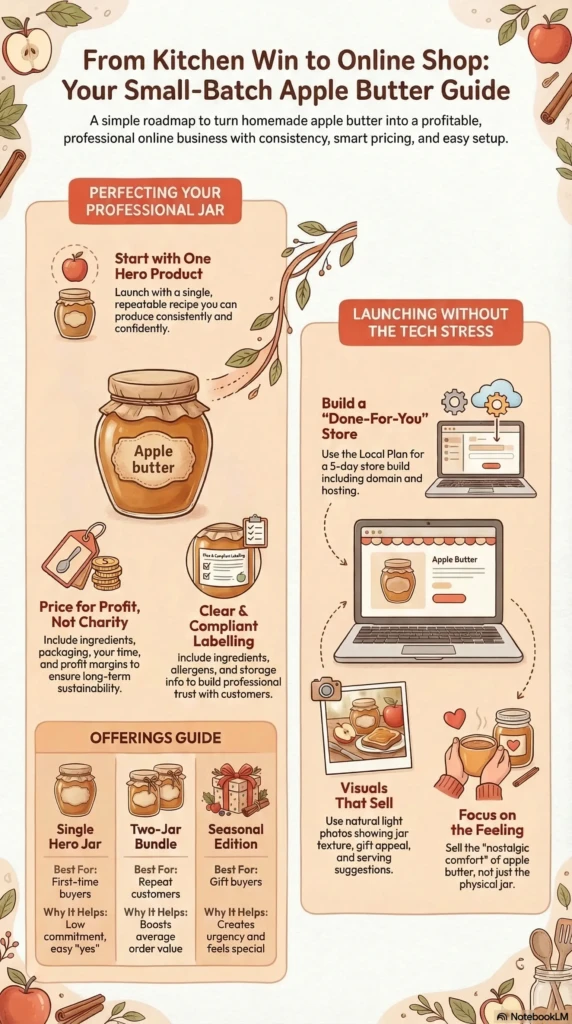
If you want to sell apple butter online, start with one main jar that you can make consistently and confidently.
That means:
Once that’s selling, you can add variants that are easy to produce.
Most customers want one of two things: classic comfort, or a twist that feels thoughtful.
Good “twist” flavours are familiar, not weird.
Keep your range tight at the beginning: one classic plus one seasonal twist is plenty.
Positioning is just answering: “Why should I buy yours?”
Pick one angle to lead with. Examples:
You don’t need to be all things. You need to be one clear thing that a customer can repeat to a friend.
Let’s talk about the slightly boring bit that protects you: the “am I allowed to sell this?” side.
Rules vary depending on what you sell, where you sell, and how you package it.
So I’m not going to pretend one blog post can replace advice from your local authority or food safety team.
But there are a few basics that almost every UK seller needs to know.
If you’re selling food as a business, you generally need to register your food business with your local authority. Registration is free and should be done before you start trading, typically with lead time. :contentReference[oaicite:0]{index=0}
If you’re producing from home, there’s specific guidance about starting a food business from your home, including food safety management and hygiene expectations. :contentReference[oaicite:1]{index=1}
Even if your apple butter seems simple, labels matter. Ingredients and allergen information requirements can apply depending on how and where you sell, including rules for foods prepacked for direct sale (PPDS). :contentReference[oaicite:2]{index=2}
Apple butter is often low-allergen, but cross-contamination can still happen if you share kitchen space with nuts, dairy, gluten, or other ingredients.
The safest mindset is: be clear, be accurate, and don’t wing it.
To sell apple butter without constantly worrying, you want three things:
That’s it. You don’t need to become a legal scholar. You need a calm system.
Cooking for friends is one thing. Cooking to sell is another.
When you sell apple butter, consistency becomes part of your brand.
For a sellable product, your recipe needs to be:
Write your recipe down properly. Include exact weights, cooking times, and how you check it’s ready.
Future you will be grateful when you’re batch cooking at 9pm and your brain is mush.
Apples vary wildly. Sweetness, moisture, and texture change by variety and season.
That doesn’t mean you can’t sell apple butter. It means you need a plan.
Customers don’t mind seasonal variation if you present it as part of the charm. They mind surprise changes with no explanation.
Start smaller than you think. Not because you lack confidence, but because you need real feedback before scaling.
A good early target is a batch that makes 12 to 24 jars.
Why?
Then build a routine:
When you can repeat your workflow, selling becomes less stressful and more profitable.
Apple butter is one of those products where packaging does half the selling.
Not because it needs to be fancy. Because people buy with their eyes first.
Pick jars that are:
As a general starting point, smaller jars can feel premium and giftable, while larger jars feel better value for repeat customers.
Many sellers do one main size, then add a smaller “gift jar” later.
Labels are where you quietly signal professionalism.
At minimum, your label should be easy to read and consistent. Customers should be able to answer:
Keep the design simple. Clear beats cute.
Apple butter sells well as a gift, especially in autumn, Christmas, and “cosy season” generally.
You can support that without expensive packaging:
That last one is secretly powerful. It turns a jar into an experience.
Most new food sellers underprice, then wonder why it feels exhausting.
It’s because they’re selling a handmade product at a supermarket mindset.
Apple butter is not supermarket apple sauce. You’re selling small-batch flavour, time, and craft.
Don’t guess. Write it down.
Then add profit. Profit is not greed. Profit is what lets you reorder stock, replace equipment, and grow.
A pricing ladder makes selling easier because customers can choose what fits their budget.
Bundles are especially good for online selling because they help cover postage and raise average order value.
| Offer | Best for | Why it helps you | Why customers like it |
|---|---|---|---|
| Single hero jar | First-time buyers | Simple to fulfil and market | Low commitment, easy “yes” |
| Two-jar bundle | People who already love preserves | Boosts average order value | Feels like value, lasts longer |
| Taster set (smaller jars) | Gift buyers | Premium positioning | Giftable and fun to try |
| Seasonal limited edition | Repeat customers | Creates urgency without pressure | Feels special and collectible |
Here’s the bit that trips most people up: they try to build a website like it’s a house extension.
Weeks go by. They’re still choosing fonts. They haven’t sold a single jar.
If you want to sell apple butter online, your shop needs to do a few things well. That’s it.
You don’t need ten pages. You need a clean setup and great product presentation.
Food businesses already have enough moving parts: production, hygiene routines, labels, stock, packaging, and customer service.
Adding “learn ecommerce from scratch” can be the thing that kills your momentum.
Make Local for Global is a UK-based ecommerce service that sets up your online shop for you, so you can focus on making and selling rather than fiddling with tech.
If you want to talk through what your shop should look like (and what products to start with), you can book a free consultation.
Keep it tidy:
Simple sells. Confusing stalls.
Apple butter is one of those products people don’t always understand until they’ve tried it.
Your product page has to bridge that gap.
Good product copy answers the real questions:
Here’s a structure that works well:
Keep paragraphs short. Make it scannable. People buy faster when they don’t feel they’re doing homework.
Food photos don’t need to be fancy. They need to be honest and appetising.
For apple butter, aim for:
Natural light by a window is usually enough. Use a white card to bounce light back onto the jar.
Marketing is easier when you stop thinking “I’m trying to sell” and start thinking “I’m helping the right people find this”.
Apple butter is a feel-good product. Lean into that.
You’ll sell more apple butter if you market to real people with real reasons to buy:
You can talk to all three, but pick one as your main audience to keep messaging clear.
You don’t need to post constantly. You need a few repeatable content types.
Every post should have a calm next step: “Available now”, “Limited batch”, “Next drop Friday”, or “Join the list for restocks”.
Apple butter is visual, seasonal, and recipe-friendly. That’s basically Pinterest’s entire personality.
If you create simple pins that lead to your product page and your “how to use it” content, you can get slow, steady traffic without daily posting.
Instead of trying to keep stock available forever, consider “drops”:
This protects your time and makes selling feel less chaotic.
Jars are heavy. Glass breaks. Postage costs money.
This is where online food sellers either build a solid business or quietly burn out.
For apple butter, your packaging priorities are:
People remember the arrival experience. If it feels thoughtful, they trust you more and they reorder.
Most “Where is my order?” messages come from unclear information.
On your shop, be clear about:
When you’re calm and specific, customers stay calm too.
Customers are more likely to buy two jars if they’re already paying for shipping.
Bundles also help you:
Your first sales are about momentum, not perfection.
You’re proving demand, collecting reviews, and learning what your customers actually love.
Your first buyers will usually be:
Don’t be weird about it. Just tell them you’ve made a small batch and you’re taking orders.
After delivery, send a short message asking:
Those answers become your best marketing content.
Give people an obvious way to picture apple butter in their life.
For example:
Pick one and build your photos and messaging around it.
This is where a proper shop matters.
If people have to message you, wait for a reply, ask for your bank details, and then wonder if it’s gone through, you’ll lose sales.
A clean ecommerce setup lets customers buy in 60 seconds while they’re still excited.
If you want the simplest route to that, you can Get your website for £99/year with Make Local for Global.
When you sell apple butter successfully once, don’t immediately reinvent everything.
Repeat the same offer with small tweaks:
Most businesses grow because they repeat the right things, not because they constantly chase new ideas.
These are the mistakes that cause stress, refunds, and burnout.
Start with one hero jar. Add options later when you know what buyers love.
If your price doesn’t cover your time, jars, labels, postage materials, and profit, you’ll eventually stop because it won’t feel worth it.
Some people know it. Many don’t.
Put one clear line in your description: “A thick, slow-cooked apple spread – like concentrated apple goodness.”
One broken parcel can wipe out profit on multiple orders.
Pack like you’re sending it to the clumsiest courier in history. You probably are.
Your shop does not need to be perfect. It needs to exist.
If setup is the barrier, use a done-for-you service so you can start selling instead of tinkering.
Not quite. Apple butter is usually cooked longer until it’s thicker and more concentrated, with a smoother texture and deeper flavour. Customers often describe it as richer and more “caramelised” than typical apple jam.
Show how to use it. Toast and spoon texture shots help, but pairing ideas sell: cheese boards, baking swirls, yoghurt toppings, and simple recipes. Seasonal marketing works well too, especially in autumn and during gifting season.
Calculate your true cost per jar including ingredients, jars, labels, time, overheads, and fulfilment materials. Then add profit. Consider offering bundles so postage feels worthwhile and your average order value rises.
Yes, especially when they feel giftable, small-batch, and clearly described. Customers buy for themselves and as presents. Your job is to make the jar look appealing, explain what it is, and make checkout easy.
You can start through markets or social selling, but having your own website helps you look established and makes buying easier. If you don’t want to build it yourself, a done-for-you setup can get you selling faster with less hassle.
If you want to sell apple butter online, keep it simple.
Create one hero jar, photograph it well, write a clear description, and make buying easy.
If you want a proper ecommerce shop without turning it into a tech project, you can Get your website for £99/year.
And if you’d rather talk through your product range, pricing, and the best way to launch, book a free consultation.
Apple butter is the kind of product people finish quickly and then miss.
If you make it well and sell it clearly, you won’t just get one-off buyers. You’ll get repeat customers who plan their breakfasts around you.
PREFERRED SOURCE
Like what you’re reading? Add Make Local for Global as a preferred source on Google to see more of our articles when you search.

Build your online presence without having to figure out everything yourself.