

READY TO SELL decorative pillows ONLINE?
Get a store built for you in 5 days, plus training and support to help you start, run, and grow your Alternative business.

Plan a decorative pillow range, check samples and UK requirements, price the full order, then build listings that answer questions about size, fabric, care and delivery.


Decorative pillows are small enough to ship as home accessories, yet a good range takes more planning than choosing a few attractive prints. Buyers need to see the exact size, cover material, insert contents, care method and room scale before they can judge a cushion online. Sellers need to control fabric batches, seam quality, postage, seasonal stock and the UK rules that apply to filled cushions and textile covers.
You can start with a small collection of decorative cushion covers, complete filled cushions, or both. Pick one buyer and one clear design idea, make or source samples, record exact dimensions and wash behaviour, then cost every order before setting a price. A cover-only range and a filled-cushion range have different packing, safety and return questions, so name the format plainly on every listing.
Set clear options for cover-only and filled products, then show size, fibre content and what arrives on every page.
“Decorative pillow” can refer to a removable cover, a filled scatter cushion, a floor cushion or a bed accent. In the UK, shoppers often search for “cushions” and “cushion covers”; other buyers use “throw pillows” or “decorative pillows”. Include common terms naturally, then state the product format in the title and first paragraph. A customer should not have to infer whether an insert is included.
A cover-only product gives buyers more control over their existing inserts and lowers parcel weight. It suits a seller with sewing, printing or fabric-curation skills. The buyer supplies a compatible insert, so you must show the finished cover dimensions and closure style. A complete filled cushion offers an easy, giftable product, but adds filling choice, compression, parcel volume, fire-safety checks and a more detailed specification.
A floor cushion is a separate product decision. It may carry a person’s weight and may be used on a hard floor, so check its seams, base fabric, filling resilience, cleaning instructions and foreseeable use with a suitable product specialist. Describe it as seating furniture only when its construction and intended use support that claim.
Decide whether your first launch will sell covers, filled cushions or a small test of both. Keep separate product codes, photos, stock counts and cost sheets for each format. A customer who orders a 45 cm cover expects a cover that fits a 45 cm insert; a buyer who orders a filled 45 cm cushion expects a finished, ready-to-display item.
Use a sentence with five parts: who it is for, where it is used, what arrives, the main material and the size. For example: “A 45 cm cotton-blend cushion cover for living-room sofas, with a concealed zip and no insert included.” This line helps you keep supplier conversations, photos, labels and checkout details consistent.
Avoid vague claims such as “luxury”, “eco-friendly”, “hypoallergenic”, “non-toxic” or “handmade”. Use them only when the exact product and evidence support them. Say what you can verify: fibre composition, print process, country of manufacture, closure, dimensions and care method. If the fabric is a blend, name the blend rather than calling it pure linen or pure cotton.
A focused buyer makes fabric, price and photography decisions easier. Possible customers include renters refreshing a neutral sofa, homeowners styling a bedroom, gift buyers looking for a colour-led set, interior designers sourcing repeatable colours, hospitality buyers replacing cushions in guest rooms, or makers who need coordinated covers for a craft project. These groups compare different details. A gift buyer may ask about packaging and dispatch dates; a small hotel may ask for replacement availability and a consistent colour lot.
Choose one lead group for the first collection. Write down what the person is decorating, what they need the cushion to do and what would stop them buying. “A pair of washable covers for a small flat’s neutral sofa” is more helpful than “homeowners who like interiors”. A precise audience statement can guide sample selection and prevent a launch from spreading across every colour, style and room.
Map the room context. A bed arrangement may use larger square cushions behind smaller accents. A compact loveseat may need fewer, smaller cushions. A deep sofa may take larger inserts, but shoppers need scale photos to judge that fit. A garden cushion needs a different material, closure and care plan from an indoor velvet cover. A decorative cushion for a child’s room raises separate questions about small parts, cords, cleaning and age-directed product safety claims.
Use conversations with likely buyers to find missing information. Show a physical sample, not only a mood board. Ask which of three colourways they would choose, what size they own, whether they buy covers or filled items, how they wash them, and what price feels plausible for that exact product. Note the words they use. “Rust”, “terracotta”, “clay” and “burnt orange” may describe related shades, but shoppers may filter by one term.
Create three concepts with a clear distinction in use or styling: a textured neutral pair, a bold patterned accent, and a seasonal colour set. Photograph or mock up the actual sample where possible. Label concepts that are not in stock as previews. Do not take money for stock you cannot supply under the delivery promise shown at checkout.
Use a low-cost test. Send a short survey to past customers, invite a few interior-focused contacts to compare samples, or show the collection at a local market. Ask people to choose between actual options rather than asking whether they “like cushions”. Record which size, material, colour and pack size attracts a concrete question or request for a price. Compliments are weak demand evidence; a request for a delivery date or a repeat quantity tells you more.
A simple test sheet can include the date, concept name, sample photograph, audience, price shown, number of people who saw it, questions asked, quote requests, email sign-ups, checkout starts and paid orders. Keep the source of each visit with the record. If a pattern gets many saves but no product-page clicks, the styling may be attractive but the buying details may be unclear. If a product page gets visits but no basket activity, review the size, price, shipping charge and insert information before ordering more stock.
Set a spending limit before you promote a sample. If you test a small paid campaign, use a separate link for each design and stop at the planned amount. Change one major factor at a time: product photo, audience, price or offer. A small test that prevents an unsuitable bulk order counts as useful information.
A compact collection is easier to photograph, store and replenish. Start with a lead cover or cushion, one supporting texture and one giftable set. Each product should serve a different buyer decision rather than create a colour choice with no other purpose. A sample range might include:
| Product role | Example | Buyer decision it supports | Detail to show |
|---|---|---|---|
| Entry cover | Plain cotton-blend 45 cm cover | Try the finish at a lower order value | Fibre composition, insert excluded, closure and dimensions |
| Core cover | Textured 50 cm cover in three tones | Match a sofa or bed palette | Close-up texture, care method and colour photos |
| Accent cover | Printed 45 cm cover with a border | Add a focal pattern to a room | Pattern scale, front and reverse, placement variation |
| Gift set | Two coordinated covers | Buy a ready-matched pair | Exact pieces, colours, packaging and combined price |
| Filled cushion | One tested size and cover style | Receive a display-ready item | Insert type, fill, finished weight and full safety information |
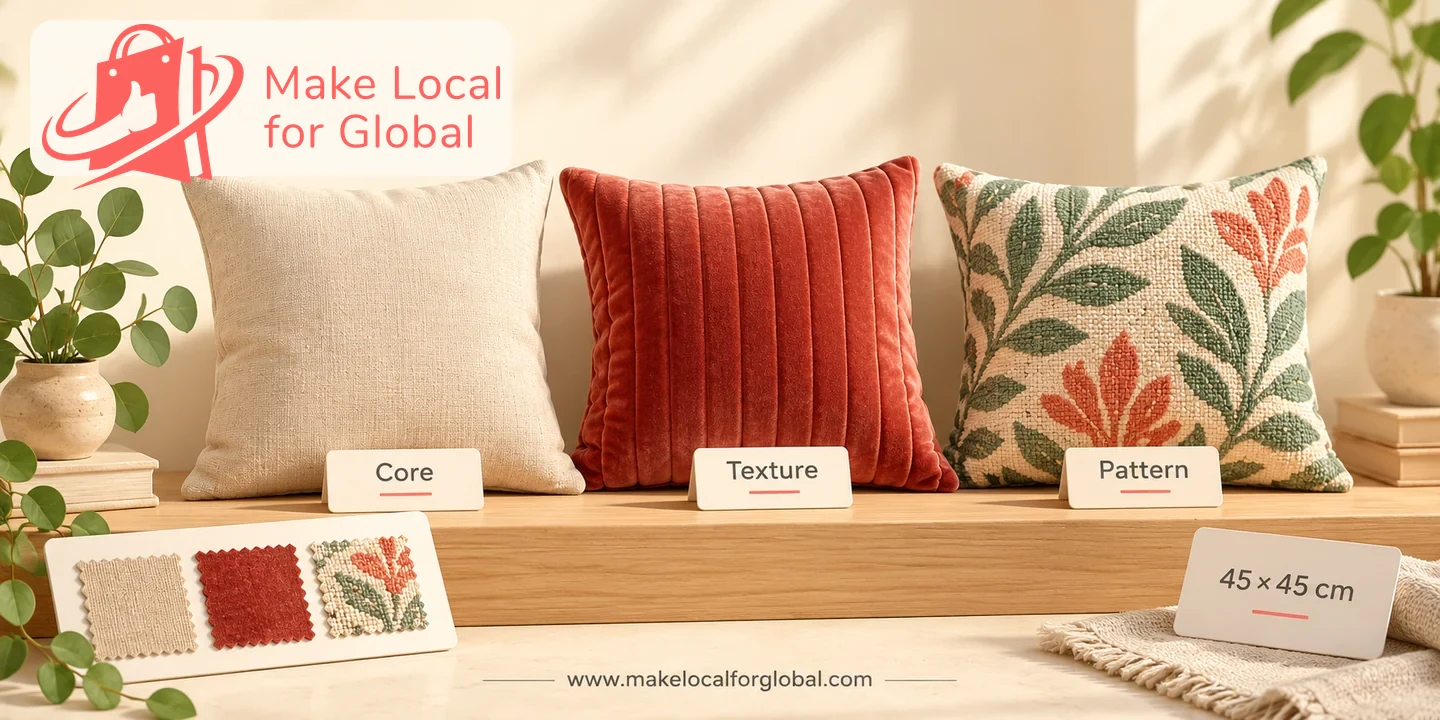
Keep size and colour codes short and repeatable. `LIN-45-SAND` can identify a sand-coloured linen-look 45 cm cover, but the code should not substitute for a customer-facing description. If your production partner changes a fabric name, keep the internal record linked to the actual material batch. Do not let “natural”, “oat” and “cream” drift across the website if they refer to the same shade.
Build a price ladder from cost and product value, not from a random premium label. A lower-priced cover can introduce the range. The core product can offer better finishing, a distinctive print or a more useful size choice. A premium filled cushion can include a tested insert and presentation packaging. Explain what changes between tiers. A higher price without a clear material, finish or service improvement can confuse buyers.
Offer bundles only when they simplify a room decision. A pair of coordinating covers can save the shopper time; a three-piece set can suit a bed display. State the exact count, individual sizes and insert status. Call a set a saving only when the set price is genuinely lower than the individual product totals and the calculation includes any extra packaging and handling.
Personalisation can add value through initials, a chosen trim or a made-to-order colour. It can create more proofs, stock parts and production time. Begin with options that fit the same base pattern and sewing process. Set a character limit for embroidery, provide a colour chart photographed in consistent light and explain which variations cannot be returned under the relevant rules. Custom work does not remove a buyer’s rights if the item is faulty or misdescribed.
Record each option in a production sheet. Write the accepted thread, fabric, zip and trim codes; embroidery position; finished size; approved sample photo; and any tolerance agreed with the maker. A customised product needs its own approval check before sewing. Ask the buyer to confirm spelling and layout before production, then keep that approval with the order.
The cover and filling need separate specifications. For a cover-only line, record outer fabric, lining if present, seams, closure, dimensions and care. For a filled cushion, add the insert’s composition, weight, loft, outer shell and product safety evidence. A cover that looks plush in a photo may use polyester velvet, cotton velvet, viscose blend or a knitted pile fabric. Name the actual fibre content and construction.
| Material direction | Useful qualities | Checks before ordering | Listing notes |
|---|---|---|---|
| Cotton or cotton blend | Familiar hand-feel; many weave and print options | Fibre record, shrinkage, colour transfer, seam slippage | Name fibre percentages and care method |
| Linen or linen blend | Visible texture and natural-looking variation | Fibre proof, creasing, slubs, batch shade changes | Explain natural texture and variation in photos |
| Polyester velvet | Saturated colour and soft pile | Pile direction, crushing, rub marks and wash behaviour | Photograph pile in more than one light angle |
| Bouclé or looped weave | Tactile surface with visible loops | Snagging, seam finish and loose yarns | Show close-up and advise against rough use if appropriate |
| Recycled-content fabric | May use verified recycled fibre inputs | Certification scope, supplier records and chain of custody | State the exact certified material and what the claim covers |
| Outdoor fabric | Intended for a named outdoor setting | UV and water performance evidence, seam and closure choices | Avoid “waterproof” or “fade-proof” without product evidence |
A fabric name is not a performance test. A cotton cover can shrink or fade; a polyester pile can flatten; outdoor fabric can still collect moisture at seams. Ask for the technical specification and test information that relates to the finished product. Avoid broad environmental terms when you cannot substantiate the claim. If a supplier says a fabric is recycled, request the exact percentage, certificate name, certificate scope and validity details before repeating the statement.
Choose the insert with fit and feel in mind. Common insert fillings include polyester fibre, feather and down mixes, foam forms or specialist combinations. Each type has different resilience, maintenance and customer expectations. Use claims such as hypoallergenic, cruelty-free or washable only when the evidence supports them for that model and its supply chain. Do not state suitability for a medical condition without product-specific support. If the supplier provides a care label, compare it with your own sample and keep a copy.
The nominal insert size and cover size can be designed to work together, but do not rely on convention alone. A cover may need to be slightly smaller than the insert to look full. State the finished flat cover dimensions and recommend an insert size only after testing the pair. A tight cover can strain the zip; a loose insert can create empty corners. Record both the cover’s measured size and the insert used for the photographed sample.
A local maker can help with short runs, fabric advice and sample revisions. You may pay more per unit, but you can inspect work and discuss changes directly. Ask whether the maker buys the fabric or expects you to supply it, who owns unused material, what happens when a colour is discontinued and how defects are handled.
A UK wholesaler can offer ready-made products with shorter lead times. Request current product specifications, composition details, supplier identity, batch information, care labels, fire-safety records for filled cushions and permission to use approved product photos. If you import and sell under your own name, your role may include manufacturer or importer responsibilities. Do not assume a supplier’s general certificate covers every fabric, filling, size or production run.
An overseas manufacturer can offer custom prints, embroidery and unit prices at scale. The total cost includes samples, freight, customs, import VAT, inspection, delays, currency risk and the possibility that a batch does not match the approved sample. Start with a pre-production sample and written product specification. Agree how defects are counted, what evidence is needed for a rework and who pays for replacement freight.
Print-on-demand can reduce unsold stock for made-to-order covers. Check whether the provider makes the product, fulfils it, uses the same fabric and print method each time, and ships in branded or plain packaging. Order a real sample from the same production route a customer will use. Confirm rights to all artwork, fonts and motifs. A print file downloaded from a design marketplace may not include commercial product rights.
Ask questions in writing and save the answers with the sample record:
A short, specific supplier brief reduces misunderstandings. Attach one reference sample, an annotated photo, a measurement sheet, the approved fibre wording, packaging requirements and the acceptance checklist. Get written notice of changes to fibre, filling, dyes, print process, factory or construction. A change to an input can change fit, care and fire-safety evidence.
Order a sample in every fabric or construction that may behave differently. A sample in one printed cotton does not prove that a velvet or filled cushion will meet the same standard. Photograph the sample on arrival and record the supplier, order date, batch, fibre information and measurement results.
These checks are useful for development and batch control. They do not replace regulated fire testing, chemical testing or accredited laboratory reports. Do not use a home flame test. Do not apply heat to a cushion or filling to “prove” that it is safe.
Record pass, fail or review for each check. A failed sample should have a clear next action: correct the pattern, change the zip, revise the care label, request a new filling report, or reject the supplier. A sample’s appearance does not override a failed check. Approve a “golden sample” that both sides can use for comparison, then store it in a clean, dry place.

Start by separating cover-only goods from filled pillows and scatter cushions. Textile and general product-safety duties may apply to both. UK furniture fire-safety rules apply to fillings in pillows and scatter cushions, with defined tests and label provisions. The first UK supplier, which can be a manufacturer or importer, needs records that trace the finished product and its materials. A retailer still needs to take reasonable steps to sell safe, correctly described goods.
For Great Britain, read the Office for Product Safety and Standards guidance on the Furniture and Furnishings (Fire) (Safety) Regulations 1988, including the 2025 amendments that came into force on 30 October 2025. Those amendments removed display swing labels for new products but did not remove permanent-label duties. For pillows and cushions, the exact test and permanent label rules depend on product construction and the applicable schedule. Ask the manufacturer or importer for model-specific evidence and confirm the requirements with Trading Standards or an accredited product-safety adviser before launch. Do not assume that a fire label from a different cushion model covers your item.
The regulations define pillows and cushions in a way that focuses on their filling material for certain test requirements. A cushion may use a tested primary cover as part of a composite route under the regulations. This is not permission to make a general “fireproof” claim. The cover, filling and production version must match the report. A cover sold separately has a different position from a complete filled product; check its label and intended use with a compliance specialist.
In Northern Ireland, the furniture fire rules apply with the relevant NI legislation. General product safety in NI moved to EU Regulation 2023/988 from 13 December 2024. If you sell into the European Union, that regulation can apply to offers targeted at EU consumers. Product offers need the information required by Article 19, including manufacturer and, where required, EU responsible-person details, product identification and warnings. A UK seller shipping cross-border should verify the responsible-person and online listing requirements before opening EU delivery.
Textile labelling rules apply to many textile products in Great Britain and Northern Ireland. A label must show fibre content; where components have different fibre content, each relevant component may need its own declaration. A cover made from a 55% cotton and 45% polyester face fabric should not be advertised as “100% cotton”. A filled cushion can have cover, lining and insert-shell materials with different compositions. Keep supplier records and check the exact requirement for the product and the UK nation served. NI guidance covers composition information in online listings where a customer can order directly from the advert.
Product safety is wider than fire performance. Assess reasonably foreseeable risks such as an unsecured button, sharp zip, loose decorative part, long cord, choking hazard or misleading use instruction. Keep model numbers and batch records, investigate complaints, stop sales if you identify a serious safety issue and follow the reporting or recall duties that apply. GOV.UK product-safety advice covers manufacturer, importer and distributor responsibilities. This section is a starting point, not legal advice for a specific design.
The product page is part of the product specification. A shopper comparing covers should be able to see the exact dimensions, fibre composition, closure, insert status, care instructions, country of origin where required and dispatch time before paying. Use a product title that reads naturally and describes the item.
Example title: “Rust cotton-blend cushion cover, 45 cm square, concealed zip, insert not included”.
Example opening: “A 45 cm square cushion cover in a rust cotton-polyester blend with a concealed zip. The listing is for one cover; the insert is not included. Measure your insert before ordering and compare it with the finished cover dimensions below.”
Then show a concise specification:
A size guide can show a cushion on a sofa, but include a ruler or flat measurement diagram too. Use centimetres as the main unit for UK buyers and provide inches if you serve markets that expect them. Explain how you measured, for example, “measured flat from seam to seam without stretching”. If a pattern placement varies by cut, say so and photograph more than one sample. If the insert is not supplied, repeat that phrase near the main call to action, in the specification and in the product photo caption.
Write for the question, not a keyword count. Use “decorative pillow”, “decorative cushion”, “cushion cover” and “throw pillow” only where the sentence remains clear. Avoid duplicate product pages that differ by a shade word and share the same text. Give each listing original photos, exact features and a useful reason for the option. Google advises creators to make helpful, reliable, people-first pages with descriptive titles and practical detail; it does not prescribe a target word count for search rankings. Read Google’s people-first content guidance.
A plain front-on photo is not enough for a tactile home accessory. Use a consistent set: front view, reverse and closure, fabric close-up, measurement view, room-scale view, and the pack contents. For a filled cushion, show its shape and a close-up of the permanent label where useful. For a cover-only item, include a photo with a visible insert only if the caption makes clear that the insert is a styling prop.
Use daylight or even lighting and a colour reference during editing. Do not shift the shade so the product looks richer than the sample. Include one close-up of weave or pile and one room image that shows the cushion beside a familiar-sized object. A hand, book or ruler can provide scale; keep the object from obscuring the product. If the fabric is reversible, show both sides. If pattern placement varies, make the variation visible rather than cropping it away.
Alt text should describe the image for a person who cannot see it, such as “Rust cotton-blend 45 cm cushion cover with a concealed zip, shown on a grey sofa.” Do not repeat the full search phrase in every image alt. File names should be short, descriptive and readable, such as `rust-cotton-blend-cushion-cover-45cm.webp`. Compress images for web delivery and keep source files so you can prepare a replacement if the colour or product changes.
A cover that costs £8 to make does not cost £8 to sell. Add fabric, sewing, packaging, inbound transport, payment or marketplace fees, customer delivery, picking time, returns and faults, and the cost of getting a buyer to the page. Fixed expenses such as rent, software, insurance and accounting are separate from per-order contribution. Income tax, corporation tax and VAT status are separate decisions too.
The example below is an illustrative single-cover order sold by a small business that is not registered for VAT. Replace every input with a current supplier quote, your actual platform fee and your own postage rate. The customer pays £34.00 including standard delivery.
| Variable order item | Illustrative amount | How to check it |
|---|---|---|
| Cover make cost | £9.20 | Fabric, sewing, label and direct make time |
| Inbound freight allocation | £0.80 | Shipment cost divided across saleable units |
| Pack materials | £1.40 | Mailer, tissue, care card and protective sleeve |
| Card processing | £0.71 | Example based on 1.5% plus 20p on £34; verify your own plan |
| Outbound postage | £3.90 | Actual service and parcel size |
| Pick and pack labour | £2.50 | Minutes spent on inspection, order and packing |
| Returns and fault reserve | £1.70 | A planning allowance, replace it with observed results |
| Customer acquisition | £2.50 | Allocated spend for this order |
| Total variable order costs | £22.71 | Add the lines above |
| Contribution before fixed costs and tax | £11.29 | £34.00 minus £22.71 |
Stripe lists standard domestic UK card pricing as 1.5% plus 20p at the time of research. On a £34 payment, the arithmetic is 51p plus 20p, or 71p. Premium, international, currency conversion, refunds, disputes and other payment routes may change the amount. Marketplace fees can include listing, transaction, payment, advertising and currency charges. Use the schedule for your account and destination, not an example from another seller. Check Stripe’s UK pricing.
The £11.29 is contribution, not profit. It must still help cover monthly costs, owner pay, tax and any costs left out of the order estimate. If a 10% promotion reduces the product price, recalculate the fee and contribution before publishing the code. If a bundle costs £54 and includes two covers, use the bundle’s actual postage, packing time, fee and acquisition cost. Do not assume two single orders cost the same as one two-cover parcel.
If you are VAT registered, calculate the net sale value and VAT treatment correctly for the product and delivery. If you sell outside the UK, taxes, import charges and consumer information may change. Ask an accountant or adviser for a calculation that reflects your trading structure. A spreadsheet should show the assumption, date, supplier quote, fee schedule and last review so a later reorder uses current costs.
Start with the lowest price that leaves a planned contribution after variable costs. Then model a realistic conversion or return scenario; do not set a minimum by copying a competitor. If a discount brings contribution close to zero, the offer may need a smaller saving, a lower-cost pack, a different delivery threshold or a higher base price.
Check how shipping appears at checkout. “Free delivery” is still a cost to the seller. You may include a delivery amount in the product price, but show total price and delivery terms clearly before payment. A threshold can encourage a pair order; it can reduce margin if the buyer adds only a low-cost item. Test the threshold with actual basket values before making it permanent.
A useful product page can explain fabric, finished dimensions, insert status, care and delivery before a buyer reaches checkout.
A cushion range can multiply into fabric, size, colour, closure and insert combinations. Count the possible variants before placing a minimum order. Three fabrics, four colours and two sizes already create 24 cover options before a filled version is added. A new shop may not have enough sales data to stock all of them.
A made-to-order offer can test a colour without holding many finished covers. Be honest about production time and stock status. A small batch can reduce per-unit costs but ties cash into designs that may not sell. A pre-order can validate demand, but it creates delivery and refund obligations. Confirm the supplier can meet the date before you promise it.
Keep a stock record with SKU, fabric lot, design, size, insert option, quantity, cost, reorder point and supplier lead time. Track damaged units separately from saleable stock. Record returns by reason: incorrect size expectation, colour mismatch, zip failure, filling preference, late arrival or gift timing. Each reason points to a different improvement.
If two covers sell as a set, store a bundle SKU but deduct each component from its individual stock count. When one shade runs out, the system should not continue selling a set that depends on it. Review slow designs before a seasonal collection ends. A small markdown can recover cash, but discounting does not correct a poor product description or a faulty size chart.
Measure each packed product, not just its loose cover. Filled cushions may compress for shipping, but the method needs a sample check. Confirm the filling returns to the photographed shape, seams are not strained, and the cover is not creased or damaged by the chosen bag. If you vacuum-pack, follow the insert supplier’s instructions, test a sample after unpacking and tell buyers how long the product may need to recover.
Covers can ship in a protective mailer when the packaging keeps moisture and dirt away. Avoid packaging so tight that a zip or embellishment presses into the fabric. Fold to protect the visible face and keep a care card from marking a light textile. If using a cardboard sleeve, confirm that the corners do not rub the fabric. A gift set may need a separate box or reusable bag; add that material to the bundle cost.
Choose a postage service from measured parcel dimensions, destination and tracking needs. A filled cushion can cross a parcel size threshold even when its weight is low. Test the dimensions with the carrier’s current size bands. Check how a parcel moves through sorting and whether the selected service includes compensation for damage or loss at the order value. Keep a photograph of the packed sample and a packing checklist.
Store fabric and finished items in a dry, clean area away from sunlight, cooking odours, dust and moisture. Keep each fabric lot separate. Write a first-in, first-out rule if several batches of a shade exist. Do not store clean cushion covers beside products with strong fragrance or loose fibres that can transfer. Check stock before listing a shade as available; out-of-stock substitutions need customer approval.
A fulfilment partner can reduce packing work when orders grow, but the service adds storage and handling fees. Send one sample parcel to yourself before moving all stock. Confirm that the partner can preserve variant labels, insert options, gift messages and batch records. Ask how returns and damaged units are received and who checks the returned product before restocking.

Online buyers in the UK have cancellation rights for many distance purchases, even when an item is not faulty. GOV.UK says shoppers can usually tell a seller they want to cancel within 14 days of receiving the item, with another 14 days to return it. A limited exception may apply to some sealed goods that cannot be returned for health or hygiene reasons after unsealing, but do not assume an ordinary decorative cushion or cover qualifies. Faulty or misdescribed goods keep their statutory protections. Read the official returns rules.
Show the return address, return steps, time period, refund timing and who pays return postage for a change-of-mind cancellation. Explain how a buyer should report damage or a defect. Do not write “no returns” or a blanket “hygiene item” exclusion. Ask a consumer-law adviser to review your terms if you are uncertain about a specific product or sealed package.
A size concern often starts with a missing measurement or a photo that hides scale. Reply with the exact product measurement and a clear link to the listing. If the order is wrong, collect the item code, photograph and batch number, then find out whether the cause is a listing error, supplier variation or packing mistake. Fix the cause before sending a replacement.
A cushion arriving compressed may need clear recovery instructions. Test the unpacking method yourself and write only what the insert supplier supports. If the filling does not recover as expected, treat it as a quality issue rather than asking the buyer to solve it by repeated forceful handling. A late gift order requires a helpful update and a realistic delivery estimate; never promise a carrier date you cannot control.
Your own ecommerce site gives you control over the product page, collection structure, policies and buying process. It requires your own traffic plan, checkout testing and ongoing site maintenance. A marketplace can put a product in front of shoppers who already search for home accessories, but its rules, listing format, fees and advertising options can change. A local interior shop or designer can create repeat orders, but wholesale price, sample cost, lead time and payment terms need their own calculations.
Pick one primary checkout channel for the first month. A second channel is useful when stock and support processes are stable. Keep one stock record across each outlet and avoid advertising a colour on two platforms after the last unit sells. For wholesale, write a line sheet with trade price, minimum quantity, colour codes, fabric details, case pack, lead time, reorder policy and any evidence required for filled products.
Before opening a marketplace listing, read its current seller and product rules. Check the fee schedule, payment processing, advertising deductions, return settings and whether made-to-order or personalised products have special terms. Do not depend on a fee from an old blog post. Add each fee to the cost sheet before deciding a channel is profitable.
For your own shop, complete a test purchase on a phone. Confirm the variant selector, quantity, shipping amount, delivery estimate, confirmation email, stock deduction, cancellation instructions and tracking link. Check product photos at a narrow width. A page can look polished on desktop and still hide the “insert not included” note on mobile.
Use a clear product category such as “Cushion covers” or “Decorative cushions”, then use filters that reflect genuine product choices: size, colour, material, pattern, closure, price and filled or cover-only. Avoid making a near-identical category page for every colour. Each filter should help someone narrow products and should not create hundreds of thin pages with repeated copy.
A collection introduction can explain how to choose an insert size, compare fabric types or style a pair. Link from that page to relevant product categories. Use descriptive internal links in related articles and buying notes. For example, a reader comparing textile products can follow the guide to selling couch covers for a related home-textile product, the curtains range guide for measurements and fabric checks, or the bed canopies article for room styling and product presentation. A seller considering novelty homeware can read how to sell animal-shaped cushions for a narrower cushion concept. Keep the links relevant to the sentence.
Give each product page a distinct title and an opening that names the actual item, material and size. Keep the meta description useful and specific. Write alt text for the visible image, use readable image file names and provide a canonical URL for the preferred version of a page through the site’s SEO settings. Check that category pages and product variants do not compete with one another for the same query. A search snippet is a summary, not a space for repeated keywords.
Google may rewrite title links and snippets. It recommends useful, descriptive titles and content that helps people, not pages written to a preferred word count. A longer collection page is not automatically better; include the information that helps a shopper choose and maintain the product. Google’s SEO Starter Guide explains the fundamentals of readable, original, useful pages.
Plan useful content from actual buyer questions. A short video can show how to measure a cushion insert. A photo carousel can compare boucle, cotton and velvet texture. A care card can explain the method printed on a particular label. An email can announce a new colour with real photos and dispatch dates. Link each piece to the matching listing, not to an unrelated home page.
Use one landing page for a collection and product pages for specific sizes and fabrics. A separate page may be useful when the design, construction, buyer and use genuinely differ. Avoid publishing ten near-identical pages by swapping “sage” for “olive” in the same paragraph. Show the actual shade and explain how screen settings can affect appearance. If a design uses original art, explain who created it and what licence applies to the shop’s use.
Useful search phrases can include “decorative cushion covers”, “cushion covers with inserts”, “linen cushion covers”, “throw pillows”, “sofa cushions”, “cushion cover size guide” and product-specific colour or fabric terms. Check actual search-console queries after the page is indexed. Use the wording that matches your stock, not a term for a different fill or fibre. Add synonyms where they read naturally; do not repeat the same phrase in every heading.
“Choose a cover-only design or a filled cushion for your living room. Each listing shows the finished size, material and care details. Check whether an insert is included before ordering, then compare the product photo with your existing sofa or bed palette.”
This wording sets expectations and directs buyers to a real choice. The collection can then link to measured products with distinct details and clear price information.
Start with people who have a reason to care about home textiles: existing customers, a local interiors group, home-staging contacts, small accommodation owners or visitors to a craft market. Ask permission before adding anyone to marketing email. Give each channel a separate tracking link and record visits, product views, questions, baskets and orders.
Test one campaign around a clear decision. For example: “See how a 45 cm rust cover looks beside a neutral sofa” can lead to a measurement page, and “Choose a paired cover set” can lead to the bundle. Use photographs of the sample that will ship. Do not promise a room transformation, fabric performance or environmental benefit that you cannot prove.
A low-budget paid test can compare one collection photo with one product-detail photo. Keep the offer, price and audience stable. Record spend, clicks, cost per product-page visit, basket starts and paid orders. If clicks are inexpensive but nobody opens the specifications, review the audience and image. If shoppers view the size guide but leave before checkout, test the price, shipping amount and insert status. Do not keep paying for visits that do not move a useful business measure.
Local partnerships can suit cushions with a clear design connection. Offer a small interior shop a sample and a wholesale sheet; promise exclusive designs only when you can track the agreement. A home stager may need repeatable neutral covers but expect commercial terms and delivery dates. A gift shop may need a smaller unit and gift-ready packaging. Find the partner’s needs before manufacturing a special batch.
Write the audience sentence and product definition. Decide whether the range is cover-only, filled or both. Choose two or three product roles and check the pattern, fabric and size with prospective buyers. Ask the supplier for fibre composition, sample cost, minimum order and lead time. For filled products, request the model-specific fire-safety evidence and label information before ordering.
Set a clear stop condition. For example, “I will place a batch order only after I approve the sample, understand the tested model and receive enough qualified interest to cover the planned trial quantity.” A written condition can prevent excitement about a print from turning into a rushed stock purchase.
Measure the cover, fit the planned insert and inspect the closure, seams and finish. Follow the care label on a sample, then record the result. Photograph the product in consistent light. Price the landed unit, pack, payment fee, postage, labour, returns allowance and customer acquisition. Calculate contribution at the normal price and promotion price.
Draft the product title, opening, specification list, care details, delivery terms and cancellation information. Check every supplier claim against a document or sample result. Do not publish “machine washable”, “recycled” or “outdoor safe” until the exact product evidence supports the statement.
Publish one or two products on the primary channel. Check each page on mobile and desktop. Confirm that the product format, insert status, size, fibre content and delivery charge are visible before checkout. Place a test order if the platform permits. Verify payment, email, stock change, packing sheet and tracking.
Invite a small, relevant audience to view the page. Record clicks, product questions, basket starts and sales. Ask a few people whether the measurements and photos let them judge fit. Do not ask only whether they like the colour. Keep the test price and dates with the data.
Compare results by product, size, colour and channel. Read questions and return reasons. Replace estimated order costs with real supplier invoices, postage charges and processing fees. Check whether the contribution remains viable after actual labour and customer acquisition.
Choose one action: reorder a colour with real demand, revise a misleading size photo, change the offer, test a different insert, request a supplier correction or stop the product. Write down what evidence led to the choice. Add no stock option merely to make the range look larger.

Yes. Name the item as a cover-only product and state that the insert is not included near the title, first paragraph, photos and checkout details. Give finished flat dimensions and recommend an insert only after testing the fit. Cover-only products have a different fire-safety position from filled cushions, so confirm the rules for the exact product, label and market.
Choose a size after speaking with your likely buyer and measuring the inserts they already own. A common size can reduce explanation, but confirm it through sample fit and order interest. Show the flat finished dimensions in centimetres, explain the measurement points and photograph the cover beside a familiar object. Do not rely on “standard size” without numbers.
Pillows and scatter cushions containing filling are covered by UK furniture fire-safety provisions for filling materials. The required tests and label details depend on construction and the rules in force. Ask the manufacturer or importer for product-specific, traceable evidence. The 2025 amendments removed display swing labels for new products but retained permanent-label duties. Confirm requirements with Trading Standards or a qualified compliance adviser before selling.
Only make a fire-performance claim when it is supported by valid evidence for the finished model and the words accurately reflect the test and applicable rules. Do not infer performance from a fabric name, an insert type or a supplier statement about a different product. Ask a qualified product-safety adviser to check the claim and product file.
There is no best fabric for every buyer or use. Choose a fabric that fits the design, target price, care method and evidence you can provide. Order samples, record the fibre content, inspect the finish, test care according to the label and compare repeat batches. Photograph texture and colour so a buyer can make an informed choice.
Test both if your buyer has a clear reason to choose each. A single item can lower the initial order price; a pair can solve a matching decision. Calculate the full costs for each pack, state the exact number of products and test whether customers choose the set. Do not call a pair a saving without a real price comparison.
Do not assume an ordinary cushion cover qualifies for a hygiene exception. Online customers usually have a cancellation period for many goods. Faulty or misdescribed items retain their rights. Publish an accurate returns process and seek advice before relying on an exception for a sealed product.
Show the front, reverse, closure, fabric texture, flat measurement and room scale. Make the insert status clear. Use accurate colour and include a close-up of the material. If pattern placement varies, show that variation. Alt text should describe what is visible in each image rather than repeat a search phrase.
Include product or make cost, inbound freight, packaging, payment or marketplace fees, postage, labour, return and defect allowance, promotion, and any taxes that apply to your business. Calculate contribution per order separately from monthly overheads and tax. Use live quotes and your own sales data rather than relying on the illustrative figures above.
A decorative cushion range is easier to manage when every product has a clear role, measured size, verified material and realistic cost. Start with a small sample set, test how the cover and insert behave together, keep safety evidence for filled products and show buyers exactly what arrives. Review questions and returns before expanding the collection.
Once your sample, costs and listing details are ready, publish a small collection and record what buyers ask before you expand it.
PREFERRED SOURCE
Like what you’re reading? Add Make Local for Global as a preferred source on Google to see more of our articles when you search.

Build your online presence without having to figure out everything yourself.