READY TO SELL Faux Plants ONLINE?
Get a store built for you in 5 days, plus training and support to help you start, run, and grow your Alternative business.

Learn how to sell faux plants online with a focused range, supplier and sample checks, clear dimensions, accurate product pages and complete packed-order pricing.

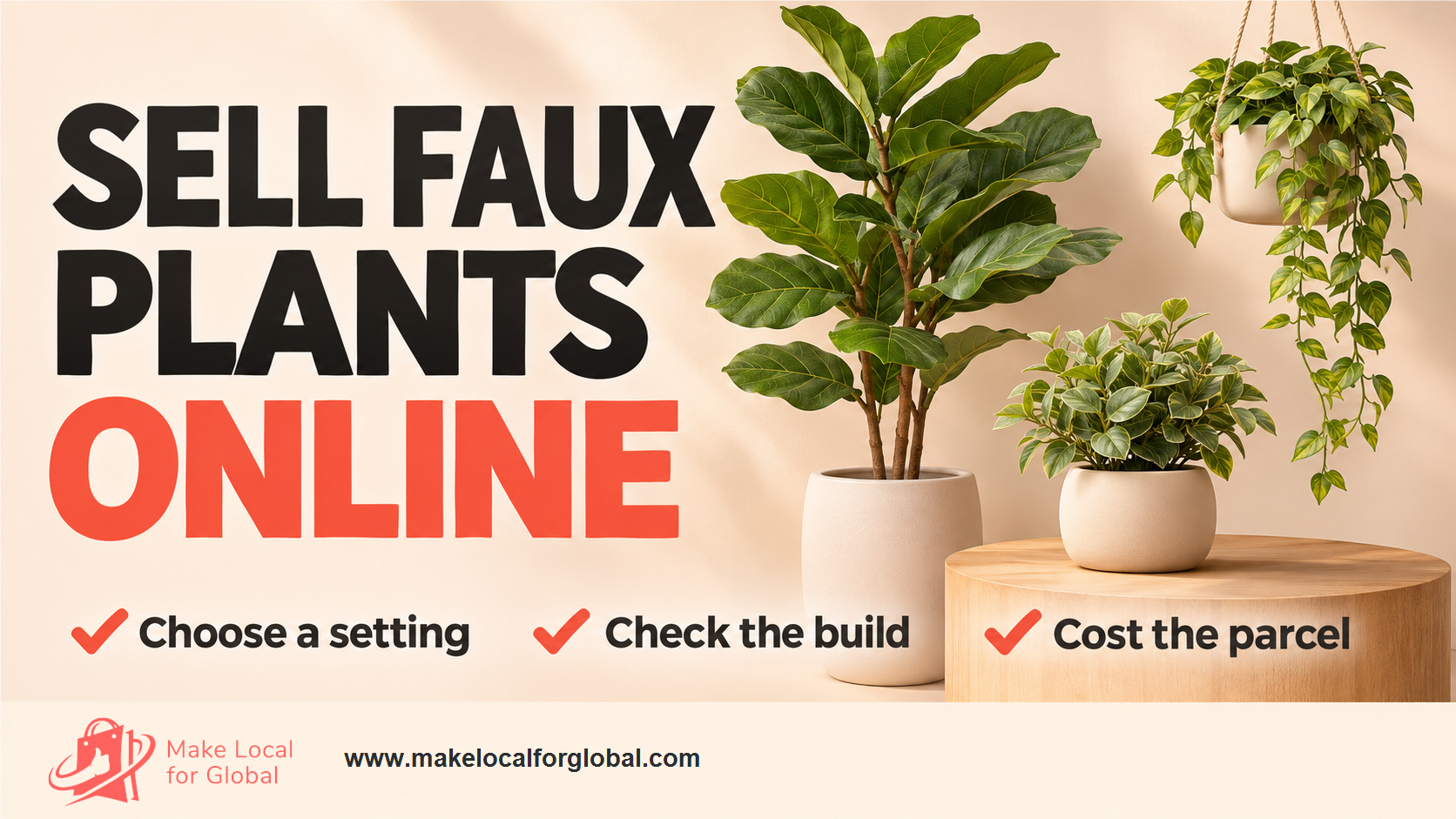
A faux plant is often bought to solve a practical decorating problem: a dim corner, a high shelf, a room where watering is easily forgotten, or a space that needs greenery without soil. For a new seller, the challenge is to make the size, finish, materials, included pot and delivery plan clear before the customer pays.
You can sell faux plants online by choosing a specific customer and room, sourcing samples whose construction you can inspect, showing the true size and finish, and pricing the packed item rather than the plant alone. Start with a small range that has distinct uses, verify the supplier and safety information, and test how each plant survives handling and delivery.
Artificial plants span compact succulents, hanging vines, desk plants, flowering stems, shrubs and full-height trees. A product name alone tells a buyer little about scale or quality. Measurements, close photographs, clear pot details, care information and an honest delivery cost help the buyer judge whether the item suits their space.
Choose a plant range for a real room
Start with a setting and size problem, then compare samples that solve it. Keep the first range small enough to inspect and cost carefully.
Start with a setting where a customer can picture the product. A small desk plant may suit a home office, a trailing vine may fit a high shelf, and a tall tree may be considered for a lounge, reception area or shop display. Treat these as customer hypotheses to test. They are not proof that one style will sell more than another.
Talk with people who have bought artificial greenery or looked for it recently. Ask what room they were furnishing, what height or width they needed, whether they wanted a pot included, what they could not judge from the listing and how the delivery charge affected their decision. Ask what they actually purchased and which alternatives they compared. This gives more useful evidence than asking whether they like an idea.
Use a simple survey or a short set of interviews. Show a product card with the plant type, assembled height, widest spread, pot measurements, materials, price and delivery. Ask the person to explain where they would put it and what information they still need. If a proposed tree only works in a room with a high ceiling, record that limitation instead of marketing it as a fit for every home.
Separate audience observations from product claims. A buyer may say that they want a plant for a dark room; that does not prove the plant is suitable outdoors, safe near a heater or resistant to sunlight. Verify the intended placement and care information with the maker before repeating it.
Write down one initial buyer group, one setting and one decision problem. For example: renters furnishing a small flat who want a compact tabletop plant with a pot included. This definition gives you a filter for sample selection, product photography and bundle design.
The word “faux plant” covers very different products. A small plastic succulent, a fabric flower arrangement and a tree with wired branches have different appearances, storage needs and delivery risks. Ask the supplier to identify the actual materials and construction for each product code rather than relying on broad category wording.
| Product type | Buyer questions | Checks before listing |
|---|---|---|
| Small tabletop plant | What are the plant and pot dimensions? Is the pot included? | Check leaf attachment, pot finish, fill material and stability on a flat surface. |
| Hanging vine | What is the total vine length and planter size? Is a hanger included? | Measure the flexible length and inspect stem joins, hooks and packaging. |
| Flowering stem or bouquet | How many stems arrive? Can the customer arrange them? | Count pieces, inspect colour consistency and state whether a vase is included. |
| Shrub or medium floor plant | How much floor space does it take? Does it need shaping? | Record the assembled spread, base dimensions, branch positions and setup steps. |
| Tall tree | Is the trunk fixed or assembled? How heavy and wide is the pot? | Check balance, joints, branch packing, carton size and the method for shaping it. |
| Outdoor-style foliage | What placement and weather use does the maker support? | Verify exposure limits and any UV-resistance statement for that model. |
Some foliage uses moulded plastics; some products use fabric, coated wire, wood, paper or mixed materials. The visible leaf surface, edge, colour and stem join affect the look from a short viewing distance. Ask for a material breakdown and a current specification. If the supplier cannot identify a material, leave that detail out of the product page until it is confirmed.
Construction can matter more than the plant name. Look for how leaves attach to the stem, whether branches bend or detach, what supports the trunk, how the base meets the pot and what filler keeps the plant upright. Take a close photograph of the joins during sample review. These are often the parts that a customer cannot judge from a styled room photograph.
Do not describe all faux plants as “plastic”. Some contain several materials, and pots may be ceramic, cement, resin, plastic, metal or woven around an inner container. List materials at the level supported by the supplier’s documentation. If a pot is a decorative sleeve and does not hold water, say so plainly.

A first range should help a shopper compare useful choices without creating a confusing list of near-identical products. One possible structure is a compact tabletop option, a hanging option and a taller floor plant. A second structure might group by setting: desk, shelf, entryway and floor. Choose the structure that matches the questions buyers asked.
Give each item a distinct job. A 25 cm potted plant and a 28 cm potted plant may not need separate listings if their shape and use are almost the same. A hanging vine, a small pot and a full-height tree give a customer more meaningful choices, provided that each has accurate dimensions and a clear price.
Separate differences that affect a purchase: plant type, foliage colour, overall height, pot finish, materials, piece count, assembly and indoor or outdoor placement. Keep variants manageable. Each extra pot colour or height adds stock tracking, photography and the possibility of the wrong version being sent.
Consider whether a pot is part of the product or a styling prop. If the plant is sold with a basic nursery pot and the lifestyle photograph shows a ceramic cover pot, label that clearly and show what arrives. If the customer receives both, name both in the product details and include their cost and weight in the parcel estimate.
Bundles can make a coherent display easier to buy, such as a pair of shelf plants or a plant with a matching pot. Before building a bundle, verify that the items fit together visually and physically. Check the combined parcel dimensions, the price of every component, stock counts and the wording of the contents list.
| Range level | Example offer | What makes the choice clear |
|---|---|---|
| Entry | One small potted plant | Show exact height, pot and whether it is ready to display. |
| Core | A medium plant in a selected pot | Explain what changes in scale or finish from the entry option. |
| Higher-priced | A tall tree or coordinated pair | Show the assembled spread, packaging size, setup needs and every included piece. |
Do not use “premium” as a replacement for detail. State what the higher-priced version adds: a heavier pot, a fuller branch layout, a larger measured height or a different finish, if each statement is accurate. Do not imply natural materials, hand finishing or a particular country of origin without a record from the supplier.
Possible sourcing routes include a UK wholesaler, a homewares distributor, a manufacturer, an importer or a private-label supplier. Each route changes lead time, minimum order, access to records and control over product information. Compare the legal supplier name, invoice details, item code, place of dispatch, carton quantity and returns process before paying.
Request a current catalogue or specification for the exact plant and pot combination. Ask for total height, widest spread, base or pot dimensions, materials, weight, assembly instructions, care advice, intended placement, country of origin where applicable and the packaging dimensions. Ask how the supplier handles a construction or material change and how it identifies each batch or production run.
Ask who made the product, who imports it and which party can answer product-safety questions. Obtain instructions and warnings for the model, plus any conformity or test documents that apply to its materials or features. If the item includes a light, battery or electrical part, treat it as a different product configuration and ask for the applicable records for that version. Do not assume a decorative item without electronics has the same obligations as a powered product.
Use one request form for every candidate supplier:
Keep answers with the product code and the current version of the listing. A generic certificate for a supplier’s catalogue may not describe the model you intend to sell. If the document has another item number, material or production date, ask for clarification in writing before making a claim from it.

Order the exact plant, pot and finish you plan to sell. Photograph the sealed delivery before opening it, then record the supplier, date, model, quantity and condition. Compare the sample with its product page and specification. A sample in a different pot or colour cannot confirm the finish of the stock you plan to order.
Inspect the plant at normal viewing distance and close up. Check that leaves are attached, branches do not pull apart under gentle handling, stems are not exposed unexpectedly and the foliage has a consistent finish. Note sharp edges, loose wire, protruding ties, uneven coating, strong residual odour or material transfer onto a clean cloth. If something concerns you, record it and ask the supplier for an explanation. A simple visual check is not a chemical or laboratory test.
Measure the plant after following the supplier’s assembly instructions. Record the height from the base to the tallest point, the widest natural spread and the pot width and height. For a tree that can be shaped, take one photograph before shaping and another after following the supplied steps. This shows the customer that the final width may depend on arrangement rather than being a rigid measurement.
Place the sample on a flat surface and check whether the base sits evenly. Give it a light, ordinary nudge, not a stress test, and note whether it rocks or tips. A tall tree with a narrow base may need a different pot or setup instruction. Do not claim that a product is child-safe or pet-safe based on a quick stability check.
Inspect any removable parts and included accessories. Count the stems, pot inserts, ties, clips and instructions against the supplier’s list. If a hanging product includes a hook, inspect its stated rating and installation instructions; do not imply that the hook suits every ceiling or wall. If the plant must be assembled, time the process and note tools required so the listing can prepare the buyer accurately.
Pack the sample as if it were an order. Use the carton and protective materials you intend to buy. Check whether leaves are crushed, branches are sharply bent or a pot moves inside the box. Open the parcel and assess whether the plant can be restored by following the maker’s instructions. If foliage arrives permanently damaged or the customer would need to reshape it beyond the stated setup, ask the supplier about a different carton or packing method.
Write a sample report with pass, fail or awaiting supplier answer for each item: identity, material, measurements, finish, stability, assembly, care, safety information and packed condition. Keep photographs beside the report. Repeat the relevant checks if the supplier changes the pot, stem, foliage material, carton or assembly instructions.
Make the product and delivery plan work together
A large faux plant needs a safe pack, clear assembled measurements and a delivery price based on the finished parcel. Review these before setting a selling price.
Faux plants are consumer products. A seller must identify the rules that apply to the precise product and their role in the supply chain. The Office for Product Safety and Standards business guidance explains that products should be safe in normal and reasonably foreseeable use, with relevant records, instructions and labelling. That page distinguishes Great Britain from Northern Ireland.
Do not treat the general guidance as a complete product assessment. A simple artificial plant may have a different risk profile from a tall floor tree, an item with a metal hook, a product packaged with a candle holder or a version with lights. Ask the manufacturer or importer which requirements and records apply to the exact model and destination market. If the product has a specific feature, check whether sector-specific rules apply.
Keep traceability information: supplier, product code, invoice, date received, quantity, model version and any batch or lot reference. Keep the product instructions and supplier responses with the listing. If a customer reports a loose part, tip hazard, sharp wire or other risk, record the exact item and contact the supplier. Follow current reporting instructions from the relevant authority if you learn that a product may be unsafe.
Great Britain and Northern Ireland have different general product-safety arrangements. The official Great Britain guidance on the General Product Safety Regulations covers Great Britain. OPSS states that the 2005 Regulations were superseded in Northern Ireland on 13 December 2024 by the relevant EU General Product Safety Regulation. Check the current NI guidance and the exact duties for your role before selling there.
If you import a product, add your own branding, change the product, or sell it under your own name, your obligations may differ from those of a retailer reselling an unchanged item. Confirm who is manufacturer, importer or distributor, who retains technical documentation, which contact details belong on the product or package and who handles a safety issue. A supplier’s reassurance in a chat message is not a substitute for identifying the responsible business and the relevant documents.
Do not make a CE, UKCA, fire-safety or child-safety statement by borrowing a mark or phrase from another plant listing. Ask which rule or feature makes it relevant, who assessed it and which product the evidence covers. If the supplier has not supplied a clear answer, remove the claim and pause that SKU if you cannot establish the information needed to sell it responsibly.
Artificial foliage is not automatically recyclable or environmentally preferable to a live plant. A product may combine foliage, wire, adhesive, coating, pot and filler that cannot be separated easily. Do not describe a whole item as “eco-friendly”, “sustainable”, “plastic-free” or “recyclable” based on one component or a supplier’s general catalogue statement.
The Competition and Markets Authority’s guidance on environmental claims says claims should be accurate, clear, substantiated and not hide important information about the wider impact. Ask which parts of the item a claim covers, the evidence date and whether the evidence relates to the exact model. A narrow factual statement, such as a documented percentage of recycled material in the pot, is different from a broad claim about the entire product.
Be just as careful with “UV resistant”, “weatherproof”, “fade resistant”, “fire retardant”, “non-toxic” or “pet safe”. These descriptions can affect where a buyer uses the product and what they expect from it. Ask for evidence and approved wording for the exact item. If you do not have that evidence, describe the visible features instead and tell the customer to follow the supplied care information.
Check each product photograph for implied claims. Showing a faux tree on an exposed patio may imply outdoor suitability. Placing foliage beside a lit candle, fireplace or heater can suggest a use the maker does not support. Use a scene that matches the placement information and show any warning or limitation in normal product text.
An online listing should answer whether the plant fits, what arrives and how it will look after setup. Begin with an accurate product name: plant type, assembled height, pot detail and a verified material if it helps distinguish the item. For example, “120 cm faux olive tree with black nursery pot” is only suitable if those exact details match the sample.
Write a short opening description that names the use without overpromising: “A 120 cm artificial olive-style tree with flexible branches and a black nursery pot. Follow the included shaping and care instructions. Decorative cover pot is not included.” Use the actual style, finish, assembly and inclusions from your item record.
Put useful measurements close to the purchase control. State height, widest spread, pot width and depth, product weight and packed or assembled requirements where they help. Explain how you measured a flexible plant. A buyer needs to know whether “120 cm high” includes the pot and whether the plant arrives pre-shaped.
| Product-page field | Information to show |
|---|---|
| Plant style | Exact model name or plant type stated by the supplier |
| Assembled size | Height and widest spread, with a note on shaping if needed |
| Pot | Material, outside dimensions, colour and whether it is included |
| Foliage and stem | Materials confirmed by the specification |
| In the parcel | Each plant, pot, hook, insert or accessory included |
| Setup | Assembly steps, tools and shaping information from the maker |
| Care and placement | Current maker instructions and supported use |
| Delivery | Dispatch estimate, carrier price, parcel limits and any split shipment |
| Returns | The shop's clear process alongside statutory consumer rights |
Use variation selectors that match the stock codes. If a buyer chooses a grey pot, the order email and fulfilment sheet should identify the grey-pot SKU. Check that a bundle lists every included piece and that stock decreases from the correct individual components.
Add concise answers to the questions the product record supports: does the pot come with the plant, is it ready to display, are branches flexible, how is it shaped, can it be placed outside and how should it be cleaned? Do not answer personal questions about allergies, children or pets without specific reliable information for the product. Direct buyers to the maker’s instructions where a use question is beyond your verified product data.
Use a clean photo of the actual sample as the main product image. Show the plant from the front, the side, the base and a close view of the leaf and stem joins. A styled interior photograph can help someone judge the scale, but pair it with a neutral view where the product shape is easy to assess.
Show scale honestly. Place the plant beside a measured wall mark, a ruler or a familiar piece of furniture on the same plane. Include the pot in the frame if it is sold with the plant. Do not enlarge foliage, hide a narrow trunk or photograph the tree from below to make it appear taller than it is.
Create a simple comparison image for variants. Keep camera distance and lighting similar so a 60 cm tabletop plant and a 150 cm floor plant do not appear the same size. Label each image with the correct model name in the page text or a restrained graphic. If a lifestyle scene uses a different pot, say that the pot is not included.
For a flexible tree, show the sample before shaping and after following the supplier’s instructions. Add an explanatory caption that branches are arranged by hand, if that is accurate. Avoid before-and-after scenes that imply a different product quality or a specific performance claim.
Write alt text for what the image actually shows. “Artificial olive-style floor tree beside a sofa, with a black nursery pot” describes visible content. Avoid repeating a chain of target search terms. If text is embedded in a checklist image, repeat its main points in nearby page text so a reader can access the instructions without relying on the graphic.
Use current supplier and carrier quotes, and identify whether each amount includes VAT. The example below is illustrative only. It is not a supplier quote, market average or profit forecast. It assumes a single 120 cm faux tree sold for £69.00, no separately charged delivery and a seller who is not VAT registered.
| Order cost | Illustrative amount |
|---|---|
| Customer payment for the tree | £69.00 |
| Plant and pot purchase cost | £26.00 |
| Inbound freight allocation | £4.00 |
| Protective carton and packing | £5.50 |
| Pick, pack and service time | £4.00 |
| Payment and channel fee allowance | £3.50 |
| Outbound delivery | £8.50 |
| Damage and returns allowance | £3.00 |
| Customer acquisition allocation | £7.00 |
| Total listed variable cost | £61.50 |
| Contribution before fixed costs | £7.50 |
The arithmetic is £26.00 + £4.00 + £5.50 + £4.00 + £3.50 + £8.50 + £3.00 + £7.00 = £61.50. Subtract £61.50 from £69.00 and the result is £7.50 contribution before fixed costs. That is not net profit. Rent, software, insurance, accounting, tax, photography, unsold stock and owner time not already counted still affect the result.
The example’s fee allowance is not a universal platform rate. Check the current schedule for the exact channel, payment method and basket value. Some services calculate charges on delivery or other parts of the order. Record the source and check date in your pricing sheet.
Run at least three scenarios: single plant, a two-item bundle and a discounted offer. Two small plants may cost less to ship than one tall tree, yet the box size, pick time or fee can still change. A discount of 10% on £69 reduces revenue to £62.10. If costs remain £61.50, contribution becomes £0.60 before fixed costs, which may not justify the promotion.
If VAT applies to the business, ask an accountant how to compare VAT-inclusive revenue with eligible input costs. Use one consistent basis and include any import duty, currency fee, packaging compliance cost or carrier surcharge that applies to the specific route. Do not treat a quote for the empty plant as a delivered-order cost.

Measure the plant in the form it will ship. A tall tree may be priced by parcel dimensions rather than weight. Ask the carrier or fulfilment partner for the current size and weight limits, volumetric rules, oversize charges, collection options and remote-area pricing. Enter the packed dimensions into the cost sheet before setting the price.
Check how the supplier packs flexible branches. A stem that arrives folded may spring back with shaping; one that has a sharp permanent crease may not. Do not compress a plant more than the maker’s packing method supports. If the order ships in two boxes, show that clearly and confirm whether the customer sees one or more tracking numbers.
Pack a sample with your proposed carton and protection. Secure the pot so it cannot knock against branches, support the trunk, protect loose foliage and keep the assembly parts together. Add a clear setup sheet if the maker supplies one or if the seller has an approved instruction. Do not invent steps that could damage the product or conflict with its care directions.
Take photographs of the packed sample from each side, note carton dimensions and weigh the complete parcel. Open it and compare the plant with the pre-packed photographs. Repeat the check after a carton or supplier change. A packaging check helps reveal movement and compression points; it does not certify a parcel for every carrier or every impact.
For local delivery or collection, state the area served, cost, lead time and handover conditions. Do not advertise a national delivery price if remote postcodes need a separate quote. If a large plant arrives flat-packed or requires assembly, describe that before checkout rather than after dispatch.
Track each plant by exact SKU, pot colour, height, supplier, purchase date, quantity and unit cost. Keep the supplier’s product sheet, instructions, invoice and sample photographs with the same record. If the product uses batch or production codes, record them on receipt and keep them linked to the shipment.
Store plants in clean, dry conditions that follow supplier instructions. Keep boxes from crushing stems and leaves. Do not store a tall tree under a heavy carton or in direct sun if the maker warns against it. Mark fragile or easily confused pot variants so a picker can choose the correct item.
Use reorder points that account for supplier lead time and the cash tied up in bulky stock. A large tree may take more storage space and cost more to return than a small pot. Track orders, average delivery cost, damage, returns, customer questions and days in stock. Review slow-selling variants before increasing the minimum order.
Set out a clear process for damaged parcels, missing parts, the wrong pot and a change of mind. Online cancellation and refund rights depend on the situation and applicable law. Read GOV.UK’s guidance on distance selling and returns before writing a policy; do not state that decorative products can never be returned.
When an item returns, record its SKU, condition, packaging, missing parts and reason. Keep damaged or incomplete products out of saleable stock until inspected. If a complaint points to the same loose branch, unstable base or crushed carton across several orders, pause that item and contact the supplier. Preserve the buyer’s report and photographs with the product record.
An independent shop gives you control over comparison tables, detailed measurements, pot options, care information and bundle listings. This route means you must attract visitors, manage checkout, answer questions and maintain stock. A marketplace can put a product beside other homewares, but each channel has its own rules for listings, images, shipping and returns.
Pick one primary channel for the first test. Build a mobile product page, place a test order, confirm the variant in the order email, measure the parcel and check that the delivery charge matches your actual quote. Review the returns link and customer support route before publishing paid promotion.
Local interiors shops, florists, offices or stylists may be possible trade customers. Prepare a wholesale price, minimum quantity, carton details, lead time and sample policy before approaching them. A buyer’s request for a discount is not proof that a wholesale order will work; calculate the packed or palletised cost and payment terms first.
If a product suits a plant-and-pot purchase together, compare your listing with the existing flower pots guide. A tall display that needs careful shipping can benefit from the planning in the decorative mirrors selling article. Use these links where they help the reader solve a related shop decision, not as filler.
Product searches may include plant style, room, height, pot, colour or placement. Use the precise terms that match the item. “Artificial olive tree 120 cm with pot” is useful only when the sample has those features. Avoid several pages that differ only by a synonym if each page would answer the same question.
Give each product page its own title and description. Put the plant type and meaningful size or pot detail in the title. Explain materials, assembly, care, delivery and contents in the body. Product-specific photographs, informative alt text, clear internal links and an accurate page description help a search engine and a customer understand the offer; no phrase density or title formula can promise a ranking.
An article about selling faux plants should focus on sourcing, sample inspection, product pages, costs and fulfilment. A separate shop category can help someone compare available styles. Avoid copying the same paragraph into every plant listing. Use a short comparison page when it genuinely helps a buyer choose between height, room placement or pot type.
Check Google Search Essentials for current guidance on making useful content discoverable. Review your search queries and support messages each month. If customers repeatedly ask whether pots are included, move that detail closer to the price and add a photograph of the actual contents.
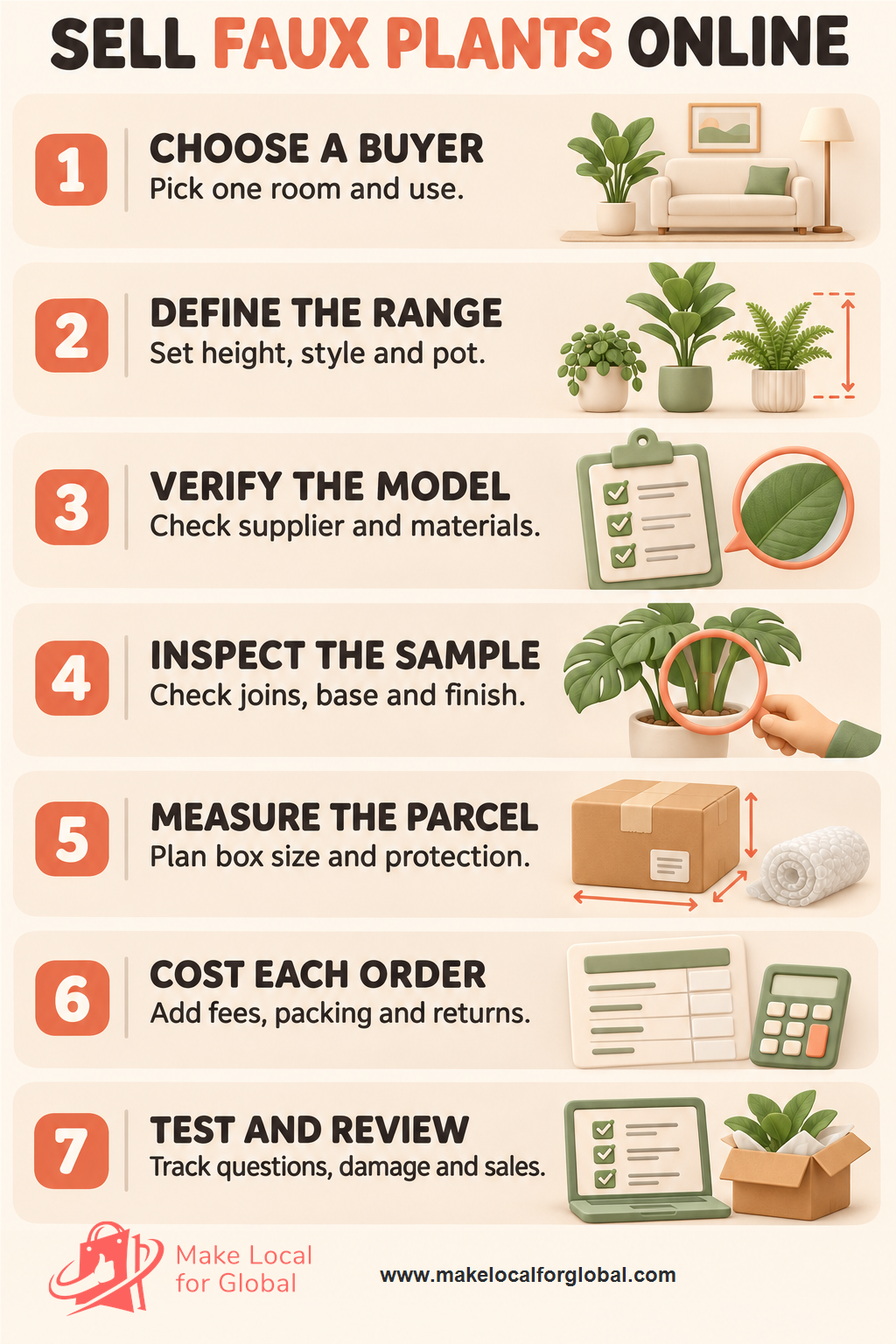
Treat the first month as a sequence of small decisions. Set a weekly question and a measurable result, then decide whether to continue, adjust the range or stop.
Choose one customer group and two settings to investigate. Speak with five to ten potential buyers about size, pot inclusion, style, price and delivery. Save the exact questions they ask and the measurements they use when planning a room.
Request specifications and quotations for three possible items. Compare materials, dimensions, pot details, minimum order, carton size, lead time and supplier responses. Remove any item whose supplier cannot identify the model or provide the basic product information you need.
Order one sample of the most promising model. Photograph its packaging, measure it assembled, check the base, inspect joins and record setup steps. Send written questions to the supplier about any unclear material, placement or safety information.
Build a sample report and cost sheet. Use the sample to test your photo plan and product page. Ask a potential buyer to find the size, pot inclusion and delivery expectation on a phone without your help.
Get a current carrier quote for the sample packed in your intended carton. Price a single order, a bundle and a discounted order. Add fees, packing time, damage allowance and customer acquisition cost. Identify the contribution before fixed costs and write down which values remain estimates.
Prepare one product page and review every claim against the supplier record. Check the variant selector, cart, order email and returns route. If the item is too large for an affordable parcel or a claim cannot be supported, change the offer before ordering stock.
Publish a limited number of the tested model if the information, stock and delivery plan are ready. Place one more order through the live shop and confirm the parcel matches the listing. Record visits, questions, sales, contribution, damage, returns and time spent packing.
At the end of the month, compare the result with your original buyer hypothesis. Continue only when the product is traceable, the customer understands the size and contents, the parcel can be delivered at the stated cost and the numbers leave a contribution you can support.
Yes, if the item meets the rules that apply to the product and your role. Check current product-safety requirements, supplier records, instructions and any sector-specific obligations before listing. Great Britain and Northern Ireland have different general product-safety arrangements.
Start with a small set that answers different space needs, such as a tabletop plant, a hanging option and a floor plant. Use buyer interviews and sample checks to decide which models deserve stock. A short range is easier to photograph and track than a long list of similar variants.
Ask for the exact model code, material information, assembled and packed dimensions, care instructions, safety records, sample terms, minimum order and defect procedure. Match the answers to the physical sample and invoice before paying for a larger order.
State clearly whether a pot is included. If the product arrives in a basic nursery pot and the styled image uses a decorative cover, label the cover as a prop and show the included pot. Include each supplied part in the price and shipping calculation.
Follow the maker’s assembly and shaping instructions, then measure from the base to the tallest point and across the widest natural spread. State whether the height includes the pot. If branches can be arranged, explain that the final spread depends on shaping.
Only use those terms when the supplier has current evidence and instructions for the exact model. Ask about the intended conditions and limits. A photograph on a patio is not proof of outdoor suitability.
Do not assume that the whole plant is recyclable. Foliage, wire, adhesive, coating and pot materials may be mixed or difficult to separate. Ask the supplier for evidence and use precise wording that identifies the component covered.
Use a carton that supports the trunk, protects the pot and gives foliage enough room. Follow the supplier’s packing method, measure the finished parcel and test a sample. Confirm the carrier’s current size and weight limits before setting a delivery price.
Start with a quantity that fits your available cash, storage and supplier minimum after a sample passes. Consider lead time, carton volume, demand evidence, return costs and whether pot or foliage variants need separate stock. A low unit price does not justify a large first order on its own.
Online cancellation and refund rights can apply even when an item is not faulty. The rules and exceptions depend on the sale and circumstances. Read current GOV.UK information and write a clear process that does not remove statutory rights.
Record visits, questions, chosen variants, orders, packed dimensions, delivery cost, damage, returns, stock age and contribution before fixed costs. Use those results to decide whether the product page, packing method or range needs a change.
Build your first faux plant test range
Use the room, sample, packed cost and product page checks in this guide to make a focused first decision. MLFG can help you plan your online selling setup.
Selling faux plants online is a product-information and delivery task as much as a sourcing task. Choose a buyer and room, compare useful types, verify the supplier’s records, inspect the exact sample and photograph its real scale. Give the customer clear measurements, materials, included parts, care and placement details.
Calculate the parcel with a current quote and include every variable cost. Keep product claims tied to the model’s evidence, store stock so leaves and stems are protected, and keep a record of each supplier and item code. If the seller information or packed economics do not work, change the item before buying a larger quantity.
If you are planning a homewares shop, browse the business apps for tools that help with early decisions, compare shop options and pricing, or contact Make Local for Global about a suitable next step.
PREFERRED SOURCE
Like what you’re reading? Add Make Local for Global as a preferred source on Google to see more of our articles when you search.

Build your online presence without having to figure out everything yourself.