

READY TO SELL Car Covers ONLINE?
Get a store built for you in 5 days, plus training and support to help you start, run, and grow your Alternative business.

Choose a car-cover buyer, verify vehicle fit, inspect supplier samples, price bulky parcels and write clearer product listings for a UK online launch.


A car cover can look like a simple fabric purchase. The hard part for an online seller is matching the cover to the vehicle and parking conditions, describing what the material can and cannot do, and shipping a bulky parcel without losing the margin.
To sell car covers online, begin with one buyer group, a small set of clearly described cover types and a verified fit guide. Then test samples, price each order from landed stock through delivery and returns, and publish photos that show the actual shape, attachment points and storage bundle.
“Car cover” can mean a breathable dust cover for a dry garage, a weather-resistant cover for occasional outdoor use, a fitted cover for one model, or a loose universal cover for several vehicle shapes. These products answer different problems. A buyer with a classic car stored indoors may care about a soft lining and dust control; a commuter parking under trees may ask about fit, rain claims, straps and how quickly the cover can be removed.
Write one clear customer statement before you contact suppliers. For example: “A reusable indoor cover for owners storing a saloon in a dry garage, with a soft inner face and a size guide based on measured vehicle length.” Every claim must match the sample and its supplier evidence. If you have not checked lining material, compatibility or care instructions, leave that detail out until you can verify it.
Separate the parking setting from the vehicle type. Indoor storage may call for dust protection and a fabric that sits gently on a clean vehicle. Outdoor use raises different questions about water resistance, breathability, wind, UV exposure, fastening and surface contact. Some buyers want protection during a short stay at an airport; others leave a vehicle covered for weeks. Avoid promising one cover will solve every condition.
Record your assumptions in a simple evidence sheet: buyer, vehicle group, parking setting, likely season, main worry, desired feature and the evidence you still need. Mark customer comments as observations and your guesses as assumptions. That distinction stops a few enthusiastic replies from turning into an unsupported demand forecast.
Start with the questions buyers already ask. Read recent reviews of competing covers and group recurring complaints: inaccurate sizing, unclear mirror coverage, fabric that feels thinner than expected, awkward straps, condensation concerns, a difficult storage bag or delivery that costs more than the product. A complaint is a clue for product research, not proof that every buyer shares the same problem.
Ask a small number of people who own the vehicle types you may serve. Ask where they park, how often they would fit a cover, what they have used before, what failed, and which dimensions or attachments they would check before buying. Do not lead with “Would you buy my cover?” A person may say yes to be supportive, then choose a different product when asked to spend money.
Make a competitor sheet with listing price, delivery charge, fit method, cover category, supplied accessories, material claims, product photos, return terms and review themes. Record the date and link for each listing. Prices and platform terms change, so a saved screenshot or dated note is more useful than relying on memory.
Use a low-cost test before buying deep stock. You could show two sample options to a local owners’ group with permission, ask an independent garage or detailing business what cover questions customers raise, or create a landing page that measures interest by vehicle group. Do not pretend to hold stock or accept payment for a product you cannot supply. State clearly when an item is a sample, preorder or planned product and follow the relevant consumer rules.
Choose a first audience narrow enough to describe accurately. “Indoor covers for small hatchbacks kept in a clean garage” gives you a testable starting point. “Covers for every car and every weather condition” creates a large compatibility burden before you know which buyers will respond.
Ask suppliers to define their product terms in writing. “Water-resistant”, “waterproof”, “breathable”, “indoor” and “outdoor” are not interchangeable. A Streetwize guide for one water-resistant breathable cover states that water-resistant does not mean waterproof and lists fitting conditions for that product. Treat this as an example of why you need the instructions and test evidence for the exact SKU you intend to sell, not as a claim about all covers.
Use the product’s intended parking conditions, construction, supplied instructions and sample results to set the listing boundaries. If a supplier has not given reliable test data, use factual wording about the construction and avoid performance labels. Never convert a supplier’s vague phrase into a guarantee in your own copy.
| Cover offer | Potential buyer | Details to verify | Listing boundary |
|---|---|---|---|
| Indoor dust cover | Owner storing a clean vehicle in a dry garage | Inner-face feel, fit, seams, storage and care instructions | Describe indoor storage only when the supplier states this use |
| Outdoor cover | Owner leaving a vehicle outside | Water test method, breathability evidence, UV information, fastening and care | Use the exact tested claim and named conditions |
| Model-specific cover | Owner seeking a closer fit for a known model and trim | Year, body style, trim, mirrors, aerial, spoiler and roof accessories | Publish the compatible combinations supplied and verified |
| Universal-size cover | Owner who can compare their vehicle measurements to a size chart | Finished garment dimensions, measurement points, fit photographs and strap layout | Explain that a size label alone does not confirm vehicle fit |
Use the supplier’s current specification for each item. These are planning categories, not performance ratings.
Write a claim ledger beside the table. For each statement in your draft listing, record the supporting source: a signed specification, a sample measurement, a test report, an instruction sheet or your own repeatable inspection. If the evidence only covers one model or one batch, keep the claim within that scope.
A first range should help you learn which fit and use details matter. It does not need a large grid of colours, sizes and cover grades. A practical pilot might have one indoor option and one outdoor option, each in two size bands that map to clear measured ranges, or one fitted option for a single popular vehicle group where you can verify exact compatibility.
Do not launch several nearly identical grades just to create an appearance of choice. More variants mean more stock, more SKU labels, more sample checks and more ways to send the wrong item. Begin with a small range you can inspect and explain. Add a size or material only when customer evidence, supplier reliability and the cost model support it.
| Range position | Example role | Proof needed before launch |
|---|---|---|
| Entry | A basic indoor cover for a defined vehicle size band | Actual dimensions, pack contents, storage and care details |
| Core | A mid-range outdoor cover for a tested parking scenario | Exact performance evidence, fasteners, fit and care instructions |
| Specialist | A model-specific cover for a clearly listed set of vehicles | Supplier fitment list, trim exclusions and support route for uncertain cases |
Use these as positions in a range, not a promise that every business needs all three.
Assign a separate SKU to each size, cover type and colour combination. Keep the SKU on the supplier quote, purchase order, sample label, storage bin and listing. If a size uses a product code shared by the supplier, add your own internal identifier so returns and defects can be traced back to a batch.
Decide the reorder point before launch. A bulky item may take meaningful room and cash, even when folded. Record supplier lead time, minimum order quantity, carton size, units per carton and the number of orders you can meet from the first batch. Set a stock limit that does not rely on a hopeful sales forecast.
Compare your customer, offer, cost assumptions and first test in the B2C Launch Assessment before committing to a large order.
You can source through a UK wholesaler, buy from a manufacturer, work with a distributor or develop a private-label version. Each route changes lead time, minimum order, control over specifications, branding, documentation and responsibility for after-sales support. A low unit quote may become expensive once freight, duties, packaging, inspection, storage and faulty stock are included.
A domestic wholesaler may offer lower order quantities and shorter replenishment, though the available models and branding options may be limited. A manufacturer may allow more control over dimensions, lining, straps or labels, with a larger minimum order and more work to check samples and records. A distributor may supply an established product with instructions and traceability, but you still need to check whether the item suits the buyer you plan to serve.
For each supplier, compare an identical quote request. Ask for unit price at several quantities, minimum order, sample charge, production lead time, carton dimensions, units per carton, packed weight, shipping terms, payment schedule, defect process, warranty wording and the documents supplied with each batch. Request the actual SKU specification, not a broad catalogue description.
Ask how fitment data is created and updated. If a supplier gives year, make, model and trim compatibility, request the revision date and the method used to match vehicle shape, mirrors, aerials, spoilers and roof accessories. Ask how a product change is communicated and whether a new sample is required when the fabric, cut, fastening or factory changes.
Check that the supplier can identify the factory and batch. Store purchase orders, invoices, test reports, product instructions and written approvals in one place. If the supplier will not provide clear records or responds to specific safety questions with marketing phrases, pause the order until the uncertainty is resolved.
A UK warehouse location does not prove UK manufacture. Record where the product was made and what later processing took place. If origin matters to your offer, check the exact wording against your supplier evidence and current trading guidance.
Order a sample from the same product code and factory you plan to sell. Photograph its packaging and labels as it arrives, then record the order date, supplier, batch, dimensions, packed weight and contents. Keep one approved sample as your comparison reference; do not rely on memory when a later delivery arrives.
Inspect the seams, hems, elastic, straps, buckles, clips, mirror pockets, aerial openings, lining and storage bag. Check for loose stitching, sharp edges, missing fasteners, uneven panels, damaged coating, odour, dye transfer and packaging damage. Make notes against an agreed specification rather than writing “looks good”. A record such as “front strap buckle released after three hand pulls” tells you what happened and what needs follow-up.
Measure the finished cover on a clean flat surface using the supplier’s named measuring points. Record length, width, height and the position of pockets or closures. Compare each result with the tolerance in the specification. A cover marked “large” is not a useful measure for a buyer who needs to know whether the body shape and mirrors fit.
Review the product’s instructions before putting it on a vehicle. Streetwize’s fitting sheet for its own breathable water-resistant covers says to fit after the vehicle has cooled, not to fit its cover to a wet vehicle, to retract aerials, and to measure with mirrors pushed in. Those instructions belong to that product; obtain and display the instructions for your own SKU, and do not generalise one supplier’s guidance to every cover.
Ask the supplier for test methods and reports supporting each performance statement. Find out which sample, material, batch, conditions and lab the report covers. A seller’s home test can help reveal a visible defect or prompt a supplier question, but it cannot replace a suitable laboratory method or prove a broad claim about long-term weather performance.
Set stop rules before the inspection begins. A torn seam, poor fit, missing fastener, inconsistent dimensions, unsafe instruction or unsupported claim should pause the listing or reorder. Write down the decision, who approved it and which evidence changed the result.

Fit is a major source of avoidable questions and returns. A vehicle’s body style, year, trim, mirrors, roof aerial, spoiler, roof rack, antenna and aftermarket additions can change how a cover sits. A general size chart may help a buyer screen options, but it does not confirm the cut suits every vehicle in that size band.
Build a compatibility table from supplier records and your own sample review. Include the vehicle group, model year range, body shape, named trim exclusions, approximate cover measurements, mirror arrangement, aerial or spoiler notes, measurement method and source date. Link to the supplier’s current data or keep a saved dated copy. When a supplier cannot verify a particular model, write “check measurements before ordering” instead of adding that model to a list of confirmed fits.
Use physical measurements as a second check. State where the buyer should measure, whether mirrors should be folded and whether the measurement starts at the chassis or another point. The Streetwize sheet gives one example of a supplier-specific method: it advises measuring with wing mirrors pushed in and taking height from the chassis, not the floor. Ask the maker of your own cover for its measurement diagram and compare it with the sample.
Test the fit on a vehicle that matches the intended listing, with the owner’s permission. Follow the supplier’s care instructions, inspect contact points and check whether each buckle or strap reaches its intended position without force. Take photos from the front, side and rear, then note any part of the vehicle the cover leaves exposed. Do not publish one test result as proof of fit for a different body style.
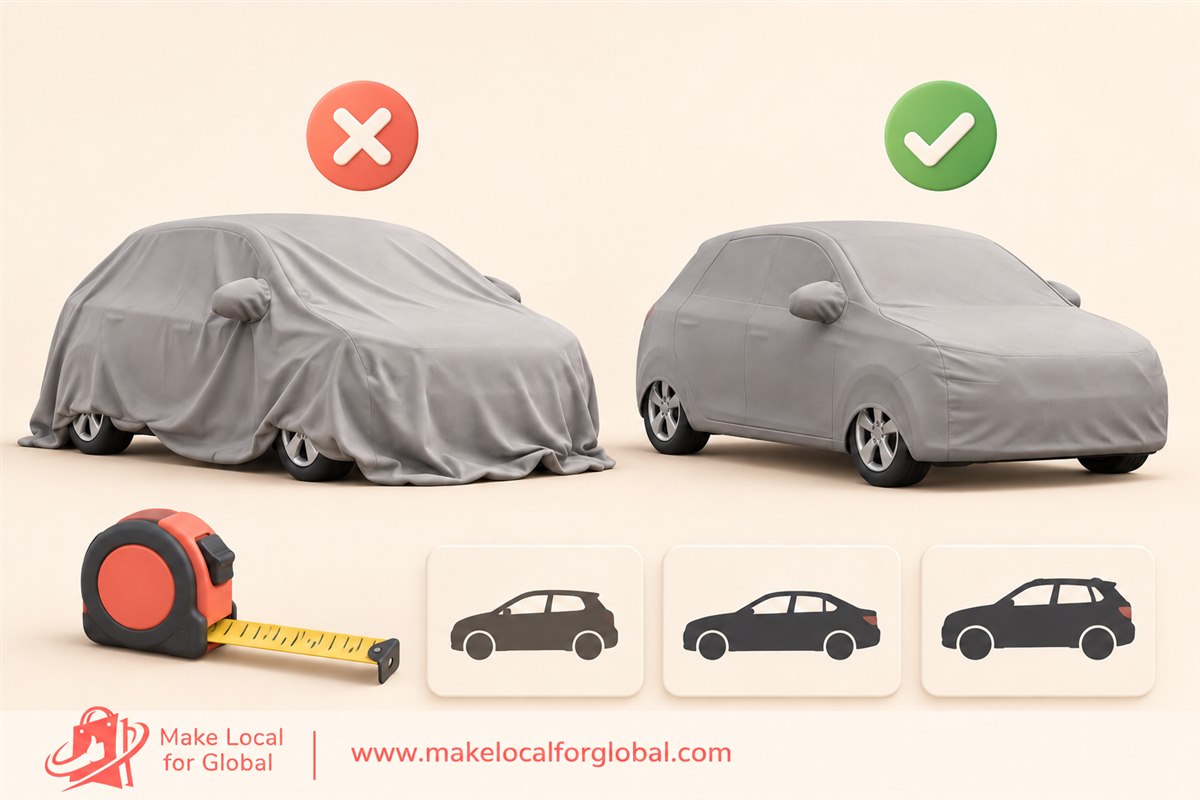
For a range that includes different sizes, show buyers a plain decision path: locate the vehicle in the verified fit list; check its year and body style; review mirror, aerial and roof accessory notes; compare the dimensions; contact you if a detail is missing. A short, honest route is better than an oversized compatibility list that implies certainty you do not have.
Car covers can be light but awkward to ship. Price the packed parcel, not just the folded fabric. Measure its final length, width and depth and weigh it with labels and protective packaging; carriers may price by the larger of actual and volumetric weight. Ask each carrier for the applicable parcel size limits, delivery zones, surcharge rules, collection options and current price.
The worked example below uses an illustrative £64.99 selling price with delivery included. It assumes a UK seller that is not VAT registered, a £25.80 landed product cost and an eBay listing in a Vehicle Parts & Accessories category for which the business-seller rate is 9.5% up to the relevant threshold, plus the current per-order and regulatory operating fees shown on eBay’s fee page checked on 21 October 2026. Confirm the actual category and fees in your own account before using the calculation.
| Cost per completed order | Illustrative amount | How to replace the assumption |
|---|---|---|
| Selling price, delivery included | £64.99 | Use the real customer price including any postage charged separately |
| Cover plus inbound freight and import costs | £25.80 | Divide the order invoice, freight and non-recoverable import charges by saleable units |
| Outbound packing materials | £1.40 | Include mailer or carton, label, tape and protective insert |
| Tracked parcel delivery | £6.25 | Use the quote for the packed size, destination and service you offer |
| Marketplace variable fee | £6.17 | 9.5% × £64.99; check category, fee base and seller performance adjustments |
| Marketplace per-order and operating fees | £0.63 | £0.40 per order plus 0.35% × £64.99, rounded |
| Returns allowance | £3.25 | A planning reserve equal to 5% of the selling price; replace with your own return data |
| Customer acquisition allowance | £4.00 | Use campaign spend divided by attributable completed orders |
| Estimated contribution before fixed overhead and tax | £17.49 | £64.99 − £25.80 − £1.40 − £6.25 − £6.17 − £0.63 − £3.25 − £4.00 |
Illustration only, not a forecast. The example uses a non-VAT-registered seller and rounded fee values. It excludes fixed overhead, owner pay, tax, insurance, subscriptions, damaged stock and any extra labour. eBay’s fee base includes the item price, postage and applicable taxes. Recheck its current business fees and your listing category before setting a live price.
The contribution in this example is not net profit. It is the amount left before fixed costs and tax after the listed variable order costs. If the actual postage price is £8.10, the supplier cost changes, a buyer returns a used cover, or a promoted listing rate applies, update the model before you order again.
Keep separate rows for a direct website and a marketplace. A direct site may avoid a marketplace fee, yet it has payment processing, hosting, marketing, customer support and checkout costs. A marketplace may bring shoppers to a listing, but it can charge a percentage of the total sale and apply other fees. Compare orders with the same selling price, postage offer and return assumption.
Run a low, expected and high cost case. Raise supplier cost, parcel price, return reserve and ad spend in the high case. Lower selling price or repeat order value in the low case. If the product only contributes under optimistic assumptions, reduce the order size or test a different offer before committing cash.
A size mismatch can consume postage, time and saleable stock. Use the B2C Returns Impact Lab to explore how different return rates change order contribution.
Ask the supplier for carton measurements and packed unit weight before you agree to an order. A folded cover can expand when packed in its final bag or box. Test whether its bundle fits within your carrier’s size bands and whether its shape needs a stronger outer carton to prevent a sharp corner or buckle from tearing the parcel.
Keep each size and type in a labelled bin. Store supplier batch and SKU information with the stock count, then remove any item with a damaged bag, missing instruction sheet or visible defect from sale. A simple stock log can track date received, units accepted, units rejected, orders, returns and reorder lead time.
Pack the cover dry and clean, with fasteners secured so they cannot mark the fabric. Include the correct instruction sheet, fit information, seller contact details and return information. Do not fold a damp sample or tell a customer that any cover can be machine-washed; follow the care directions for the product you sell.
Set a realistic dispatch window and cut-off time. If a size is held at a supplier and not in your own warehouse, make the expected dispatch date plain before payment. Track delivery exceptions and carrier damage by service and parcel type; several crushed cartons from one route may call for a different box or carrier.
For international sales, calculate postage and returns by destination before enabling a country. Check customs declarations, tax handling, product safety duties, delivery times and whether the platform’s international programme changes the buyer’s cost or the seller’s responsibility. Start with destinations you can serve and support reliably.
A useful listing helps a buyer decide whether the product suits their own car and storage conditions. Put the cover type, vehicle group or measured size range, intended setting and strongest verified feature in the title. For a size-led offer, a title might read “Indoor Car Cover for Hatchbacks, 430–455 cm, Soft Inner Face” only if those dimensions, body type and material are supported by the supplier specification and your sample check.
In the first lines of the description, say who the cover is for, how the buyer checks fit and which parking setting it is intended to serve. Add a short “Check before ordering” list for year, body style, folded mirrors, aerial, spoiler, roof rack and the measurement points. If the product is universal fit, explain what the size range means and link to the measuring diagram.
Use a structured specifications area for outer dimensions, packed dimensions if useful, material composition, inner face, fastening method, mirror pockets, storage bag, colour, included items, care, dispatch estimate and returns route. Mark unavailable facts as unknown rather than inventing them. A blank answer is a research task, not an invitation to guess.
Describe limits in visible language. A cover advertised for indoor storage should not be presented as suitable for exposed outdoor parking. If an accessory such as a spoiler or roof rack changes the fit, say so beside the compatibility information. Use broad terms like “all-weather”, “scratch-proof” or “perfect fit” only when they are accurate, supported and permitted for that product.
Before you publish, ask someone unfamiliar with the product to find the right cover using only your page. Note each point where they hesitate: Which measurement is unclear? Can they tell if it fits a hatchback or estate? Do they understand if the cover is waterproof or only water-resistant? Can they see what arrives in the parcel? Fix the page where confusion appears.
Use photographs of the actual cover or a sample that matches the SKU. Show a full side view, front and rear, mirror area, fastening points, seams, lining, label, folded pack and storage bag. Include a vehicle silhouette or a clearly marked measuring graphic where the fit method depends on size.
Keep the real cover colour and texture. A dark cover on a dark vehicle can hide its edges, so choose a background and lighting that make the seams and fit visible. Add a scale reference only when it is accurate. Avoid digitally changing fabric colour or making the cover look thicker, softer or more fitted than the sample.
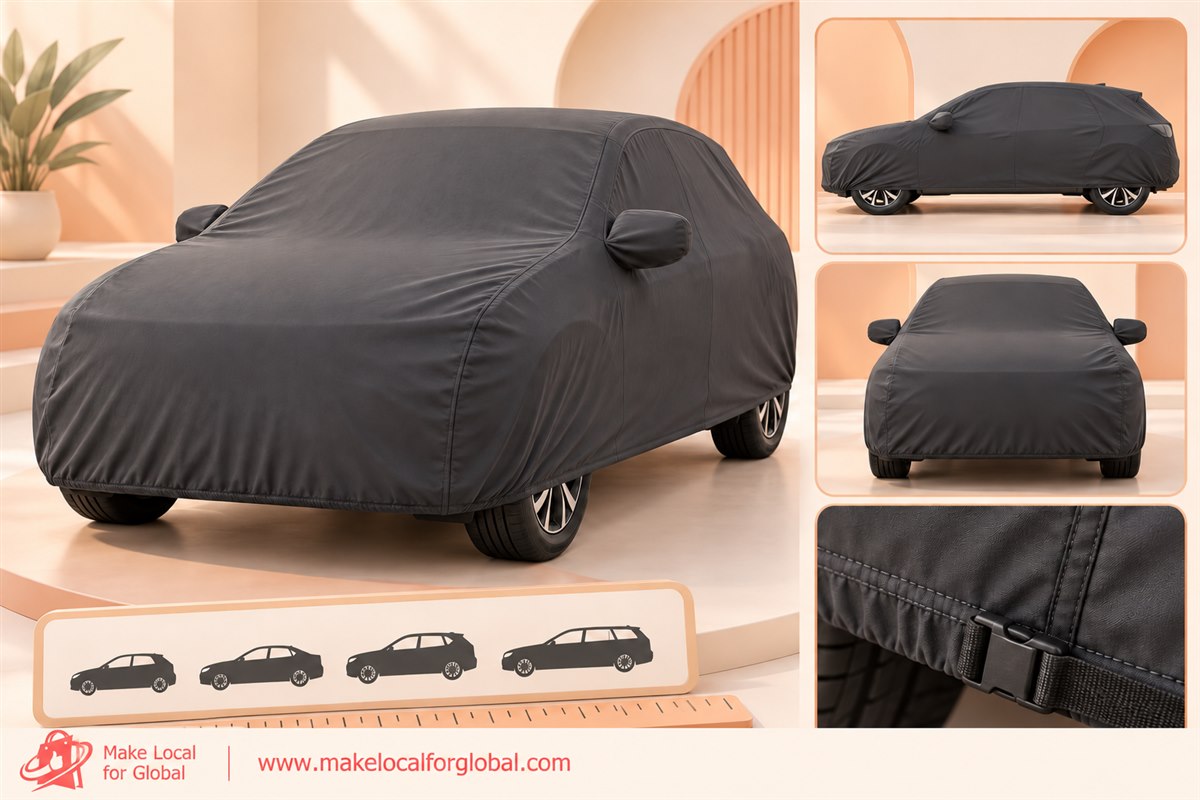
Give each image meaningful alt text based on what it actually shows, such as “Charcoal cover fitted over a blue hatchback, viewed from the passenger side”. Alt text helps someone using a screen reader understand the image; it is not a place to repeat the same search phrase on every image.
Use a short clip only if it demonstrates a real action, such as how two people fit the cover or where the securing straps attach. Keep the vehicle stationary, follow the supplier’s fitting and safety instructions, and do not demonstrate a technique that contradicts the product sheet.
Use the language buyers use when they are trying to solve a fit or storage question. Search suggestions and marketplace filters can reveal phrases such as “indoor car cover for hatchback”, “car cover size for [model]” or “breathable outdoor car cover”. Treat these as query ideas, then confirm that the product actually serves the described use.
Give every variant a distinct page or a clearly selectable option with its own fit details. If a buyer has to open a second listing to compare two sizes, link them with plain labels and explain what separates the size options. Do not create near-duplicate pages that change only one keyword; each page should answer a distinct vehicle or use question with real product details.
For a website, use a clear page title and a short description that describe the actual cover. Write headings around practical questions, such as how to measure a hatchback or which details affect fit. Add internal links where they help: a reader comparing another fit-sensitive vehicle product can see the car-seat selling guide, and someone researching other product categories can browse the Product To Sell collection.
Useful supporting content can answer questions before they become support tickets. You might publish a measurement explainer, a comparison of indoor and outdoor storage needs, a guide to folding and storing a cover, or a checklist for preparing a vehicle for storage. Base each post on a real customer question and supplier instructions; avoid presenting a general article as a guarantee of fit.
On a marketplace, choose the most accurate category and complete its fitment and item-specific fields. Follow platform rules for compatibility data, photos, delivery promises, returns and customer contact. eBay’s current business fee page lists different rates by category and says the final value fee is calculated on the total sale amount, including postage and applicable taxes. Use the fee shown for the actual category in your seller account; do not copy one example rate into every marketplace.
Keep product details consistent across your website, marketplace, packing slip and support replies. If a supplier changes a material or compatibility list, update all versions and check existing stock before making a new claim. Out-of-date fit information can keep generating orders long after the supplier has changed the item.
Choose one audience and one channel for the first test. For example, show an indoor-storage cover to local classic-car owners through a suitable club partnership, or use a marketplace search listing for a measured hatchback size band. Ask the group or site owner for permission before posting promotional material, and make any commercial relationship clear.
Make the first message useful before it becomes promotional. A short measuring checklist, an honest explanation of water-resistant versus waterproof, or photos that show mirror coverage can help a buyer decide. Link to the exact product variant and state what evidence supports its claims.
Test one change at a time. You might compare a photo showing the full vehicle with one showing a strap detail, or compare a size-first title with a parking-use title. Record dates, spend, impressions, clicks, questions, orders, cancellations, returns and contribution. Likes alone do not show an ad attracted relevant visits or sales. Measure clicks and orders too.
Build a question log from enquiries. If several buyers ask whether a cover fits a particular estate, check the supplier fitment records and inspect a sample before you add that model. If questions focus on shipping size, show the folded parcel dimensions and delivery options. If buyers are unsure about rain performance, make the supporting documents and wording clearer, or remove the unsupported claim.
Use email only where you have a lawful basis and a clear way for people to opt out. Keep any post-purchase feedback request neutral. Do not trade a discount or gift for a positive review, and do not ask a customer to hide a defect report.
Owners of child car seats may ask detailed model and fit questions too, but the product risks and approval rules differ. Read the separate car-seat article before building a related offer; do not transfer its compliance advice to a textile cover.
Before the first order, decide how a buyer contacts you, what photos or details help you diagnose a problem, how you identify the SKU and batch, and who approves a replacement or refund. Keep a short template for fit questions, missing parts, delivery damage, fabric defects and a buyer who selected the wrong size.
Record the reason for every return using specific categories: wrong vehicle body style, buyer measurement error, inaccurate listing, defect, damaged parcel, changed mind or unknown. Add the return postage, handling time, lost packaging and any reduction in resale value to your review. A repeated reason may call for a different photo, product choice or fit selector.
Explain the return route in plain language before checkout. State the time limit, who pays for return postage where the law allows that choice, how to package the cover and how to contact you. Do not use a blanket “no returns” statement to remove statutory rights.
For online orders, GOV.UK says shoppers normally can cancel up to 14 days after delivery without giving a reason, then have a further 14 days to send the goods back. The trader must tell customers about the right and provide required information; the rules have exceptions and details depend on the contract. Read the current GOV.UK distance-selling guidance and the returns and refunds guidance, then get qualified advice if your situation is unclear.
A returned cover may have been opened or tried on a vehicle. Follow the relevant consumer rules on handling and deductions, and inspect the item fairly. Record whether it is clean, dry, complete and resalable; quarantine any item with a safety concern or unexplained damage until you have reviewed it.
Car covers are consumer products, so a seller should check the rules for the product, role and territory before sale. GOV.UK guidance says Great Britain uses the General Product Safety Regulations 2005 and Northern Ireland has applied Regulation (EU) 2023/988 since 13 December 2024. The guidance for Great Britain and Northern Ireland is different; check the current rules for where you place the product on the market.
Importers can carry producer responsibilities. GOV.UK guidance for consumer product businesses describes duties that include demonstrating safety, keeping relevant technical records, providing product information and instructions, and maintaining supply traceability. Keep the supplier identity, invoices, SKU, batch details, approved sample notes, test reports and complaint records with the product file.
Check whether any product-specific rules or standards apply to your exact item and claims. Do not add a CE or UKCA mark merely to make a cover look compliant; check whether a marking is legally required for that product. Ask the supplier for documents that match the exact material and model. If you cannot establish what a certificate covers, do not describe the product as certified.
Online sellers need to provide required pre-contract details. GOV.UK lists business contact information, product description, total price, payment, delivery arrangements and cancellation information among the items buyers need before placing an order. Include a durable order confirmation, clear dispatch expectations and an accessible support route.
This section gives a starting point for research, not legal advice. Check official guidance and speak with a qualified adviser or Trading Standards service about a product-specific issue, import arrangement or claim. Requirements can change, and the seller remains responsible for checking the rules that apply to the actual product and destination market.
A month is a useful first testing window, not a promise that the business will be ready to scale. Set a small budget and a clear stop point. Move forward only when the evidence for fit, claims, delivery and contribution is good enough for the next step.
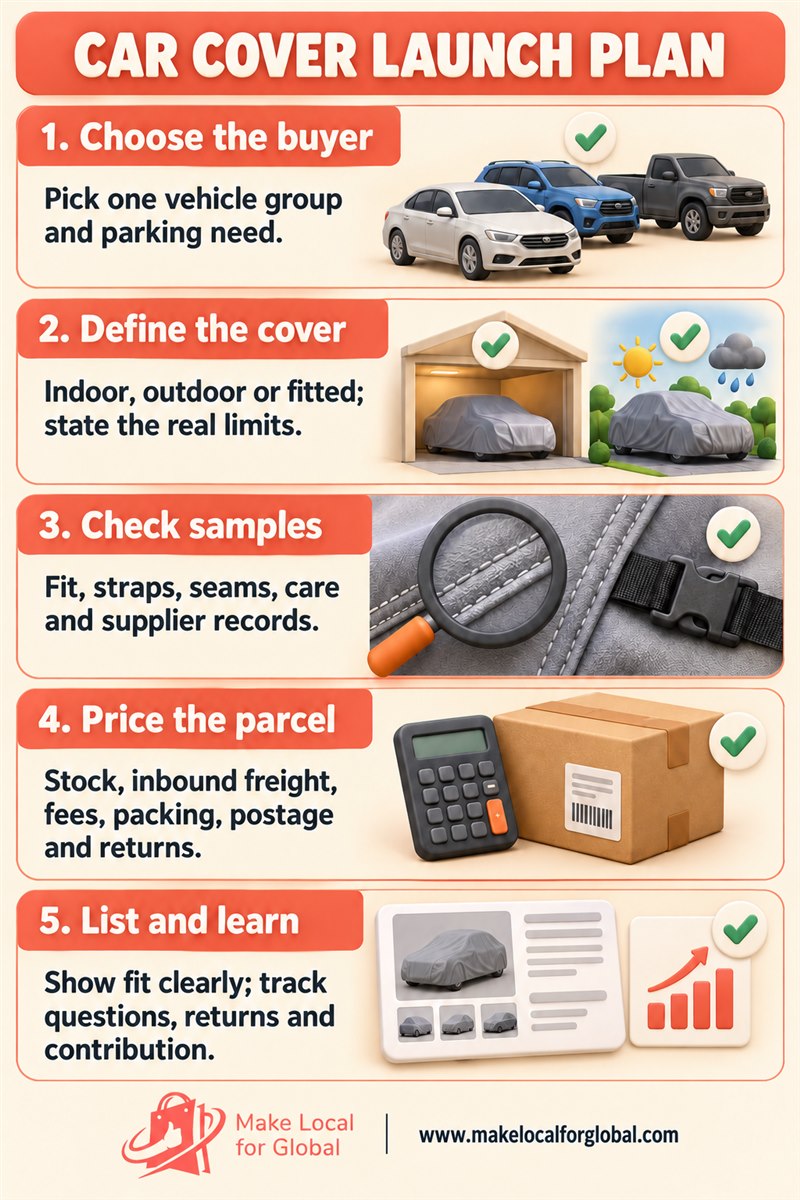
Week 1: buyer and demand. Choose a vehicle group and parking need. Read competitor reviews, speak with relevant owners and record their fit or care questions. Compare a small set of competing listings by material claims, dimensions, delivery and returns. Write down what you still need to confirm.
Week 2: supplier and samples. Send the same quote request to several suppliers. Order samples from the intended SKU and factory, then inspect seams, straps, dimensions, fit, labels and instructions. Ask for evidence behind performance and compatibility claims. Pause any claim or supplier that cannot be supported.
Week 3: cost and product page. Measure a packed parcel and confirm the carrier price. Calculate the expected contribution with marketplace or payment fees, packing, delivery, returns and customer acquisition. Prepare one or two listings with clear fit information, real photos and a plain return route. Ask a new reader to find the right variant.
Week 4: small launch and review. Make a limited quantity available, state dispatch times and send traffic from one suitable channel. Track visits, clicks, fit questions, orders, cancellations, returns, defect reports, delivery cost and contribution. Compare results with the assumptions from Week 1 and decide whether to reorder, revise or stop.
Set a review date after the first delivery cycle. If buyers reach the page but do not select a size, improve the fit selector. If people buy and then return for incompatibility, pause the variant and check the data. If traffic is low, test a channel or search phrase before lowering price. Make each change respond to evidence that can be observed.
It can suit a seller who can choose a clear vehicle group, verify fit and describe product limits accurately. The margin depends on supplier cost, parcel price, channel charges, returns, advertising and support time. Test a small offer and replace every estimate with real supplier and order data before scaling.
A beginner could test an indoor dust cover, an outdoor cover, a universal size range or a model-specific offer. Choose one type where you can get a sample, current instructions, accurate dimensions and evidence for each performance statement. Avoid starting with many materials and vehicle variants at once.
Use the supplier’s current fitment list and measuring diagram, then check year, body style, trim, mirrors, aerial, spoiler and roof accessories. Compare vehicle measurements with the exact cover dimensions and test a sample on a matching vehicle where possible. Do not infer a confirmed fit from the words “small”, “medium” or “large”.
Only use a waterproof claim when suitable evidence for the exact product supports it and the wording accurately reflects the test conditions. Water-resistant is a different claim. A supplier instruction sheet may set limits for use, fit or care; read the documents for your own SKU.
Begin with the smallest range your supplier can support and your fit data can describe clearly. One vehicle group or a few measured size bands may be easier to test than a wide model list. Add another size after customer enquiries and actual orders point to a clear gap.
A marketplace can help test search demand, and a direct website gives more control over fit information and customer follow-up. Compare category fees, parcel requirements, listing rules, returns, support effort and traffic source. Use a channel you can maintain well rather than opening several before the product information is ready.
Many distance sales have cancellation rights, and GOV.UK says buyers normally have up to 14 days after delivery to cancel. There are details and exceptions, and return costs can depend on what the trader disclosed and the circumstances. Read the current government guidance and set your policy to match the applicable rules.
For another fit-sensitive vehicle product, see the separate guide to selling car seats online. Its safety requirements are product-specific, so do not apply them to a car cover without checking the rules for that item.
Once your listing has real visits, questions and sales, use the B2C Store Health Assessment to review the parts of the buying experience that may need attention.
PREFERRED SOURCE
Like what you’re reading? Add Make Local for Global as a preferred source on Google to see more of our articles when you search.

Build your online presence without having to figure out everything yourself.