

READY TO SELL Canvas bags ONLINE?
Get a store built for you in 5 days, plus training and support to help you start, run, and grow your Alternative business.

Learn how to sell canvas bags online, from choosing a buyer and testing samples to pricing each order, writing a clear product page and running a 30-day launch test.

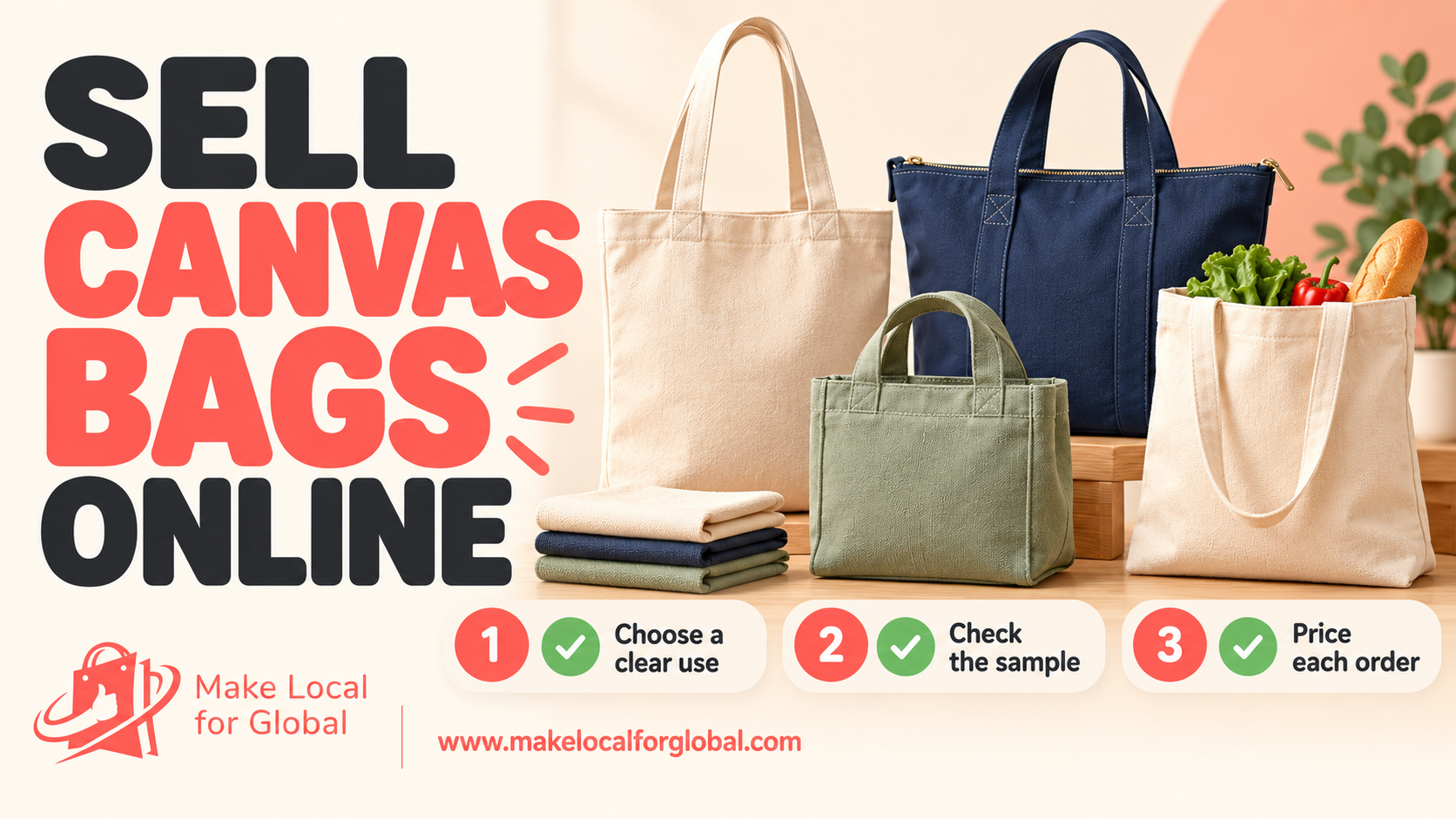
Canvas bags can look simple on a product grid, yet a seller still has to make clear choices about use, shape, fabric, handles, decoration, order size and delivery.
To sell canvas bags online, begin with one buyer and one use, then source a small range of samples, test the construction, price every order and show the dimensions clearly. Start with a focused collection that you can explain and fulfil well. Add colours or styles after customer questions and sales data show what people want.
This approach can work for a maker, a small brand, a retailer or a print-on-demand seller. The right route depends on how much control you need over the fabric and finish, how much stock you can fund and how quickly you can fulfil an order.
Ready to plan a focused online range?
Compare the current store options before choosing a channel for your first canvas-bag collection.
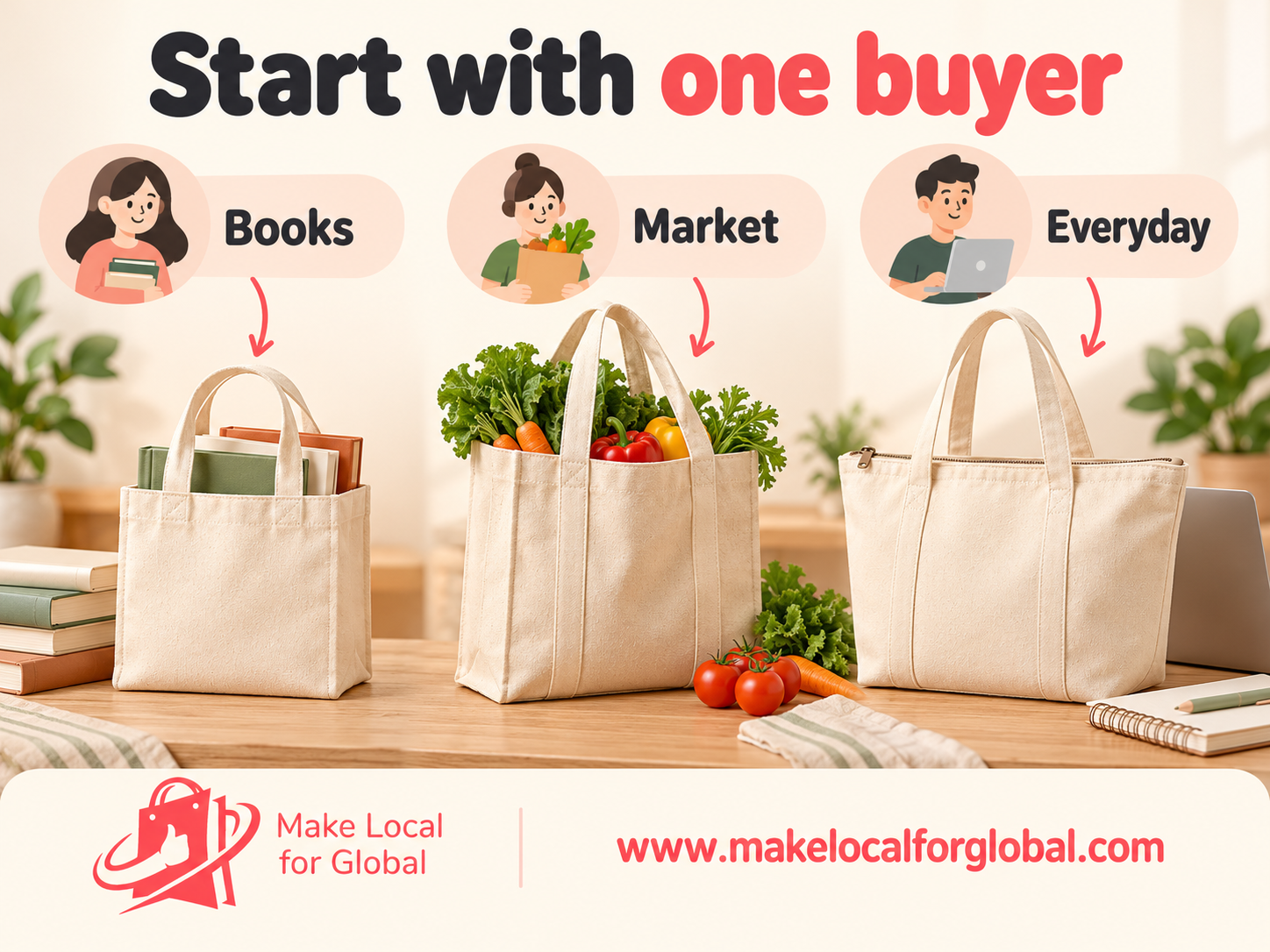
“Canvas bags” covers several products. A shopper who needs a reliable bag for a weekly market has different priorities from a reader carrying books, a commuter carrying a laptop or a customer buying a personalised gift. Picking a specific use helps you choose the bag shape, then gives you useful details to show on the product page.
Write a one-sentence buyer profile before you request samples. Keep it practical: “I sell a zip-top cotton tote for commuters who need room for a notebook, water bottle and light jumper.” This statement is not a promise about demand. It is a testable starting point for product decisions.
Ask what the customer wants to carry, where the bag will be used, how it will be carried and what would make the current option inconvenient. A market shopper may value a wide opening, a gusset and handles that feel comfortable over a coat. A book buyer may prefer a narrower base and a tall body that keeps books upright. Someone buying a gift may care more about colour, a neat finish and a personalisation option.
Look for evidence before you order stock. Read questions and reviews on existing products, visit independent shops and craft markets, and ask potential buyers to compare specific samples. Listen for repeated needs rather than treating one enthusiastic comment as proof. A person saying “I like it” is less useful than a buyer describing the size, pocket or closure they would pay for.
Check search suggestions and marketplace listings for the language people use. Search phrases might include “large canvas tote with zip”, “canvas book bag”, “market shopper with gusset” or “personalised cotton tote”. These phrases can help shape your range and page wording. They do not prove that a phrase has enough demand or that you will rank for it.
Make a simple evidence sheet. Record each buyer group, their main use, the products they compare, questions they ask and what they say would stop them buying. Add a note about where each observation came from. Separate direct feedback from your assumptions. This reduces the chance of ordering a product solely on the strength of your own colour or shape preference.
Set a small test budget before you purchase. Include sample charges, delivery, design work, product photography, listing fees and any first stock order. Choose an amount you can afford to have tied up if the first design needs revision. If supplier minimums exceed that amount, compare a smaller local maker, a blank-bag wholesaler or a made-to-order test.
You can test a concept without promising stock you do not have. Show a sample to a small audience, collect email interest, or run a clearly labelled pre-order only when your supplier lead time and refund process are realistic. Never use a fake “almost sold out” notice to make people act. Keep a record of clicks, questions and paid orders, then decide whether the result supports another step.
Canvas describes a sturdy woven fabric, not a single fibre. Bags sold as canvas can use cotton, polyester or a blend, and the coating, lining, trim and printing method can change the feel and care needs. Request the actual fibre composition from the supplier. Do not infer “100% cotton” from a natural colour or a canvas-like texture.
Choose a shape that matches the buyer’s task. A flat tote packs and posts easily, but may not suit bulky groceries. A gusset creates depth and can help a bag stand, yet it adds material and bulk. A zip top can keep items contained, but the zip, stitching and opening need careful testing. An open shopper gives quick access, but buyers need to know that it has no closure.
Common starting options include:
Do not launch every shape at once. A small range makes it easier to compare sample quality, describe differences, photograph each item and keep stock accurate. It can reveal whether buyers are choosing the use you expected.
An opening collection might have one main shape, two sizes and three colours. Another seller may start with one bag and three different handle lengths. The right test is the one that makes a useful comparison without creating too many combinations. If the bag has a print, begin with a small number of designs that you own or have permission to use.
Build a clear price ladder only when each option has a real distinction. An entry bag could be a simple flat shopper. A core option might add a gusset or inner pocket. A higher-priced version might use a zip, lining or custom embroidery. Do not call an item premium solely on the basis of a higher price. Explain the material, construction or service that the extra price pays for.
Check that variations do not confuse the buyer. If size, fabric, colour and printing all change at once, it becomes hard to learn which feature led to a sale or complaint. For an early test, keep most variables steady and change one at a time. A clear comparison can tell you whether customers prefer a smaller bag, longer handles or a closure.
Personalisation can help a small seller stand apart, but it adds work. Decide whether you offer initials, a short name, a set design or a fully custom print. Set a character limit, specify print placement, show a proofing step when needed and state when a personalised order enters production. Check the spelling entered by the customer before printing. Keep customer artwork and personal information stored only as long as your business needs.
The product itself should lead the collection. A bag photo, a clear shape name and a short use description are easier to shop than a page full of abstract colour names. Use names that help the buyer tell a “Market Shopper” from a “Zip-Top Daily Tote”, then use the description to add the exact dimensions and materials.
| Bag type | Useful for | Questions to answer |
|---|---|---|
| Flat tote | Books, light shopping, events | How wide is the opening? Are the handles long enough for a shoulder? |
| Gusseted shopper | Groceries or bulky items | What is the base depth? Does the bag stand when partly filled? |
| Zip-top tote | Everyday carry where a closure matters | How wide is the opening? Does the zip run smoothly? |
| Lined bag | Buyers who want a more finished interior | What is the lining made from? Are seams neat and accessible? |
| Personalised tote | Gifts, groups and business orders | What can be customised, where is it placed and what is the lead time? |
Use this as a planning aid, then confirm each choice against a real sample and buyer feedback.
This table is a planning aid, not a claim that one type suits every person in a group. Let the product sample and customer feedback guide the final choice.
If you are comparing adjacent bag types, see how to sell beach bags online for a different use case, how to sell cosmetic bags online for pocket and lining decisions, and how to sell crossbody bags online for strap and carry details.
There is no single best way to source canvas bags. Compare the amount of control, cash, time and supplier dependence that each route creates. Ask for all charges in writing, including sample fees, delivery, artwork setup, printing, packing and any cost for a repeat run.
Buying ready-made stock from a wholesaler can be a quick way to test basic shapes. You may be able to order a modest amount and focus on product pages, photography and fulfilment. The trade-off is that other sellers may offer a similar bag, and you may have limited control over fabric, colour or handle length.
Working with a manufacturer can give you more control over size, lining, pockets, closures and branding. It usually requires more sample rounds and clearer specifications. Minimum order quantities can tie up cash before you know which variation buyers prefer. Ask how the supplier handles a rejected sample, a late order or a manufacturing fault.
Print-on-demand can reduce the amount of finished stock you hold. A production partner prints after a customer places an order. Before listing, order the product as a buyer would, inspect the print and stitching, time the delivery and learn how the partner handles a lost parcel or a misprint. Verify that blank-bag stock does not change without notice.
Making the bags yourself can support small batches and direct quality control. It requires time for cutting, stitching, pressing, packing and customer support. Calculate labour for every unit, including setup, mistakes, product photos and communication. If your sewing time is missing from the cost sheet, a sale can look profitable even when the business pays you very little.
Upcycling or using reclaimed fabric needs careful description. State what the bag is made from, which parts are new and how colour or wear can vary. Do not claim an environmental benefit that you cannot support. If customers receive different fabric from the photo, explain that variation before checkout.
Ask the supplier to confirm the fibre composition, fabric weight if they measure it, finished dimensions, handle drop, gusset depth, lining and closure details. Request current photos or a sample when the specification changes. Ask whether the sample and production batch use the same fabric and components.
Get the minimum order quantity for each colour and design, the lead time for a sample and the normal production lead time. Ask how shipping is priced and whether duties or taxes may be due when goods cross a border. Confirm how the supplier records batch details and who will investigate a defect.
For printed bags, request a sample that uses the same artwork process and placement you intend to sell. Ask how print colour can vary, what care instructions the supplier supports and whether print setup fees apply again to later orders. Confirm that you have written permission to use the artwork, font, logo and any customer-supplied image.
For a first order, avoid terms that leave the main risks unclear. Confirm what happens if the delivered quantity differs from the invoice, bags arrive with stains or damaged seams, or a colour is no longer available. Keep the supplier’s written answers with the purchase order and sample record.
Order more than one sample if a purchase depends on consistency across a batch. Compare the seams, handle placement, dimensions and colour. A single good sample does not prove every unit will match. If the supplier cannot explain how it checks production quality, decide how much risk you can accept before paying a larger deposit.
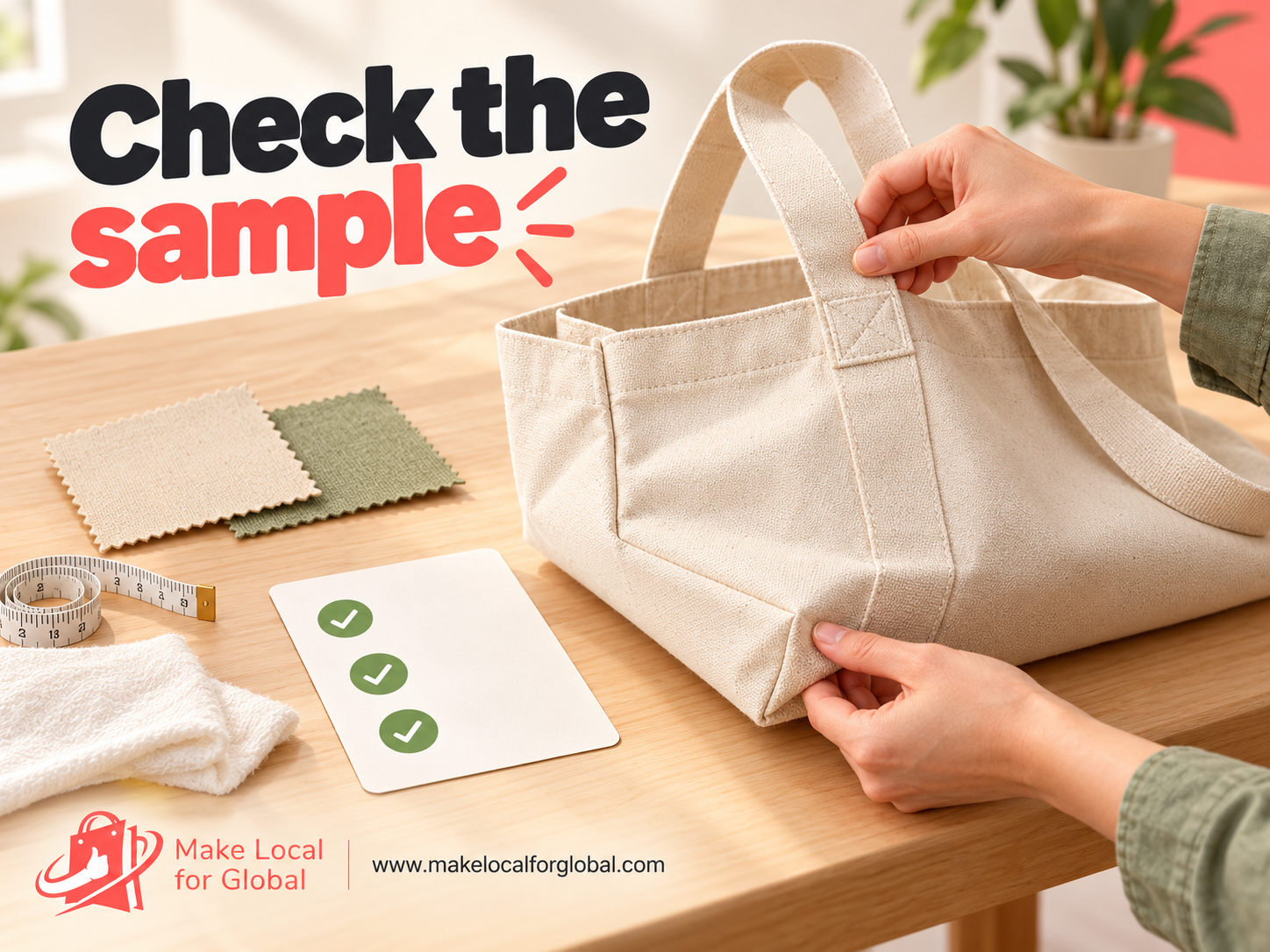
Inspect the whole bag in daylight. Look at the weave, seams, base corners, handles, lining, pocket edges, closure and print. Check for loose threads, skipped stitches, staining, a sharp chemical odour or colour transfer. Record a clear photo of each fault and send it to the supplier before approving production.
Measure the body width and height, gusset, handle width and handle drop. Record whether you measured the bag flat or opened. A handle drop is the clear space from the top edge of the bag to the inside of the handle, not the full strap length. Give the same measurement method on every product page.
Load a sample with the items buyers are likely to carry. A book tote can be checked with books of different sizes. A market shopper can be checked with a modest grocery load. Look for handle strain, seam movement, a base that twists or a bag that becomes awkward to carry. Do not use a casual test as a certified weight rating. Publish a maximum-load claim only when a suitable test supports the stated rating and you can keep the evidence.
If the bag is washable, follow the supplier’s care instructions and test a sample before describing the result. Note whether the fabric shrinks, wrinkles, fades or changes shape. If a print is present, check for cracking or colour loss after the stated care process. Keep the tested sample and record the steps. If you do not know whether a bag can be washed, do not guess.
Ask another person to try the handles over a light jacket and with the bag carried by hand. Check whether the handle rubs, the opening feels too narrow or the bag hangs too low. Photograph the bag beside a familiar object only when the scale is honest. A person in a photo should use the bag as intended, not pose with it in a way that hides size or fit.
Record the result as a pass, revise or reject decision. A pass means the sample matches the written specification and the intended use. Revise means the supplier can change a specific detail and provide another sample. Reject means the problem affects the product or the supplier cannot resolve it. Save one approved sample for later comparison with repeat stock.
A canvas bag price needs to cover more than the supplier’s unit cost. For every order, list the bag, inbound freight, import charges where applicable, packaging, payment or marketplace fees, postage, a return or replacement allowance and any advertising cost linked to the sale. For made-to-order work, include labour and production materials.
Keep fixed costs separate from order costs. A monthly website plan, accounting software and insurance are fixed or period costs. A shipping label, bag, mailer, transaction fee and print are usually linked to individual orders. You need both views: contribution per order and the cash the business must cover each month.
An illustrative example can show the arithmetic. Assume a seller buys a small batch of 100 plain shoppers at £6.00 each. The seller allocates £1.20 per bag for inbound freight and import handling, £0.65 for a protective mailer and label, £3.45 for tracked postage, £1.12 for a payment fee, £0.85 as a returns or replacement allowance and £2.00 for paid customer acquisition. The selling price is £23.50.
At those assumptions, the variable cost per order is £15.27. The calculation is £6.00 + £1.20 + £0.65 + £3.45 + £1.12 + £0.85 + £2.00. The order contribution before fixed costs and tax is £23.50 minus £15.27, or £8.23. This is not net profit: it does not include business overhead, the seller’s labour, income tax, corporation tax or other charges.
The payment-fee figure is hypothetical. It assumes a fee of 3.5% of the £23.50 order value plus 30p, which rounds to £1.12. Replace it with the rate and transaction rules for the actual processor or marketplace. Check whether fees apply to delivery, refunds, currency conversion or a fixed monthly plan.
The returns allowance is not a legal limit or a forecast. It is a planning estimate. Once orders come in, compare it with the actual cost of refunds, return postage, replacement bags, payment fees that were not refunded and stock that cannot be resold as new. Keep a separate record of product defects and buyer changes of mind.
If you offer free delivery, postage still belongs in the calculation. If customers pay for shipping, record the amount collected and the carrier charge separately. A shipping charge can be taxable and may be included in marketplace fee calculations, so check the platform and tax treatment that applies to your business.
| Cost item | Per-order assumption |
|---|---|
| Bag | £6.00 |
| Inbound freight and handling | £1.20 |
| Packaging and label | £0.65 |
| Tracked postage | £3.45 |
| Payment fee, illustrative | £1.12 |
| Returns or replacement allowance | £0.85 |
| Customer acquisition | £2.00 |
| Total variable cost | £15.27 |
| Selling price | £23.50 |
| Contribution before fixed costs and tax | £8.23 |
Illustrative only. Fee, postage, returns, VAT and customer-acquisition figures must be replaced with the seller’s actual amounts.
The table makes contribution visible but does not show the amount needed to pay monthly overhead. If fixed costs total £180 per month, a seller with £8.23 contribution per order would need about 22 orders to cover that amount before other costs: £180 divided by £8.23 is 21.87. That is a break-even illustration, not a sales prediction.

Test different prices with the same cost assumptions. A price below the example might leave too little contribution for photography, defects and customer service. A much higher price needs an explained product distinction, such as better construction, a secure closure, a defined personalisation service or a bundle. Do not use a competitor’s price as proof of your own costs or likely sales.
If you are VAT registered, recalculate using the VAT treatment of the bag, delivery and expenses. The standard VAT rate is 20% in many cases, though the correct treatment depends on the supply. A VAT-inclusive £23.50 price is not all revenue retained by a VAT-registered seller. HMRC says the VAT registration threshold is more than £90,000 of taxable turnover in a rolling 12-month period, or an expectation of exceeding it within the next 30 days. Check the current VAT threshold guidance and your circumstances.
Review prices when supplier quotes, postage bands, exchange rates or platform fees change. Keep a dated cost sheet for each bag style and size. If you sell a bundle, calculate the whole bundle cost and delivery weight rather than multiplying the price of one bag.
Start with one item at a price you can explain. A simple bag may sit at the entry point, and a larger or lined model can carry a higher price if it adds materials or work. A personalised bag might have a separate design or production charge, but show the charge before the customer submits payment.
Test bundles that solve a clear use. A pair of matching shoppers can suit a household or a small event. A gift set could pair a bag with a small accessory only if both items are compatible and the packed parcel remains costed. Do not add a low-value item just to make a bundle appear larger.
For wholesale or event orders, include volume pricing only after calculating the labour and delivery at each quantity. A 50-bag order may require a proof, one large parcel or several parcels, and a deadline that changes your workload. State the minimum quantity, proofing process, production time and delivery terms in writing.
A product page should help someone decide whether the bag will do the job. Put the clearest product name first. For example: “Gusseted Canvas Market Shopper, Natural, Long Shoulder Handles”. Add “cotton” only when the supplier information supports that fibre claim. Avoid a long row of keywords that reads like a search query.
Begin the description with the use and the product’s most useful detail. A sample opening could be: “A gusseted canvas shopper for weekly markets and everyday errands, with a wide opening and shoulder-length handles.” Follow with the actual dimensions, fibre content, closure, pockets, care information and what is included.
Show measurements in centimetres. State width, height, depth or gusset, handle width and handle drop. Explain whether the bag was measured flat. If a zip or snap reduces the usable opening, mention it. If dimensions vary slightly by batch, give the expected range only when the supplier can support it.
Describe capacity in a way a buyer can understand. “Fits a paperback, notebook and a light jumper in our sample test” is more helpful than “huge capacity”, provided that this was genuinely checked. A photo can show the same items placed in the bag. Do not imply a laptop sleeve exists if the bag has only an unpadded pocket.
List the materials by component when they differ. Separate outer fabric, lining, trim and printed decoration. State whether the image shows the exact colour and whether the print placement can vary. If the product is handmade, explain what changes from one unit to the next.
Use photos that answer a question:
Keep product photos consistent in lighting and background so shoppers can compare colours. Do not retouch a canvas texture so strongly that it looks like a different material. If the colour varies across screens, say that the display may affect how it appears, then use clear daylight photos from more than one angle.
Write alt text for the image’s purpose, not as a list of keywords. “Natural canvas market shopper shown from the side to display the gusset” explains the image. A decorative background image should have empty alt text when the site supports it. Give every product option its own images if the size, handle or closure changes in a visible way.
Answer likely questions close to the purchase button. State when the order will be dispatched, how the bag is packed, whether personalisation can be returned and how a buyer can contact you. Do not make a shipping promise your supplier or carrier cannot meet.
Gusseted Canvas Market Shopper, Natural
“A structured shopper for market trips and everyday errands. The wide opening and spacious base give room for bulkier items, and the long handles sit over the shoulder in our sample carry check.”
“Outer: [verified fibre composition]. Lining: [verified composition or unlined]. Width: [measured] cm. Height: [measured] cm. Gusset: [measured] cm. Handle drop: [measured] cm. Closure: [state clearly]. Care: [supplier-confirmed instructions].”
“The bag in the photographs is shown beside [specific familiar items] for scale. Colour can look slightly different on each screen. Dispatch estimate: [realistic period].”
Replace every bracket with checked information before publishing. A template is a writing aid, not a substitute for inspecting the sample.
An own online store gives you control over product pages, bundles, customer emails and brand presentation. You need to bring visitors to the site and keep checkout, payment, delivery and returns information current. If you want to build your own store, MLFG lists its online-store setup and pricing options.
A marketplace can place your listings beside products customers are already browsing. Read the current seller rules, fee schedule, image requirements, prohibited-item policy and dispatch standards before you list. Marketplace search placement is controlled by the platform and can change. Do not assume that paying for an account guarantees visits.
Social channels can help you show the bag in use and answer common questions. Link each post to a product page with accurate price, stock and delivery details. A social post can demonstrate handle drop, a pocket or the bag’s folded size more clearly than a static catalogue photo.
Wholesale can suit event organisers, bookshops, galleries or businesses buying branded bags. Ask buyers to approve a sample and proof before production. Set payment terms, artwork permission, quantity, delivery date and the process for approving print colour. Keep enough time to correct a proof without missing the event.
Start with one primary channel and one way to attract customers. Add another channel after you can keep stock, prices and delivery estimates in sync. If you list the same bag in several places, use one inventory record and update it as soon as an order is confirmed.
Pack a sample order before you choose a mailer. Fold the bag as it will be sent, place it in the intended packaging and measure the finished parcel. Include the label, tissue, insert and any outer box in the final weight and dimensions. Postal bands can change with small size or weight differences.
Decide how to protect the bag from moisture, dust and transit marks. A clean paper wrap or a suitable mailer may be enough for a soft tote. A structured or personalised bag may need a box to protect its shape or print. Test the packaging by packing one sample and handling it through your normal dispatch routine. Do not add layers that increase cost without protecting a real risk.
Keep a packing check beside the work area: correct style and colour, correct size, print or personalisation checked, no visible defects, order note included if needed, parcel weight recorded and address label matched to the order. One repeatable check can prevent an incorrect colour or blank bag from reaching a buyer.
Set a daily cut-off for orders and tell customers when the parcel will leave. Track supplier replenishment, stock on hand, units reserved for paid orders and items set aside for faults. If a colour is out of stock, remove it or give a clear back-in-stock date rather than leaving the product page misleading.
Write a returns procedure before the first sale. It should explain who responds, how a customer requests a return, how the item is checked and how a refund or replacement is recorded. Online customers in the UK usually have a limited right to cancel a distance purchase even when the product is not faulty. GOV.UK explains the rules for online and distance selling and returns and refunds. Check whether a specific exception applies before relying on it.
If the bag is faulty or not as described, your obligations differ from a change-of-mind return. Keep the listing, supplier batch details, customer message and photographs together. Look for a pattern. Several reports about a seam or print can point to a batch problem that needs a supplier review before more units ship.
Treat a return as product information. Record why the bag came back: smaller than expected, handle drop, colour, print quality, a missed delivery estimate or a fault. Use the signal to revise a measurement, photo, description, packing choice or supplier instruction. Do not make return access unnecessarily difficult to reduce a number on a spreadsheet.
The product information on a listing must be accurate. State what the bag is made from, what it does and how it is supplied. UK guidance says labels must not mislead people about a product’s size, material, price, origin or claims about its performance. Review the GOV.UK product-labelling guidance before making a claim that may affect a buyer’s decision.
Textile labelling rules apply to relevant textile products in England, Scotland and Wales. GOV.UK says textile labels must show fibre content, and content for separate components may need to be shown where their fibre compositions differ. Check whether your exact bag falls within scope, what exceptions apply and how Northern Ireland rules differ. Read the current textile-labelling guidance and ask your supplier for evidence rather than relying on a product title.
If you import bags, work out which business is responsible for the label and product information before placing the order. Get the fibre names and proportions in writing, then compare the delivered sample with the paperwork. A vague statement such as “natural canvas” does not tell a buyer whether the bag is cotton, polyester or a blend.
Consumer products must be safe in normal and reasonably foreseeable use. The UK’s product-safety guidance explains the baseline requirements for Great Britain and points to separate Northern Ireland guidance. Keep the supplier, batch and product records you may need to trace a complaint. Start with the Office for Product Safety and Standards guidance and check whether a rule specific to your product or intended use applies.
Use care with environmental wording. “Reusable”, “organic”, “recycled”, “plastic-free” and “sustainable” can shape buying decisions. Keep current evidence for a claim and state its scope. A claim about one fabric component should not imply that every part of the bag or its production has that quality. The Competition and Markets Authority says environmental claims should be accurate, clear, substantiated and not hide relevant information. Read its Green Claims Code guidance.
If you print a slogan, character, logo or artwork, check who owns it and whether you have permission for commercial use. A customer sending a picture does not automatically give you every right to reproduce it. Keep a written licence or permission record and check any platform rules for custom products.
Check your VAT position as taxable turnover grows. HMRC’s current threshold guidance covers registration tests and routes for businesses selling across borders. If you send bags to customers outside the UK, check destination tax, customs and product rules before accepting an order. Rules can differ by destination, and a parcel may need an accurate customs description and value.
Packaging producer responsibility can apply based on the business’s size, turnover, packaging activity and weight. The Environment Agency and Defra guidance includes thresholds, reporting and exemptions. Check the current EPR packaging test rather than assuming that small parcels automatically put a seller outside the rules.
Rules depend on where the seller is established, where the bag is placed on the market and what the product contains. This section is a starting point for checks, not legal or tax advice. Ask the relevant regulator, Trading Standards or a qualified adviser when your sourcing or destination creates uncertainty.
Give each page a distinct search purpose. One page can focus on a “canvas book tote”; another can serve a “zip-top canvas tote”. Keep colour or minor size variants on one product page when the product is otherwise the same. Separate pages are more useful when shape, closure or buyer use changes enough to need different photos and explanations.
Write the page title as a clear product name, then add a feature that helps someone choose. “Zip-Top Canvas Tote with Inside Pocket” is clearer than a string of every possible search phrase. Use the main phrase naturally in the page title, URL, first paragraph and one or two headings where it fits. Avoid repeating it in every sentence.
Use a concise page description that names the bag type and useful detail. A meta description should describe the page accurately, not promise a price, delivery speed or result that may change. Search engines may choose a different snippet based on the query, so write for a person deciding whether the page is relevant.
Add internal links where they help a reader continue. A seller comparing fabrics can link to your product materials or sourcing advice. A seller deciding between a marketplace and an own store can link to a relevant ecommerce setup resource. Keep each link descriptive so a reader knows what opens. The Product To Sell category can point to more product-specific selling articles without making this page repeat them.
Use image filenames and alt text that describe each image. Keep file names short and plain, such as canvas-market-shopper-gusset.jpg. A filename helps you manage assets but does not replace useful image content. Compress images for a fast page, use a suitable width and avoid uploading several near-identical photographs.
Add structured product details where your ecommerce platform supports them: price, stock, material, dimensions, colour, variant, delivery estimate and return policy. Check the rendered page after saving, especially on a phone. Confirm the key product details appear before the customer needs to scroll through long brand copy.
Use customer language as a starting point for research, then decide whether each phrase belongs on a product page, category page or article:
These are topic ideas, not measured search volumes. Check search data from your own site and tools before prioritising them. A phrase is useful only when your product genuinely answers the need behind it.
Create a small launch test that connects a specific audience to a specific product page. A maker might show a sample to existing craft customers. A bookshop supplier might ask two independent bookshops to review a book tote sample and minimum order. A gift seller might show the personalisation proof process to customers who already buy locally made gifts.
Use a simple weekly observation sheet. Record visits to each product page, add-to-basket actions, completed orders, customer questions, returns, refund reasons and the cost of any paid promotion. Keep channel and product variation separate. One hundred visits to a market shopper page tell you something different from ten visits to a personalised tote page.
When a page gets visits but few add-to-basket actions, inspect the product clarity, price, images and delivery detail. When people add a bag but leave checkout, look for unexpected postage, a confusing returns policy or a payment issue. When customers buy but return it, review size expectations, handle comfort, colour and construction.
Change one major element at a time when possible. If you change the photo, price and product description together, you may not know which change mattered. Keep a note of the old version, what you changed and when. Compare a reasonable period of data rather than reacting to one quiet day.
Content can support the product page when it answers a real buyer question. A short article can explain how you measure handle drop, choose a bag for books or prepare artwork for printing. A demonstration video can show how a gusset opens or how the zip works. Link back to the exact bag shown in the content.
Use email only for customers who have given the relevant consent. A back-in-stock message can be useful if it reflects real inventory. A post-purchase note can ask whether the bag matched the dimensions and use described. Do not ask for a positive review in return for a reward or hide how feedback will be used.
If sales are low, do not immediately add more colours. Recheck the buyer, product, page promise, price, traffic source and sample quality. You may need a clearer use case or better photos. You may need to stop a design that people do not choose. Small tests make those decisions less expensive.
Need help choosing a sales route?
Use the free Ecommerce Pathfinder to compare a starting route for your product idea.
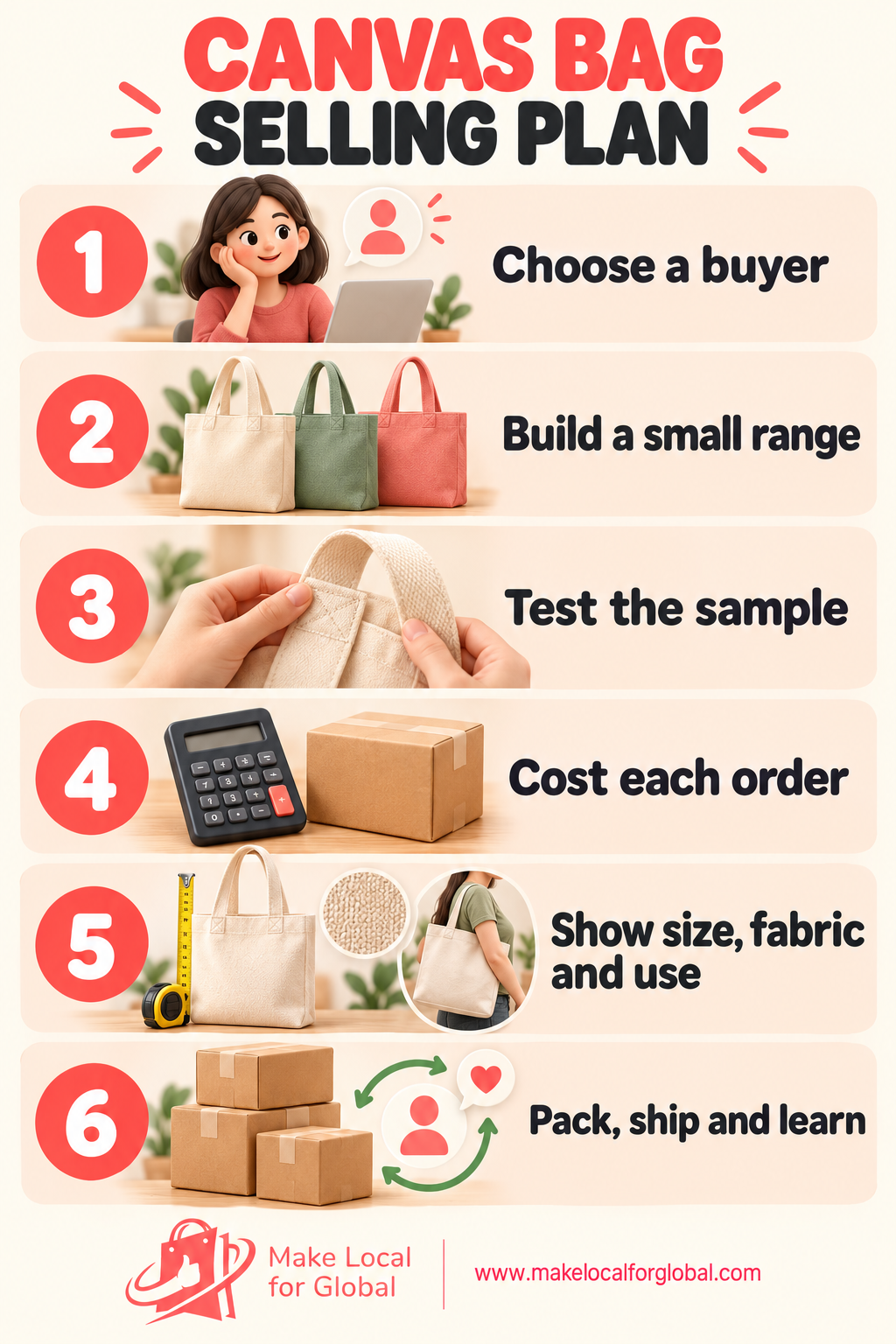
Choose one buyer group and one use. Write down the reason a customer might select this bag over a cheaper or more familiar option. Collect questions from potential buyers and current listings. Note which points are known and which are still assumptions.
Set your test budget and compare sourcing routes. Contact at least three plausible suppliers with the same written questions about material, dimensions, minimum quantity, sample, lead time and defect handling. Compare the replies in a simple table. Do not choose a supplier from a low headline price alone.
Choose the first shape and variation set. Keep the range small enough to photograph and cost. Create a draft product specification with dimensions, materials, handles, closure, print placement and packing requirements. Ask the supplier to confirm it in writing.
Order samples from the best-fit supplier or production partner. Measure each bag using the same method, check construction and test it with the intended carry items. Photograph each issue. Ask for a revision when a specific detail can be changed.
Build a cost sheet for every shape and size. Include the item, inbound freight, duty or handling if applicable, packaging, delivery, platform fee, returns or defects and customer acquisition. Add labour if you make or personalise the bag. Check the contribution at a few possible prices.
Draft the listing with the sample beside you. Confirm each measurement and material claim against the actual product. Draft a title, description, care statement, dispatch estimate and return information. Leave placeholders rather than inventing information you have not confirmed.
Approve one sample and keep it as a reference. Photograph the front, side, base, inside, handle attachment and the bag in use. Use the same lighting and scale for each variation. Add concise alt text that describes each product view.
Set up one sales channel. Add the product name, price, stock, dimensions, materials, shipping profile and return policy. Check each variation and its images. Test a checkout path without creating a false order or charging a real customer.
Pack one sample parcel and record its finished measurements and weight. Confirm the right postage service and label process. Prepare a packing checklist and customer message for an order delay or stock issue. Check relevant product labelling, cancellation, product safety and packaging requirements.
Publish the product page when the sample, price, stock and fulfilment process are ready. Share it with one defined audience and record the channel, date and message. Use a small promotion only when the budget is within your test limit.
Review customer questions and page behaviour at the end of each week. If people do not understand the size, add a scale photo or improve the measurements. If visitors ask whether the bag closes, bring that detail higher on the page. If the print changes from the sample, pause new sales until the listing matches the product.
At day 30, compare orders, contribution, customer feedback, returns, delivery performance and remaining stock. Decide whether to repeat, revise, test a second size or stop. Write down the evidence for that decision. A clear stop can protect cash for a better product test.
Ordering too many colours can leave cash parked in stock. Start with variations that help test a buyer need, then add a shade after customers ask for it or choose it repeatedly.
Using “canvas” as if it proves the fibre content can create inaccurate product information. Ask for the composition and label evidence. If you cannot verify a claim, leave it out until you can.
Choosing by appearance alone can hide handle, seam or size problems. Carry out the same checks on every sample and keep the approved bag for later comparison.
Copying a competitor’s product page can bring the wrong expectations and may copy wording or images you do not own. Describe your own sample, show your own photos and explain the details that actually distinguish the bag.
Leaving postage until after the price is set can erase the contribution. Pack a sample, measure the parcel and calculate shipping before the product goes live.
Calling a bag “eco-friendly” without evidence can mislead buyers. Make a precise claim only when you can support it and explain what part of the product it covers.
Treating one sale as proof of demand can trigger an oversized reorder. Look for a pattern across customer questions, page visits, orders and fulfilment results.
Using an image that hides the bag’s dimensions can increase returns. Show the opening, depth, handle drop and scale from a few consistent angles.
It can be, when the price covers the bag, freight, packaging, fees, postage, returns, acquisition and labour. Work out contribution per order, then compare it with fixed costs. The illustrative figures above show a method, not a forecast.
Choose the shape that fits one buyer’s use and that you can source or make reliably. A book tote, market shopper or zip-top everyday bag can each be a valid first product. Test a sample and ask buyers about specific dimensions before ordering stock.
Compare fibre and construction details, minimum order, sample charges, lead times, communication, defect handling and full landed cost. Order a sample and compare it with the written specification. Save the supplier’s answers and the approved sample details.
Check the fabric, dimensions, handle drop, base, seams, lining, pocket, closure, print and care instructions. Load it with items that suit the intended use and observe how it carries. Publish a load rating only when suitable testing supports the stated figure.
Add unit cost, inbound freight, packaging, postage, fees, returns or replacement allowance and customer acquisition. Add labour and fixed costs in the wider business calculation. Compare contribution at several prices and use actual platform fee rates.
Textile labelling requirements depend on whether the product falls within scope and on the market where you sell it. GOV.UK describes fibre-content requirements for relevant textiles in Great Britain and notes separate Northern Ireland guidance. Confirm the composition with your supplier and check the current rules for your bag.
Use broad environmental wording only when you have current evidence that supports the full impression a customer is likely to take. A verified claim about one component should name that component and its limits. Read the CMA Green Claims Code before publishing environmental claims.
Show the front, side or gusset, interior, handle attachment, scale and the bag in use. Add a close-up of the print or pocket when that feature matters. Keep colour and lighting consistent across variations.
Set a clear process that follows the consumer rules for your business and destination. UK online customers usually have a limited cancellation period for many distance purchases. Faulty or misdescribed goods have separate rights, so check current GOV.UK guidance and state the process in plain language.
Start with the smallest range that lets you test a real choice, such as one shape in two sizes or one size in a few colours. Each additional print or option adds supplier, photography, listing and stock work. Add a variation after customer evidence supports it.
It can reduce finished stock, but quality, print placement, production time, delivery and return handling depend on the partner. Order samples, check every customer-facing promise and calculate the partner fee, shipping and likely customer support before listing.
Make the product page match the real bag. Show measurements, handle drop, opening, closure, materials and care details, and add scale photos. Record each return reason and revise the product or page when a pattern appears.
Choose one bag shape, one buyer and one sample check to complete this week. Once the first product is costed and described accurately, decide whether to build a dedicated online store or keep testing through a smaller sales channel. MLFG explains its store setup and pricing options for sellers who want support with an online shop.
If you want feedback on the next step for your business, contact Make Local for Global. Keep the first range manageable, use the supplier evidence you have collected and let customer behaviour decide what you add next.
Talk through your next step
Share your canvas-bag range and the questions still open with Make Local for Global.
PREFERRED SOURCE
Like what you’re reading? Add Make Local for Global as a preferred source on Google to see more of our articles when you search.

Build your online presence without having to figure out everything yourself.