

READY TO SELL Card games ONLINE?
Get a store built for you in 5 days, plus training and support to help you start, run, and grow your Alternative business.

Learn how to sell card games online: choose a clear audience, test the rules, compare print quotes, check UK toy-safety duties and price a packed order.

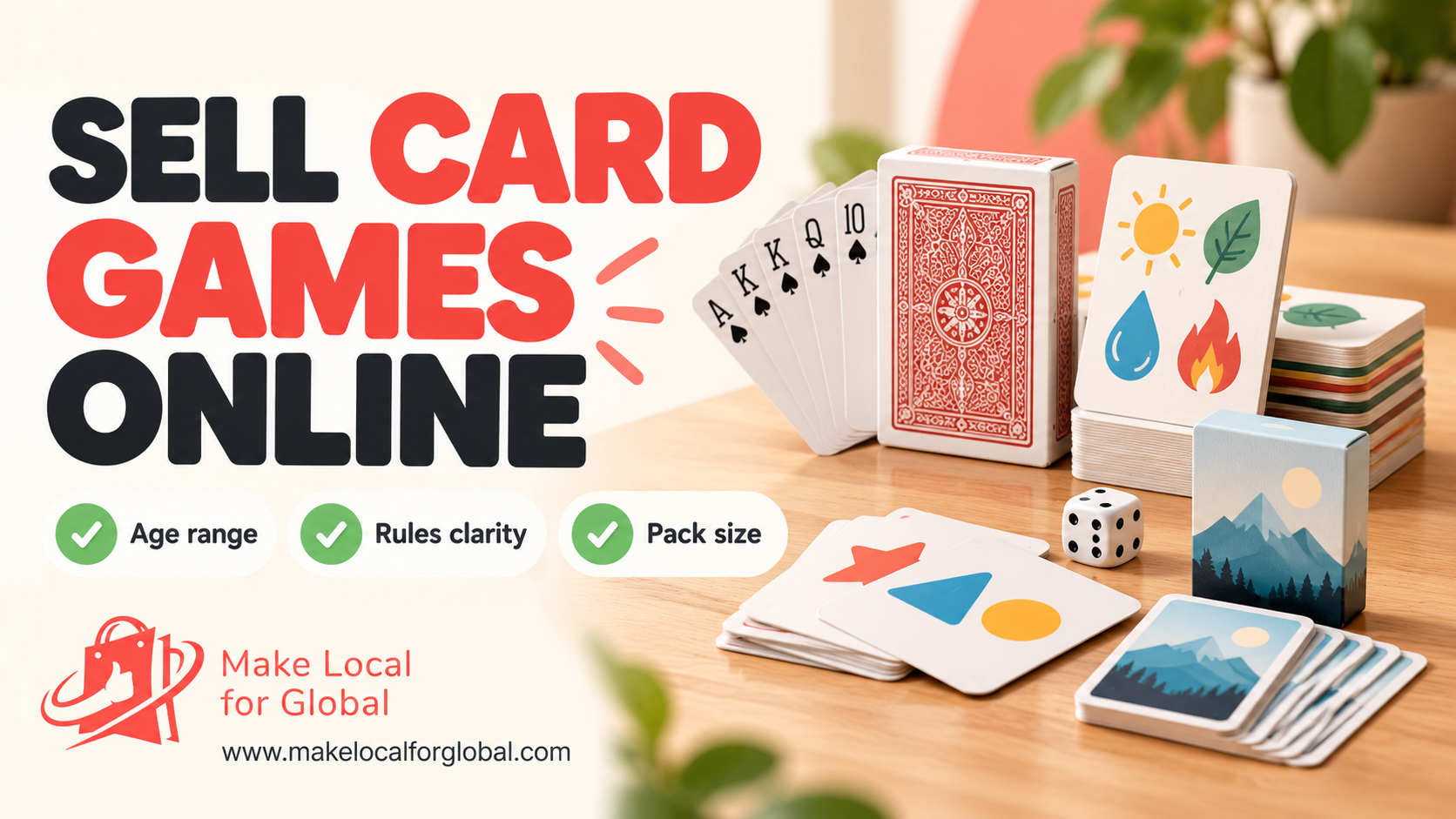
A card game can be easy to explain at a kitchen table and hard to sell online if shoppers cannot picture the play, the box contents or the people it suits. To sell card games online, start with one clear player group, test the rules with people outside your design team and cost the finished packed game before you order stock.
This approach works for original party games, family games, learning decks and hobby card products. The checks vary by audience: a game intended for children may bring toy-safety duties, and artwork or a name can raise intellectual-property questions.
Map the game, its audience and the product-page details before you commit to a print run.
“A fun card game for everyone” gives a shopper little help. Describe a particular play occasion: a quick party round for adults, a co-operative family game, a travel game with a small pack, or a classroom activity for a defined age group. The point is not to rule out every other buyer. It is to make the first listing easy to understand.
Use a sentence such as: “A 15-minute deduction game for three to six adults, played with 72 clue cards and no extra pieces.” Every detail must match the tested version. If a buyer sees the number of players, play time and components before checkout, they can judge whether the game fits their group.
Ask test players what they thought the game was about before they read the full rules. If their answers vary widely, the product promise or box front may need work.
| Game format | Buyer question | First range test |
|---|---|---|
| Party or conversation deck | How many people can play and how long is a round? | Test one core deck with a clear group size and example turn |
| Family game | What age group can follow the rules and handle the pieces? | Test the rule sheet and components with the intended players |
| Learning or activity cards | What skill or activity does the pack support? | Show one use example and state what is inside the pack |
| Collectible or deck-building cards | What is fixed in a pack and what is random? | Explain set contents, rarity terms and repeat-pack rules plainly |
Use these as planning prompts. The right format depends on the game you have tested.
Keep the first offer narrow. One base game and one useful expansion or gift bundle may be easier to test than several unrelated decks. Add a second edition after you know which questions, returns and reorder patterns the first one creates.
MLFG has other product ideas for hobby sellers in its list of hobbies with selling potential. Use it to compare business routes, then keep your game offer rooted in the people who enjoyed your play tests.
A polished illustration cannot rescue a game that players cannot start. Before paying for a large print run, test the turn order, card wording, round length, scoring and end condition with a paper prototype. The test should answer a decision: which rule is confusing, which card is never used, or whether the game ends as intended.
Use people outside your close circle for at least some sessions. Friends may already know what you meant. New players expose unclear wording and assumptions about turn order, scoring or prior knowledge.

Review font size, contrast, card orientation and symbols on a printed sample. Do not rely on colour alone to identify a suit or action; add a shape, letter or icon that still works for players with colour-vision differences. Check that illustrations and card backs do not reveal hidden information from across the table.
Set rules for edge cases and define key terms once. A short example turn can teach a game faster than another page of explanation. If the game needs a long rulebook, test whether a quick-start sheet can help new players begin.
Ask specialist game printers, local print firms and print-on-demand services for quotes using the same component specification. Compare the full delivered order, not a headline unit price. BoardGamesMaker describes small custom runs starting from one piece on some products; that can help a designer test a sample, but prices, materials and delivery still need checking for the exact game.
Send each printer the same card count, card dimensions, colour files, finish, box style, rule sheet, packing method and delivery destination. Request a written quote for a sample and for more than one order quantity. Ask how shipping, duties, set-up, rejected cards, replacement stock and reprints are handled.
A digital proof checks layout; it cannot show how the cards shuffle or how a sealed box survives transit. Keep one signed-off sample and compare a production copy with it when the first order arrives.

The UK Intellectual Property Office explains that copyright can protect written and artistic work, and that trade marks protect signs used to distinguish goods. Keep the original rule text and illustration files, agree in writing who owns commissioned artwork, and obtain permission for any licensed content. Search the proposed game name before ordering boxes or running ads; an existing mark or a recognisable character can create a costly dispute.
See the IPO’s guidance on intellectual property and using another person’s intellectual property. For a commercial game, speak with an IP professional if ownership, licensing or name clearance is unclear.
In Great Britain, the Toys (Safety) Regulations 2011 cover toys designed or intended, whether or not exclusively, for play by children under 14. A child-focused card game can fall within that scope. The product’s design and intended use matter; adding a higher age label does not by itself settle its legal status.
Where the rules apply, manufacturers have duties that include a safety assessment, conformity assessment, technical documentation, product identification and appropriate warnings. Importers and distributors have duties too. Read the current Great Britain toy-safety guidance before sourcing or selling, and check the separate Northern Ireland guidance if you place games there.
Great Britain currently recognises CE marking for many product sectors, including toys, alongside UKCA. Northern Ireland follows different arrangements; CE remains needed, and CE plus UKNI applies in certain cases involving a UK body. Check the current UK marking guidance for your product and supply route. Do not copy a mark from a competitor or treat a supplier’s logo as proof of compliance.
Ask the manufacturer for the test reports, declaration, traceability information and exact product specification that apply to your version. Safety warnings that affect a buying decision, such as age suitability, need to be visible before an online purchase where the rules require it. Confirm requirements with a qualified product-safety specialist or Trading Standards before listing a child-directed game.
A low per-deck print quote can hide freight, customs, storage, damaged stock and the cost of a box that does not fit the finished deck. Work from a complete sellable unit and one real packed parcel. The example below is illustrative, not a supplier quote or a profit forecast.
| Illustrative UK order | Amount | Replace with your figure |
|---|---|---|
| Game price | £24.99 | Your retail price |
| Delivery charged | £3.50 | Amount collected from buyer |
| Game print and inbound freight | −£8.50 | Landed unit cost |
| Mailing carton and protection | −£0.70 | Packed-order materials |
| Postage | −£3.80 | Carrier cost for a tested parcel |
| Standard UK card fee estimate | −£0.63 | Your provider and payment mix |
| Returns and damage allowance | −£1.25 | Your observed rate and replacement cost |
| Customer acquisition test | −£3.00 | Measured promotion spend per order |
| Contribution before overhead, labour and tax | £10.61 | Revenue less listed costs |
Illustration only; no VAT adjustment. The £0.63 payment fee applies Stripe’s published standard UK-card rate of 1.5% plus 20p to £28.49. Other card types, processors and pricing plans differ. Check the live rate before using the calculation.
Arithmetic: £24.99 + £3.50 − £8.50 − £0.70 − £3.80 − £0.63 − £1.25 − £3.00 = £10.61. This is contribution from one order before your time, website or marketplace charges, storage, artwork, returns handling, income tax and any VAT due. Stripe lists its current UK payment fees; use the rate for the payment method your buyer selects.
If a deck sells through a marketplace, add its listing, transaction, advertising and payment charges from the current seller terms. For crowdfunding, include platform and payment fees, fulfilment, replacements, taxes, and the cost of delivering rewards to different regions. Recalculate for a single game and a bundle; a larger order can change parcel class and contribution.

Use a small set of verified costs to decide whether the first edition can support its price, postage and returns allowance.
Your first screen should show what the game is, who can play and what arrives in the box. A useful title might be “The Lantern Case: a 15-minute deduction card game for three to six players” if each detail has been verified. Follow with a short description of the objective and an example turn.
Use original photos of your approved sample. Avoid mock-ups that hide the number of cards or make the box look larger than it is. If a child-focused game has an age or safety warning that affects the purchase, show it clearly on the listing.
UK online sellers must provide key information before checkout, including the product description, full price, delivery arrangements and cancellation details. Review the current online and distance-selling guidance and make the terms easy to find, then provide the contract confirmation in a form the buyer can keep.
Clear product pages matter for other categories too. MLFG’s article on selling cotton towels online shows how dimensions, contents and packed costs can answer practical buying questions in a different product range.
Place the box inside a mailer or carton that resists corner crushing and moisture. Test the packed game with a short handling and drop check, then inspect the box and cards. Record parcel length, width, depth and weight after packing, not from the empty box specification.
Royal Mail’s current Small Parcel category allows up to 45 × 35 × 16 cm and 2 kg; a single card game may fit a smaller and cheaper class, depending on its packed thickness. Check the live Royal Mail size guide and the service you plan to buy. Use the actual tariff and keep proof of postage for each order.
For overseas orders, price the parcel, customs paperwork, destination restrictions and delivery times separately. State where import charges may apply and avoid promising a delivery date the carrier cannot support.
Pick one main channel for the first test: your own shop, a marketplace, a local game event or a direct crowdfunding campaign. Each route has different fees, audience expectations and delivery work. Use the same product facts across the shop page, ad and packaging.
A small sample can point to a question worth testing; it does not prove broad demand. Compare the actual order contribution with your target and decide whether to reorder, change the offer or pause the next print run.
Use four weeks to make the first edition understandable, testable and costed. Save the results at each stage so your next print decision uses evidence from players and orders.

Choose the next action from the results. Repeated questions about player count point to a page change. Damaged corners call for a packaging test. A positive play session with weak order interest means the price, audience or offer deserves another check before you print more.
Define one player group, make a paper prototype, run play tests with people outside your team, compare print quotes and price a complete packed order. Approve a physical sample and prepare a listing that states the rules, components, player count and delivery terms.
It depends on how the product is designed and intended to be used. In Great Britain, the toy rules cover products intended for play by children under 14, subject to defined exclusions. Check the current GB or Northern Ireland guidance for your product and obtain product-safety advice where needed.
There is no single right quantity. Compare a small proof or short-run option with a larger unit-cost quote, then use tested demand, cash available, storage and reorder lead time to choose. Do not select the lowest unit price without checking the total stock commitment and landed cost.
Keep dated records of original rules, artwork and design files, agree ownership with collaborators in writing, and obtain permission for licensed material. A proposed game name may need a trade-mark search. Ask an IP professional about the protection that fits your product.
State the objective, player count, tested age range, play time, language, components, card size, setup, example turn, delivery and cancellation information. Show the real card faces, box, complete contents and the game being played.
Add the landed cost of every deck, extra packaging, postage, payment and marketplace fees, returns allowance and promotion. Compare the bundle contribution with each item sold alone, then include labour, storage, overhead and tax before settling the price.
A clear player group, tested rules, approved physical proof and measured packed-order cost give you a sound basis for a first edition. Keep the offer small, answer buyer questions on the page and use order results to decide what deserves a second print run.
If you are setting up an online store for a card game, plan the product details, delivery information and checkout around the way buyers will choose and play the game.
Start with a tested edition, clear product details and costs you can check.
PREFERRED SOURCE
Like what you’re reading? Add Make Local for Global as a preferred source on Google to see more of our articles when you search.

Build your online presence without having to figure out everything yourself.