

READY TO SELL Cotton towels ONLINE?
Get a store built for you in 5 days, plus training and support to help you start, run, and grow your Alternative business.

Plan a focused cotton towel range with clear fibre details, sample wash tests, accurate product pages and a full packed-order cost.


A towel can look simple in a shop photo, yet buyers still compare size, weight, cotton content, care and the number of pieces in a set. If you want to sell cotton towels online, start with a small range you can check, describe and price accurately. Your first buying decision should be based on a real sample and a complete packed-order cost.
Choose a clear buyer, compare a few useful towel formats, verify the fibre and care information, wash-test each sample, then build product pages around facts you can support. This approach keeps early stock decisions focused and gives shoppers fewer unanswered questions.
Plan your first towel listings around clear sizes, fibre details and a simple offer.
Decide who will use the towels and what they need from the purchase. A housewarming buyer may prefer a coordinated bath and hand towel set. A gym user may value a lighter towel that fits in a bag. A guest-house owner may need consistent sizes and repeat availability. These are different orders, so avoid launching all of them at once.
Record each towel’s finished length and width, then name the format in plain language. Buyers should be able to tell whether they are ordering a face cloth, hand towel, bath towel or bath sheet without guessing from a styled photograph. Give exact dimensions, since product names and sizes vary between suppliers.
| Towel format | Useful first question | Simple range test |
|---|---|---|
| Face cloth | Will it be sold alone or in a multipack? | Compare a single cloth with a set of four |
| Hand towel | Does the buyer need one, two or a coordinated pair? | Test a pair in one core colour |
| Bath towel | What finished size and weight will suit the use? | Show dimensions beside a clear scale reference |
| Bath sheet | Will the larger size change postage or storage? | Pack and measure one sealed order |
Use your supplier’s actual sizes and packed measurements. The examples above are range-planning questions, not standard towel dimensions.
A first offer could be one bath towel, one hand towel and one two-piece set in two colours. Add a bath sheet or gift bundle only after buyers show interest and the packed cost still works. MLFG’s bath towel selling article and beach towel article cover nearby product angles; use the differences in size, use and presentation to keep your own range specific.

Ask suppliers for the fibre composition, finished dimensions, weight, construction, colour options, care label and carton quantity. Confirm whether a towel is terry, flat weave or another construction, and ask what each feature means for the buyer. Do not treat a supplier’s description as a substitute for checking the sample.
GSM means grams per square metre and is used to describe towel weight. Christy’s explanation of towel GSM notes that higher GSM towels are typically heavier and thicker. Use GSM to compare like-for-like product specifications, then check softness, drying time, absorbency, construction and price on the actual sample. A weight figure alone does not tell a shopper everything about how a towel will feel or perform.
Be careful with terms such as “Egyptian cotton”, “Turkish cotton”, “organic”, “hotel quality” or “quick drying”. Ask for documentation that supports any fibre origin, certification or performance claim. Use a certification logo only when the supplier has confirmed that the exact product is covered and your use of the mark is allowed.
Compare local wholesalers, textile makers and importers by minimum order, sample cost, lead time, repeat availability, colour options and defect process. Ask for a written specification for every colour and size. Confirm who is responsible for the label, what is included in a carton and whether the supplier will tell you when a material or production detail changes.
Measure the sample before washing and note its colour, hem, loops, weight and care instructions. Wash and dry it exactly as the label directs. Measure again, inspect for loose loops, colour transfer, twisting, lint and changed texture, then record how long it takes to dry in the same conditions as your other samples.
If a 700 mm sample measures 680 mm after washing, the change is 20 mm, or about 2.9% of its original length. This is your observation for that sample and wash method, not a guarantee about every production batch. Repeat the check on representative colours and sizes before placing a larger order.

Use a simple sample log with the supplier, product reference, colour, batch, measurements before and after washing, care method and notes. It helps you compare quotes fairly and gives you a record if a later delivery differs from the approved sample.
Use a small set of verified products to test your pricing, product pages and delivery offer.
For England, Scotland and Wales, GOV.UK’s textile labelling guidance says textile labels must show fibre content. The fibre details must match the goods, and products with more than one relevant component may need each composition shown. Business Companion explains that where a textile can be ordered from an online description, the fibre content may need to appear in that description too. Check the rules for the market where you sell; Northern Ireland has different applicable rules.
Do not write “100% cotton” from a supplier headline alone. Compare the item label, invoice, product specification and online listing. If a towel set includes different textiles, confirm which parts the composition statement covers. If anything is unclear, check with the supplier or Trading Standards before listing the product.
Online sellers must give shoppers key purchase information before checkout, including product description, price, delivery arrangements and cancellation details. See the current GOV.UK online and distance selling guidance, then make those details easy to find on the product page and at checkout.
A towel set can appear profitable until inbound freight, packaging, postage, card charges and returns are included. Build the calculation around the order you will actually send, including the exact set, wrap, carton or mailer and delivery service.
| Illustrative UK order | Amount | What to replace |
|---|---|---|
| Customer price | £32.00 | Your selling price |
| Towel set and inbound freight | −£12.50 | Supplier invoice and transport |
| Packaging | −£1.20 | Band, bag, box and label |
| Delivery contribution | −£3.00 | Packed parcel minus delivery charged |
| Standard UK card fee estimate | −£0.68 | Your payment provider’s rate |
| Returns and damage allowance | −£1.00 | Your own return experience |
| Customer acquisition test | −£3.00 | Your measured promotion spend |
| Contribution before overhead, labour and tax | £10.62 | £32 minus the listed costs |
Illustration only, with no VAT adjustment. It is not a supplier quote or profit forecast. The payment estimate uses Stripe’s published 1.5% plus 20p standard UK card rate, checked 19 October 2026. Other rates and methods differ.
For this example, £32.00 − £12.50 − £1.20 − £3.00 − £0.68 − £1.00 − £3.00 = £10.62 contribution. Add your time, storage, website or marketplace charges, replacements, VAT position and other overheads before deciding whether the price is workable. MLFG’s online product pricing guide walks through a wider cost plan.

Write a title that names the format and set contents, such as “Cotton bath towel set: two bath towels and two hand towels” only when those details are correct. Show each finished measurement, fibre percentage, GSM if verified, weave or pile, care label, colour, hem detail, items included, dispatch estimate and delivery cost.
Give each colour and size a clear variant name, and check that the selected option matches the photograph and stock record. Useful product details help shoppers choose the right set and can reduce avoidable questions. See MLFG’s advice on reducing returns with clearer product pages.
Fold a towel set in the same way for each order, keep it clean and dry, and choose packaging that protects it in transit without adding bulk you do not need. Pack one complete set, seal it, then record its parcel weight and three dimensions. Royal Mail’s current small parcel guide lists a maximum of 45 × 35 × 16 cm and 2 kg for that category; compare your packed order with the live limits for the service you plan to use.
Check carrier collection, tracking, compensation, delivery estimates and international customs information before setting your shipping price. A set that fits one parcel category in one colour may not fit after you add a bath sheet or gift box, so test each offer you plan to list.
Choose one main sales channel and a small group of listings. Use clear search phrases that match the item, such as “cotton bath towel set”, “cotton hand towel pair” or “large cotton bath sheet”. Use origin, certification or performance terms only when the supplier can support the claim for that product.
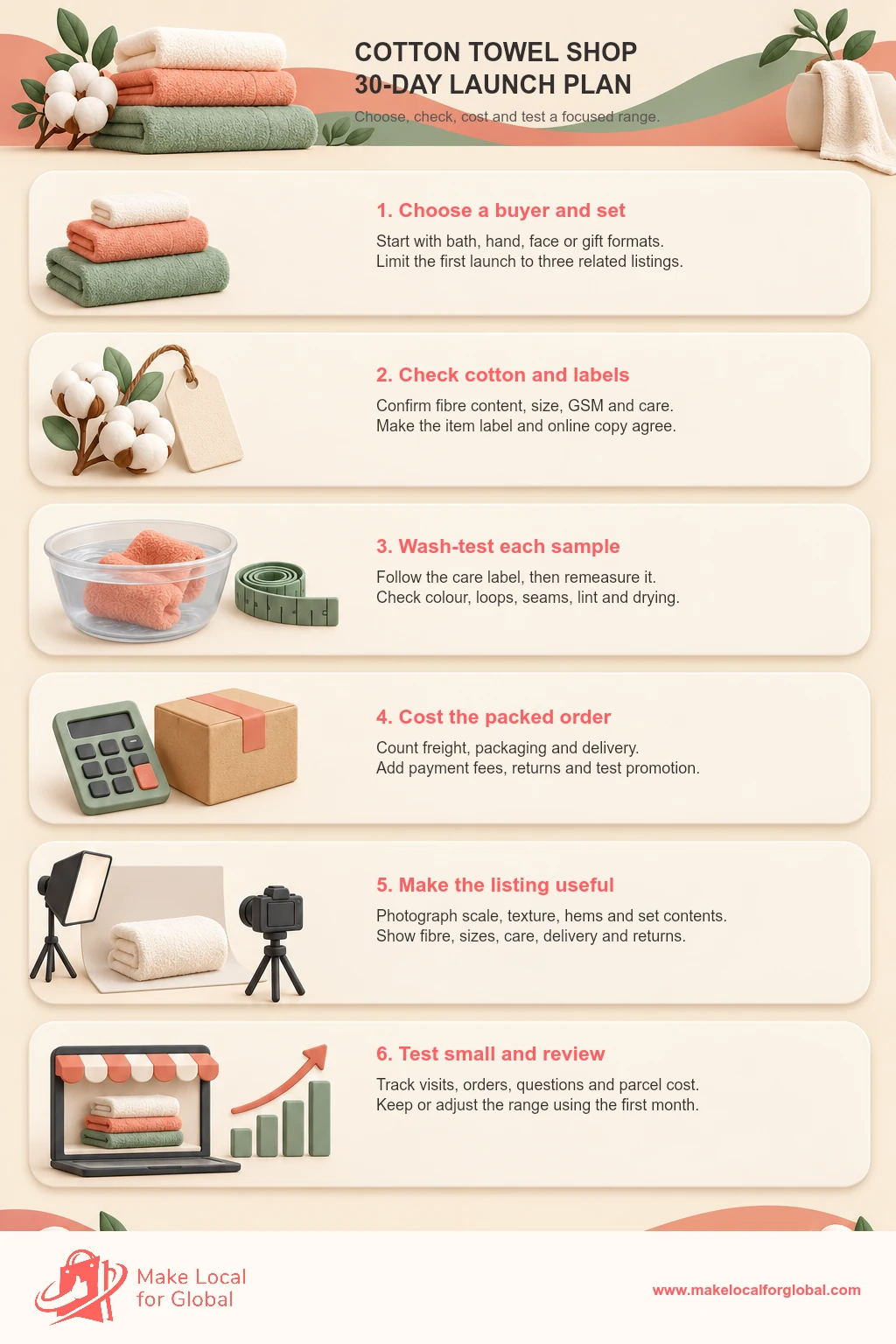
Track product views, add-to-basket activity, conversion, customer questions, order costs and return reasons. If shoppers leave after opening the size guide, make dimensions easier to find. If a colour attracts views but not orders, check its photos, delivery offer and price before adding it to the range.
Choose one buyer and a few related towel formats, find suppliers with written fibre and care details, inspect and wash-test samples, then calculate the packed order cost before listing a small range.
Begin with a small group such as hand towels, bath towels and one coordinated set. Add face cloths or bath sheets only when your samples, parcel cost and early buyer feedback support them.
GSM describes weight per square metre. Compare it alongside fibre details, construction, care instructions and a wash-tested sample; weight alone does not show how the towel will feel in use.
Textile labelling rules apply in Great Britain, and the label and product description must reflect the verified fibre content. Check the applicable requirements for Northern Ireland or any other destination where you plan to sell.
Add the towel and inbound cost, packaging, delivery contribution, payment and marketplace fees, returns allowance and customer acquisition spend. Then include labour, overhead and your tax position before deciding whether the price works.
Use supplier evidence, sample checks and real packed costs to decide what belongs in your first collection. Start with a few well-described products, review what buyers ask and expand only when the numbers and customer response support the next step.
Plan a clear shop experience for the products you have checked and costed.
PREFERRED SOURCE
Like what you’re reading? Add Make Local for Global as a preferred source on Google to see more of our articles when you search.

Build your online presence without having to figure out everything yourself.