READY TO SELL Dog Crates ONLINE?
Get a store built for you in 5 days, plus training and support to help you start, run, and grow your Alternative business.

Build a dog-crate range around suitable fit, tested construction and clear buyer information. Learn how to check samples, cost delivery and launch without treating a crate as a substitute for dog welfare.


Dog crates look simple until a buyer starts comparing them. They want to know whether a crate suits their dog’s build and behaviour, whether it fits the room, how the doors and tray work, what arrives in the parcel and how to introduce it safely. A seller who answers those questions with evidence can make a more useful offer than a shop listing five sizes and a photograph.
This page is about indoor dog crates used as an open resting place, for gradual training or for short periods when appropriate. It is not a guide to outdoor dog kennels, transport restraints or a way to keep a dog confined for long periods. The RSPCA describes crates as a possible safe haven or training aid and says a crate should let a dog stand, turn around, lie down and stretch. The charity says a crate should never be used as punishment. Read its crate guidance before making product or use claims.
For a first shop, define one buyer and one crate use case, choose a small set of sizes and constructions, inspect a physical sample and price the complete order. Then publish clear inside measurements, assembly details, honest photographs and a calm note about appropriate use. Use customer questions, returns and parcel results to decide what deserves a second purchase.
Choose the first crate offer before buying stock
Compare the indoor use, fit information, sample quality and full parcel cost that support your product promise.
The word “crate” covers more than one construction and buying situation. A folding wire crate for a home is not the same product as a plastic travel carrier, a vehicle restraint or an outdoor kennel. Select one category before you ask a supplier for a catalogue.
A buyer might want an open resting space for a newly adopted adult dog, a crate that can be folded away between visits, or a larger adult-size option for a growing puppy. Another buyer may need a crate for an indoor recovery plan advised by a vet. Each situation changes which features matter and what guidance belongs on the product page.
Do not position a crate as a fix for separation distress, barking, chewing, toilet training or aggression. Those are not reasons to promise that a crate will solve a behaviour problem. The RSPCA advises positive, gradual introduction and says signs of distress mean the process has moved too quickly. A listing should direct concerned owners to a vet or qualified behaviour professional rather than claim the product will treat a condition.
Write a short buyer statement before choosing stock. For example: “A folding indoor wire crate for owners who need a clearly measured, easy-to-store resting area for a dog that already settles comfortably in a crate.” This statement narrows the product, photography, size chart, instructions and customer questions.
Speak with dog owners who match the intended group. Ask what they currently use, how they measure their dog, which rooms they can place a crate in, what feels difficult about assembly and what information would help them choose. Ask about their last purchase rather than “would you buy this?” A recent experience gives clearer details than a polite guess about a future order.
Show a draft listing with a real sample or a faithful specification sheet. Include the external dimensions, internal dimensions, door positions, folded size, weight, floor area, material, tray and delivery estimate. Ask the owner to explain which size they would pick and what they still cannot tell. If several people confuse internal and external width, improve the diagram before running an advert.
Test a small landing page or marketplace listing with a waitlist if you do not have stock. State whether the product is in development or available. Track relevant actions separately: listing visits, size-chart use, questions, email sign-ups and paid orders. A visit is not a sale, and an email sign-up does not show that a buyer accepts the final delivered price.
Use search suggestions, marketplace questions and dog-owner discussions as clues for the words people use. Treat them as prompts for direct research, not proof of demand. Record the exact issue: “door swings into narrow hallway” is more useful than “people like practical products”.
A shop can create a large number of variants by mixing size, bar spacing, coating, colour, door arrangement and bundle options. Each variation adds stock decisions, product records, photos and possible picking errors. A small range makes it easier to learn which detail affects a buyer’s decision.
Folding wire crates are often sold with a removable tray and one or more doors. They can be useful for indoor set-up and storage, though the pack size, wire finish, hinge points and latch performance need hands-on checks. Do not assume that every wire crate folds without tools or that one tray fits every size.
Rigid plastic crates use moulded halves, ventilation openings and door hardware. They may suit buyers looking for a more enclosed product or a crate that can be carried when its specification permits. Check whether the product is intended for indoor resting, home transport or a specific travel method. Those uses are not interchangeable, and a consumer must follow the relevant vehicle or carrier guidance for transport.
Soft-sided crates use fabric panels and a frame. They can be lighter and easier to pack, but may not suit a dog that chews, scratches or pushes against the walls. Ask the maker for permitted use, cleaning method, frame material, panel replacement options and warnings. Do not describe fabric as chew-proof without product-specific evidence.
Furniture-style crates combine an enclosure with a table-like surface or cabinet appearance. Their visual appeal creates extra questions about airflow, entry, cleaning and stability. The surface must not tempt a buyer to place objects that make the structure unstable. Check dimensions and assembly with the full unit built, not just the carton photographs.
An entry item might be a compact wire crate with a tray and one door. A core item could add a second access door, divider panel or a different size range if those features solve observed buyer needs. A specialist option might be a rigid indoor crate or a fabric crate for an approved use case. Do not add the second and third items merely to make a price ladder look complete.
Keep the first assortment short enough for a buyer to compare. Use size names only when they connect to clear internal measurements and a suitable measuring method. “Medium” alone does not say how tall or long the interior is. If two sizes have similar outside dimensions but different useful floor space, explain where the sizes differ.
Bundles can include a crate mat, spare tray or compatible water bowl if each item fits the crate and the bundle remains simple to pack. Confirm dimensions and fit with a sample. A separate range of dog beds serves a different resting setup, so do not describe a bed as a crate insert only when it fits the listed interior. Avoid presenting bedding, covers or toys as a substitute for supervision or product-specific instructions.
| Range level | Possible offer | Evidence to gather before launch |
|---|---|---|
| Entry | One folding wire crate with a tray | Actual internal size, panel finish, latch and carton size |
| Core | A second size or door arrangement | Which buyer need supports the added stock and how each variant differs |
| Specialist | Plastic, fabric or furniture-style product | Maker’s intended use, cleaning, assembly, ventilation and care details |
| Add-on | Compatible mat or tray | Exact fit, cleaning instructions and whether it changes usable space |
A home crate does not automatically qualify as a vehicle restraint. A travel carrier may need features and testing intended for a particular trip or vehicle system. An outdoor kennel has weather exposure, floor, roof and run considerations that do not transfer to an indoor cage. Use the relevant dog kennel selling guide for that product type. If your shop sells vehicle accessories, see the separate car accessories product guide and keep its claims distinct from an indoor crate listing.
If your range includes carriers, make a separate category and ask the manufacturer for documented intended use. Avoid phrases such as “car safe” or “crash tested” only when the exact model, test method and result support the claim. A seller should not infer a travel claim from a plastic shell or carry handle.
Size confusion can lead to returns, poor fit and frustration for both the buyer and the dog. The page should distinguish the product’s outside footprint from the usable interior. Measurements should refer to the assembled item and state whether a divider, tray, mat or cover changes the available space.
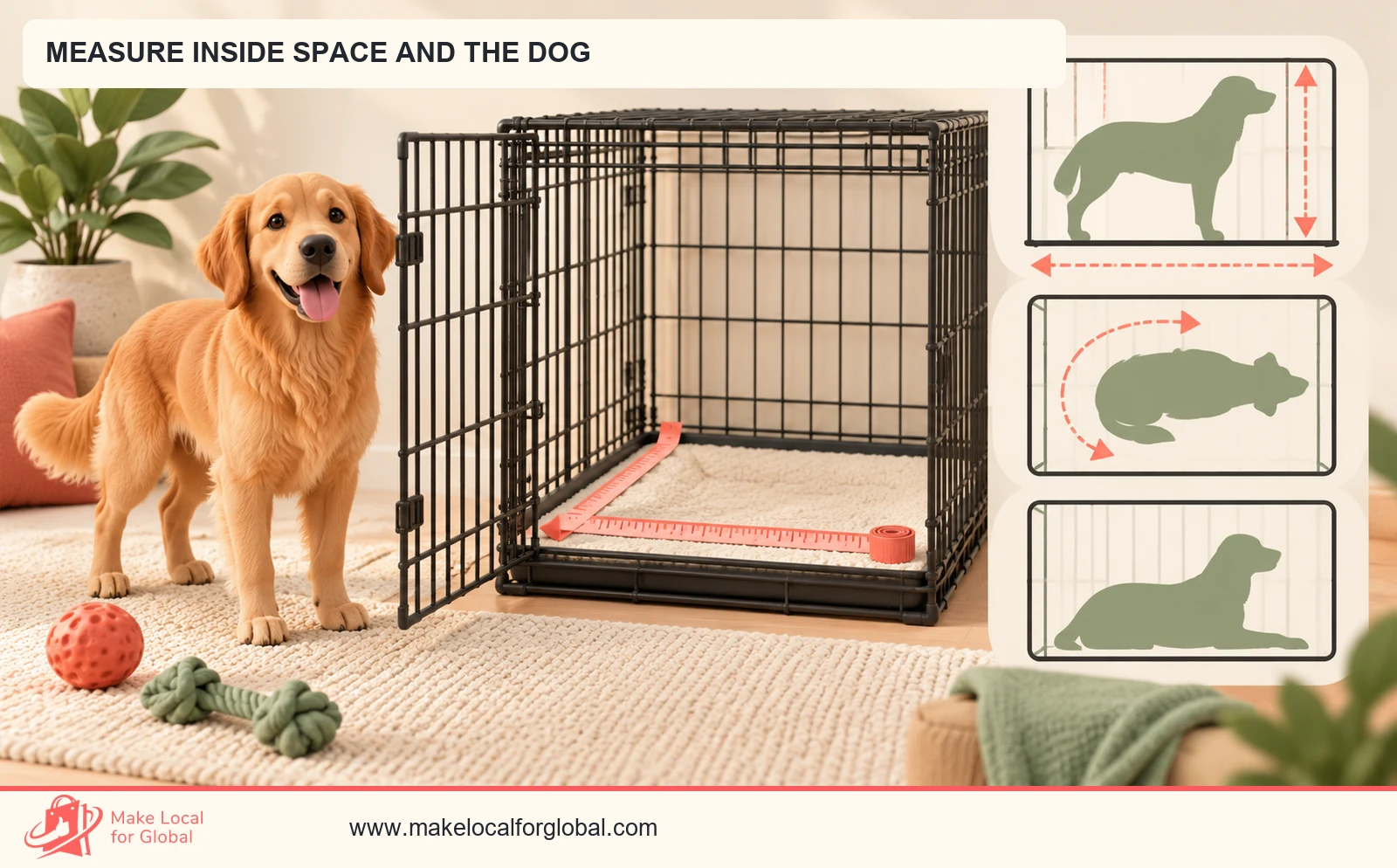
Ask the manufacturer which measurement approach they recommend for the model. A seller’s chart should not replace individual advice from a vet or qualified trainer, but it can help buyers compare the dog’s measurements with the stated internal area. Explain how to measure length and height in plain steps and where to add room for movement according to the supplier’s guidance.
Show the internal length, width and height in centimetres. Add external dimensions for room planning, plus folded dimensions and product weight where the item folds. State whether the measurement is taken at the widest point, the tray edge or the frame. Use the same reference points across every size.
Photograph a tape measure against the actual sample. A diagram can help a buyer understand where a number comes from, though it should match the current product. Add a silhouette to show the dimensions being checked, not a claim that one breed always fits a particular size. Dogs of the same breed can have different body sizes and proportions.
The RSPCA guidance says a crate should allow a dog to stand, turn, lie down and stretch. Put those practical checks near the size chart. Do not rely on a breed label or weight band alone. Weight does not tell the whole story about leg length, shoulder height or the room a dog uses to lie down.
A puppy may grow into a larger adult size, which can affect the buying choice. The RSPCA suggests a crate large enough for a puppy to grow into for home use, and separately notes that an adult-size crate may not provide the right protective fit during travel. Keep that distinction clear and direct readers to current expert advice for the dog’s situation.
If a supplied divider changes the available floor area, show the divider in place and explain that the buyer must follow the product instructions and welfare guidance. Do not sell a divider as a way to confine a puppy to an unsuitable space. Explain whether the divider is adjustable and whether it is included in that exact SKU.
Offer a measurement worksheet as a simple download only if you can maintain it and keep the steps consistent with the product maker’s information. The worksheet can guide the owner to measure the dog, room and access route, then compare those figures with the listing. It should direct a buyer to professional advice when the measurements conflict.
Crates can be awkward to carry through a hallway or assemble in a small flat. Show the assembled footprint and the package dimensions. If the product only fits through a doorway after folding or assembly, explain that plainly. Include the open-door swing area for models with a hinged door.
Check whether the crate can be carried through a stairwell or placed in a car boot by the buyer. Do not imply that the product is safe for car use only when it has been expressly designed and documented for that purpose. A room photograph with a scale reference can make the floor area easier to picture, but add actual numbers so a buyer can measure.
If you sell a crate mat or cover, explain whether the fitting changes the interior dimensions or ventilation. A thick mat reduces clear floor height. A fitted cover can alter airflow if it blocks openings. The product page should describe the accessory’s own dimensions and use limits.
Before comparing wholesale prices, find out who made the product, what documents support its design and which party handles a defect or recall concern. Sellers remain responsible for what they offer, and supplier assurances should be checked against traceable product information.
Buying from a UK wholesaler can simplify communication and replenishment, though it does not remove your need to check product information or sample quality. Ask who holds stock, how returns are handled and whether the exact product can be traced to a batch or production run.
Direct importing can give more choice in finish, size and packaging. It can bring longer lead times, currency changes, import charges and greater responsibility for product checks. Ask who is the manufacturer, who is the importer, which records identify the product and what happens if a safety concern appears.
Private label can put your brand on a supplier’s existing crate. Ask what changes from the original, whether the product has been tested in its new form, and whether instructions, packaging and spare parts use the correct brand and model details. A changed coating, wire gauge, latch or tray can affect performance, so treat each altered specification as a new check.
Request a written specification with model code, internal and external dimensions, materials, finish, net weight, package contents and assembly steps. Ask for batch identification, supplier contact details, spare-part availability and the process for reporting an incident. If the supplier provides test reports or declarations, verify that they refer to the model being sold and the intended market.
For imported goods, identify which business is responsible for compliance in the destination market and what product contact details have to appear on the packaging or online offer. Great Britain and Northern Ireland requirements can differ. The Office for Product Safety and Standards business guidance explains that businesses making, importing, distributing or selling consumer goods have product safety responsibilities. Check current rules for the precise product, origin and sales territory before launch.
Ask how the supplier responds to a defect report, a missing latch or a product that does not match the listing. Get response times and replacement-part arrangements in writing. A friendly sales message is not a substitute for a clear process when an order arrives damaged.
Use a short scorecard so you can compare two suppliers on the same evidence. Include minimum order quantity, sample cost, lead time, carton dimensions, spare parts, defect allowance, documentation and payment schedule. Mark unanswered items rather than filling gaps with assumptions.
For a first run, ask whether the supplier can provide a single sample and whether production can be split into a smaller initial quantity. A low wholesale price may be less useful if the smallest order exceeds your storage or cash limit. Record the quote date and currency. Reconfirm the terms before paying for production.
Keep an approved master sample with the listing specification and dated photos. When a new delivery arrives, compare the new batch with that sample. If the wire coating, tray fit or hardware changes, pause the listing until you know whether the existing copy still describes the product accurately.
A crate is made from connected parts. One weak latch, sharp wire end or tray that slides out too easily can create a poor customer experience or a safety concern. Inspect the sample as a complete product and record the evidence with photos and notes.
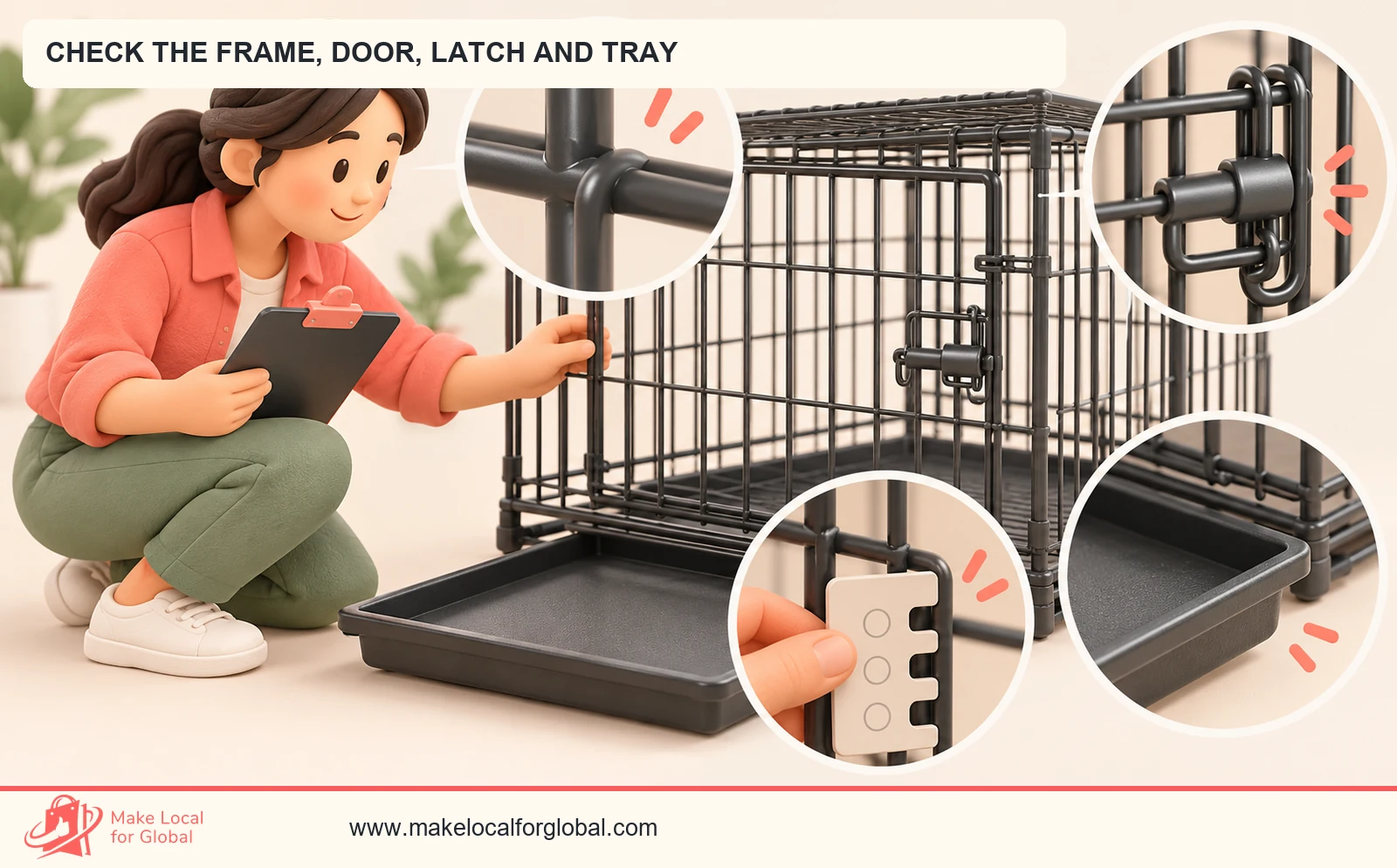
Inspect every panel, joint and edge under good light. Look for burrs, exposed wire ends, coating gaps, rust, loose welds, bent bars and inconsistent spacing. Run a cloth over edges to identify snags, then examine any area a dog might contact with its muzzle or paws. This is a seller’s sample check, not a substitute for appropriate product testing.
Check that the assembled frame sits level on a flat surface. Press each side with a consistent, gentle hand force and record movement, noise or a panel that pulls away. Do not improvise a force test and describe it as a recognised standard. Follow the manufacturer’s test method when one exists.
Inspect door alignment, hinge movement and latch engagement. Open and close each door repeatedly. Confirm that the lock engages without forcing the panel and remains secure during ordinary handling. Photograph how the latch works so a buyer can see the mechanism.
Slide the tray in and out. Check for sharp edges, wobble, gaps, excess movement and whether it can be removed for cleaning without lifting the whole crate. Confirm the tray dimensions and material. If the crate has a divider, confirm that it fits the specified model and locks into place as described.
Count all clips, bolts, panels and instructions against the packing list. Check the hardware bag for tears or missing pieces. Small loose parts should be kept out of reach of pets and children during assembly. The listing should state what tools are required and whether the tools are supplied.
Assemble the product using the supplied instructions without referring to the supplier’s sales representative. Note unclear steps, missing orientation marks and whether a first-time user can complete the task. Photograph the assembled sample and each door configuration. If the directions are confusing, ask for a corrected version before production.
One attractive sample can hide a quality variation. If your cash plan allows, inspect several samples or units from a production run. Compare latch alignment, coating, panel geometry, tray fit, carton protection and instructions. Record the date, batch details and result for each item.
Create a simple pass, hold or reject record. “Pass” means the item matches the approved specification and checks. “Hold” means a question needs written resolution or further testing. “Reject” means the issue is clear enough to stop selling that unit or batch. Tell the supplier what needs to change and what evidence you require before you approve the next shipment.
Do not hide a known limitation in fine print. If one size has a different latch or only one door, show which feature changes beside each size option. If the supplier cannot confirm a material or finish detail, leave that claim out of the product page.
The product page should answer the questions that affect fit, assembly, daily cleaning and delivery. Buyers should not have to interpret a studio photograph or message you for the basic inside dimensions.
Start with the product type, construction, size or use detail that helps distinguish the item. A title such as “Folding Wire Dog Crate with Removable Tray, 91 cm External Length” gives more context than “Premium Pet Cage”. Do not use “premium” as a quality claim without something concrete to explain it.
Open with the facts: whether it is for indoor use, which construction it uses, what comes in the box, and where to find the inside and outside measurements. Avoid implying that a crate suits every dog or helps with behaviour. A clear first paragraph helps a buyer decide whether to read further.
List internal and external dimensions, assembled floor area, door count and positions, folded size, weight, materials, finish, tray details, divider inclusion, carton contents, tools and care steps. Identify whether a measurement is approximate and state the manufacturer’s tolerance if supplied. Use centimetres and kilograms for UK shoppers, with another unit only when it helps a stated market.
Describe how the crate is cleaned and dried based on manufacturer instructions. State whether a tray is dishwasher safe only when the documentation says so. Explain how to source replacement panels or trays if the supplier supports them. Do not create warranty promises that exceed the supplier’s written terms or the customer’s legal rights.
Use the physical sample. Show the whole assembled crate, each door, the latch close-up, tray removal, fold-flat state and the interior dimensions. Add a photo of the exact carton and its dimensions when bulky delivery or storage matters. Use a dog only as a calm scale reference with the crate open; the image should not imply all dogs will accept the same product.
Label diagrams with the same units and reference points as the specification. Use a clear line or arrow rather than a vague “fits most dogs” badge. If you show a puppy beside an adult-size crate, explain that home use and transport needs may differ. Avoid images of a closed dog in a crate as the lead visual.
State whether the crate arrives assembled or flat packed, how long assembly usually takes only if you have measured it, and which tools are needed. Explain parcel weight, delivery area, access constraints, tracking and what happens if a carton is visibly damaged. Give a realistic dispatch estimate based on stock status.
Tell buyers how to contact you about a missing part or damage. Explain the return process, including any cost and how to repack an opened but unused product, in wording that is fair and consistent with consumer rights. Do not suggest a customer loses statutory rights simply on the basis that a carton has been opened.
The CMA’s consumer law guidance for sellers covers transparent price information, optional charges, returns and fair marketing. The UK online and distance selling rules describe information to give before an order, including product details, full price and delivery arrangements. Review the current requirements for your business model and customer location.
Crates vary greatly in weight and carton volume. A compact carrier-style model may have a different delivery price from a large folding wire unit. The delivered contribution can change when a courier applies a volumetric tariff or when a parcel needs a two-person service.
The table below uses hypothetical figures for one wire crate shipped to a UK customer. It is not a market quote or expected margin. Replace each amount with a current supplier invoice, fulfilment quote, channel fee and your own customer acquisition data. VAT treatment will depend on the business and supply; these example amounts exclude VAT and VAT is not calculated here.
| Cost item | Illustrative amount | How to check it |
|---|---|---|
| Crate purchase price | £28.00 | Confirm the supplier quote, currency and minimum order |
| Inbound freight and import allocation | £6.00 | Divide the shipment cost across saleable units |
| Carton protection and packing materials | £2.20 | Include any outer box, corner protection and tape |
| Payment or marketplace fee | £4.80 | Calculate against the actual selling price and channel rate |
| Outbound delivery | £7.50 | Obtain a rate for real packed weight and dimensions |
| Damage and return allowance | £3.50 | Set from your own observed rate once orders exist |
| Customer acquisition allowance | £5.00 | Use campaign cost per completed order, not a click estimate |
| Illustrative variable cost total | £57.00 | £28 + £6 + £2.20 + £4.80 + £7.50 + £3.50 + £5 |
| Example selling price | £79.00 | Hypothetical price for arithmetic only |
| Contribution before fixed costs and tax | £22.00 | £79 − £57 |
The £22 is not net profit. It does not include staff time, storage, insurance, software, samples, photography, accountancy or tax. Add VAT only if it applies to your sales and show whether your planning sheet uses VAT-inclusive or VAT-exclusive values. If you are VAT registered, check the treatment with an accountant or current HMRC guidance.
The return allowance is a planning line, not a prediction. A product that is difficult to assemble, incorrectly sized or damaged in transit may produce a higher cost. Review the actual rate and the reasons behind each return before changing the allowance.
Ask two or more couriers for a rate based on the fully packed carton, not the bare crate. Provide dimensions, weight, collection postcode and delivery area. Ask about surcharges, remote areas, claims evidence, collection windows and whether the service includes delivery to the door or a room of choice.
Run a low, expected and high delivery scenario in your cost sheet. For example, if the carrier charge moves from £7.50 to £12.00, the contribution at a £79 sale price falls by £4.50. That can change whether free delivery, a delivery charge or a different product specification makes sense.
Separate the product price from a delivery charge only when the whole checkout remains clear. Do not use a low headline price and reveal a large required fee at the final step. The CMA’s guidance says businesses should present prices and mandatory charges clearly. Check the full basket total before publishing a promotion.
Work out the cash needed for the smallest viable order, samples, inbound freight, storage and possible refunds. Decide what quantity you can afford to have unsold. Keep a separate reserve for damaged items, replacement hardware and customer returns.
If the supplier wants a larger quantity, ask whether you can test a smaller run, mix sizes within a minimum order or use a local wholesaler for the first batch. Compare the total cash commitment and not just the per-unit discount. Record the date when supplier price and lead time were checked.
Map the crate sample and first sales test
Gather the product checks, packed dimensions, cost assumptions and launch measures in one plan.
A folded crate can still be a bulky parcel. Delivery planning begins with the carton, not the assembled product photo. A carton that arrives crushed may bend a panel, crack a tray or leave a latch loose.
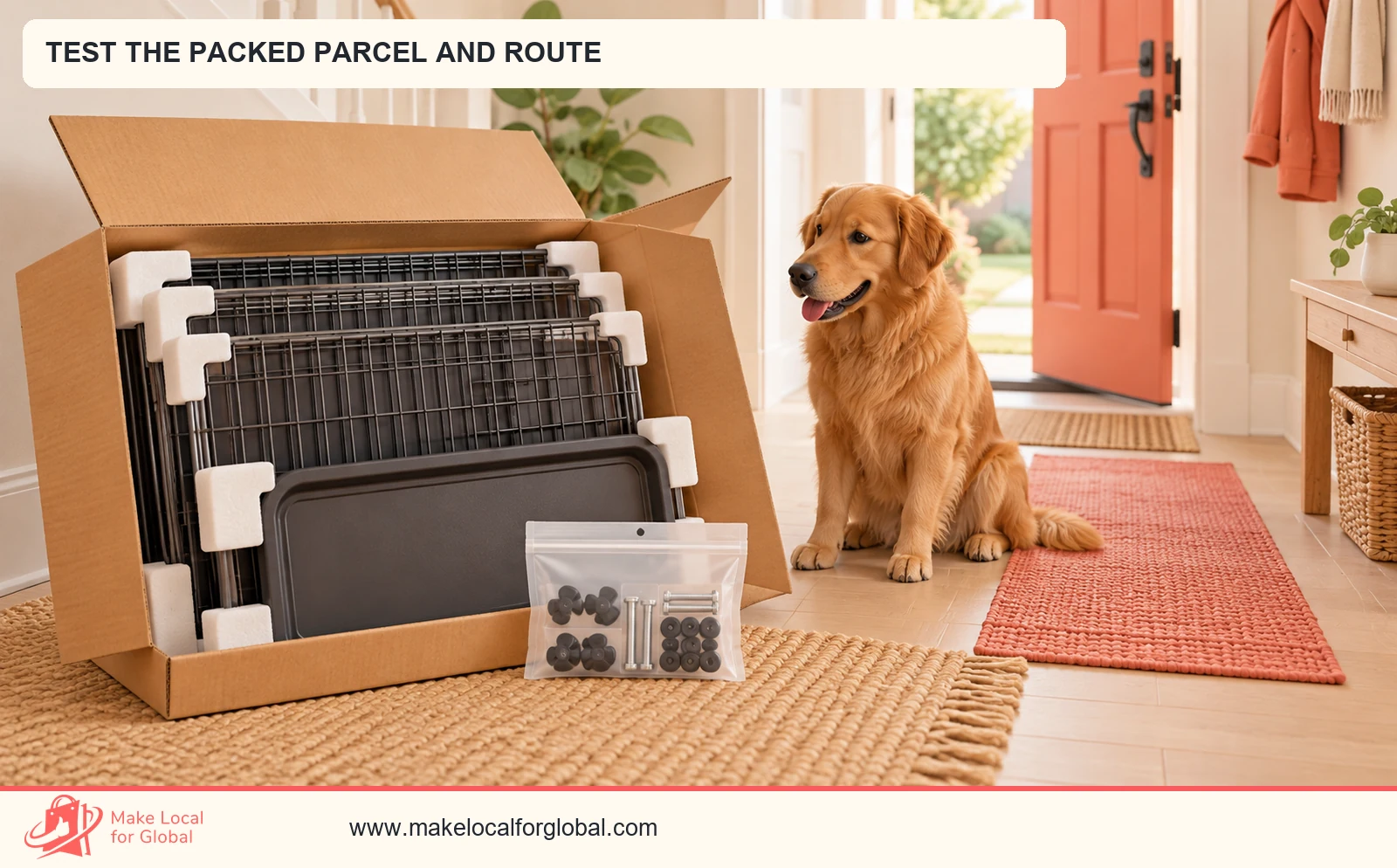
Photograph the packaging before opening the sample. Check whether panels are separated by protective sheets, corners are supported and the hardware bag cannot scratch the finish. Look for clear orientation labels and a parts list. Record carton length, width, height and gross weight.
Repack the sample after inspection. Check if a first-time customer could put the components back into the carton without forcing them. If opened units will be returned, explain what should be retained and how a return collection works. Keep the return instructions fair and follow the customer’s statutory rights.
Ask the carrier how claims for damage are submitted and what photos or packaging must be retained. Set a process for customers to report visible transit damage without placing unreasonable conditions on their rights. Keep batch and dispatch records so you can identify repeated carton problems.
Measure the carton stack, not just the individual parcel. Estimate how many units fit in a rack or storage area and how to access each size without moving the whole stack. A large crate can occupy space well beyond its product value.
Pick a clear bin or shelf label for each model and size. Use a barcode or SKU that does not confuse internal and external measurements. Before dispatch, match the carton label to the order, check the door count and confirm the hardware bag is present.
If a fulfilment provider handles the item, give them correct carton dimensions, handling notes and SKU mapping. Ask how they record oversize charges and damaged returns. Test one order through the full pick, pack, carrier and customer communication flow before moving all stock to a provider.
Some customers may value assembly, but it brings additional cost, scheduling and liability questions. Start by documenting the assembly time for the sample and the tools required. If offering an assembly service, define the delivery area, appointment window, access requirements and what happens if a room cannot fit the assembled crate.
Do not imply that a basic crate installation is a safety inspection or behaviour consultation. The product should arrive with understandable manufacturer instructions. A seller should not provide dog-training directions beyond its competence.
This section is a starting point for business research, not legal advice. Rules can depend on the product design, the business role, where the product is sold and the customer’s location. Ask a qualified adviser or the relevant regulator when a requirement is unclear.
The Office for Product Safety and Standards says businesses that make, import, distribute or sell consumer products in the UK have responsibilities for product safety and labelling. The applicable requirements differ between Great Britain and Northern Ireland. Review the current product safety advice for businesses and the product-specific guidance that applies to the exact crate.
Maintain product identification, supplier details, purchase records, batch records and a complaint process. Keep a record of the product specification and sample checks. If an incident or repeated defect is reported, assess it quickly, preserve evidence and contact the supplier or relevant authority as appropriate.
Do not apply a conformity mark on the basis of a logo file supplied by the vendor. First confirm that a particular rule applies and that the mark is required and correctly supported. Do not use “certified safe” without a current document that identifies the model and scope.
Before checkout, make business contact details, a full product description, total price and delivery information easy to find. State whether the crate is in stock, made to order or dispatched by a partner. Confirm the order in a format the buyer can keep and provide delivery within the agreed period.
Online consumers usually have cancellation rights for distance purchases, subject to legal exceptions and rules. A product’s bulky size does not itself remove those rights. Read current GOV.UK distance selling guidance and returns and refunds guidance. Write a process that accounts for cancellation, faulty goods and goods that do not match the description.
If you sell to customers outside Great Britain or to Northern Ireland, check destination-specific rules, taxes, delivery and product safety obligations. Do not rely on a UK-wide wording from a supplier without confirming where it applies.
Crates are products used around a living animal. Keep the offer factual and avoid presenting confinement as a remedy for distress, chewing or other unwanted behaviour. A positive resting place is not a replacement for exercise, water, social contact or supervision.
If you describe a crate as “escape-proof”, “anxiety reducing”, “training approved” or suitable for all dogs, keep evidence for the exact claim. In most product offers, a neutral specification with clear limitations will be more trustworthy than a sweeping promise. Refer welfare or behaviour concerns to a vet or qualified professional.
Use careful photography and captions. Do not show a dog in a closed crate for an extended period. Do not make a product image imply that the animal is comfortable solely on the appearance in one staged frame. A calm open-door resting image can show construction and scale without prescribing how a buyer should manage their dog.
Your first channel should let you present the size chart and assembly information clearly. A small independent shop offers control over comparison pages and FAQs. A marketplace can provide existing search traffic and checkout processes, but may have listing fees, category rules and strict response expectations. Check current terms and costs before committing.
Use the words buyers type in natural headings and product names: “folding wire dog crate”, “indoor dog crate with tray”, “large dog crate dimensions” or “dog crate with two doors”. These are example phrases, not search-volume data. Check actual search suggestions and customer language before choosing the final page title.
Write a separate page for each materially different model or size if the differences matter to purchase decisions. Do not create near-identical pages that repeat the same copy with a size word changed. A comparison page can explain which measurements differ and link to each precise product record.
Create helpful content around choosing measurements, assembling a folding crate, cleaning a tray, planning delivery and distinguishing an indoor crate from a travel carrier. Keep welfare advice current and link to reputable animal welfare sources. Do not copy the RSPCA’s training steps into a sales funnel or imply endorsement.
Choose one acquisition test, such as a small paid search campaign on a phrase with clear purchase intent, an email to an opted-in audience or a product demonstration video. Set a spending limit and a meaningful time period. Record visits, size-chart interactions, add-to-basket actions, completed orders and questions.
When someone leaves a question, capture the exact confusion. “Will this fit in a 76 cm doorway?” can lead to a useful access-route diagram. “Can I use it in a car?” may show that a product page needs a clear statement about intended use. Do not answer with a guess; verify the model information first.
Review delivery and returns alongside sales. A listing that sells but produces repeated missing-parts reports may need a packing change. A high number of size questions may indicate that the measurements are buried. Use observations to change one thing at a time and note the date.
Choosing sizes by dog breed alone. Breed is a rough clue, not a measurement. Give inside dimensions and explain how the owner should compare the dog and crate.
Using only a staged product image. Buyers cannot inspect latch operation, tray movement, folded dimensions or carton size from one beauty shot. Photograph those details from the actual sample.
Calling every crate a travel crate. Product material or a carry handle does not prove that the model is suitable for a particular vehicle or trip. Separate indoor rest products from products with documented travel use.
Treating the crate as a behaviour solution. Do not promise that confinement stops barking, chewing or distress. Explain neutral product facts and send welfare concerns to a professional.
Ordering the whole size chart at once. Extra sizes tie up cash and create inventory that may not match real enquiries. Check buyer fit questions and supplier minimums before adding more sizes.
Using the bare item dimensions for delivery. Carrier fees use the packed parcel and can include volume-related charges or service restrictions. Measure and weigh the sealed carton.
Ignoring spare parts and batch changes. A missing clip or a new latch can turn into a return. Ask the supplier how to identify a batch and order replacement parts.
Copying supplier copy without checking it. Broad claims may not match your exact model or local rules. Build the listing from a checked specification and keep evidence for each claim.
Hiding mandatory delivery costs. A low price followed by a required fee at checkout can mislead buyers. Show the full cost early and confirm the checkout total.
Use four weeks to collect evidence and prepare a manageable launch. If your lead time or sample delivery takes longer, extend the schedule rather than skipping the checks.
| Week | Work | Evidence to keep |
|---|---|---|
| 1 | Choose one indoor-crate buyer, review competing product specifications, ask owners about fit and delivery concerns | Interview notes, repeated questions, draft size comparison |
| 2 | Contact suppliers, request records, price samples, compare minimum order and carton details | Supplier scorecard, current quotes, intended-use information |
| 3 | Inspect and assemble the sample, test tray and latch, photograph dimensions, calculate full cost | Sample record, photos, packed dimensions, scenario costs |
| 4 | Publish one precise listing, run one capped discovery test, review questions and orders | Listing version, campaign limit, enquiries, orders and issues |
At the end, make a documented choice: reorder, revise the listing, change supplier, test a different size or stop. “No orders” is useful only when you know how many relevant buyers saw the listing and what they understood. If the test had little exposure, improve the discovery route before deciding the product itself has no demand.
For a first month, a useful target is a completed evidence set rather than a sales promise: one approved sample, one cost sheet, one full listing, a recorded buyer feedback sample and a delivery plan. Your next step can be to adjust the offer based on what real enquiries show.
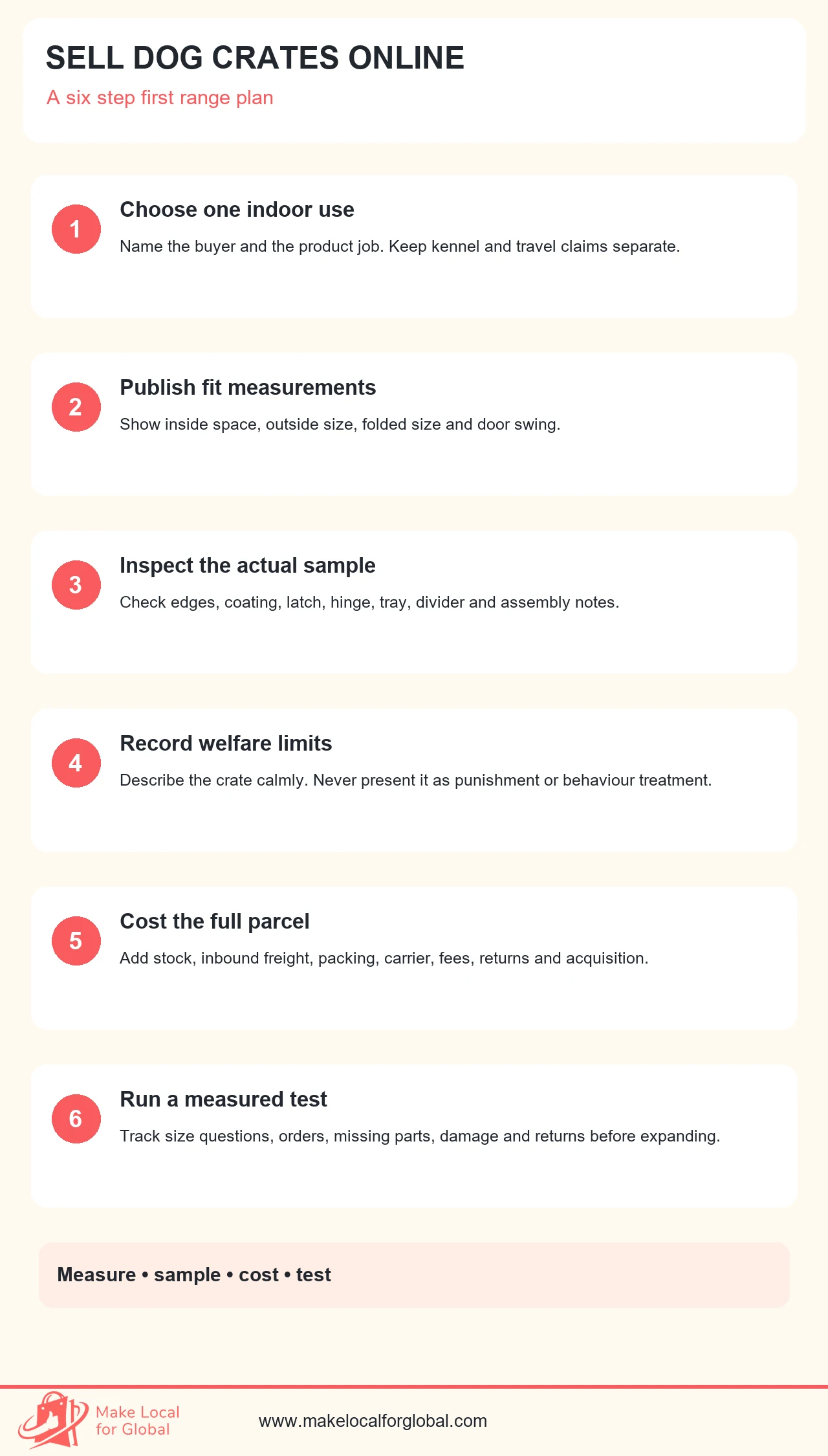
Review the crate page before opening orders
Check internal and external measurements, use limits, sample photos, delivery details and returns information.
No. This article focuses on indoor crates. An outdoor kennel has different requirements around weather protection, floor, roof, run space and access. Use a distinct listing and seller plan for each product type.
Publish exact internal dimensions and explain the measurement method from the supplier. The RSPCA says a dog should be able to stand, turn around, lie down and stretch in its crate. Breed name or weight alone is not enough for a reliable choice.
Avoid promising that a crate treats anxiety or behaviour. A crate is not appropriate for every dog, and a seller should not give clinical behaviour advice. Refer concerns to a vet or qualified behaviour professional.
Only if the exact model includes a compatible divider and you can describe its intended use accurately. Explain how the divider affects interior space and direct owners to appropriate welfare guidance. Do not encourage a buyer to use it to reduce the space below a suitable fit.
Only when the manufacturer documents that specific model for the stated travel use. Do not infer travel suitability from a handle or plastic construction. Owners should follow the vehicle, carrier and professional guidance relevant to their trip.
Check the frame, coating, spacing, edges, door hinges, latch, tray, divider, assembly instructions, carton, parts list and identification marks. Test the complete sample and retain photos and supplier records. Investigate uncertain safety claims before taking orders.
Add purchase cost, inbound freight, packaging, outbound delivery, channel fees, returns and damage allowance, acquisition spending and fixed costs. Use the sealed carton measurements for courier quotes. A simple contribution calculation is not net profit.
State intended use, internal and external dimensions, material, finish, door arrangement, tray details, package contents, assembly steps, carton measurements, dispatch estimate, delivery terms and returns information. Use sample photos and a clear size diagram.
Return and cancellation rights depend on the circumstances and applicable law. Do not remove statutory rights through a blanket “opened box” statement. Review current government guidance and write a fair process that explains any conditions which law allows.
Start with the smallest set that serves the buyer you have researched and that you can accurately stock, measure and describe. Add another size when enquiries, orders or fit-related feedback point to a specific unmet need.
PREFERRED SOURCE
Like what you’re reading? Add Make Local for Global as a preferred source on Google to see more of our articles when you search.

Build your online presence without having to figure out everything yourself.