

READY TO SELL Dog Water Bowls ONLINE?
Get a store built for you in 5 days, plus training and support to help you start, run, and grow your Alternative business.

Learn how to sell dog water bowls online: compare materials and sizes, check samples, cost delivery, write accurate listings and plan a measured launch.

A dog water bowl looks like a simple product until a buyer asks how much it holds, whether it slides across the floor, how easy it is to clean and whether it fits a small kitchen or a travel bag. A seller who can answer those questions with measurements, sample checks and honest photographs has a clearer offer than a catalogue full of vague claims.
To sell dog water bowls online, choose one buyer and use case, compare a small number of materials and sizes, test physical samples, calculate the full order cost and show the dimensions and care instructions on each product page. Start with a range you can inspect and replenish. Add variants only when buyers or sales data show a reason.
This practical UK seller plan covers bowl types, supplier questions, sample checks, claims, pricing, listing details, fulfilment, returns, search content and a 30-day launch. Rules can vary across Great Britain, Northern Ireland and export markets, so check the rules that apply to your business and customers before you place stock.
Use the Single Product Product Page Assessment to review whether a listing gives buyers enough information about the item, price and delivery.
“Dog water bowl” covers a wide set of products. A compact bowl for a puppy, a heavy ceramic bowl for a kitchen, a wide stainless bowl for a large dog and a collapsible bowl for a walking bag do not solve the same problem. Pick one first use case so the capacity, material, base and photography all make sense together.
Possible buyers include new puppy owners furnishing a home, owners of large dogs who want a stable bowl, people who travel with a dog, multi-dog households and gift buyers. Avoid assuming that one style suits every dog. A narrow, deep shape may not suit every muzzle; a very light travel bowl may be wrong for a dog that pushes it around at home.
Write the offer in one sentence before contacting suppliers: “We sell [bowl type and size] for [specific use], with [verifiable feature] and clear [care or delivery detail].” Keep every bracket grounded in a sample, a supplier record or a test you can repeat. “Fits in a walking pack” can be checked against dimensions. “Stops spills” is an absolute promise that a real-life product may not support.
Use a short customer interview, a small landing page or a low-cost sample test to learn which details matter. Ask a dog owner what makes them replace a bowl, where the present one sits, what cleaning is like and what size they would consider. Record the exact language people use. A friendly reaction to a photograph is not evidence that someone will pay your planned price.
Start with a small range that buyers can compare in seconds. One useful opening plan might be two capacities of a stainless bowl with the same shape and base, plus one collapsible travel bowl. A different plan could focus on ceramic kitchen bowls with two capacities and a small number of neutral colours. Avoid launching every material, shape, colour, capacity and bundle at once.
Each size or colour adds inventory records, images, supplier questions and the chance of picking the wrong item. A colour choice that has no effect on how the product works might be a later variation. A capacity change affects whether the bowl is suitable for a buyer’s setting, so it needs a separate measurement and a clear description.
Organise choices around use rather than arbitrary price tiers. A home bowl might need a non-slip base and easy daily cleaning. A travel bowl might need to fold, clip to a bag and dry without retaining water. A raised feeding station is a different product with fit and stability questions; do not add it to a bowl listing unless it is actually included.
| Range idea | Buyer problem | What to verify | Inventory risk |
|---|---|---|---|
| Everyday stainless bowl | A durable bowl for a regular feeding area | Capacity, inner diameter, rim, base, cleaning guidance | Low to medium if you limit sizes |
| Ceramic kitchen bowl | A heavier bowl that suits a home setting | Glaze, chips, weight, finish, packaging strength | Medium because breakage and colour variation matter |
| Collapsible travel bowl | Water on walks or trips | Open capacity, collapsed size, seams, clip and drying | Medium if several colours or accessories are added |
These are range-planning examples, not a product recommendation. Confirm the exact construction and claims on each supplier sample.
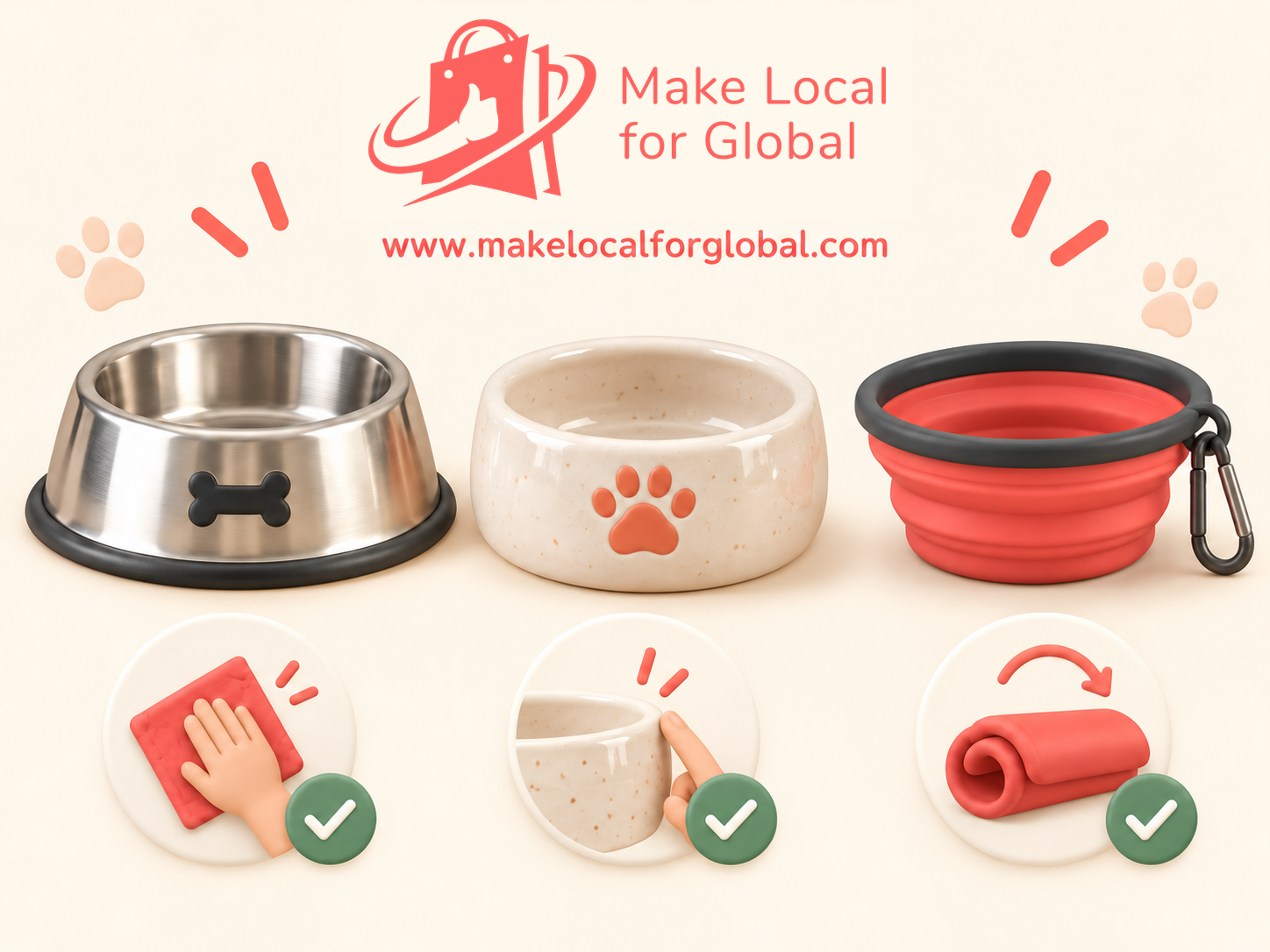
Material is not a quality grade on its own. The design, finish, thickness, manufacturing and care instructions affect how a bowl works. Compare physical samples rather than choosing from a supplier’s catalogue photograph. Ask for material specifications and any documentation that supports the claims you plan to make.
Stainless bowls are often sold as everyday bowls because they are simple in shape and easy to wipe. Check the stated steel grade instead of assuming every steel bowl uses the same material. Inspect seams, rolled edges, the underside, finish consistency and whether the base is separate or bonded. A thin bowl can ring loudly, flex or slide differently from the sample pictured in the catalogue.
Ask the supplier for a written specification and care instructions. Avoid claims such as “rust proof” or “dishwasher safe” unless the supplier can substantiate them for the exact finish and any attached base. Photograph the interior and underside so a buyer can see what the listing actually includes.
Ceramic can feel substantial and suit a fixed feeding area, but its weight and breakage risk affect storage, parcel cost and returns. Look for glaze pinholes, sharp or uneven edges, cracks, wobble and colour variation. Check the base protection and how the glaze meets the rim. A decorative finish can chip, so the seller needs to say how to inspect a delivery and what to do if it arrives damaged.
Do not treat a “food safe” phrase in a sales email as proof for every market. Ask what test or specification supports the exact bowl, where it applies and which surface it covers. If a glaze or coating raises a compliance question, ask a qualified product-safety adviser or Trading Standards rather than making an unsupported promise.
A flexible bowl can pack down for a walk, car journey or day trip. Test the seam, rim, fold lines, clip, opened shape and stability when partly filled. Measure both the open and collapsed product. Check whether the bowl retains water in creases after washing and whether the seller’s cleaning instructions explain how it should be dried.
Ask the supplier for material details and documentation for the exact item. Do not infer that a bowl is safe for food or water contact only from its appearance, smell or a marketplace description. Confirm which claims can be used in the countries where you intend to sell and retain the supplier’s written response.
You could buy finished bowls from a UK wholesaler, import finished items, work with a manufacturer on a private-label design or make bowls yourself. The right route depends on the level of control you need, your budget, production knowledge, order quantity and ability to handle returns. A low unit price is not a good deal if sample quality varies or the supplier will not identify the batch.
Ask each potential supplier the same questions: What material and grade is used? What are the capacity and external dimensions? What is the minimum order? Can I buy a sample from the same production run? Which care claims are supported in writing? How are colour or size variations controlled? What is the defect and replacement process? Can each carton be traced to a batch or production date?
Ask who pays import duty, freight, insurance, inspection and inland delivery, and when ownership or risk transfers. If goods arrive with defects, ask for the deadline and evidence needed to claim. Get the terms in writing. Keep supplier quotes and sample notes together so you can compare the true landed cost rather than a headline unit price.
For a private-label order, approve a marked sample before the full run. Confirm artwork placement, colours, product dimensions, packaging labels, barcode and care text. Ask the factory to record agreed tolerances. “Same as sample” needs a sample ID and a shared record; it is not useful if either party cannot identify which version was approved.
Do not pay for a large run until you understand how slowly the stock may turn, what cash is needed for freight and tax, and how you will store ceramic items without damage. A sample and small order help reveal quality and delivery problems while the financial exposure is limited.
Write a short inspection plan before the sample arrives. Use the same steps on each candidate bowl and record the results, photos and date. The aim is not to prove that a product suits every dog. It is to check whether the listing can accurately describe this specific design and show its limits.
Record pass, fail or unresolved for each check. If a claim cannot be verified, remove it from the listing or ask the supplier for evidence. If samples from one model behave differently, stop and find out whether there are multiple factories, batches or product revisions. A pleasant-looking sample cannot stand in for every item in a later shipment.
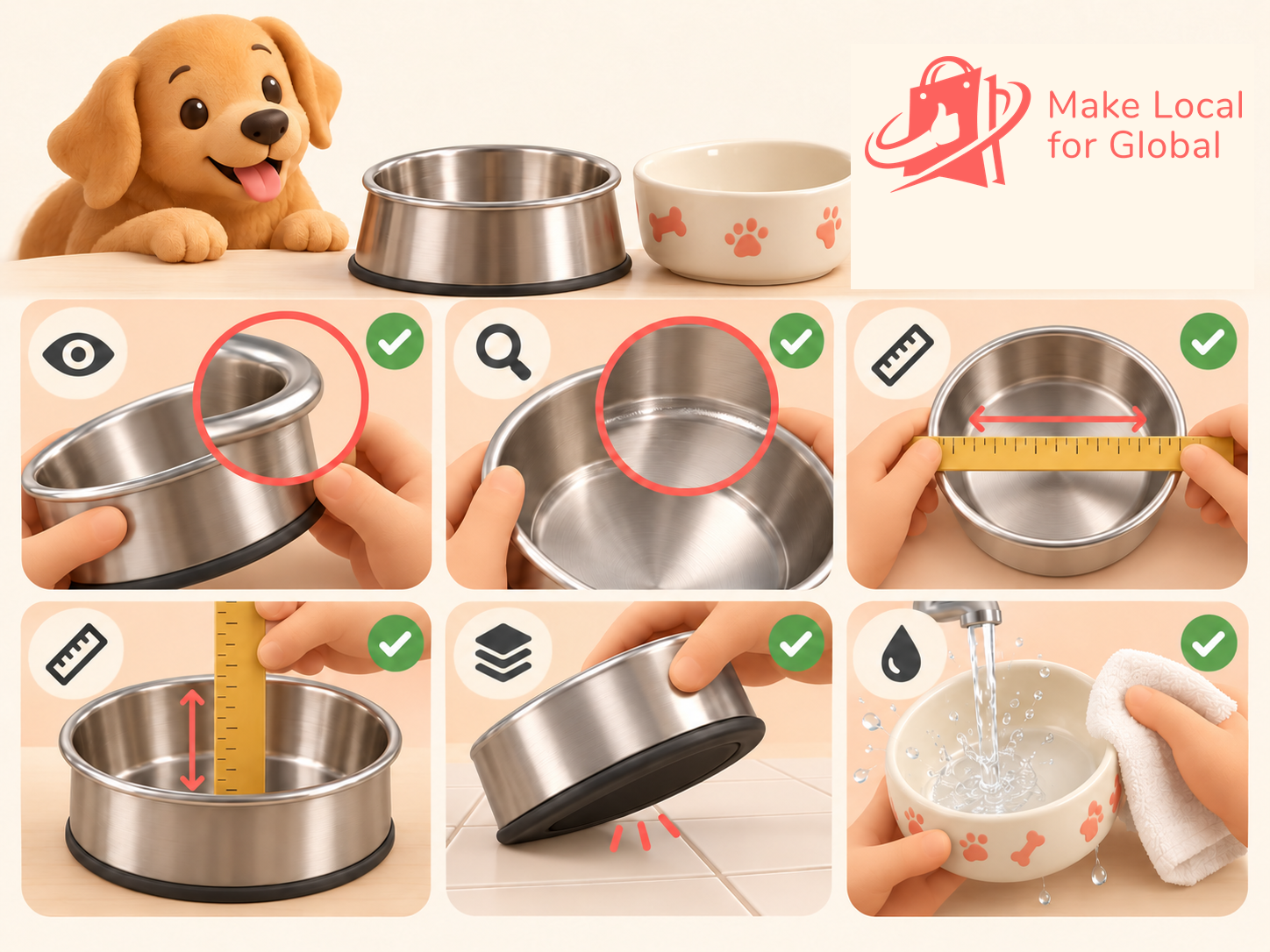
Give shoppers enough detail to compare the bowl with the space and dog they have in mind. List the external diameter, internal opening, height, empty weight and measured capacity. Explain how you measured capacity, such as filling to a marked level below the rim. If several colours share the same bowl, say whether dimensions apply to all colours.
A litre figure alone can mislead. Two bowls may hold the same volume but have different widths and depths, and a photograph without scale gives little sense of either. Show the bowl next to a ruler or a familiar object, and include a side view. If you suggest a size for a dog weight range, explain where that recommendation came from and whether it is the supplier’s guidance or your own tested fit observation.
Avoid medical, dental, digestion or posture claims unless you have evidence and are authorised to make them. Do not say that one bowl prevents bloat, fixes a health issue or is suitable for every breed. If a buyer’s dog has a medical need, direct them to their veterinary professional rather than trying to diagnose a bowl choice.
For travel bowls, include open height, open width, collapsed depth, empty weight and clip details. State whether a carabiner is included, what it is made from if verified and whether it is intended to carry the empty bowl only. For a bowl with a mat, state the mat’s dimensions separately and show exactly what comes in the package.
| Measurement | How to record it | Why a buyer needs it |
|---|---|---|
| Usable capacity | Measured fill level, leaving room below the rim | Compare with refill routine and intended setting |
| Inner opening | Measure inside edge at the widest point | Understand access and available surface area |
| Height and outside width | Measure the bowl on a flat surface | Check a feeding space, shelf or travel kit |
| Empty weight | Weigh the bowl without water | Compare portability and parcel weight |
Publish your own measured values. Supplier dimensions can be a useful starting point, not a substitute for checking the sample you will sell.
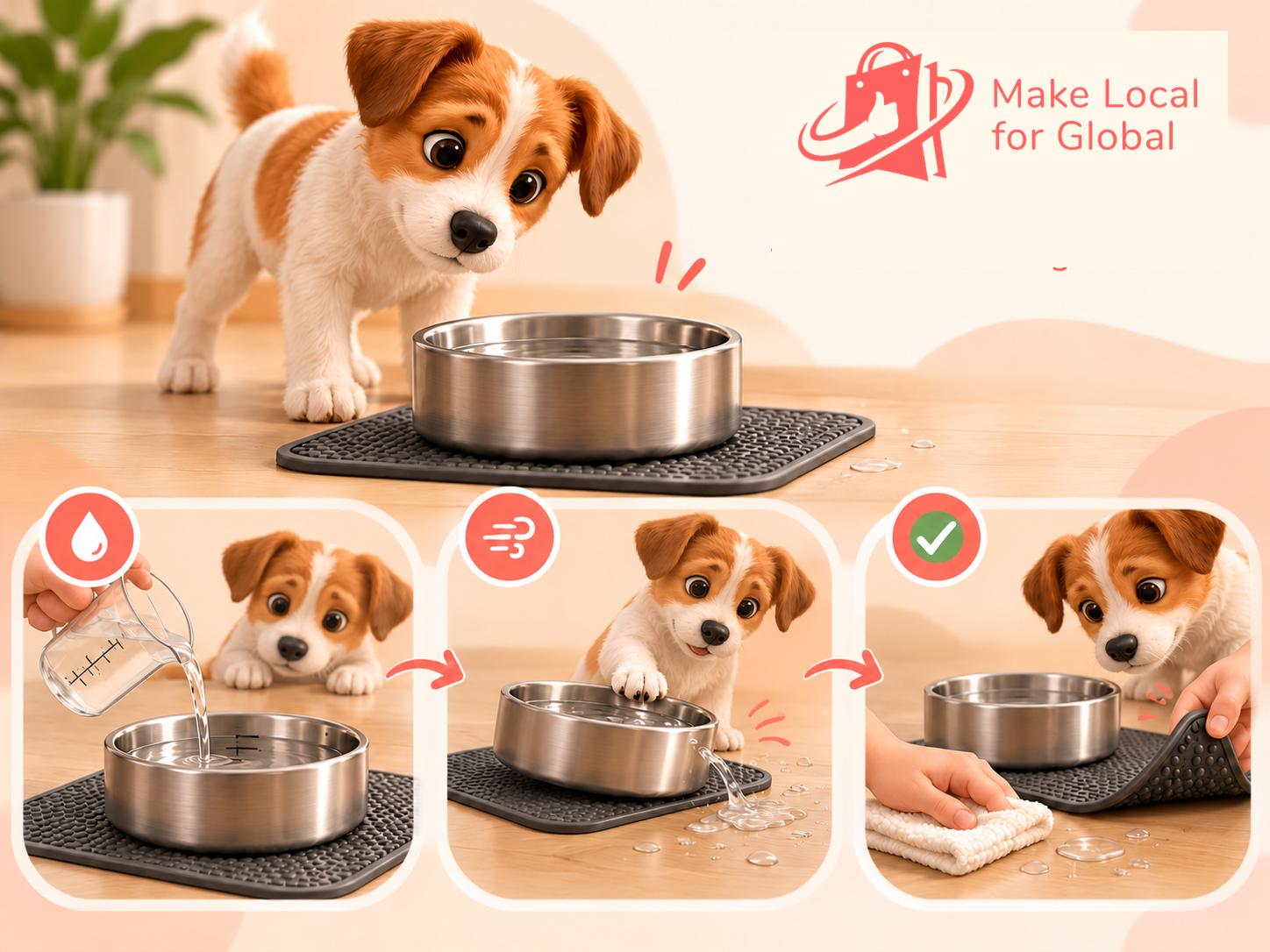
Buyers often ask whether a bowl slides, tips or splashes. Test the base on a few clean surfaces, with the bowl empty and filled to a stated level. Record the surface, fill level, direction of force and result. A quick push on one kitchen floor does not show how the bowl behaves on every floor or with every dog.
For a bowl-and-mat set, check whether the bowl stays in place on the mat and whether the mat itself moves. Measure the overlap, raised edge and area around the bowl. If you photograph a spill test, explain that it is a sample demonstration under those conditions, not a guarantee that no water will spill in use.
Avoid vague terms such as “non-slip” unless you can explain the feature and support the claim. A rubber ring may help reduce movement on a particular surface; it does not lock a bowl in place. Describe the construction precisely and make the limitation easy to see before purchase.
Cleaning is part of daily use, so ask for exact care instructions before ordering stock. Can the bowl be hand washed only? Can a rubber base be removed? Does a silicone bowl need to be opened fully to dry? Does a ceramic finish require a particular handling method? Put supplier instructions in a saved product record and include the correct version in the box and online listing.
Do not infer dishwasher suitability from the material name or a similar-looking product. Heat, detergent, coatings, attached rings and printed designs can change the instructions. If the supplier’s documentation is unclear, ask for a written answer or avoid making a dishwasher claim.
Use “food-grade”, “BPA-free”, “antibacterial”, “non-toxic”, “stain resistant” and similar statements only when you can substantiate the precise claim for the specific bowl and sales market. Do not reuse a supplier image that carries a certification or claim you cannot verify. Keep dated supplier specifications, test reports, packaging copy and a record of where each statement appears.
Dog bowls are used with water or pet food, but the legal status of a product and its materials can depend on how it is made, marketed and placed on a particular market. Do not assume that requirements for human kitchenware automatically answer the question for an animal bowl. Check with a qualified adviser or the relevant enforcement body for the product and territory you intend to sell into. Northern Ireland and Great Britain can have different arrangements for some product rules.
In Great Britain, the General Product Safety Regulations 2005 set the general safety framework for consumer products. Northern Ireland applies the EU General Product Safety Regulation from 13 December 2024. The Office for Product Safety and Standards says businesses that make, import, distribute or sell consumer products must make sure the product is safe and follow applicable labelling requirements. Check the current official GOV.UK product safety advice for businesses before deciding which duties apply to your role.
If you manufacture or import, keep records that identify the supplier, batch or product reference, material specification, safety information and any relevant assessment. If you distribute, retain purchase and traceability records and pass on material safety information. The exact duties depend on the product and your place in the supply chain. The manufacturer and importer guidance describes technical records, labelling and safe-use information.
Set up a complaint log before launch. Record the item code, batch, issue, photo, date, customer contact and action taken. If a pattern appears, pause sales of the affected batch while you investigate. The GOV.UK guidance explains how businesses should report risks and work with Trading Standards or the relevant Northern Ireland authority. Product liability insurance may be worth discussing with a broker, especially if you import or private-label the bowl.
Check that the product and packaging show the correct supplier or business information where required, use understandable care instructions and do not create misleading impressions about capacity, material or performance. The official product labelling guidance says labels must not mislead about the material, size, origin or what the product can do. Ask Trading Standards for help if the rule for your exact product is unclear.
If a bowl is intended to contact food or water, ask a qualified product-compliance adviser to confirm whether food-contact rules apply to that item and market. The Food Standards Agency publishes information on food contact materials, and Northern Ireland has separate alignment considerations. Keep the claim narrow: do not present a general human-food-contact document as proof for every pet-bowl claim or market.
List every cost that changes when one order is placed. Include the bowl, inbound freight and duty if applicable, packaging, payment or marketplace fees, pick-and-pack time, customer delivery, breakage or return allowance and customer-acquisition spend. Then compare the amount left with fixed overhead, tax obligations and your own pay. Contribution is not net profit.
Here is an illustrative example for one medium stainless bowl sold through an online shop. The figures below are hypothetical, exclude VAT and do not represent a supplier quote or a market average. Replace them with current costs from your own supplier and carrier. The customer price is £24.00.
| Cost item | Illustrative amount | Working note |
|---|---|---|
| Bowl purchase cost | £6.80 | Supplier invoice for one unit |
| Inbound freight and duty allocation | £1.10 | Allocated per unit across the shipment |
| Protective pack and insert | £1.35 | Carton, cushioning and care card |
| Payment or channel fee | £0.95 | Illustrative fee, check your provider rate |
| Tracked customer delivery | £3.60 | Use a current quote for parcel dimensions |
| Returns and damage allowance | £1.20 | Planning reserve, not a guaranteed loss |
| Customer acquisition allocation | £2.00 | Illustrative average for the campaign period |
| Total variable cost | £17.00 | Add the amounts above |
| Contribution before overhead and tax | £7.00 | £24.00 less £17.00 |
Illustration only. VAT is excluded throughout; confirm your own VAT position and compare like with like. The £7 contribution does not include rent, software, wages, income or corporation tax, refunds beyond the allowance or owner drawings.
Run a second version of the example with a heavy ceramic bowl. Weigh the packed parcel and check a carrier price before setting a free-delivery threshold. A broken item can erase the contribution on several good orders, so test packaging and claims procedures before increasing sales volume.
Check whether free delivery, a two-bowl bundle or a mat-and-bowl set still works after fees, additional packing and the risk of a partial return. Do not use a percentage markup as your only pricing method. Work backwards from the likely selling price and your minimum contribution, then test whether customers respond to the offer.
A single bowl is the clearest starting product. Add a set only where it solves a real use case and the contents are obvious. A home bowl with a matching mat might reduce splashes around one feeding area. A travel bowl paired with a clip may help carry an empty bowl. Do not bundle an accessory that has different safety or care requirements without checking those details separately.
For each set, list every included part, quantity, material, size and care instruction. Show the total price against the items bought separately only if the separate prices are genuine and current. A “starter set” should not imply that a customer has everything needed if a mat, stand or travel clip is sold separately.
Set a policy for partial returns before you promote a bundle. If a buyer returns the bowl but keeps the mat, explain what happens to the refund under applicable law and your terms. Avoid making returns more confusing than the product is worth to buy.
Start with a product title that identifies the type, capacity or dimensions and a substantiated feature. For example: “Stainless Steel Dog Water Bowl, 1.2 L, Removable Rubber Base” works better than “Pawfect Premium Bowl”. Use the capacity only if it matches your measurement method, and say whether the base is included and removable.
Write the opening description for a buyer comparing bowls: state the intended use, size, material and what is included. Then add a clear specification list with usable capacity, inner diameter, outer diameter, height, empty weight, finish, base construction and care. Keep the same facts in the product attributes, photographs, shipping calculation and packaging insert.
Avoid phrases like “perfect for all dogs”, “spill proof”, “indestructible” or “guaranteed hygiene”. Replace them with checkable facts: measured capacity, tested base type, packaging contents and written care directions. If a feature varies by colour or size, make the distinction clear before the buyer selects an option.
Use a question section for the details that tend to delay orders: Does it include a mat? How much water does it hold to the marked level? Can the base be removed? How should it be washed? What should a buyer do if the bowl arrives chipped? Answers should match your policies and stock, not a generic supplier description.
Use a clean, neutral background and consistent lighting. A front-on product shot makes the shape clear; a side photo shows height; an overhead shot helps compare the opening. A close-up can show a seam, rim or surface finish. For a collapsible bowl, show it both open and folded. Include scale without using a dog as the only size reference.
Photograph the item you actually ship. If a colour differs between batches or a base changes between revisions, update the images and product record before sending orders. Do not add a watermark or badge that implies an approval you do not hold. Use filenames that distinguish product type, material, capacity, view and version, for example `stainless-dog-water-bowl-12l-side-view.jpg`.
For an image showing a sample movement or splash test, note the surface and test conditions in its caption. For a size photo, use the actual listed dimensions. Alt text should describe what is visible and why it helps a buyer, not repeat the same search phrase in every image.
Your own online shop gives you control over detailed specifications, bundles, support and search content, but it requires work to attract visits and maintain checkout. Marketplaces can offer established product discovery yet may restrict certain claims, product images, fee structures or packaging inserts. Check the current rules and charges for each channel before pricing.
Use one stock record as the source of truth. Include item code, material, capacity, supplier, batch, sample approval date, units available, damaged units, reorder lead time and location in storage. If you sell across more than one channel, update the same inventory promptly after a sale or reservation. A simple sheet can work for a small test if every person handling orders follows it.
Decide a reorder point using lead time and recent sales, not the excitement of a first launch. A bowl that sells steadily may still tie up too much cash if its colour options multiply. Reorder the proven size first and wait for evidence before adding another finish or bundled accessory.
A lightweight stainless bowl and a heavy ceramic bowl need different packing. Test the exact bowl, insert, care card and shipping carton together. Record packed dimensions and weight, check whether the bowl moves, and confirm the box can withstand ordinary parcel handling. For breakable bowls, add protection around the rim and sides without letting a hard accessory rub against the glaze.
Calculate delivery from the packed product rather than the bowl alone. A dimensional weight rule or a parcel-size band can change the price. Save the carrier quote, service level, tracking route, insurance limit and any exclusion for ceramic goods. Test the checkout from a phone using a real delivery postcode and review the confirmation message.
Make the dispatch promise realistic. If the item is made to order, say so and give a clear estimate. If stock is low, update the page before a customer pays. If a parcel is delayed or damaged, keep the order, tracking number, packing photo and message history together so you can respond consistently.
For UK consumers buying online, official guidance says they usually have 14 days after receiving goods to tell the seller that they want to cancel, followed by another 14 days to return the item. The customer must be refunded within 14 days after the seller receives the returned goods. Check the current GOV.UK returns and refunds guidance and apply the rules relevant to your business and territory.
Explain what the customer should do if a bowl arrives damaged or the wrong size arrives. Ask them to contact you with the order number and photos of the product and packaging, then tell them what you will do next. A photo request can help investigate a parcel claim; it does not remove the customer’s legal rights.
Inspect returned products with a consistent checklist. Note whether the bowl was used, washed, chipped, missing a base or returned in its original package. Put sound stock back into inventory only after it has been checked. Keep defective stock separate from sellable stock so an item with a sharp edge or damaged coating cannot be sent out again by mistake.
Include the time and cost of returns in your order model. A low-priced bowl can be expensive to return if the buyer pays for a parcel nearly as large as the product. Clear dimensions, close-up photographs and an honest product description help a customer decide before ordering; they do not remove the need for a fair returns process.
Work through your product page, customer questions and delivery information before you commit to a larger bowl order.
Use search and social content to answer real questions about capacity, cleaning, travel, stable placement and parcel size. A useful short video can show a bowl being opened, measured or packed. A comparison page can explain differences among steel, ceramic and flexible travel bowls without claiming that one material is best for every dog.
Test customer acquisition with a small, defined budget and a single product page. Track impressions, visits, product-detail engagement, basket adds, completed orders, contribution and questions. If people visit but do not understand the size, improve the measurements and images. If baskets fail at delivery price, test a packed-parcel quote and communicate it earlier.
Ask local dog trainers, walkers or community groups whether the sample and description make sense, but do not imply endorsement without permission. Do not offer a benefit in exchange for a positive review. Keep feedback separate from verified product testing, and update the page when a recurring question points to missing information.
Set a stop rule for a campaign. For example, pause if the cost of acquiring an order is greater than your contribution after delivery, or if product questions reveal that the supplier evidence is not strong enough for the promised claim. A stop rule protects cash and makes the next test easier to interpret.
Choose one main phrase for this seller guide: “sell dog water bowls online”. Product pages should target the exact item a customer can buy, such as a measured stainless bowl with a removable base or a collapsible travel bowl with a stated capacity. Keep the article focused on seller decisions; do not turn every heading into a repeated keyword.
Write a distinct product title and meta description for each page. Add the material, capacity, key dimension and verified feature where they help someone choose. Include a plain summary near the top, descriptive headings, useful internal links and images with informative alt text. A search snippet may change, and no metadata choice guarantees a ranking or a click.
Support product pages with content that solves specific buyer questions: how to measure a bowl opening, how to compare a collapsible bowl with a home bowl, how to clean a particular model, or how to pack a ceramic bowl for delivery. Link from each help page to the product it describes and back to the relevant care or returns information. Do not publish a generic article that competes with the product page for the same intent.
Check the search terms arriving in Search Console once the pages have data. If the same page is appearing for an unexpected phrase, review its title, copy and internal links before creating a second URL. Keep descriptions accurate and varied; a genuine product difference gives you a reason to use different copy.
For wider context, connect this topic to related guides such as selling dog harnesses online, choosing and costing dog carriers and selling dog tags online. Use a link where it helps the reader plan a related product, not just to insert another keyword.
Choose one buyer and use case, write the offer sentence and list the three product details a buyer needs before choosing. Interview at least five people who fit the buyer description. Record their current bowl type, size confusion, cleaning questions and delivery expectations. Treat the conversations as directional evidence rather than a sales forecast.
Shortlist suppliers and request sample costs, minimum order, lead time, material details, care instructions, test documents, batch traceability and defect terms. Compare the total landed cost for a small order. Do not approve a production run while a key material or care question remains unanswered.
Measure the sample, record its finish and base, test stability on selected surfaces, follow cleaning instructions and pack it for a test parcel. Take photographs and note each pass, fail or unresolved point. Ask the supplier to explain any mismatch with the specification before you accept the sample.
Build the order-cost sheet for each model and size. Include product cost, freight, duty, pack, fee, delivery, return allowance and acquisition cost. Run a scenario with a damaged ceramic parcel or a discounted travel bowl. Set a maximum stock investment and leave cash for refunds and replenishment.
Photograph the actual sample and write the specifications, capacity method, care instructions and limits. Check the product page on a phone. Confirm the price, stock count, delivery charge, dispatch promise and return route. Create a simple pick-and-pack checklist that identifies the correct bowl, base and included parts.
Place a test order through your own checkout or chosen channel. Check whether the confirmation includes the right product and dispatch information, whether the carrier quote matches the packed parcel, and whether a damaged-bowl message has a clear response. Save the evidence and correct the gaps before accepting sales.
Launch a small quantity or a limited campaign. Review views, product-detail engagement, questions, orders, contribution and returns each week. If buyers ask repeatedly about volume, make the capacity image clearer. If the packed bowl is expensive to ship, revisit the offer and shipping model before buying more stock.
At day 30, choose one action: continue with the same product, change one feature, add one size supported by buyer questions, or pause and protect remaining cash. Write down what evidence informed the decision. That record is more useful than ordering a new colour because it looks attractive in a catalogue.
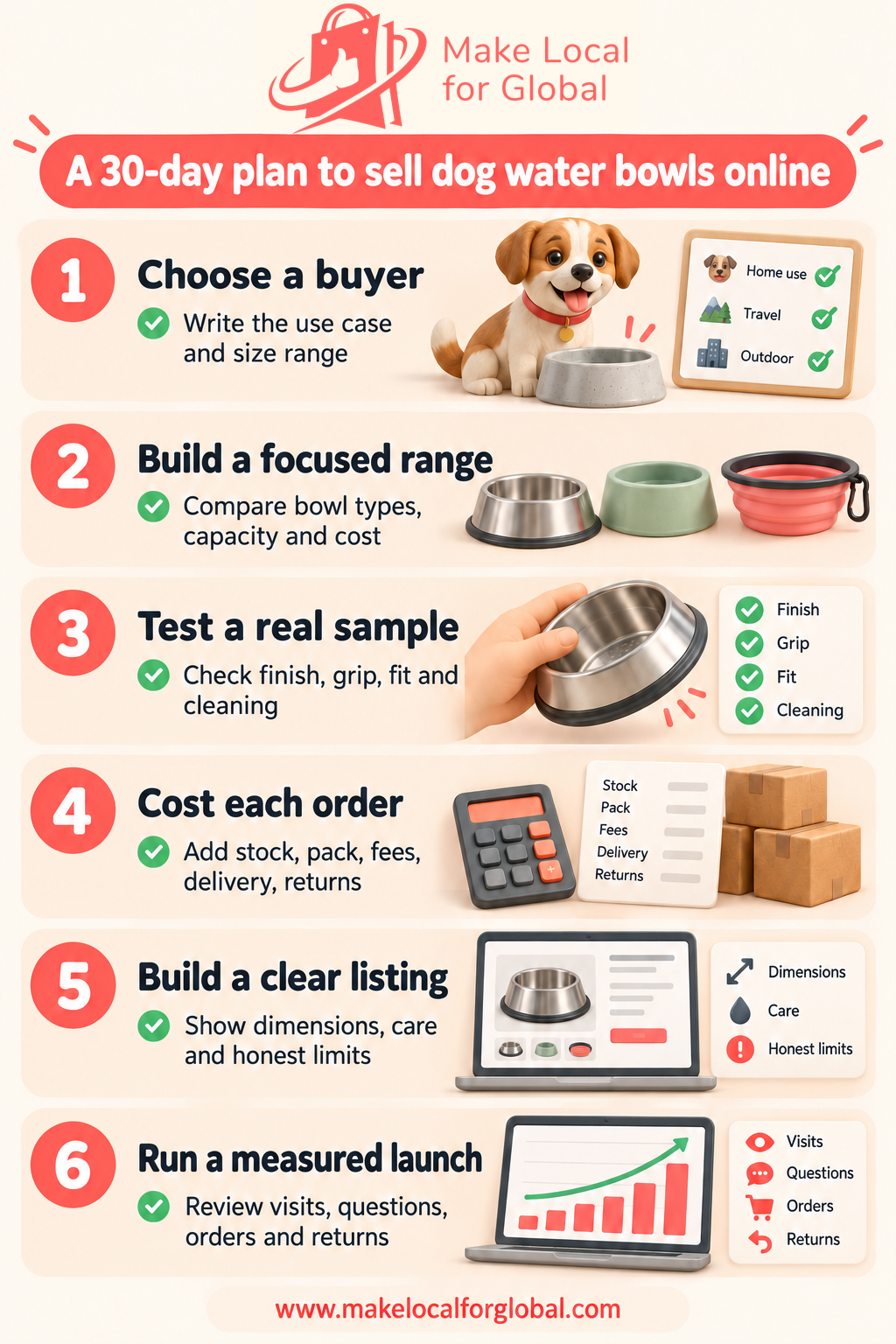
Choose a type for one buyer and use case, such as a measured stainless bowl for a regular home feeding area or a collapsible bowl for travel. Order a sample, verify its dimensions and care information, then compare the complete order cost before choosing stock.
Measure usable capacity with a repeatable fill level below the rim, then record the inner diameter and depth. Explain the measurement method. If you suggest a use by dog size or weight, support it with the supplier’s tested guidance or your own documented assessment and avoid veterinary claims.
Not for every buyer. Compare weight, cleaning instructions, travel use, breakage risk, base construction, finish and the evidence for any material claim. The best first offer is the one you can verify, describe accurately and deliver at a workable cost.
Use only claims you can substantiate for the exact bowl and conditions. A rubber base may reduce movement on a tested surface; it does not prove the bowl cannot move or spill in every home. Describe the feature and explain what you tested.
Ask for material specifications, measured capacity and dimensions, sample availability, cleaning instructions, support for product claims, minimum order, batch identification, lead time, freight terms, defect handling and replacement terms. Keep the answers in writing and compare suppliers using the same questions.
Consumer product-safety rules apply according to the product and your role in the supply chain. Check current official guidance for Great Britain or Northern Ireland, keep supplier and traceability records, and ask a qualified adviser about any material or food-contact question for the exact bowl and market.
There is no single start-up cost. Add samples, minimum order, inbound freight, duty, packaging, storage, insurance, website or marketplace fees, delivery, returns reserve and marketing. Use current supplier and carrier quotes, then start with a quantity your cash can support if sales take longer than expected.
UK distance-selling rules usually give consumers 14 days after receipt to notify the seller they want to cancel, followed by another 14 days to send goods back. Check the current official guidance for your business and location, and explain the process and exceptions accurately before checkout.
If your first bowl range, costs and fulfilment plan are taking shape, talk with Make Local for Global about your ecommerce website needs.
PREFERRED SOURCE
Like what you’re reading? Add Make Local for Global as a preferred source on Google to see more of our articles when you search.

Build your online presence without having to figure out everything yourself.