

READY TO SELL Doughnut Makers ONLINE?
Get a store built for you in 5 days, plus training and support to help you start, run, and grow your Alternative business.

Learn how to choose, check and price doughnut makers for an online shop, from supplier documents and sample tests to product pages, parcel costs and returns.


A countertop doughnut maker looks simple in a catalogue. For a buyer, the decision depends on batch size, cavity dimensions, heating, cleaning, safe electrical details and whether the appliance will fit in a cupboard. For a seller, those same details determine which samples to request, how to price a parcel and what claims the product page can support.
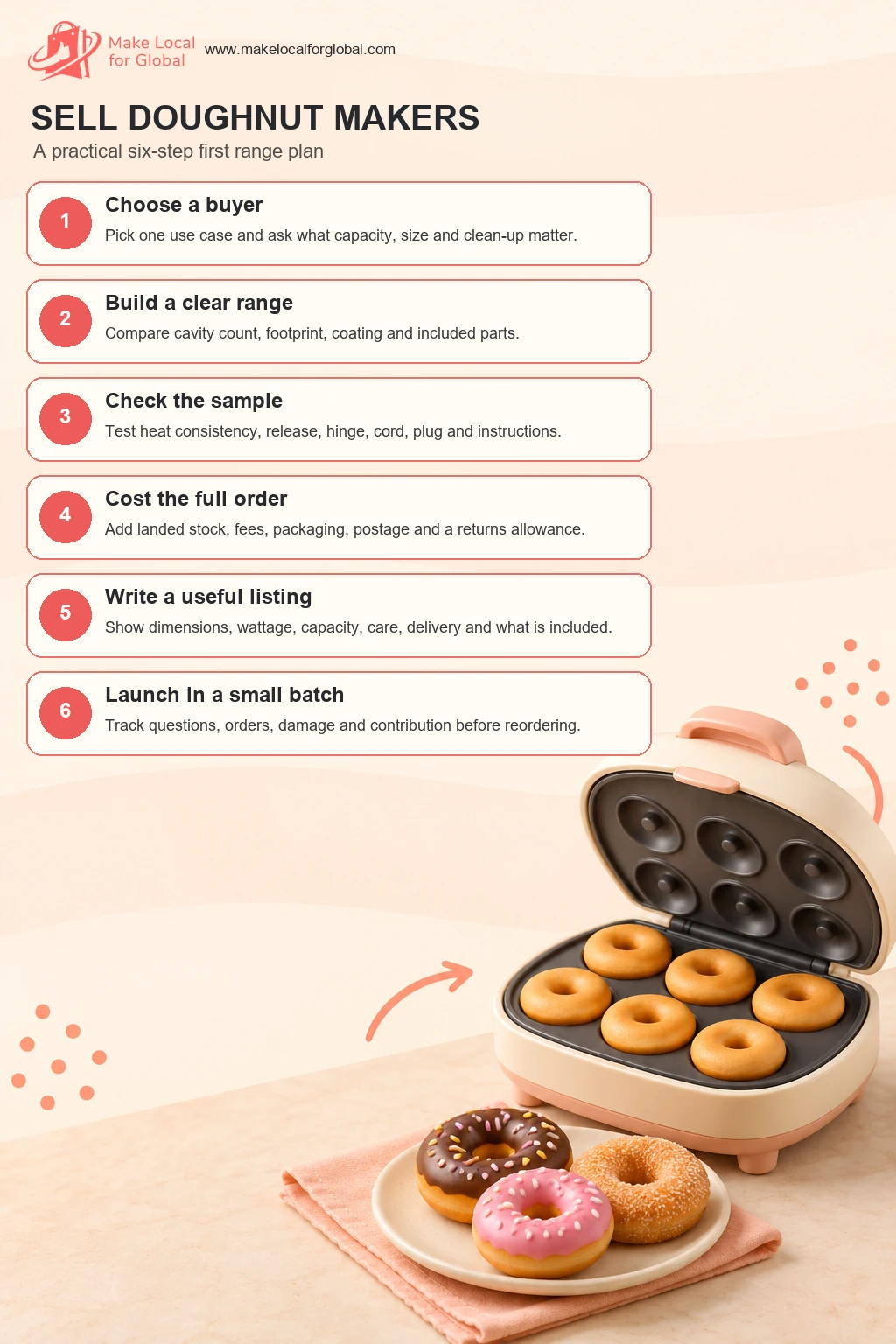
If you want to sell doughnut makers online, start with a specific customer and use case. Compare a small number of machines, obtain model-specific safety and food-contact information, test a physical sample under the maker’s instructions, and calculate the full cost of one delivered order before buying stock. A focused first range is easier to check and explain than a page full of near-identical variants.
Present a focused range with clear specifications, delivery information and a working route to checkout.
“People who like doughnuts” is too broad to guide a first order. A parent may want a quick weekend activity and enough cavities for a family. A student may need a low-cost appliance that fits on a narrow shelf. A keen home baker may care more about repeatable heat and cavity shape. A gift buyer may need a clear box list, suitable finish and delivery date. Each buyer creates a different specification and product story.
Write a testable buyer statement, such as: “I want to help people with small kitchens make a few ring-shaped treats without storing a large appliance.” This points to questions you can measure: external footprint, cord storage, appliance height, cupboard clearance and portion size. If you serve a larger household, ask how many batches the customer is willing to cook and whether the machine returns to temperature between batches.
Talk with potential buyers before you choose stock. Ask what they use now, how often they would make a batch, what would make clean-up frustrating, and where the appliance would be stored. Ask them to measure a counter or shelf. Keep their actual phrases and note repeated questions. Compliments are pleasant, but requests for exact dimensions, a delivery estimate or a comparison of two capacities give you more to investigate.
Treat the conversations as discovery, not proof of a market. A small sample can expose poor fit or a missing feature, but it cannot predict sales at scale. Look for low-cost next steps such as a sample demonstration, a waitlist with transparent terms or a limited launch quantity. Do not collect payment for an item you cannot supply by a date you have explained.
List the five questions a buyer asks before ordering. For a countertop appliance these may be: how many cavities does it have; how wide are they; how much counter space does it take; what plug and voltage does it use; and how is the plate cleaned? Let those questions shape supplier checks, photographs and the page structure. Avoid guessing at the answer when a model document or test is needed.
Doughnut makers vary in cavity count, cavity shape and depth, rated power, temperature control, indicator lights, hinge, cord storage, plate construction and supplied accessories. A name such as “mini doughnut maker” does not guarantee a standard portion or equal cooking behaviour. Compare measurements and sample results, not just catalogue titles.

A first range might offer one compact appliance, one model with a meaningful capacity or control difference, and a bundle only if it solves a real customer need. Every variant adds photography, product data, stock records, supplier checks and packing decisions. Begin with the smallest range that can test your buyer hypothesis. Add colours or accessories when customers ask for them and the cost model still works.
| Offer role | Possible choice | Evidence to gather |
|---|---|---|
| Compact starter | Fewer cavities and simple controls | Footprint, batch size, storage and clean-up |
| Higher-capacity model | More or larger cavities | Cavity measurements, cycle time and repeat-batch results |
| Gift bundle | Appliance with verified utensils or booklet | Exact contents, compatibility, packed size and added cost |
| Spare or accessory | Only model-approved replacement part | Fit, supplier support and whether it is sold separately |
These are range-planning examples. Confirm all details for the exact product.
Create a comparison sheet before you request final quotations. Include supplier and model code, cavity count, internal measurements, overall dimensions, net and packed weight, wattage, voltage, controls, cord, plug, coating description, care, warranty, carton dimensions and box contents. Mark each entry as documented, sample-checked, supplier-stated or unresolved. This record helps keep the web listing, picking process and customer reply consistent.
Use shopper-facing names that distinguish the products, for example “Compact 4-Cavity Doughnut Maker” and “6-Cavity Adjustable Doughnut Maker”, only when those facts are correct. Keep SKU codes separate. Show colour, capacity and included parts beside the selected price. A photo with six cavities can make a four-cavity variant look misleading if the customer cannot tell which model is selected.
The cooking plate may be described as non-stick, ceramic-coated, PTFE-coated or simply coated. Those phrases are not interchangeable and should not be inferred from colour or supplier photographs. Ask what materials contact batter, how the coating is identified, which tools are allowed, and how it should be cleaned. Request documents that apply to the precise model and any included utensil.
Food-contact materials are controlled to limit the transfer of substances into food. The Food Standards Agency’s food-contact materials guidance is a starting point for checking the rules and responsibilities. Requirements may differ between the UK nations. For imported appliances, ask the manufacturer and importer for the relevant declarations or test information, then seek competent advice if a document does not cover the model or the market you plan to serve.
Be precise with product claims. “Dishwasher safe”, “PFOA-free”, “food safe”, “scratch resistant” and “easy to clean” each create a specific expectation. Ask for evidence; do not repeat claims copied from another seller. If the maker’s instructions say to wipe the plates with a damp cloth after cooling, state that rather than implying the appliance can be submerged or put in a dishwasher.
Treat accessories as separate food-contact components. A batter dispenser, brush or pair of tongs may have its own materials and care information. If the appliance bundle includes several items, make sure the supplier’s documents and your listing describe the same pieces. Do not imply an accessory is included when it is only a styling prop.
Save product specifications, supplier statements, manuals, test results, model photographs and correspondence with the SKU record. Note the date and source of each claim. When a supplier changes a coating, mould or factory, ask whether the documents and sample must be reviewed again. An old document for a similar looking model is not a reliable substitute.
A doughnut maker is a mains electrical appliance. If you sell in Great Britain or Northern Ireland, identify which rules apply to the product and your role in the supply chain. The Office for Product Safety and Standards (OPSS) publishes Electrical Equipment (Safety) Regulations 2016 guidance. Requirements and conformity routes can differ between Great Britain and Northern Ireland, so do not assume one market’s paperwork covers the other.
Ask the supplier for the exact model’s technical documentation, declaration of conformity where required, rating label, user manual, safety warnings, traceability details and manufacturer identity. If you import the appliance, your responsibilities differ from those of a retailer buying from a UK distributor. Establish which business must be named as importer or responsible economic operator and where the contact details must appear. Ask a product-safety specialist when your position is unclear.
Check plug, cable, voltage and rated frequency against the destination market. A UK customer should not receive an appliance requiring an improvised adapter or an undocumented plug change. Do not replace a fuse, wire, label or plug to make an unsuitable product appear ready for sale. Confirm that operating instructions and warnings are legible in the required language.
Inspect the sample for cracked housing, exposed conductors, loose screws, unstable feet, a stiff or pinching hinge, damaged strain relief and missing labels. Test only as the maker instructs. Keep supplier, model, batch and customer records so affected stock can be traced. If an appliance is suspected to be unsafe, pause sales while you investigate and follow appropriate reporting and corrective-action steps.
Do not label an appliance “child safe”, “cool touch”, “overheat proof” or “safe for unsupervised use” without evidence for the exact claim. A warm handle or exposed hot plate can cause burns. Explain the maker’s stated precautions clearly. A short disclaimer does not replace safe product selection.
You might source from a domestic wholesaler, manufacturer, importer or specialist distributor. A wholesaler can simplify ordering, but may give you fewer product choices. Direct importing can widen the range and lower a unit quote, but may add minimum quantities, freight, customs, currency risk, documentation and more responsibility. Private-label branding does not remove your duties for the appliance.
Ask each supplier the same questions: Which factory and model are quoted? Which manuals and conformity documents are available? Can you inspect documents before ordering? What is the minimum quantity by model or colour? How are defective units replaced? What is the lead time for samples and replenishment? How are changes to cord, coating, mould or packaging communicated? Can you order replacement parts?
Request a written quotation listing currency, validity period, product code, unit price, minimum, packaging, carton quantity, gross weight, delivery terms, production time and payment schedule. Separate product price from freight, customs brokerage, duty, import VAT and delivery into your stock location. For import classification or charges, check the current UK Trade Tariff and consult a customs broker where needed.
Create a supplier scorecard for sample quality, document completeness, communication, lead time, defect resolution, replenishment and landed cost. Treat safety documentation as a gate, not a low-scoring factor that a bargain price can offset. Keep a dated record of the sample you approved and compare production stock against it when units arrive.
Ask what happens if an appliance has a damaged coating, inconsistent heating, broken hinge or missing manual. Get the process and time limits in writing. Clarify whether the supplier needs photographs, batch codes or a returned sample. Set aside cash for replacements and reverse delivery. A low purchase price is poor value if a supplier cannot investigate faults or trace a batch.
Order a physical sample of each model and finish. Keep the packaging, inserts and manual. Photograph the rating plate, plug, cord, hinge, feet, exterior, cavities and cooking surface. Record the date, supplier code and batch marking. Catalogue photos cannot show the texture, assembly, smell, movement or coating condition of the unit you will actually send.
Follow the instructions for initial cleaning, preheating and use. Place the machine on a stable, heat-resistant surface with suitable clearance. Keep the cord away from the hot body and do not leave the appliance unattended. Test controls, indicator lights, hinge, handle, latch if present and feet. Record unevenness or movement rather than deciding informally that it is acceptable.
Prepare a repeatable cooking check with ingredients measured by weight, the same recipe, portion size and cycle approach. Observe preheat time, indicator behaviour, colour, shape, release and differences between cavities. Repeat after the appliance has warmed. A first batch may differ from later ones; buyers need realistic guidance about that behaviour. These notes are seller evaluation, not a laboratory performance or safety test.

After use, disconnect the appliance and allow it to cool as instructed. Clean only by the approved method. Check whether batter collects at plate edges or the hinge. Do not submerge a mains unit, use abrasive cleaners or scrape a coated surface unless the manual permits it. If normal instructed use damages the coating, stop and ask the supplier to investigate.
Inspect the box contents and instructions. Are accessories present and correctly named? Is there protective packing around the hinge and feet? Can the unit move inside the carton? Keep a test record with dated photos, steps, observations, defects and a clear decision: approve, reject or investigate. Compare delivered stock with the approved sample before listing each new batch.
Doughnut makers can be light but bulky. Measure the sample after inserting the manual, accessories and protective inserts. Record the longest side, width, height and total weight. Check whether the appliance shifts in the carton, whether a corner can be pushed through the box, and whether the cord rubs against the coating. Ask whether production cartons will match the sample packaging.
Get carrier prices using the final parcel dimensions. Check surcharges, delivery areas, tracking, compensation, collection fees and failed-delivery handling. A large box can move a light appliance into a costlier size band. If you are considering overseas delivery, confirm the plug, warranty, customs and consumer information for each market before displaying a shipping option.
Protect the lid, cord and plate without excess movement. Keep accessories from scratching the cooking surface. Test the packed unit through your intended delivery service, then inspect the appliance and box. Do not claim that the packaging passed a named drop test unless it was tested to that method. Verify material and disposal claims before calling packaging recyclable.

The figures below are a hypothetical planning example, not a supplier quotation, market average or forecast. Replace each amount with a written quote, current channel schedule or measured parcel cost. Record the tax basis so each row can be compared fairly.
| Per-order item | Illustrative amount | How to confirm it |
|---|---|---|
| Appliance landed at your store | £22.00 | Unit price plus allocated inbound freight and import charges |
| Protective packaging | £2.20 | Carton, inserts, tape and packing materials |
| Tracked parcel | £5.50 | Quote for measured size and destination |
| Channel and payment fees | £4.50 | Fee schedule or channel calculator |
| Returns and damage reserve | £1.50 | Your own expected rate and remedy cost |
| Acquisition spend | £3.00 | Campaign spend divided by attributable orders |
| Variable total | £38.70 | £22 + £2.20 + £5.50 + £4.50 + £1.50 + £3 |
| Illustrative selling price | £54.99 | Test with buyers; apply your tax treatment |
| Contribution before overhead and tax | £16.29 | £54.99 minus £38.70; not net profit |
Illustration only. Tax, fee and cost treatment depend on your business and sales channel.
This contribution still needs to support fixed costs such as insurance, storage, accounting, web hosting, photography and your time. Include sample expenses and unsold stock in the wider buying decision. If VAT registered, keep the model consistent about VAT collected, input VAT and recoverable costs. Get accounting advice where the treatment is unclear.
Etsy’s UK help page currently lists a USD $0.20 listing fee and 6.5% transaction fee on the order amount; payment processing, a regulatory operating fee, advertising charges and applicable taxes may add costs. Review its live fees and taxes schedule before setting a price. Other platforms use different charges. Do not use one marketplace’s fees as a proxy for another.
Try a price sensitivity check: what happens if postage rises by £1, one order in twenty needs a remedy, or acquisition costs double? If the offer only works when every unit sells, no customer returns it and your time is free, revisit the product, channel, bundle or order size. A cost model supports a decision; it cannot show that buyers will pay the price.
Lead with the verified model name and one useful distinction. “Compact six-cavity doughnut maker” is clearer than “Ultimate treat machine” when it accurately describes the item. Add model code and colour in the option selector. Near the price, state what the buyer receives, dispatch timing and delivery cost or the point at which it is calculated.
Include batch capacity, cavity dimensions, outer measurements, appliance weight, rated wattage and voltage, cord length, controls, plate-care instructions, plug type, warranty terms and everything in the box. Use units and measurement points consistently. If cavity size varies between models, show the exact figure for each selection. Explain that finished output can vary with portion size and recipe rather than promising a fixed yield.
Photograph the real sample open, closed, from the side and beside a ruler or familiar kitchen object. Include the label and cooking surface where useful. Show a typical counter so shoppers can judge scale. Clearly identify decorative props, ingredients and optional accessories. Generated illustrations can explain a workflow, but should not stand in for truthful product images of the exact appliance.
Write a short care section that follows the maker’s instructions. If the plate must cool before wiping, say that. If the surface is not removable, explain how the customer can reach it safely. Avoid unsupported terms such as “non-toxic”, “commercial grade”, “professional”, “dishwasher safe” or “perfect results”. Specific, tested facts help buyers decide without overstating what the machine can do.
Search phrases may include “mini doughnut maker”, “six cavity doughnut machine”, “doughnut maker for small kitchens” or a model name. Use natural wording in the title, headings and specification rather than repeating one phrase mechanically. Add a short comparison of capacity, size and care if it answers a genuine buyer question. Do not create a page for every tiny keyword variation; keep the main product page focused on the chosen model.
Write helpful supporting content: a photographed sample test, an appliance-storage measurement, a clear care explanation or a packing walkthrough. Keep recipe advice consistent with the manufacturer’s manual and test it yourself. Do not promise better search placement or traffic. Track what people ask and which content leads to useful visits or orders.
A simple recipe can help customers picture the appliance in use, but a recipe is not proof that every machine behaves alike. If you publish one, test it on the exact sample and state the batch size, portion method and cooking approach. Results can change with ingredient temperature, batter consistency, room conditions and appliance variation. Do not add health or allergen claims without the appropriate evidence and controls.
Check who owns the instruction sheet and recipe text before reusing supplier material. Do not edit or remove safety warnings. A customer still needs the correct manual with the appliance. If a recipe comes from your own test, explain that it is a serving suggestion and follow the maker’s use and cleaning directions.
A bundle should solve a real need, such as providing a measured scoop and cooling rack that fit the customer’s workflow. List each item, quantity and material. Check food-contact details for accessories, confirm whether items are compatible, and state what is not included. Bundle economics must include extra weight, packaging, pick time, separate stock records and breakage risk. A bundle that complicates returns may not add enough value.
A standalone shop lets you control the category structure, product comparisons, help content and customer email journey. You are responsible for attracting visitors and maintaining checkout, policies and service. A marketplace may place your product beside related kitchen items, but its listing rules, fees, payment timing and advertising options affect costs. A local demonstration can help people see size and operation, but event fees, transport and safe setup need planning.
Choose one main channel for the initial test. Check its rules for electrical products, required documents, returns, warranties and product claims. Keep the inventory count accurate. If you cross-list, synchronise stock or reserve enough units to prevent overselling. Maintain one master product record and adapt it for each platform rather than copying mismatched specifications.
Prepare standard answers about cavity count, plug, care, manual, delivery, warranty and contents. Identify who handles technical faults and how you can obtain a manufacturer response. Do not promise repair, spare parts or warranty duration before confirming the process. Keep customer information private and use only what is needed to resolve the order.
Content should demonstrate one decision at a time: how wide the appliance is, what arrives in the box, how a sample releases after cooling or how to measure a cupboard shelf. Keep videos faithful to a real unit. For related kitchen-selling ideas, link readers naturally to selling artisan bread online, building a kitchen-textile range and selling barbecue tools online. Each page should answer its own product question.
A focused shop can present the model, its specifications and the order details in one place.
Before taking an order, provide the information required for online and distance sales, including business contact details, product description, full price and taxes, payment methods, delivery arrangements, costs and cancellation information. Read current GOV.UK online and distance-selling guidance. Rules for international sales can differ, and Northern Ireland may have distinct product requirements.
Online customers have cancellation rights for many distance purchases, and faulty or misdescribed goods raise separate remedies. The government’s returns and refunds guidance explains key consumer rights. Avoid a blanket “no returns” statement. Set out the cancellation process in plain language and check the current rules for the customer’s location and product situation.
Create a fault-response checklist. Ask for order number, model, batch markings and a description of the problem. Do not ask a customer to open, rewire or repair a mains appliance. If a report involves shock, smoke, overheating, damaged cable or exposed parts, tell the customer to stop using it and follow the appropriate safety process. Preserve records and contact the supplier or competent adviser when required.
When stock arrives, inspect carton condition and a suitable sample against the approved unit. Count appliances and accessories, check model labels and record damage. Keep suspect units out of sale until resolved. A small check at receiving can prevent an incorrect model or damaged batch from reaching customers.
Set a spending limit and a review date before the experiment begins. A first-month plan cannot guarantee sales. It helps you gather information about product fit, paperwork, parcel costs and customer questions before committing further cash.
| Period | Work | Evidence to keep |
|---|---|---|
| Days 1–5 | Speak with possible buyers and measure kitchen-space needs | Repeated questions, storage dimensions, preferred batch size |
| Days 6–10 | Request supplier quotes and product documents | Model-specific records, terms, lead times |
| Days 11–15 | Inspect and test sample; measure packed parcel | Test log, photos, dimensions and weight |
| Days 16–20 | Calculate complete order costs and price range | Fee assumptions, carrier quote, contribution model |
| Days 21–25 | Prepare product listing, policies and support answers | Approved facts, photos, care, delivery and returns text |
| Days 26–30 | Offer limited stock and review customer response | Visits, questions, orders, faults, delivery and returns |
Planning example. Allow more time if supplier documents or freight need follow-up.
At each checkpoint, list what is unknown. If the coating is undocumented, omit coating claims. If the parcel quote is based on a smaller carton, do not use it in the price calculation. If the manual is missing, obtain it before taking orders. A pause to confirm facts is better than a listing built on assumptions that can harm a customer or your business.
Track relevant product-page visits, add-to-basket actions, completed orders, delivered price, contribution, dispatch time, questions, cancellations, faults and damage. Record available stock and traffic source. A page with very few suitable visitors tells you something different from a page with many views and repeated questions about whether the plug is included.
Use signals as clues. Visits without basket additions may point to mismatch, poor images or unclear dimensions. Basket additions without orders may point to delivery charges, dispatch timing or payment friction. Frequent questions about cavity width indicate that the listing needs better measurements or scale photos. A fault pattern calls for an investigation and may require stopping sales; it is not an advertising problem.
Change one major part of the offer at a time. If you change the main image, price, shipping promise and audience together, you cannot tell which change mattered. Keep a dated log and wait for enough observations to be useful. A small number of orders creates uncertainty, so avoid treating one sale or complaint as a market verdict.
A sale may contribute to a viable business, but the result depends on landed cost, channel fees, shipping, customer acquisition, returns, faults, tax and fixed overheads. Build a per-order calculation from your actual quotes. The difference between a factory price and your selling price is not net profit.
Confirm the exact model, supplier identity, manuals, electrical documents, food-contact information, ratings label, plug suitability, traceability, sample results, minimum order, delivery terms and returns process. Measure the packed carton and calculate a complete order cost. Resolve missing evidence before you commit to a larger quantity.
Begin with one well-tested model or a small pair with a clear distinction such as footprint or cavity count. Each extra colour or option adds stock, photography, product data and picking work. Use customer questions and results from a limited launch to decide whether another model is useful.
Use the description only when it is accurate for the exact appliance and supported by the maker’s documentation. Ask what coating is used and how it should be cleaned. Do not infer coating chemistry or performance from a picture or copy another seller’s description.
Electrical equipment sold in the UK is covered by applicable product-safety requirements. Duties depend on your role as manufacturer, importer, distributor or retailer and on whether you sell in Great Britain or Northern Ireland. Read current OPSS guidance and obtain model-specific records relevant to your role.
State the model, batch capacity, cavity measurements, outer size, weight, voltage, wattage, controls, plug, care, box contents, delivery, warranty and returns. Add photographs of the real sample and identify any props. Explain what the buyer can verify from the specification and what may vary by recipe.
A private label does not remove supply-chain duties. Confirm your role, required documentation, traceability, markings, instructions and safety process. A brand or design change may affect the compliance route, so get competent advice before changing the product or its labels.
Show accurate dimensions and box contents, test a sample, measure the finished carton and protect the lid, cord and plate. Set dispatch expectations clearly and provide a practical support process. Accurate care and cooking information helps customers choose a suitable product, but does not remove their legal rights.
A recipe may help explain how to use the product. Test it in the exact model, state the batch size and method, respect the maker’s instructions and avoid unsupported dietary or health claims. Check permissions before copying a supplier’s recipe or manual text.
Review relevant visits, completed orders, contribution, stock time, customer questions, faults, returns and cash position. Confirm that the supplier can repeat the approved model and provide current documents. Reorder when evidence and working capital support the decision, not just because one variant received attention.
Before a larger purchase, record the target buyer, chosen model, supplier, supporting documents, sample results, order quantity, cash at risk and open questions. Keep the quotation, landed-cost calculation, packed parcel measurements, product-page facts, photographs and returns plan together. Set a limit for the first test and a date to review it.
Compare each delivered unit with the approved sample. Update claims only when you have new evidence. After customer questions, improve the product information where the answer is confirmed. After each order, compare actual fees, parcel cost and packing time with the estimate. A small range with a sound process gives you clearer learning than a large order based on assumptions.
For adjacent kitchen products, see our articles on selling artisan bread online and selling kitchen textiles online. Keep the doughnut maker page focused on the appliance, and link between products where a reader is comparing a home-kitchen range.
Once the product, evidence and delivery plan are clear, decide what support will help you present the offer online.
PREFERRED SOURCE
Like what you’re reading? Add Make Local for Global as a preferred source on Google to see more of our articles when you search.

Build your online presence without having to figure out everything yourself.