

READY TO SELL Firewood Racks ONLINE?
Get a store built for you in 5 days, plus training and support to help you start, run, and grow your Alternative business.

Learn how to sell firewood racks online with measured dimensions, tested frames, clear product pages, complete order costs and practical delivery planning.

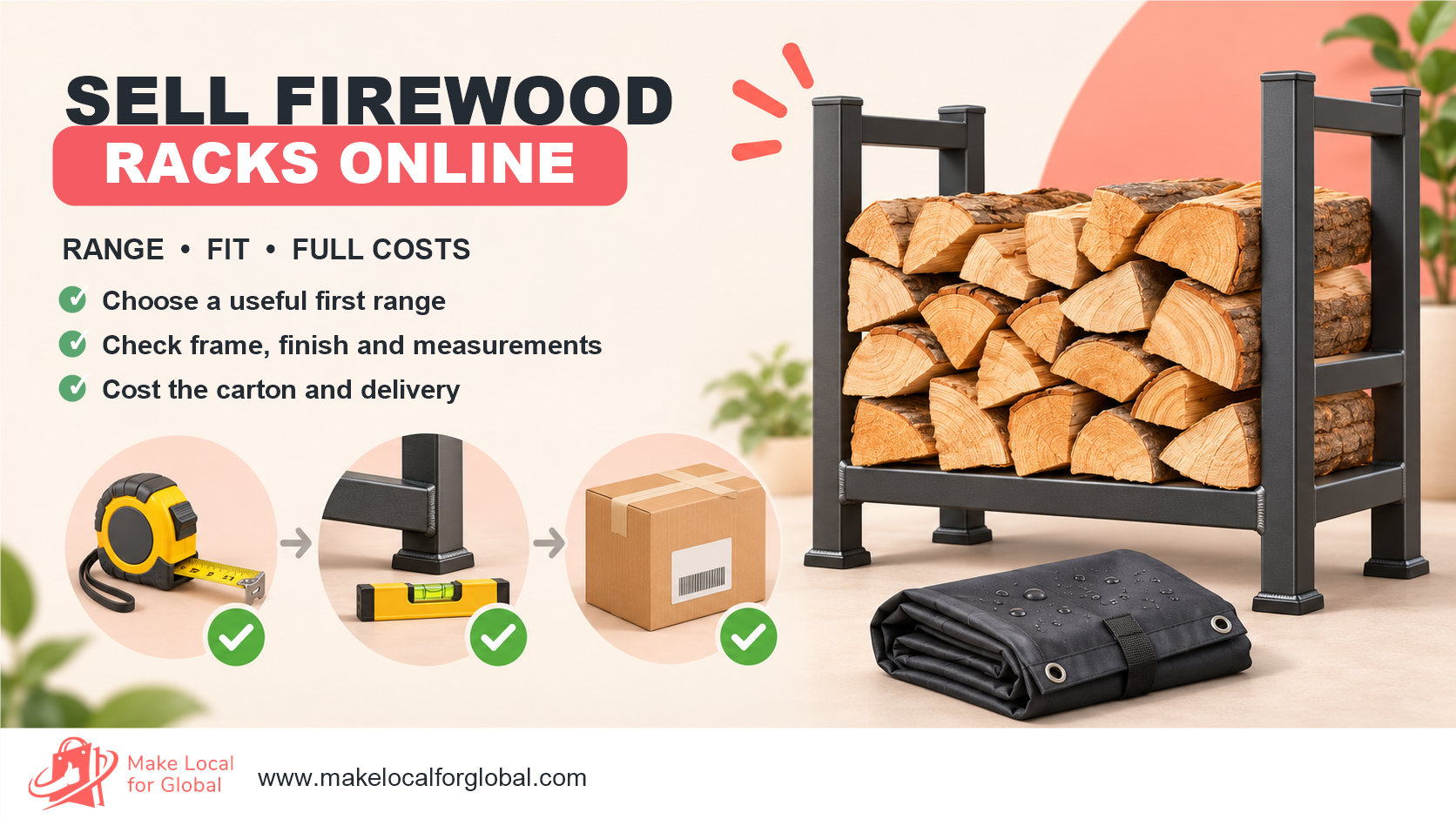
A firewood rack looks like a simple frame, yet the buyer needs to know much more than its colour. Will a chosen log length fit between the uprights? Is the rack intended for a sheltered room, a garden or a covered log store? How much floor space does it take up, how does it assemble, and what will delivery cost for a long, heavy carton?
You can sell firewood racks online by choosing a clear buyer group, testing the rack and finish, recording usable measurements, pricing the packed parcel and writing a product page that shows the frame in use. Start with a small range of formats. Ask suppliers for traceable specifications and proof for any load or weather claim. A rack that looks substantial in a photograph still needs evidence for the promises you publish.
This product can be sold on its own or as part of a home, garden or fireplace collection. The selling challenge sits in the dimensions, weight, finish, stability, assembly and delivery. A clear offer helps a customer decide whether the rack suits their space before ordering. The same information helps you avoid buying a large model that cannot ship profitably or fit the buyer’s logs.
A first range becomes easier to manage when it solves one recognisable storage problem. A compact indoor rack for a few logs beside a stove is very different from a long outdoor rack holding a winter’s supply. The same steel finish or product photo cannot make those products interchangeable.
Start with people you can reach and ask about their existing routine. A homeowner may want logs close to the house without carrying them through a hallway. A small garden may have room for a narrow vertical rack, but no space for a two-metre store. A rural property may need more capacity and a cover. A fireplace shop or firewood retailer could want several racks for display or bundled sale.
Do not assume every buyer owns the same appliance or burns the same log length. Ask what the person stores, where the rack will stand, what access they have for delivery and which problems occur with the current setup. A customer who keeps kindling in baskets may prefer a shelf. Someone carrying logs up steps may care more about stable feet and a manageable height than total volume.
Ask potential customers to describe a recent purchase or storage problem. Useful questions include:
Ask for a tape-measured space or a photo with permission, rather than relying on “quite small” or “plenty of room”. A doorway, path, stair turn or gate can matter as much as the place where the rack will stand. Record the measurements and recurring concerns, then compare them with supplier samples.
A simple test page can describe a proposed rack and collect expressions of interest. Label it clearly as a planned product if you do not hold stock. Do not take payment or promise a delivery date before you can honour it. Track specific actions such as a customer asking for a dimension drawing, requesting a sample finish or confirming a trade quantity. Compliments and social likes alone do not confirm a viable product.
Test one or two product concepts at a time. If a compact indoor rack gets more questions than a large outdoor rack, find out whether buyers want a narrower frame, a second shelf or a different finish. Change one detail at a time so you can tell what made the offer clearer. A pre-order test needs accurate terms, a real delivery estimate and a clear refund process; for a new seller, an interest list may be simpler.
A range needs enough choice to fit the buyer’s needs, yet each extra model creates stock, photography and parcel work. Begin with a small number of products that serve different spaces or storage jobs. Give each option a reason to exist, then remove near-duplicates that only vary by a colour name.
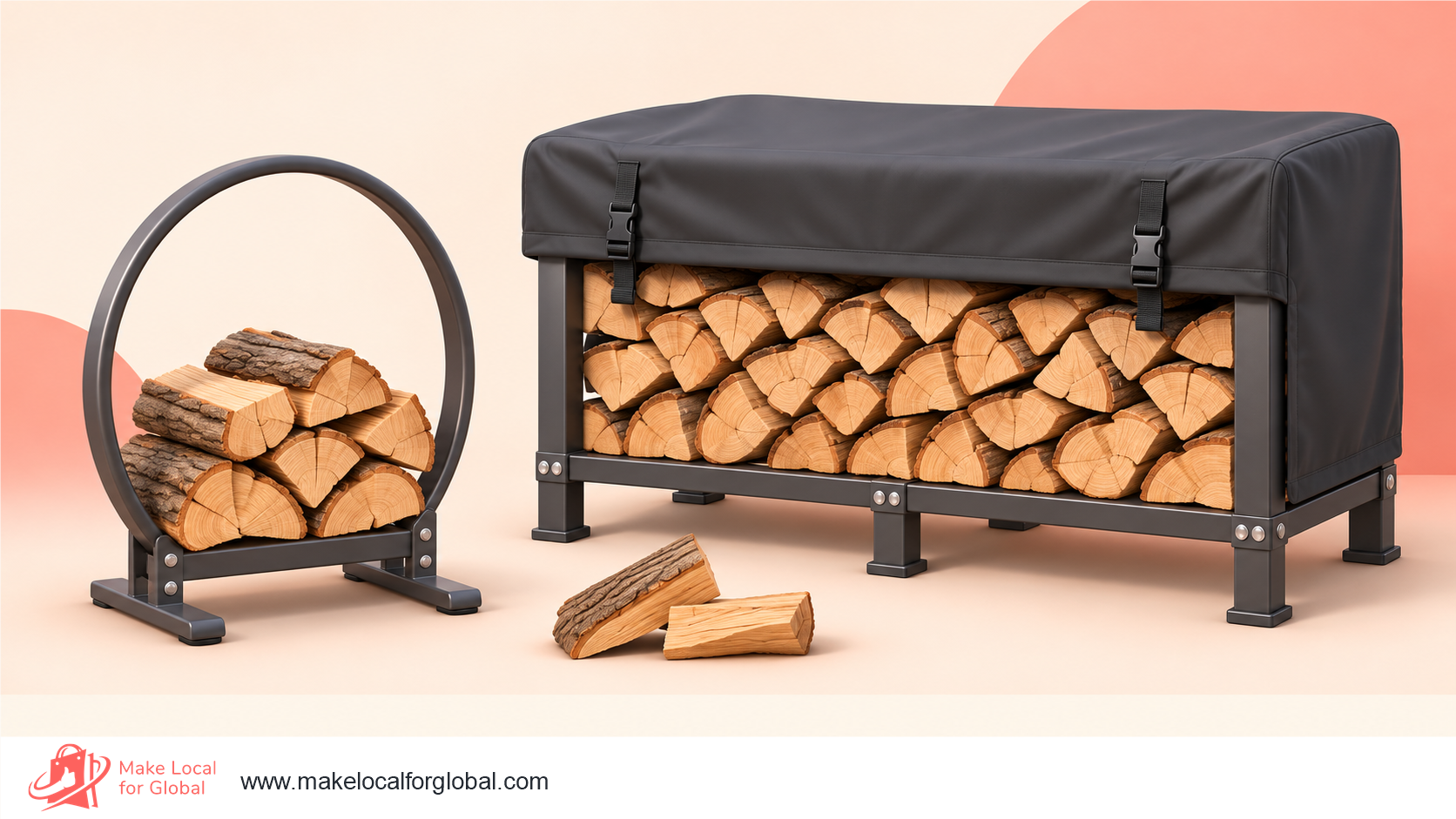
Common rack formats include:
| Format | Best starting use to explore | Questions to answer before listing |
|---|---|---|
| Compact indoor hoop or basket | A small number of logs near a hearth | What is its footprint? Are handles decorative or intended for lifting? Is the coating suited to the stated indoor use? |
| Freestanding open-frame rack | A larger stack in a utility room, shed or sheltered garden | What log length fits? How much usable floor space and clearance does it need? How is it stabilised? |
| Long modular rack | Buyers needing an extended stack | Can sections be added safely? How do connectors affect the assembled dimensions and carton count? |
| Rack with fitted cover | Outdoor storage where a top cover is useful | Which surfaces are covered? How is the cover attached? Does the maker explain airflow and wet-log use? |
| Log store with roof and raised base | Garden storage with shelter and a clear separation from ground moisture | Is it a rack, a full log store, or both? What are the roof, base, fixings and assembly details? |
| Rack with kindling shelf | Buyers who want smaller pieces alongside larger logs | How much space remains for the main stack? Can small pieces fall through the shelf? |
These are product groups, not performance claims. A buyer should be able to tell which form fits a measured space. Check product details from a current sample. Supplier wording can call two very different designs a “log rack”, so use photographs and dimensions to explain what the item actually includes.
Choose whether to focus on steel racks, timber stores or a small mixed range. Steel frames can ship in compact pieces and may assemble with bolts. Timber stores can include a roof and base, yet their cartons may be larger and their assembly more involved. A ready-built product avoids assembly questions but can cost more to store and deliver. These trade-offs need to be checked for the exact supplier and item.
A three-level offer can help buyers compare, provided the levels have a real product difference. An entry rack could be a compact open frame. A core option might add a tested cover or a useful kindling section. A higher-priced choice could use a larger frame, a roofed store or a documented design detail. Do not call an item “heavy duty” or “premium” just to justify a higher price.
One option is a primary rack with a separate cover, rather than a large number of colour combinations. A customer may prefer to replace a cover without buying another frame. Record which cover model fits which rack, how it attaches and what the pack contains. If a shelf or extension is sold separately, show the assembled product with and without it, then state which components are included in each price.
A small set could pair a rack with a matching cover or kindling basket. Keep the extra item useful, compatible and simple to pack. List the contents, fit and limitations of the set. A lower bundle price should still cover each item’s cost, the extra handling and any change in shipping weight or parcel size.
Do not create size names such as “medium” and “large” without putting exact dimensions next to them. A buyer may assume “large” refers to log capacity, total width or overall height. Name the measurement directly. Keep a product code for each rack, cover, colour and hardware set so stock, returns and replacement parts stay connected to the correct version.
Compare buyer needs, rack formats and likely order costs before you commit to stock.
Possible supply routes include a UK metal fabricator, a home and garden wholesaler, a specialist fireplace supplier, a regional steel-products maker or an overseas manufacturer. The right fit depends on order minimums, product records, inspection access, lead time, return handling and the cost of moving a long carton. Compare the landed order cost, not the factory price alone.
Ask suppliers to identify the exact model, material, finish, included parts, country of origin, pack dimensions and weight. For a rack, ask how the joints are formed, whether the frame is welded or bolted, which parts carry the logs, what surface treatment is used and what care instructions apply. Ask for the current assembly sheet and a list of all fixings. If the rack has a stated load limit, request the evidence and the method behind that figure.
If a supplier gives no load rating, do not invent one from a photo or the tube’s apparent thickness. You can still publish measured product dimensions and a clear description of the intended arrangement. Ask the supplier whether they have a tested limit and how it was assessed. If you manufacture the rack or plan to publish a formal load rating, arrange a suitable technical review and test plan for the product’s construction and expected use.
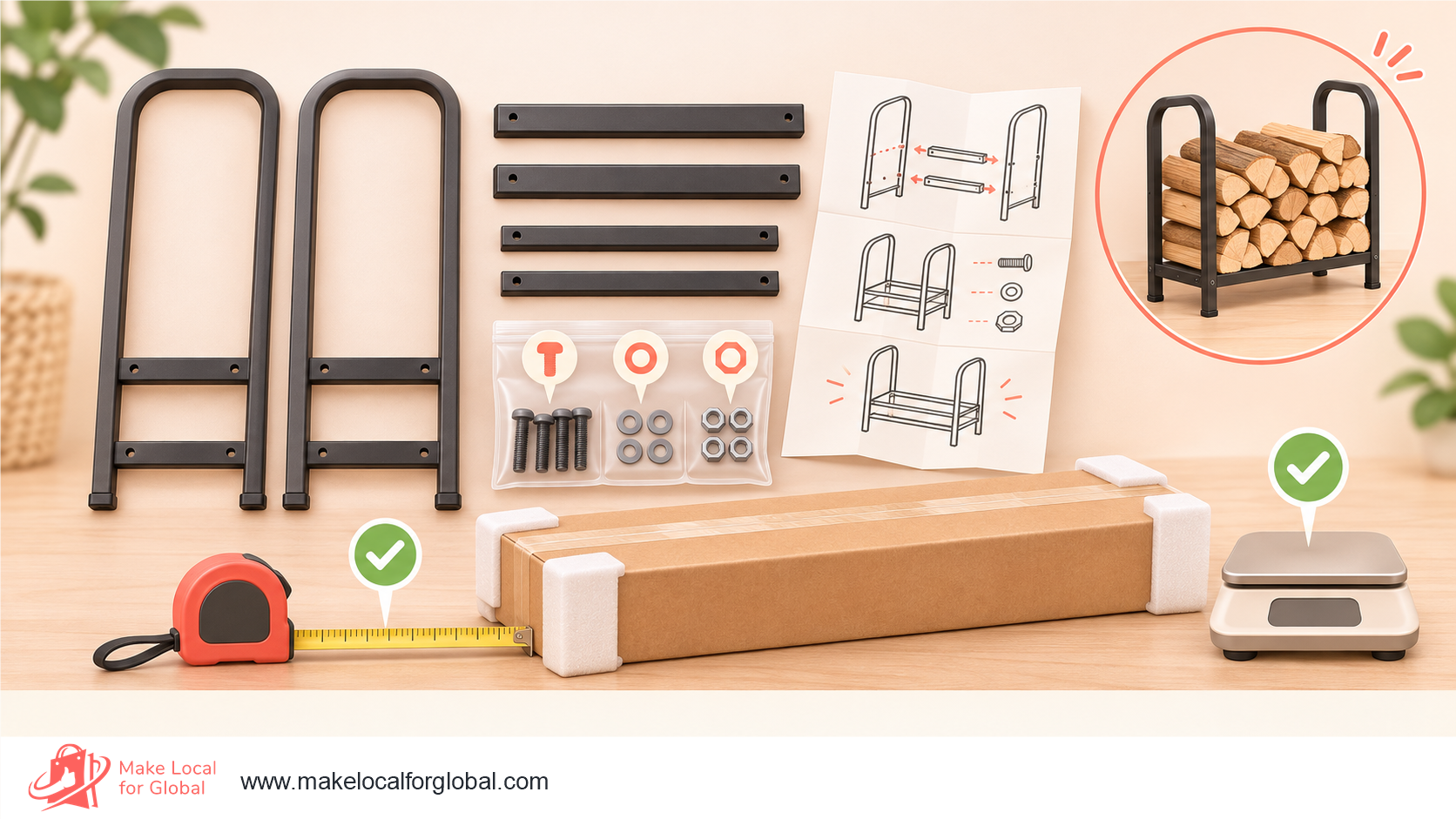
Check whether the price includes a cover, floor bars, wall straps, feet, fasteners, tools, instructions and spare parts. A product photograph may show logs, kindling, a decorative basket or a roof that is not included. Ask for a written bill of materials and verify one sample against it. Record any discrepancy before you approve a larger order.
Request a current quote with the order minimum, sample fee, payment terms, production lead time, dispatch point, carton count, transport charge and procedure for defects. Ask how a repeat order will be identified. A new batch may use a different shade, bolt size or packaging insert even when the model name stays the same. Have the supplier confirm changes in writing and store the response with the product code.
For overseas orders, estimate duties, import VAT, clearance, port or courier fees and delivery from the arrival point to your own storage. Confirm who acts as importer and which party can provide safety and traceability documents. If the quote is in another currency, make a second cost view with a less favourable exchange rate. A rack with a low unit price may become an expensive product after bulky freight and handling.
Order a representative sample from the exact model and finish. Assemble it with the supplied instructions and record how long it takes, which tools are needed, where the parts can be confused and whether the frame sits level. Keep the carton and inserts until you have tried packing it for a return or replacement. A neat sample on a studio floor tells you little about how a customer will receive a damaged corner or missing bolt.
Powder coating, paint, galvanised steel and stainless steel are different material and finish descriptions. None should be casually translated into “rust proof”. Ask for the precise finish and care instruction. Photograph any burr, sharp edge, coating chip, loose weld, misaligned hole or exposed metal. Do not put a questionable sample on sale while the supplier investigates.
A rack may be exposed to changing temperatures, damp, condensation, rain or stored wood that has not dried. Ask whether the cover is for the top only or the full stack, whether it should be removed at any time and how ventilation is intended to work. Do not state that a rack dries logs or makes wood ready to burn unless there is suitable evidence for that product and result. A rack holds stored wood; it does not replace a log store’s roof or the seller’s need to explain the actual design.
Take close photographs of the legs, corners, welds, bolt holes and coating. Keep one image of each incoming sample beside its product code. When a delivery arrives, compare the new unit with the approved sample before adding it to existing stock. A change in the tube profile or assembly holes may affect the way parts fit, even when the new product appears similar at first glance.
Start with the build sheet. Check part names, quantities, hardware and assembly order. Follow the supplied process rather than forcing a bolt or using a power tool that the maker prohibits. An instruction sheet that is unclear or missing a step is a supplier issue to resolve before you ship the item to a customer.
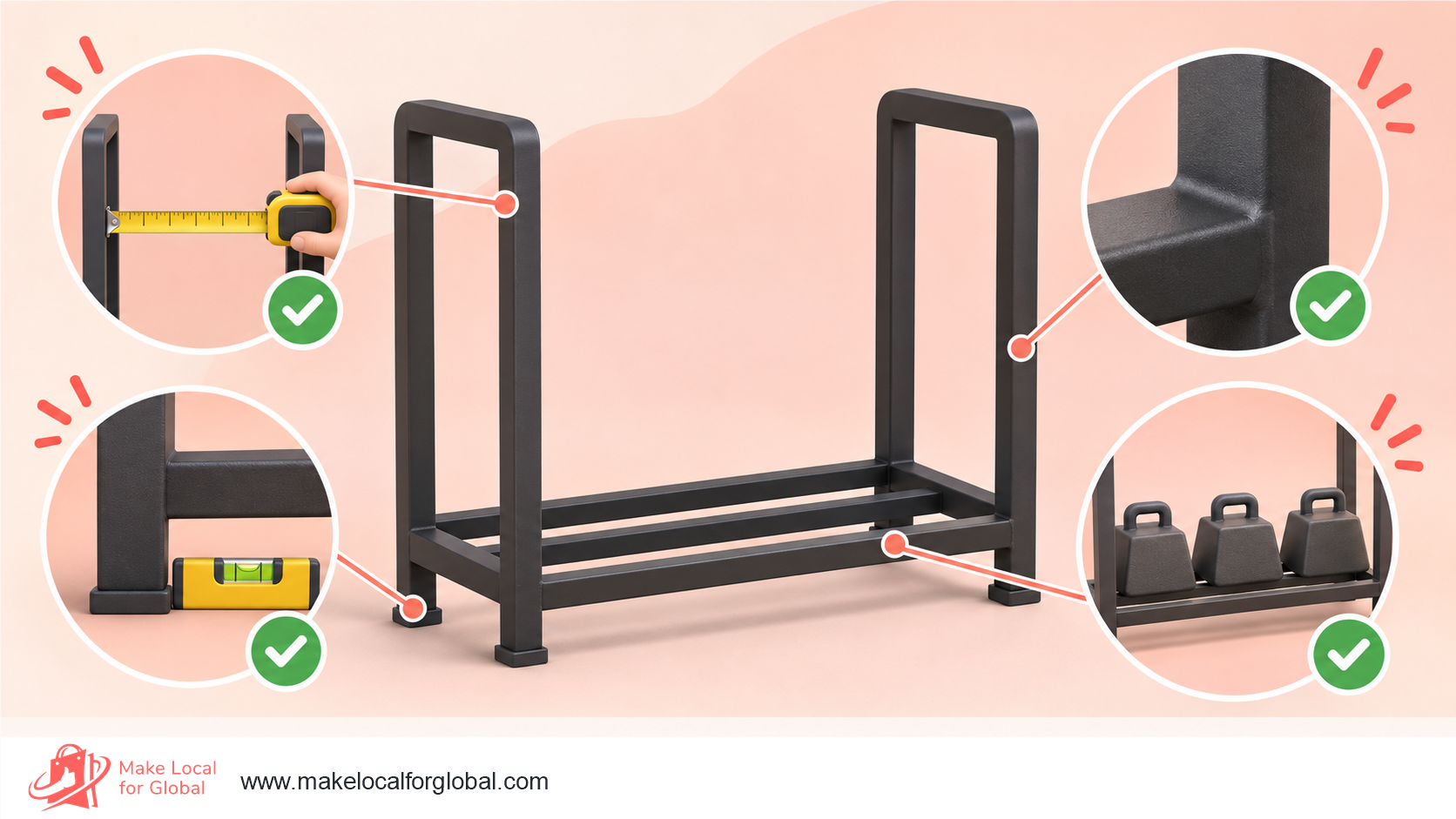
Assemble the frame on a firm, level surface. Look for rocking feet, frame twist, loose fasteners, uneven crossbars, sharp edges and joints that move when light hand pressure is applied. Check that every fixing reaches its correct hole without bending a rail. Note whether an anti-tip strap or wall fixing appears in the instructions and which material the anchor is intended to enter. Do not market a safety feature unless the parts are supplied and the instructions explain how to use it.
A seller can carry out a documented inspection, yet a casual demonstration is not a certified load test. If you need to substantiate a maximum load, ask the supplier or a qualified engineer to define a test that reflects the rack’s intended use. Record the model, sample, parts, load distribution, duration, surface and observations. A load test on one frame cannot be assumed to apply to another size or a later batch.
For a basic incoming check, inspect every joint and edge, confirm the frame sits level, assemble and dismantle the sample, and test whether the fixings remain secure after repeated assembly only if the supplier expects customers to do this. Do not load the product with people or treat it as a seat, ladder or climbing frame. One manufacturer’s firewood-rack instruction sheet says to follow the maximum specification and not stand or jump on that model. Read the instructions for the exact item instead of copying a limit or warning from another rack.
Record the test method in plain language. “Held a large stack” is not enough to support a numeric claim. If no verified load capacity exists, avoid quoting one. A useful listing can still say what the manufacturer specifies, describe the dimensions and explain that logs should be placed evenly in line with the assembly instructions. Attribute a supplier specification and keep its source.
Inspect how the surface changes after the sample is assembled, handled and wiped using the care method provided. Do not invent a salt-spray test, outdoor-life guarantee or rust-duration claim. If the finish is damaged, ask the supplier how the customer should treat it and whether a replacement part is available. Make sure the product page does not promise a finish that the support team cannot explain.
Create a short sample record with the date, supplier, model, lot, finish, part list, assembly time, test observations, photographs and open questions. Keep a separate copy of the supplier’s instructions. When you receive inventory, check a sample from each delivery before fulfilling orders. If the material or hardware changes, review the product description and photographs before sales resume.
A customer needs outside dimensions to plan the footprint, internal dimensions to judge log fit and a delivery size to understand access. These are not the same measurement. A 90-centimetre-wide frame may have less usable space between uprights. A flat-pack box can be much longer than any single rack part once rails and padding are included.
Measure the sample on a flat surface. Record external width, height and depth; usable width between the uprights; ground-to-lowest-rail height; shelf spacing; and any cover dimensions. If the frame is modular, measure it in each supported configuration. Use centimetres as the main unit for UK buyers and add inches only where your shop serves buyers who expect them. State how each measurement was taken and allow for normal manufacturing tolerance only when the supplier confirms it.
| Product detail | How to record it | Why a buyer needs it |
|---|---|---|
| Overall width, height and depth | Measure the assembled product at its widest points | Helps check the space and route into the room or garden |
| Usable space between supports | Measure the clear opening between rails or uprights | Helps check log length and placement |
| Floor clearance | Measure from the surface to the lowest wood-supporting rail | Shows whether logs sit directly on the ground or are raised |
| Shelf or kindling area | Record internal dimensions and openings | Shows which pieces fit and what could fall through |
| Cover measurements | Record coverage, fasteners and fit against the rack model | Prevents a buyer choosing a cover that does not fit |
| Packed carton | Record each box’s length, width, height and weight after packing | Supports an accurate carrier quote and delivery estimate |
| Included parts | Count hardware, rails, feet, straps, shelf and tools | Reduces missing-part disputes and setup confusion |
If you quote a capacity, explain the measure. A stack of split logs contains gaps, and log size varies. A volume estimate depends on the exact clear space and the stacking method. Calculate the internal rectangular volume only if the measurements support it, label it as a geometric space estimate and avoid presenting it as a guaranteed amount of firewood. A photograph with several logs is not proof of a capacity figure.
A useful product page can show a tape measure in the clear opening, a side view of the foot clearance and one example of the log length beside the frame. Keep the scale honest. Do not digitally enlarge logs, remove a support rail or crop out a stabilising bar. If you show firewood, say if it is included. A buyer may assume every visible item forms part of the order unless the listing explains the scene.
Create one record for each model and finish with fields such as:
A product record can live in a spreadsheet or stock system. Link it to the invoice and product photos. When the finish, hardware, carton or instructions change, add a dated note and decide whether the listing needs a change. This makes it easier to answer a customer question without relying on memory or an old supplier message.
A listing should help a buyer rule a product in or out. Put the core fit details close to the price and add longer notes below. Avoid a headline that repeats “log rack, wood rack, firewood store” without explaining what is included.
A precise title might read: “Compact Steel Firewood Rack with Kindling Shelf, 62 cm Wide”. Use those words only if the physical item matches the example. A broader title such as “Outdoor firewood rack with fitted cover” should name the actual dimensions, finish and cover arrangement on the page. Include a model or size label if you have several versions.
Build the description around the buyer’s questions:
Distinguish facts you measured from claims supplied by a manufacturer. “Our sample measured 90 cm across the outside feet” describes your check. “The maker specifies a maximum load of X kg” attributes a specification to its source. Do not write “holds a full winter’s supply” or “weatherproof for years” without a clear, supportable basis.
Use a short summary near the purchase control, then provide a compact specification section. A buyer should not need to search a long paragraph for a crucial figure. If the rack has multiple sizes, use one table for model, outside dimensions, clear width, packed dimensions, weight and included components. Make each row traceable to the product code.
If the product requires wall attachment, anchoring, a particular floor or a specific assembly tool, state that before the order. Name which fittings are included and which surface types they suit, using the current instructions. Do not use a generic “secure to the wall” note if the product maker provides no safe detail for the wall type. Refer technical fixing questions to the supplier or a qualified installer.
A concise care note can explain how to inspect fasteners, wipe the frame or store the cover, based on the supplied directions. Avoid creating a new instruction that conflicts with the maker’s guide. If the product is for outdoor use, use the exact maker wording and say what “outdoor” covers for that model, such as a covered position or exposure to rain.
Think through the product details, delivery route and features that make the rack easier to compare.
A customer cannot touch a frame through a screen, so each image needs a job. Show the whole assembled rack from the front, a side angle that reveals depth, an open or covered view, a close detail of the joints, and the included pieces laid out before assembly. Use the same lighting and camera angle for each colour or size.
Include one scale view with a real measuring tape, ruler or familiar object. Keep the object on the same plane as the rack part being measured. A small stove tool placed far behind a rack can look tiny or oversized from perspective, so it does not prove scale. A dimension graphic can summarise measurements, yet the image should not contradict the written specification.
Photograph the actual sample, not just a supplier render. If you add logs to show a likely arrangement, state whether they are included and use the correct length. Show the rack partially loaded only if the product remains stable and you can explain the loading arrangement. Do not show a person standing, sitting or climbing on it. Do not stage the rack close to a flame or describe it as a hearth product where the maker has not approved that placement.
An outdoor image can show the rack in a realistic garden setting, but avoid a cover that hides the frame, feet or opening. Capture the product against a neutral backdrop first. Use an additional setting photo for atmosphere, not as the only evidence. Accurate photos can reduce questions about colour, coating and the gap between rails.
Use descriptive alternative text for images that explain useful information, such as “Charcoal steel firewood rack with cover and four feet, shown beside a tape measure”. Do not put sales claims or a list of keywords into alt text. If an image is purely decorative and does not add information, its accessible text can be empty according to the site’s image rules.
A large metal frame can have a small unit price on a supplier quote and a much larger cost by the time it reaches the buyer. Add the product invoice, inbound freight, import charges, checking time, packaging, payment fees, parcel delivery, damage allowance and marketing cost. Include replacement hardware and return handling if the supplier model makes those likely.
Here is a hypothetical example for one rack order. It is not a supplier quote, current market price or profit forecast. It assumes a seller who is not VAT registered and a £109.99 customer price with delivery included. The fee allowance is an example equal to about eight per cent of the sale price; replace it with the fee terms for your actual channel.
| Order cost | Illustrative amount |
|---|---|
| Rack purchase cost | £42.00 |
| Inbound freight share | £5.00 |
| Incoming inspection and sample-test labour | £3.50 |
| Protective carton and packing material | £8.00 |
| Pick, pack and customer handling time | £4.00 |
| Marketplace and payment fee allowance | £8.80 |
| Outbound parcel delivery | £11.00 |
| Damage, replacement and return allowance | £6.00 |
| Customer acquisition allowance | £5.00 |
| Total variable cost in this example | £93.30 |
| Sale price, delivery included | £109.99 |
| Contribution before fixed overhead and tax | £16.69 |
The arithmetic is £109.99 less £93.30, leaving £16.69. That is contribution towards fixed costs, not net profit. It excludes business insurance, storage rent, software, accounting, tax and the owner’s wider overhead unless those are allocated elsewhere. A seller must replace each amount with actual quotes and recorded work time.
Bulky delivery can change the result quickly. A carrier may price by parcel dimensions, weight, collection method, destination or surcharge zone. Measure and weigh the parcel after the rack is packed, then request a price for that exact shape. A separate box for a cover or extension can create another charge. Do not assume a 4 kg rack and a 20 kg rack cost a similar amount to ship because both are one item.
Model three order patterns: a compact rack delivered to a nearby buyer, a long rack shipped to a distant postcode and a set with a cover or shelf. Include fees on the actual amount charged where the platform calculates fees on postage as well as the product. If the platform fee changes by category or plan, check the current terms before publishing a margin claim.
Run a downside view with a carrier surcharge, a discounted sale price, a replacement rail and one return. Ask whether the contribution remains enough to support the business. If not, reduce parcel size, change the supplier, charge a fair delivery amount, improve average order value with a compatible accessory or select a different product.
A bundle can raise the order value, yet it may add a longer carton or second parcel. Compare the bundle contribution with each separate sale after fees and delivery. A free-delivery label is a price decision, not proof that postage has no cost. Show a delivery price that covers the route you can actually serve.
VAT-registered sellers must model sales and costs on a consistent VAT basis and confirm their treatment with an accountant. Do not mix VAT-inclusive retail prices with VAT-exclusive costs in one calculation. Keep the cost sheet beside the supplier quote, carrier rate and platform fee schedule, then update it when any of those amounts change.
A firewood rack can ship flat, partly assembled or ready to use. Each option changes the customer’s setup and your carton. Flat packing can protect the frame and reduce assembled storage space, but long rails may still exceed parcel limits. A ready-built frame can need a bespoke carton, extra labour or a two-person delivery service. Test the shipping method before you buy a large batch.
Pack one sample using the material you plan to ship. Protect corners, threaded ends and painted surfaces from rubbing against other parts. Hold rails in place so they cannot slide through the carton. Put bolts in a sealed bag with a part list. Keep the assembly sheet visible and use an outer label that does not hide handling marks or product identification.
Move the packed sample through a safe handling check that reflects the parcel’s route. Do not drop a sale product onto a hard floor to imitate a courier mishap. Ask the packaging supplier or carrier about parcel testing suited to the item. Photograph the carton before dispatch and record its weight, dimensions, courier service and tracking number. Review any dent, lost bolt or scratched finish against the packing method.
If a customer reports damage, ask for photographs of the carton, frame, label and affected part. Compare the product code and batch with your record. Give a clear support response and keep the incident details. If a defect could cause injury or signal a wider risk, stop sales of the relevant stock and follow the appropriate reporting and corrective-action process rather than treating it as a routine cosmetic return.
Set a fulfilment time after checking stock, pick capacity and carrier collection. A large rack may not fit a normal post office drop-off or a small household vehicle. State whether the service is kerbside or room-of-choice only if the carrier confirms it. Tell the buyer what to do if access restrictions, a missed delivery or an over-size surcharge changes the plan.
For international sales, confirm the destination’s import requirements, taxes, delivery service and product information before showing that country at checkout. Steel and timber may face different market requirements depending on the product and destination. A country list in a checkout does not prove that a seller has checked each market.
Product responsibility depends on whether you manufacture, import, distribute or resell the rack. Read the current OPSS product-safety advice for businesses, which was updated on 21 July 2026. For England, Scotland and Wales, the General Product Safety Regulations 2005 guidance describes the general safety duties. The guidance states that Northern Ireland applies EU Regulation 2023/988 on general product safety from 13 December 2024. Check the rules for the part of the UK and the product role that apply to your business.
Do not assume that one general label, a supplier logo or an old conformity mark proves that a product meets every requirement. Check whether specific rules apply to the design, intended use or another product feature. Keep supplier invoices, model references, batch details, product instructions and safety evidence. Ask a specialist or local Trading Standards service if a product’s legal category is not clear.
A maker or importer may need technical records, product identification and instructions. A reseller still needs to take care not to supply a product they know or should know is unsafe. If you receive a serious safety complaint, keep the item and batch details, notify the supplier and follow the applicable reporting process. Prepare a route for stopping sales, contacting buyers and handling a withdrawal or recall if a risk is identified.
Keep the product’s intended use clear. A rack is for storing logs in the way described by its maker. Do not present it as a seat, step, climbing frame, support for heavy tools, fire screen or shelf for another load unless the product is specifically designed and assessed for that use. Avoid a lifestyle photo that quietly makes a use claim the text never addresses.
For online sales, GOV.UK’s distance-selling guidance lists information to provide before an order, including the business’s contact details, product description, total price, delivery arrangements and cancellation information. GOV.UK’s returns and refunds guidance explains cancellation rights for many online orders. The usual distance-sale cancellation period for goods is 14 days after delivery, followed by another 14 days for the customer to return the item after notifying the seller. Check exceptions and the exact rules for your order and jurisdiction before writing a policy.
A blanket “assembled items cannot be returned” term can mislead a buyer. For many online purchases, the customer can handle goods to inspect them as they would in a shop, although excessive use can affect the refund amount in some circumstances. Faulty or misdescribed goods are a separate issue. Explain the real process for an unwanted rack, a missing part, a delivery dent and a safety concern. Do not shift statutory rights onto the customer through a short line in the listing.
If you describe a product as “recycled steel”, “made in Britain”, “rust resistant” or “weatherproof”, keep evidence for the exact claim and product. A steel component from a recycled source does not establish that the whole rack is recycled. A final assembly step in the UK does not, by itself, settle where a product was made. Read the CMA Green Claims Code before publishing an environmental claim. Clear limits and a record of the evidence can reduce confusion.
An own online store gives you space to show dimensions, instructions, options and delivery terms in a consistent format. A marketplace can place a product beside shoppers already looking for fireplace and garden goods, yet its fees, listing rules, returns and parcel labels need to fit your cost model. A local garden centre, fireplace shop or firewood merchant may offer a route to trade orders and local collection. Compare completed orders and contribution, not views alone.
Before buying advertising, publish a useful specification page and test a small amount of promotion. Track product-page visits, size-guide use, add-to-cart actions, abandoned checkouts, questions, delivery quotes, orders, returns and contribution. When visitors leave after seeing the shipping cost, check parcel size and pricing. When they ask the same measurement question, move that fact closer to the price and add a photo.
Search phrases should match the product you sell, such as “small indoor firewood rack”, “metal log rack with cover”, “freestanding firewood holder” or “log store with kindling shelf”. Use a phrase only on a page that actually describes that format. A broad rack page cannot meet every query well if some models are open indoor holders and others are outdoor stores.
Write helpful content around buyer questions: how to measure space for a firewood rack, how to check log length, what packed dimensions mean, how to assemble a specific model and which parts come with a cover kit. Add links from those pages to the relevant range and support page. A practical comparison can help a buyer distinguish a compact hearth rack from a covered garden store.
Your next collection can connect to related product topics. A person planning a fireplace area may compare fireplace tools with log storage. A garden-focused range can sit beside farmhouse decor when the products serve a similar buyer. A textiles collection might include furniture covers or fabric by the metre for makers who sell complementary home items. Keep each page focused on its own product and use internal links where they help the reader take a relevant next step.
Consider a trade page if you can supply shops, installers or firewood retailers. State the minimum order, carton quantity, lead time, trade contact and what happens with mixed sizes. A retail price and a bulk price need separate cost checks. Do not accept a large order until stock, assembly parts and carrier capacity are confirmed.
Keep a log of pre-sale messages. If buyers ask whether the rack takes 30 cm logs, answer with the clear internal opening and the way the product was measured. If they ask whether a cover reaches the sides, add a coverage diagram. If the carrier cannot deliver to a rural postcode, update the delivery zone or quote process before the next order.
Invite a buyer to review the product after delivery without asking for a positive review. Ask whether the parcel arrived intact, whether the instructions matched the parts and whether the measurements suited the location. Use feedback to identify an unclear image or packing problem. Do not claim that a rack is a customer favourite after a handful of responses.
Review search terms and customer questions each month. Remove queries that attract the wrong buyer, such as log-splitting equipment when your page sells a storage frame. Add a short answer for repeated questions and link it to the right variant. A focused page can serve both searchers and people arriving from a product collection.
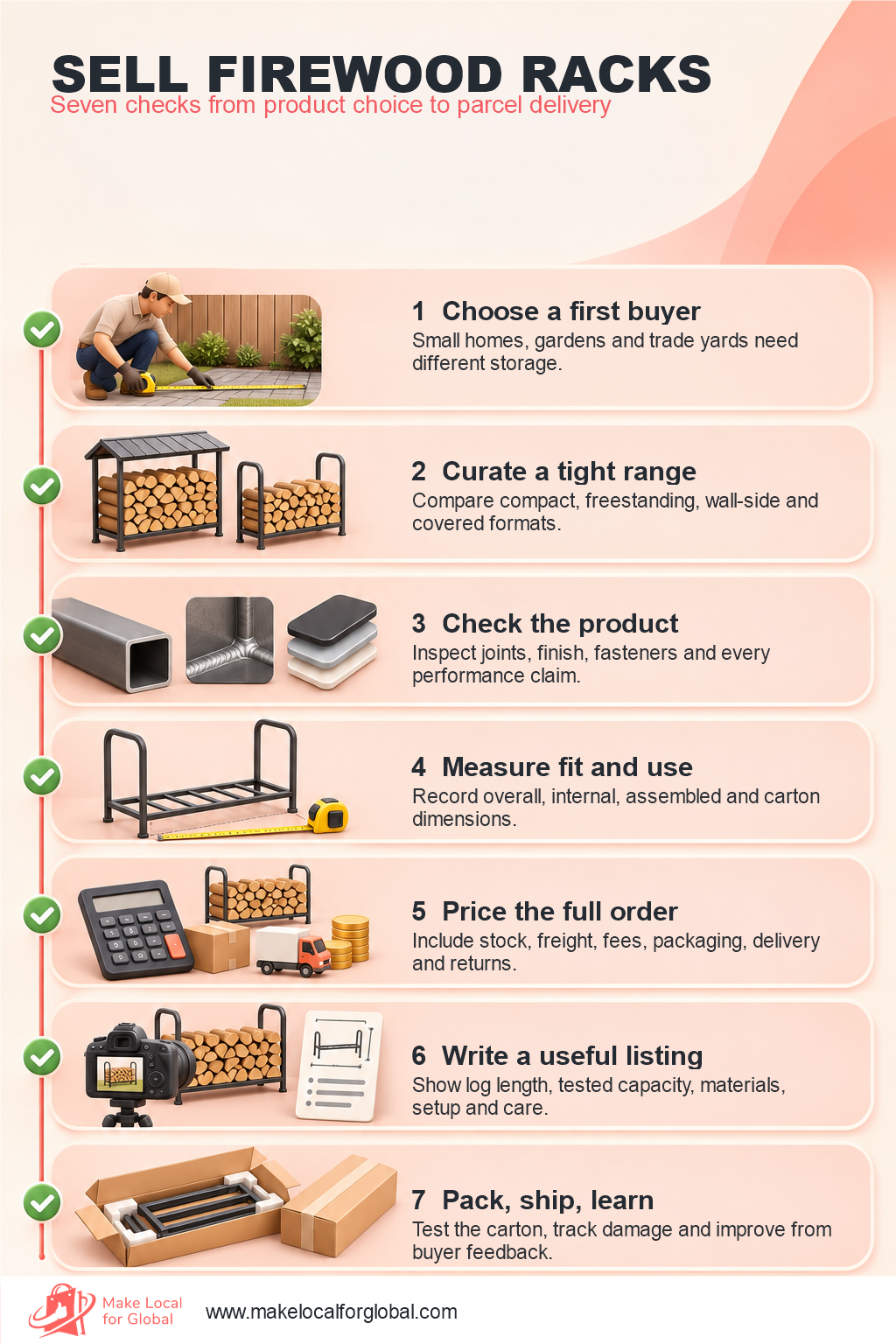
A short launch plan helps you learn before committing to more inventory. Record what you will check each week and what result will change your next decision.
Write down one buyer group and the storage problem they describe. Speak with five to ten people who have bought firewood racks or log stores recently. Ask about the location, log length, current dimensions, assembly, delivery and what did not work. Look at three supplier options and request current product sheets, carton measurements, order minimums and lead times.
Create a comparison sheet. Include model, material, finish, internal width, outside footprint, included cover or shelf, packed weight, minimum order, sample price, inbound freight and delivery route. Mark facts as verified or awaiting a response. Do not choose a supplier just because the product image looks polished.
Order one or two representative samples. Assemble them on a level surface, follow the instructions, record missing parts and inspect the joints, coating and feet. Take measurements and photographs beside the product code. Ask the supplier about any discrepancy before ordering stock.
Build the order-cost calculation for a compact rack and a longer model. Include inbound shipping, test labour, carton, handling, channel fees, outbound carrier, damage allowance and customer acquisition. Request a carrier quote using the packed sample measurements. Test a discounted sale and a return scenario. Keep only the models with a clear buyer, a supportable product description and viable contribution.
Write the title, concise summary, full specification, included-parts list, assembly note, care information, delivery promise and returns information. Check each statement against supplier documents or your measurements. Photograph the assembled frame, open dimensions, cover, joints and carton contents.
Pack one sample parcel and review the route from storage shelf to carrier collection. Label hardware, print the parts list and prepare a replacement-parts process. Check that the rack code, carton label, instructions and product page identify the same version. Set stock numbers and a reorder reminder based on lead time and real order data.
List a narrow selection with actual stock quantities. Share the product page with the people who asked for an update and invite useful feedback. Keep paid advertising small until the product images, shipping amount and page have been checked on a phone and computer.
Review questions, add-to-cart actions, completed sales, carrier performance, packing time, damage reports, return requests and contribution. If many people ask about log length, make the clear internal measurement easier to see. If parcel cost erases the contribution, revisit the carton or service before ordering again. At day 30, decide which model to keep, which feature to test and which product to drop.
Bring buyer notes, sample checks and parcel costs into one plan before restocking.
It may suit a seller who can test a physical sample, measure long parcels and handle bulky returns. The main costs include stock, freight, packaging, delivery and replacement parts. Start with a compact number of models and check the customer’s storage needs before committing to a large order.
Choose a format that matches a buyer you can reach and a delivery service you can afford. A compact indoor holder can be easier to store than a long outdoor rack, but it serves a different use. Compare dimensions, materials, assembly, supplier records and the packed parcel before you decide.
Measure the product’s outside dimensions and the clear opening between the supports. Ask buyers to measure their available space and the length of their logs. Put both measurements near the price and show a scale view that matches the product in the parcel.
Only publish a load figure that is supported for the exact model and configuration. Ask the supplier for its test method or work with a suitable technical specialist if you make the product. A casual stack of logs is not enough evidence for a numeric rating.
Not by itself. Check which surfaces it covers, how it attaches and what the manufacturer says about exposure and ventilation. Describe the actual construction and avoid “waterproof” unless the claim is supported for that cover and intended conditions.
Compare customer effort, storage space, carton dimensions, delivery charges and damage risk. A flat-pack can be smaller than an assembled frame, yet long rails may still exceed ordinary parcel limits. A built product avoids home assembly but can raise handling and delivery costs.
Show exact outside and internal dimensions, material, finish, included parts, assembly requirement, care instructions, verified capacity details, packed size, dispatch estimate and return information. Identify whether firewood, a cover or a kindling shelf appears in the images but is not included.
Measure and weigh a packed sample, then request a quote for the destination types you plan to serve. Add the actual carrier price, fees, packing labour, damage allowance and return cost to the order model. Test bundles and discounts with their own parcel size and contribution calculation.
Use a country-of-origin statement only when you have reliable evidence for the claim. Ask the supplier where materials are made and where substantial manufacturing takes place. Assembly or packing in the UK may not be enough to support a broad “made in the UK” claim for every product.
The first job is to identify a storage problem you can solve with a rack that fits a real space and can reach the buyer at a viable cost. Get a sample, inspect the frame, follow its instructions, record measurements and price the packed order. Build the product page from evidence, then use the first questions and deliveries to decide what changes.
A compact indoor rack and a covered garden model can belong in one shop, yet they need separate specifications, photos and parcel calculations. Keep those details close to each product code. If the supplier cannot confirm what a feature means, leave it out of the claim until the evidence is clear.
Use buyer feedback and actual cost records to choose the next model. If an offer earns clicks but the carrier removes the contribution, revisit the carton and delivery plan. If buyers cannot tell what is included, show the parts and explain the price. The best first range is one you can describe, inspect, ship and support with confidence.
PREFERRED SOURCE
Like what you’re reading? Add Make Local for Global as a preferred source on Google to see more of our articles when you search.

Build your online presence without having to figure out everything yourself.