

READY TO SELL Furniture Covers ONLINE?
Get a store built for you in 5 days, plus training and support to help you start, run, and grow your Alternative business.

Choose a furniture-cover range, test fit and fabric, price every order and set clear delivery and returns information before launch.

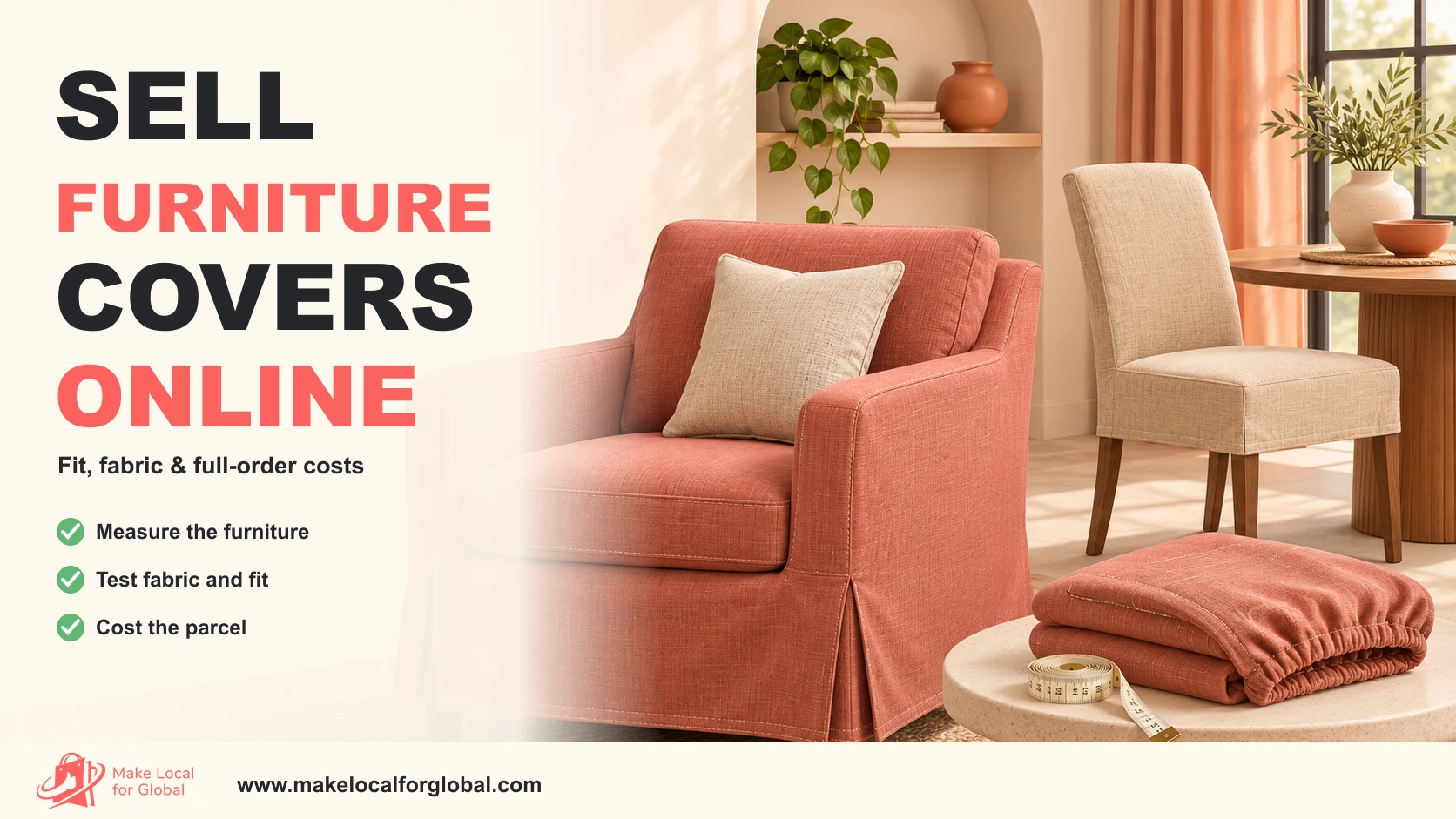
Furniture covers can help customers protect or refresh chairs and other pieces without replacing the furniture itself. For an online seller, the hardest part is not choosing a colour. It is showing whether the cover will fit a real piece of furniture, how it will look from different angles, how it fastens and what the customer receives. A photograph cannot show every chair shape or explain how a fabric behaves after washing.
To sell furniture covers online, choose one buyer and one furniture type, build a small range around measured examples, test fabric and construction, and state the fit limits before payment. Then cost the whole order, including pattern work, labour, packaging, delivery, payment fees and a return allowance. Start with a narrow range of non-sofa covers such as dining chairs, armchairs or outdoor benches. A separate MLFG article covers sofa and couch covers.
Choose a defined furniture type, make fit information clear and give buyers an easy way to discuss their store or product range.
“Furniture covers” describes several different products. A fitted dining-chair slipcover might be made from washable cotton or a stretch blend. A tailored armchair cover can require a pattern for a particular frame. An outdoor bench cover needs different fabric, seams and closures from an indoor dining-chair cover. A recliner cover may need clearance around a lever and footrest. Those products need distinct samples, measurements and care information.
Write down your first product in one sentence: “A washable fitted cover for a straight-back dining chair with a 44–50 cm seat width.” Or: “A water-resistant cover for rectangular garden benches up to a stated length.” The sentence helps you decide what to sample, photograph and explain. Avoid a launch range that claims to fit every chair or every home.
Choose the buyer as well as the item. A renter may want to change the look of a dining set without buying new chairs. A household with young children may prioritise a removable cover that can be washed. A small café may need matching covers for a group of chairs. A customer storing outdoor furniture may need a cover that fits a bench and stays in place. Ask which problem is real for your intended buyer, then select materials and details for that use.
Sofa and couch covers have separate fit questions: seat depth, arm shape, detachable cushions, corner sections and reclining mechanisms. Keep that product family distinct so shoppers can tell whether a listing is for a chair, dining seat, ottoman or sofa. MLFG’s measured range guide to selling couch covers online covers sofa-specific choices. Link to it when a buyer needs that category; do not reuse sofa measurements for an armchair or dining cover.
One starting point could be a single chair type in three size bands, two fabrics and two colours. Another could be one fitted armchair style with a short list of confirmed compatible shapes. For outdoor furniture, focus on a specific bench or chair format and dimensions. The right count depends on sample and fulfilment capacity. A small range that you can measure and explain is more useful than many untested styles.
Choose a naming pattern before creating products. It might state furniture type, shape, size band, fabric and colour: “Dining Chair Cover, Straight Back, Medium, Oatmeal.” Keep a product code for each pattern and revision. If a supplier changes elastic, fabric or seams, your code and sample record should reveal which version you are selling.
Cover construction affects appearance, fit tolerance, time to make and parcel size. A stretch cover may accommodate some variation in shape, yet it still needs clear measurements and limits. A tailored cover has panels and seams designed for a more specific silhouette. A loose drape can suit some customers, but photographs must show how much fabric hangs and how it is secured. An outdoor protective cover is built around exposure and anchoring, not the appearance of an indoor slipcover.
| Cover type | Possible first use | Product details to prove |
|---|---|---|
| Stretch fitted cover | A defined group of dining or accent chairs with compatible shapes | Tested width and depth range, stretch recovery, seam strength and fastening |
| Tailored slipcover | A specific chair or bench shape where a neat fit is part of the offer | Pattern reference, finished dimensions, fitting method and wash result |
| Loose drape cover | Customers who prefer a relaxed appearance | Finished drop, fabric weight, tie or tuck method and clear photographs |
| Outdoor protective cover | A named bench, chair or other outdoor furniture format | Exact length, width and height, closure points, storage and care |
Treat each material statement as something to substantiate. “Water-resistant”, “wipe-clean”, “machine-washable”, “pet-proof”, “stain-resistant”, “recycled” and “made in Britain” each set an expectation. Ask the maker for evidence and keep your own sample-test record. If you cannot substantiate a claim, describe observable features instead: the fibre composition, weave, fastening, care label or result of a named test.
The next decision is how the cover fits the furniture. A universal cover may suit a limited set of shapes. A model-specific cover may be built for a named chair or maker. A custom-made version may use measurements supplied by the customer. Each route changes pattern work, support and lead time. Pick one first; combining all three before your measuring process is reliable adds complexity.

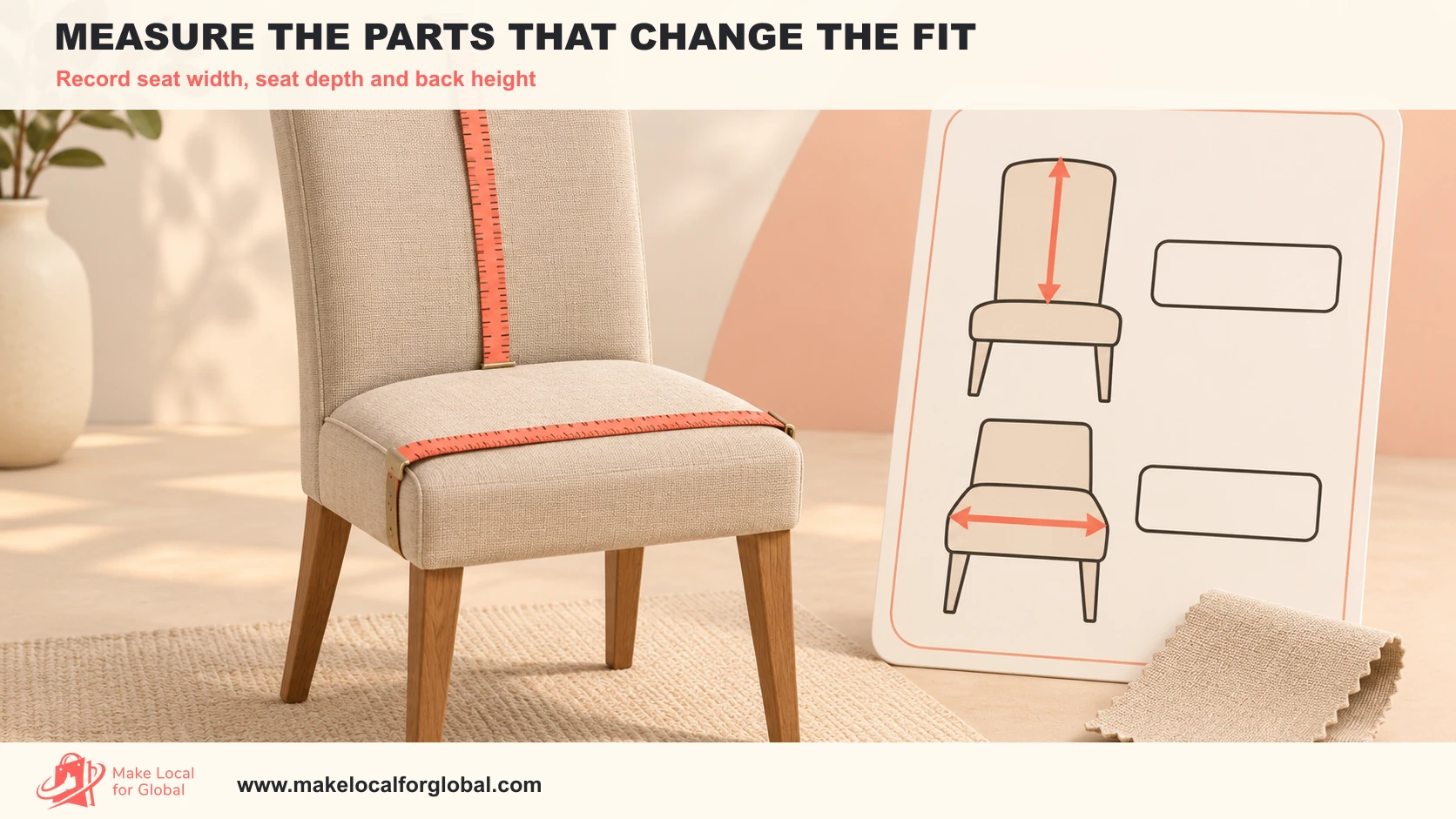
A size chart should help a buyer decide whether a cover will fit before payment. Begin with the furniture itself, not a generic small, medium and large label. Measure several examples of the shape you intend to cover. Record where each measurement starts and ends, the furniture position, and whether the tape follows the curve or crosses the widest point in a straight line.
For a dining chair, useful dimensions may include seat width, seat depth, back width, back height, total height, and the shape or thickness of the seat. A chair with arms needs arm height, inside width and clearance around the legs. An armchair may need overall width, seat width, back height, seat depth, arm height and floor-to-seat height. An outdoor bench may need length, depth, total height and the shape of any fixed back. The exact list depends on the pattern. Include dimensions that affect fit.
Make one internal specification sheet for every furniture shape. Add a simple drawing with arrows and numbered points. List the accepted minimum and maximum at each point, the ease allowance, fastening position and sample used to verify the pattern. Explain the tape position in plain language. A width measured between the outside edges of two arms is different from the seat cushion width.
Test the guide with someone who has not seen the pattern. Ask them to measure a chair using only the instructions. If they pause to ask where the tape should sit, add a clearer drawing or sentence. A small mismatch can cause a poor fit, so treat measurement questions as an important product-page issue.
Separate the furniture dimension from the finished cover dimension. A listing can show both: “Fits a chair with a seat width of 44–50 cm” and “Finished cover seat panel measures 52 cm flat before stretching.” State how elastic, ties or drape change the result. Do not offer a single “cover width” without saying where the customer should measure the furniture.
Use a real chair or bench that sits within the listed size range. Show the cover fitted from the front, side and back. Add a close-up of a seam, hem or fastening. Include a ruler or tape only when it clarifies the dimension, with the ruler aligned to the measurement named in the caption. A folded-cover photograph can show fabric weight and parcel size.
Show a second compatible shape only if it demonstrates a tested fit. If a cover does not suit curved arms, high backs or thick cushions, say so and show an excluded example. Clear exclusions help customers avoid a mistaken purchase and choose the right pattern.
Start with a brief for the intended use. A dining-chair cover may be handled and washed often. A decorative accent-chair cover may need a particular texture or colour match. A garden-bench cover may face sun, moisture and dirt. Write down the expected use, cleaning method, indoor or outdoor exposure and the fit behaviour required before asking a maker for fabric suggestions.
Request a swatch and a sewn sample from the same fabric batch or specification you expect to use. Check colour in daylight and indoor light, surface feel, opacity, stretch and recovery, seam bulk, fraying, shrinkage and how the material behaves when pulled over the furniture corners. Photograph the sample before and after the stated care cycle. Record the detergent, temperature, drying method and any change in measurements. One informal wash is useful product development, but it is not a certified performance claim.
Pull gently at corners, ties and elastic channels. Check whether stitching skips, fabric distorts or the closure slips. Fit and remove the cover repeatedly. Sit on the covered chair if that reflects the intended use, and see whether the cover shifts or catches. For outdoor designs, test the fastening against the intended wind exposure in a controlled, safe way and inspect water ingress after a clearly described test. Avoid promising “windproof” or “waterproof” from a brief home check.
Look for design details that reduce fit problems: labelled front and back, a discreet fastening, adjustable ties, separate cushion pieces where appropriate, reinforced corners, and instructions that show the fitting sequence. Each extra feature has a cost and a failure point. Include it only when customers value the result and the sample proves it works.
Ask suppliers about fibre composition, colour consistency, lead times, minimum order quantities, batch variation, care information, country of origin and documentation. Get quotes for sample, small-batch and repeat production. If a supplier changes a fabric source, colour lot, elastic or sewing method, treat it as a change that may require another fit and wash check.
Decide whether you will make covers yourself, commission a local maker, buy finished stock or use a manufacturing partner. Compare the real work involved: pattern development, sampling, cutting waste, sewing capacity, inspection, stock storage, labels and handling of alterations. A low per-unit quote can hide expensive sampling or a minimum order that ties up cash.
Write a simple specification before placing an order. Include a drawing, pattern code and revision, fabric composition, colour reference, finished dimensions, tolerance, seam and closure details, label content, packing method and inspection checks. Agree who owns the pattern and how defects or changes are handled. Keep the approved sample as a reference and date it.
Textile fibre composition has labelling rules in the UK. Check the current official textile labelling guidance and applicable legislation for the exact product and sales market. Use the correct fibre names and percentages supplied by a reliable source; do not infer composition from appearance. If selling into other countries, check local language and labelling rules for those markets.
Product safety obligations depend on the product and how it is made and sold. The Office for Product Safety and Standards publishes advice for businesses. Furniture and furnishings fire-safety rules have a particular scope and have been amended; check the current official overview of the 2025 amendment and the regulations for your exact item. Do not assume that every loose cover is treated the same way, or that a supplier’s general statement replaces your own classification and documentation. Ask a qualified adviser or regulator when the intended use or construction is unclear.
Keep supplier invoices, batch references, specifications, sample checks, customer complaints and corrective actions in one record. If you discover an unsafe or materially misdescribed product, pause sales of the affected batch and follow the relevant reporting and remedy process. Good records help you trace what was made, which customers were affected and what action you took.
Set a price from actual costs and the value of the product, rather than copying a competitor’s number. List costs that change with each order and costs that must be recovered across sales. For a made-to-order cover, account for pattern time and cutting waste even if you do not pay yourself a separate wage yet. Your business still uses that time and material.
An illustrative order might sell for £96 before any applicable sales tax. The example below is not a market quote or profit promise; replace every amount with your supplier’s prices and measured process.
| Cost per order | Illustrative amount |
|---|---|
| Fabric and cutting waste | £18.00 |
| Pattern and sample allocation | £4.00 |
| Sewing labour | £16.00 |
| Closure and label | £3.00 |
| Inspection and handling | £3.00 |
| Protective packaging | £4.00 |
| Delivery paid by seller | £7.00 |
| Payment fee | £2.50 |
| Returns or exchange allowance | £4.00 |
| Customer acquisition allowance | £9.00 |
| **Illustrative variable cost total** | **£70.50** |
| **Contribution before overhead** | **£25.50** |
The £25.50 contribution is not net profit. It must help pay fixed costs such as software, insurance, photography, workspace, accounting, equipment, storage, tax and your own unallocated time. The return allowance is a planning estimate, not a reason to refuse a customer’s statutory rights. Model realistic scenarios: a normal month, a slower sales month and a month with extra exchanges or a supplier price rise.
Separate one-off launch costs from monthly overhead. List the cash needed for patterns, samples, photography, labels, packaging, first production run and postage before customer payments settle. If you hold stock in several sizes and colours, calculate how much cash remains tied up in each variant.
For a simple break-even estimate, divide monthly fixed costs by contribution per order. If fixed costs were £510 and the contribution were £25.50, break-even would be 20 orders for that period, before tax and owner drawings. If the contribution falls to £17 after higher delivery or advertising costs, the same fixed costs require 30 orders. Use this calculation as a planning tool, not a demand forecast.
Check whether your price includes delivery, whether the delivery promise fits your production capacity, and whether you will charge for a made-to-measure consultation. If custom measurements add labour, price that work openly. Confirm VAT treatment with HMRC or an accountant for your circumstances; the example above makes no assumption about registration or tax owed.
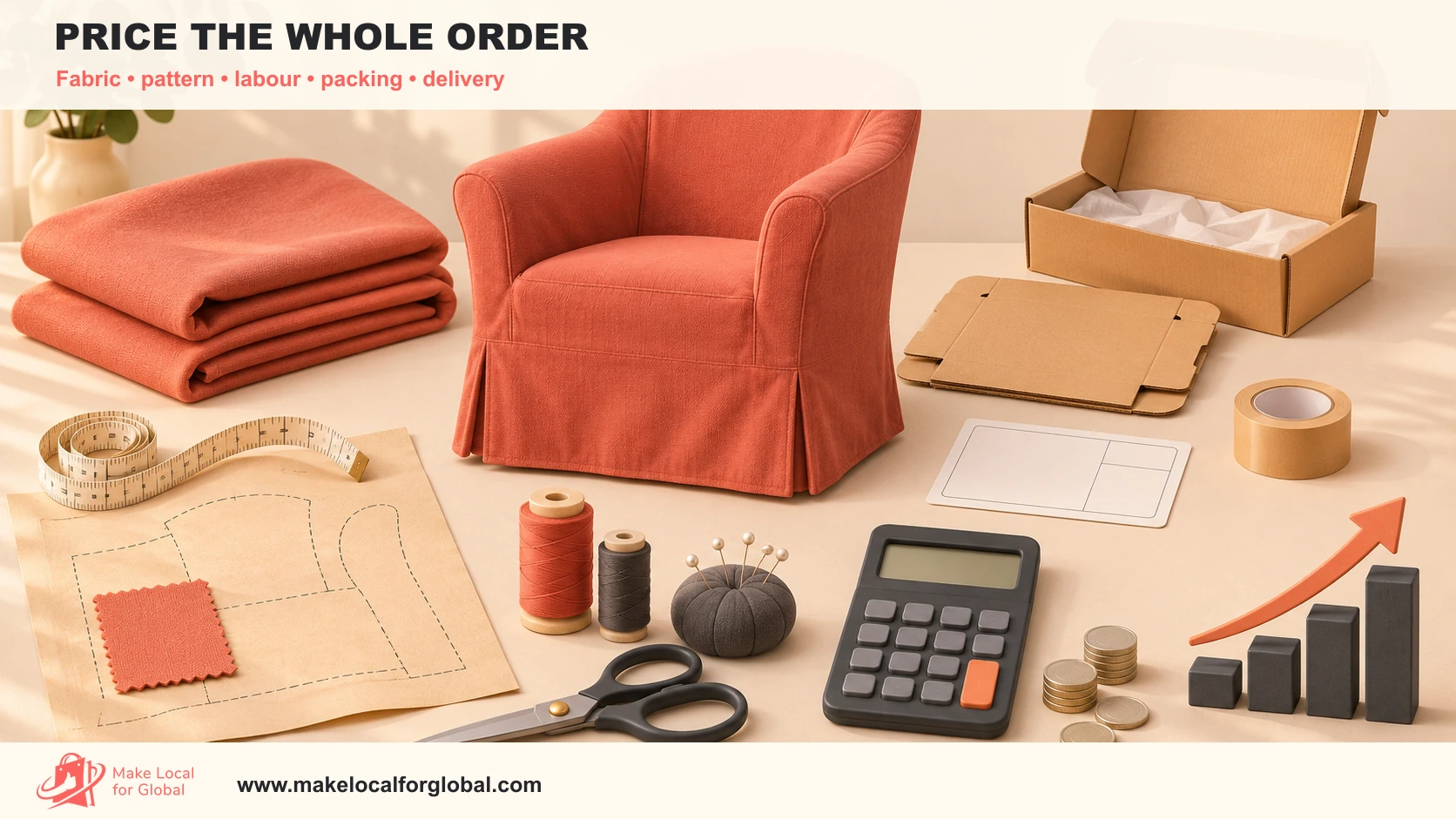
Model fabric, pattern time, labour, packaging, delivery, fees and returns before you set a price or add variants.
Use a specific product title: “Washable straight-back dining chair cover, medium” tells a shopper more than “Premium furniture protector”. Start the description with the furniture type, fit range and most important limitation. Explain whether the cover is sold singly or as a set, which pieces are included, and whether the chair shown is included. State the pattern or compatible model only when you have verified it.
Add a dimension diagram with numbered arrows that match the measuring instructions. Give accepted furniture ranges in centimetres and show how the customer should measure each one. If material stretch affects fit, state that and show a tested example. A comparison table can help customers choose a size, but do not use size names without actual measurement limits.
Photograph the product clearly in useful contexts. A strong set can include:
Use genuine product photographs where possible, with consistent light and a plain setting. Do not digitally reshape the cover or furniture in a way that exaggerates fit. Write concise, descriptive alt text for informative images, such as “Oatmeal slipcover fitted to a straight-back dining chair, side view showing seat depth.” Google’s image SEO guidance recommends useful context and descriptive filenames; search visibility still depends on the whole page and cannot be guaranteed by image metadata alone.
Include fabric composition, care instructions, what arrives in the parcel, production time, dispatch estimate, delivery options, returns route and contact details. Explain how to request help before ordering. If a customer needs to compare measurements, offer a simple form that asks only for the dimensions needed to check compatibility.
An own online shop gives you control over detailed fit information, product variants and customer support. A marketplace may provide existing shopper traffic but has its own fees, listing rules and competition. A craft fair or local interior event lets people feel the fabric and ask questions; use feedback there to improve the online size guide. You can test one channel first and add another when fulfilment is stable.
Organise products around the way customers shop: furniture type, shape, size, use and colour. Keep similar covers together, but make each item’s compatibility clear. Link related categories where it helps someone move from a dining chair to a bench cover. Link the separate couch-cover range guide for people looking for sofa products. Internal links should support a real next question, not repeat the same keyword in every paragraph.
Write for specific searches and questions. A category page can explain the available chair shapes and how to choose a size. A product page can target the exact cover type and dimensions. Helpful support content might answer how to measure a dining chair, how to wash a slipcover or whether a particular fastening suits a removable cushion. Avoid creating near-identical pages for every colour; use variants when the product is otherwise the same.
Use a descriptive page title and a concise search description that accurately summarise the range. Include the main product phrase naturally where it helps identify the page. Use one clear page heading and descriptive subheadings. Keep product details consistent across title, images, size chart and structured product data. Follow Google’s SEO starter guide: make pages useful for people, accessible to crawlers and easy to understand. No title, keyword density or markup guarantees a ranking.
Gather customer questions and reviews with permission and handle them honestly. A review that names the chair model and dimensions can help another shopper assess fit. Do not invent testimonials, ratings or compatibility claims. Track which product pages receive views, measurement questions, cart additions, exchanges and completed purchases. Improve the page that creates confusion before spending more on traffic.
Choose packaging that protects the fabric and keeps the cover clean without making the parcel unnecessarily large. Test the packed sample through your chosen delivery service. Weigh and measure the parcel after packing so the shipping price uses real dimensions. Add a product code, care information and fitting instructions where useful. Keep packaging claims factual and check local recycling requirements before printing labels such as recyclable or compostable.
Set a realistic production and dispatch schedule. For made-to-order work, state the current preparation time and tell customers if a supplier delay changes it. Keep separate statuses for order received, measurements checked, cutting, sewing, inspection and dispatch. A simple checklist reduces missed labels, wrong sizes and incomplete sets.
Write a support process for fit questions. Ask for the product code and the named measurements, then compare them against the documented range. Avoid diagnosing from a vague description or promising fit before seeing the relevant dimensions. If a mistake is yours, explain the available remedy and keep a record so you can identify a pattern or production issue.
Distance sales in the UK carry information duties and cancellation rights. Read the current government overview of online and distance selling for businesses. Some genuinely personalised or made-to-specification goods may fall within a cancellation exception under the Consumer Contracts Regulations, but choosing a size from a standard range does not automatically make a product custom-made. Faulty or misdescribed goods have separate protections. Explain your policy accurately and get advice for the exact ordering process if you collect customer dimensions or alter a standard product.
Ready stock lets you dispatch quickly, though each size and colour can tie up cash. Made-to-order production can keep inventory lower, but customers wait longer and you must manage capacity and fabric availability. A hybrid can hold a small quantity of the most requested variant and make other versions after purchase. Use actual order history before deciding which option to expand.
For stock products, set a reorder point based on supplier lead time and recent demand. For made-to-order items, cap available orders to the number you can produce within the stated period. Record fabric lot and pattern revision on each order. If stock is low or an input is delayed, change the listing promptly rather than accepting orders against an outdated promise.
Make the packing check specific. Match the product code on the order to the sewn label and packing slip. Confirm the number of covers in a set, include the right fitting card, check the finished product for marks or loose threads, and photograph unusual custom orders before dispatch. The check need not be complicated; it needs to catch mistakes customers would notice.
Show the cover solving a real room problem, such as refreshing mismatched dining chairs or protecting a bench between uses. Short demonstrations can show the fitting process, fastening and wash-care routine. Use the same tested product as the shop listing, and label staged images or samples accurately. A useful measurement graphic can appear on a product page, email and social post without turning each channel into a separate claim.
If you collect email addresses for restock notices or care tips, explain what subscribers will receive and use a consent process that fits the markets where you sell. A post-purchase message can ask whether the dimensions were clear and invite feedback after the customer has had time to fit the cover. Ask permission before using a customer’s room photograph. Keep customer information only as needed for the service and follow relevant privacy rules.
Compare promotion by contribution, not by likes alone. Record campaign spend, orders attributed, discounts, shipping subsidies and returns for each product. A discount that brings many low-value orders may be less useful than a small number of customers who buy a matching set at full price. Treat early data cautiously: a few purchases show that transactions occurred, not that demand will continue at the same rate.
Once orders arrive, note which dimensions customers submit, which fit questions repeat, which colour is chosen and which variant gets exchanged. Use those signals to improve the size chart or narrow the next production run. If a particular cover gets interest but no purchases, inspect product photos, price and delivery information before assuming that more colours will solve the problem.
Set a regular review date, such as once a month, and bring the same simple measures each time: visits, product-page conversion, average order value, contribution per order, dispatch time, returns and reasons for support contact. A single number can mislead; compare it with the previous period and with changes you made. Keep a short note about each change so you can learn which version of the page or process customers saw.
Hospitality buyers, landlords, interior stylists and small venues may ask for coordinated sets. A larger order can make production planning attractive, but it brings its own requirements: consistent colour batches, delivery dates, replacement pieces, invoices and clear responsibility for measuring. Keep a separate trade enquiry form that collects the furniture type, quantity, required date and whether the buyer can provide dimensions or a sample chair.
Quote a trade order from a written specification. State the number of covers, size band, fabric and colour reference, unit price, sample approval step, production schedule, delivery arrangement and how changes affect the quote. Do not reserve a production slot or purchase materials based only on an informal message. Confirm the order and terms in writing, and decide how much deposit is appropriate for your business and local law. A trade customer may have different purchasing terms from a consumer, so do not copy consumer checkout wording into a business quotation without checking it.
Before accepting a large batch, sew and inspect a pre-production sample, then agree what counts as an acceptable colour or measurement tolerance. Keep an approved sample or clear photographs with the order record. Split delivery into stages only if the buyer has approved the schedule and each shipment can be tracked. These controls reduce the chance that an otherwise successful order becomes an expensive remake.
Trade enquiries can be a way to learn which dimensions or replacement options matter to a group of buyers. They are not proof that every venue wants the same product. Note the time spent measuring, quoting and coordinating alongside the revenue, and compare the contribution with direct consumer orders. If a custom request needs too much support, offer a standard size range or decline politely with a clear explanation.
Choose one furniture type and define a buyer. Review competing listings for fit language, materials, lead times and common questions. Note what is missing or confusing, but do not copy photos or wording. Talk with a few likely buyers and ask what they currently use, what frustrates them and what measurements they can provide confidently. Treat responses as discovery, not proof that a large market exists.
Request fabric swatches and one sewn sample. Create the measurement card, test fitting and care, photograph the sample and calculate a full cost. Ask the supplier for a second quote or a small-batch option. Decide whether the price can cover variable expenses and contribute to overhead. If not, adjust the product, process or price before ordering stock.
Write the product page, size chart, care details, dispatch estimate and return information. Test the measuring instructions with another person. Pack a sample parcel and verify its weight, dimensions and delivery cost. Prepare a small FAQ using questions people actually asked. Set up order tracking and stock limits before opening checkout.
Publish the first product or small set of variants. Share it with relevant local groups or existing customers where promotion is welcome. Ask early buyers for feedback on fit instructions and packaging. Review visits, questions, conversion and exchanges. If shoppers repeatedly misunderstand one dimension, change the diagram or wording before adding another size.
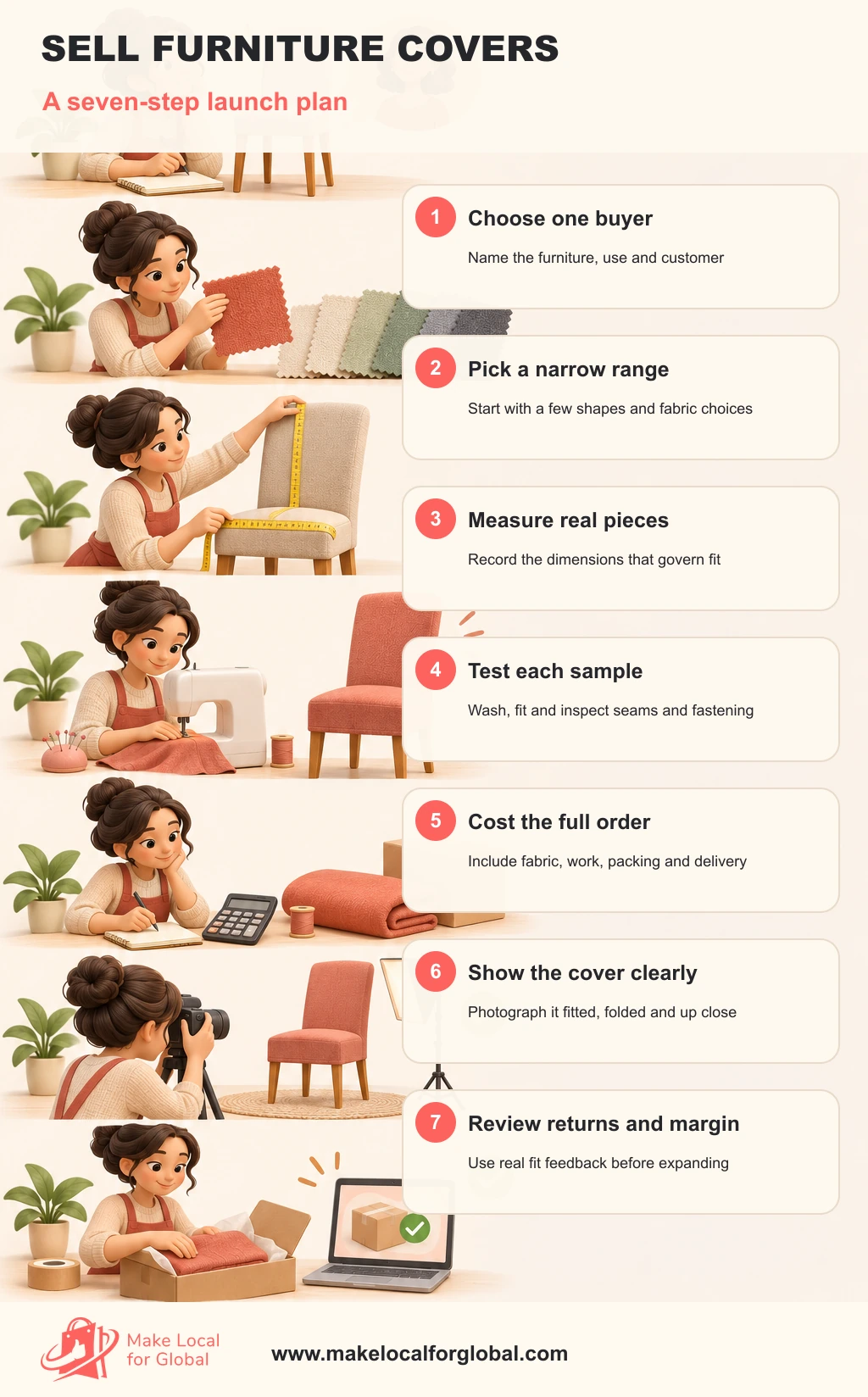
Furniture shapes vary. State the exact range you tested and name the features that affect compatibility. Do not treat stretch as a substitute for a measurement guide.
Every new shape adds samples, documentation and stock decisions. Start with an offer you can inspect consistently, then add a pattern when customer demand and production capacity support it.
Small, medium and large only help when linked to clear furniture dimensions. Show where to place the tape and which shapes are excluded.
Pattern work, labour, packaging, delivery, fees, rework and customer acquisition all affect the order contribution. Calculate them before setting the retail price.
Words such as waterproof, stain-proof, pet-proof or fire-safe need appropriate evidence and careful scope. Describe observable features when performance has not been validated.
Customers need to know what is made to order, when it should arrive and what happens if it does not fit. Present the policy before checkout and comply with applicable rights.
The side, rear and fastening often explain whether the cover will work. Show those details and the furniture dimensions used in the fit test.
Begin with one shape you can measure and sample, such as a defined dining-chair type or a specific outdoor bench format. Choose based on buyer questions, supplier access and your ability to explain fit. Do not start with every furniture category at once.
Measure representative furniture at the points used by the pattern, document the accepted ranges and test the sample on examples near the range limits. Show the tape position and fastening. State exclusions plainly.
Stretch may accommodate some variation, but it does not make all shapes compatible. Recovery, seam strength, fabric opacity and ease of fitting need checking. List the tested furniture dimensions and shape limits.
Yes, if you can collect dimensions reliably, make the pattern or adjustment consistently and explain price and lead time. Build a measurement form and confirmation step before production. Check consumer rules for the exact customisation and cancellation terms; do not assume every size selection is personalised manufacture.
The amount depends on sampling, pattern development, tools, production minimums, packaging, photography and stock strategy. Price the first test range and estimate cash needed before orders are paid out. A made-to-order pilot can reduce inventory, but still has sample and setup costs.
Show the cover on the intended furniture, front and side views, fastening details, texture, dimensions and care or packaging information. Keep the images accurate to the actual sample and avoid edits that make a cover look more fitted than it is.
Fibre composition rules apply to many textile products in the UK. Check the current rules for the product and market, use accurate composition data and provide required information in the proper form. Seek specialist advice if the product classification is uncertain.
Set out the applicable cancellation, return and faulty-goods process clearly, using current rules for your sales market. Some personalised goods may qualify for a limited cancellation exception, but standard size variants are not automatically custom-made. A policy cannot remove statutory rights.
Selling furniture covers online is a product-information and operations task as much as a design exercise. Choose a defined furniture type, write a measurement system around real examples, test fabric and stitching, and calculate every order cost. Then make the listing answer fit, care, delivery and returns questions before checkout.
Begin with one small, well-documented range and learn from actual questions and orders. Add a new shape when you can make and support it to the same standard. That measured approach gives customers a clearer way to choose and gives you better information for deciding what to produce next.
Review buyer demand, supplier reliability and real order contribution before committing to more shapes or stock.
PREFERRED SOURCE
Like what you’re reading? Add Make Local for Global as a preferred source on Google to see more of our articles when you search.

Build your online presence without having to figure out everything yourself.