READY TO SELL Food Storage Containers ONLINE?
Get a store built for you in 5 days, plus training and support to help you start, run, and grow your Alternative business.

Plan a food storage range around a clear buyer, verified materials, measured capacities, sample checks and a full cost model from supplier to customer.


A food storage container is a simple product to recognise and a surprisingly detailed product to sell. Buyers need to know what material touches their food, whether each lid fits, how much a container holds, what the care limits are and whether a set will arrive intact. A listing that says “airtight, microwave safe and leakproof” without evidence can create costly returns and safety concerns.
Selling food storage containers online works best when you choose a clear buyer and storage job, compare a small set of materials and sizes, obtain product-specific food-contact information, inspect the sample and calculate the complete cost of each order. This article gives a UK-focused process for planning that first range. The legal and market requirements depend on product design, destination and your role in the supply chain, so confirm current requirements with the relevant authority or a qualified adviser before placing stock.
Turn one real storage task into a focused offer with clear dimensions, verified materials and a product page buyers can compare.
Food storage containers sit in several customer jobs. A student may need stackable lunch tubs for a small fridge. A household may want leak-resistant containers for leftovers. A meal-prep buyer may care about portion sizes and repeatable capacity. Someone organising a pantry may be comparing clear, space-efficient boxes rather than containers for hot food. These are different reasons to buy, and they call for different product details.
Begin with a one-sentence buyer description: “I want to help [person] store [food or meal] in [place or situation] with [verified benefit].” For example, “I want to help commuters carry prepared lunches in a small bag with clearly stated dimensions and a sample-tested closure.” This is a hypothesis. Use interviews, marketplace questions, review themes and a small landing-page test to see whether people understand and value the offer.
Do not make a benefit a promise before you can support it. A clip lid may look secure but still leak when the container is tipped. A box may be labelled “food grade” by a supplier without evidence tied to the finished product. Write down the buyer question and what would prove the answer before choosing a supplier.
List the likely contents, where the item will be used, how it will be transported, how it will be cleaned and how it will be stored when empty. A container for dry pasta may not need the same seal, temperature limits or material as a container that holds soup in a work bag. A pantry jar and a microwave lunch box might share a material, but they answer different shopping questions.
Use real language from potential buyers. Ask what they currently use, what fails, which sizes they reach for, how they wash the product and what they would need to see before paying. Read reviews of competing products to collect themes such as “lid is hard to clean”, “does not stack”, “too large for my lunch bag” or “capacity was unclear”. Treat every review as one observation. It does not establish how common that experience is.
Record the evidence in a small table: buyer type, job, current alternative, stated frustration, buying trigger, price context and next question to test. Interview several people who match the buyer you have in mind, not just family members who want to encourage you. A page with two or three clearly explained options can test interest, but a click is weaker evidence than a purchase or a paid pilot.
Household consumers and cafés, caterers or meal-prep businesses can need different quantities, formats and records. A consumer might buy a three-piece nested set. A small food business could need uniform stackable tubs, replacements, case pricing and delivery on a schedule. Business buyers may ask for dimensions, capacity, temperature limits, documentation and repeat stock availability before considering a sample.
Choose one primary customer for the first test. Trying to serve a home cook, a restaurant, a school and a meal-prep company with one unstructured catalogue can multiply pack sizes, selling terms, support questions and stock commitments. Add a second route only when you can describe its requirements separately and support them with product evidence.
Material affects weight, breakage risk, care instructions, appearance, shipping cost and the evidence you need from a supplier. Avoid declaring one material universally best. The finished container, lid, seal, colourants, coatings and intended use all matter.
Glass can help buyers see what is stored and can feel substantial on a kitchen shelf. It is heavier and more likely to break during fulfilment than many plastic options. Ask what type of glass the product uses, whether the lid or gasket contains other materials, and which temperatures or uses the maker supports. Do not use “heatproof” or “oven safe” from appearance alone.
Inspect the rim, corners and base under good light. Check whether lids remain usable after the glass is removed for cleaning, and whether replacement lids can be ordered by the exact model. Measure the packed unit. A set of glass containers can move into a more expensive parcel band and require protective dividers that change the landed cost.
Plastic products can be light, stackable and economical to ship. The word “plastic” does not identify a single material or prove that a container is suitable for every food or temperature. Request the exact polymer or component information from the manufacturer, the conditions of intended use and the records supporting the food-contact claim. If recycled material is used, ask which components contain it and what evidence applies to the intended food-contact use and market.
Check the base, lid, hinges, clips, corners and printed marks. Some buyers care about staining, odour retention or surface scratches, so test representative foods and cleaning methods only where the supplier’s instructions support that use. Do not make “BPA-free”, “non-toxic”, “chemical-free” or health claims without precise, current substantiation. A single label or generic supplier certificate does not establish every claim for every SKU.
Stainless steel can offer a durable-looking option for dry goods or packed meals, though construction and lid design vary. Confirm the grade and construction of each relevant component rather than relying on “stainless” as a full specification. Ask whether the lid uses plastic, silicone, a coating or another material, and whether a seal is included. Clarify that a metal container may not be suitable for microwave use unless the manufacturer explicitly says otherwise for a specific product design.
Check for sharp edges, rough seams, uneven rims, corrosion marks, rattling lids and sharp corners. Weigh each size. A heavy lunch container may be a poor fit for a customer who prioritises a lightweight bag, and added weight affects postage.
Silicone may appear as a gasket, lid, collapsible body or accessory. Confirm the exact material and model, its intended use and the manufacturer’s temperature and care instructions. The seal’s fit depends on the container rim, so a lid that stretches over one box cannot be assumed to fit every product in the range.
Inspect whether a gasket can be removed for cleaning, whether it sits evenly after refitting and whether replacement parts are available. If the container uses several materials, request information for each food-contact component. A product page should identify the parts clearly rather than describe the complete set with one broad material label.
A container is a system. Its base, lid, hinge, latch, gasket, insert and any divider can have separate dimensions and materials. Ask the supplier to identify the exact compatible lid for each base and whether the part is included in every variant. Show the set contents in a photograph and list them in text so a customer does not mistake a prop for a supplied item.
Do not call a container “airtight” or “leakproof” unless the maker supports the intended claim and your own sample checks match the stated conditions. Define the test you performed: what liquid or food was used, how long it was stored, whether the container was upright or tipped, and what result you observed. An informal sample check helps assess a product; it is not a universal performance certification.
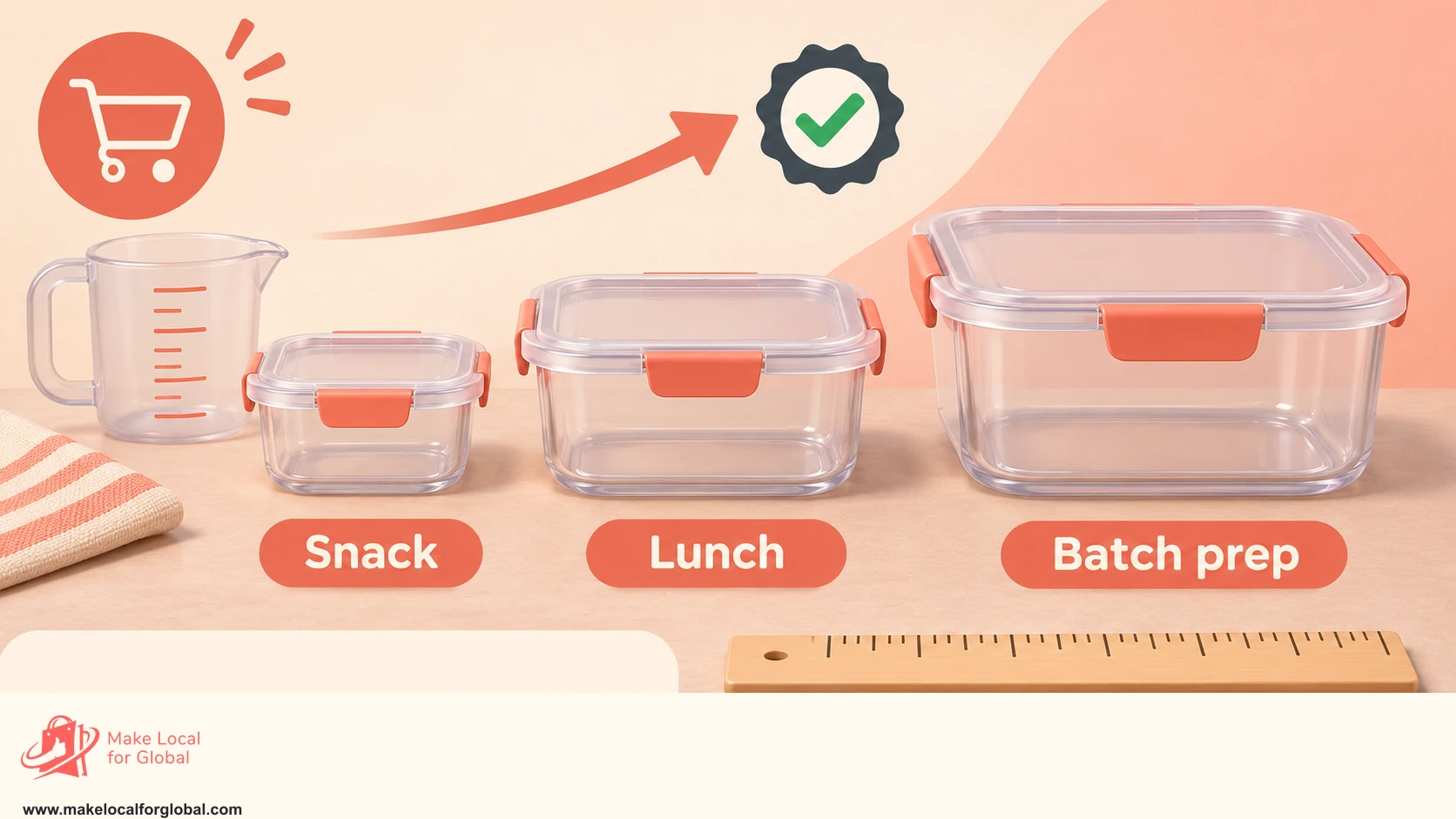
A clear first range might include a small snack container, an everyday lunch size and a larger leftovers or batch-prep option. Another route is one base shape with two capacities and matching lids. These are starting patterns, not fixed rules. Use measured capacity and dimensions from the specific sample rather than guessing from a photograph.
Suppliers may state millilitres, fluid ounces, external dimensions or “small, medium and large”. Give shoppers the information they need to picture the container in a lunch bag, fridge shelf or cupboard. Record usable internal capacity when it can be measured consistently, external length, width and height, lid height, product weight and the packed size.
If you test capacity with water, state how you measured it and whether you filled to the rim or to a practical usable level. A nominal 700 ml capacity does not tell a shopper whether the container suits a 700 ml meal when it needs headspace or a different food shape. Use photographs beside a common object or a ruler to make scale clear, but keep measurements as the primary evidence.
The entry option should be easy to try and inexpensive enough to test without undermining the per-order economics. A core set can solve a regular storage job, while a larger bundle may suit households or gift buyers. The three offers should feel like steps within one reason to buy, not unrelated containers collected from different catalogues.
Compare each offer by use, materials, capacity, included components, packed weight, supplier minimum and contribution. A multi-piece set may raise order value but increase the carton size, breakage exposure and cost of returning one damaged item. A single container may ship cheaply but leave too little contribution after fees. Model each offer before choosing.
Every colour, lid style, shape and pack count creates another stock record and another chance of a mismatch. Begin with the smallest set of options that tests the buyer question. Add a colour or bundle when customers request it and the supplier can keep materials, shade, model and lid fit consistent. A long dropdown does not make a weak product range more useful.
Write the first range specification in a shared document. Include the target buyer, use, material by component, dimensions, weight, capacity, closure type, care limits, supported claims, intended market and pack contents. Use that same specification when you compare suppliers and inspect samples.
Potential sources include UK kitchenware wholesalers, specialist packaging or homeware distributors, trade fairs, manufacturers and sourcing platforms. A domestic wholesaler may offer faster replenishment or a lower minimum. A direct manufacturer may allow more control over dimensions or packaging but can bring higher minimums, longer lead times and more responsibility for checks and import administration. Compare the real offer rather than assuming one route is cheaper.
Request quotes for the same item specification and quantity. Ask for unit price, sample price, minimum order, carton quantity, lead time, freight terms, packaging dimensions, replacement-part availability, defect handling and payment conditions. Ask how the supplier will notify you of changes to material, manufacturing site, tooling, lid, gasket, packaging or test documentation.
Check that the company name on the quote, invoice and product information is consistent. Keep copies of the supplier answers, technical documents, sample photographs, invoices and your own inspection notes together by SKU. If a document names a different model, material or factory, ask the supplier to explain the link before ordering.
Internal examples can help you compare adjacent products: selling bento boxes online raises similar questions about compartments, capacity and sets, while selling bamboo cutlery online shows how a material claim should map to the actual product components. For a different kitchen use case, see selling cocktail mixers online.
Food storage containers are food-contact materials because they are intended to hold food. The Food Standards Agency defines food-contact materials to include containers, packaging and kitchenware. The applicable rules depend on material, market and supply-chain role. For Great Britain, read the FSA food-contact materials authorisation guidance and its guidance on food-contact material authorisations. These explain which materials are subject to specific authorisation processes. They do not provide a blanket approval certificate for a finished container.
Ask the supplier for written, product-specific information. It should identify the manufacturer, model, food-contact components, intended food types and conditions, and the relevant supporting declarations or test reports. A declaration, test report or positive-list reference has a scope. Confirm that it applies to the finished item and the market you plan to serve. For a plastic item, do not assume that one test covers every colour, lid, gasket, recycled component, temperature or contact duration.
Check Great Britain and Northern Ireland separately. GOV.UK explains that the general product-safety rules differ by jurisdiction, with separate guidance for GB and NI. The Great Britain product-safety guidance and Northern Ireland guidance on Regulation (EU) 2023/988 help identify the relevant general safety framework. Product-specific food-contact rules may apply alongside general safety obligations. If you import directly or make a private-label product, ask a qualified compliance adviser which obligations attach to your role.
Food-contact compliance is not established by a logo that looks official, a generic “food grade” phrase or a supplier’s claim that an item is popular. Keep records, trace supplier and product batches, and have a plan for complaints, corrective action and a product safety concern. If the supplier cannot provide clear evidence for a material or claim, pause that SKU rather than making the claim yourself.
This article is practical business information, not a legal opinion or laboratory assessment. Check current regulator guidance and obtain product-specific advice before advertising or selling a new food-contact product.
Order the exact model, colour and lid combination you intend to list. Photograph the unopened parcel and retain the packaging label, batch details and supplier documents. Use a written inspection sheet so you compare samples with the same steps and do not rely on memory.
Look for cracks, sharp edges, rough seams, bubbles, warping, uneven rims, stains and strong unexplained odours. Measure external length, width, height and weight. If capacity matters to the use case, measure it using a repeatable method and distinguish brim-full volume from practical fill volume. Compare the result with the supplier specification and record any difference.
Stack several units if the range claims nesting or stackability. Check whether they sit securely, separate without force and store in a realistic cupboard or fridge space. Photograph how the bases nest and whether the lids stack separately. A product that stacks in a supplier image may still jam or take more room than expected.
Match each lid to its exact base. Look for gaps, warped edges, inconsistent clips, stiff hinges, loose corners or gaskets that twist. Close the container using the manufacturer’s instructions. Repeat the action with several samples if the order size warrants it and record how many passed.
If you perform an informal leakage check, describe it narrowly. Use a cool, non-staining liquid with the container upright in a tray, then follow with a controlled tilt only if the product is intended for that use. Photograph the setup and result. This does not prove the product is leakproof under every food, pressure, temperature or journey condition. Do not test in a way that could create a spill hazard or misrepresent a supplier specification.
Follow the supplier’s written instructions for washing. Check whether the gasket or insert is removable, whether food residue can lodge in corners, whether the lid can be placed in a dishwasher and which rack or cycle the maker specifies. Do not run a product through a dishwasher, freezer, oven or microwave based on a competitor’s claim. A sample check can inform your buying decision, but it cannot replace required compliance evidence or a manufacturer’s stated limit.
If you compare before-and-after appearance, photograph the same surface under the same light and describe the process. Avoid broad claims such as “stain proof” or “never retains odour”. Use factual wording that matches the evidence, such as “supplier instructions say to hand wash the seal”.
Lay out the complete set. Count bases, lids, seals, dividers, bags, care cards and spare parts. Check that the packaging protects corners and glass edges, that the model label matches the sample, and that the instructions do not contradict the product page. Take photographs from above, side and base so the listing can show the parts that matter.
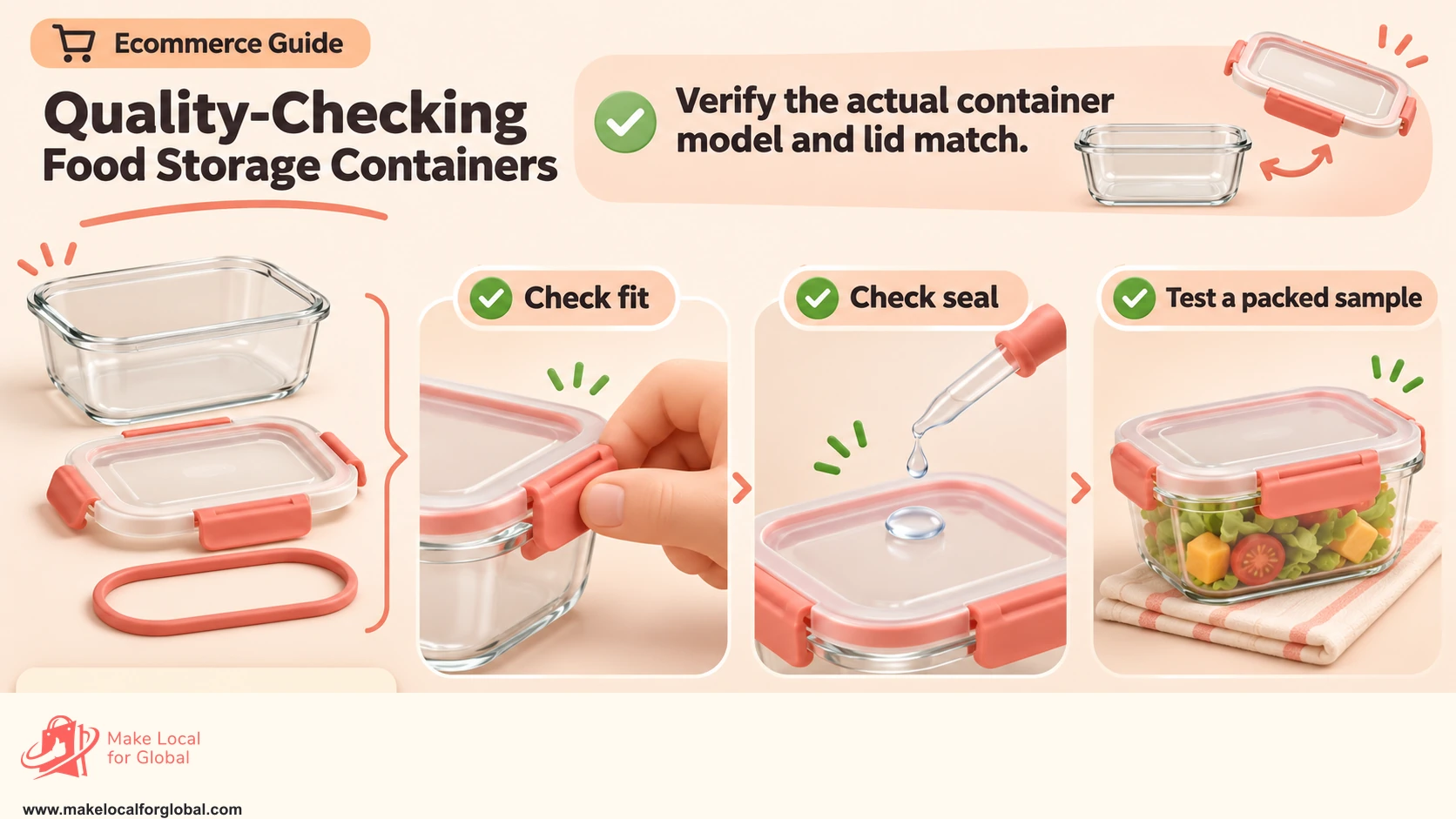
Weigh and measure the packed product, not just the container. Pack a representative order using the materials you expect to use. Check whether lids shift, glass edges touch, clips press into another item or nested pieces rattle. Record carton dimensions and the weight that a carrier will bill.
For glass, test the protective layout with a packaging provider or a documented handling plan appropriate to the shipment. A single drop from one height does not prove a parcel will survive every courier route. For plastic or metal, check that pressure from other items does not crack lids or deform clips. Save photographs of the packing steps so someone else can reproduce them.
Ask the carrier or fulfilment provider for current parcel prices and size bands before setting a free-delivery threshold. Include void fill, dividers, tape, labels, pick-and-pack charges, storage fees and surcharges. Recheck the packed unit after any set, carton or carrier change.
Supplier unit price is only one part of a sale. Count product, inbound freight, insurance, import charges where relevant, packaging, fulfilment, transaction fees, delivery, marketing and a realistic allowance for returns or damage. Keep launch photography, samples and website costs separate from recurring per-order costs, then decide how to allocate those fixed costs when reviewing the business.
The worked example below is hypothetical. It is not a quote, market average, recommended price or promise of profit. It assumes one set containing three containers, sold to a UK customer for £29.99 including VAT, by a seller registered for VAT at 20%. The actual VAT position, transaction and recoverable input VAT must be checked with an accountant.
| Cost or revenue line | Illustrative amount | Replace it with |
|---|---|---|
| Customer payment including VAT | £29.99 | Your tested price and tax treatment |
| Net revenue after 20% output VAT | £24.99 | Your actual VAT position |
| Container set and supplier packaging | £6.00 | Quote for the exact model and quantity |
| Inbound freight and allocated import costs | £1.20 | Freight, insurance, duty and handling |
| Protective outer packaging | £1.10 | Tested carton, dividers, tape and labels |
| Payment and platform fees | £2.10 | Fee schedule at the planned checkout price |
| Outbound delivery cost after customer charge | £3.50 | Carrier quote less delivery income |
| Returns and damage reserve | £1.50 | Your actual return and breakage data |
| Variable customer acquisition cost | £4.50 | Measured cost from the chosen channel |
| Illustrative variable cost total | £19.90 | Recalculate from actual orders |
| Contribution before fixed overhead | £5.09 | £24.99 net revenue minus £19.90 |
The arithmetic is: £29.99 ÷ 1.20 = £24.9917, rounded to £24.99 net revenue. The listed costs total £19.90. £24.99 − £19.90 = £5.09 contribution before rent, software, insurance, accounting, staff, tax on profit, owner time and any other omitted costs. This contribution is not net profit.
If the seller is not VAT registered, the calculation may differ. If the sale is through a marketplace, fees may be charged on shipping or tax-inclusive amounts. Confirm the actual fee basis and tax treatment before using the result. Do not remove a return reserve just because the first few orders arrive intact. Replace the assumption with observed rates as data accumulates.
Run a separate model for one container, a three-piece set and a larger bundle. A larger order could improve the average order value yet push the parcel into another carrier band. The customer may return the full set if one lid is missing. A lower single-item price can still work if shipping and acquisition costs leave adequate contribution, but verify through a real test.
At minimum, compare a cautious, expected and strong case. Change conversion, order value, shipping, acquisition cost, breakage, returns and supplier price. Ask how much cash is tied up in the minimum order and how long a replenishment will take. Add a stop rule, such as not reordering until a measured share of the first batch sells at the contribution level you accept and the complaint rate stays within your tested range.

Count inbound costs, protective packaging, carrier charges, platform fees, customer acquisition and returns for each pack size.
Product copy should let a shopper decide whether the container fits a real kitchen task. Do not copy a supplier title full of generic claims. Give each model a distinct name, useful specifications, care limits, included parts, delivery information and return details.
Example title: “Three-Piece Glass Food Storage Set, 400 ml, 800 ml and 1.2 L”
Example opening: “A set of three stackable glass containers for storing prepared food and leftovers. Each box includes a fitted lid. Check the measured dimensions below before ordering. Use and care limits follow the supplied manufacturer instructions.”
Use that copy only if the actual set, capacities, compatibility and contents match. If a supplier documents microwave use for the container body but not the lid, state that distinction clearly. A title should not imply that every component has the same temperature or care rating.
For every variant, show the external dimensions, measured usable capacity and product weight. Identify material for the body, lid and seal. List the number of pieces, whether lids are included, how they close, how to clean them and the supplier’s supported use limits. Mention whether the items nest or stack only if you have checked that feature.
If a container is sold as a set, give a table rather than a single capacity for the whole pack. Explain how each size can be used without promising that one size fits every meal. Tell the buyer if photos include a plate, food, cutlery or another item that is not supplied.
Photograph the set from above, from the side, with lids off and with lids fitted. Include a scale reference and a separate image for each capacity. Show the seal or clip close-up, a stack or nested view, the base markings and the complete box contents. Use the same angle and lighting across sizes so buyers can compare without interpreting a styling scene.
Write alt text for what an image actually shows. For example: “Three clear food storage containers with fitted coral lids beside a ruler, arranged from small to large.” Do not repeat a keyword in every image description. If an image is a render rather than the exact stock item, label it accurately and do not imply it proves the construction of a product you have not checked.
The buyer should not need to guess whether the product can go in a microwave, dishwasher, freezer, oven or hot-fill process. State each claim separately and identify whether it applies to the body, lid, gasket or full assembly. If you cannot confirm a claim for the exact model, omit it and invite the supplier to provide written instructions.
Describe care in plain terms taken from the maker’s directions. If a seal must be removed before washing, say so. If the maker sets a temperature limit, name the component and the condition. Do not convert “resistant to” into “safe for every use”. Do not present laboratory or conformity paperwork as a consumer certification unless the source explicitly authorises that wording.
Your own online shop gives you room to show material details, capacities, care and set comparisons. It still requires you to attract relevant visitors, set accurate policies, manage checkout and fulfil orders. A new store can test a focused range, but should not rely on a large catalogue to create confidence.
Marketplaces can expose an offer to existing shoppers. Check their current category rules, image requirements, prohibited claims, fee schedule, fulfilment charges and returns process before choosing a channel. A high sales rank or many reviews on a competitor page does not prove that your version will sell at your target cost.
Local kitchen shops, zero-waste stores, lunch-prep sellers and small food businesses may be useful wholesale prospects. Ask what specifications, case quantity, barcode, pack format and evidence they need. Wholesale pricing must leave a viable margin for both businesses, so calculate contribution at the trade price and your fulfilment terms.
Use a single main channel for the first launch unless a clear test needs a second. Keep stock counts synchronised and make delivery dates consistent. A marketplace and a direct shop may have different price structures, customer data access and service expectations; write those down before committing.
Search phrases should match the product and question. Potential wording includes “glass food storage containers with lids”, “stackable lunch containers”, “leak resistant meal prep tubs”, “food storage container capacity” and “replacement lids for [model]”. These are ideas to validate with keyword tools, customer questions and search performance, not guaranteed search volume.
Use one clear main phrase in the title, URL, opening and a relevant heading. Add related terms only where they describe a real difference. Avoid making separate near-identical pages for each colour when the specifications and buyer task are the same. A collection page can compare a range; a product page can describe one exact model.
Useful content ideas include how to measure fridge-shelf space, choosing container capacity for a lunch bag, comparing stackable and nesting designs, cleaning removable seals, what to check before buying a glass set and why the lid material matters. Base every recommendation on product evidence and make clear where a feature varies by model.
Link helpful pages naturally. A reader planning a lunch set could compare bento boxes. Someone building a food-prep range may find the bamboo straws or cheese graters product examples useful for thinking about material, cleaning, packaging and complementary products. Use internal links because they answer a related question, not to add repetitive anchors.
Track impressions, clicks, product-page engagement, add-to-cart rate, completed orders, questions, refunds and damage reports. A high page view count without sales may signal that the offer, price, evidence or delivery cost needs work. A return pattern tied to lid fit may call for a better compatibility check or clearer photographs. Use observations to improve the page and product selection.
Set a reorder point based on stock sold, supplier lead time, minimum order, available cash and defect experience. Keep lids, seals and bases identifiable by model. Do not substitute a visually similar lid without checking the fit and intended use. Store glass where it cannot strike hard edges, and protect products from dust, heat, moisture or stacking pressure if the maker’s directions require it.
For each order, scan or record the model, quantity, lid and insert count. Use a packing checklist that records carton size, protective layout and the final parcel weight. Photograph any damage claim with the product, packaging and shipping label before replacing or refunding, while keeping the customer service process fair and clear.
Online customers have information and cancellation rights. Read current GOV.UK online and distance selling guidance and returns and refund guidance before writing your policies. Requirements can depend on the product, seller, transaction and market. Do not use a blanket “no returns” line to remove statutory rights.
Create a support script for the questions most likely to affect a purchase: What fits in the box? Is the lid included? Which component can be washed in a dishwasher? What is the exact outer size? How is a missing gasket replaced? What should the customer do if glass is cracked on arrival? Answer from the supplier’s instructions and your actual process. Escalate a credible safety concern to the supplier and appropriate authority rather than treating it as an ordinary return.
This timeline is a planning tool, not a promise that a new store will be ready or profitable in a month. Extend it when documentation, samples, testing or supplier answers need more time.
Talk with potential buyers about the containers they use, where they store them and what failed. Review competitor questions and returns themes. Write a product specification with material, capacities, dimensions, closure, intended use and required supplier evidence. Select one primary customer and no more variants than you can inspect.
Measure the likely parcel and choose a maximum landed cost that could work in a cautious model. Note the claims you will not make until verified. By the end of the week, have a short list of suppliers and a written buyer hypothesis to test.
Send the same questions to each supplier. Compare model-level documents, response quality, minimum quantities, sample price, lead time, packaging and defect process. Pause suppliers who cannot identify the model or components. Order samples only after their intended use and evidence are sufficiently clear for a preliminary review.
Record the agreed specification, model, colour and lid. If the sample differs from the quote or documentation, do not assume it is harmless. Ask the supplier to reconcile the difference before approval.
Measure and inspect the sample using a written checklist. Record closure, stack, cleaning and packaging checks. Keep informal observations separate from formal compliance documents. Obtain current carrier pricing for the packed product. Replace estimates in the cost sheet with written supplier and fulfilment quotes.
Create product photographs from the actual sample. Write a draft listing with all sizes, materials, components, care limits and delivery details. Ask a few people in the target buyer group to tell you what they think they are buying after reading the page. Correct any detail they misread.
List a limited quantity through the chosen channel. Use a modest, measured traffic test that fits your cash plan. Record traffic source, order conversion, questions, shipping cost, packing time, damage, cancellations and returns. Ask for honest product feedback without paying for positive reviews.
At the review, decide whether to continue, revise, reorder or stop. Reorder only if demand, contribution, supplier reliability and product evidence support the next batch. If shoppers keep asking whether lids fit, add a model-specific compatibility image. If packing takes longer than the cost model allows, adjust the process or price before scaling.

Choosing products from photographs alone. Photos hide actual capacity, lid fit, weight and materials. Order the model you intend to list and compare it with its documents.
Treating “food grade” as proof for every use. Ask what the phrase means, which model it covers and which food or temperature conditions are supported. Remove claims you cannot substantiate.
Assuming lids are interchangeable. Similar shapes may use different rims or clips. Identify each lid and base by model and photograph the supplied combination.
Advertising microwave, dishwasher or freezer use by guesswork. Apply each claim only to the component and conditions confirmed by the manufacturer. A container and lid may have different limits.
Starting with too many colours and capacities. Every variation ties up cash and adds stock and support complexity. Test the buyer task with a short, coherent range first.
Using a low supplier price as the whole margin calculation. Add inbound freight, packaging, carrier charges, marketplace fees, acquisition costs, returns and damage.
Skipping a parcel test. A set that looks inexpensive can become costly after protective packaging or a carrier size surcharge. Measure the packed order.
Using generic photos that do not show the exact components. Show the lid, seal, dimensions, stack and pack contents. Label props that are not included.
Using health or safety claims to make a listing sound stronger. Use specific, supported material information and obtain expert review for any claim with regulatory implications.
Buying a large first quantity before checking the evidence. A low minimum price does not compensate for poor documents, inconsistent samples or a mismatch with the buyer.
It can be, but the category does not determine the result. Calculate net revenue and subtract the container, inbound cost, packaging, selling fees, delivery, customer acquisition and a realistic return or damage reserve. Add fixed overhead before assessing profit. Use real quotes and replace early assumptions with order data.
Choose a small range for one buyer and one storage task. A lunch-focused offer might start with a measured snack size, an everyday container and a larger meal box. Confirm materials, capacity, lid compatibility and care limits for every model before listing.
There is no single best material for every buyer. Glass can be heavy and needs careful packing, plastic varies by polymer and intended use, stainless steel needs clear component details and silicone is often part of the seal or lid. Choose based on buyer needs, supplier evidence, sample results and delivery economics.
The phrase alone does not show which model, component, food type or use conditions are covered. Request written records identifying the manufacturer, exact product, food-contact materials, intended conditions and supporting declarations or reports. Ask a specialist if the scope is unclear.
Only when you have evidence that supports the exact claim and the stated conditions. Confirm the supplier’s method and check a sample using a recorded process. Say what was tested and avoid suggesting that an informal test proves every container will remain leakproof in every position or journey.
Use those claims only when the manufacturer’s instructions support them for the exact model and component. A lid, gasket and base may have different limits. State the relevant conditions plainly and avoid extending a claim from one size or colour to every product.
The duties depend on your role, product and destination market. Ask the supplier for records tied to the exact model and retain your supply-chain information. Importers and private-label sellers may have additional duties. Check current official guidance and obtain advice for your situation.
Use the fewest sizes that test the buyer need. Two or three can be enough when each has a clear job and the supplier can provide reliable dimensions and documentation. One well-supported SKU may be a better test than several unverified variants.
Compare both offers. Sets can raise order value but add packing, shipping and return complexity. Individual items can lower the trial cost but may not cover the postage. Model the packed order and test buyer preference rather than assuming a bundle will perform better.
Measure the packed product, protect edges, prevent movement and show exact dimensions and contents. Follow the manufacturer’s instructions for use and care. Track return reasons so you can distinguish a product issue from unclear sizing, missing parts or parcel damage.
Possibly, but an importer may have specific product-safety, food-contact, traceability and documentation duties. Great Britain and Northern Ireland do not always use identical arrangements. Confirm the obligations for the exact product, market and supply route before committing to stock.
Base the quantity on the minimum order, cash available, replenishment time, sample confidence and measurable demand. Model what happens if only a portion sells, if delivery costs rise or if a batch has a defect. Set a reorder condition before launching and avoid treating an optimistic sales forecast as proof.
Food storage containers sell on details buyers can check: the material of each component, actual capacity, lid fit, care limits, packed size and what arrives in the box. Choose a narrow use case, request evidence for the exact model, inspect samples with a written routine and calculate costs through delivery and returns.
Start with a small offer that can teach you whether the product and page answer a real buyer need. Record questions, delivery outcomes and contribution after each order. Use those observations to improve or expand the range, and keep unsupported claims out of the listing.
Review buyer questions, parcel outcomes and contribution before you add another size or material.
PREFERRED SOURCE
Like what you’re reading? Add Make Local for Global as a preferred source on Google to see more of our articles when you search.

Build your online presence without having to figure out everything yourself.