

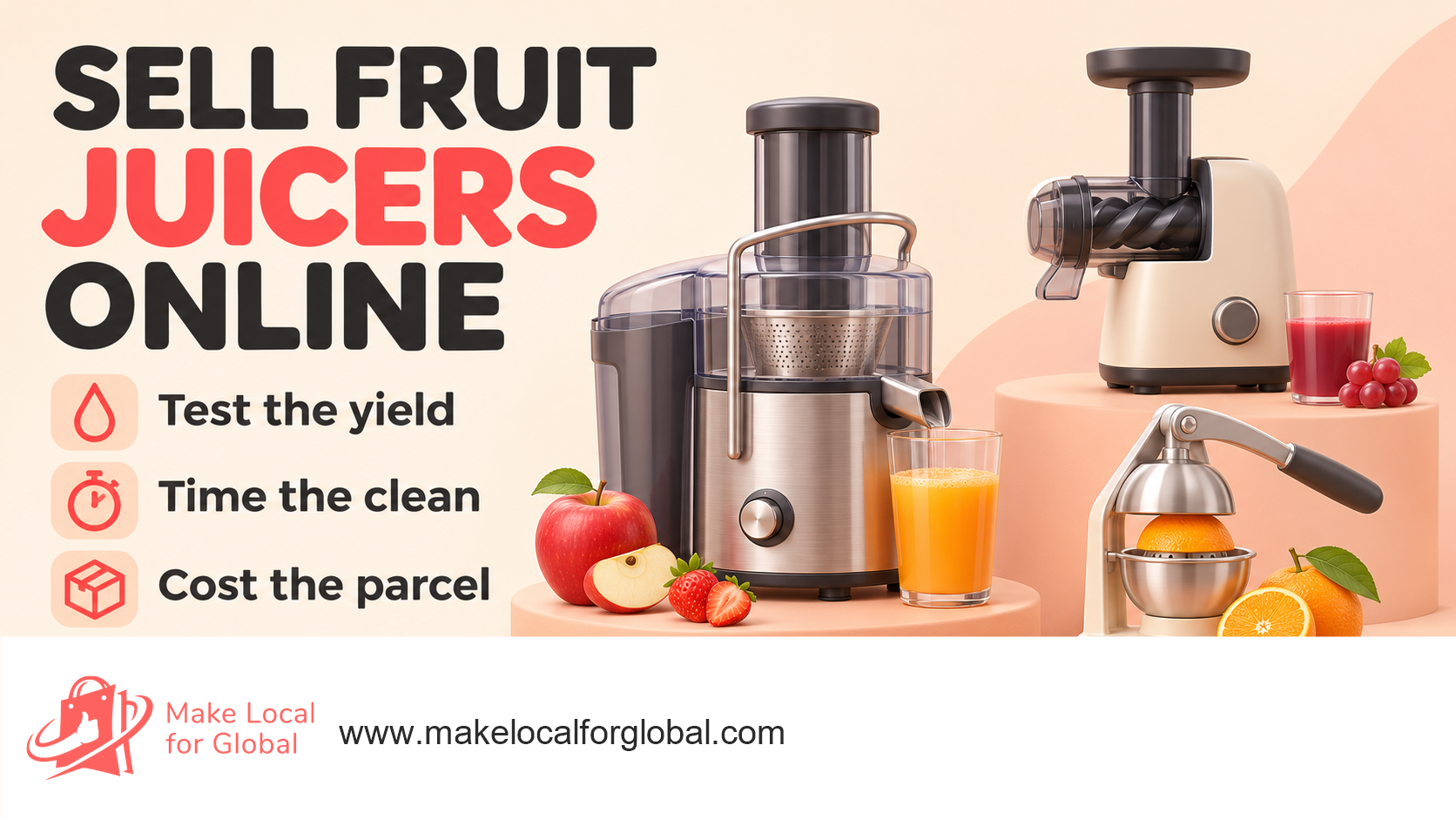
READY TO SELL Fruit juicers ONLINE?
Get a store built for you in 5 days, plus training and support to help you start, run, and grow your Alternative business.

Sell fruit juicers online by choosing a buyer, checking suppliers, testing yield and cleaning, costing delivery and preparing a clear product page.

A fruit juicer looks simple in a product photo. For a new seller, the hard questions sit behind the photo: who needs this machine, what ingredients can it process, how much juice does a repeatable test produce, how long does cleaning take, and what paperwork proves the electrical and food-contact parts are suitable for sale?
Fruit juicers can be a good fit for an ecommerce shop that can explain those details clearly. A product page built around verified measurements, assembly, cleaning and support can help a buyer choose between a citrus press, a centrifugal model and a slow juicer. A vague claim such as “more juice” or “easy to clean” gives the buyer little to judge and can create avoidable returns.
Start with one buyer and one routine. Get a saleable sample, test it with the same produce and method each time, record what happened, and cost the packed order before placing a larger stock order. This keeps the first range focused and gives your product page facts that come from the product you intend to sell.
Match a juicer type to a real buyer routine, then list the questions to answer with a working sample.
Fruit juicers serve different routines. Someone who wants a glass of fresh orange juice at weekends may need a simple citrus press. A household making juice from apples, carrots and beetroot may compare a centrifugal machine with a slower auger model. A café buyer may care about duty cycle, speed, cleaning between customers, spare parts and commercial-use support. Those are different offers with different costs.
Write one buyer statement before you compare suppliers: “I am testing a compact juicer for a renter who has limited worktop and cupboard space and wants to make one or two glasses at breakfast.” Replace the example with a buyer you can actually reach. The statement gives the sample test a job to do.
Speak with a small group of people who already buy juice or make it at home. Ask what they juiced the last time they used a machine, how many servings they made, who cleaned it, where it was stored and which step took the most effort. A recent example tells you more than “Would you buy a juicer?”
Ask whether the buyer wants whole-fruit convenience, a wide feed chute, quiet morning use, a small footprint, a pulp texture choice or a short wash-up. Each feature has a trade-off. A wider chute can reduce chopping for some produce, yet it does not remove the need to follow the maker’s instructions or check the machine’s safe-use limits. A compact appliance may be easier to store but have a smaller jug or pulp bin.
Notice what happens after the first use. A machine that is awkward to assemble or wash may stay in a cupboard. Ask people to show you where they would place it, what nearby sockets are available, how much worktop they have and how they store removable parts. Record the answers without turning one person’s preference into a market-wide claim.
Prepare a simple concept page or draft listing. State that the product is being evaluated, include a provisional price range, list only confirmed features and ask interested people to join a notification list with clear consent. Do not accept payment for stock you cannot supply on the terms shown.
Count high-intent actions separately. A relevant buyer asking about cleaning brushes, replacement filters, warranty support or dimensions is different from a casual social like. Record the question, which product type prompted it and what evidence you still need. If several buyers ask whether a component can go in a dishwasher, make that a supplier question. Do not turn a buyer’s question into a product claim.
Use supplier manuals and working samples to confirm how each mechanism operates. Product labels are not always consistent, and terms such as “cold press” or “slow juicer” do not prove juice yield, nutrition retention or cleaning time. Compare the complete machine, its instructions, parts and service route.
| Juicer type | Possible buyer use | Checks before listing |
|---|---|---|
| Manual citrus press | Small batches of orange, lemon or other citrus juice | Lever force, counter stability, fruit-size range, drips, removable cone and wash-up |
| Electric citrus juicer | Frequent citrus portions with powered reaming | Cone sizes, reverse action if fitted, pulp control, splash, jug markings and cleaning |
| Centrifugal juicer | Quick processing of firm produce such as apples or carrots | Feed chute, cutting basket, lid lock, pulp container, noise, foaming and cleaning access |
| Slow or auger juicer | A buyer comparing a slower crushing and pressing mechanism | Assembly steps, produce preparation, outlet blockages, reverse setting, screen cleaning and spares |
| Commercial juicer | A food-service operator with repeated use | Rated duty cycle, cleaning between jobs, service, warranty terms, capacity and suitability for the stated setting |
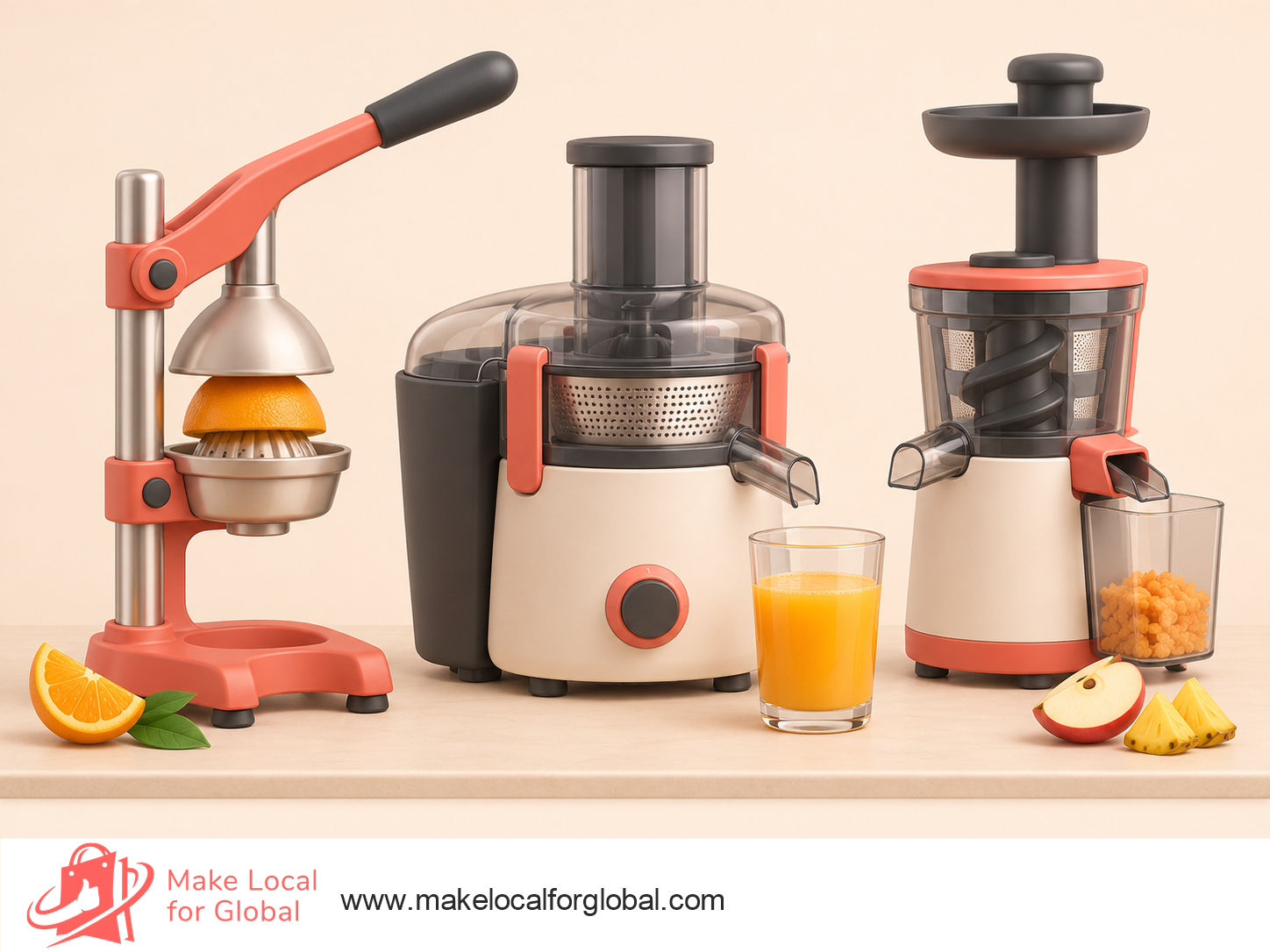
These are starting groups, not claims that every model performs the same way. Test the specific unit and use the maker’s current instructions. Describe a domestic model as suitable for commercial use only if its maker supports that use.
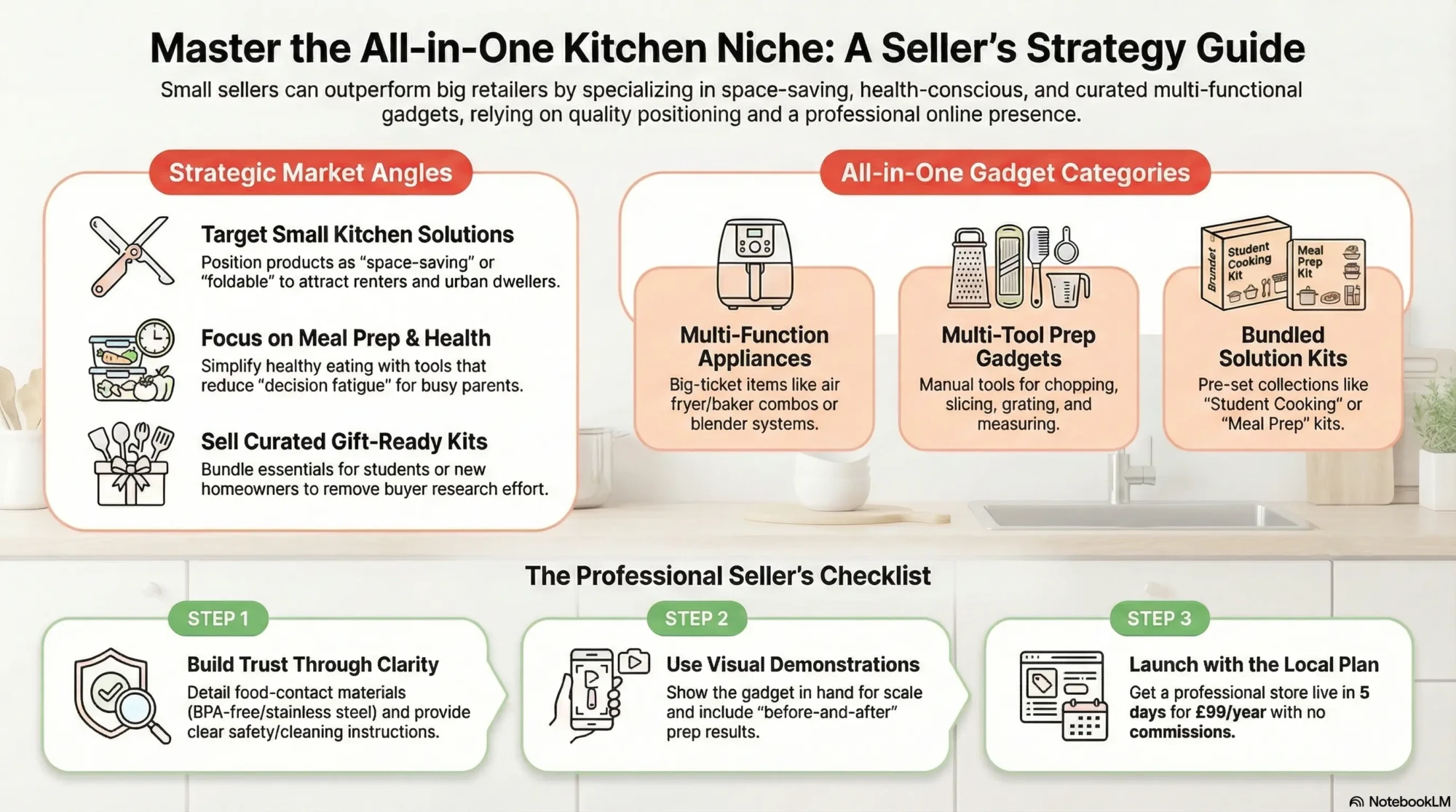
If you are planning a wider kitchen range, compare the product checks in our apple slicer selling guide and all-in-one kitchen gadgets guide. Each item needs its own test method, parts list and delivery costs, even when the customer shops in the same category.
Begin with one main product type and a small number of meaningful choices. A citrus press in two colours may be easier to stock and support than several unrelated mechanisms. A compact and a larger model can make sense if each has a clear buyer, measured footprint and verified capacity. Keep differences easy to explain on a comparison page.
Create a simple entry, core and higher-price structure only if the products are genuinely distinct. The entry model might use manual pressure and have fewer removable parts. A core option might include a powered reamer or larger jug. A higher-price model might offer another mechanism, verified parts or a support benefit. Explain each difference in plain language and show how the buyer’s routine changes.
Bundles should solve a real task. A bundle might combine the juicer with a compatible spare strainer, a cleaning brush or a measured glass jug. Check part compatibility with the supplier. Cost each bundle as a separate order: extra parts change carton size, packing time, stock control and likely support questions. A generic brush or storage bottle should not be called compatible until you have checked how it fits and what the maker permits.
Sourcing can mean buying from a UK wholesaler, importing a finished model, working with a manufacturer on a branded specification or arranging fulfilment through a supplier. Each route changes who handles stock, technical documentation, import records, customer service and returns. A supplier’s marketplace listing is not a complete product file.
Ask for the exact model number and version, photographs of the product label and packaging, English user instructions, parts list, warranty terms, business contact details and the identity of the manufacturer and importer. Ask which electrical safety, electromagnetic compatibility and restricted-substance requirements apply to the exact unit and request the relevant declaration and test evidence. Check that the documents match the motor, voltage, plug, attachments, model code and brand you will sell.
For parts that touch juice, ask the supplier what materials are used for the jug, strainer, auger, chute, seals and juice outlet. Request food-contact compliance documentation for the materials and intended conditions of use. A generic “BPA-free” line or a symbol on a product photograph does not answer every food-contact question. Keep the response against the exact component and model.
Ask who handles a safety complaint, replacement part, product withdrawal or recall. Clarify how the supplier identifies production batches, how long parts remain available, how a warranty claim is raised and who pays for a collection or replacement. Get key answers in writing before transferring a large payment or agreeing a private-label run.
Order a saleable sample through the same route and specification as the planned stock. Photograph the carton label, serial or batch code and contents before assembly. Compare the delivered unit with the approval photographs and paperwork. If a component, cord, plug, lid, strainer, colour or instruction sheet differs, pause and ask whether the production specification changed.
For larger orders, agree how you will check units at receipt. Set a basic incoming checklist for model identity, visible damage, included parts, electrical label, manual language and packaging. Keep a record of the sample, order, batch and inspection. Units with cracked plastic, exposed wiring, missing interlocks or unidentified changes should be held aside during the supplier review.
If the supplier proposes drop-shipping, order a sample to your own address. Check dispatch times, packaging, tracking, return location, damage handling and how the seller gets a replacement to a buyer. Confirm whether the supplier packs the same accessories and English instructions that appeared in your product photos. You remain the customer’s point of contact even when another business ships the box.
A useful sample check compares products under the same conditions. Record the fruit or vegetables, amount, preparation, room temperature if relevant, machine setting, run time and collected juice. Avoid quoting a yield figure without stating the method. Produce varies by variety, ripeness, storage, preparation and size, so one test does not predict every customer’s result.
Use a scale and a jug with readable markings. Weigh the input ingredients. Follow the machine manual. Collect the juice and pulp separately, then note the measured output and any spills. Repeat the same ingredients and steps at least three times on the same unit. The repeats show whether your method is consistent; they do not establish a universal claim for the model.
Use a short test sheet for each run:
Do not run a machine beyond its stated duty cycle. Stop if it smells burnt, leaks near electrical parts, has a damaged cable, fails to lock or behaves unexpectedly. Do not improvise electrical repairs or place a hand near a blade or moving part. Follow the manufacturer’s cleaning, assembly and isolation instructions each time.

If buyers ask whether one juicer “gets more juice”, measure output from the same amount of the same produce, prepared in the same way, using the exact sample and method. Document the machine setting and the range across repeated runs. If you publish a comparison, identify the models and test conditions. Do not imply that more juice means more vitamins, better health or a medical benefit.
Record pulp texture as an observation, not a quality verdict. Some buyers prefer pulp; others do not. Check whether the product has an adjustable pulp setting and show the result only when your sample supports it. Claim that a slower mechanism prevents oxidation or retains nutrients only when reliable, model-specific evidence supports the wording and applicable advertising rules permit the claim.
Read the current manual before assembly. Check that the stated voltage and plug suit the destination market. Inspect the cable entry, strain relief, plug, switches, lid, locks, feet, body seams and removable parts. Confirm that an interlock works only as the maker describes. Do not defeat a safety switch to test the motor.
Run the sample on a dry, level worktop with the maker’s clearance and ventilation instructions observed. Check whether it slides, rocks, leaks, vibrates or makes a new sound. Use only the supplied pusher and the instructed ingredients. Note how the motor responds under normal use, not an overload test. Let the machine cool or rest for the stated interval.
Inspect the parts after washing according to the manual. Look for whitening, warping, cracks, clouding, colour transfer, rough edges or retained pulp. Do not tell customers a part is dishwasher-safe based on one wash. Use the exact instruction or written manufacturer confirmation. Keep photographs and notes to support your product page and supplier query.
The listing should let a buyer decide if the appliance fits the routine, worktop and cleaning preference. Start with a specific title, such as “Compact electric citrus juicer with two cone sizes” only when the exact model has those features. A title like “Best juicer ever” offers no verifiable detail.
Show these specifications where they apply:
Photograph the actual sample from front, side and above. Show the assembled appliance beside a scale or measuring tape, the parts included, the pulp container, the strainer and the actual carton. Do not use an illustration to suggest a verified feature that the physical product does not have. A diagram can explain how the parts connect only when it matches the manual.
Write the description around a buyer’s questions. Which ingredients can the maker’s instructions handle? Do they need to be peeled, cut or deseeded? How much worktop does the assembled machine need? Which parts touch juice? How does the buyer switch it off, remove the strainer and clean the outlet? What should they do if pulp blocks a part? Answer with the model’s verified instructions.
Avoid universal claims about “quiet”, “powerful”, “easy-clean”, “maximum yield” or “whole fruit”. If you use a comparison, state the basis. If you call the appliance compact, provide its dimensions and explain what was included in the measurement. Put setup, cleaning, delivery, warranty and returns information close to the purchase decision.
Build a cost sheet for each model and bundle. Include the supplier cost, inbound delivery, import duty or handling where relevant, inspection, packaging, payment fees, outbound delivery, return collection, replacements, customer acquisition and the time needed to answer support questions. Include storage, insurance, software and accounting in fixed overhead.
The example below is illustrative only. It is not a supplier quote, average market price or profit forecast. Assume a non-VAT-registered seller charges £129.95 for one domestic juicer with standard delivery included:
| Order cost | Illustrative amount |
|---|---|
| Juicer purchase cost | £40.00 |
| Inbound freight allocation | £4.50 |
| Inspection and receiving time | £2.00 |
| Protective packaging and carton | £3.20 |
| Payment fee allowance | £3.45 |
| Outbound delivery | £5.80 |
| Return, damage and warranty reserve | £4.00 |
| Customer acquisition allowance | £9.00 |
| Pick, pack and support labour | £2.00 |
| Total variable order cost | £73.95 |
At £129.95, the example contribution is £56.00 before fixed overhead, owner pay and tax. That is the sale amount less the listed variable order costs. It is not net profit. The return reserve is an assumption, not a measured rate. Replace every line with your own quote and actual results.
If you register for VAT, model the sale and recoverable input VAT on a consistent basis and ask an accountant how the specific costs are treated. Do not add together VAT-inclusive and VAT-exclusive amounts. If an online marketplace charges a percentage of the selling price, work out the fee on the same price basis the marketplace uses. A discount changes the contribution quickly, so make a lower-price scenario before setting a promotion.
Suppose monthly fixed costs are £560 and the example contribution remains £56. The simple break-even point is ten completed orders: £560 divided by £56. This pays the modelled fixed costs only. It leaves no room for owner drawings, income tax, a failed batch, extra warranty claims or an unexpectedly expensive delivery route.
Cash flow can be tighter than the break-even calculation. A supplier may require a deposit, the remaining balance before dispatch and a separate freight payment before the first customer places an order. Make a cash plan for sample, initial stock, freight, packaging, advertising, returns and replacement parts. Avoid using every available pound on units before you know whether buyers understand the product page and the fulfilment cost.
Run a downside case with a higher carrier quote, more returns, a lower selling price and slower stock turnover. If the offer only works when every unit sells immediately at full price, reduce the first order, negotiate a smaller batch or test a different product type.
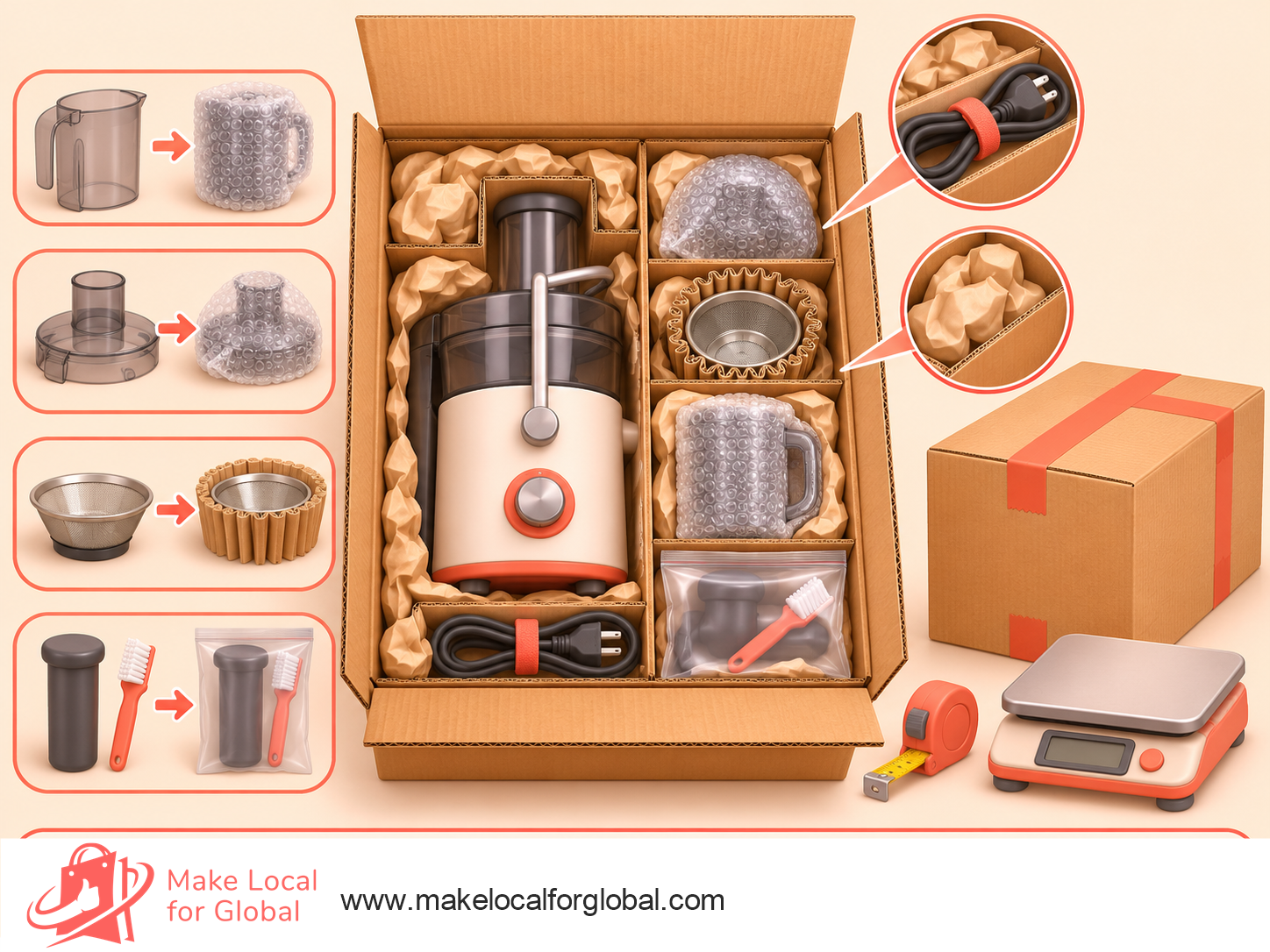
Juicers combine a motor body, a cord, plastic parts and sometimes a glass jug or metal strainer. Pack the appliance so the body cannot move, the jug cannot strike hard edges, and removable parts do not rub or pierce one another. Protect the strainer from crushing and keep small accessories together so the buyer can see what is included.
Use the manufacturer’s packaging where it is suitable for delivery. Add only enough cushioning to stop movement. Pack the juicer only when it is dry and free of pulp residue. Secure the cord without bending it tightly. Place the instructions, warranty information and required safety material where the buyer can find them. Confirm that the carton closes without pressing on the lid or switching controls.
Pack and seal one sample order. Measure the outside of the carton and weigh it after packing. Use those figures to request a carrier quote for the product’s selling price and likely destinations. Ask about fragile handling, compensation limits, collection, postcode surcharges and the process for a damaged parcel. An estimate based on the bare appliance can understate the parcel band.
Take photographs of the packed arrangement and keep the bill of materials. Review returned or damaged units before placing them back in sellable stock. Record whether the issue came from an assembly error, missing component, transit damage, product fault or unclear instructions. Each reason points to a different fix.
Write a returns process that describes how a buyer contacts you, how the appliance must be prepared and what happens to the parcel. For most online goods, customers can cancel within 14 days after delivery and then have a further 14 days to send the goods back. Check the current GOV.UK returns and refunds guidance and online and distance selling guidance before drafting your policy. A change-of-mind cancellation and a faulty or misdescribed appliance are different situations. Do not display a blanket “no returns” statement.
This section is a practical signpost, not legal advice. Requirements depend on the exact product, the seller’s role and the market. A business that imports a juicer or sells it under its own name can have different duties from a retailer reselling a product placed on the market by another UK business. Confirm your role before ordering stock.
In Great Britain, the Electrical Equipment (Safety) Regulations 2016 guidance describes duties for manufacturers, importers and distributors. Ask for the current declaration and technical evidence for the exact model, not a certificate for a similar product. Check nameplate, manufacturer or importer details, model identification and English instructions. General GOV.UK product safety advice for businesses explains that businesses must take appropriate steps before offering consumer products for sale.
CE and UKCA requirements depend on market, product category and conformity route. Government guidance on placing UKCA or CE marked products on the market in Great Britain describes current marking options and documentation. Northern Ireland has a separate route. Do not decide compliance from a marketplace badge or copy one marking statement to every territory.
Electrical appliances can have other applicable requirements, including electromagnetic compatibility and restrictions on hazardous substances. Ask the supplier which rules apply and how the documentation covers the exact configuration. Read the RoHS guidance and ask an appropriate product compliance specialist if the evidence is unclear. Do not alter the plug, cable, switch, enclosure or product label.
Parts that contact juice need materials suitable for their intended food contact and conditions of use. Request supporting documents for the strainer, jug, auger, seals, chute and outlet, and keep them with the model file. The legislation on materials and articles in contact with food and relevant current food-contact rules can vary by nation and material. Seek specialist guidance when importing or rebranding rather than relying on a short supplier declaration with no model reference.
If you place electrical equipment on the UK market under your brand or import it commercially, check whether you are an electrical equipment producer for WEEE purposes. The GOV.UK WEEE guidance explains producer and distributor responsibilities, registration and take-back. Retailers can have obligations to offer free take-back of like-for-like electrical waste. Confirm the current online return route that applies to your business and tell customers how to use it.
Keep supplier invoices, declarations, manuals, batch or serial records and safety complaints together. Search the UK product recalls and alerts service for the brand and model before listing and as part of your ongoing product checks. If a safety concern appears, pause sales, isolate affected stock and contact the supplier or relevant authority for product-specific guidance.
If you sell prepared juice or food rather than the appliance itself, separate food-business rules may apply. The Food Standards Agency says a business that sells, stores, handles, prepares or distributes food may need to register with its local authority. See the Food Standards Agency food business registration guidance. Selling a juicer on its own does not make you a juice producer.
A marketplace may give access to shoppers who already search for kitchen appliances, but its fees, listing rules, return handling and product data requirements affect the margin. Your own store gives you more room for demonstrations, comparison tables, cleaning instructions and customer support. A local kitchen shop or food market may let people handle the sample, though it brings display and staffing costs.
Compare each channel using the full order model. Record listing or subscription charges, payment costs, fulfilment, storage, advertising, customer service expectations, return routes and the effect of damaged goods. Do not assume a higher traffic count means more completed orders. Track qualified product views, questions, add-to-basket, orders, delivery damage, returns and contribution by channel.
Build content around the questions you can answer with evidence: how to compare citrus and centrifugal juicers, what to measure on a worktop, how to clean a specific strainer, what parts come with the product, how to store the appliance and how to prepare a parcel for return. Use actual product photos or clearly labelled explanatory illustrations. Do not give medical or nutrition advice through product marketing.
Use search language naturally. Useful phrases may include “fruit juicer”, “electric citrus juicer”, “centrifugal juicer for apples”, “slow juicer cleaning” or “compact juicer dimensions” when the page matches that product and topic. Give each model an individual title and meta description. Avoid making duplicate pages for colour variants with nearly identical copy. There is no title or meta description that guarantees a Google position.
Ask for permission before reusing a customer photo or quote. Invite buyers to review the exact product and do not offer a reward only for positive feedback. If you show a product test, state the ingredients and conditions. A clear demonstration builds more trust than a claim that the appliance is “the best”.
Consider product specifications, support, stock handling and the parcel before choosing a selling setup.
Write a buyer statement and speak with five people who make juice or shop for kitchen appliances. Note the ingredients, servings, storage, clean-up and price questions they raise. Compare three products from suppliers who can provide model-specific manuals and compliance information.
Choose the sample that best fits the intended routine. Set a maximum test budget and a first-stock cash limit. Ask suppliers about minimum order quantity, lead time, warranty, spare strainers, replacement jugs, service contact and how model changes are communicated.
Receive the saleable sample and photograph the label and carton. Follow the manual, record each component, run the same produce test three times, measure output and time the wash-up. Write down any unclear assembly step, leakage, vibration, splash or retained fibre. Stop if the unit appears unsafe or differs from its documentation.
Pack a complete order in the intended materials. Measure the sealed parcel and get a carrier quote. Add supplier cost, freight, inspection, packing, fees, delivery, returns and customer acquisition to the cost sheet. Check break-even and a downside case before deciding the maximum order quantity.
Write a product page with model code, included parts, verified dimensions, voltage, weight, cleaning instructions, warranty, delivery timing and return information. Photograph the actual sample. Save the supplier declarations, manual, batch details and a dated record of the product recall search.
Prepare a support checklist for missing parts, blocked outlet, leaks, transit damage, electrical faults and cleaning questions. Include a safe escalation route. Confirm how a customer can return an old like-for-like appliance if your business has WEEE distributor duties.
Publish only when stock or fulfilment, product information, support, compliance records and returns process are ready. Share the page with a small relevant audience or run a limited campaign that fits your budget. Ask the same buyer group to compare the product page with their original questions.
Review the results weekly. If people hesitate over cleaning, add a clear photo sequence. If they ask whether a part is dishwasher-safe, confirm the manual and put the answer beside the specifications. If delivery cost weakens contribution, test a different carton or carrier quote before changing the advertised price. At day 30, choose whether to reorder, adjust the offer or stop.
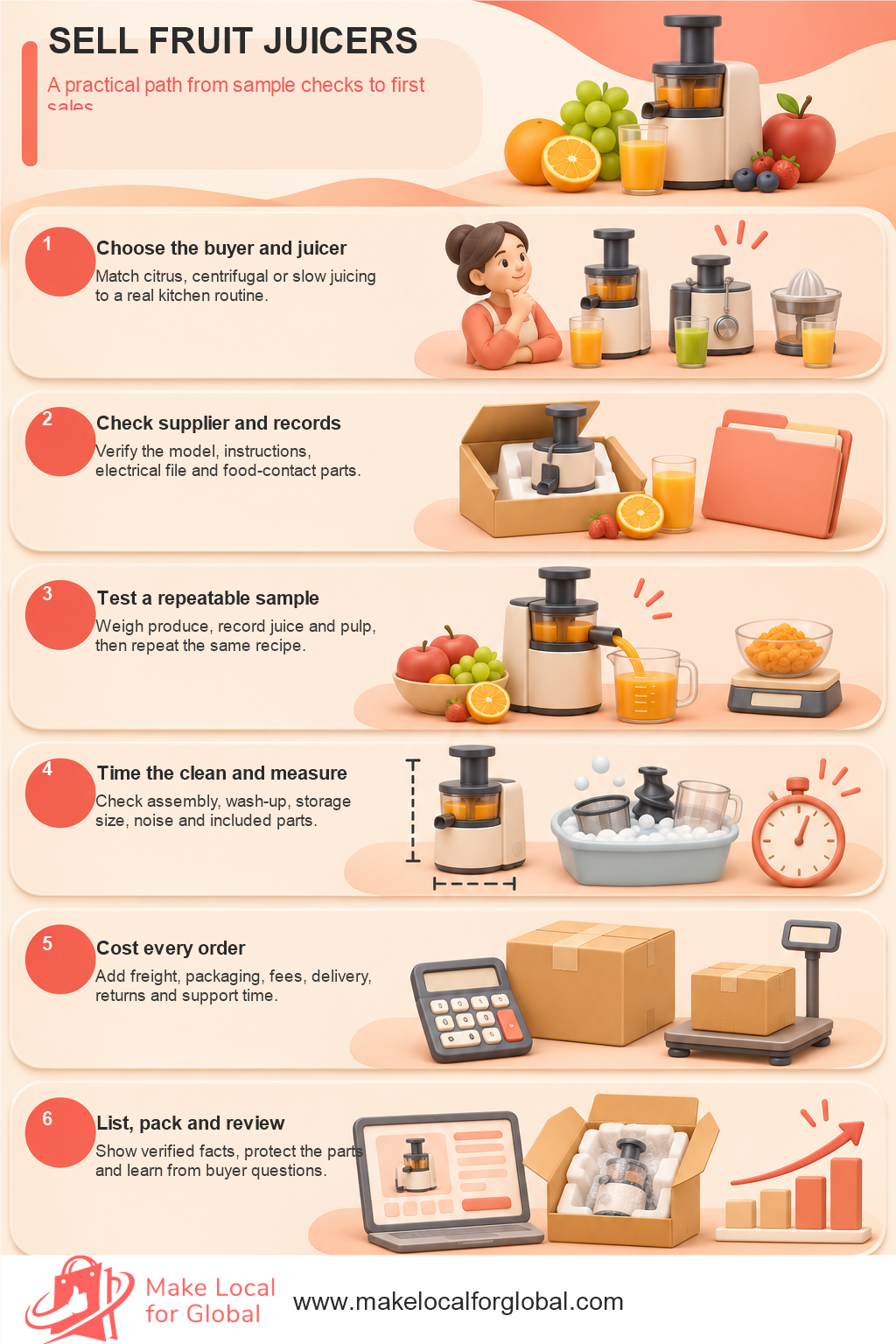
It can be a fit if you can identify a buyer, test a real sample, verify documentation and explain cleaning, delivery and support. The electrical product file and return cost need attention before you buy stock. Start with one model that suits a known routine.
Choose the mechanism that fits one buyer’s routine and your ability to support it. A citrus press, centrifugal juicer and slow juicer have different uses, parts and cleaning steps. Compare manuals, replacement parts, supplier records and sample tests before selecting the first model.
Use the same produce, amount, preparation and process for each machine. Weigh ingredients, collect output in the same way and repeat the test. Record the method and model. Do not turn a small sample test into a universal claim or a statement about health benefits.
List the exact model, voltage, dimensions, weight, jug capacity, included components, intended use, duty cycle where relevant, cleaning instructions, warranty and delivery details. Use actual sample photos and state which features come from supplier records versus your own measurements.
Only when the current maker’s instructions or written model-specific confirmation says so. Check which components are covered, any temperature or rack limits and whether the motor base must stay dry. Keep a copy of the instruction source with the product file.
You need to understand your role and the applicable rules for the exact market. Ask the supplier for the current declaration, technical evidence, model identification and English instructions. Great Britain and Northern Ireland have separate routes. A marketplace badge does not replace a product file.
WEEE rules cover waste electrical and electronic equipment. Depending on your business role, you may have producer or distributor responsibilities, such as registration or like-for-like take-back. Review current GOV.UK guidance and confirm the route for online sales before listing.
Add product cost, inbound freight, inspection, carton, payment or marketplace fees, outbound delivery, returns, warranty provision, marketing and labour. Compare the resulting contribution with fixed overhead and cash tied up in stock. Use your actual quotes rather than a competitor’s retail price as proof of profit.
For most online goods, a customer can notify the seller within 14 days of delivery that they wish to cancel, then has a further 14 days to return the item. Exceptions and the rules for faulty or misdescribed goods differ. Use current GOV.UK guidance and give customers the required information before purchase.
Selling prepared juice is a separate food activity. If you sell, prepare, store, handle or distribute food, food-business registration and food safety duties may apply. Check Food Standards Agency guidance and your local authority requirements before launching a juice service.
Bring together the buyer’s routine, sample test sheet, supplier documents, measured parcel and full order cost. If the product fits the buyer, the records are in place and the support route is clear, run a small launch and learn from real questions. If any of those pieces remains unclear, adjust the range before committing to more stock.
Use the buyer routine, test sheet, supplier documents and parcel cost to decide what to list next.
PREFERRED SOURCE
Like what you’re reading? Add Make Local for Global as a preferred source on Google to see more of our articles when you search.

Build your online presence without having to figure out everything yourself.