

READY TO SELL car care products ONLINE?
Get a store built for you in 5 days, plus training and support to help you start, run, and grow your Alternative business.

Choose a car-care buyer, check samples and supplier documents, understand UK labelling and delivery duties, then price each order and prepare a focused online launch.

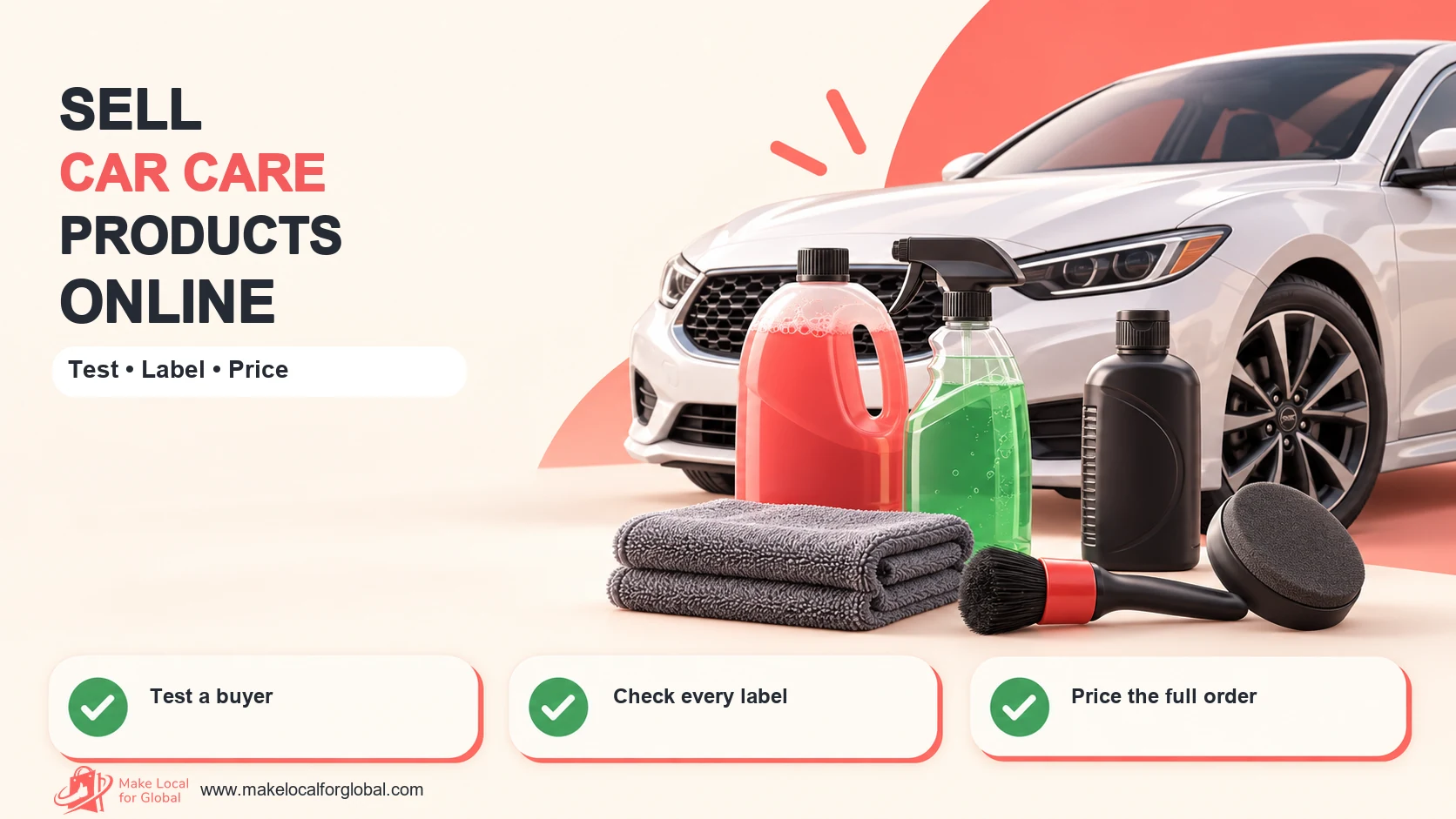
Car care is a broad product shelf: shampoo, wheel cleaner, interior spray, glass cleaner, wax, cloths, brushes and complete wash kits all solve different jobs. A new online shop rarely needs every type. It needs one clear buyer, a small range that performs well together, accurate instructions and prices that still work after packing, delivery, fees and returns.
A useful first offer could be a weekend exterior wash kit for first-time car owners or a compact interior-care set for commuters. Test the products on suitable surfaces, check the supplier’s safety and classification documents, and confirm how each item can travel before buying stock. Then build product pages that explain the task, method, quantity and surfaces for which the supplier lists the product.
This article explains how to choose car care products to sell online, check suppliers and samples, work out a full-order cost, write clearer product listings and plan a measured first month. The figures are examples only, not supplier quotes or a forecast.
Once your buyer and product range are clear, compare store plans and see which setup fits the way you intend to sell.
“People who own cars” is too broad to guide a useful product range. A new driver who wants a simple wash routine has different needs from a mobile detailer who buys larger volumes, tests specialist finishes and expects technical documents. Choose one first buyer, then write down the job that person is trying to complete.
Possible audiences include first-time car owners, households that wash one or two cars at home, enthusiasts who maintain their own vehicles, professional detailers, taxi and rideshare drivers, fleet operators, motorhome owners, or people who want basic interior upkeep without specialist equipment. These groups overlap, but their orders, questions and price expectations can differ.
Describe the situation in concrete terms. A commuter may want a quick interior clean after muddy shoes and spilled drinks. A weekend washer may want to clean paintwork, dry it without marks and put everything away in one box. A detailer may want a larger refill size, dilution guidance and repeat supply. The clearer the use case, the easier it is to decide what belongs in the first range.
Avoid building your opening offer around vague claims such as “professional results for everyone”. That does not tell a shopper what the item does, where it can be used or what skill it needs. A useful promise is narrow and factual: a wash kit for routine exterior cleaning, an interior set for named surfaces, or a starter set for cleaning wheels with a dedicated brush.
Write a short buyer note before contacting suppliers. Include the vehicle type or setting, the surface or task, the buyer’s experience level, the storage space available, likely basket size and the question they are most likely to ask. Use this note to assess each proposed item. If a product does not support the chosen job, leave it out for now.
Demand checks help you learn which job matters, what buyers already use and what information they cannot find. They do not prove that a shop will succeed, and a few positive comments are not the same as a paid order. Treat them as evidence for a small next step, not as a promise of future sales.
Start with search language. Collect phrases such as “car wash kit for beginners”, “interior cleaner for fabric seats”, “wheel cleaner safe for alloy wheels”, “microfibre drying towel” and “car cleaning kit for new drivers”. Look at questions in search suggestions, motoring forums, product reviews and marketplace listings. Record repeated concerns, such as residue on glass, a sprayer that leaks, a cloth that sheds lint or instructions that omit dilution.
Compare existing listings for the same task. Note what the seller explains well and what remains unclear. Do not copy another shop’s wording or assume a high review count means the item will suit your buyer. Look for gaps you can answer with your own product checks, clearer photography, a better bundle or more precise compatibility information.
Interview five to ten people who match your chosen buyer. Ask what they clean, what they currently buy, how often they replace it, which surfaces worry them, how they choose a product and what makes a listing feel trustworthy. Ask them to talk through a recent purchase. Questions about something they actually did tend to produce more useful evidence than “Would you buy my kit?”
Create a mock product page with a draft title, contents, price assumption and two or three photographs of a sample. Ask people to explain what they think is included and how they would use it. If they mistake a concentrate for a ready-to-use spray, your page needs clearer wording. If they expect a cloth that is not included, the bundle description needs a contents list.
You can run a small landing page or email-interest test before committing to a large order. State plainly that the product is being assessed and do not take payment for stock you cannot supply. Track visits, questions, sign-ups and requests for a particular size or surface. A useful signal is a specific action from a relevant buyer, not a broad compliment from someone unlikely to purchase.
Keep an evidence log: date, source, exact question or behaviour, buyer type, what you learned and what decision it changes. At the end of the first week, choose one small decision to test next, such as sample size, bundle contents or the wording of a surface warning.
Car care products can include liquids, accessories and kits. Liquids may include car shampoo, pre-wash, wheel cleaner, glass cleaner, interior cleaner, tyre dressing, wax or quick detailer. Accessories may include wash mitts, drying towels, detailing brushes, applicator pads, buckets and organisers. A starter kit combines items needed for one defined routine.
A useful opening range can have three layers. The entry item solves one simple task and carries a lower commitment. The core item is the main bundle or product that best matches your buyer. A higher-priced option adds a clear benefit, such as a larger quantity, a specialist applicator or a second cloth for a separate surface. These are product roles, not fixed price bands.
For a weekend wash customer, an entry item might be a single wash mitt or drying towel. The core offer could include shampoo, a mitt and a drying towel. Another option might add a pre-wash product or wheel brush, but only when instructions and delivery rules are clear. Do not add a chemical just to raise the displayed bundle value.
Keep early variation controlled. Too many scents, colours, bottle sizes and kit combinations multiply stock-keeping units and make it harder to see what sells. Begin with one or two sizes only where the buyer has a reason to choose between them. If separate fragrances need separate minimum orders, test interest before carrying both.
Separate product functions. Wheel cleaner is not interchangeable with paint shampoo. Tyre dressing is not an interior dressing. A glass cloth may need to stay separate from a cloth used with wax or dashboard products. Bundle items by sequence and surface, then explain why each item is included and what the buyer needs to supply themselves.
Make a range map before ordering. For each item, record the buyer problem, format, size, surfaces, method, complementary items, supplier, minimum order, landed cost, label status, transport classification and storage needs. If those fields are unknown, the item is not ready for the first range.
A focused range can expand later. Wait for evidence such as repeat requests, frequent questions, bundle attachment or repeated stock-outs before adding a new product family. Tie expansion to a buyer need you can explain in one sentence.
If you are comparing nearby automotive categories, see the separate guides to selling car seats online and selling car mats online. They show how buyer fit, materials and product checks change from one vehicle product to another.

Wholesale resale can be a manageable way to test car care products when you can obtain the supplier’s current product information, label details and transport information. Your listing must describe the item accurately, and you are responsible for the claims and information you present to shoppers. Ask the supplier what support they provide if a bottle leaks, a label changes or an item is recalled.
An own-brand range can give you more control over presentation and bundle design, but it adds work. Get a written agreement about who formulates the mixture, who classifies it, who approves label artwork, who holds safety data, who handles complaints and how changes are communicated. Do not assume that putting your name on a label transfers every responsibility to the factory.
Private-label and contract-filling arrangements vary. Before placing an order, ask whether the finished formula matches one already assessed, whether the packaging and closures are suitable, what batch records are kept, what the minimum order covers and who must approve a change to ingredients, fragrance, bottle or label. Obtain written answers and keep the version linked to the delivered batch.
Accessories such as cloths, brushes, mitts and organisers may have fewer chemical handling issues, though they still need honest descriptions, suitable materials and accurate claims. Check colour transfer, lint, seams, handle attachment, bristle stiffness, shedding, odour and wash instructions. A brush that scratches trim or a towel that leaves fibres can undermine a complete kit.
Importing products can add customs, product compliance, language and transport work. If you import a chemical mixture into Great Britain, HSE identifies import into GB as placing that mixture on the market; supplier duties can apply to the importer. Do not treat an overseas supplier’s label or safety sheet as proof that the product is ready for every UK market.
For a first launch, choose the model that lets you verify documents, product quality, batch traceability and delivery before taking orders. A low unit price is not a saving if it comes with unclear classification, missing instructions, long lead times or no response when a customer reports a leak.
Request a sample and a document pack before agreeing to a production run. Ask for the current product name and specification, ingredients or material details where available, intended surfaces and uses, method and dilution, storage conditions, shelf life where relevant, batch coding, packaging dimensions, case quantity and known transport restrictions.
For chemical products, ask who determined the GB CLP classification and which product version it applies to. Request the latest safety data sheet where relevant, label artwork, hazard information and evidence that the marketed claims match the tested product. Ask what process alerts you to a formula or packaging change. Read the documents rather than relying on a sales message that says “compliant”.
Ask how the supplier checks each batch. Depending on the product, this could include viscosity, appearance, fill weight, closure torque, trigger function, leakage, batch label or consistency against a retained sample. Ask how defects are reported, what evidence is needed, how affected units are identified and what happens to stock while a concern is reviewed.
Confirm the minimum order for each fragrance, size and label version. A supplier may quote an attractive unit price only for a full case or a much larger run than you can sell. Ask whether you can buy mixed cases, order samples at a small scale or use a shorter lead-time item until the first sales pattern is clearer.
Request a full price breakdown: unit price, setup or label fees, sample fees, pallet or delivery charges, import costs, payment terms and packaging surcharges. Ask whether the quotation includes VAT and which delivery term or location applies. Keep the quote date; supplier prices and transport terms change.
Check the supplier’s identity and business address, payment details, complaint route, insurance information where relevant and references for similar products. If the product is filled or labelled for your brand, identify who holds product records and who can provide them if an authority, marketplace or carrier asks.
Record answers in a supplier comparison sheet. Do not choose on unit cost alone. Compare sample quality, document completeness, lead time, minimum order, order flexibility, defect process, transport information and your ability to restock without creating a cash gap.
A sample check should match the product’s instructions. Do not invent a new use, mix products together or apply a chemical to a surface the maker does not list as suitable. Follow the label and safety information, wear the stated protective equipment, work in a suitable area and keep the sample away from children and pets.
For car shampoo, check how clearly the dilution is stated, whether the product mixes as instructed, how the wash feels with the supplied mitt and whether rinsing leaves visible residue on the test surface. Use a controlled area and a comparable clean surface for each sample. Record water conditions and method if they may affect the result. Do not claim a product is safe for every coating, finish or vehicle.
For glass cleaner, inspect the finish in daylight from multiple angles. Test the cloth separately from the liquid to identify lint or streaks. For interior cleaner, use only a compatible test surface and follow the maker’s spot-test advice. Look for residue, colour transfer, gloss changes or an odour that remains after the instructed use.
For wheel cleaner, check the approved wheel types and instructions before testing. Record whether directions ask the user to work on a cool wheel, avoid drying, rinse within a stated time or use a separate brush. Do not ignore a warning to make a demonstration look dramatic. A seller must not imply a product suits every alloy or finish without evidence.
The same habit of checking fit and real use applies to other vehicle ranges. The car covers selling guide explains how to check fit against a specific vehicle and record sample findings before building a listing.
For cloths and brushes, test shedding, stitching, edge finish, handle strength, bristle feel and wash behaviour. Wash according to the care label and check whether the cloth changes shape or colour. Keep separate cloths for glass, paint and interior products if the routine calls for that separation, then make the distinction obvious in bundle photos and instructions.
For every liquid, test the actual closure and pack it as a customer order. Store the parcel in the intended orientation, move it through ordinary handling, then inspect the cap, trigger, seal, carton and insert. This is a basic pack check, not formal transport certification. Follow the supplier and carrier requirements for any product classified as dangerous goods.
Use a sample scorecard with the buyer’s task, surface, instructions, result, finish, leakage, packaging, smell, clean-up, time taken and questions raised. Ask a second tester who matches the target buyer to repeat the same method. If two people interpret directions differently, improve the listing and ask the supplier whether the label can clarify the method.
Keep test results factual. Describe what you did, on what compatible surface, following which instructions and under what conditions. Do not turn one informal test into claims such as “scratch-proof”, “safe on all surfaces”, “non-toxic” or “environmentally harmless”. Product claims need evidence that supports the exact wording.
Some car care products are chemical mixtures, and rules depend on formulation, hazard classification and market. HSE says chemical suppliers, including manufacturers, importers, downstream users and distributors, have responsibility for classification under the GB CLP regime. HSE states that classification applies regardless of the amount supplied. The small size of a bottle does not automatically exempt a retailer from these rules.
A supplier’s classification is not approved or vetted in advance by HSE. Ask who is responsible for the product and verify that documents relate to the exact formula, label and pack you will sell. If you import, rebrand, decant, relabel or change the mixture, your role and obligations can differ from a retailer reselling an unchanged packaged item. Get specialist advice before making those changes.
HSE’s detergent guidance covers the detergent rules in Great Britain and notes that the regime in Northern Ireland differs under the arrangements described on its page. If your shampoo or cleaner is a detergent, check the applicable requirements for the market and product. Do not copy a label from a similar product; fragrance, concentration and formula can change its classification and required information.
Labels must be accurate and not mislead shoppers about size, price, composition, origin, performance or endorsement. GOV.UK says safety information must be included for products that could be dangerous. The exact information depends on the product rules and classification. Use the supplier’s approved label and provide clear instructions in the online listing; do not remove or obscure safety text in photos.
Show the net volume, intended job, directions, compatible surfaces, limitations, storage information, warnings and manufacturer or responsible business details where required. For a concentrate, state the measurement and dilution method exactly as supplied. If the package contains several chemical products, make the contents and each item’s role clear. Never imply that a product suits a surface not named by the supplier.
For Great Britain and Northern Ireland, check rules that apply in each destination before listing across the UK. Requirements can differ. Keep dated copies of supplier documents, label versions and your listings so you can identify which text accompanied a batch. Recheck them after a supplier changes a formula, bottle or claim.
Read the HSE explanation of chemical classification, HSE guidance for detergents in Great Britain and the GOV.UK product labelling overview. These links are starting points; they do not decide the classification of an individual formula.

Car care orders can contain liquids, aerosols, flammable products, corrosive mixtures, cloths and tools. Each format can have different storage, packing and carrier conditions. Before adding an item to your shop, ask the supplier for its current transport classification and check the exact carrier service you intend to use. Retail availability does not mean every courier accepts an item in every service or parcel type.
GOV.UK sets out different rules for dangerous goods carried by air, road and sea. A regulated item may need compliant packaging, marks, documents, trained staff or a suitable carrier arrangement. For air transport, GOV.UK states that anyone packing dangerous goods must be specially trained. Do not rely on a generic “we ship nationwide” statement from a supplier or marketplace setting.
Ask each carrier in writing whether it accepts the actual product and packaging for the route, service, quantity and destination. Give the correct classification and safety data. Carrier policies can be stricter than the legal minimum and can vary between standard parcel, international, air and business services. Recheck after changing bottle size or shipping method.
Create a handling procedure for receiving and storing stock. Cover the supplier’s storage instructions, temperature or sunlight limits, damaged parcels, leaked bottles, access control, spill response, stock rotation and disposal. Keep chemical products in their original containers with labels readable. Store accessories separately if cross-contamination could affect clean cloths or applicators.
For each liquid, choose packaging based on the actual closure and parcel check. A sealed inner bag, absorbent material, dividers or a rigid outer box may help control a small leak, but these do not replace any legally required dangerous-goods packaging. Do not put a bottle directly against a product that could be damaged by a leak. Photograph pack trials and record materials used.
Confirm delivery cost by packed parcel, not product weight alone. Measure the sealed carton, then price the actual carrier service. A bundle with a bucket, multiple bottles or thick towels can move into another size band. If you offer free delivery above a threshold, model postage on the largest common order and check whether the contribution still covers it.
Write a damage process before the first order. Decide how a buyer reports leakage, what photos or batch details help, how quickly you reply and when you replace or refund. Never ask customers to post a leaking chemical parcel back without confirming that the carrier accepts it and the package meets its requirements.
Price the delivered order, not just the bottle. Add unit cost, a share of inbound freight, customs or duty where relevant, outer packaging, inserts, payment or marketplace fees, customer delivery, pick-and-pack time, a return or damage allowance and any paid acquisition cost. Add recurring overhead separately when reviewing monthly profit.
Use the customer-facing price that applies to your buyer and tax position. GOV.UK explains that prices displayed to the general public show VAT included where VAT is chargeable, while prices for businesses may be presented differently. A VAT-registered seller should check current VAT treatment and threshold with HMRC or an adviser; VAT collected is not sales income available to cover stock.
Here is an illustrative single-bottle order for a VAT-registered seller treating the item as standard-rated. The public checkout price is £24.00 including VAT, so this example separates £4.00 output VAT and £20.00 sales revenue before costs. Your VAT position, rate, fee basis and costs may differ.
| Per-order item | Illustrative amount |
|---|---|
| Customer price, including assumed VAT | £24.00 |
| Less output VAT in this example | £4.00 |
| Sales revenue before costs | £20.00 |
| Product purchase cost | £5.20 |
| Allocated inbound freight and duty | £0.80 |
| Carton, seal and protective packing | £0.65 |
| Payment fee assumption | £0.70 |
| Outbound parcel delivery | £3.60 |
| Returns and damage allowance | £0.60 |
| Customer acquisition allowance | £2.50 |
| Illustrative contribution before overhead | £1.95 |
Illustration only. These are not supplier or carrier quotes. Confirm your VAT position, fees, product costs and delivery rates.
The arithmetic is £20.00 less £5.20, £0.80, £0.65, £0.70, £3.60, £0.60 and £2.50, leaving £1.95 before overhead. This is contribution, not net profit. It excludes labour, rent, software, insurance, accountancy, storage, tax on profit and unsold stock. If paid advertising did not acquire a customer, the £2.50 line changes; marketing costs still belong in the wider business view.
Run the calculation again for a bundle. Add selling prices and unit costs, then include the larger carton, extra packing time, added postage weight and any payment fee rule. A bundle can raise basket value but shrink contribution if the delivery jump or discount exceeds the added gross margin.
Compare three price scenarios: a single item with paid delivery, a kit with paid delivery and a kit with delivery included. Calculate contribution for each. Set a price that is easy to explain, then test whether buyers understand what is included. A competitor’s price does not prove that your cost structure will work.
Keep assumptions visible in your spreadsheet: tax status, transaction fee percentage and fixed fee, package size, carrier service, returns estimate, acquisition source and supplier quote date. Update the model after real orders. Use measured packing time and campaign cost once you have evidence.

A minimum viable order is the smallest stock purchase that lets you test a product and fulfil a realistic run without risking money needed for ordinary business costs. The right quantity depends on supplier minimums, shelf life, storage, cash available, lead time and how quickly you can collect buyer feedback.
Count the cash needed before stock arrives. Include sample fees, deposits, freight, duties, label or setup fees, packaging, safety documents or testing, photography, shop costs and the remaining balance due before dispatch. Then estimate what remains for fulfilment and customer service. A quote that looks affordable per bottle may need a larger first payment than your working cash allows.
Ask the supplier whether a small mixed case is possible, or whether the first order can use one size and one label. If a larger minimum is unavoidable, check whether you can sell through multiple channels, fulfil from a compliant third party or wait for more evidence. Do not order several scents and formats only to reach a production threshold if you cannot explain them to a buyer.
Set a stock cover target based on lead time and observed orders. Before the first sale, any forecast is uncertain. Use a cautious scenario, record the assumption and keep a reorder trigger that includes supplier lead time and a buffer for delays. For chemicals, check shelf life and storage instructions before deciding how many months of stock to hold.
Track batches and stock movement. For each receipt, record supplier, delivery date, batch code, quantity, condition and document version. On dispatch, record the order and batch where relevant to your process. These records help you isolate a product question and communicate accurately with a supplier or customer.
Prepare a low-stock rule before launch. For example, pause paid promotion if available units fall below the number needed to cover current orders and likely delivery issues. Mark the product unavailable if it cannot be supplied within the stated time. Clear stock information protects trust better than accepting orders on an unconfirmed restock assumption.
The title should name the product and its main use. “Car shampoo concentrate for routine exterior washing, 500 ml” gives more information than “Ultimate Clean”. Avoid superlatives and unsupported results. If the buyer needs to know a surface or vehicle fit, place that detail in the title or the first description lines.
Lead with a clear summary: who the product is for, what task it covers and what arrives in the parcel. Then describe the method, quantity, compatible surfaces, limitations, storage and required tools. If the supplier gives an exact dilution, repeat it accurately and show an example only when the arithmetic is correct.
Show all bundle contents. Name each item, size and count, and say whether the buyer needs a bucket, water source, gloves or another item not supplied. A photo of the whole kit should match the list. If there are separate glass and interior cloths, label them in the photo or a contents diagram so the buyer can identify them after opening the parcel.
Put compatibility and exclusions in plain language. State which surfaces the supplier names and any surfaces or finishes that should be avoided. If there is uncertainty, contact the supplier rather than making a broad safety claim. Explain whether the buyer needs to test an unseen area first, where that is part of the product instructions.
Use a specification block for bottle volume, concentrate or ready-to-use format, scent if relevant, pack count, accessory materials, dimensions, care instructions and delivery restrictions confirmed by the carrier. Keep units consistent. For a cloth, give dimensions in centimetres and composition only where verified. For brushes, note handle length or head dimensions if the supplier provides them.
Answer questions that prevent mistaken purchases. Is the cleaner suitable for fabric seats? Does the kit contain a drying towel? Is the shampoo concentrated? How much is supplied? Can the parcel go to a home address? Is an applicator included? Do not bury answers in an image or assume shoppers know car-care shorthand.
Add a short FAQ to a product page only when answers are reliable and useful. Use actual customer-support and pre-launch questions. Keep safety answers consistent with approved instructions. Do not copy review claims unless you have permission and a genuine record of the review.
Images should explain the product. Use a front label photo, a complete contents photo, a scale or size reference, a close-up of the closure or textile weave, and a safe demonstration on a surface listed by the maker. Write accessible alt text that describes each image’s purpose. Do not add keyword strings to alt text or crop out warnings to make a label look cleaner.
For chemical products, an attractive image cannot replace the label. Photograph the real packaging so the name, size and instructions can be read at a useful zoom. If you make a diagram to explain a routine, distinguish your steps from the supplier’s directions and link to the product details.
Demonstrate one job in a short sequence: show the compatible surface, prepare the product as instructed, apply it with the stated tool, observe the result and show the clean-up. Use a camera angle that lets a buyer see how much product is used. Do not edit the finish to look cleaner than the recorded result.
A side-by-side comparison can help a buyer choose between a ready-to-use spray and a concentrate, two cloth sizes or two kit levels. State the measured difference. Avoid implying that one product is better for every user. A small table of tasks and contents can be clearer than a long text block.
Make accessibility part of the image plan. Use descriptive file names, useful alt text, captions where detail needs explanation and strong contrast for overlaid words. Check images on a phone; label text that is readable on a desktop may be too small in a social preview. Keep safety information in page text, not only in a graphic.
Give each image a job in the buyer’s decision. A featured image identifies the category and starter checks. An in-use photo shows scale and method. A close-up clarifies the cap, cloth edge or included tool. A packing image can show how a multi-item kit arrives, provided it matches your real process. Replace any image that implies a feature you do not supply.
Use a consistent background and lighting so the range feels related, yet vary the composition by item. Do not use the same bottle mock-up for every product. For a bundle, include an overhead layout with labels or a numbered contents key, and a parcel photo only when it reflects your actual packaging.
A direct online shop gives you control over product pages, bundles, email capture and customer service. You must bring relevant visitors and manage payments, policies, delivery, returns and product questions. Before launch, test checkout on a phone, check that the delivery method accepts each item and read every automated email a buyer receives.
Marketplaces can offer product search traffic and established checkout, but fees, restricted-goods rules, listing policies and advertising options vary. Read the current policy for each product type. A marketplace may restrict a chemical or require information beyond what the supplier supplied. Do not list a product until you know how the platform handles regulated goods, safety complaints, returns and account verification.
Local garages, valeting firms, mobile detailers and car clubs can be useful research partners. A small trade pack may suit a local business if sizes, instructions and supply rhythm fit their work. Agree whether the price is retail or trade, how repeat supply works and what support you can provide. Do not promise recurring supply before the supplier’s lead time is clear.
Use a small channel test rather than opening several storefronts at once. Pick one primary shop and one source of relevant visitors. Measure product-page views, add-to-basket actions, checkout starts, purchases, questions and abandoned baskets. Use a consistent period and note the offer and traffic source so results can be compared.
Organise the shop around tasks shoppers understand: exterior wash, wheels, glass, interior, drying and accessories. Keep category names straightforward. Use filters only when they help a buyer select size, surface, format or kit contents. Avoid filters that repeat the same attribute in confusing ways.
Set service expectations. State dispatch days, delivery area, carrier limitations, support hours, returns process and what to do if a parcel arrives damaged. Where a product cannot travel by a chosen service, block that delivery option rather than allowing checkout and cancelling later.
Review fees before choosing a channel. Include listing, transaction, payment, advertising, fulfilment and currency conversion fees where relevant. Check whether each fee is based on item price, postage or tax. Use the fee schedule current when you list; rates can change.
Search content should answer a specific buyer question. Build a keyword map around product and use case: type, surface, format, quantity, routine and common issue. A page for “car shampoo concentrate” should explain concentration and use, while a page for “microfibre drying towel” should cover size, material and care. Do not force every phrase into one title.
Use one primary topic per product page and write naturally. Create a useful SEO title and meta description that tell a shopper what the page contains. Add headings for product details, instructions, compatibility, delivery and FAQs. Search descriptions can change in search results, so write for clarity rather than a promised display.
Publish supporting pages that answer genuine setup questions: how to choose a first wash kit, how to keep cloths separated by task, what to check before buying wheel cleaner, or how to store car-care products. Link each page to a relevant item only where the product suits the advice. Do not create a safety claim to target a search phrase.
Useful video topics include opening a sample pack, showing measured dilution from the label, comparing cloth sizes, demonstrating a compatible surface check, packing a real order and explaining what the kit does not include. Add captions, keep the steps accurate and use the same product claims as the listing.
Email can bring a buyer back for a refill or accessory, but messages should reflect consent and product use. Send a useful care note after purchase, then a reminder only when a realistic replacement period exists. A refill message sent before a buyer could have used the product may feel like noise. Ask customers about actual usage before setting timing.
Partner with a small number of local detailers or motoring groups for feedback. Offer a sample for evaluation only where you can disclose the arrangement and avoid presenting an incentive as an independent endorsement. Ask permission before using a person’s name, photo or review. Keep comments attributed and exact.
Track the source of each order and the cost of each test. A social post may attract views but no product-page visits; a search page may bring fewer visits but better questions. Give each campaign a distinct tracking link, record the date and compare outcomes after enough time for the intended buyer to see it.
A small catalogue can suit a focused single-product shop. Compare the store options before you choose a setup.
Write the fulfilment routine before the first purchase. Define how an order is checked, how the correct item and batch are picked, how the label is verified, what protective packaging is used, how the parcel is weighed and where the dispatch record is stored. Ask another person to follow the steps; any point that causes hesitation needs clearer wording.
Keep chemical bottles upright where the supplier and carrier process requires it, secure closures and prevent items rubbing together. Pack cloths so they stay clean and away from a leaked product. Include an instruction leaflet only where the supplier permits it and the information matches the current label.
Check the order confirmation and dispatch notice. They should name the product, quantity, delivery address, expected dispatch timing and support contact. The packing slip should reflect the contents. A complete order prevents a buyer wondering whether an item is missing or packed inside another component.
Set a return policy that follows consumer law and marketplace rules for the channel. Explain how buyers contact you, what condition is required and what happens with opened or used goods. Rules can vary by product, circumstances and jurisdiction. Get advice if you are unsure how a chemical product’s seal or safety status affects a return.
For damage, ask the buyer for an order reference, photos of the outer carton and product, and the batch or lot code where visible. Respond with a clear next step. Keep the damaged item in its original packaging until safe handling and carrier instructions are confirmed. Do not tell the buyer to pour a product away or post it back without checking the approved method.
Review complaints for patterns. One parcel can be an isolated event, yet two leaks from the same closure may indicate a pack issue. Record product, batch, carrier, box, damage, customer report and resolution. Pause affected stock or a carrier route if a safety question is unresolved; ask the supplier for the next action.
A car care range depends on supplier documents, packaging, carrier terms and marketplace policies. Put a named owner and review date beside each item’s specification, classification notes, label, safety data, transport decision, price and product page. A review calendar can prompt a check before a seasonal campaign or supplier update.
Keep the exact label image and text version that was used for each batch. If the supplier changes fragrance, formulation, closure, volume or warning, do not assume the old page is accurate. Ask what changed, which batch it affects and whether existing stock or page text needs review.
Maintain a cash view with stock payments, pending supplier invoices, delivery charges, taxes, refunds, payment settlements and monthly overhead. Product cash can be tied up before a buyer pays: deposits, lead time and minimum quantities create a gap. Set aside money for refunds and replacement parcels rather than counting every bank receipt as spendable profit.
Review contribution by item and bundle. A high-revenue item can have low contribution if it is heavy, attracts costly delivery or needs paid traffic. A low-priced accessory can improve a kit only if added margin exceeds extra packing and fees. Use actual order data after launch and update the model when a supplier or carrier changes a rate.
If you register for VAT, keep records and follow current HMRC rules. Public price presentation should match your tax status and audience. The GOV.UK VAT pricing explanation describes how VAT appears in prices for consumers and business customers. Check current rules for your business rather than copying a competitor’s display.
A frequent mistake is buying an assortment before choosing a buyer. A wide shelf makes each item harder to explain and can leave cash in slow stock. Start from one routine, identify the products needed for it and add alternatives only when buyers can choose between them for a clear reason.
Another mistake is accepting incomplete product documentation. A supplier saying that a product is “ready for the UK” is not a substitute for checking the formula, classification, label, territory and delivery route. Ask for current documents and match them to the item you will receive.
Do not assume a parcel is safe to post after a quick shake check. A parcel trial can expose weak caps, poor dividers and carton problems, but it does not decide whether the product is regulated for transport. Get the classification and carrier acceptance before listing the service.
A pricing error is to add a small amount to unit cost and call the difference profit. That leaves out VAT treatment, freight, postage, packing time, fees, refunds and customer acquisition. Write each cost as a line and update it from quotes. If the result is too low, change the product, pack size, bundle or price before placing the next order.
Do not write broad claims from one test. “Safe on every wheel”, “restores all plastics” and “environmentally harmless” can mislead shoppers and create a safety problem. Use product information and evidence that supports the exact statement. If a buyer asks whether an item suits a specific finish, answer from approved information or refer the question to the supplier.
Do not hide product limits. A buyer who knows that a brush is for a certain task or that a cleaner is not listed for leather can make a better choice. Clear exclusions reduce mistaken orders and support contact.
Do not scale advertising before checkout and fulfilment are ready. A campaign can increase orders faster than a new shop can pack them or confirm stock. Test the order route, carrier service, customer emails and complaint process first. Increase spend only when stock, contribution and dispatch performance can support it.
Pick one buyer group and one task. Write the buyer note, list the questions they ask, record search phrases, review product pages and interview five to ten likely buyers. Capture sources and dates in a short log.
At the end of the week, decide which range idea to test. For example: “New drivers want one clearly labelled kit for a routine exterior wash.” Write what evidence would change that idea, such as repeated demand for interior care instead or confusion about storage and dilution.
Contact three potential suppliers and compare sample quality, minimum order, lead time, documents, packaging and total cost. Ask who classifies each chemical mixture and whether the chosen carrier accepts the product and service. Request a sample pack for one use case.
Test products according to the label, using suitable surfaces and basic observations. Log method, result, leakage, instructions and tester questions. Stop if documents, safety instructions or carrier route remain unclear. Do not move to a bulk order to meet a campaign date.
Choose the smallest workable opening range. Calculate landed and per-order costs; check a single item and a bundle. Set a price and delivery policy that match your tax position and channel costs.
Photograph the real contents, write the listing with size, use, compatibility and limitations, then prepare a parcel. Ask another person to follow the instructions and pack a test order. Note where they hesitate or misread bundle contents. Update the page before inviting buyers.
Open sales only when product details, carrier acceptance, stock and customer-service steps are ready. Share the page with people and groups who match your buyer. Track visits, add-to-basket actions, orders, questions, dispatch time, cost per order, leakage, damage and refund requests.
Set a review date after the first useful activity. Decide whether to change the page, packaging, bundle or traffic source based on observed behaviour. Keep a change log so you know which version buyers saw. Delay expansion if a safety, margin or fulfilment question remains unanswered.
A useful first-month outcome is not a particular number of orders. It is a clearer picture of who understands the offer, which questions remain, what a real order costs and whether your supply process can meet the stated promise. Use that evidence to decide whether to reorder, revise or stop.

It can suit a focused shop if you choose a defined buyer and job, test products and check delivery before ordering stock. The category is broad, and liquids can carry documentation and transport work. A small kit or a carefully chosen accessory can be easier to explain than a large catalogue. Use buyer conversations and small tests to judge whether your offer earns genuine interest.
Start with items needed for one routine, such as a basic exterior wash or simple interior clean. Choose products with clear instructions, reliable supplier information and a practical delivery route. Check a sample on a compatible surface and make sure the bundle contents are easy to understand. Add products after you see a repeated buyer need.
You can sell some products online, but duties depend on the formula, classification, your supply-chain role, UK territory and carrier. Check current Great Britain and Northern Ireland requirements, obtain product-specific documents and confirm the delivery service accepts the item. Do not rely on another seller’s page as a compliance decision.
Some mixtures need specific hazard and safety information based on their classification. GOV.UK says dangerous products need safety information, and HSE explains supplier responsibility for chemical classification in Great Britain. Ask the supplier for the current label and documents for the exact formula. Get advice if you import, rebrand, decant or alter a product.
Add every product, inbound freight, duty, protective packaging, payment or marketplace fees, delivery, picking time, returns or damage and customer acquisition. Apply the correct VAT treatment. Compare contribution before overhead for each delivery and bundle option. Use actual supplier and carrier quotes when available.
Formulating adds responsibility for development, testing, classification, labels, records, packaging and market-specific rules. It is not a shortcut to a more profitable range. A first-time seller may find unchanged wholesale resale or a supplier-supported own-brand arrangement easier to assess, but each route still needs checks. Get technical and regulatory advice before changing or creating a mixture.
Show exact volume, format, bundle contents, instructions, compatible surfaces, limitations and delivery conditions. Photograph real items and explain which tools are included. Ask someone who has not seen the product to describe what they think will arrive and how they will use it. Update anything they misunderstand.
Do not assume so. Ask the supplier for transport information and the carrier whether it accepts the product, quantity, package, service and destination. Dangerous-goods rules differ across air, road and sea, and carrier rules may add restrictions. Check again after a change to product size, formula or route.
Buy the smallest quantity that lets you test demand and fulfil orders while covering cash obligations and supplier minimums. Consider shelf life, storage, lead time and batch traceability for liquids. Avoid treating an untested forecast as a sales plan. A small order can protect cash while giving evidence for a reorder decision.
Track relevant visits, product-page engagement, questions, orders, contribution after variable costs, dispatch time, leakage, damage, returns and repeat requests. Compare results by traffic source and offer. A low order count can still reveal page or product questions; a high count can expose weak stock or margin planning. Choose the next change from collected evidence.
Review your buyer evidence, supplier checks and full-order costs. If you are ready to shape your store, MLFG can explain the available setup and support.
Choose one buyer, one car-care task and a small range that addresses it. Ask suppliers for product-specific documents, test samples according to their instructions, confirm delivery and model a complete order before buying stock. Write the product page to answer the questions sample testers raised.
If you are shaping your shop, compare the MLFG online store plans and read other Product To Sell articles for further planning ideas. Keep the first launch measured: collect buyer questions, follow the cost of each parcel and expand only when the next product solves a clear need.
PREFERRED SOURCE
Like what you’re reading? Add Make Local for Global as a preferred source on Google to see more of our articles when you search.

Build your online presence without having to figure out everything yourself.