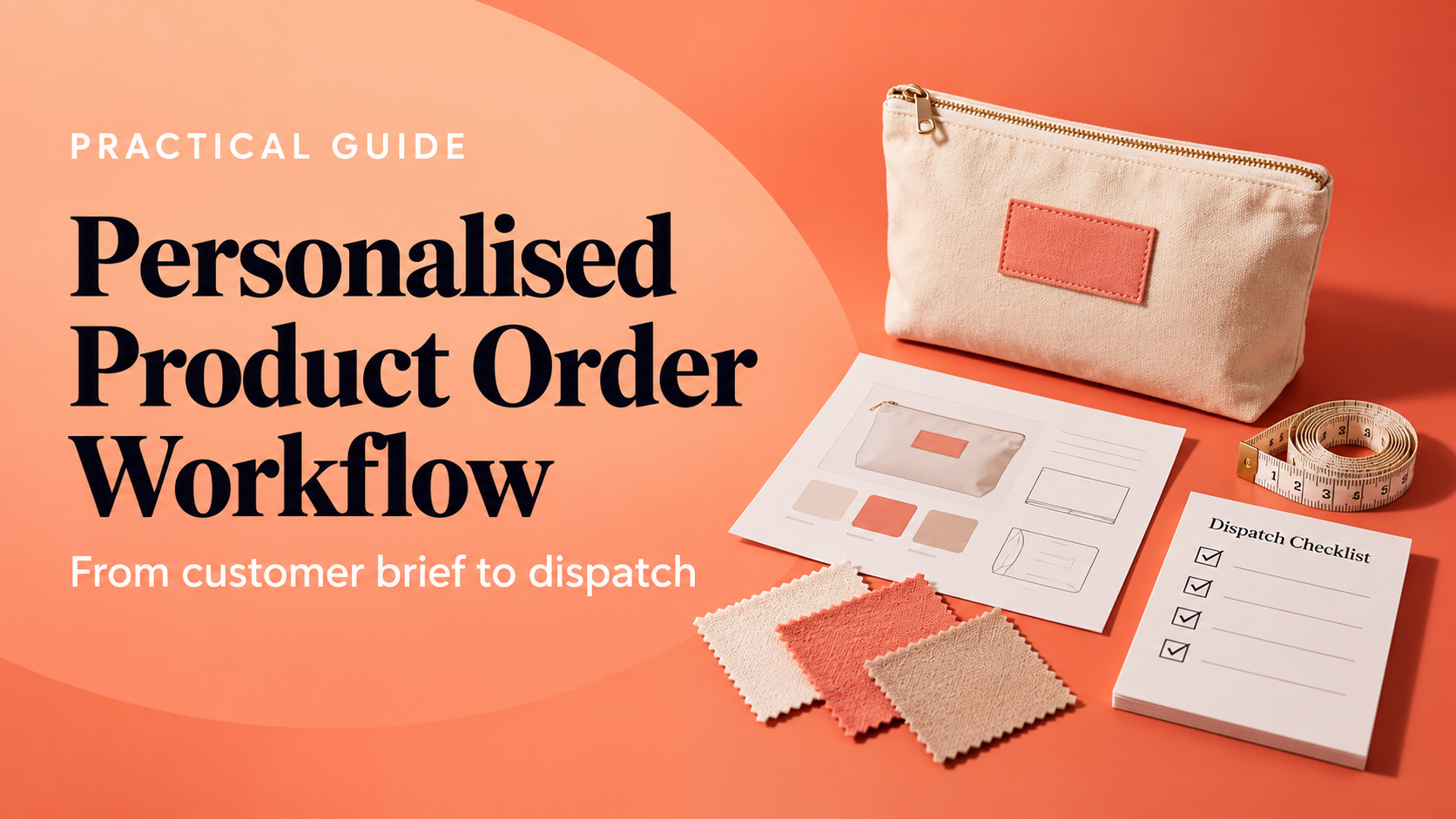


Custom orders can command a higher price because a buyer chooses a name, colour, message, size or design. But a personalised product also adds work that a standard order may not have. You may need to check a proof, prepare a machine, find the right materials, handle a customer change, inspect the finish and remake an item if something goes wrong.
A useful price therefore starts with the full order process, not just the blank product and a markup. This guide shows how to calculate a contribution per custom order, include a clear allowance for rework, and check whether your planned order volume fits the hours you actually have.
Model the price, time and capacity together
The free Customised Products Simulator compares per-order contribution with monthly workload using your own costs and assumptions.
Why a personalised order costs more than its materials
Standard product costing often misses the small, repeated steps that make a personalised order possible. Those steps can include collecting customer details, confirming spelling, preparing artwork, waiting for approval, setting up equipment, cleaning between colours, packing carefully and answering delivery questions.
Some work happens once for a design or production run. Other work happens for every order. Keep these categories separate. A one-off set-up cost should not be quietly buried in the unit cost, and repeatable labour should not be treated as free just because the owner is doing it.
- Per-order materials: the base item, personalisation materials, protective packaging and inserts.
- Per-order labour: customer checks, production, quality control, packing and the administration you choose to include.
- Order costs: payment or marketplace fees and any delivery amount you pay on the buyer’s behalf.
- Expected exceptions: the cost of rework, replacements or failed personalisation, based on a stated assumption.
- One-off set-up: tools, templates, sample runs or equipment needed before the first order.
Build the cost of one custom order
Use one representative order and write down every cost you can observe. If a fee is a percentage of the selling price, calculate it from the price you actually expect to charge. If postage is partly paid by the buyer and partly by you, include only your subsidy in this particular model.
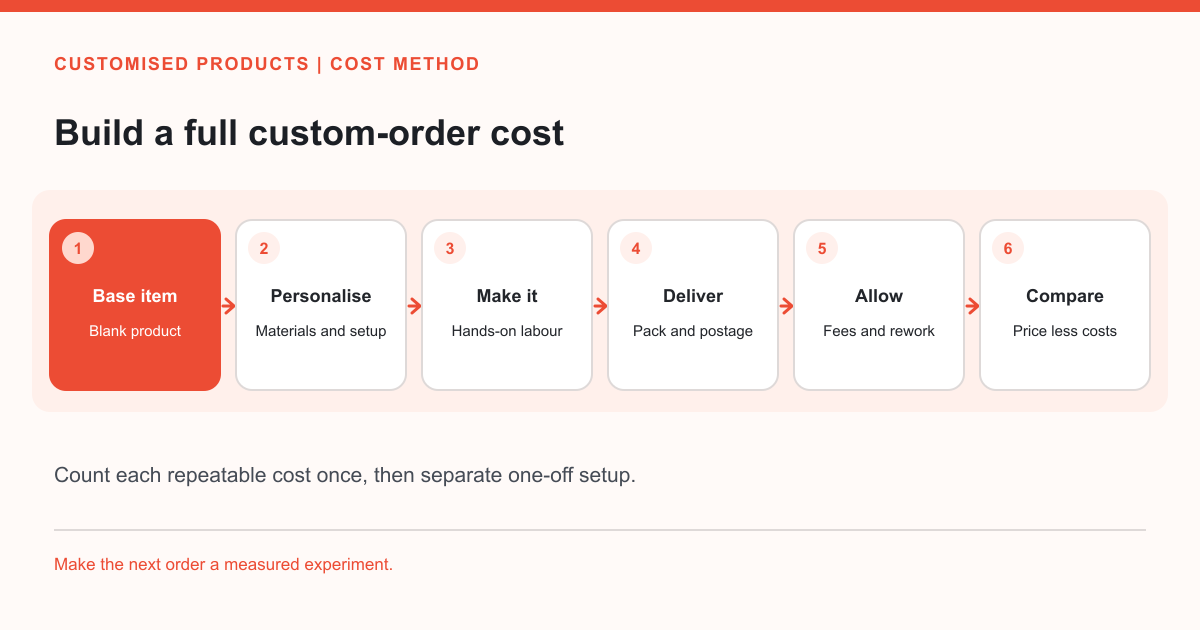
Next, time the work. For a simple first estimate, multiply the minutes spent per order by an hourly labour rate, then divide by 60. If an order takes 36 minutes and your planning rate is £13.50 an hour, the labour allowance is 36 ÷ 60 × £13.50, or £8.10 per order.
The rate is a planning input, not a statement about the legal status of a founder’s work or a substitute for payroll and tax advice. Choose a rate that makes the time visible in your business decision. If you later employ staff, check the applicable pay rules separately.
Worked example: one order priced at £42
The figures below are illustrative assumptions, not a recommended market price. They show how a seemingly healthy gap between the item cost and sale price can narrow once production time and delivery are included.
| Assumption per order | Illustrative amount |
|---|---|
| Selling price | £42.00 |
| Blank or base product | £11.50 |
| Custom materials and packaging | £4.50 |
| 36 minutes of labour at £13.50 per hour | £8.10 |
| Payment or marketplace fee at 3.2% | £1.34 |
| Shipping subsidy | £4.25 |
| Expected rework allowance at 5% | £1.42 |
| Modelled contribution before tax and overhead | £10.89 |
The rework allowance here is five per cent of the base item, custom materials, labour and shipping. It represents a simple expected repeat production and delivery cycle. The example does not add a second transaction fee. Your own records may show that rework is rare, more expensive, partly recoverable or caused by different factors. Use evidence to replace the assumption.
In this scenario, the £10.89 contribution is about 25.9% of the £42 selling price, before fixed overheads, tax, refunds, returns and any costs not listed. Contribution is not profit. It is a useful subtotal for comparing an order with its variable costs.
Check the work, not just the margin
A custom product can have a positive contribution and still be difficult to fulfil at the volume you want. Add up the active production time across the month, including the expected repeat work. Then compare it with the hours genuinely available after admin, customer support, sourcing, breaks and other responsibilities.
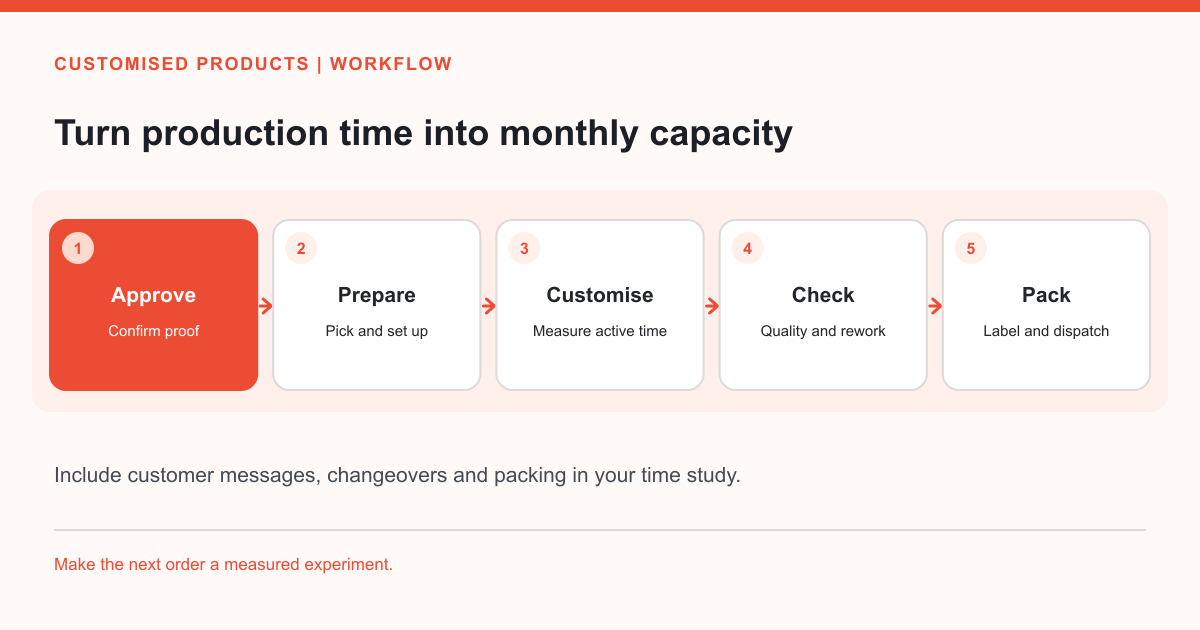
For example, 30 monthly orders at 36 minutes each use 18 hours before rework. Applying a five per cent expected repeat cycle gives 18.9 modelled production hours. If you have 48 hours available for this work, that is about 39% of stated capacity. It is not proof that you can safely accept 30 orders: the estimate excludes any unentered work such as artwork changes, machine set-up, customer messages and batching.
Use a short time study on several typical orders. Record start and finish time for proof checks, preparation, production, inspection, packing and dispatch. Note unusual orders separately so one difficult item does not distort every estimate.
Separate one-off set-up from monthly cash
Tools, sample products or production templates may require an upfront payment. Keep this one-off cash need visible. A simple recovery measure is:
Orders to recover set-up = one-off set-up cost ÷ positive contribution per order
With £450 of setup and £10.89 contribution, the rough recovery point is 42 orders. That does not predict when those orders will arrive. It also assumes the per-order contribution is available to recover setup and that the costs entered are complete.
Cash timing matters too. A custom order may involve buying materials before the buyer’s payment is cleared. A model that assumes all orders are collected in the same month can overstate cash available if settlement is delayed, deposits are partial or a refund is issued. Keep a separate cash buffer for commitments already made.
Compare a small monthly scenario
Enter your price, material costs, labour minutes, fee rate, shipping subsidy, rework rate and available production hours. The simulator keeps the assumptions visible.
Run a controlled first test
When every order offers a different product, size, font, colour and finish, you have many moving parts and little comparable evidence. Limit the first test to one base item and a short menu of personalisation choices. Set an order cap you can fulfil comfortably and state clearly what the buyer must approve before production begins.

- Choose one product and one buyer use case to test.
- List the exact choices the buyer can make, and make the approval point clear.
- Set a safe batch limit based on your real available time and cash.
- Record price, materials, minutes, fees, postage, defects and remakes for every order.
- Compare the observed results with the estimate before adding more variants or volume.
Changing one important assumption at a time makes the next result easier to interpret. If the price changes at the same time as the product, artwork, delivery promise and advertising, you may not know which change affected the outcome.
Make custom-order promises carefully
Personalisation does not mean every customer right disappears. The UK government’s overview says personalised or custom-made goods can be an exception to the usual online change-of-mind cancellation right. It also explains that legal rights still apply when goods are faulty or not as described. Check the current rules for your product and selling arrangement, and get suitable advice if you need a policy for a specific case. See the government guidance on returns and refunds.
Operationally, reduce avoidable disputes by stating the personalisation options, proof approval deadline, production window, delivery estimate and how errors are handled. Keep the approved wording or artwork and the final quality check with the order record. Make sure your policy does not promise less than customers’ statutory rights.
What the example cannot tell you
A spreadsheet or simulator can check arithmetic. It cannot establish demand, predict conversion, validate product safety or decide whether a design is worth launching. The example above also excludes tax, VAT treatment, refunds, chargebacks, fixed overheads, unsold stock, financing costs and delayed payments. Add any relevant costs before relying on a price decision.
Use the model as a question generator. Which cost is supported by a supplier quote? Which labour time has been observed? How many reworks have you recorded? What is the maximum order load you can fulfil without lowering quality? Where is the evidence, and what will you change if the next test disagrees?
A practical pricing checklist
- I have a current quote for the base product and personalisation materials.
- I have timed the repeatable work from proof check through dispatch.
- I have included fees and any delivery amount I pay for the customer.
- I have labelled the rework rate as an assumption or replaced it with records.
- I have separated one-off tools and setup from per-order costs.
- I have checked workload against actual available hours and cash timing.
- I have set a small test limit and a clear approval process.
Ready to test the numbers?
Use the free simulator to compare contribution and capacity, then choose one custom order you can measure from approval to delivery.