READY TO SELL duvet covers ONLINE?
Get a store built for you in 5 days, plus training and support to help you start, run, and grow your Alternative business.

Plan a duvet-cover range with verified sizes, fabric and closure checks, clear product pages and a full-order cost model.

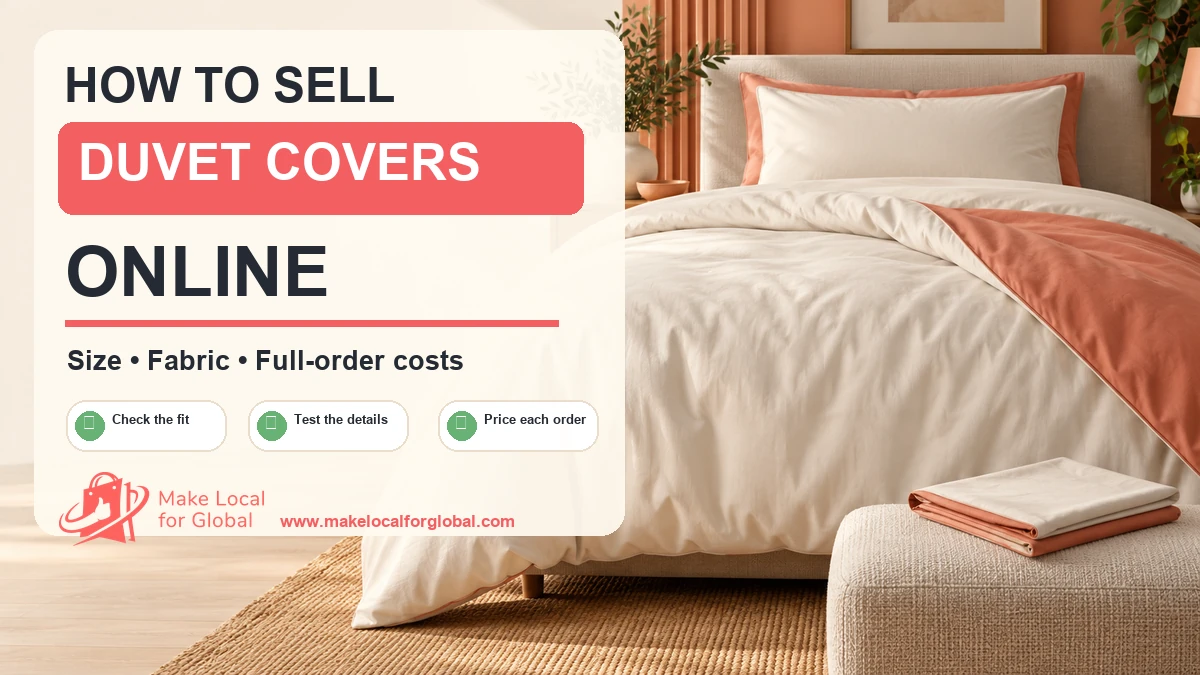
Selling duvet covers online looks simple until a customer asks whether a “king” cover will fit a particular duvet, whether the pillowcases are included, or why the colour looks different from the photograph. Those details decide whether a product earns trust, whether the parcel is profitable and whether a first order turns into a recommendation.
A new seller does not need dozens of designs or a warehouse full of every size. A more reliable start is a small, clearly described range, samples checked against real measurements, photographs that show the cloth and fastening, and a cost model that includes the parcel and the work behind it. This guide takes you from choosing that first range through sourcing, pricing, listing, fulfilment and early marketing.
This guide focuses on duvet covers and duvet-cover sets: the removable outer covers that enclose a duvet. It is narrower than a general bed-linen range guide, which looks at bedding as a broader category. If your first range is centred on bamboo sheets, see our guide to selling bamboo sheets online. Keep the duvet-cover page focused on cover construction, fit, fabric, sets and how the packed order works.
Start with a product decision, not a catalogue. Choose one customer, one useful fabric direction and a manageable set of sizes. Verify one sample in each materially different construction before you commit to stock.
“People who need bedding” is too broad to guide product selection. A small shop needs a clearer reason for being on a shopper’s screen. A useful starting customer could be a first-home renter furnishing a double bed, a parent buying practical single-bed bedding, a design-conscious buyer looking for muted colour, or a guest-house operator replacing matching sets. You do not have to exclude everyone else. You do need an initial customer whose questions you can answer consistently.
Write down the practical job the cover should do. Is the range meant to feel cool and crisp, smooth and soft, easy to wash, easy to change, or visually distinctive? These are different product decisions. A smooth fabric is not automatically cooler; a natural fibre is not automatically stronger; and a higher thread count does not by itself prove better performance. Ask suppliers for the fibre composition, weave or knit, finished dimensions, fabric weight if available, care instructions and construction details. Then judge a real sample rather than relying on a fabric name.
List the buyer’s likely concerns before choosing designs: will the cover fit their duvet; does the set include one or two pillowcases; is the opening a zip, buttons or envelope flap; can they see the colour in ordinary light; and will it arrive in time? These questions become your selection criteria, the details in your product pages and the checks you perform before listing.
Use evidence from conversations and small tests. Ask a few likely buyers what they currently find confusing or disappointing about duvet covers. Show a small set of actual swatches or sample photographs and ask what they would want to compare. Record what people say without presenting polite interest as proof of demand. A useful signal is a specific action: a customer asks about a particular size, joins a relevant waitlist, requests delivery timing, or places a paid order under clear terms.
If you already sell another bedding item, look at real customer questions, search terms and returns. Those can reveal a fit problem worth solving. Do not assume the most popular item in a supplier catalogue is the best first product for your business. The right starting product has a defined customer, a reason to choose it, a supplier you can verify and an order economics model that works.
Your offer needs a precise contents statement. A cover-only product is straightforward: one duvet cover in one size. A set may include the cover and one or two pillowcases. Some sellers offer a fitted sheet or flat sheet in a bundle, but that changes the stock, packaging, price and customer expectation. Put the exact contents near the title and in the first screen of the product page. “Double duvet set” is not enough if shoppers cannot tell what is in the parcel.
Cover-only products can help a buyer replace a worn cover while keeping existing pillowcases. They can also give a new shop a simpler inventory structure. Sets may increase order value and create a coordinated look, though they introduce more pieces to count and more chances for a listing to be misunderstood. If a set includes pillowcases, state their finished measurements and closure type as well as the duvet-cover dimensions. Do not assume buyers know whether “pair” means two cases.
Decide whether to offer a single design as separate pieces, a fixed set, or both. If customers can add a matching pillowcase, make the choice visible and explain whether the case is sold individually or as a pair. If a photograph shows cushions or sheets that are not included, label the image or explain the styling clearly. A lifestyle photograph should help someone picture the product; it must not quietly enlarge the promise.
Build a simple assortment table before you order. Rows can be designs, columns can be sizes, and separate fields can identify cover-only, set configuration, supplier SKU, purchase cost, minimum order quantity and expected replenishment time. Mark an item as unavailable until you have confirmed that the supplier can provide the exact variant. Keep supplier names and internal costs out of the public product description.
For a first release, test one coherent offer rather than trying to serve every bedding need. A small collection might use two calm solid colours and one patterned option in three core sizes. Another shop might test one print in a single size to a known audience. There is no universal correct number. The point is to keep each stock choice explainable and to avoid buying a large range before you have evidence that shoppers want it.
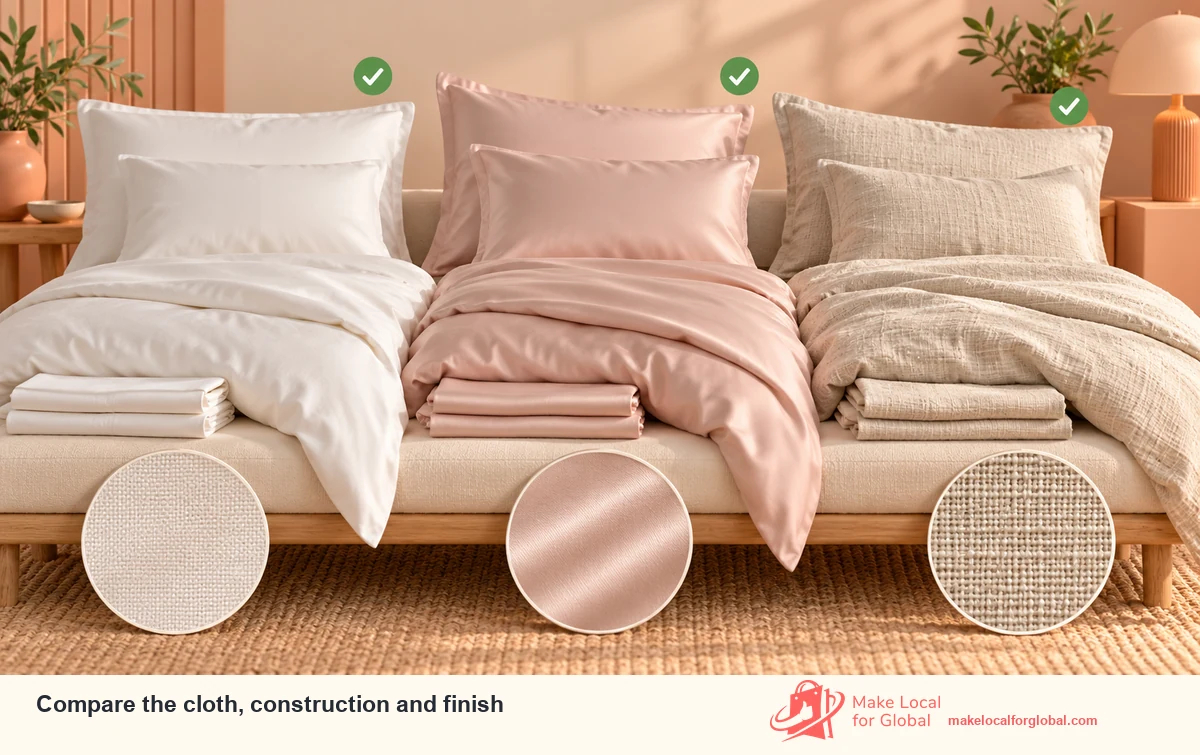
Fibre names are not a complete product description. Cotton, linen, viscose, polyester and blended fabrics can behave differently according to yarn, weave, finish and manufacturing. “Percale” usually describes a plain woven construction with a crisp hand; “sateen” describes a weave that can create a smoother face. Those terms are useful only when the supplier confirms the construction and your sample feels consistent with the description. Avoid promising a temperature effect, allergy benefit, durability level or environmental advantage without reliable evidence for the specific product.
Compare samples under ordinary bedroom light and in daylight. Look at how the cloth drapes, whether it feels comfortable against skin, how opaque it is, whether the colour shifts, and whether the surface is consistent across the piece. Check seams and hems. Run your hand across the inside and outside. See whether the fabric attracts lint or shows creases in a way that matters to the intended customer. Take notes and keep a labelled reference swatch so that future stock can be compared against the approved sample.
Ask the supplier to state fibre percentages for each component. If a cover has a different fabric on one side or decorative trim made from another fibre, ask how the composition is represented on its label. Verify the final product and packaging information before you write a claim. Great Britain’s textile rules require fibre names and composition to be provided in prescribed ways; a retailer should not assume that a supplier’s marketing sheet is a compliant label. Check the current GOV.UK textile labelling guidance for the product and market you serve.
Treat “organic”, “recycled”, “responsibly sourced”, “plastic-free” and similar statements as claims that need substantiation. Keep the certificate, supplier declaration, scope and date that support each claim. Say exactly what is certified: a fibre, a facility, a product line or another defined part. The Competition and Markets Authority’s Green Claims Code explains that environmental claims need to be clear, accurate and supported. Avoid a broad “eco-friendly” badge when you can state a specific, evidenced fact instead.
Build a comparison sheet for samples. Record fibre content, construction, finish, fabric weight where supplied, dimensions, wash performance, colour change, shrinkage, seam quality, closure, care label and the date you approved it. Score each factor against what your target customer values. The score is a decision aid, not a replacement for evidence. If the softest sample pills or shrinks beyond your tolerance, do not keep it simply because it feels good on the first touch.
The word “double” refers to a bed or duvet size category; it does not guarantee that every retailer’s cover measures exactly the same. For example, current UK charts from John Lewis, The White Company and Dunelm show close matches for some categories and differences for others, including single and king dimensions. Always verify the particular duvet-cover specification you will ship. A size label should help navigation; the measured finished dimensions should remove doubt.
| Common UK category | Example duvet-cover dimensions in supplier size guides | What to verify on your own product |
|---|---|---|
| Single | Around 135–140 × 200 cm | Finished width and length, plus pillowcase size |
| Small double | Around 175–200 × 200 cm | Whether the supplier offers a distinct small-double cover |
| Double | Around 200 × 200 cm | Actual finished dimensions and the matching duvet range |
| King | Around 225–230 × 220 cm | Supplier’s measured width and length, not just “king” |
| Super king | Around 260 × 220 cm | Finished measurement, seam allowance and pack dimensions |
These are examples, not a universal specification. The ranges above reflect differences in published UK retailer charts checked on 24 October 2026. Before selling, measure your own approved sample and write the cover’s finished width and length in centimetres. Ask the supplier whether the stated size is the sewn product size, an unsewn cut size or a nominal category. Ask whether measurement tolerance applies and how much. Record the answer in your product file.
Do not confuse duvet-cover sizing with mattress sizing. A mattress guide tells a shopper about the bed surface; the duvet cover must fit the duvet. Some buyers have an older or generously filled duvet, a non-standard imported duvet or a preference for extra drape. Tell customers to compare their duvet’s own dimensions with the cover’s dimensions. If you have confirmed that a specific cover is designed for a particular duvet category, say that and still show the measurement.
The actual difference between the cover and the duvet matters. A cover that is much smaller can be difficult to put on and may compress the filling. A cover that is much larger may allow the duvet to move around. Do not invent a fit tolerance. Ask the manufacturer what the measurements mean and test a sample with a compatible duvet. Photograph the fit and measure the sample after laundering according to the care label.
Show both centimetres and, if your audience needs it, inches. Keep the unit consistent through the title, size selector, specification table and care card. Use the same order—width × length—everywhere. If the design uses a different size chart from your other products, explain why rather than copying an inaccurate chart for the sake of consistency.
The opening is a working part of the product, not a small styling detail. A zip can make a cover quick to close, while buttons can be a visible design feature. An envelope or flap closure avoids a fastener but may feel different to use. None is automatically best for every customer. Confirm exactly what the sample uses, how long the opening is, whether the fastener runs smoothly and whether any part catches on the fabric. A neat close-up photograph can answer a question that a generic supplier image cannot.
If there are buttons, count them, check that they are sewn securely and see how the closure behaves after washing. Check that a zipper has a fabric guard if the design claims one, and examine the stop and stitching. A zip should run through its full track without snagging. With an envelope closure, check the overlap depth and whether the duvet can escape during normal handling. Report only features verified on the item being sold.
Corner ties or loops can help keep a duvet in place, but customers need to know whether they are present and how many there are. Inspect each corner and the stitching. See whether the ties can be reached after the duvet is inserted. If the product has no ties, do not imply that it does in a diagram. If the supplier uses a different arrangement by size, disclose that difference. An accurate photo of the inside corner can make the product page more useful.
Check the seam finish along the opening, corners and hems. Look for skipped stitches, loose threads, uneven folds, raw edges and fraying. Inspect label placement: the label should be readable and should not create an uncomfortable patch on a sleep surface. Where relevant, compare left and right sides so that the cover does not twist or show a pattern mismatch. Keep photographs of any defect and agree the supplier’s acceptable quality standard before a purchase order.
Make a written sample checklist and use it for each design and supplier. A sample approval record should include a product code, colour, size, component list, measurements, closure, tie count, care label, observed defects, wash result and sign-off date. Save a photograph next to the record. When a later production run arrives, compare it against the signed-off sample rather than relying on memory or a website image.

Use the care instructions supplied for the product and keep a record of the test. Measure the sample before laundering, wash and dry it as directed, then measure it again. Note changes in width and length, seam distortion, puckering, colour transfer, lint, pilling, softness and closure operation. A simple percentage change is: (after-wash measurement minus before-wash measurement) divided by before-wash measurement, multiplied by 100. A negative result indicates shrinkage. Record the actual results; do not turn one sample test into a blanket guarantee about every future batch.
Photograph the sample before and after laundering under similar lighting. Compare it with a colour reference rather than a phone screen alone. If you use a colour name such as “stone”, “sage” or “terracotta”, make sure the name is a helpful description and not a claim that the item will look identical on every display. Let customers know that screen settings and room lighting can affect appearance, while still providing accurate images and a clear returns process.
Test the cover on a duvet with measurements close to the product’s stated target. Check whether the corners align, whether the fastening closes without strain, and whether the duvet fills the cover evenly. Put it on and take it off more than once. That reveals whether an opening is awkward, whether ties are reachable and whether the cover twists. Ask another person to try it without coaching; their difficulty can reveal a product-page instruction you need to add.
Check the care label and the supplier’s written instructions. If the label differs from the supplier brochure, resolve the discrepancy before selling. Do not write a hotter washing temperature, tumble-drying method or ironing instruction based on a guess. Care information should match the product and label. Keep a copy of the label artwork and order specification. If labels are not in English for your intended UK customers, ask the supplier how to obtain correct customer-facing information.
If the product’s performance is variable or a sample reveals a fault, pause the listing. Ask the supplier for an explanation and a corrected sample. A discount does not solve an undisclosed quality problem. If you decide to sell a seconds item, describe the defect prominently and check that your consumer-law obligations still allow the offer you intend to make. Separate it from standard stock and make the condition unmistakable before checkout.
Supplier choice is a product and cash-flow decision. A low quoted unit price can hide a high minimum order, freight, customs charges, inconsistent sizing or a long replenishment time. Ask the supplier for a written quotation that separates product price, sampling, packaging, transport, duties or import charges where applicable, and any artwork or labelling setup. Establish the currency, quotation validity, payment terms and what happens if delivery is late or goods do not match the approved sample.
Ask for the company’s legal name, business address, production location, product specification, fibre evidence, care information, quality process, typical production lead time and complaint contact. Verify that the company can be reached through independent contact details. Request references or inspect a sample order. A marketplace profile or polished catalogue is not proof that the supplier can meet your exact requirements. If a supplier refuses to identify the manufacturing or dispatch arrangements relevant to your product, treat that as a reason to investigate further.
Discuss tolerances clearly. How much can finished width and length vary? Can the fibre composition, dye lot, print placement, zip, button or trim change without approval? What inspection records are available? How are defective units reported and resolved? Who pays return freight for a production fault? Get answers in writing, then make them part of your purchase order or supply agreement. A verbal assurance can be difficult to use when a later batch differs.
For an initial order, keep the quantity tied to evidence. Calculate the cash tied up by the minimum order, shipping and packaging, then compare that total with a realistic sales test. Think about how many weeks of stock you can store and how much you can afford to have unsold. If several sizes share one print, do not assume the demand split will be equal. Ask whether the supplier can replenish specific sizes quickly or whether you must buy a full size curve again.
If you import, confirm who is importer of record, how landed charges are calculated and what paperwork will be supplied. Seek current advice for the countries involved; rules and costs depend on where the goods are made, where they enter and where you sell. Keep invoices, purchase orders, declarations, shipping documents and any product-safety records. A supplier saying “tax included” is not enough unless the arrangement and paperwork are clear.
Start a supplier scorecard with columns for sample quality, communication, specification accuracy, lead time, order flexibility, documentation, price and after-sales response. Revisit the score after each order. A dependable supplier who answers fit and labelling questions may be more valuable than the lowest cost quote. Keep a backup option for critical products, but qualify the alternate with its own sample; do not assume two suppliers use interchangeable dimensions or finishes.
Every variant multiplies decisions. A product with four colours, five sizes and two set formats has forty combinations before you add pillowcase options. Each combination can have its own stock position, photograph, supplier code, barcode or dispatch constraint. A wide selector can look impressive while hiding a fragile inventory plan. Start with variants you can name, photograph, store and replenish accurately.
Separate the design decision from the size decision. Decide first how many designs are needed to express the brand, then choose the sizes that the target customer is likely to buy. Use supplier data as a clue, not as a substitute for your own demand evidence. If the supplier only offers a size you cannot explain or support, do not include it because a competitor has it.
Make a variant master sheet with a stable SKU for each sellable option. A SKU might encode product family, design, colour, size and set type, but keep it short enough to use on a packing slip. Do not change the SKU whenever the display name changes. Map each SKU to the supplier’s code, product barcode if any, approved sample, selling price and stock count. Test that the shop’s inventory system reduces the correct variant when an order arrives.
Photograph colour variants separately if the differences are meaningful. A swatch card beside the same neutral background can help shoppers compare. Keep lighting, angle and white balance consistent, but do not edit the image until a colour becomes misleading. If a colour name is shared across suppliers, compare the actual cloth before presenting the items as matching. “Matching” can be a strong promise in home textiles.
Review range breadth after a small sales period. Which size received questions? Which colour got clicks but no sales? Which bundle created confusion? Did buyers request a cover-only option? A low-selling variant is not automatically a failure; it may have been hard to find or poorly explained. Use analytics together with support messages and returns to decide what to change. Avoid buying more stock solely to make a collection look full.
Do not set a duvet-cover price by adding a simple percentage to the supplier’s unit price. An online order consumes more than the product: inbound freight, protective packaging, pick-and-pack time, postage, payment fees, discounts, customer acquisition and a realistic allowance for defects or returns can all matter. Include platform subscription and software costs in your overhead plan, even if they are not charged per order.
Here is an illustrative scenario for a duvet-cover set sold for £58. It assumes a seller not registered for VAT, so the amounts below are cash costs paid per order. The numbers are examples, not supplier quotations or a market average.
| Per-order item | Illustrative amount |
|---|---|
| Selling price received | £58.00 |
| Landed cover set, including inbound freight allocation | £17.50 |
| Packing materials | £1.10 |
| Pick-and-pack labour allowance | £2.50 |
| Outbound postage paid by seller | £4.25 |
| Standard UK card fee at 1.5% + 20p | £1.07 |
| Customer acquisition cost allowance | £6.00 |
| Returns/defect reserve | £4.50 |
| Total illustrative variable costs | £36.92 |
| Contribution before overheads and tax | £21.08 |
The card-fee line uses Stripe’s published UK standard card pricing of 1.5% plus 20p at the time checked; verify the provider’s current UK pricing before using it. £58 × 1.5% + £0.20 equals £1.07 after rounding. Rates can vary by card type, country, account and product, and other providers charge differently. The postage figure is a placeholder: a duvet-cover set may be bulky, and the actual price depends on parcel dimensions, weight, route and service. Measure a packed sample and price it with the carrier. Royal Mail’s current postage prices can be checked, but compare other suitable carriers too.
The £4.50 reserve is a planning assumption, not a published returns rate. One way to build a reserve is to estimate the chance of a returned or defective order and the average cost that you cannot recover. For instance, a 10% planning assumption multiplied by a £45 irrecoverable cost gives £4.50. Replace both assumptions with your actual data as orders arrive. Do not count a returned product as a full loss if it can be inspected and resold, and do not count it as full value before you know its condition.
Contribution is not net profit. It is the amount left after the listed variable costs and before overheads, owner pay, tax, interest and other business costs. If you are VAT registered, do not copy this calculation unchanged: output VAT affects the amount retained from a consumer price and eligible input VAT may be recoverable under the rules that apply to your business. Model VAT with a qualified accountant or current HMRC guidance. Include discounts, failed deliveries and marketplace fees where relevant. If you sell through Etsy, check its current fee schedule; a transaction fee is only one possible cost, and payment processing and advertising can add further charges.
Run a sensitivity check before ordering stock. What happens if postage is £2 higher, the landed cost rises by 12%, acquisition costs double, or a promotion removes £5 from the selling price? Work out a minimum price that preserves the contribution you need, then check whether it still makes sense to the buyer. If a plausible change wipes out the whole contribution, the offer needs a different product cost, pack size, channel or price before you scale.
Use a clear, descriptive title that says what the item is and signals the key distinction. “Duvet cover set – cotton percale, sage, double” is more helpful than a poetic collection name by itself. Place the measured dimensions, fibre composition and exact set contents close to the size selector. Keep the chosen size and selected set format visible in the cart. A buyer should not have to infer whether pillowcases are included from a photograph.
Write a short opening paragraph that describes the intended product and its verified features. Follow with a compact specification list: cover dimensions, pillowcase dimensions, fibre composition, closure, number of corner ties, set contents, care instructions, country of origin if accurately known, and what is not included. Use an expandable details area if the page is long, but do not hide the most important fit and contents information behind it.
Add a fit note that encourages shoppers to check the duvet itself. For example: “Measure your duvet before ordering. This cover measures 200 × 200 cm; check that your duvet dimensions are compatible.” Do not tell a buyer that a label guarantees a fit if it does not. If your supplier publishes tolerances, explain them in plain terms. Make the size chart easy to find on mobile and keep it close to the selector.
State dispatch and delivery expectations honestly. Distinguish the time before dispatch from the carrier’s transit time. If a size is made to order, say so before checkout and give a realistic estimate. Explain how tracking works and what happens if a parcel is delayed or appears lost. Avoid guaranteeing an arrival date unless your fulfilment process and carrier service genuinely support it.
Explain returns in a way that is accurate and easy to locate. UK distance-selling rules generally give consumers a right to cancel many online purchases within 14 days after receiving goods, with a further 14 days to send them back after notifying the seller. Specific exceptions exist, and the buyer must be told required information before they order. Review the current GOV.UK distance-selling guidance and returns and refunds guidance; do not assume that opened bedding is automatically exempt. State how the customer should contact you, what condition is expected where relevant, who pays return postage when the law permits, and when a refund is processed. Your policy should match the applicable law and your actual process.
Use a concise FAQ for genuine product questions, not repeated keyword variants. Useful questions include “Are pillowcases included?”, “How do I choose the correct size?”, “Can I wash it before use?”, “What is the closure?”, “Do the colours match the photographs?” and “When will this size dispatch?” Answer from the product file. If a question applies only to one fabric or design, answer on that product rather than copying it everywhere.
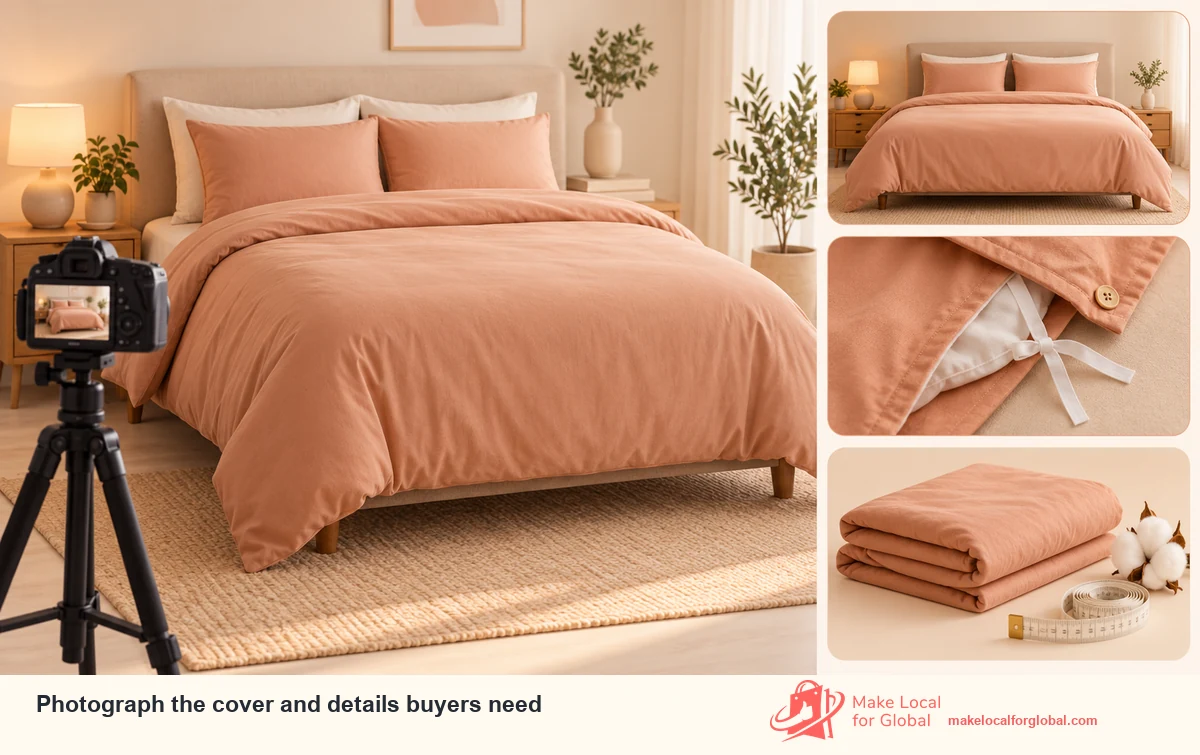
The first image should make the product and its visual character clear at thumbnail size. Use a clean bed scene with the featured cover as the main subject. Keep styling simple enough that the fabric, colour and pattern remain visible. A crop of an unrelated bedroom may be attractive but does not help a shopper judge the item. Add a close-up of the weave or print, the fastening, an inside corner tie if present, the label where appropriate and the folded parcel or set contents.
Take colour photographs with consistent, soft lighting and a neutral reference. Avoid dramatic filters, heavy shadows and strong colour casts. Capture the same design in a wider room view and close detail. Use a separate photograph for each colour when useful. Images should show what the buyer receives. If a bed includes cushions, throws, sheets or decor that are not part of the offer, say so near the gallery or use a clearly labelled styling note.
Use a short image sequence that answers a decision in order: what the cover looks like on a bed; what the surface looks like up close; how the closure works; what is inside the set; and how the cover is packed. A small graphic can explain dimensions or set contents, but do not ask graphics to carry details that should be plain text. Ensure any text remains legible on a phone and do not include unverified quality marks or certification icons.
Use descriptive filenames and alt text. A filename such as `sage-cotton-duvet-cover-double-bed.webp` is more useful to your media library than `IMG_1048-final2.webp`. Alt text should say what a screen-reader user needs to know about that image, not repeat the search phrase. For a decorative bedroom scene, “Sage duvet cover set styled on a double bed” is clearer than “sell duvet covers online best duvet cover”. For a technical close-up, describe the visible closure or tie. If the image is purely decorative, an empty alt attribute may be appropriate in the page context.
Compress images while preserving readable detail and a suitable aspect ratio. Serve a modern format supported by the site and keep the gallery consistent. Check the product page on a phone: the first image should not be cropped so tightly that the cover’s colour or full bed context disappears. Do not generate a room image and present it as a literal photo of the exact physical item unless you disclose that it is illustrative and the representation remains accurate. Product accuracy matters more than a polished scene.
Duvet covers compress, but the folded bundle can still create a bulky parcel. Pack a real sample using the packaging you expect to use. Measure the finished parcel and weigh it with the insert, care card and label included. Check whether your carrier charges by actual or volumetric weight and whether the parcel stays within the service’s dimensions. A shipping estimate based on a naked fabric sample can understate the final cost.
Choose packaging that protects the product and is practical to reuse, recycle or dispose of, but only make environmental statements that you can support. Avoid packaging so tight that opening it damages the cover. Include a packing checklist so the correct size, colour and set pieces are counted. For higher-volume fulfilment, scan or verify the SKU at pick and again at pack. A simple final check prevents sending a double set to someone who ordered king.
Record stock by sellable variant, not by design family alone. A set containing one cover and two pillowcases needs all components available. If pieces are stored separately, track the bundle components and the quantity each can support. Reserve stock when payment is confirmed. Set a reorder point using lead time, average sales and a safety buffer that reflects supplier reliability; do not reorder solely after a variant reaches zero.
Use a basic stock count schedule. Reconcile the physical quantity with the online store on a regular cadence and after any damaged, returned or sampled item. Mark a returned cover as available only after it has been inspected and its condition meets your stated resale standard. If hygiene, sealing or customer expectations make a returned textile unsuitable for resale, reflect that in your process and cost assumptions. Check applicable consumer rules before setting any policy about opened goods.
Keep a batch record for each delivery: supplier, purchase order, invoice, arrival date, quantities, lot or dye reference if supplied, inspection result and any issue raised. If two batches differ in colour or finish, do not mix them under one product expectation without checking. A small shop can use a spreadsheet at first; the important part is keeping a traceable link between the customer order and the stock batch.
Textile content information, consumer rights and product safety depend on where you sell and the product’s exact configuration. In Great Britain, check the current textile-label requirements and the product-safety advice for businesses. If you sell into Northern Ireland, rules can differ: see the current Northern Ireland general product-safety guidance. Do not assume a statement for Great Britain automatically covers Northern Ireland or EU destinations. If you import, manufacture or sell under your own brand, identify your legal role and the obligations that attach to it.
Maintain a product file with supplier and manufacturer details where required, the specification, fibre evidence, label copy, sample approvals, purchase records, safety or conformity records relevant to the item, customer complaints and corrective actions. The level of documentation depends on the product and market. Ask a competent adviser if you cannot determine which obligations apply. Keep the file accessible and current; it should not be assembled for the first time after a complaint.
Be precise with claims about softness, durability, breathability, cooling, hypoallergenic properties, antimicrobial treatment and sustainability. Such claims can affect a purchase decision and should have evidence for the exact item. A supplier’s generic brochure may not substantiate your own specific claim. Keep a record showing what test or documentation supports it. If you cannot substantiate a claim, remove or narrow it.
Review all information displayed before a shopper pays: product identity, main characteristics, total price and any delivery charges, payment options, delivery arrangements, cancellation information and contact details. Distance-selling information has specific requirements. Re-read the official online-selling guidance when you change your checkout or offer. If you use a marketplace, the marketplace’s settings do not necessarily remove your own legal responsibilities.
Your own store gives you control over product presentation, customer service and repeat-purchase relationships, but it also means you must attract qualified visitors. A marketplace may already have relevant shoppers and can help test a product, though fees, competition and channel rules affect the economics. Compare channels based on total cost, buyer intent, customer data access, listing control and the time needed to fulfil orders. Do not count marketplace search traffic as free.
Start with one or two channels you can maintain. Build a clear store page, make a small set of listings accurate and establish a customer-service routine before adding more platforms. If you advertise, begin with a modest, measurable test. Track campaign spend, product-page views, add-to-baskets, purchases, refunds and contribution after fees. A high click-through rate is not a profitable outcome if orders lose money.
Use product-specific content to answer real questions. A short guide on measuring a duvet, a comparison of closure types or a photo showing the difference between a cover-only listing and a set can attract and help buyers. Link that content to the relevant product page with plain anchor text. Do not produce near-duplicate pages for each keyword. Make each page useful on its own and keep product facts consistent across the site.
For organic search, use the words buyers naturally use in the page title, headings and product description, while keeping every phrase readable. Distinguish “duvet cover”, “duvet cover set” and any material or size detail that is genuinely part of the offer. Add structured product data through a reliable ecommerce system and check that price, currency, availability and product identity match what a shopper sees. Do not use reviews, ratings or stock schema that does not represent real information.
Share helpful photographs and care advice on social channels, then direct readers to a product page with the same claims and price. Ask for reviews after a real purchase and do not condition an incentive on a positive rating. Respond to questions in a way that can become a useful FAQ, but remove personal information before reusing a message. If customers mention fit, colour or care repeatedly, improve the listing and sample-check process.
Measure a simple weekly set of indicators: product-page visits, conversion rate, average order value, contribution per order, return rate, defect rate, delivery time and stock cover. Segment results by size and channel. A rise in sales alongside an increase in refunds may indicate that a size chart is unclear or a colour is not represented accurately. Use the signal to investigate, not as proof of a single cause.
Create short, accurate answers for common questions about size, set contents, care, dispatch, tracking, returns and colour. Store the approved product facts where anyone handling enquiries can find them. If a customer gives a duvet measurement, help them compare that measurement with the cover specification; do not promise a fit outside what you have tested. When an answer is uncertain, check the supplier record rather than improvising.
Set a response expectation that you can meet. Decide who handles messages, what hours they are monitored and how an urgent delivery issue is escalated. Keep the order number, SKU, batch and carrier details together so you can investigate a complaint. If a customer reports a defect, ask for the information needed to assess it without making the customer repeat their story. A clear, respectful process can preserve trust even when the product has a problem.
Record each complaint and its resolution. Group issues by fit, colour, closure, missing set pieces, delivery damage or care outcome. Review the pattern after a reasonable number of orders. One report can reveal a serious risk; a repeated pattern can reveal a process problem. Pass verified manufacturing issues to the supplier and keep the response. Do not dismiss a report because the listing received positive reviews.
Create a returns inspection checklist. Confirm the item and variant, note its condition, photograph any damage, check whether the packaging is complete and decide whether it can be restocked under the rules and policy you communicated. Update stock and the return reason. Refund in line with applicable requirements, not only when the returned parcel is convenient to process. Keep records so that your reserve and product descriptions can be improved.

Days 1–4: define the offer. Choose a first customer and one product direction. Decide cover-only or set, the first design choices, sizes and the reasons for each. Review your own market research and existing bedding questions. Write the exact information you need from suppliers before requesting a quote.
Days 5–9: compare suppliers. Request written specifications, samples, lead times, minimums, packaging details and fibre information. Compare landed costs instead of unit costs alone. Check that the supplier can support the intended labels and measurements. Keep a shortlist and record unanswered questions.
Days 10–14: test samples. Measure each sample, inspect seams and closures, check the set contents and run care tests as directed. Test fit with a compatible duvet. Photograph before and after. Approve only the items that meet your written criteria. Resolve discrepancies with the supplier before ordering.
Days 15–18: price the order. Build a variable-cost model for each offer. Include payment fees, realistic packaging and postage, labour, advertising, marketplace fees and a returns/defect allowance. Check VAT treatment for your business. Test a higher-cost and lower-price scenario. Choose a price that is explainable to a customer and leaves a contribution after the listed costs.
Days 19–23: prepare the store. Create SKUs, inventory records, product titles, descriptions, accurate photographs, size tables, care details and customer-service answers. Configure delivery, returns and checkout information. Test the product selector on a phone and make a test order through the shop’s normal process. Confirm that the right SKU appears on the order and stock changes correctly.
Days 24–27: receive and inspect. If stock has arrived, compare it with the approved sample and purchase order. Check quantities and components, inspect a sample from each variant, record batch details and put away sellable units. Pause any item that differs materially until it is resolved. If stock is not yet available, keep the listing’s availability and dispatch estimate accurate.
Days 28–30: run a controlled launch. Share the product with a small, relevant audience or start a limited campaign. Monitor questions and conversion behaviour. Check parcel dimensions and actual dispatch time. Review the first orders individually. Do not treat a short launch window as proof of long-term demand; use it to identify friction and correct errors before scaling.
Using size names without measurements. A “king” label can conceal supplier variation. Publish the actual finished cover dimensions and guide the shopper to measure the duvet.
Listing the styled photograph as the contents. A bed scene may include props that are not for sale. State exactly what is included and label optional styling items.
Buying a broad range before sampling. A cheap minimum order can create many slow-moving variants. Test construction, fit and demand before expanding.
Assuming a fabric term proves a benefit. Fibre, weave and finish are separate details. Use claims supported by the exact product and test evidence.
Pricing from the supplier invoice alone. Include the packed parcel, labour, carrier charge, payment fee, marketing and returns assumptions. Replace guesses with actual results.
Copying a supplier’s dimensions or copy without checking. Your shop owns the customer promise. Confirm the item and keep the specification aligned with the actual batch.
Treating a returns policy as a way to avoid statutory rights. Make the policy easy to find and legally accurate. Check current official guidance for the market you serve.
Using one image for every variant. Colour, size and set differences are material to a buyer’s choice. Photograph differences clearly and keep images representative.
Expanding because a competitor has more options. More options add complexity. Add a variant when customer evidence and stock economics support it.
Making search pages that repeat the same content. Focus each page on a distinct product or useful customer question. Keep the duvet-cover guide separate from broader bedding and sheet guides.
It can be, but profitability depends on the price, landed product cost, shipping size, marketing expense, payment or marketplace fees, returns and overhead. Model the full order before buying stock. Track contribution after variable costs, then account for fixed costs, owner pay and tax. A positive margin before postage or acquisition cost is not enough to establish a profitable business.
There is no single ideal number. Choose enough options to express a useful, coherent range while keeping each size and set format manageable. A small shop might test a few designs and core sizes; another may begin with one specialist offer. Base the decision on customer evidence, minimum order quantities, storage and replenishment rather than a competitor’s catalogue size.
Both formats can serve different buyers. A cover-only option helps someone replace one piece. A set can simplify matching and may raise order value, but adds components and listing detail. If you sell a set, state the exact number and dimensions of all included pieces near the price and size selector.
Use the supplier’s confirmed finished dimensions, then measure the approved sample. Compare the cover with a compatible duvet, not just a mattress chart. Show the size name and centimetre measurements together. Tell shoppers to check their duvet’s dimensions before ordering, particularly where supplier charts use different values for the same label.
There is no best fabric for every buyer. Choose based on the intended hand-feel, appearance, care routine, price and verified construction. Compare physical samples, check fibre content and run the care test. Avoid using a fibre or weave name as a guarantee of cooling, softness, durability or sustainability.
Corner ties can help some duvets stay in position, but not every cover includes them. Check the actual product and test how easy the ties are to reach and use. State whether they are present and how many there are. Do not show a tie in a diagram if the product does not have one.
At a minimum, include accurate dimensions, fibre composition, exact set contents, closure, corner ties if any, care instructions, representative photographs, delivery details, total price and clear returns information. Place important fit and contents details near the buying controls. Add verified origin or certification details only where you have evidence.
Only if the supplier has granted the rights you need and the images represent the exact product and colour you sell. Ask about usage scope, channels, territory and duration. Check that the images do not show unincluded products or features. Your own checked sample photographs can make the offer clearer and reduce mismatched expectations.
Follow the law and the policy presented before purchase. Many distance purchases have cancellation rights, and a blanket “no returns on opened bedding” statement may not reflect the applicable rules. Inspect returned goods, document condition and update stock accurately. Read current official guidance and get advice if a product-specific exception may apply.
Put actual finished cover measurements in the size selector and product details. Explain that buyers should measure their duvet, not rely only on the bed label. Keep width and length order consistent. Add a simple visual size guide, but make sure the guide matches the item’s specification. Review support messages and returns for repeated fit confusion.
A durable duvet-cover business is built from the little promises that hold up: the stated measurements match the cover; the set contains what the page says; the sample survives the care process you describe; the colour photographs help rather than mislead; and the price covers the parcel as well as the fabric. Each promise is manageable when it is written down, checked and tied to a specific SKU.
Before placing a large order, write a one-page launch decision. Name the customer, describe the offer, list the variants and sizes, record the approved supplier sample, set a maximum cash commitment and show the contribution model. Include the questions that remain open. If you cannot answer a basic fit, label, set-contents or cost question, delay that variant until you can.
Once the first units are live, use customer questions and order data to decide what to improve. Check whether buyers understand the measurements, whether the images show the right details, how long packing takes and what the real return and shipping costs are. Update the product page when the evidence changes. Add a new colour or size only when you can source, explain and fulfil it reliably.
If you are planning a wider bedding catalogue, use this duvet-cover work as one part of a connected range and read our broader bed-linen guide. Keep the pages distinct, link them where the next question naturally arises, and let the product evidence—not the size of the catalogue—guide your next step.
Before you commit to a wide bedding order, compare the product costs, fees and cash tied up in stock. Use the Make Local for Global pricing resources to work through the numbers, then contact us if you need help deciding what to test first.
PREFERRED SOURCE
Like what you’re reading? Add Make Local for Global as a preferred source on Google to see more of our articles when you search.

Build your online presence without having to figure out everything yourself.