


READY TO SELL gardening seeds ONLINE?
Get a store built for you in 5 days, plus training and support to help you start, run, and grow your Alternative business.

Plan a focused vegetable and herb seed range, check the supplier and seed rules for your product, price each complete order and test a measured first launch.


Selling gardening seeds online can suit a small shop that wants light, compact products and repeat seasonal demand. The work sits in choosing a clear growing audience, sourcing seeds through a compliant route, controlling seed lots and writing product pages that tell a gardener what to do next.
This page focuses on edible garden seeds for vegetables and herbs. Flower-only ranges have different customer questions and their own product planning, so use the flower seeds selling guide for that separate range rather than mixing both topics into one catalogue.
Start with a narrow offer such as salad crops for containers, easy vegetables for small beds or a practical herb collection. Before you order stock, confirm which rules apply to the exact species, variety, pack format and part of the UK where you plan to trade. In England and Wales, APHA guidance says a business marketing covered agricultural or vegetable seed varieties needs a seed-marketing licence; the page describes marketing as including keeping seed before sale and offering it for sale. Requirements elsewhere in the UK and for different seed categories need their own check.
Use a simple business check to challenge the buyer, product and cost assumptions behind a first seed range.
“People who garden” is too broad to guide buying, packaging or product copy. A person with two window boxes needs different crops, quantities and instructions from an allotment holder planning rows of beans and potatoes.
Pick a real growing situation and learn its constraints. A narrow buyer group makes it easier to choose useful seeds, write relevant advice and spot questions that should appear on the product page before the buyer reaches checkout.
Container growers care about mature plant size, pot depth, sunlight, watering, support and the number of plants they can fit in a small area. They may favour compact tomatoes, salad leaves, radishes, chard, bush beans, chillies and herbs, provided the variety suits container growing and the packet instructions match.
The photograph can make a crop look small, so check the supplier’s variety information and growing advice before calling it “perfect for pots”. State what the customer needs: an appropriate container, a sunny or sheltered position if specified, a support if required, and room for roots.
An example starter offer could be a salad box collection with several leaf types and radish seeds. The page should name the crops, say how many separate packets are included, show the packet sizes and explain that sowing instructions and results vary by variety and local conditions.
Beginners often need confidence about when and how to sow. They may not know whether a seed goes directly into the final bed, starts under cover or needs to be moved after germination.
Build a beginner range around crops with straightforward instructions from the supplier. Pair the packets with a printed or online sowing planner that explains the order of tasks without claiming that one date works for every garden in Britain.
A starter set might combine lettuce, radish and a named herb. Make the set coherent: explain what can be sown in a container, what may need thinning and how the buyer can sow small quantities at intervals. Do not promise continuous harvests or a fixed yield.
These buyers may plan several months ahead and want varieties that complement a rotation or make good use of available bed space. They can value larger packet counts, succession-sowing choices and crop combinations that mature at different times.
Ask whether your customer wants a small number of carefully chosen crops, a theme such as salad leaves, or a wider season plan. A bundle should solve a real planning problem. A dozen unrelated seed packets with no plan may feel like a clearance lot rather than a useful collection.
Your garden tools range can sit alongside seeds in the wider shop, but use separate product pages and relevant cross-links. A buyer shopping for seeds should not have to scan a page about tools to learn packet size, sowing depth or seed-lot details.
Herb buyers may grow in a kitchen, greenhouse, courtyard or garden bed. Basil, parsley, coriander, chives, dill and other herbs can be grouped by cooking use, growing place or sowing method, provided the specific seed and instructions support the claim.
Avoid implying every herb is perennial, frost-hardy or suitable for the same windowsill. Product pages should follow the supplier’s variety-level information. If the advice is not available, ask the supplier before you write it.
Begin with conversations and observable actions rather than guesses about a large market. Ask local allotment groups, community gardens or existing customers what they struggled to find last season. Keep the questions about the product: crop, packet quantity, timing, growing space, trust in seed source and the information they need before buying.
Test a small landing page or a short product survey with a clearly described range. Measure meaningful signals such as email sign-ups, requests for a particular crop, clicks on a specific product and completed pre-orders only if your payment and fulfilment process is ready. A friendly comment is useful feedback, but it is not the same as evidence that someone will buy.
Record the date, audience, question, response count and result. If ten balcony growers ask for compact salad varieties and one asks for a large packet of broad beans, that gives you a clue for the first test. It does not prove demand across the UK, so keep the opening order proportionate.
Gardening seeds can mean many things: vegetable seed, herb seed, flower seed, lawn seed, wildflower mixes, seeds sold for sprouting, tree seed and seed collections for children. The rules, customer expectations, packaging and quality checks can differ across those groups.
For a first shop, define what the range includes and what it leaves out. This article’s working boundary is edible garden seed packets for home vegetable and herb growing, sourced from suppliers who can document the route to market. That boundary keeps product research, compliance checks and customer support focused.
Keep flower-only products in their own range. Link customers who want ornamental planting to the separate flower seeds article, which can address flower choices without forcing flower-specific advice into a vegetable seed page.
Do not casually add seeds for sprouting or eating. A seed sold for growing a plant is not automatically suitable for food use. Before adding edible sprouts or microgreens, check the food-safety and seed requirements that apply to that product and sales model with the relevant authority and supplier.
A useful first catalogue can be small. The aim is to cover a few connected needs with clear choices, not to match the width of a national seed retailer before you know how your own customers buy.
Create a range map before asking for wholesale pricing. For each candidate product, record the buyer, crop, variety, pack quantity, source, available instructions, likely delivery format, regulatory questions and reason for including it.
An entry, core and specialist structure can help buyers compare options, but it should reflect actual product differences. “Entry” might be a small packet of one crop, “core” a practical multi-crop set and “specialist” a variety with a distinct use or growing requirement. A higher price alone does not make a packet premium.
Consider structuring by a real gardening task:
Each collection needs an explanation of what is inside, who it serves, how the seeds differ and what is needed to grow them. If customers cannot distinguish two offers, simplify the range or improve the comparison information.
Each variety, packet size and bundle can add a stock record, product page, supplier reference, label check and potential customer question. A shop with five crop types and two packet sizes has more combinations to track than the headline product count suggests.
Start with a number of products you can inspect and describe accurately. If your supplier requires a high minimum order for one variety, calculate how long it may take to sell through before committing. Seeds have a useful shelf life only when stored and handled within supplier guidance; unsold stock can become a quality and cash problem.
Record the SKU, crop, variety, supplier, supplier lot or batch reference, packet count, date received, best-before or test information supplied, storage instruction and units sold. If the supplier changes a variety or lot, keep the new record separate rather than assuming the packets are identical.
Bundles can raise the value of an order and make a gardening task simpler. A container salad bundle could combine varieties that the supplier confirms suit the intended use, a small planting plan and clear instructions for using each packet.
Check the unit economics before making a bundle. Add the cost of every packet, outer pack, pick time, postage weight, selling fee and any extra printed material. Compare this total with the price a customer will pay and the contribution you need to cover overhead.
Do not make unsupported claims such as “feeds a family all summer” or “guaranteed harvest”. Germination and crop results depend on seed quality, conditions, timing and how the buyer grows the crop. Describe what the bundle contains and let the buyer judge whether it fits.
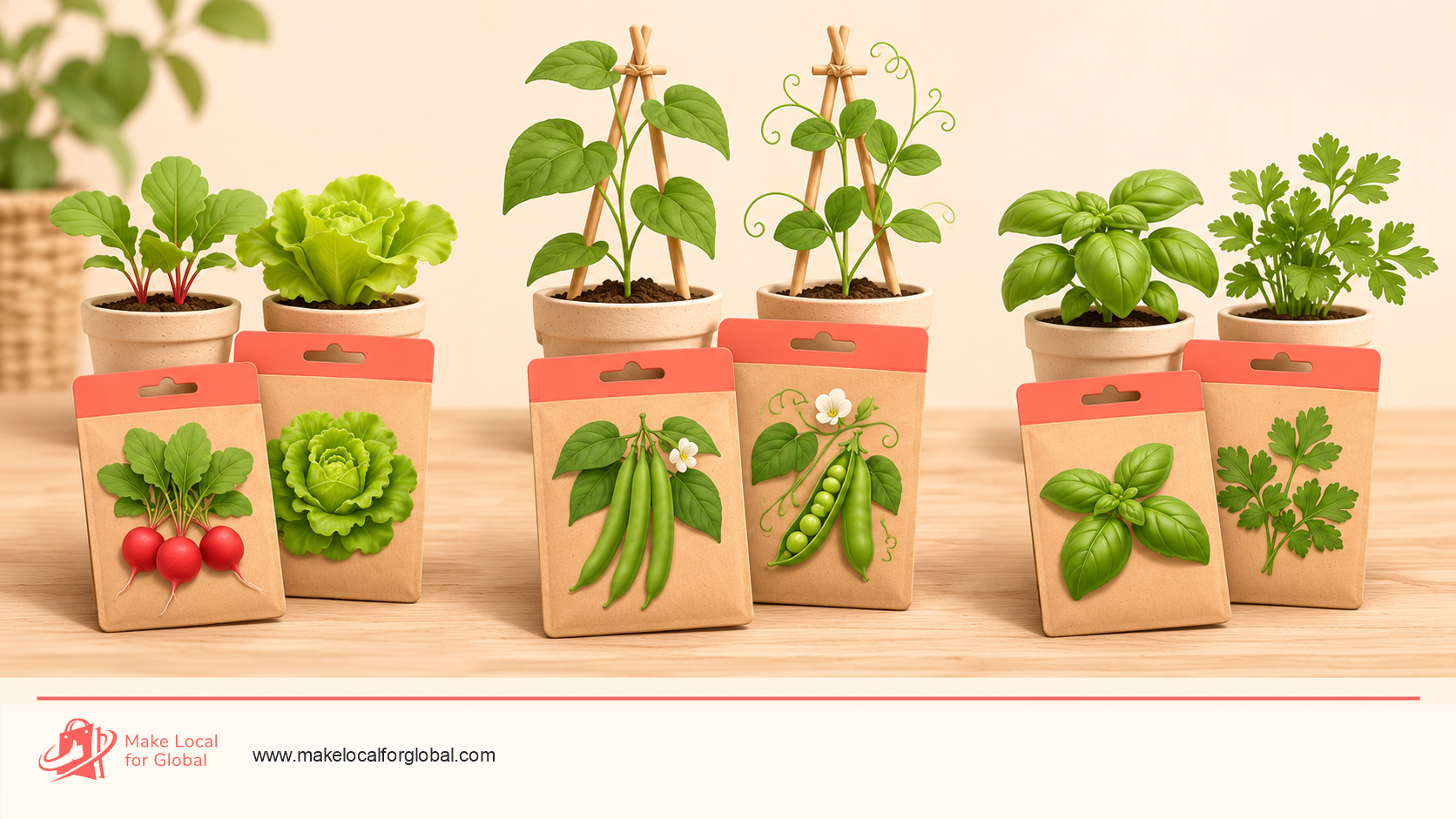
Seed demand follows growing seasons, but the useful timing varies by crop and local conditions. The RHS explains that vegetable sowing can take place in spring, summer and autumn depending on the crop; some seeds are started under cover, and others are sown directly in their final position. Link to the RHS vegetable sowing advice for general growing information, then point buyers to the exact instructions on the packet.
Use a seasonal calendar as a planning aid, not a promise. Show the relevant period, the crop, whether it is direct-sown or started under cover according to supplier information, and the conditions or local variation the buyer should check.
Offer a pre-season buying window only if stock, supplier lead times and delivery plans support it. If you list a variety before stock is confirmed, state the real availability and dispatch timing. Delayed seed orders during the sowing window can frustrate customers more than a product that is temporarily unavailable.
Sourcing is not just finding the lowest wholesale price. Your supplier needs to provide the product identity, lot traceability, quantity, packet details, storage information and the documents required for the type of seed and the role your business plays.
For a first launch, compare licensed domestic suppliers and established seed wholesalers before looking at complex imports or repacking. A supplier who can answer questions and identify a lot is often more useful than a low quote with no records.
Ask for the botanical or common crop name and variety name, packet quantity, seed lot reference, current test or certification information where applicable, storage requirements, packing date or relevant date mark, and the approved use of any product claims. Ask what happens if a customer reports a damaged packet, a mismatch or poor performance.
For each candidate, request a sample or a small first order. Confirm that the physical packet matches the listing details, the packet is sealed as supplied, the quantity is legible and the care instructions can be read. Keep one reference packet and the supplier paperwork with your stock records.
Ask who is responsible for licensing, certification, official packing and labelling. Get a clear answer in writing. A general statement such as “all compliant” does not identify which regulation applies or who carries out each regulated step.
A seed lot is a traceable quantity linked to the seed’s source and relevant checks. Your own record should connect the packet in an order to the supplier and lot information that arrived with it.
When the supplier ships a replacement lot, update the product record. Do not quietly mix new packets into the old stock container if the lot or label changes. A customer complaint or a supplier notice is much easier to investigate when you can see which orders received which lot.
Set a receiving routine: compare the delivery note with the purchase order, count the packets, inspect outer damage, record the lot and dates shown, then store the stock under the supplier’s instructions. Quarantine any packet that is open, unreadable, damp, crushed or different from the order until the supplier advises you.
Buying a large seed quantity and dividing it into your own small packets may look like a cheap way to create a brand. It changes the work you do: you may be packing or repacking regulated seed, handling labels, preserving lot identity and taking responsibility for product information.
Do not assume that a small pack size removes the need for a licence or that a supplier’s approval covers your operation. APHA’s England and Wales guidance says businesses that market, pack or repack covered seed need the relevant licence, and its packing section sets requirements for supervised packing and labels. Confirm your exact activity with APHA before buying bulk stock for your own packets.
If you want branded packets without managing a regulated packing operation, ask a licensed supplier whether it can pack under the required controls and provide the records and labels for your model. Keep the agreement and lot references with the product file.
Seed rules are product-specific. A seller should identify the species and variety, where the seeds were produced and packed, who will market them, whether they are certified or standard seed, what pack format is used and where the customer is located.
For covered agricultural and vegetable seeds in England and Wales, APHA’s seed-marketing guidance states that the business needs a licence and the seed needs certification before marketing. It says that offering seed for sale, including advertising it, and holding it before sale count as marketing. APHA notes that a business may market seed another licensed person has certified, but that does not remove the need to check your own role and licence requirements.
The page lists crop categories such as fruits and vegetables among those for which certification may be required. It describes standard seed as a category available only for vegetable seeds and says standard vegetable seed must meet analytical, varietal-purity and germination standards. Do not infer that every seed sold for home gardening has the same status or that a product is outside the rules since it is sold in a small packet.
England and Wales are the scope of that APHA guidance. Scotland has separate guidance, and Northern Ireland follows separate rules. If you plan to sell across those borders, ask the relevant inspector or agency to confirm the exact product and movement rules before you list the stock.
Imports can add variety-list, certification, plant-health, import-document and labelling checks. APHA’s guidance covers imports and movement between territories in separate sections. For an early shop, buying from a supplier that already understands the intended UK market can reduce operational complexity, but it does not transfer every legal duty automatically.
Seed is a plant product, so import and movement rules can depend on the species, origin and destination. Check current plant-health instructions for the exact product and route. Do not promise international dispatch until you know that the seed can legally move to the buyer’s country and that the required documents and labels are available.
The practical next step is a written compliance checklist for each product family. Include the official source consulted, date, species and variety covered, territory, supplier evidence, licence or certification status, label format and the person who confirmed the answer. If the answer is unclear, pause the listing and contact the relevant authority rather than guessing.
This is a business planning summary, not legal advice. Rules can change and small differences in crop or sales activity can change the answer. The relevant seed authority or a qualified adviser can check your exact model.
Talk through your product range, store setup and the work needed before launch with Make Local for Global.
Seed packets are small, but a damaged or misleading packet can create a large trust problem. A good receiving check catches errors before an order leaves your workspace and gives you a record when a customer asks about a batch.
Check that the crop and variety match the purchase order, the packet is sealed, the quantity is present and legible, the lot information can be recorded, and the sowing and storage information is readable. Check the supplier’s label or documentation for the information required for that category; do not substitute a marketing sticker for a required label.
Look for dampness, punctures, split seams, crushed corners, fading, missing information and signs that packets have been exposed to heat or moisture. A packet that looks clean from the front can still be damaged at the seam. Keep any questionable item out of sale stock until the supplier has assessed it.
Do not open packets to “check the seeds” except as part of an approved process that keeps lot identity, quantity and packaging requirements intact. Opening stock may damage the product or compromise traceability. Ask the supplier for a sample intended for inspection or for the appropriate testing evidence.
Suppliers may provide test reports or certification details. Record the source document, lot, date and scope. A result for one lot does not prove the status of a different lot, and a test certificate does not make every variety suitable for every garden.
Never claim a germination percentage, organic status, non-GM status, disease resistance, harvest yield or climate suitability without evidence that applies to the product you are selling. Ask the supplier for the approved wording and keep it with the listing record.
A home germination check can help you understand a sample, but it is not a replacement for official sampling, testing or certification where those are required. If you perform an internal check, write down the method, sample size, date, conditions and result. Explain the result carefully and do not use it as a regulatory claim.
Create a simple way for customers to report a problem: order number, crop and variety, lot number, packet photo, date received and what happened. A complaint might relate to damaged delivery, missing packets, unreadable labels, delayed dispatch or a growing result that needs more context.
Reply with a clear question rather than asking the customer to prove fault. For a possible seed-quality issue, pause the affected lot as you compare the customer information with your records and contact the supplier. If an official notice or certification withdrawal affects a lot, follow the authority’s instructions and contact customers who received the affected stock as required.
Keep a log of the decision, replacement or refund and the stock action. A pattern across multiple orders may indicate a supplier issue or a listing that failed to explain the crop’s requirements.

Seeds do not need bulky shipping, but their packets can tear, bend or become unreadable in transit. Your packing method should protect the packet, preserve any required label and keep the order contents clear.
Store seeds under the supplier’s instruction, away from damp, heat and direct sunlight when specified. Do not assume that all seeds share one ideal storage condition or that a household fridge is suitable. Use closed, clean stock containers if they support the supplier’s storage requirements and keep lots separate.
Use a simple pick face with product names and lot records visible to the person packing. Pick by SKU and lot, check each line against the order, and place packets in a mailer that protects corners and seals. If a collection contains several crops, use an insert list so the buyer can confirm the contents without opening every packet.
Weigh real packed orders before setting delivery prices. A light seed packet may still need a protective mailer or rigid backing. Measure the finished parcel, compare carrier services, account for label and collection costs, and check that the chosen format is accepted by the carrier.
Print or write the dispatch date on the order record, not on a seed packet except when the approved label requires it. Send a confirmation with the items, dispatch estimate and a link to tracking if the carrier provides it. If stock is delayed, tell the customer quickly and give a clear choice under your terms.
Do not treat seed as automatically exempt from consumer cancellation rules. GOV.UK says distance sellers must explain the right to cancel within 14 days of delivery for most goods and provide the required pre-contract information. Exceptions are specific; check whether an exception applies before excluding a seed product from your returns policy.
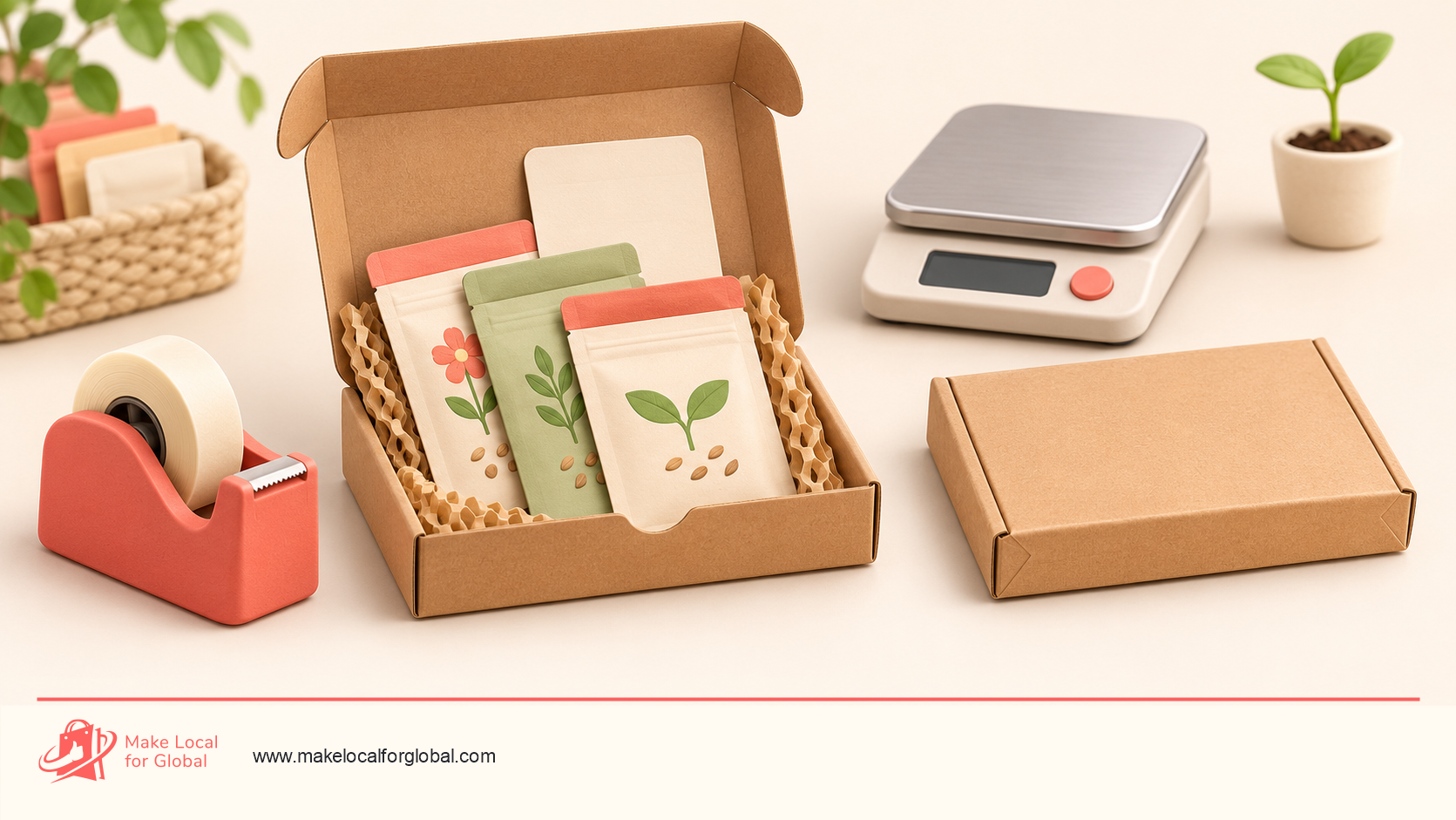
Customers cannot turn a packet around in their hand when they shop online. A detailed page should reproduce the useful product information, clarify what is included and make the growing requirements easy to find.
Name the crop, variety and format in plain language. “Tomato seeds, 25 seeds, ‘Moneymaker’ variety” is more useful than “Summer garden favourite”. Use the supplier’s exact variety name and spelling.
If there are several packet counts, make them selectable and label each option in a way that is clear on mobile. Do not put materially different varieties under one option name if the growing information or price changes.
List the crop, variety, packet quantity or weight, lot or label details where required, recommended sowing approach, sowing depth and spacing when supported by the supplier, relevant timing, expected growing setting, harvest details where supplied and storage instructions.
Use precise language for sowing. If the crop is usually started under cover, say that only when the supplier’s instructions support it. If the advice varies by region or conditions, say so. Link to an authoritative general growing resource such as the RHS sowing advice, but keep the product’s own details on its own page.
State exactly what the customer receives: one packet, a number of packets, a seed collection or another format. Identify whether pots, compost, labels or other items are included. A styled image can suggest a pot or soil, so use a caption or product note to clarify when the image shows props rather than included goods.
Show the actual packet front and back if the supplier permits it and the required information remains readable. Add a close view of any size or quantity mark. A separate image of the mature crop can help recognition, but it should match the variety and should not imply a guaranteed result.
Use a simple diagram to explain what the buyer gets in a bundle or how varieties differ by growing space. Avoid decorative collages that repeat the same packet and leave the customer unsure which item is for sale. The image should support the text, not replace key specifications.
Use phrases a buyer may search for, such as “vegetable seeds for containers”, “easy salad seeds” or a crop and variety name, where the page truly answers that need. Write a distinct title and description for each product rather than swapping one crop name into an identical template.
Add useful categories such as vegetable seeds, herbs, containers or seasonal sowings only when each filter leads to real products. Add short advice pages that answer one customer question, then link to relevant products. Avoid pages that list varieties without enough information to choose.
The product cost is only one part of an order. Include supplier delivery, packaging, pick time, payment and marketplace charges, postage, promotional discounts, damaged or missing orders and the cost of finding a customer.
Use a spreadsheet with one row per SKU or bundle. Keep assumptions visible and refresh them when supplier prices, fees, carrier rates or returns change. Compare contribution per order before deciding whether a price or bundle works.
The example below assumes one customer buys a vegetable and herb seed set. The prices are made-up planning figures, not supplier quotes or evidence of a typical margin. The seller is assumed not to be VAT registered for this simple example; tax, fixed overhead and owner salary are not included.
| Order line | Illustrative amount |
|---|---|
| Product price collected | £20.00 |
| Delivery charged to customer | £2.80 |
| Total order revenue | £22.80 |
| Seeds and packet stock | −£4.80 |
| Outer packaging | −£0.55 |
| Pick and pack time | −£0.60 |
| Postage and carrier service | −£2.40 |
| Payment and marketplace fees | −£1.80 |
| Customer acquisition allowance | −£1.20 |
| Damaged or missing order allowance | −£0.40 |
| Contribution before fixed overhead and tax | £11.05 |
Illustrative planning figures only. Replace them with your own supplier, fee and delivery costs.
The arithmetic is £22.80 revenue less £11.75 variable order costs, leaving £11.05 before rent, insurance, software, accounting, owner pay and tax. If the customer uses a discount, update the revenue and fees. If the seller funds delivery, the delivery charge becomes £0 and contribution falls by the amount collected.
Check the VAT basis before you publish prices. If you become VAT registered or recover input VAT, calculate the net sales and costs using current HMRC guidance and your actual treatment. Do not combine VAT-inclusive sales with VAT-exclusive supplier costs and call the remainder profit.
A low-priced single packet may be awkward to ship profitably if the postage and payment costs are close to the selling price. A multi-packet set can spread those costs across several items, but only if the customer values the combination and stock can be picked accurately.
Calculate contribution per order for a single packet, a small set and a larger collection. Include the cost of extra mailer strength or a printed planting plan. A minimum-spend offer can lift order value, but a discount that wipes out contribution is not a successful result.
If you run a promotion, record the original price, discount, fees and outcome. Compare the number of orders, average order value, contribution, customer questions and repeat purchases. More orders are not automatically better if the extra work and costs erase the contribution.
Seeds tie up cash during the wait for the right season. Estimate likely sell-through using your own demand test and past order data if available. Avoid using a supplier’s minimum order as a forecast of what customers will buy.
Set a review date for each seasonal product. If stock is moving slowly, check the product page, availability timing, price and customer questions before reducing price. Do not relabel or resell stock beyond its supplier information or applicable requirements.
Your own online shop gives you control over product pages, email capture and the customer buying path. It means you must bring people to the site, answer service questions, maintain a secure checkout and manage policies.
An established marketplace can expose a small range to shoppers who are already browsing, but you must learn its listing, fee, fulfilment and customer-service rules. Keep a record of the full fees and avoid relying on a marketplace as your only route to repeat customers.
Local garden centres, allotment groups, workshops and community events can help you learn which crops people want. If you sell in person or use a partner shop, keep product labels and stock records consistent with the online catalogue. A QR code on a display can link to sowing advice, but the printed packet still needs the required information.
You can combine channels after a small test. Use one product identifier and inventory record across every channel so the same packet is not sold twice. Set a stock buffer if inventory updates are delayed.
If you need help testing the business idea before choosing a channel, MLFG’s Business Idea Stress Test offers a structured way to challenge assumptions. Use it to organise questions; then validate them with real seed buyers and supplier evidence.
Gardeners search when they have a task, a season approaching or a problem to solve. Useful content can meet those questions and link to the exact products that answer them.
Build content from customer support logs and search questions. A short page about sowing lettuce in containers can explain spacing, timing and what information to check on the packet, then link to a lettuce variety only if the product matches that use. A seasonal email can remind subscribers about a sowing window, but it should follow current stock and accurate supplier guidance.
Use social channels to show the range, packet information, storage and a real planning process. Photograph actual stock and tests. If you use illustrative images, state that the seeds or props shown are not necessarily the exact item included.
Collect email permission clearly and send messages that match what subscribers asked to receive. A simple sequence might include a welcome message, a seasonal sowing note and an update when a selected crop is restocked. Make it easy to unsubscribe and keep customer data secure.
Test one acquisition route at a time. For example, publish one container-growing page and track visits to the relevant product, add-to-basket actions, orders and contribution. If people read but do not click, the page may not match the product. If they click but leave at checkout, review delivery cost, timing and trust information.
Avoid paying for broad adverts before your product pages, stock records and fulfilment process are ready. Set a small spend limit, use a specific audience or search phrase, and stop if the cost of acquiring an order is greater than the contribution it produces.
Seeds are often bought to a schedule. Give a realistic dispatch window, keep stock availability accurate and send an update if a supplier delay affects an order. A customer may have planned a sowing weekend around the delivery date.
Make the returns and cancellation information clear before checkout. GOV.UK’s distance-selling guidance says sellers must provide business contact details, goods description, full price and delivery information, payment methods and cancellation information before the order. It says customers can cancel most goods orders up to 14 days after delivery. Check the detailed rules and any specific exception before writing a policy for seeds.
If a packet arrives damaged or a line is missing, gather the order number and packet details, then give the customer a clear remedy under your policy and legal duties. Make a replacement easy to identify in inventory so it is not accidentally picked from a different lot.
When a customer says seeds did not germinate, ask for the packet lot, sowing date, method and conditions. Do not blame the gardener or promise a crop. Check the supplier’s information, compare other reports and pause the lot if evidence suggests a wider issue.
For every question, record whether the product page lacked a fact. Repeated questions about container size, sowing depth, packet count or dispatch timing are a signal to improve the page. The best support reply often becomes a clearer specification or a small advice article.
Keep a returns and issue policy that matches the product, seller obligations and actual stock process. Seeds are living material with a sowing season, yet that does not automatically exempt them from consumer cancellation rights. Check the specific exception criteria with current official guidance before applying one.
A simple stock routine prevents a promising seasonal range from turning into a pile of packets with missing records. Reserve a set time each week to review low stock, open supplier orders, product availability and customer issues.
Use a separate bin or shelf for each SKU and lot. Put the oldest appropriate stock at the front only when the supplier’s dates and storage instructions support that order. Keep damaged or disputed packets in a clearly separated hold area.
At the start of each month, compare forecast demand with current stock and supplier lead times. A reorder point can be calculated from average weekly sales multiplied by lead time, plus a buffer based on uncertainty. With few sales, do not pretend the average is reliable; use a smaller test order and review it more often.
At season end, decide whether to reorder, reduce the range, improve the listing or stop carrying a slow product. Keep the reason in the stock record. A product with few orders may have poor visibility, a confusing page or an unfavourable season; review those factors before assuming the crop is unwanted.
A large catalogue looks impressive but multiplies supplier questions, compliance checks, stock records and page-writing work. Start with a range you can describe and fulfil well, then expand when order and customer data point to a real gap.
Requirements depend on species, variety, sale role, packing activity and territory. Treating “garden seed” as one legal category can lead to a listing or shipment that should have been checked first.
Opening bulk bags and making branded packets changes the seller’s role and may trigger licence, sampling, sealing, label and record duties. Get a clear answer before buying bulk stock for repacking.
“Plant in spring” may not answer when, where or how. Use supplier details and reputable general guidance to explain the method, spacing and setting, then say where local conditions can change the result.
Germination, harvest size and timing vary. Avoid guaranteed yields and unsupported percentages. State the product facts and help the customer use the packet information correctly.
Carrier charges, mailer cost and dispatch time belong in the price calculation. A light item still has a handling cost. Review paid delivery and free-delivery thresholds using the contribution calculation.
If packets from two lots are blended in one stock box, it becomes harder to trace a complaint or supplier notice. Track each receipt and record which lot is picked for each order.
An identical template may save time, but it can leave a carrot page with tomato instructions or a herb page with irrelevant spacing. Build a reusable layout with crop-specific fields and review each page before publishing.
Pick one growing context such as small containers or raised beds. Speak with at least five people who fit that context; five is a working target for your own discovery, not a statistically representative sample.
Ask what they bought last season, what they could not find, which packet details were unclear and what they would need to trust a new seller. Record exact phrases. Do not start by asking whether they “like” your business idea.
At the end of the week, write one sentence describing the buyer and one sentence describing the first range. If both still contain several unrelated customer groups, narrow them again.
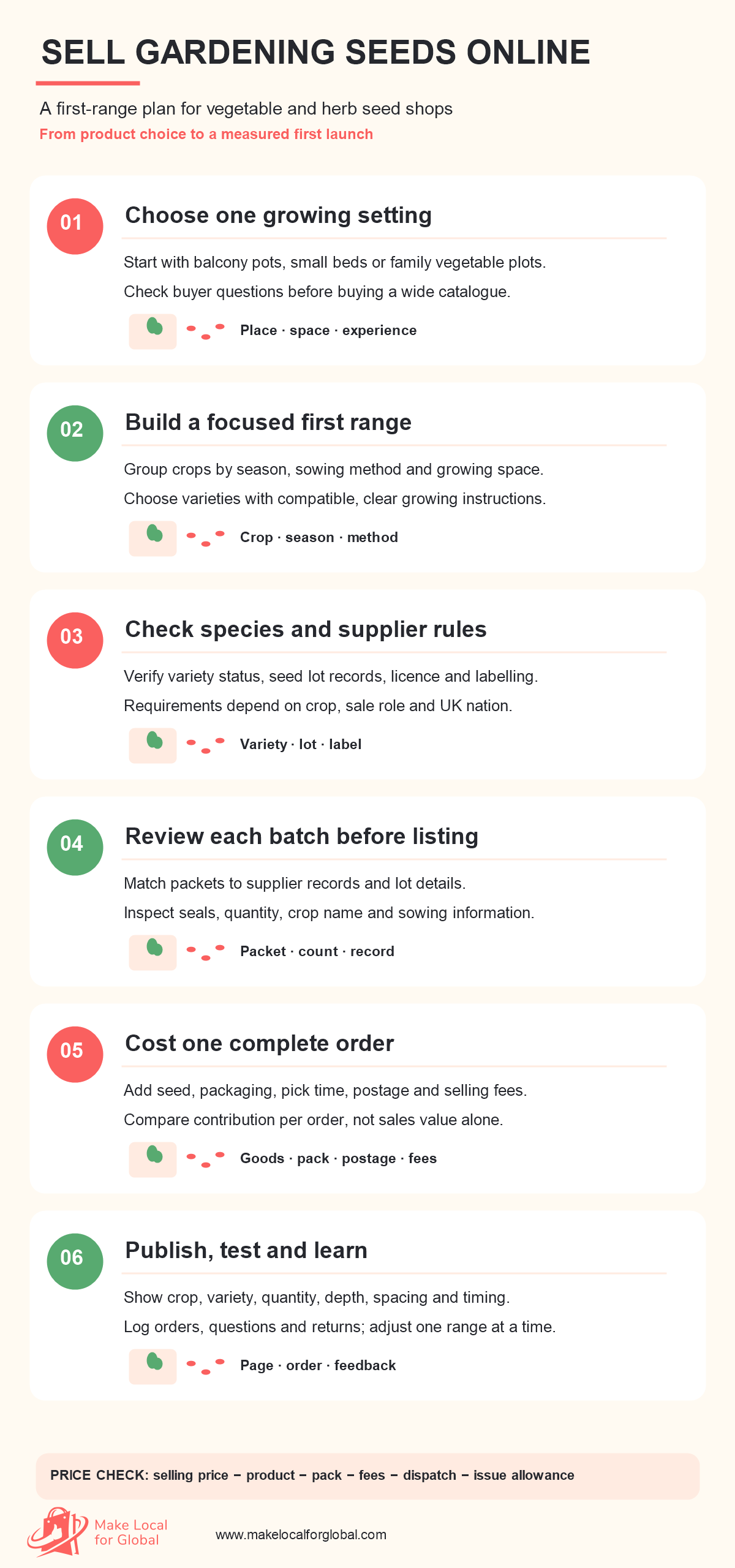
Request current product information and sample terms from two or three suppliers. Record variety names, packet quantities, lot data, storage information, lead time, minimum order and the documents available for the seed category.
List each candidate product and identify the relevant authority and territory. For covered seeds in England and Wales, read the APHA guidance and contact the inspector if the seller role, packet format, licence or supplier evidence is unclear. Check separate rules for Scotland, Northern Ireland or export destinations before offering those routes.
Set aside any product whose compliance, stock or growing information is unresolved. A smaller confirmed range is better for a first release than a broad listing built on assumptions.
Write one complete page per product using the supplier’s exact information. Include the crop, variety, quantity, sowing method, timing, spacing and what the customer receives. Ask a second person to read each page and point out facts they still need.
Calculate the full order cost for a single packet and for each planned bundle. Include carrier charges, platform and payment fees, packaging, pick time, promotions and an issue allowance. If the contribution is too small, change the product combination, cost, channel or price before buying a large quantity.
Prepare a product image, packet photo and one useful growing diagram. Check that every image matches the range and does not imply that props are included.
Open a small range or a pre-order only if your stock, legal duties, fulfilment dates and payment process support it. Tell buyers what is available, what dispatch timing to expect and how to contact you.
Track views, product clicks, add-to-basket actions, completed orders, average order value, contribution, questions, refunds and dispatch time. Review results by product rather than relying only on total sales.
At day 30, keep the products with clear evidence of interest and workable fulfilment. Identify the one biggest barrier, such as stock timing, unclear instructions or expensive delivery, and test one change at a time.
You can sell seed products when your business and products meet the rules that apply to their species, variety, packing activity and destination. In England and Wales, APHA guidance describes licensing and certification duties for covered seed. Scotland and Northern Ireland have separate requirements, so check the relevant authority before listing products.
Do not assume the answer from the word “resell”. APHA says a business marketing covered seed needs a licence and recognises marketing as holding before sale or offering seed for sale. The same guidance says a business may market seed certified by another licensed person. Ask APHA to confirm the licence and category that apply to your exact activity and packets.
Repacking may bring licensing, supervised packing, labelling, testing and record requirements. Check with the relevant seed authority before buying bulk seed or opening supplier packets. A licensed packer may offer a route for branded packets under controlled conditions.
Choose a connected group for one buyer, such as salad seeds for containers or an introductory herb range. Confirm supplier evidence and seed rules first, then test demand with a small order and clear product pages.
There is no fixed number. Stock only the varieties you can source, describe, store, trace and fulfil well. Start with a manageable range and add products when customer questions or order data show a useful gap.
Calculate the full order cost, including product, packaging, pick time, postage, platform and payment fees, promotion and an allowance for issues. Compare the resulting contribution with your overhead and business needs. A low wholesale price alone does not make a profitable product.
Distance-selling rules give consumers a right to cancel most goods orders within 14 days after delivery. The seller must provide required information before purchase. Exceptions are specific, so do not treat seed as exempt without checking the current rules.
Name the crop and variety, state packet quantity, show the relevant supplier-approved lot or label information, explain sowing method and timing where available, give spacing or depth if supported, set delivery expectations and say what the buyer receives. Use accurate images and avoid guarantees about germination or harvest.
Source through a documented supplier, keep lots separate, store stock as instructed, use clear product information and ask customers for the packet lot and sowing details when a concern arises. A home check does not replace official testing or certification where required.
Pick one kind of gardener, shortlist a small group of edible crops and confirm the supplier and compliance route before you buy. Then cost one complete order and write a product page that answers the questions a buyer would ask with the packet in hand.
If you need a shop built around a clear product range, talk to Make Local for Global. For a wider business context, read the related guides on gardening gloves, greenhouses and grow lights.
Review MLFG ecommerce plans and see which setup matches your next step.
PREFERRED SOURCE
Like what you’re reading? Add Make Local for Global as a preferred source on Google to see more of our articles when you search.

Build your online presence without having to figure out everything yourself.