READY TO SELL Floating Shelves ONLINE?
Get a store built for you in 5 days, plus training and support to help you start, run, and grow your Alternative business.

Plan a floating shelf range with verified materials, concealed supports, wall guidance and a full packed-order cost. Learn how to inspect samples, write a clearer listing, protect long boards in transit and review a 30-day launch test.

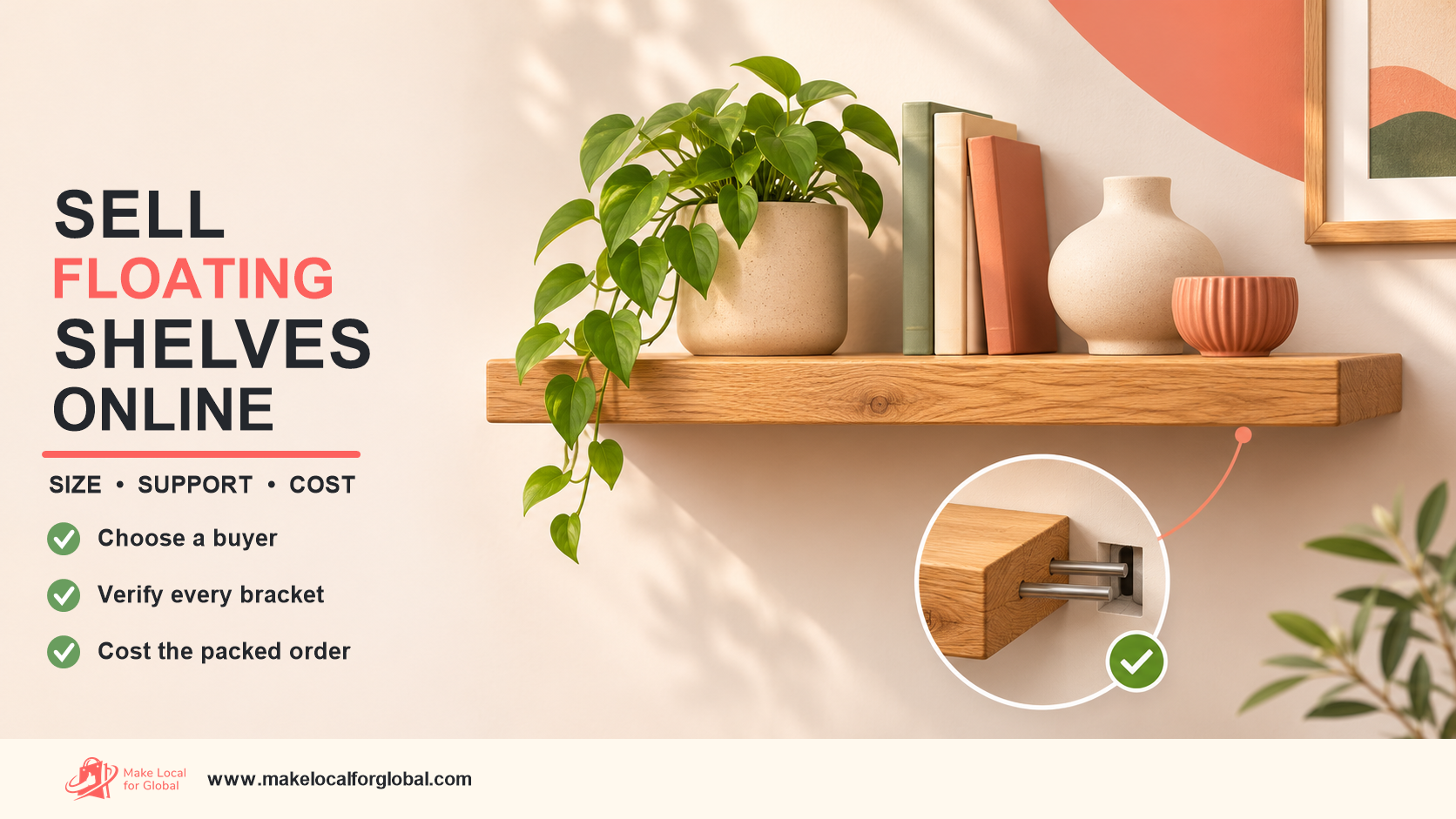
A floating shelf can look almost weightless on a wall, yet the hidden bracket, wall type, shelf depth and supplied fixings determine whether the product is useful and safe. A buyer who cannot tell what is included or what their wall needs will hesitate. A seller who cannot support a load claim may face complaints, returns or a safety issue.
To sell floating shelves online, choose a clear buyer and room, build a compact range around verified dimensions and finishes, inspect the complete shelf-and-bracket system, and describe wall compatibility without promising a universal load. Price the packed order after inbound costs, packaging, fees, delivery, returns and promotion. Start with indoor decorative or light-storage use only where the manufacturer supports it; add heavier-use or made-to-measure options after you can document their construction and installation requirements.
This article is for a UK-based founder planning to sell new, non-upholstered floating shelves to consumers. It focuses on products with concealed supports. It does not provide structural engineering advice or replace a product's instructions. Shelves intended for commercial, outdoor, bathroom or unusually heavy use need evidence for that use and the conditions around it.
Present real dimensions, finish details and the support system so a customer can compare options with confidence.
A floating shelf hides most or all of its support hardware. Common systems use rods fixed into a wall, a concealed metal plate or rail, or a bracket that slots into a hollow shelf. Some products marketed as floating shelves use a shallow visible lip, a keyhole plate or an integrated support. Treat the name as a style description, then inspect how the actual model mounts.
The visual promise and the fixing system are tied together. A slim shelf may look minimal in a photograph, but the buyer needs to know its depth, thickness, finish, bracket position, wall requirements and load guidance. The listing should make the invisible parts understandable without turning into a risky do-it-yourself tutorial.
Different buyers use shelves for different reasons. A renter may want a small ledge for a framed photo or lightweight plant. A homeowner may be looking for a long display shelf above a sofa. A kitchen buyer may want jars or cups within reach. A home-office buyer may need a row of books or small equipment. A trade buyer may need a consistent finish across several rooms or units.
These needs change the dimensions, finish, quantity and support evidence a buyer expects. A decorative ledge is not the same offer as a shelf presented for dense books, kitchenware or a bathroom environment. Begin with one primary use and state the intended setting. Use a second audience only if the same model and documentation genuinely fit both.
Write a one-sentence customer profile. For example: “A homeowner wants a warm oak-look display shelf for a living room, with two lengths and a concealed rod bracket whose instructions state the compatible wall types.” That statement points to the questions your first range and page need to answer: how long is it, what does it look like, what hardware arrives, and what must the buyer confirm before fitting it?
Read marketplace questions and reviews for repeated concerns. Look for uncertainty about actual colour, wall plugs, stud positions, shelf depth, bracket visibility, fixing tools, load claims, returns after drilling, or damage to corners in transit. Record the question, where it appeared, and the answer your supplier can support. Do not copy another retailer's product claims or treat an unverified review as engineering evidence.
Ask a small group of likely buyers about the last shelf they installed or considered. Find out which room it was for, what they planned to store, how they chose the size, what their wall was made from, and what made them trust or reject a listing. Questions about a real past purchase are more useful than “Would you buy this?”
You can test page interest before ordering a broad range. Build a landing page with an accurate product concept, indicative lead time and a clear statement that it is not yet available. Invite email interest without taking payment for stock you cannot supply. Track qualified visits, clicks on size options, questions about installation and sign-ups. A small sample of responses helps shape the next test; it does not prove long-term demand.
The product is a system: shelf board, concealed support, fixings, wall substrate, finish and installation information. A mismatch between any two parts can make the whole offer difficult to use. Ask the supplier to identify the exact model and components before comparing unit prices.
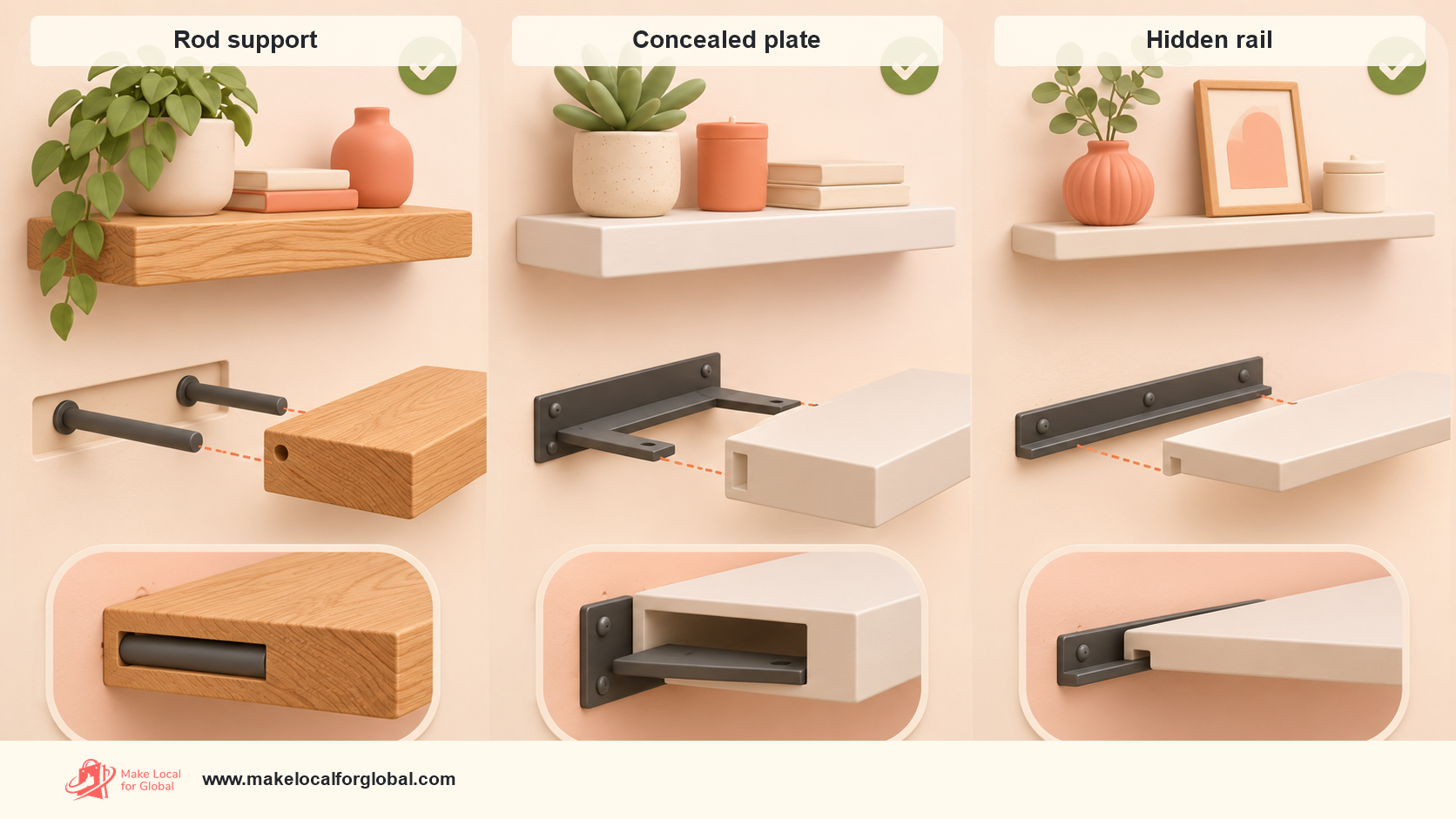
Rod systems typically use one or more metal rods fixed to the wall and inserted into holes in the back of the shelf. The rods need to align with the drilled channels and the shelf needs enough material around those channels. Ask for the rod diameter, projection, spacing, plate dimensions, required drill depth and installation sequence for the exact kit.
Check if the shelf can be removed after installation and how it is retained. Some systems use a small locking screw beneath the shelf. Others rely on a close fit or a particular support geometry. Avoid showing a cross-section that implies every shelf slides onto every pair of rods. Model-specific differences matter.
A plate or rail may spread support across a wider area, but the wall attachment and shelf construction still control performance. Some hollow shelves contain a cavity or engineered insert for their support. A solid-looking front does not tell a buyer whether the inside is solid timber, a panel, a honeycomb core or a veneer over a core board.
Ask the manufacturer how the bracket is fixed, which screws are supplied, how the shelf engages with the support, whether it has a lock, and which parts can be replaced. Request an assembly drawing with measurements. Verify the wall and board drilling dimensions against the hardware before writing them into a listing.
Solid timber can show natural grain and variation. It may be heavier than a hollow or panel construction, and its appearance can vary between boards. Ask about species, grade, moisture condition, finish, knot limits, expected colour range and care. If the seller offers solid wood, do not use a veneer photograph or a generic “solid oak” description as a substitute for the supplier specification.
MDF, particleboard, plywood and hollow-core constructions each have different edges, weight, finish and support needs. A foil, paper wrap, veneer, paint or laminate changes how the product looks and how its edges should be protected. Photograph a representative sample under neutral daylight and a warm indoor light. Make clear that screens and lighting can affect perceived colour.
Finishes can be grouped into a small, useful palette: natural or clear wood effect, darker wood effect, white, black, and a limited set of painted colours. Do not stock every finish at launch. Choose a core finish that matches the audience's room style, then add a second option when customer questions or pre-orders support it. Keep names distinct: “warm oak veneer” should describe that material and tone, not imply a specific timber species.
A simple opening range could include a compact shelf for a narrow space, a standard display length, and a longer statement shelf. Each size can share the same profile and finish if the supplier's support design covers those dimensions. A second depth may help customers with different display needs, and this creates more product combinations and stock.
Use exact dimensions and consistent units in every listing. State length, usable depth, thickness, product weight and any protruding part of the support. If the wall plate sits behind the board or a rod enters the shelf, show those dimensions in a diagram. State whether each size has a different bracket count or support spacing.
| Range choice | What it may suit | What to verify before listing |
|---|---|---|
| Short, shallow shelf | Compact display or a narrow wall | Usable depth, support spacing and supplied hardware |
| Medium display shelf | Everyday room styling and light objects | Bracket layout, board construction and wall instructions |
| Long shelf | Wider wall feature or grouped display | Mid-span support, sag guidance, packaging length and carrier cost |
| Deeper shelf | Larger display objects or selected storage uses | Load evidence, leverage at the wall, board thickness and room clearance |
| Made-to-measure option | Buyers with a precise alcove or wall width | Accurate cutting process, lead time, tolerances and cancellation terms |
The table is a planning aid, not proof that a product suits any listed load. Tie the final use case to the manufacturer's specifications and tested installation conditions. A long shelf may need a different support layout than a short shelf even when both use the same material and finish.
An entry, core and premium structure can work if each tier changes something the buyer values. An entry offer could be one short shelf in a core finish. A core offer might add a second length or a verified matching shelf. A higher-value option could be a longer, made-to-measure board or a finish with an upgraded edge. Include only brackets, fixings or accessories that are in the actual box. A higher price alone does not make a shelf premium.
Two matching shelves can form a useful pair for a wall display or alcove. A shelf plus a compatible second length may suit buyers creating a layered arrangement. A spare support set can help with a multi-shelf project only if the manufacturer confirms the exact model match and component count.
State every bundled component, quantity and finish. Show how far apart the shelves may be installed only if that arrangement is supported by the product instructions. Keep a separate contribution calculation for the single shelf and each bundle. A longer carton, extra protective packaging or added carrier charge may erase the apparent bundle advantage.
Possible supply routes include a UK wholesaler, a domestic manufacturer, an importer, a craft workshop or a private-label producer. A wholesaler may make restocking and returns simpler. A maker may offer control over dimensions and finish. Direct import may create a wider choice yet adds lead-time, customs, documentation and service work. A handmade model may need capacity planning and consistent tolerances.
Request a written quote tied to a model number and version. Ask whether samples come from the same process and materials as production stock. Ask about minimum order, colour batches, lead time, damaged-unit process, spare brackets, replacement boards, packaging dimensions, warranty handling and reorder quantities. Record the answer rather than relying on a call summary.
Use a supplier questionnaire. Ask for:
If the supplier sends a certificate or report, check the product identity, materials, issuer, date, scope and the question it addresses. A generic quality certificate does not establish that a particular shelf is safe on a particular wall. Ask a qualified professional for advice when a document's relevance is unclear.
Inspect the sample on arrival. Compare the board, finish, dimensions, brackets, fixings and included paperwork with the quote and packing list. Measure length, depth and thickness at more than one point. Record the board weight and packaged weight. Photograph edges, corners, support holes, welds, coating and labels.
Check the finish under ordinary lighting. Look for chips, thin coverage, sharp splinters, rough veneer edges, colour mismatch, glue marks or a visible seam that was not shown in the listing. Confirm that the back surface is finished or described as unfinished. Run a dry cloth over the surface and follow the maker's care method before testing any cleaning claim.
Fit the sample only according to its instructions. Do not substitute a generic wall plug or a different screw length just to make the shelf appear to fit. Record the wall type the instructions specify, the supplied hardware, the drilling dimensions, the bracket spacing and the time needed to understand the process. If instructions are unclear or contradict the hardware, stop and request written clarification.
Test the shelf's engagement with its support on a safe, suitable test fixture or controlled installation, with a competent person following the product instructions. Check that the board sits level and flush, any lock engages, and no component moves abnormally during the maker's stated use. Do not add a guessed weight or convert a one-off demonstration into a public load rating. Independent load assessment may be appropriate for products sold for substantial storage or trade installation.
Record defects and tolerances. Check whether matching shelves from one delivery have the same finish, fit and support dimensions. If the product is made to order, inspect several samples or a small production run before promising tight colour matching. Establish a clear acceptance standard with the supplier for chips, bowing, edge quality, support-hole position and finish variation.
The wall is part of the installed product system. Brick, concrete, timber studs, plasterboard, metal framing, tiled surfaces and hollow partitions cannot be treated as interchangeable. A fixing that is appropriate for one substrate may not be suitable for another. Shelf depth and the position of objects change the force at the wall support.
The manufacturer's installation guide should name the wall types and hardware it covers. The REHAU instructions, for example, describe one product designed for specified timber framing and state that other wall materials are not permitted for that system. This is an example of a model-specific restriction, not general advice for all shelves. The REHAU floating shelf instructions show why a seller needs to carry the exact instruction set with each model.
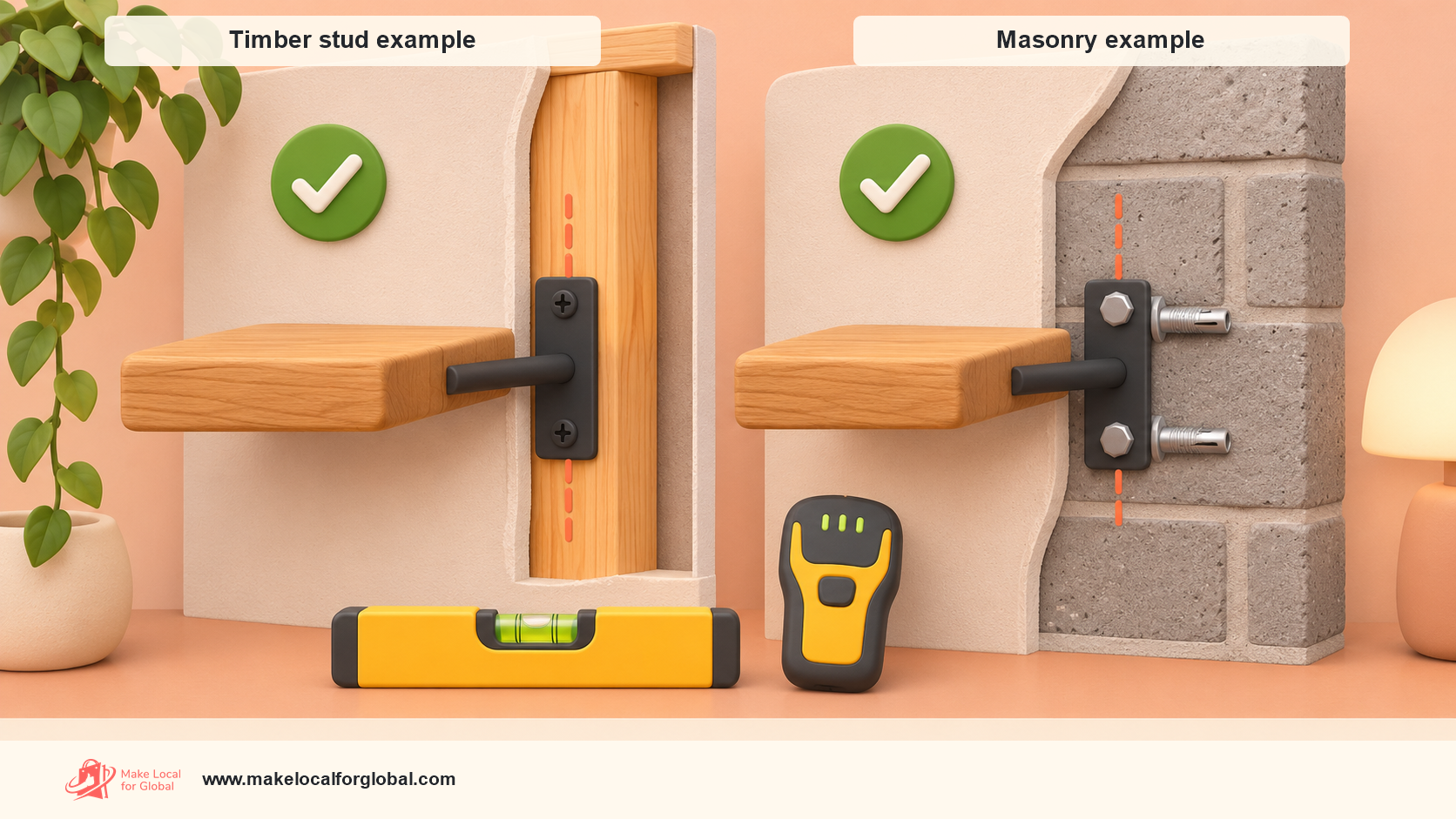
An installation illustration should help the buyer identify what the manufacturer asks them to check, not encourage improvised drilling. A stud finder and level may appear in a diagram, but a product page should direct the buyer to the actual manual and advise them to check for hidden services and local conditions. If the wall or fixing method falls outside the instructions, recommend an appropriately qualified installer rather than offering a guess.
Never borrow a load number from a similar-looking shelf. A number may depend on shelf length, depth, board material, bracket type, bracket spacing, wall, fixing, fitting quality and load distribution. One manufacturer's rating does not transfer to another model or another wall. “Holds 20 kg” is incomplete if the conditions and configuration are missing.
The Wickes floating shelf rod instructions list different maximum loads for different rod sizes and hole depths. Those values apply to the specified products and installation directions, not to every floating shelf. Ask the supplier for a model-specific document and preserve its wording, conditions and units.
If the manufacturer states a load, reproduce it accurately with all relevant qualifications. Clarify whether it refers to the shelf itself, the full installed system, a distributed load, or a certain wall and fixing. If no substantiated value exists, do not create one through a casual home test. Describe only what the supplier supports, and leave capacity out when it cannot be verified.
The product page can help a customer identify the next check without pretending to cover every wall or building. State the bracket type, the number of supports, whether fixings are included, the manual's wall exclusions and which measurements the buyer should compare. Provide a readable instruction download before purchase if the supplier authorises it.
Avoid phrases such as “fits any wall”, “install in minutes”, “holds heavy items” or “no drilling required” when the exact model and instructions do not support them. Do not show an image of a shelf holding books, crockery or a large plant if the advertised model has no evidence for that use. A styled product photograph is not a capacity test.
If you make, import, distribute or sell consumer products in the UK, you have responsibilities for their safety and the information supplied with them. The Office for Product Safety and Standards says sellers should not supply products they know or should know are unsafe, and product-safety rules require suitable evidence and response to identified risks. Read the current GOV.UK product safety advice for businesses and identify which role your business has in the supply chain.
The product safety guidance for manufacturers and importers explains the need to demonstrate compliance, provide safe-use information and retain traceability. Keep supplier identity, model and batch references, purchase records, technical documents, instructions, inspection notes and customer reports together. If a shelf presents a credible risk, stop sales of affected units. Follow the applicable reporting and corrective-action route.
The general product safety framework differs between Great Britain and Northern Ireland. Check the rules for the territory and product before offering delivery there. Add UKCA or CE marks, fire-safety claims or other badges only when the product and applicable law require or support them. A non-upholstered shelf should not be confused with a regulated upholstered item, but other product and consumer rules still apply.
Before checkout, provide accurate product description, total price, payment, delivery cost and timing, business contact details, cancellation information and the other required terms. GOV.UK distance-selling guidance explains information that must be supplied before the customer places an order and the 14-day cancellation right for covered distance sales. Made-to-measure products can involve specific rules, so check the actual terms and product rather than assuming an exception applies.
The shelf's wholesale price is only one cost. A long, fragile board may need edge guards, a rigid carton and a carrier service priced by parcel dimensions. The bracket kit, inbound freight, duty, payment charges, damage risk, return handling and customer acquisition belong in the model too.
The following example is illustrative. It is not a market price or a forecast. It assumes a UK consumer sale with £54.00 shelf price and £5.99 delivery charged, a VAT-registered seller applying 20% standard VAT to the full customer payment, a payment fee estimated at 2.9% plus 30p, and cost figures shown as the seller's amounts used in this simple calculation. Real VAT and input-tax treatment depend on the transaction and business. GOV.UK explains how to remove standard-rate VAT from a VAT-inclusive figure: divide the gross amount by 1.2.
| Order line | Illustrative amount | Calculation or note |
|---|---|---|
| Shelf price | £54.00 | Customer-facing item price |
| Delivery charged | £5.99 | Added at checkout |
| Total collected | £59.99 | Shelf plus delivery |
| Sales amount excluding 20% VAT | £49.99 | £59.99 ÷ 1.2, rounded |
| Shelf and bracket purchase cost | £19.00 | Supplier unit cost |
| Inbound freight and duty allowance | £4.20 | Allocated per shelf |
| Protective packaging | £3.10 | Corner guards, board sleeve and carton |
| Payment fee estimate | £2.04 | 2.9% of £59.99 plus £0.30 |
| Outbound delivery | £5.99 | Carrier charge for actual packed size |
| Returns and damage allowance | £2.50 | Planning provision per order |
| Customer acquisition | £5.00 | Illustrative cost to secure an order |
| Estimated contribution before overhead | £8.16 | £49.99 less the listed costs |
The arithmetic leaves about £8.16 before fixed overhead. It is not net profit. The example excludes labour, website hosting, insurance, photography, storage, professional fees, income or corporation tax and the cost of a serious defect. A seller who does not charge delivery, uses another fee structure or recovers input VAT needs a different model.
Measure the packed shelf before you lock the shipping line. A product's longest edge, not just its weight, can affect service options and price. Royal Mail advises weighing the parcel with its box and packing materials and measuring the packed dimensions. See Royal Mail's parcel measuring guidance. Compare carriers with the finished carton, not the bare shelf.
Build one spreadsheet row per size, finish and support configuration. Record supplier currency, quote date, exchange assumptions, unit quantity, inbound cost, packaging, payment or marketplace charges, carrier service, return provision and advertising. Add a column for the contribution target. Review the actual parcel charge, damage rate and time spent on returns after the first orders.
Custom lengths can answer a real alcove or niche requirement. They can create more measuring questions, production variation and wasted offcuts. Before listing, document the available length increments, measurement method, tolerances, finish choices, lead time, packaging limits and treatment of an incorrect customer measurement.
Use a sample order to model cut waste and set a minimum charge. Track the time needed to confirm dimensions and approve drawings. If the buyer's wall is uneven, the product still has to be manufactured to the selected size; explain which measurements the buyer should take and which conditions need a fitter's input.
Do not state that a made-to-measure order is non-returnable without checking applicable consumer rules and the exact product. The distance-selling rules have limited exceptions for goods made to a consumer's specification or clearly personalised, but the legal test and other rights matter. Make the terms visible before payment and get professional advice for your own policy.
Compare fulfilment, packaging and website costs against the contribution each packed shelf can earn.
Lead with a product-specific title and a direct description. A useful example format is: “Oak-effect floating shelf, 80 × 20 cm, concealed rod support.” Use that wording only if the finish, size and fixing actually match. A second line can explain the intended room, supplied hardware and the buyer's next installation check.
List the material honestly. Say “oak veneer over MDF” if that is the construction, or use the supplier's precise description. Separate the shelf's dimensions from the bracket projection and the packaged dimensions. State the number of support rods or rails, fixings included, assembly status, care method, indoor or outdoor use and product weight.
Write the wall compatibility section from the instructions. For instance: “Check the included fitting guide for compatible wall construction before purchase. This model requires the named support structure and does not include fixings for every wall type.” Adapt the sentence to the actual shelf. Do not promise that included plugs suit every home.
Photograph the shelf from the front, end, underside and back. Include a close view of the holes, plate or rod support. Show one image with the product beside a tape measure or dimension card. Put the bracket, screw pack and instructions next to the shelf so a buyer can see exactly what is included.
For a finish range, photograph the real samples under similar light and give each option a written colour name. A colour swatch helps, yet it cannot guarantee every screen will render the tone the same way. Explain natural grain or finish variation if the supplier specifies it. Do not use a generated room image as evidence of an exact product colour or installed load.
Captions can add useful detail: “Back view shows two concealed support rods” or “The dimensions shown are the board's overall length and depth.” Use those lines only when accurate for the featured model. Alt text should describe what the image contains for someone using a screen reader; avoid repeating the same keyword across every image.
Keep option labels predictable: length, depth, finish and quantity. A dropdown called “Size” is less helpful than “Length: 60 cm” when the shopper is comparing boards. Show the per-option price and dispatch estimate. Tell the customer when a colour or custom size is made to order.
Check that each combination maps to a real SKU, support set and packaging plan. A “two shelf bundle” must have the matching number of brackets, fixings and instruction sets. Don't show every variant in the hero photograph if some are unavailable or sold separately.
The product page should answer the major fit questions near the buy button: overall dimensions, wall type, bracket style, included fixings, supported use, installation link, delivery size and return route. A buyer should not need to search through a long story to find the shelf depth or whether the bracket is visible.
Your own shop gives you control over product explanation, size comparisons and follow-up, though you must attract visitors and run checkout, policies and customer support. A marketplace may already have home décor shoppers, yet its fees, image rules, fulfilment terms and competition affect the economics. A social channel can show room transformations, but a view does not prove purchase intent.
Choose one main sales channel for the first test. Make one product page easy to inspect on a phone. Add one supporting channel where your likely buyers spend time. Keep stock, prices, lead times and returns terms consistent. Add another marketplace only after you can keep the catalogue synchronised and respond to questions there.
Useful early content can answer a specific concern: a close-up of the hidden bracket, a side-by-side size comparison, a finish sample in daylight, a packed-shelf demonstration, or a clear diagram linking a model to its installation guide. Do not publish a “how much weight can it hold?” video using an unverified test. Use manufacturer evidence and show its conditions.
Potential phrases include “floating shelves”, “wood floating shelf”, “concealed bracket shelf”, “floating shelf with hidden support”, and exact dimensions or finish terms. Search wording can vary by country and product. Use only variants that describe the actual model. Avoid putting many phrases into one sentence or repeating the product name in every heading.
Create useful supporting pages only when you can answer a separate buyer question. A fitting guide should explain how to read the manufacturer's instructions and when to get professional help. A finish guide can compare veneer, solid timber and panel construction without pretending all products use the same material. Related product-selling advice can link naturally to selling adjustable shelves online, where the reader needs a broader range-planning perspective. A home décor seller comparing display products can read MLFG's advice on selling framed art prints online.
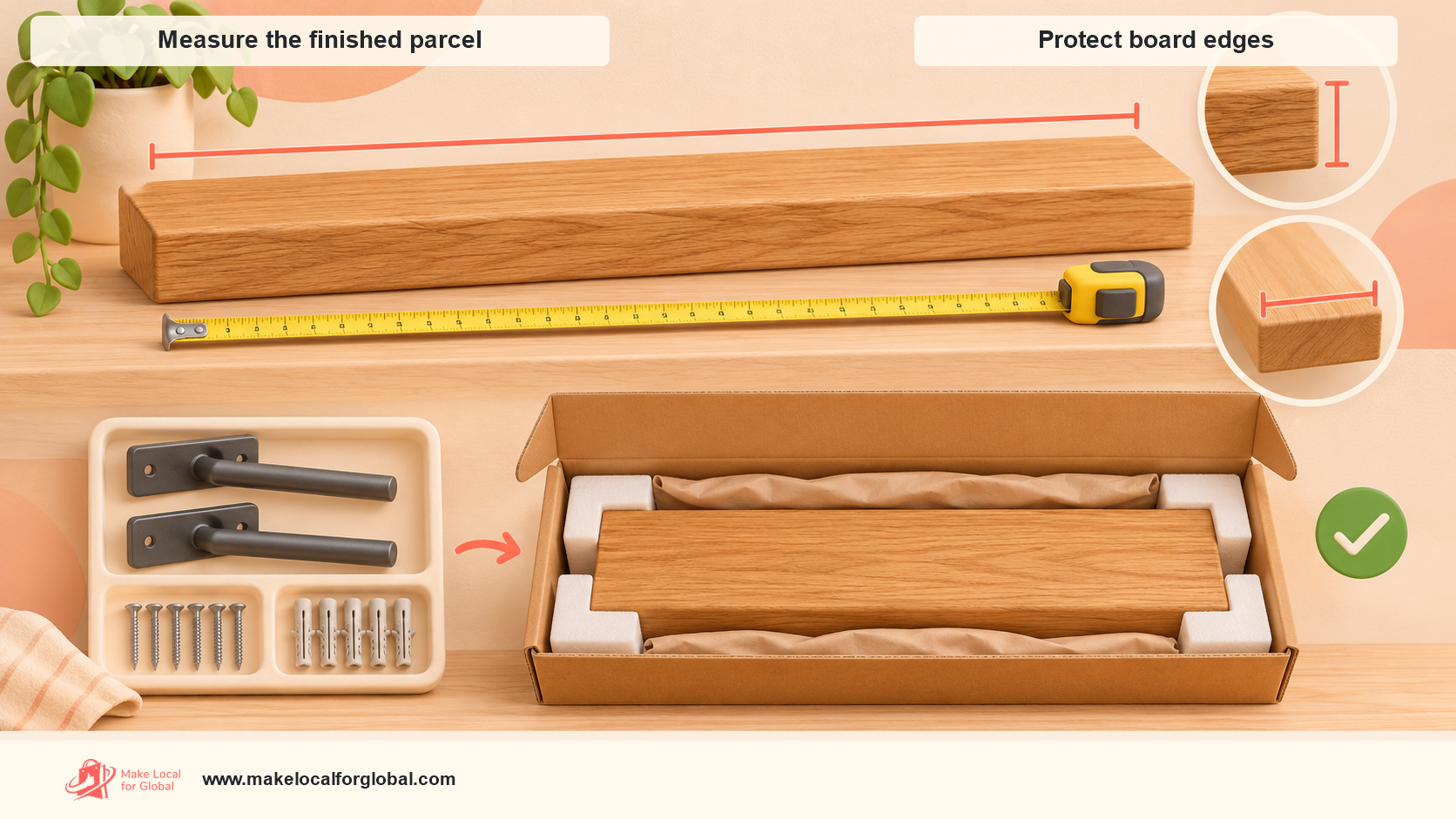
Long boards are vulnerable at the corners and edges. A carton that is only just longer than the shelf can crush or split at its ends. Test a full parcel drop and movement check with a representative sample through the shipping route you plan to use. Ask the supplier how boards are protected in pallet freight and parcel orders.
Use a sleeve or surface layer to reduce rubbing, rigid corner guards at all exposed corners, a carton with suitable edge clearance, and internal restraint that stops the shelf sliding end-to-end. Keep metal supports and screws away from the finished surface. Pack them in a separate secure section or wrap them to prevent scratching. Do not use a loose bag of fixings that can puncture the board.
Pack one complete order and weigh and measure it. Photograph the interior layout and write a short fulfilment checklist. Make sure the carton closes without pressing on a projecting bracket. Check if the outer carton can be lifted safely by one person and whether the courier accepts the packed dimensions. Update the unit-cost model with the real parcel size.
Separate dispatch time from carrier transit. State whether the shelf is in stock, made to order or awaiting a restock. A delivery estimate should reflect finishing, packing and carrier collection, with some allowance for supplier delays. Do not promise next-day dispatch if the board needs a custom finish or inspection.
For larger lengths, compare parcel, oversize and specialist delivery services. Check postcode surcharges, insurance limits, collection options, damage-photo requirements and what the carrier treats as adequate packing. Keep a process for contacting the buyer if a made-to-order item will miss its estimate.
Consumers buying online generally have a cancellation period for covered goods. The details depend on when the item arrives, what information was supplied and whether a specific exception applies. Read the current GOV.UK guidance on returns and refunds. Do not claim that drilling, shelf size or contact with a wall removes a customer's legal rights.
When a shelf returns, inspect the board, finish, support holes, supplied brackets and packaging. Record whether it is unused, assembled, scratched, damaged or faulty. Keep it separate from stock sold as new until condition is established. Follow your legal duties and written policy consistently. If the report concerns a fall, injury or fixing failure, pause sales of affected stock. Record the details and contact the supplier.
Ask for the model, batch or order reference, a description and relevant photos where appropriate. Do not ask a customer to repeat an installation or weight test that could be unsafe. Record the finding and resolution: replacement, refund, supplier investigation, revised instruction or stock hold. Look for patterns by support type, wall claim, finish and carton design.
Packaging can include the product box, the outer mailer, protective wrap and other materials you supply. The UK's Extended Producer Responsibility rules may apply to businesses that pack, fill or import packaging, alongside turnover and tonnage tests. Review the current GOV.UK EPR packaging checker, identify your role and keep the weights and materials you need to report. Do not assume that a small shelf business is automatically outside the rules.
Use the first month to decide whether the product, presentation and fulfilment process work together. Set a small stock or sample budget, one primary audience and an end-of-test decision date. Count actual customer actions beside percentages; small samples can make conversion rates swing sharply.
Choose a room and use case such as a living-room display, narrow hallway or kitchen ledge. Review customer questions about length, depth, wall type, visible supports and finish. Shortlist no more than a few models with clear model identity and supplier access. Request dimensions, construction, finish details, installation drawings, wall limits, load documentation, packaging data and spare-part information.
Write down what would rule a model out: missing support details, unclear wall requirements, no traceable supplier, inconsistent finishes, damaged sample, or unsupported capacity claim. Ask suppliers to answer in writing. Do not place stock orders solely to meet a launch date if core questions remain open.
Receive and measure the sample. Compare board and bracket dimensions with the drawing. Follow the actual fitting instructions on an appropriate test wall or fixture. Record any unclear step, alignment issue, finish defect or mismatch between the supplied hardware and manual. Have a competent installer review the process if you cannot assess it safely.
Pack a complete order with every included part. Weigh it, measure the carton and request carrier pricing for the destination types you expect to serve. Build an order-cost sheet from the real minimum purchase quantity, packaging and delivery estimate. Do not use the unboxed shelf dimensions as a parcel quote.
Prepare one listing with accurate size options, finish names, bracket images and supplier-backed installation guidance. Add clear box contents and a delivery estimate. Ask several likely buyers to locate the wall requirements, dimensions and returns route using a mobile screen. Note where they pause or ask for help.
Share the page through one relevant channel. If you pay for traffic, set a small cap first. Track qualified visits, size-option clicks, add-to-cart events, purchase rate, customer questions and contribution after variable costs. Keep the offer and audience consistent enough that the results are interpretable.
Pack each order with the same checklist. Record time, carton damage, carrier surcharge, delivery time, finish complaints, installation questions and returns. Compare actual costs with the original worksheet. If the parcel exceeds the predicted band or a corner is damaged, change the packaging before taking more orders.
At day 30, choose to reorder, revise and retest, or stop. Reorder when the buyer, margin, production quality and delivery method are supported by evidence. Revise when the page leaves a repeat question unanswered or the carton needs work. Stop if the model's support evidence or economics do not meet your requirements. If the sample is too small to interpret, extend the test with a defined budget and end date instead of buying broadly.

Start with one clearly defined use, a manageable length range and a finish you can inspect consistently. Choose products with a named support system, complete instructions, traceable sourcing and a parcel size you can price. A small tested range gives you a clearer basis for a second size or finish.
“Floating shelf” usually describes a wall shelf whose support hardware is concealed or less visible from the front. Product terminology is not consistent across sellers, so show the actual bracket and use the manufacturer description. State clearly if a shelf has a visible lip or side support.
Only if the product's instructions and evidence support every wall type you name, which is uncommon. Many systems are intended for a defined substrate and fixing method. List the covered construction and exclusions from the exact manual. Refer customers to a qualified installer if their wall falls outside those directions.
Use only the value stated for the exact shelf and installation conditions. The rating may depend on shelf size, bracket layout, fixing, wall, load distribution and installation. Never infer a number from a similar model or a one-off test. Leave the figure out if you cannot substantiate it.
Solid timber, veneer over a panel, painted MDF, laminate and hollow-core products can each suit different designs and price points. Verify the construction and finish with the manufacturer. Describe the surface and core honestly, and account for weight, edge treatment, moisture guidance and packaging needs.
Custom lengths may serve buyers with alcoves or specific wall widths. They add measurement, production, wastage and cancellation questions. First verify cut tolerances, finish quality, lead time, packaging and terms. Test a small number of custom orders before promoting a broad made-to-measure service.
That depends on the product. List the exact bracket and fastener contents and say when a buyer must source a fixing for their wall. Do not call included fixings universal if the manual names a limited set of wall types.
Use edge and corner protection, restrain the shelf inside a suitable rigid carton, and isolate metal supports from the finished surface. Pack a representative order, weigh and measure it, then test the route. Keep photos of the packed layout and log damage by carton and carrier.
Only when the material, finish and support instructions cover that environment. Humidity, splashes and cleaning can affect some boards and finishes. Ask the supplier for written care and environment guidance for the exact model, then use those limits in the listing.
Show the shelf's length, depth, thickness, finish, construction, support style, included contents and installation-guide link. Put wall compatibility and the maker's load guidance near the purchase decision. Use product photos that show the back and actual included parts, not only a styled room view.
Choose one room and one buyer. Ask suppliers for the model drawing, surface and core details, support hardware, wall instructions, load evidence, parcel dimensions and traceability records. Inspect a sample, fit it only as directed, and calculate the actual packed order before committing to a wide range.
The strongest first listing makes an invisible support system easy to understand. It tells a buyer what the shelf is made from, what arrives in the box, which wall conditions the instructions cover and which checks belong to an installer. Keep each claim tied to the product you have inspected.
Use verified dimensions, installation records and parcel costs to decide whether the first shelf range is ready to sell.
PREFERRED SOURCE
Like what you’re reading? Add Make Local for Global as a preferred source on Google to see more of our articles when you search.

Build your online presence without having to figure out everything yourself.