

Compare private-label MOQs, upfront cash, unit costs and remaining stock with a practical two-quote example in pounds.

A lower minimum order quantity can preserve cash, while a larger batch may reduce the supplier’s quoted unit price. Neither number tells the whole story. To compare private-label batch sizes, calculate the cash due before your first sale, the full cost of the order and how much stock could remain under a cautious sales scenario.
This guide shows you how to do that, what to ask a supplier, and how to use the free Private Label MOQ Lab to compare two quotes. The figures are examples only. They are not a sales forecast or a recommendation to place an order.
Enter each supplier quote, deposit, setup, packaging and freight. The free MOQ Lab shows the cash required before a first sale, entered unit cost and stock left in your own scenario.
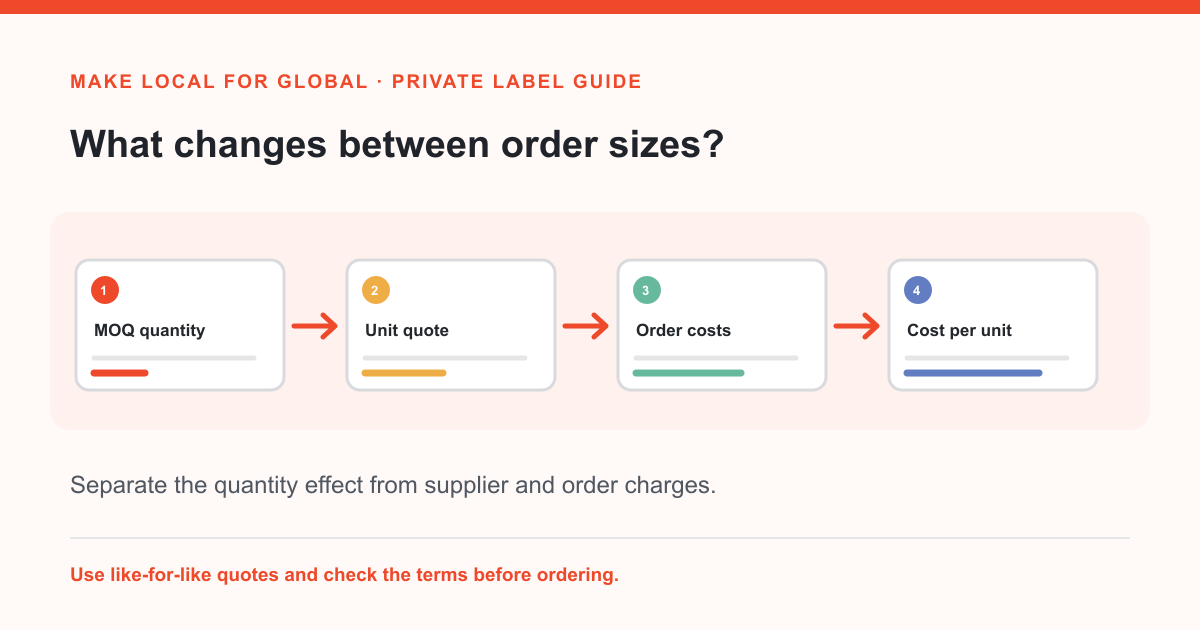
Minimum order quantity, or MOQ, is the smallest batch a supplier will accept for a particular product, specification or production run. A quote with a lower per-unit price at a higher MOQ can still be a poor fit if the bigger order ties up cash or leaves more stock than you can sell and store.
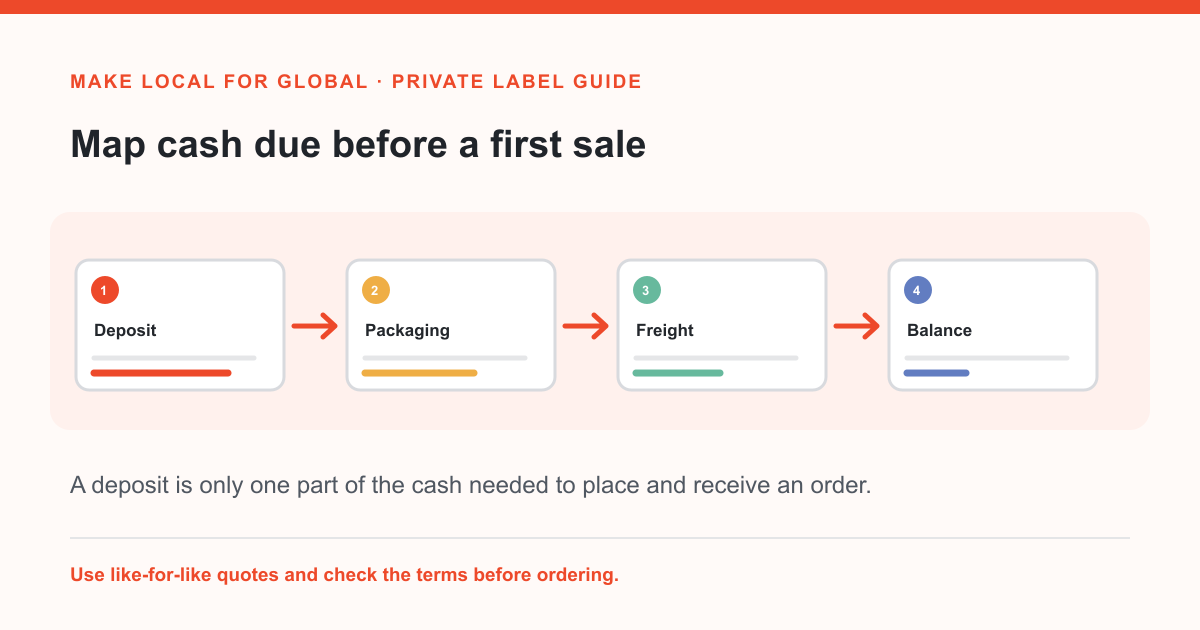
Compare the whole commitment, not just the product line on the quote. Include any one-off setup or tooling charge, the packaging per unit, freight, the deposit schedule and the balance due before dispatch. Also ask whether prices include samples, inspection, labelling, cartons or other work you expected to be included.
The MOQ Lab uses a conservative full-order commitment: the product total, setup, packaging and freight entered. It shows the deposit separately as part of that total, not as an extra charge. Compare the full amount with available cash, then check the supplier’s actual payment dates. A low deposit does not make the order affordable if a large balance is due before dispatch or delivery.
Ask the supplier to confirm each payment milestone in writing. Clarify whether freight is an estimate or a confirmed charge, who pays any customs costs, and whether any extra charges could arise if an inspection or packaging revision is needed.
For a useful first comparison, add the product cost, setup cost, packaging and freight you have entered, then divide by the order quantity. This creates an entered all-in unit cost for comparing the quotes on the same basis. It is not necessarily your final landed cost or accounting cost.
Depending on your product and route to market, there may be costs the calculator does not include, such as customs duty, import VAT, compliance testing, inspection, storage, fulfilment, payment fees, returns or finance. Add these to a separate landed-cost worksheet once you have verified them for your own goods and supply route.
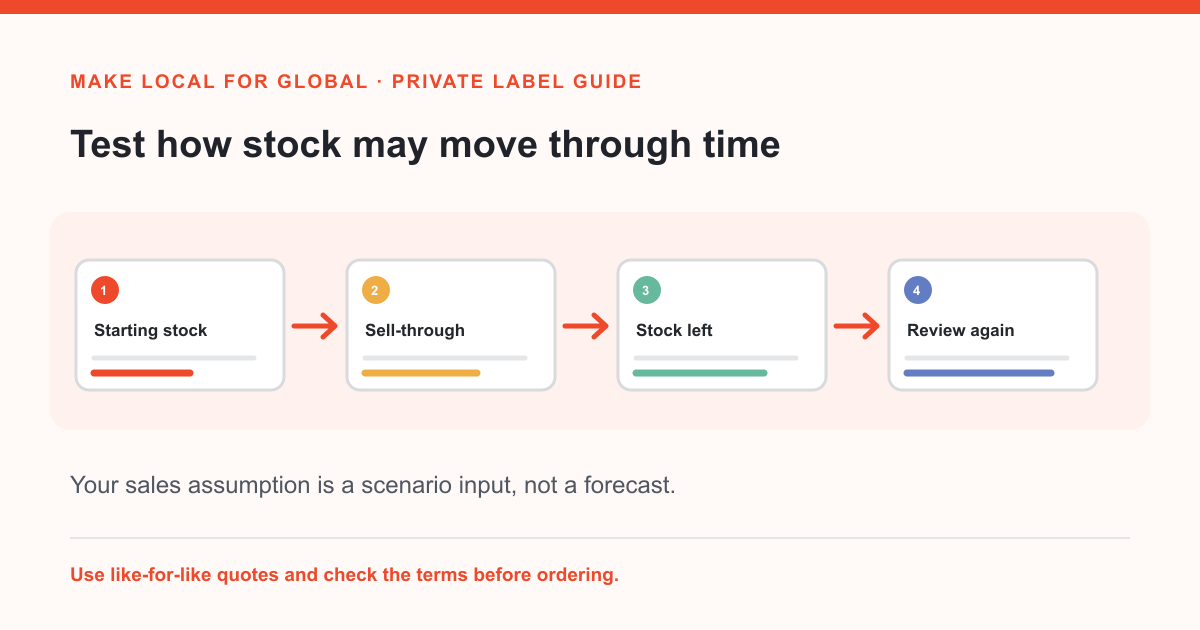
Choose a review period and enter a monthly sales assumption. The tool multiplies that assumption by the period and subtracts the result from the batch to show an illustrative remainder. This answers “what if this rate continued for these months?” It does not estimate what customers will buy.
Suppose two illustrative quotes have different batch sizes but the same entered setup charge, packaging rate and freight per order. Assume the full product order, setup, packaging and freight are funded before the first sale. The app shows a 40% production deposit separately within the product total. The sales rate is set at 80 units per month for three months.
| Entered assumption or result | Quote A | Quote B |
|---|---|---|
| Order quantity | 500 units | 250 units |
| Product price per unit | £6.40 | £7.20 |
| Shared setup charge | £300 | £300 |
| Shared packaging rate | £0.45 per unit | £0.45 per unit |
| Shared freight per order | £450 | £450 |
| Cash before first sale | £4,175 | £2,662.50 |
| Entered all-in unit cost | £8.35 | £10.65 |
| Units left after the three-month scenario | 260 | 10 |
| Cost value of those units at entered average cost | £2,171 | £106.50 |
Quote A has a lower entered unit cost, but it requires more cash up front and leaves more stock under this scenario. Quote B costs more per unit on the entered figures, yet the smaller order has less unsold stock exposure in this example. That is a trade-off to investigate, not a verdict: your real costs, sales evidence, payment dates and supplier terms may change the comparison.
Use the same assumptions for both options, then change the review period or monthly sales scenario to see how sensitive the stock remainder is.
For its cash-before-first-sale comparison, the calculator conservatively counts the full product total, setup, all packaging and freight entered as funded before the first sale. It does not model tax, customs duty, import VAT, storage, fulfilment, returns, marketing, finance costs, stock write-offs or changes in exchange rates. Check these separately before committing cash.
Keep the answers with the quote. A supplier comparison is only meaningful when the product specification, delivery point, timing and included services match.
If you are importing goods, do not assume the freight amount covers every border cost or legal requirement. The UK government’s import step-by-step guide explains the process for bringing goods into Great Britain and Northern Ireland, including preparation, commodity codes and customs declarations. The UK Trade Tariff lets you look up commodity codes and check applicable duty, VAT and measures. HMRC also explains VAT on imports. Rules and rates depend on the goods and route, so verify current details for your specific product and seek qualified advice where needed.
For a separate introduction to the wider budget, see our private-label order cash-flow planning guide. It covers the broader launch cash picture; this article focuses on comparing batch-size and MOQ trade-offs.
No. It can reduce the initial commitment, but the unit price, setup charges, quality controls, repeat-order terms and delivery costs also matter. Compare the full terms and your ability to fund the order.
No. You enter the monthly sales assumption yourself. The app shows what the stock remainder would be if that scenario continued for the period you choose. It does not predict demand or business success.
No. It compares the product price, setup, packaging and freight amounts entered. It does not automatically calculate customs duty, import VAT, compliance, storage, fulfilment, returns or other costs. Verify those separately.
It is the remaining unit count multiplied by the entered average unit cost. It is not a resale value, cash balance or guarantee that the units can be sold.
Convert both quotes to the same currency before entering them, and note the exchange rate and date you used. This tool is designed to display an easy comparison in pounds and does not update foreign exchange rates.
Before accepting a production quote, confirm what the MOQ applies to, when each payment is due, which costs are excluded and how the supplier handles quality issues. Then compare the cash commitment and a cautious stock scenario alongside your real customer evidence.
Compare two private-label quotes in pounds, test the cash due before sale and save a PDF of your assumptions. Then review your supplier terms before placing an order.
PREFERRED SOURCE
Like what you’re reading? Add Make Local for Global as a preferred source on Google to see more of our articles when you search.























Build your online presence without having to figure out everything yourself.