

Use six practical checks to decide whether your ecommerce store is ready for a controlled launch before you spend more on traffic or promotion.


An ecommerce store can look ready before the business behind it is ready. The product pages may be polished, checkout may accept payments and launch posts may already be scheduled. None of that proves that the offer is clear, the numbers work, orders can be fulfilled reliably or the team knows when to pause.
A safer question is: “Is my ecommerce store ready for a controlled launch?” A controlled launch sends a limited amount of real traffic through the complete customer journey, with owners, tracking, spending limits and decision rules already in place.
Our free Ecommerce Launch Readiness Assessment checks six practical areas: offer clarity, customer evidence, unit economics, store experience, fulfilment and launch operations. It gives you a score, identifies your strongest signal and biggest gap, then suggests three next actions.
Answer six short questions and get a practical launch-readiness result based on the evidence you have today.
An ecommerce store is ready for a controlled launch when a new visitor can understand the offer quickly, matching buyers have shown meaningful interest, one order still works after all likely costs, the buying journey passes on real devices, fulfilment and returns have been rehearsed, and the launch has named owners and limits.
You do not need a perfect business or a guarantee of sales. You need enough evidence to run a limited release without exposing customers or your budget to avoidable failures. If one critical system is weak, postponing wider promotion is usually cheaper than paying to discover the problem at scale.
Launch principle: do not ask whether everything is perfect. Ask whether the next amount of traffic can be served safely, measured clearly and stopped quickly if the evidence turns against the plan.
Each check offers three evidence levels worth 0, 2 or 4 points. The maximum score is 24. The questions are deliberately practical: they ask what has been written, tested, measured or rehearsed, not how confident the founder feels.
A launch offer needs one clear buyer, one relevant problem or desire, a specific product promise, a visible price and an obvious next action. If visitors must read several sections before they understand what is sold, early campaign data will be difficult to interpret. A weak conversion rate could mean the audience is wrong, the product is wrong or simply that the message is unclear.

Run a ten-second test. Show the first screen of the product page to five people who resemble the intended customer, then hide it. Ask what was sold, who it was for, why it mattered and what they would do next. If the answers vary widely, sharpen the headline, hero image, price presentation and call to action before buying traffic.
Keep the first offer narrow. One flagship product or a small, related range is easier to explain and measure than a store trying to serve every possible buyer. If you are still choosing the model, read Ecommerce Business Models Explained before setting a launch date.
Followers, impressions and compliments show attention. They do not necessarily show willingness to pay. Stronger evidence comes from matching buyers taking a meaningful action, such as joining a product-specific waitlist, completing a detailed enquiry, paying a deposit, placing a pre-order or buying a close version of the offer.
Record who provided the signal, which product and price they saw, and how much commitment the action required. Twenty vague sign-ups from a giveaway may be less useful than five qualified buyers who accepted the intended price and delivery promise.
If the launch still depends mainly on belief, hold five buyer conversations before increasing spending. Ask about current behaviour, alternatives, previous purchases and the conditions that would make the new offer useful. Do not lead the person towards the answer you hope to hear.
Revenue is not margin. A product can sell and still weaken the business if the price ignores packaging, payment fees, delivery, discounts, returns, customer support and acquisition costs. Build the model around one completed order, including a cautious allowance for problems.

Imagine a product selling for £42. A simple cautious model might be:
| Order item | Example amount |
|---|---|
| Product or supplier cost | £14.00 |
| Packaging and printed inserts | £1.80 |
| Delivery paid by the seller | £4.20 |
| Payment and platform fees | £1.50 |
| Return and problem allowance | £2.50 |
| Customer acquisition allowance | £8.00 |
| Total planning cost | £32.00 |
| Amount left before overheads and tax | £10.00 |
The £10 left is not automatically profit. It may still need to contribute to software, storage, insurance, salaries, professional services and tax. Run a second scenario with a higher return rate or acquisition cost. If a small change removes the margin, set a strict campaign limit and replace estimates with live quotes before launch.
For a broader calculation process, use our guide to pricing a product without guessing and check how much it can cost to start ecommerce.
The store should be tested from landing page to confirmation, not only viewed in the editor. Use a real mobile, a desktop browser and keyboard navigation. Check product choices, basket updates, delivery costs, payment errors, order confirmation, customer emails and support links.
Ask three people from the intended audience to complete the journey without guidance. Watch for hesitation, not just technical failure. A control can work correctly and still be confusing. Record the device, step, observed problem and outcome so the team fixes the route rather than debating impressions.
The customer journey continues after payment. Stock allocation, quality checks, packing, dispatch, tracking, customer support, refunds and returns all need an owner and a tested route. A launch is not ready if the team only knows how to accept an order.
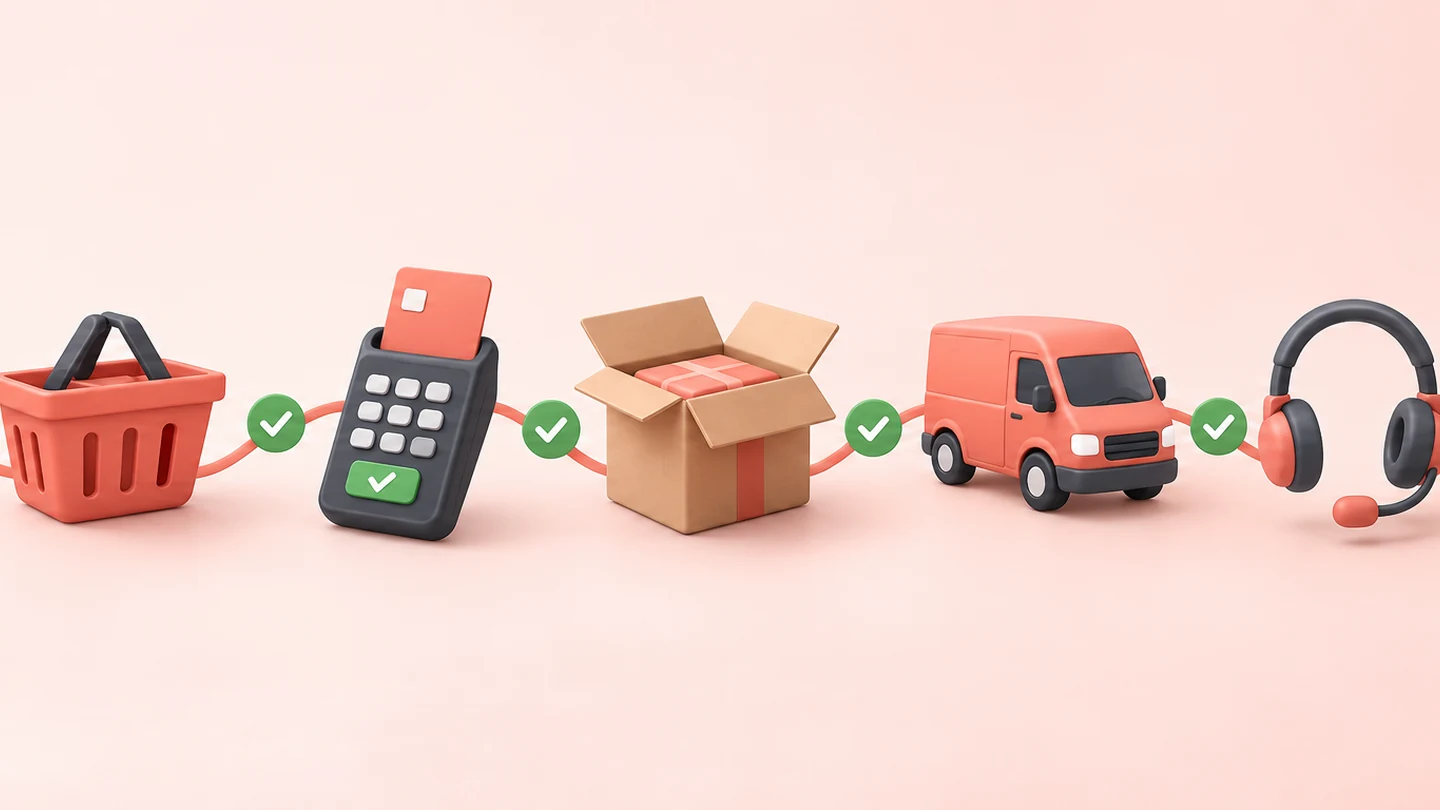
Run at least two rehearsals. The first follows the normal path from order to successful delivery. The second introduces an exception, such as a damaged parcel, missing item, late supplier update or customer return. Time each step and check that customer messages match what actually happens.
For UK distance sales, customers generally need clear pre-order information about the product, price, payment, delivery and cancellation rights. The current GOV.UK distance-selling guidance also explains post-order information and delivery expectations. Return rights vary by product and circumstance, so check the current returns and refunds guidance rather than relying on a copied policy.
A campaign calendar is useful, but it is not an operating plan. Before traffic starts, assign an owner to the store, payments, fulfilment, customer support and launch decision. Verify every tracked link and define the thresholds that would make you continue, change or pause.
| Launch control | Write before launch | Example review trigger |
|---|---|---|
| Traffic and budget | Channel, audience, spend cap and owner | Review after £150 or 300 qualified visits |
| Store | Error monitoring and responsible person | Pause if payment or checkout failures appear |
| Stock | Available units and reorder point | Stop promotion before the safe stock limit |
| Customer support | Inbox owner and response target | Add cover if open cases exceed capacity |
| Commercial result | Minimum useful conversion and margin | Change the offer if qualified traffic does not act |
Keep the first release narrow enough that the team can observe it. One audience, one main offer and one measured channel usually produce clearer learning than several promotions running at once. The purpose is not to manufacture a positive result. It is to learn whether the full system works under real conditions.
The assessment scores each of the six areas from 0 to 4. Your total places the current launch plan in one of three bands:
| Score | Result | Practical meaning |
|---|---|---|
| 18 to 24 | Ready for a controlled launch | The core systems are credible enough for a limited release. Cap traffic, watch real behaviour and keep a clear stop rule. |
| 10 to 17 | Close, with launch gaps | Several foundations are in place, but one or two weak systems could waste traffic or damage the first customer experience. |
| 0 to 9 | Pause and strengthen the plan | A wider launch would expose too many unresolved assumptions. Fix the weakest area and rehearse a small end-to-end order first. |
The total score is not a forecast. Always inspect the dimension scores. A high total can hide one serious blocker. For example, a clear offer, strong demand and a good store cannot compensate for an unsafe product or a fulfilment route that has never been tested.
Score all six areas, see your evidence map and turn the weakest system into a practical next action.
Write the release scope and guardrails before increasing traffic. State the product, audience, channel, budget cap, stock cap, support cover and review point. Watch completed purchases, failed payments, cancellations, support demand, delivery performance and margin together. Do not judge the launch from revenue alone.
Choose the weakest critical dimension. Replace one estimate with evidence, complete one user test or rehearse one exception before moving the date. Do not respond by adding more campaign content. More promotion increases the cost of an unresolved operational problem.
Reduce the release to a private test, a small paid pilot or a complete internal order. Focus on offer, economics and fulfilment before decorative work. A short delay is useful when it prevents wasted traffic, refunds or damage to customer trust.
The assessment measures operational and commercial readiness. It does not decide whether your exact product, marketing or data processing complies with the law. Before accepting orders, confirm the requirements that apply to your business, product, customer location and sales channel.
Important: government and regulatory guidance can change. Use the linked official sources for the latest position and seek qualified advice where the risk or product category requires it.
No. A controlled launch can focus on one complete flagship product or a small related range. Every item you promote must have accurate information, workable pricing, safe stock and a tested fulfilment route. Unfinished products should not compete for attention or create broken journeys.
There is no universal number. Set a limit based on stock, support capacity, budget and the amount of evidence needed for the next decision. A small qualified audience is more useful than broad traffic the team cannot interpret or serve.
No. The score describes the current evidence and operating system. It cannot predict demand, competition, costs or customer behaviour. A high result supports a limited test, not unrestricted spending.
Start with the gap most likely to harm customers or make all later evidence misleading. Product safety, payment failure and inability to fulfil usually come before campaign polish. If those are secure, clarify the offer and unit economics before paying for wider traffic.
Yes. Retake it when the offer, audience, cost structure, store or fulfilment route changes. Replace planned evidence with real conversion, support, return and delivery data. The assessment is useful as a release check, not only as a one-time pre-launch quiz.
Use the free assessment to find your strongest signal, expose the biggest gap and leave with three practical next actions.
Prefer to discuss the weak point first? Contact Make Local for Global for a practical conversation about the next step.
The Ecommerce Launch Readiness Assessment is an educational planning tool. It does not predict sales, profit or business success and does not replace legal, tax, financial or product-safety advice.
PREFERRED SOURCE
Like what you’re reading? Add Make Local for Global as a preferred source on Google to see more of our articles when you search.






















Build your online presence without having to figure out everything yourself.