

Learn the six practical systems behind a print on demand business, then use the free course app to choose one focused product test.


Print on demand is a useful way to test a product without buying a large batch in advance. It is not a shortcut around product research, customer service or cash flow, though. The best first step is a small, evidence-led learning loop.
This beginner course walks through six connected systems: choosing a focused product, understanding the buyer, checking supplier quality, pricing the complete order, creating a simple promotion test, and planning fulfilment and support. You can work through the free POD Mini Course app as you read and download a short roadmap at the end.

With print on demand, a supplier usually prints and fulfils an item after a customer places an order. That can reduce the risk of holding unsold stock, but the supplier still charges for production and delivery. Your business must also cover payment processing, platform fees, refunds, customer support, tax obligations and the time you spend improving the offer.
The model changes the timing of production. It does not remove the need to make a clear promise, deliver a good product, or handle a disappointed customer. Treat each early order as a learning opportunity with a cost, not as proof that the business is already predictable.
Answer six practical questions about your product, buyer, supplier, pricing, promotion and fulfilment. The app turns your answers into one focused next test and a downloadable roadmap.
A broad catalogue makes learning slow. Choose one product family and describe the first buyer in a sentence. For example, you might test a personalised gym tote for new members of independent fitness studios. The point is not to write a perfect persona. It is to make a testable choice about the problem, occasion or identity your product supports.
Look for evidence before investing in promotion. Read customer reviews in the category, note repeated complaints, and study the language real people use. A good first product gives you a specific reason to exist beyond “this design looks niceâ€. Keep a short evidence log with the source, date and insight so that your decisions remain traceable.
A design is only part of the offer. Explain who it is for, when they might buy it, what makes it useful or meaningful, and what they can expect after ordering. Avoid claims you cannot verify, especially around durability, sustainability or delivery speed.
Create a simple product page outline: a clear title, three benefit-led bullets, product measurements, care information, production and delivery expectations, returns information, and a way to contact you. This outline is also a useful test of whether the product idea is specific enough to explain.
Supplier listings can hide important differences in print quality, sizing, packaging and delivery. Order a sample where possible. Inspect the garment or item in good light, compare the printed result with the design file, check measurements, wash or use it as appropriate, and record the delivery time. Also test how quickly the supplier answers a sensible support question.
Write down the result of each check. If you cannot test a point, label it as an assumption rather than presenting it as a fact. This protects customers and gives you a clear list of work before a wider launch.
Start with the amount that leaves your bank account for one successful order. Add the product cost, print cost, fulfilment, packaging, delivery, payment fees, marketplace or platform fees, expected refund allowance and any customer acquisition cost. Then decide what contribution you need to pay for your time and future improvements.
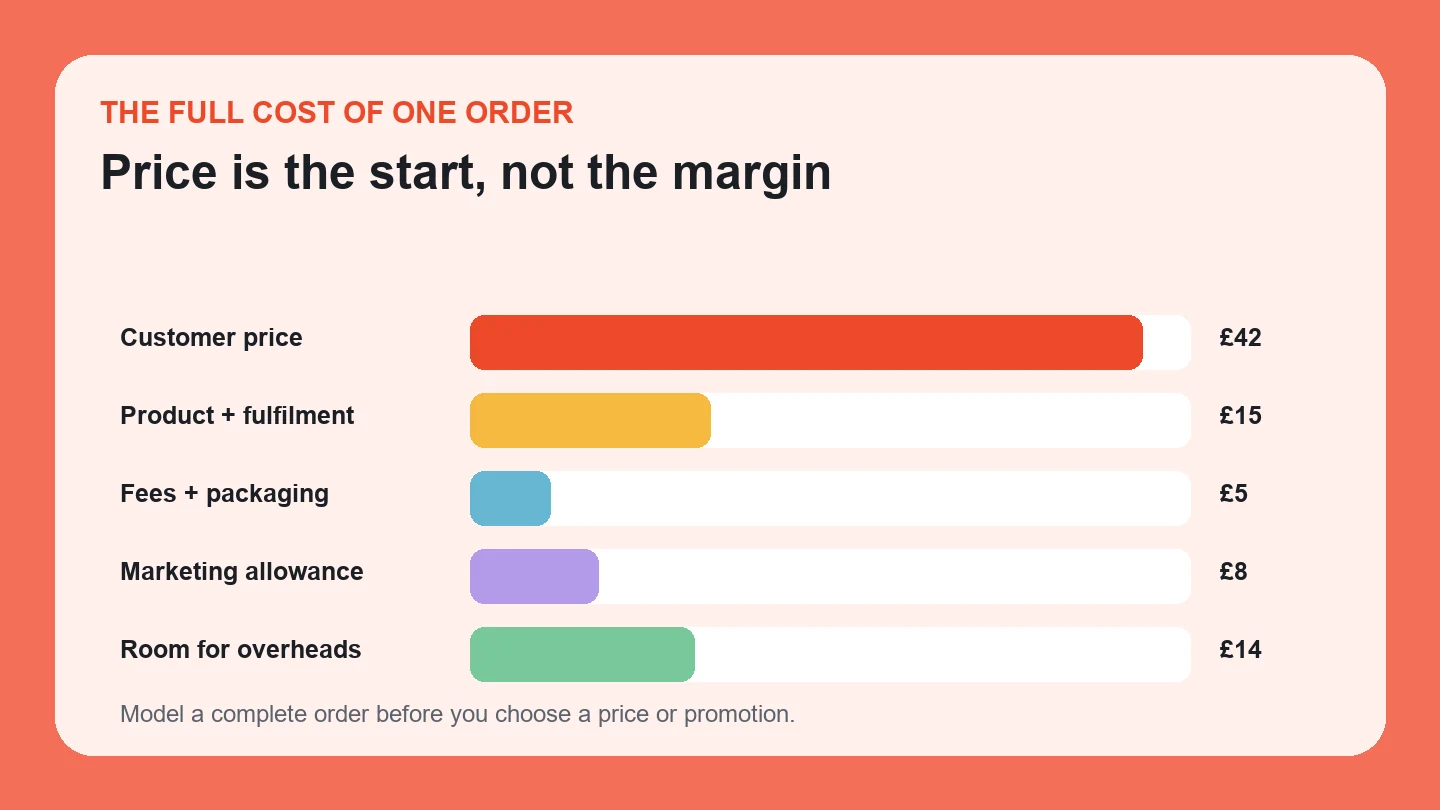
A simple formula is: selling price minus complete variable cost equals contribution per order. Test the calculation with a cautious shipping figure and a small problem allowance. If the result is negative, changing the product description will not fix the economics. Adjust the offer, cost, price or channel before spending more on traffic.
| Cost area | Question to answer | Evidence to save |
|---|---|---|
| Product and print | What does one finished item cost? | Supplier price and sample order |
| Delivery | What will the customer pay or what will you absorb? | Current delivery table |
| Fees | Which payment, platform and marketplace fees apply? | Provider fee pages and a worked order |
| Problems | What allowance covers replacements, refunds or failed prints? | A clearly stated planning assumption |
Promotion should teach you something. Pick one audience, one message and one channel for a limited test. Decide what action counts as useful evidence, such as a product-page visit, an email sign-up or a purchase. Keep the budget and test period small enough that a weak result is affordable.
Use consistent UTM links so you can distinguish the source, medium and campaign in your analytics. Record impressions, clicks, product views, enquiries, sales and refunds. Do not judge a product only by likes. A small number of qualified actions is more useful than a large amount of passive attention.
Write the customer journey from order confirmation to delivery. Include the expected production time, dispatch update, tracking message, support email and what happens if an item arrives late or damaged. Make the return and refund route easy to find. In the UK, consumer information and cancellation rights can depend on the product and the contract, so check current guidance from GOV.UK consumer protection rights and take professional advice for your situation.
If you collect names and email addresses for a roadmap, explain what you will send and how people can opt out. The ICO direct marketing guidance is a useful starting point. Keep only the information you need and document the consent route.
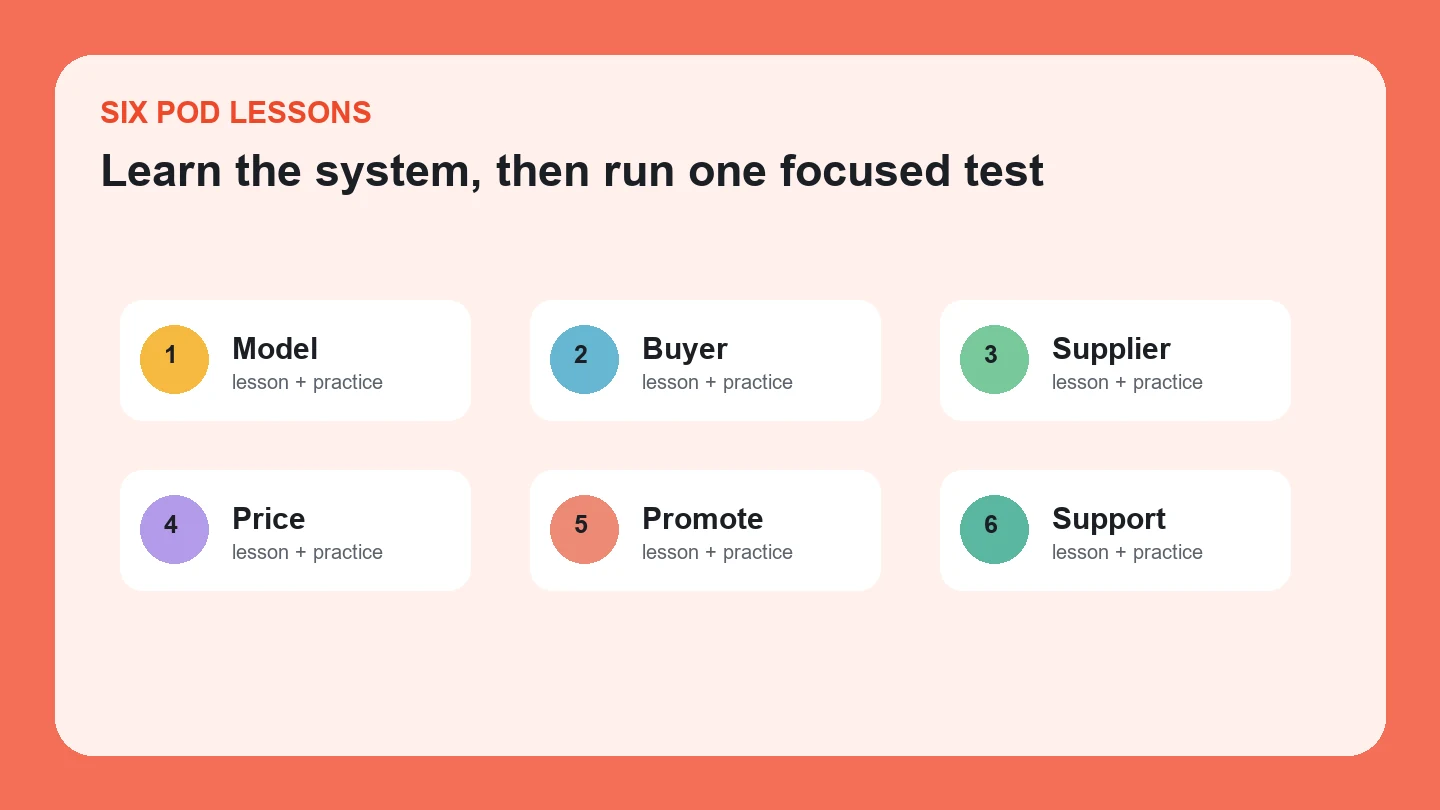
Choose the weakest lesson rather than trying to improve everything at once. If the product and buyer are unclear, interview or observe potential buyers before making more designs. If supplier quality is uncertain, order a sample. If pricing is incomplete, rebuild one full order calculation. If promotion is untested, run one controlled message experiment. If fulfilment is vague, write the support workflow and publish realistic expectations.
Set a review date and keep a decision log. At the review, compare your assumptions with evidence and choose one of three actions: continue the test, change one important variable, or stop the idea. Stopping a weak test is useful progress when it protects time and cash for a stronger one.
The POD Mini Course app gives you a short result summary and a downloadable roadmap. Use it before you add more products, run paid traffic or commit to a supplier promise.
Print on demand can be a sensible way to learn when the experiment is small, honest and measurable. Work through the six lessons, make one clear promise, and let customer evidence decide what happens next.
Open the free POD Mini Course and download your personalised course roadmap.
PREFERRED SOURCE
Like what you’re reading? Add Make Local for Global as a preferred source on Google to see more of our articles when you search.











Build your online presence without having to figure out everything yourself.