

Use a dropshipping pricing formula to cover order costs, calculate a minimum price and compare a contribution target in pounds.


Dropshipping pricing guide
A dropshipping price should cover the costs attached to an order and leave the contribution you want. This guide shows a practical minimum-price formula, a worked example in pounds and a sensitivity check. It is a planning model, not a promise of profit or a recommendation for what customers will pay.
Start with one product and current cost evidence. Then use the free Dropshipping Pricing Lab to calculate a target price and compare the contribution at prices 10% lower and higher.
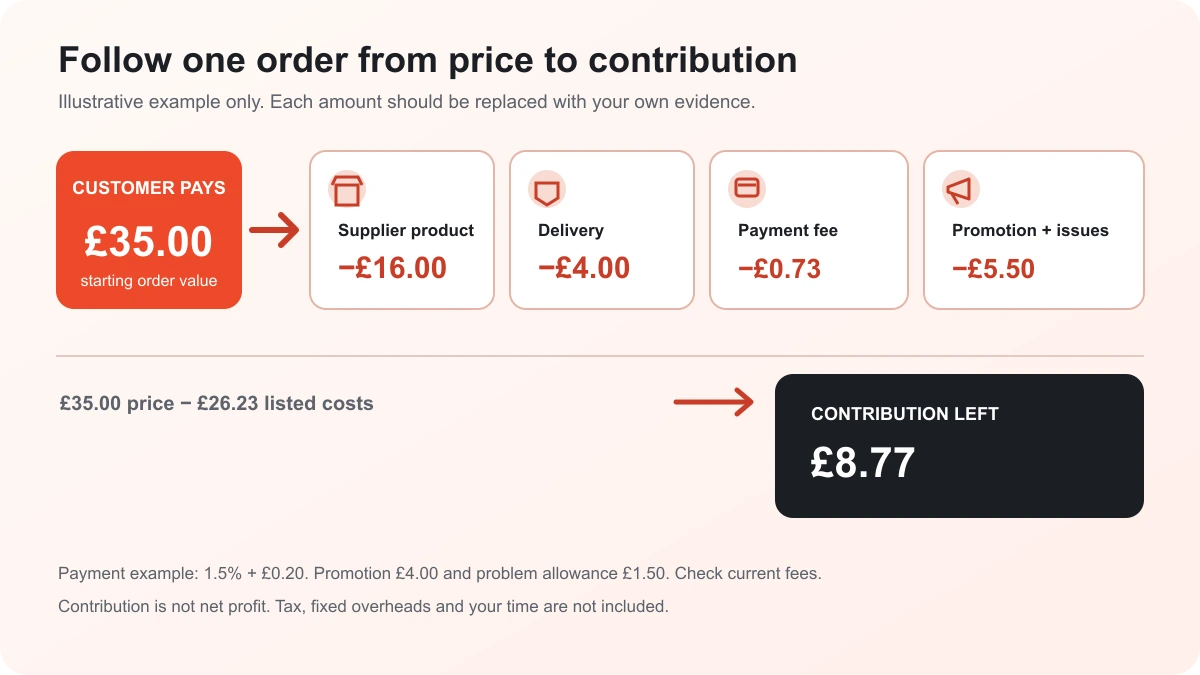
The customer price is not the same as the amount left for your business. A supplier may charge for the product and delivery. A payment provider or marketplace may charge fixed and percentage fees. Promotion, discounts, refunds and replacements can also affect the amount left on each order.
List one cost per order, not only the costs shown in a supplier listing. Include delivery or handling that you pay, the fee for taking payment, any platform fee, an evidence-based promotion allowance and a sensible average allowance for customer problems. If you collect a delivery charge from the customer, include it in the total customer payment used as the selling price, then include the supplier delivery cost separately.
Keep cost evidence dated. Supplier quotes, delivery schedules and payment rates can change. Record whether an amount is a quote, an estimate or an actual cost so you know which inputs need another check.
Enter a customer price, supplier costs, fees and a contribution target. The free app compares the current model with prices 10% lower and higher.
When percentage fees are charged on the customer price, simply adding fixed costs and a target contribution is not enough. The fee also rises when the price rises. A useful first calculation is:
Minimum price = (supplier cost + delivery cost + fixed fees + promotion allowance + problem allowance + contribution target) ÷ (1 − payment fee rate − platform fee rate)
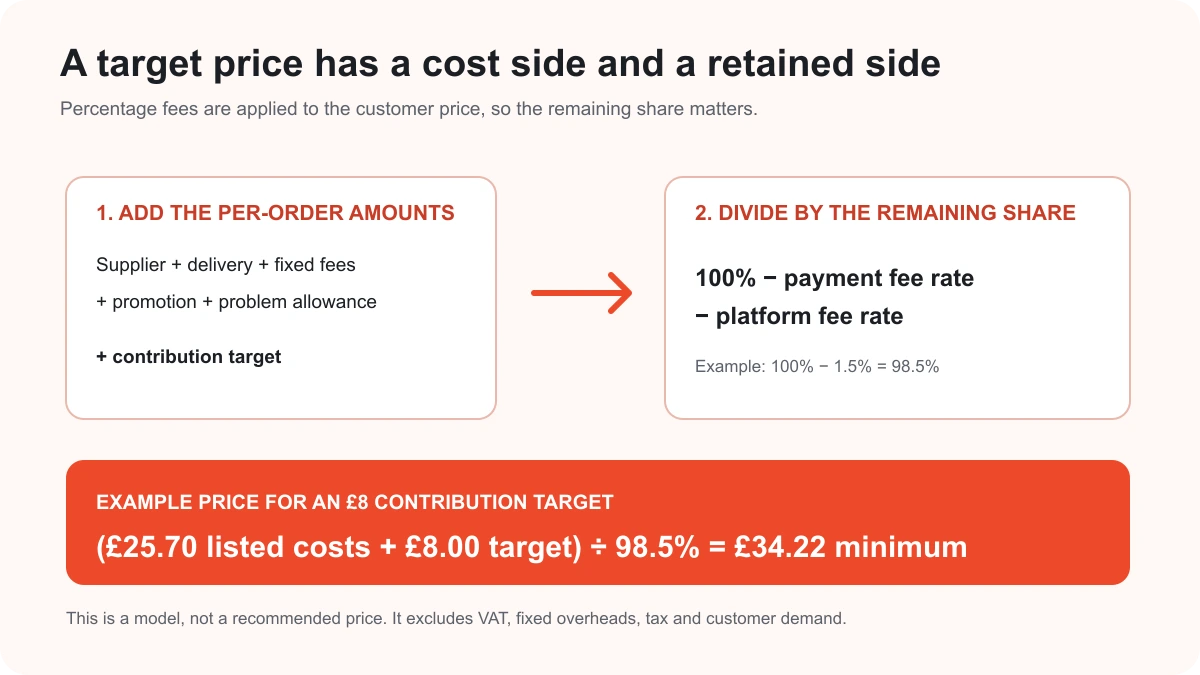
In the formula, convert fee percentages to decimals. For example, 1.5% becomes 0.015, so the remaining share is 1 − 0.015 = 0.985, or 98.5%. Include percentage platform fees in the same way. The formula only works when the combined percentage rates are below 100%.
Payment providers may round each fee per transaction and may apply special rates to some payment methods or cards. That means the formula gives a starting estimate. The calculator rounds the percentage fee lines to pennies and checks that the minimum price actually reaches the target under its model. Your provider’s bill may use different rules, so compare the result with the provider’s current terms.
Suppose a sample order has £16.00 for the supplier product, £4.00 delivery, a £0.20 fixed payment fee, £4.00 promotion allowance and £1.50 allowance for refunds or replacements. The payment rate in this illustration is 1.5%, with no platform fee. To target £8.00 contribution, add the fixed amounts:
| Input | Illustrative amount | Evidence to check |
|---|---|---|
| Supplier product | £16.00 | Current product quote |
| Supplier delivery and handling | £4.00 | Destination and shipping method |
| Fixed payment fee | £0.20 | Current payment-provider price |
| Promotion allowance | £4.00 | Actual cost per completed order |
| Refund or replacement allowance | £1.50 | Your own order and support records |
| Contribution target | £8.00 | Your planning objective, not a forecast |
The fixed amounts total £33.70. Divide by the remaining 98.5% share: £33.70 ÷ 0.985 = about £34.21. Because percentage fees are rounded to a penny in the app, its exact minimum price is £34.22, which reaches at least the £8.00 target in this example.
This is not a recommended retail price. It only answers, “What price meets this contribution target using these inputs?” It does not answer whether a buyer wants the product, whether the price fits the market or whether the business covers all its other obligations.
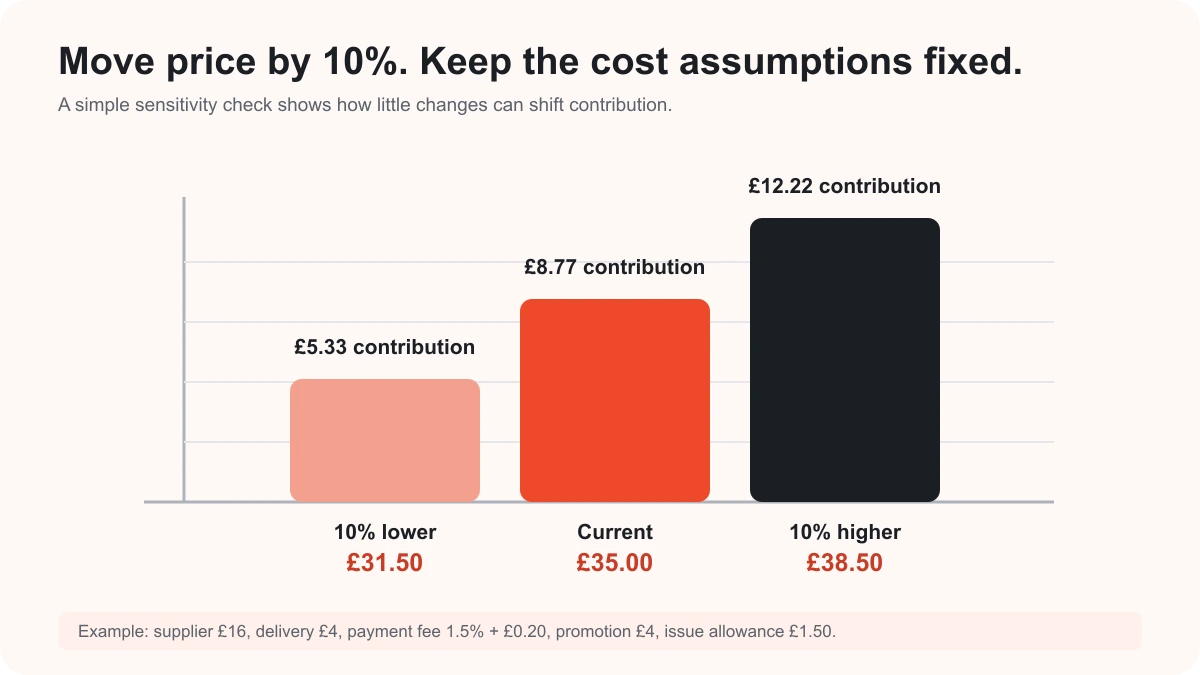
With the same example costs, the Dropshipping Pricing Lab estimates £5.33 contribution at £31.50, £8.77 at £35.00 and £12.22 at £38.50. The comparison isolates price while keeping the inputs constant. In real trading, a higher price may change conversion, buyer expectations or the cost of promotion. A lower price may increase order volume but leave less per order. The app does not predict any of those responses.
Use a small, measurable test to learn how buyers respond. Choose one product, a buyer group and one price. Set a spending limit and review date before running a promotion. Record the number of relevant visits, enquiries, completed orders, refunds and support issues. Do not treat clicks or likes alone as proof that the economics work.
Try your current assumptions, see the minimum price and download a three-page worksheet after entering your details.
The calculator is not a VAT or tax calculator. It uses the customer selling price you enter and does not calculate VAT, income tax, fixed overheads or your time. If you are VAT registered, confirm how VAT affects the amount you retain and your pricing. Check current GOV.UK VAT guidance or speak with a qualified adviser about your circumstances.
For online sales, customers should be able to understand the total price and relevant delivery information before ordering. Review the current GOV.UK distance-selling guidance and make sure your product page and checkout show accurate information. Legal obligations vary with the product and sale, so get advice if you are unsure.
Pricing improves as your evidence improves. Update the model when quotes, provider fees or customer outcomes change. A clear calculation makes assumptions visible, but only careful tests can help you learn whether the offer works for the people you want to serve.
Compare the current order with a target price, check a 10% sensitivity range and download your pricing worksheet in the free app.
PREFERRED SOURCE
Like what you’re reading? Add Make Local for Global as a preferred source on Google to see more of our articles when you search.
























Build your online presence without having to figure out everything yourself.