

Build a practical ecommerce content plan from customer questions, reliable product information and a publishing rhythm your team can sustain.

Ecommerce content planning works best when it starts with a buyer’s real question, not a calendar full of topics chosen to fill space. A clear plan connects the question to accurate product information, a useful answer, a format customers can use and a review date.
This guide walks through a practical process for a small ecommerce team. It is designed to help you make a useful first plan, not promise rankings, traffic or sales. You can also work through the free Content Planning Mini Course and save your answers as a personalised plan.
Use six short lessons to choose a clear goal, check product facts, select a useful format and set a publishing rhythm your team can maintain.
A plan is a working decision record. It should make it easier to answer four questions: who is the content for, what are they trying to understand, what reliable information can you provide, and who will keep the answer useful? If a calendar only lists dates and formats, it may organise publishing without helping customers.
For a small shop, a useful first plan can be a single page. Pick one product or product group and one buyer need. A homeware shop might help customers decide whether a storage unit fits a narrow hallway. A clothing business might explain how to compare garment measurements. The scope should be narrow enough to check properly.
Collect questions from sources close to the customer: support conversations, product reviews, sales enquiries, on-site search or questions your team hears repeatedly. Search Console can show queries that already lead people to your pages. Record the question in the customer’s language, where it came from and when you observed it. Remove personal information from working notes.
Search trends and keyword tools can help you explore wording, but they are signals rather than proof that a specific audience will buy. Google Trends, for example, normalises results relative to the selected place and time; a low-volume term can appear as zero. Treat such tools as prompts for investigation, then compare them with your own customer evidence and product context.
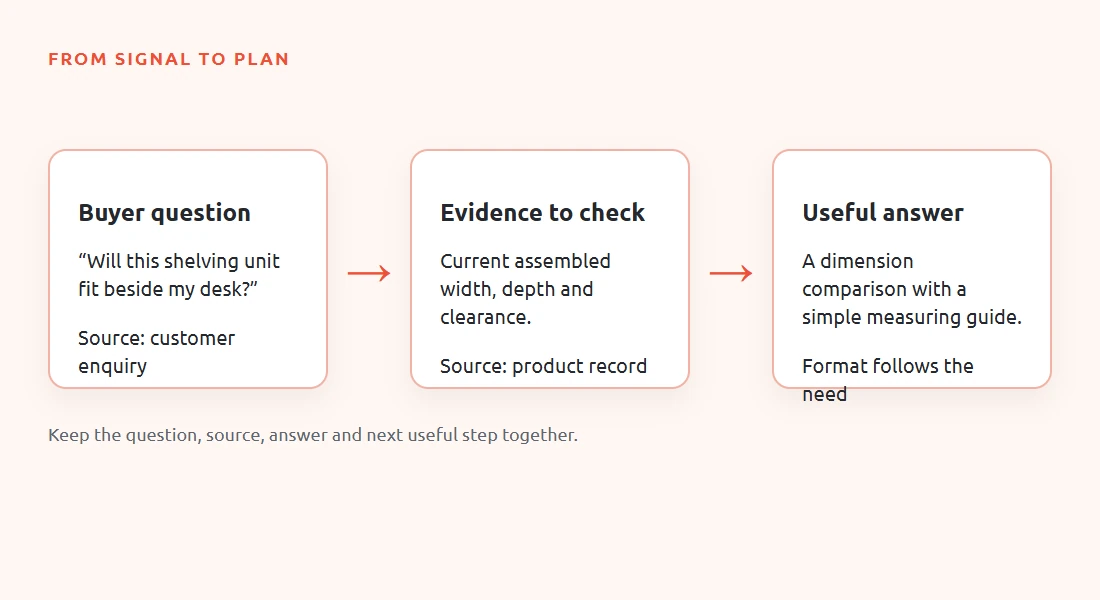
Turn the question into a clear job statement: “Help [buyer] decide [what], using [information], so they can [next step].” This keeps a piece focused. If the question is “Will this shelving fit beside my desk?”, the answer may need assembled width, depth, clearance and a simple measurement guide, rather than a broad article about home organisation.
Format should follow the buyer’s task. A short FAQ may answer one recurring question. A comparison table can make dimensions easier to scan. A labelled photograph may explain a feature, while a short demonstration can show how an item is assembled or used. Do not choose video, a long guide or a social post simply because it is fashionable.
Before drafting, list the information a customer must see to use the answer. For a fit question, that may include current product measurements, how they were taken, the space to measure at home and any limits to the example. If the necessary information is missing, make checking it part of the plan rather than filling the gap with an assumption.
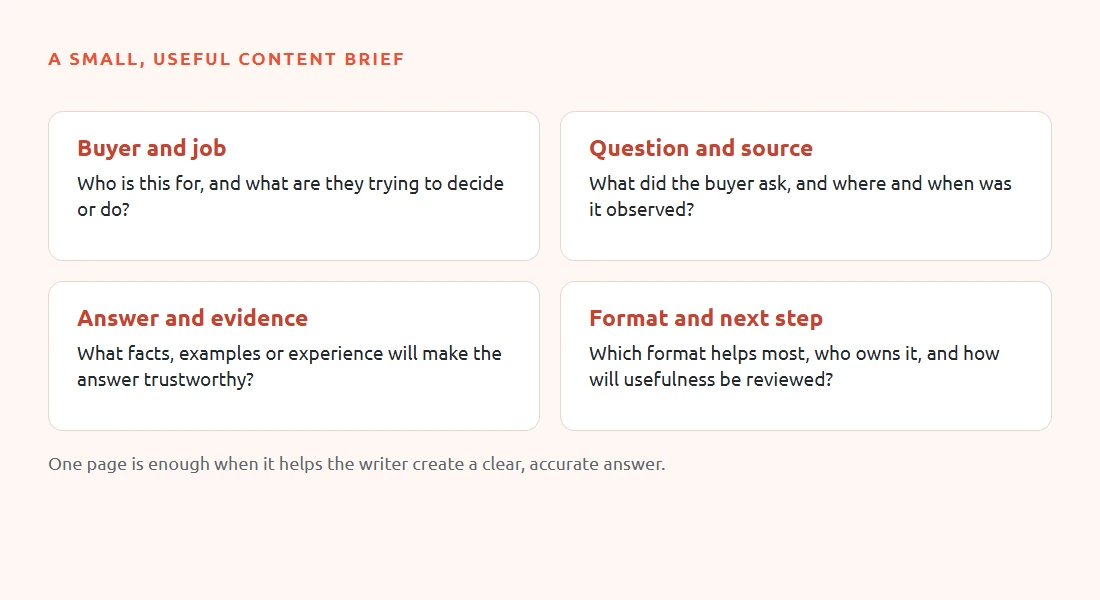
A short brief keeps the work tied to customer value. Record the audience, question and evidence source; the answer and product facts to verify; the format; a useful next step; an owner; and a review date. A brief does not need to prescribe every sentence. It should help the writer deliver a clear answer without losing the reason the content exists.
Check product details against current records before publication. Depending on the item, that might include dimensions, materials, compatibility, what is included, care instructions, delivery terms or availability. Note the source and date. Supplier pages can change, so assign someone to recheck details that customers rely on.
Keep facts, personal experience and assumptions distinct. If you have tried a product, describe what you actually observed and the conditions. Do not imply that one example guarantees the same outcome for every buyer. If a detail remains unverified, omit it or label the uncertainty and resolve it before making a firm claim.
Choose a schedule that fits available time and the effort needed to check the information. One dependable product guide each month may be more valuable than weekly posts that become inaccurate or unfinished. For every item, name an owner, a realistic due date and the person responsible for checking the facts.
Group related work when it reduces repetition: one verified measurement record might support a product page, comparison table and customer-service answer. Still make each version useful in its own place. Reusing a fact is sensible; copying the same vague paragraph across channels is unlikely to help a customer with a specific task.
The free course helps you work through the buyer question, supporting facts, format and review routine, then download your three-page content plan.
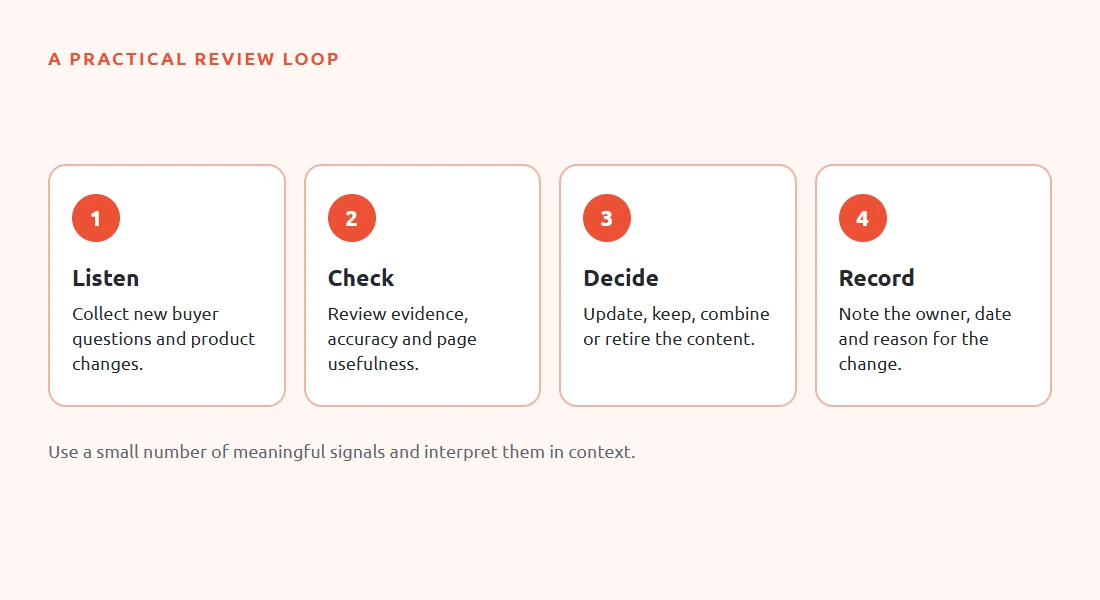
Set a review date when the content is created, especially if product specifications, suppliers or policies can change. Decide what evidence will prompt an update: a changed product record, repeated customer confusion, a new question, an outdated image or analytics that suggest visitors are not finding the information they need.
Interpret performance carefully. A change in visits does not, by itself, explain why behaviour changed or whether the content helped a customer. Combine quantitative signals with the page’s purpose and qualitative evidence. Then decide whether to update, keep, combine or retire the item and record why.
| Planning check | What to record |
|---|---|
| Buyer and task | One audience and the decision or task the content supports |
| Question and evidence | The customer question, source and date observed |
| Product facts | Current source, owner and details that need rechecking |
| Answer format | The simplest format that makes the answer easier to use |
| Publishing and review | Owner, realistic due date, review date and useful signal |
Start with one small item and improve the process as you learn. A plan should help your team answer real questions accurately and maintain the answer over time. For guidance on making useful, people-first material, also read Google’s helpful content guidance; it is a quality principle, not a shortcut or ranking guarantee.
Work through the six-step course and save a personalised plan for the customer question you want to answer next.
PREFERRED SOURCE
Like what you’re reading? Add Make Local for Global as a preferred source on Google to see more of our articles when you search.













Build your online presence without having to figure out everything yourself.